| REPORT ATTRIBUTE | DETAILS |
|---|---|
| Historical Period | 2020-2023 |
| Base Year | 2024 |
| Forecast Period | 2025-2032 |
| Industrial Mixers Market Size 2024 | USD 4,148.2 million |
| Industrial Mixers Market, CAGR | 5.66% |
| Industrial Mixers Market Size 2032 | USD 6,435.1 million |
Market Overview:
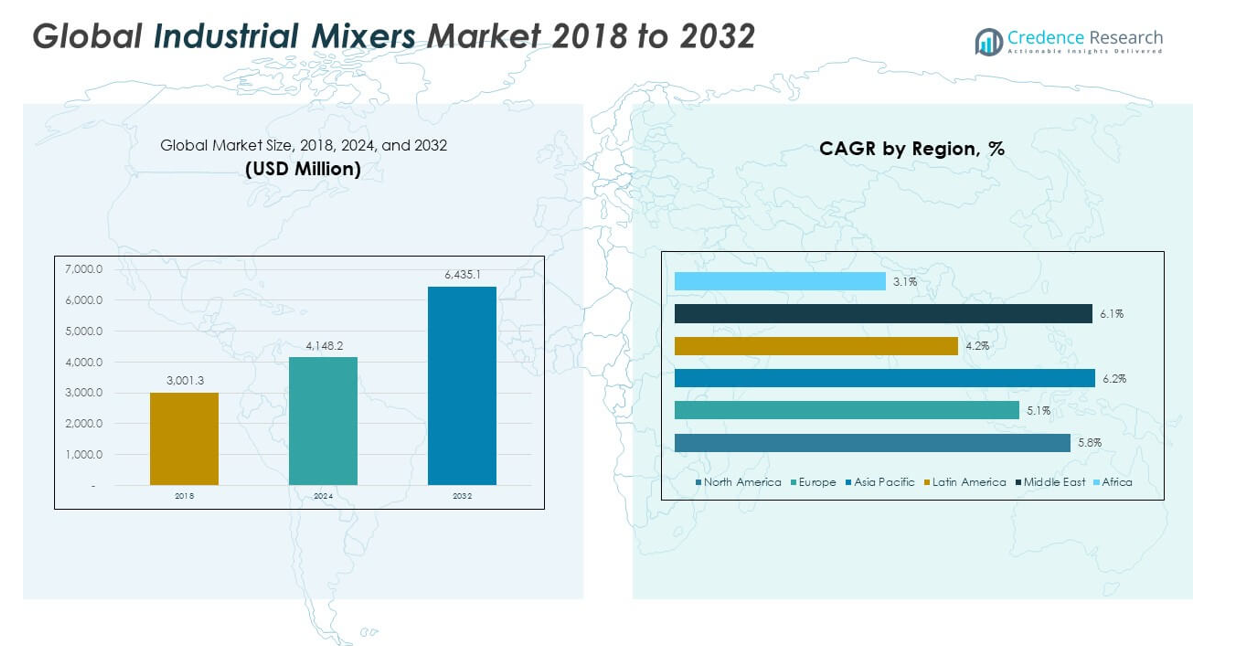
The Industrial Mixers Market size was valued at USD 3,001.3 million in 2018 to USD 4,148.2 million in 2024 and is anticipated to reach USD 6,435.1 million by 2032, at a CAGR of 5.66% during the forecast period.
The industrial mixers market is expanding due to strong growth in industries such as chemicals, pharmaceuticals, food and beverages, and water treatment. Rising demand for processed foods and pharmaceutical products is accelerating the adoption of advanced mixing systems that ensure consistency, hygiene, and efficiency. Regulatory pressure for wastewater treatment and environmental compliance is also pushing industries to upgrade their mixing technologies. Furthermore, the shift toward continuous processing and automation, along with the integration of Industry 4.0 technologies like real-time monitoring and predictive maintenance, is boosting mixer efficiency and productivity. Energy-efficient and sustainable mixing solutions are gaining traction, especially in biofuel and specialty chemical applications. Technological advancements such as high-shear, static, and vacuum mixers with smart control features are further fueling market adoption.
North America leads the industrial mixers market due to its advanced manufacturing infrastructure and strong demand from the food, pharmaceutical, and chemical sectors. The U.S. continues to dominate with widespread adoption of automated and compliant processing systems. Europe holds a significant share, driven by countries like Germany and France, where stringent quality standards and industrial automation are well established. The Asia-Pacific region is the fastest growing, with China and India spearheading demand due to rapid industrialization, expanding pharmaceutical production, and chemical processing growth. Southeast Asia is also contributing to regional momentum. Latin America and the Middle East & Africa are emerging markets showing gradual adoption of industrial mixers, particularly in water treatment and manufacturing. Although their current market share is smaller, improving industrial infrastructure and increasing regulatory compliance are expected to drive future demand, making them key regions for long-term growth opportunities.

Market Insights:
- The Industrial Mixers Market is projected to grow from USD 4,148.2 million in 2024 to USD 6,435.1 million by 2032, expanding at a CAGR of 5.66%.
- Rising demand from food, pharmaceutical, and chemical sectors is driving the need for precise, hygienic, and high-capacity mixing solutions.
- Automation and continuous processing trends are pushing adoption of mixers with smart controls, real-time monitoring, and predictive maintenance capabilities.
- Environmental regulations are prompting industries to replace legacy equipment with energy-efficient mixers to reduce power consumption and emissions.
- High initial investment and maintenance costs pose adoption challenges for SMEs, particularly in budget-constrained regions.
- Increasing complexity in customization and regulatory compliance often delays procurement and slows integration of new mixer systems.
- Asia Pacific is the fastest-growing region due to industrial expansion in China and India, while North America maintains leadership through technological advancement and infrastructure maturity.
Market Drivers:
Rising Demand from Food, Pharmaceutical, and Chemical Industries Enhances Equipment Adoption
The Industrial Mixers Market benefits from consistent growth in core sectors such as food and beverages, pharmaceuticals, and chemicals. These industries rely on precise and efficient mixing to maintain product uniformity, meet safety standards, and support high-volume production. Rising consumption of processed foods, personal care products, and generic drugs continues to strengthen demand for specialized mixing equipment. Manufacturers are focusing on quality control and compliance, which requires mixers capable of handling diverse materials with varying viscosity and sensitivity. The push toward cleaner formulations and allergen-free products further increases the need for hygienic mixing systems. It provides manufacturers with advanced tools that improve operational accuracy and product quality.
- For example, Charles Ross & Son Company’s Ribbon Blenders are engineered for efficient mixing of powders, granules, and bulk solids, supporting batch sizes from a few liters up to 20,000 liters, and are widely used in food and pharmaceutical processing for their hygienic, clean-in-place (CIP) capabilities.
Industrial Automation and Process Optimization Drive Mixer Modernization
The shift toward automation and continuous manufacturing is transforming how industries integrate mixers into production lines. Companies are prioritizing equipment that supports real-time monitoring, remote control, and predictive maintenance. These technologies enhance process reliability while reducing human error and unplanned downtime. High-shear and vacuum mixers, equipped with smart sensors and control systems, are now standard in modern facilities. The Industrial Mixers Market is seeing strong interest in systems that allow faster batch turnover and reduced cleaning time. It aligns well with lean manufacturing strategies and the broader movement toward Industry 4.0.
Environmental Regulations Promote Demand for Energy-Efficient Mixing Solutions
Governments and regulatory bodies are enforcing stricter environmental standards, particularly in wastewater treatment and chemical processing. Industries must invest in mixers that reduce energy usage, minimize waste, and operate within tighter emission guidelines. This shift is pushing companies to replace legacy systems with energy-efficient static and inline mixers. The Industrial Mixers Market is increasingly influenced by sustainability metrics such as power consumption and material compatibility. It supports long-term compliance with environmental policies while reducing operational costs. Equipment manufacturers are responding by introducing mixers designed to lower energy demand without compromising performance.
Growth in Emerging Applications Expands Market Scope
New applications in bioprocessing, nutraceuticals, cosmetics, and specialty chemicals are broadening the scope of the Industrial Mixers Market. These sectors require customized mixing technologies that ensure homogeneity, product stability, and contamination control. High-growth industries, especially in the Asia-Pacific region, are investing in equipment that meets stringent production standards and accommodates rapid scaling. Demand for versatile mixers that support multi-step processes is rising in R&D and pilot-scale operations. It is encouraging innovation in mixer design, material selection, and process integration. The market continues to evolve in response to niche requirements and specialized applications across emerging verticals.
- For example, Ystral’s PiloTec system, designed for laboratory and pilot-scale production, enables dust- and loss-free powder induction, vacuum wetting, and multi-stage shear ring dispersing, supporting reliable scale-up from R&D to full production.
Market Trends:
Integration of Smart Technologies Is Shaping Next-Generation Mixing Systems
Automation and digitalization are key trends reshaping equipment design and operation across industries. Manufacturers are adopting mixers with integrated sensors, PLC controls, and data analytics to monitor viscosity, temperature, and motor load in real time. These systems enhance process accuracy, enable predictive maintenance, and improve product consistency. Smart mixers support better resource utilization and reduce downtime, which drives operational efficiency. The Industrial Mixers Market is embracing Industry 4.0 standards to meet the growing demand for flexible and intelligent processing. It is becoming a central component in modern production environments that prioritize reliability and transparency.
- For example, Datum Electronics’ Rotary Power System provides real-time, direct shaft power measurement with an accuracy of 0.1% and repeatability of 0.04%. This system interfaces seamlessly with PLC, PC, and SCADA-based control or data acquisition systems, enabling precise monitoring of viscosity, motor load, and process energy input.
High-Shear and Vacuum Mixers Are Gaining Popularity in Precision Manufacturing Precision-driven industries such as pharmaceuticals, cosmetics, and specialty chemicals require mixers that deliver uniform results and handle complex formulations. High-shear and vacuum mixers are increasingly preferred for their ability to disperse solids, emulsify liquids, and eliminate air pockets during mixing. These systems help achieve tighter tolerances and higher product quality in controlled environments. Customization features, such as variable speed drives and pressure-rated vessels, are becoming standard. The Industrial Mixers Market is responding to this shift by expanding product lines tailored to specific application requirements. It supports the movement toward high-performance manufacturing across regulated and innovation-intensive sectors.
Sustainability Goals Are Influencing Mixer Design and Material Selection
Sustainability is a growing concern for both manufacturers and consumers, prompting changes in equipment specifications and lifecycle strategies. Companies are seeking mixers that consume less energy, support clean-in-place operations, and comply with environmental regulations. Stainless steel and corrosion-resistant materials are preferred to extend equipment lifespan and reduce maintenance needs. The Industrial Mixers Market is evolving to meet green manufacturing objectives without sacrificing operational capabilities. It reflects the broader industry focus on reducing carbon footprint and achieving long-term cost savings. Equipment providers are investing in R&D to design mixers that align with circular economy principles.
Globalization of Manufacturing Is Driving Demand for Modular and Scalable Mixers
Expanding global operations is pushing manufacturers to seek modular and scalable mixing systems that adapt to various production capacities. Multinational companies prefer standardized mixers that ensure consistent output across facilities in different regions. Equipment that supports quick installation, flexible integration, and simplified maintenance is becoming more attractive. The Industrial Mixers Market is seeing increased demand for systems that offer plug-and-play functionality and compatibility with diverse product lines. It enables manufacturers to maintain agility while scaling operations to meet fluctuating market needs. Standardization and modularity are emerging as essential features in the procurement of industrial mixing equipment.
- The ROSS PowerMix, for example, is available in scalable designs up to 500 gallons, supporting both pilot and full-scale production without compromising batch quality or process control.
Market Challenges Analysis:
High Capital Investment and Maintenance Costs Limit Adoption Across Small Enterprises
Industrial mixers often require significant upfront capital investment, which poses a barrier for small and medium-sized enterprises (SMEs). The cost of advanced systems with automation, high-shear capability, and specialized materials adds pressure to limited budgets. Installation expenses, customization requirements, and the need for trained personnel increase the overall financial burden. For industries operating on thin margins, this deters adoption or delays equipment upgrades. The Industrial Mixers Market faces challenges in penetrating cost-sensitive regions where budget constraints outweigh operational efficiency gains. It must address pricing flexibility and offer scalable solutions to expand its reach among smaller manufacturers.
Complexity in Customization and Regulatory Compliance Slows Procurement Decisions
Industrial mixing applications often require tailored configurations based on material type, process conditions, and end-use requirements. Customization increases engineering complexity, lead times, and coordination between equipment suppliers and end users. Compliance with industry-specific regulations, such as FDA, GMP, or ATEX standards, further adds to the design and validation workload. This slows procurement cycles and impacts time-to-market for new production lines. The Industrial Mixers Market must balance the need for flexibility with the demand for faster deployment and standardized systems. It faces ongoing pressure to reduce complexity while ensuring performance and regulatory alignment across diverse applications.

Market Opportunities:
Rising Demand from Emerging Economies Creates New Growth Channels
Rapid industrialization across emerging economies is opening new opportunities for mixer manufacturers. Countries in Asia-Pacific, Latin America, and the Middle East are expanding their food processing, pharmaceutical, and chemical sectors. This growth creates consistent demand for reliable, high-performance mixing equipment. Governments are investing in manufacturing infrastructure, which supports wider adoption of automated systems. The Industrial Mixers Market stands to benefit from this expansion by offering cost-effective and scalable solutions tailored to regional needs. It can gain a competitive edge by partnering with local distributors and service providers to strengthen market presence.
Innovation in Sustainable and Modular Mixer Design Supports Market Expansion
Shifts toward sustainable manufacturing practices are increasing demand for energy-efficient and eco-friendly mixers. Companies are looking for modular systems that reduce downtime, simplify integration, and support clean-in-place functions. These features improve operational efficiency and align with environmental targets. The Industrial Mixers Market can capture new business by developing compact, versatile mixers that meet evolving regulatory and performance standards. It can also leverage digital technologies to offer advanced control systems and remote support services. Product innovation that aligns with customer priorities will enhance market competitiveness and long-term growth potential.
Market Segmentation Analysis:
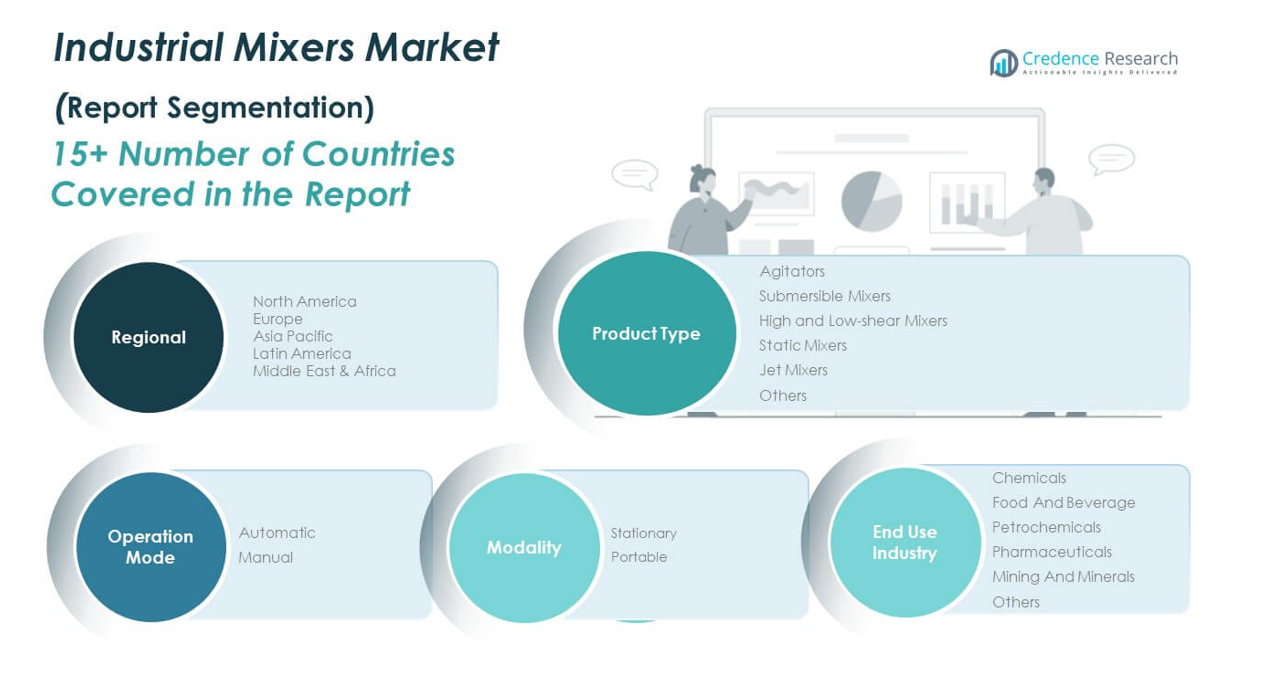
The Industrial Mixers Market is segmented by product type, modularity, operation mode, and end user industry.
By product types, agitators and high and low-shear mixers account for a significant market share due to their widespread application in chemical and pharmaceutical processing. Submersible mixers are gaining traction in wastewater and sludge treatment, while static and jet mixers offer efficient blending solutions for continuous operations. The demand for versatile and specialized systems is also creating space for niche products under the "others" category.
- For instance, the Silverson L5M-A Laboratory Mixer, a high-shear model, achieves tip speeds up to 8,000 m/min and is validated by pharmaceutical companies for emulsification and particle size reduction.
By modularity, stationary mixers dominate due to their integration in large-scale production facilities. Portable mixers are growing steadily, driven by their flexibility and ease of use in small-batch applications and field operations.
- For example, Dynamix’s portable mixers, such as the GMX Series, are engineered for tank sizes from 50 to 5,000 gallons, featuring quick-clamp mounting and variable speed drives, making them popular for on-site and small-batch operations.
By operation mode, automatic mixers lead the segment due to increased adoption of smart manufacturing and real-time process control. Manual mixers remain relevant in low-capacity operations and cost-sensitive industries.
By end user industry, the food and beverage, chemicals, and pharmaceuticals sectors represent the largest consumers. These industries demand high precision, hygiene, and compliance with regulatory standards. Petrochemicals and mining also contribute significantly to the Industrial Mixers Market, requiring heavy-duty, durable equipment. It continues to evolve across all segments, responding to operational needs, industry regulations, and technological advancements.
Segmentation:
By Product Type:
- Agitators
- Submersible Mixers
- High and Low-shear Mixers
- Static Mixers
- Jet Mixers
- Others
By Modularity:
- Stationary
- Portable
By Operation Mode:
- Automatic
- Manual
By End User Industry:
- Chemicals
- Food and Beverage
- Petrochemicals
- Pharmaceuticals
- Mining and Minerals
- Others
By Region:
- North America
- U.S.
- Canada
- Mexico
- Europe
- Germany
- France
- U.K.
- Italy
- Spain
- Rest of Europe
- Asia Pacific
- China
- Japan
- India
- South Korea
- South-east Asia
- Rest of Asia Pacific
- Latin America
- Brazil
- Argentina
- Rest of Latin America
- Middle East & Africa
- GCC Countries
- South Africa
- Rest of the Middle East and Africa
Regional Analysis:
North America
The North America Industrial Mixers Market size was valued at USD 823.85 million in 2018 to USD 1,149.18 million in 2024 and is anticipated to reach USD 1,804.40 million by 2032, at a CAGR of 5.8% during the forecast period. North America holds the largest share of the global market, accounting for 25.5% in 2024. The region benefits from a strong industrial base, advanced manufacturing infrastructure, and strict quality regulations, particularly in the pharmaceutical and food processing sectors. The U.S. leads demand, driven by early adoption of automation, regulatory compliance requirements, and high investment in R&D. Demand for mixers with enhanced clean-in-place functionality and process flexibility is rising, especially in biotech and specialty chemical production. The Industrial Mixers Market in North America continues to evolve with the integration of smart technologies and data-driven systems. It remains a mature but innovation-focused region, with strong replacement demand for legacy systems.
Europe
The Europe Industrial Mixers Market size was valued at USD 717.01 million in 2018 to USD 959.19 million in 2024 and is anticipated to reach USD 1,422.15 million by 2032, at a CAGR of 5.1% during the forecast period. Europe accounted for 21.3% of the global market in 2024, led by Germany, France, and the UK. The region’s focus on sustainable manufacturing, stringent environmental policies, and advanced process controls support steady mixer adoption. High precision requirements in pharmaceutical, food, and cosmetic manufacturing drive demand for customized mixing systems. European manufacturers prioritize energy efficiency, hygiene, and automation, increasing the use of vacuum and high-shear mixers. The Industrial Mixers Market benefits from the EU’s regulatory environment, which favors equipment upgrades and process standardization. It continues to be shaped by innovation in design and adherence to evolving industry norms.
Asia Pacific
The Asia Pacific Industrial Mixers Market size was valued at USD 1,017.43 million in 2018 to USD 1,450.70 million in 2024 and is anticipated to reach USD 2,342.37 million by 2032, at a CAGR of 6.2% during the forecast period. Asia Pacific holds the largest regional share, accounting for 32.2% of the global market in 2024. Rapid industrialization in China, India, and Southeast Asia fuels strong growth across sectors including pharmaceuticals, chemicals, and food processing. Rising investments in manufacturing infrastructure and increasing foreign direct investment boost equipment demand. The Industrial Mixers Market in Asia Pacific benefits from growing local production, urbanization, and demand for automation. It presents strong opportunities for cost-effective and modular systems suited to high-volume operations. Local and global suppliers are expanding their presence to capitalize on regional demand.
Latin America
The Latin America Industrial Mixers Market size was valued at USD 173.47 million in 2018 to USD 221.99 million in 2024 and is anticipated to reach USD 307.60 million by 2032, at a CAGR of 4.2% during the forecast period. Latin America represents 4.9% of the global market in 2024, with Brazil and Mexico leading demand. Growth is supported by food processing, chemical manufacturing, and improving healthcare infrastructure. Infrastructure challenges and limited automation adoption slow wider uptake of advanced mixers. However, increasing industrial investments and regulatory improvements are expanding market potential. The Industrial Mixers Market in Latin America is gradually shifting from basic systems to more efficient and hygienic technologies. It presents moderate growth prospects, especially for affordable and durable mixing solutions.
Middle East
The Middle East Industrial Mixers Market size was valued at USD 189.98 million in 2018 to USD 270.05 million in 2024 and is anticipated to reach USD 434.37 million by 2032, at a CAGR of 6.1% during the forecast period. The Middle East contributes 6% of the global market in 2024, driven by industrial diversification in the UAE, Saudi Arabia, and Qatar. Expanding chemical, pharmaceutical, and water treatment sectors create demand for specialized mixing systems. Governments are investing in non-oil manufacturing to support economic growth, which increases demand for industrial equipment. The Industrial Mixers Market is gaining momentum through public-private partnerships and adoption of modern process technologies. It remains a growing but niche region for mixer manufacturers. Suppliers offering localized support and energy-efficient systems are better positioned for long-term success.
Africa
The Africa Industrial Mixers Market size was valued at USD 79.53 million in 2018 to USD 97.13 million in 2024 and is anticipated to reach USD 124.20 million by 2032, at a CAGR of 3.1% during the forecast period. Africa holds the smallest share of the global market, contributing 2.2% in 2024. Industrial development is still emerging, with opportunities concentrated in South Africa, Nigeria, and Egypt. Demand stems from food and beverage, water treatment, and basic chemical processing applications. Infrastructure gaps and limited capital availability slow adoption of high-end mixers. However, government initiatives focused on industrial growth and import substitution are gradually improving equipment demand. The Industrial Mixers Market in Africa is at a nascent stage, offering long-term potential for low-cost, rugged, and easy-to-maintain mixing systems. It presents entry points for suppliers willing to build capacity and local presence.
Key Player Analysis:
- Xylem Inc.
- The Bühler Holding AG
- Sulzer Ltd.
- SPX FLOW Inc.
- Landia Inc.
- Alfa Laval AB
- Komax Systems Inc.
- GEA Group AG
- Charles Ross & Son Company
- Amixon GmbH
Competitive Analysis:
The Industrial Mixers Market features a competitive landscape dominated by global players offering technologically advanced and application-specific solutions. Key companies such as GEA Group, SPX FLOW, Alfa Laval, Ekato Group, and Silverson Machines focus on product innovation, process automation, and energy efficiency. These firms invest heavily in R&D to develop high-performance mixers suited for pharmaceutical, chemical, and food industries. Regional manufacturers are expanding portfolios to cater to niche markets and cost-sensitive customers. Strategic initiatives such as mergers, acquisitions, and partnerships help leading brands enhance global presence and production capacity. The Industrial Mixers Market remains highly fragmented, with intense competition in both standardized and customized equipment segments. It continues to evolve through advancements in mixing technologies, digital integration, and compliance with industry regulations.
Recent Developments:
- In May 2025, DC Norris Group strengthened its industrial mixers portfolio through the acquisition of AE Mixers. The deal enhances its offerings in precision mixing systems, including high-shear, low-shear, and vacuum configurations for food, beverage, chemical, and cosmetic applications.
- In December 2023, GMM Pfaudler completed the acquisition of Professional Mixing Equipment Inc. (MixPro), strengthening its industrial mixers business.
Market Concentration & Characteristics:
The Industrial Mixers Market demonstrates moderate market concentration, with a mix of global leaders and numerous regional and specialized manufacturers. Large companies dominate high-value segments with advanced, automated, and custom-engineered systems, while smaller firms compete in standardized and cost-effective mixer categories. It is characterized by high product customization, long equipment lifecycles, and strong after-sales service requirements. Buyers prioritize operational efficiency, hygiene, and compliance, especially in food, pharmaceutical, and chemical sectors. The Industrial Mixers Market also reflects strong technological orientation, with increasing integration of IoT, automation, and energy-efficient designs. It remains highly application-driven, requiring continuous innovation and adaptability from equipment providers.
Report Coverage:
The research report offers an in-depth analysis based on product type, modularity, operation mode, and end user industry. It details leading market players, providing an overview of their business, product offerings, investments, revenue streams, and key applications. Additionally, the report includes insights into the competitive environment, SWOT analysis, current market trends, as well as the primary drivers and constraints. Furthermore, it discusses various factors that have driven market expansion in recent years. The report also explores market dynamics, regulatory scenarios, and technological advancements that are shaping the industry. It assesses the impact of external factors and global economic changes on market growth. Lastly, it provides strategic recommendations for new entrants and established companies to navigate the complexities of the market.
Future Outlook:
- Increasing demand for automated and smart mixers will reshape equipment design and functionality across industries.
- Energy-efficient systems will gain priority as manufacturers align with global sustainability targets.
- Growth in pharmaceutical and specialty chemical sectors will drive adoption of high-shear and vacuum mixers.
- Asia Pacific will lead global expansion due to rapid industrialization and infrastructure investment.
- Modular and scalable mixers will see rising preference in multinational and multi-site operations.
- Advanced control systems with real-time monitoring will become standard across mid-to-high-end segments.
- Rising food safety regulations will boost demand for hygienic and clean-in-place mixer designs.
- Customization capabilities will be critical for manufacturers serving diverse end-use requirements.
- OEMs will strengthen aftermarket services to retain long-term customer relationships.
- Competitive differentiation will depend on digital integration, design innovation, and regional adaptability.

Request a Free Sample
Fill in your details and we'll send you a free sample report.
- Sample data tables & charts
- Research methodology
Need a Custom Version of This Report?
Tailor the scope, geography, or segments to your exact requirements.
- Custom geography or segment scope
- Direct access to our analyst team
Frequently Asked Questions
What is the current size of the Industrial Mixers Market?
What are the key segments within the Industrial Mixers Market?
What are some challenges faced by the Industrial Mixers Market?
Who are the major players in the Industrial Mixers Market?
Table of Content
Chapter 1. Report Introduction
- 1.1 Report Description & Purpose
- 1.1.1 Report Title & Market Definition
- 1.1.2 Unique Selling Propositions (USP) & Key Differentiators
- 1.1.3 Value Proposition for Stakeholders
- 1.2 Research Objectives
- 1.2.1 Market Sizing Objectives (Volume & Revenue)
- 1.2.2 Segmentation Objectives
- 1.2.3 Competitive Intelligence Objectives
- 1.2.4 Forecast & Scenario Objectives
- 1.3 Report Scope
- 1.3.1 Industrial Mixers Scope – Types & Subtypes Covered
- 1.3.2 Geographic Scope – Regions & Countries Covered
- 1.3.3 Historical Period, Base Year & Forecast Period (2024; forecast to 2032)
- 1.3.4 Inclusions & Exclusions
- 1.4 HS Code & Classification Framework
- 1.5 Currency, Units & Pricing Basis
- 1.6 Target Stakeholders
- 1.7 Limitations & Assumptions
Chapter 2. Executive Summary
- 2.1 Global Industrial Mixers Market Snapshot
- 2.1.1 Market Size – Historical (2024) & Forecast (2024-2032) (2024: USD 4,148.2 million → 2032: USD 6,435.1 million)
- 2.1.2 Volume & Revenue – Global Totals
- 2.1.3 Key Market Highlights – Top Five Facts
- 2.2 Industrial Mixers Market Segmentation Snapshot
- 2.2.1 Market Split by Region – 2024 vs. 2032
- 2.3 Competitive Snapshot
- 2.3.1 Top 10 Players by Revenue Share – 2024
- 2.3.2 Top 10 Players by Volume Share – 2024
- 2.3.3 Recent Strategic Developments (18-Month Summary)
- 2.4 Key Investment Highlights & Strategic Conclusions
Chapter 3. Industrial Mixers Market Dynamics & Industry Analysis
- 3.1 Market Overview & Context
- 3.1.1 Industrial Mixers Market Position in the Broader Automotive Value Chain
- 3.1.2 OEM vs. Replacement Market Dynamics
- 3.1.3 Market Maturity & Development Stage by Region
- 3.2 Industrial Mixers Market Drivers
- 3.3 Industrial Mixers Market Restraints & Challenges
- 3.4 Industrial Mixers Market Opportunities
- 3.5 Porter's Five Forces Analysis
- 3.5.1 Threat of New Entrants
- 3.5.2 Bargaining Power of Suppliers
- 3.5.3 Bargaining Power of Buyers
- 3.5.4 Threat of Substitutes
- 3.5.5 Competitive Rivalry – Intensity Assessment
- 3.6 Industrial Mixers Value Chain Analysis
- 3.6.1 Upstream – Raw Material/Input Suppliers
- 3.6.1.1 Raw Material/Input 1
- 3.6.1.2 Raw Material/Input 2
- 3.6.1.3 Raw Material/Input 3
- 3.6.2 Midstream – Production/Manufacturing/Service Delivery
- 3.6.2.1 Production/Process Overview
- 3.6.2.2 Key Facility Locations & Capacity by Manufacturer
- 3.6.3 Downstream – Distribution & End Consumer
- 3.6.3.1 Primary Channel – B2B/OEM
- 3.6.3.2 Secondary Channels – Dealer, Retail, Online, Direct
- 3.6.4 Value Chain Profitability Analysis
- 3.6.1 Upstream – Raw Material/Input Suppliers
- 3.7 PESTEL Analysis
- 3.7.1 Political Factors
- 3.7.2 Economic Factors
- 3.7.3 Social Factors
- 3.7.4 Technological Factors
- 3.7.5 Environmental Factors
- 3.7.6 Legal Factors
- 3.8 Industrial Mixers Supply Chain Analysis
- 3.8.1 Raw Material/Input Supply Risk Assessment
- 3.8.2 Manufacturing Concentration Risk (Geographic Exposure)
- 3.8.3 Trade Disruption Impact Analysis
- 3.9 Regulatory & Policy Landscape
Note: The regulatory and policy landscape section covers regulations based on their applicability to the market, Industrial Mixers category, geography, and scope of the study. Only regulatory frameworks with a material impact on operations, compliance, trade, sustainability, or market access are analyzed in detail.
Chapter 4. Key Investment Pockets & Opportunity Analysis
- 4.1 Industrial Mixers Market Attractiveness Analysis
- 4.1.1 By Region – Investment Attractiveness Matrix (Volume × CAGR)
- 4.2 Absolute Revenue Growth Opportunity
- 4.2.1 By Region – Absolute USD Growth Through 2032
- 4.3 Incremental Volume Opportunity
- 4.3.1 By Region – Incremental Volume Through 2032
- 4.3.2 Segment – Incremental Volume
- 4.4 Emerging Submarket Opportunity Deep Dive (Subject to Applicability)
- 4.5 Emerging Market Opportunity Scorecards
- 4.5.1 United States
- 4.5.2 Europe
- 4.5.3 Asia
- 4.5.4 Middle East & Africa
Note: Emerging Market Opportunity Scorecards will be included based on relevance and strategic importance. Regions listed are indicative and may vary depending on data availability and market dynamics.
Chapter 5. Industrial Mixers Import-Export Analysis & Trade Flows
- 5.1 Global Trade Overview
- 5.1.1 Global Export Value by Country (2024)
- 5.1.2 Global Export Volume by Country (2024)
- 5.1.3 Global Import Value by Country (2024)
- 5.1.4 Global Import Volume by Country (2024)
- 5.1.5 Net Trade Balance by Country (2024)
- 5.2 Export Analysis – Segment
- 5.2.1 Type 1 (HS Code)
- 5.2.2 Type 2 (HS Code)
- 5.2.3 Type 3 (HS Code)
- 5.2.4 Type 4 (HS Code)
- 5.2.5 Type 5 (HS Code)
- 5.3 Import Analysis – Segment
- 5.3.1 Type 1 (HS Code)
- 5.3.2 Type 2 (HS Code)
- 5.3.3 Type 3 (HS Code)
- 5.3.4 Type 4 (HS Code)
- 5.3.5 Type 5 (HS Code)
- 5.4 Average Unit Trade Prices
- 5.4.1 Average Export Price – Segment & Country
- 5.4.2 Average Import Price – Segment & Source Country
- 5.4.3 Price Trends (2024)
- 5.5 Key Trade Route Analysis
- 5.5.1 Trade Route 1
- 5.5.2 Trade Route 2
- 5.5.3 Trade Route 3
- 5.5.4 Trade Route 4
- 5.5.5 Trade Route 5
- 5.6 Trade Policy Impact Assessment
- 5.6.1 US Anti-Dumping & Section 301 Tariffs
- 5.6.2 EU Customs Union Impact
- 5.6.3 Major Free Trade Agreements
- 5.6.4 USMCA Rules of Origin
Note: Trade policy analysis will be included only where relevant to the Industrial Mixers market.
Chapter 6. Competitive Landscape & Company Benchmarking
- 6.1 Industrial Mixers Market Concentration & Structure
- 6.1.1 Herfindahl-Hirschman Index (HHI) – vs. 2024
- 6.1.2 Tier 1, Tier 2 & Tier 3 Market Structure
- 6.1.3 Global, Regional & Local Player Dynamics
- 6.2 Industrial Mixers Market Share Analysis – 2024
- 6.2.1 Global Revenue Share by Company
- 6.2.2 Global Volume Share by Company
- 6.2.3 Regional Revenue Share
- 6.2.4 Market Share Evolution ( vs. 2024)
- 6.2.5 OEM Segment Share by Company
- 6.2.6 Replacement Segment Share by Company
- 6.3 Production/Delivery Capacity & Facility Analysis
- 6.3.1 Global Installed Capacity
- 6.3.2 Capacity Utilization Rates
- 6.3.3 Production/Output Volume
- 6.3.4 Facility Locations & Capacity Map
- 6.3.5 Planned Capacity Additions
- 6.4 Industrial Mixers Competitive Benchmarking Matrix
- 6.4.1 Revenue, Volume, CAGR & Profitability Comparison
- 6.4.2 Channel Revenue Mix
- 6.4.3 Geographic Revenue Exposure
- 6.4.4 R&D Intensity
- 6.4.5 Sustainability Maturity
- 6.5 Strategic Developments in Industrial Mixers (Last 24 Months)
- 6.5.1 Mergers, Acquisitions & Divestments
- 6.5.2 New Industrial Mixers Launches
- 6.5.3 Facility Expansions
- 6.5.4 Strategic Alliances, Joint Ventures & Partnerships
- 6.5.5 Distribution Expansion & Market Entry
- 6.5.6 Sustainability & ESG Initiatives
- 6.6 Competitive Strategy Mapping
- 6.6.1 Leader, Challenger, Follower & Niche Classification
- 6.6.2 Pricing Strategy Comparison
- 6.6.3 Channel Strategy Matrix
Note: Strategic developments are included based on their materiality and the availability of reliable information.
Chapter 7. Global Industrial Mixers Market – By Distribution Channel
- 7.1 Segment Overview
- 7.1.1 Volume & Revenue Split by Channel (2024 & 2032)
- 7.1.2 Channel Mix Evolution (2024-2032)
Chapter 8. Regional Market Analysis – Global Overview
- 8.1 Global Regional Overview
- 8.1.1 Regional Volume Share
- 8.1.2 Regional Revenue Share
- 8.1.3 Regional Volume by Region
- 8.1.4 Regional Revenue by Region
- 8.1.5 Regional Forecast Through 2032
- 8.2 Cross-Regional Segment Analysis
- 8.2.1 By Distribution Channel
- 8.2.2 By Brand/Price Tier
Chapter 9. North America Industrial Mixers Market
- 9.1 United States
- 9.2 Canada
- 9.3 Mexico
Chapter 10. Europe Industrial Mixers Market
- 10.1 Germany
- 10.2 France
- 10.3 Italy
- 10.4 United Kingdom
- 10.5 Spain
- 10.6 Poland
- 10.7 Russia
- 10.8 Netherlands
- 10.9 Belgium
- 10.10 Sweden
- 10.11 Denmark
- 10.12 Norway
- 10.13 Rest of Europe
Chapter 11. Asia Pacific Industrial Mixers Market
- 11.1 China
- 11.2 India
- 11.3 Japan
- 11.4 South Korea
- 11.5 Thailand
- 11.6 Indonesia
- 11.7 Vietnam
- 11.8 Malaysia
- 11.9 Australia
- 11.10 Rest of Asia Pacific
Chapter 12. Latin America Industrial Mixers Market
- 12.1 Brazil
- 12.2 Argentina
- 12.3 Colombia
- 12.4 Chile
- 12.5 Rest of Latin America
Chapter 13. Middle East Industrial Mixers Market
- 13.1 Saudi Arabia
- 13.2 United Arab Emirates
- 13.3 Turkey
- 13.4 Israel
- 13.5 Iran
- 13.6 Rest of the Middle East
Chapter 14. Africa Industrial Mixers Market
- 14.1 South Africa
- 14.2 Egypt
- 14.3 Nigeria
- 14.4 Morocco
- 14.5 Rest of Africa
Chapter 15. Industrial Mixers Company Profiles
- 15.1 [Company 01]
- 15.1.1 Company Overview
- 15.1.2 Key Management Personnel
- 15.1.3 Products & Services Portfolio
- 15.1.4 Financial Performance
- 15.1.5 Key Market Focus & Geographic Presence
- 15.1.6 Recent Developments & Strategic Initiatives
Note: The company profile list is preliminary and may change based on research findings, market developments, data availability, and client requirements.
Chapter 16. Appendices
- Appendix A – List of Abbreviations & Acronyms
- Appendix B – Industry Classification Code Reference – Full Series
- Appendix C – Production & Capacity Data Tables
- Appendix D – End-Use & Demand Base Tables
- Appendix E – Consumption & Replacement Rate Assumptions
- Appendix F – ASP Reference Tables
- Appendix G – Manufacturing & Facility Database
- Appendix H – Import-Export Data Tables
- Appendix I – Regulatory Summary Tables
- Appendix J – Primary Research Participant List (Anonymized)
- Appendix K – Primary Research Questionnaire Framework
- Appendix L – Data Sources & Bibliography
- Appendix M – Market Size Divergence & Source Comparison
Chapter 17. Research Methodology
- 17.1 Research Framework & Philosophy
- 17.2 Secondary Research – Sources, Hierarchy & Data Extraction
- 17.3 Data Modeling – Bottom-Up & Top-Down Market Sizing
- 17.4 Primary Research – Stakeholder Framework, LOI & Sample Sizes
- 17.5 Forecast Methodology – Regression, Scenario & Sensitivity Analysis
- 17.6 Quality Control – Four-Layer Validation Framework
- 17.7 Limitations & Standard Assumptions
- 17.8 Disclaimer