Market Overview:
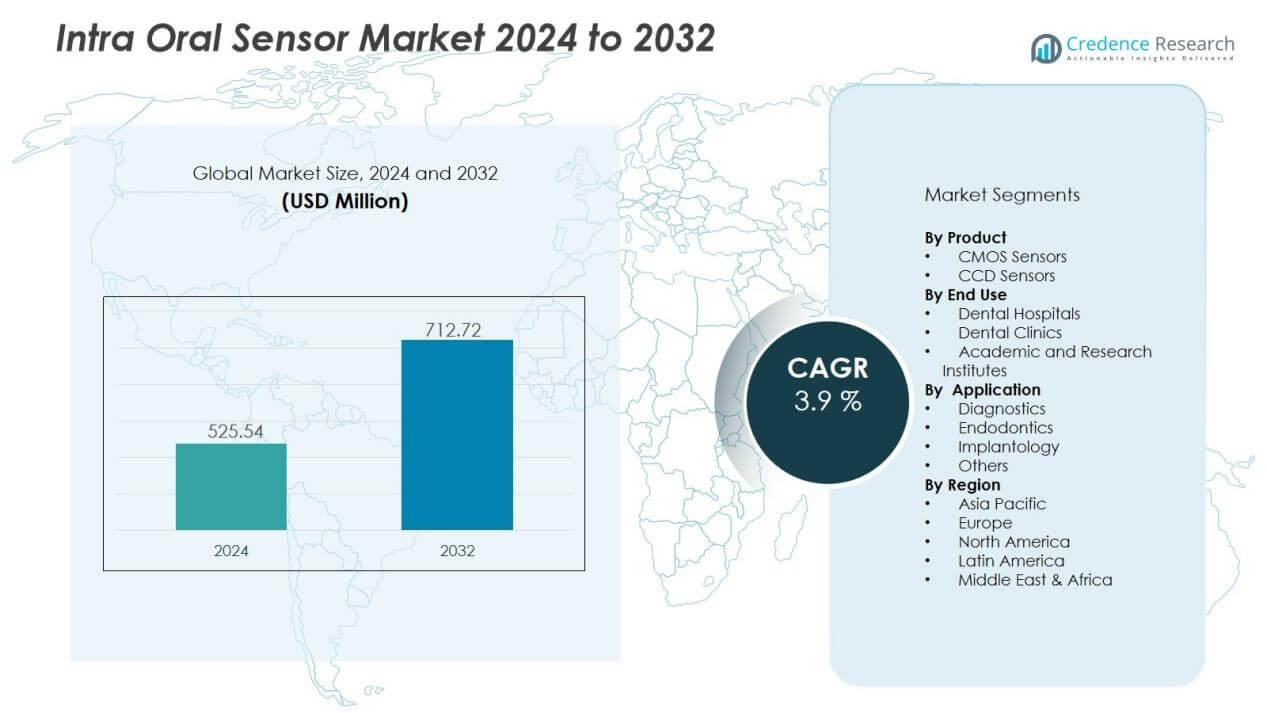
The intra oral sensor market size was valued at USD 525.54 million in 2024 and is anticipated to reach USD 712.72 million by 2032, at a CAGR of 3.9 % during the forecast period (2024-2032).
| REPORT ATTRIBUTE |
DETAILS |
| Historical Period |
2020-2023 |
| Base Year |
2024 |
| Forecast Period |
2025-2032 |
| Intra Oral Sensor Market Size 2024 |
USD 525.54 Million |
| Intra Oral Sensor Market, CAGR |
3.9% |
| Intra Oral Sensor Market Size 2032 |
USD 712.72 Million |
Key drivers fueling the intra oral sensor market include increasing prevalence of dental disorders, rising geriatric population, and growing demand for minimally invasive diagnostic tools. The push for preventive dental care and improved patient experience has accelerated the adoption of advanced imaging systems. Continuous innovation in sensor technology, such as improved image resolution and wireless connectivity, further supports market penetration. Investments by manufacturers in ergonomic, durable, and portable designs also strengthen adoption across varied dental practices.
Regionally, North America dominates the intra oral sensor market due to high healthcare expenditure, advanced dental infrastructure, and strong adoption of digital technologies. Europe follows closely, supported by favorable reimbursement policies and expanding dental practices. Asia-Pacific is projected to register the fastest growth, driven by rising awareness of oral health, increasing disposable incomes, and rapid modernization of healthcare infrastructure in countries like China and India. Latin America and the Middle East & Africa present emerging opportunities with ongoing improvements in dental care accessibility.
Market Insights:
- The intra oral sensor market was valued at USD 525.54 million in 2024 and is projected to reach USD 712.72 million by 2032, growing at a CAGR of 3.9%.
- Rising prevalence of dental disorders such as cavities and periodontal issues is driving strong demand for advanced imaging solutions.
- The shift toward preventive and patient-centric care continues to strengthen adoption of high-resolution digital imaging systems.
- Technological advancements, including wireless connectivity, ergonomic designs, and enhanced durability, are improving workflow efficiency in dental practices.
- High cost of sensors and limited accessibility in developing regions remain key barriers to broader adoption.
- North America held 38% share in 2024, supported by advanced dental infrastructure, favorable reimbursement policies, and high awareness.
- Asia-Pacific accounted for 24% share in 2024 and is expected to grow fastest, driven by rising disposable incomes, expanding healthcare infrastructure, and growing dental tourism.
Access crucial information at unmatched prices!
Request your sample report today & start making informed decisions powered by Credence Research Inc.!
Download Sample
Market Drivers:
Rising Prevalence of Dental Disorders Driving Advanced Imaging Adoption:
The intra oral sensor market benefits from the increasing burden of dental diseases such as cavities, periodontal issues, and oral cancers. Patients demand quicker and more accurate diagnostic solutions to address these conditions. Digital sensors provide superior image clarity compared to film-based methods, enabling earlier detection of oral health problems. It strengthens diagnostic accuracy and supports timely treatment planning.
- For instance, Carestream Dental’s RVG 6200 intraoral sensor delivers an actual image resolution of 24 line pairs per millimeter (lp/mm), surpassing traditional film resolution and enhancing diagnostic precision for early detection of dental issues.
Growing Shift Toward Preventive and Patient-Centric Dental Care:
Preventive dentistry is gaining traction, with patients seeking early interventions to avoid complex procedures. The intra oral sensor market supports this demand by offering tools that reduce diagnostic errors and enhance comfort during imaging. High-resolution digital images improve patient communication, allowing dentists to explain conditions more effectively. This shift reinforces adoption across clinics focused on patient satisfaction and preventive care outcomes.
- For instance, Carestream Dental’s CS 1500 intraoral camera delivers high-resolution images, which enhances patient communication and understanding, thereby increasing treatment acceptance and supporting patient-centric outcomes.
Technological Advancements Enhancing Imaging Capabilities and Workflow:
Manufacturers are investing in innovations such as wireless sensors, enhanced ergonomics, and durability. The intra oral sensor market benefits from features that improve workflow efficiency and reduce retakes, which save time and resources. Advanced sensor designs deliver consistent performance under demanding clinical environments. These innovations support better integration with dental software, improving storage and sharing of patient records.
Expanding Dental Infrastructure and Healthcare Investments Worldwide:
Emerging economies are expanding dental infrastructure through public and private healthcare investments. The intra oral sensor market gains traction as clinics and hospitals upgrade from analog systems to digital solutions. Rising disposable incomes and growing awareness of oral hygiene further accelerate adoption in developing countries. It creates opportunities for global manufacturers to strengthen presence across diverse regional markets.
 Market Trends:
Integration of Digital Technologies and AI to Improve Diagnostic Accuracy:
The intra oral sensor market is witnessing a clear shift toward digital technologies and artificial intelligence integration. Dentists increasingly adopt AI-powered imaging tools that detect cavities, root infections, and bone loss with higher accuracy. It improves treatment planning and reduces human error in diagnosis. Cloud-based storage and digital record systems also support seamless data sharing between practitioners, enhancing collaborative care. The adoption of wireless and portable intra oral sensors further aligns with the trend toward modern, patient-friendly dental practices. These developments create a pathway for more efficient, connected, and precise dental workflows.
- For instance, Freedom Technologies Group’s DC-Air wireless intraoral sensor employs direct-conversion X-ray technology combined with Bluetooth, enabling over 150 images per battery charge, enhancing diagnostic clarity and patient comfort with its ultra-thin 5.4 mm design.
Growing Demand for Ergonomic, Durable, and Patient-Friendly Sensor Designs:
The intra oral sensor market is moving toward sensors designed for patient comfort and practitioner efficiency. Manufacturers focus on creating smaller, flexible sensors that minimize discomfort during procedures. It ensures higher patient acceptance, particularly among children and elderly populations. Durable sensors capable of withstanding frequent sterilization cycles and intensive use are also in demand. Ergonomic designs improve ease of handling, reducing dentist fatigue and improving workflow speed. This trend reflects the market’s focus on balancing advanced functionality with comfort and long-term usability in dental environments.
- For instance, Planmeca’s ProSensor HD offers three sensor sizes with rounded edges for patient comfort and features a carbon fibre plate for durability, delivering a resolution over 20 lp/mm and sustaining high use without damage.
Market Challenges Analysis:
High Cost of Advanced Sensors and Limited Accessibility in Developing Regions:
The intra oral sensor market faces challenges due to the high upfront cost of digital sensors and related imaging systems. Many small dental clinics in developing countries still rely on film-based methods because digital upgrades demand significant investment. It limits widespread adoption, particularly in price-sensitive markets where reimbursement policies are weak. Maintenance expenses and frequent need for software upgrades further increase operational costs. These financial barriers slow penetration in rural and emerging economies despite growing awareness of digital benefits.
Technical Limitations and Training Gaps Hindering Seamless Adoption:
The intra oral sensor market also struggles with technical and operational barriers that affect user adoption. Sensors may face calibration issues, image distortion, or reduced durability under high clinical workloads. It creates workflow disruptions and reduces confidence among dental professionals. Lack of adequate training for practitioners and staff in handling digital sensors compounds the challenge, leading to underutilization of advanced features. Concerns about data security with cloud-based imaging systems also limit integration in certain regions. These challenges highlight the need for continuous education, stronger support services, and improved product reliability.
Market Opportunities:
Expansion of Digital Dentistry and Rising Demand for Preventive Care:
The intra oral sensor market holds strong opportunities with the rapid expansion of digital dentistry. Growing emphasis on preventive care and early detection of dental disorders supports higher adoption rates. It enables dentists to deliver precise diagnosis and faster treatment planning, enhancing patient trust. Increasing government initiatives promoting oral health awareness further strengthen the demand for advanced imaging tools. Integration with digital workflows such as CAD/CAM systems creates cross-functional applications for intra oral sensors. This synergy between technologies opens new revenue streams for manufacturers.
Growth Potential in Emerging Markets with Improving Healthcare Infrastructure:
The intra oral sensor market is poised to benefit from the ongoing development of healthcare infrastructure in emerging economies. Rising disposable incomes, urbanization, and growing middle-class populations create higher demand for advanced dental services. It provides opportunities for manufacturers to introduce cost-effective sensors tailored for local markets. Partnerships with regional distributors and dental associations can accelerate penetration in underserved areas. Expanding dental tourism in countries like India, Thailand, and Mexico further boosts the need for modern imaging solutions. These dynamics establish emerging markets as key growth engines for the industry.
Market Segmentation Analysis:
By Product:
The intra oral sensor market by product is segmented into CMOS sensors and CCD sensors. CMOS sensors dominate due to lower power consumption, faster processing, and compact size. It is increasingly favored by clinics and hospitals for its high-quality imaging and durability. CCD sensors still hold relevance in certain practices but continue to lose ground as CMOS-based solutions gain wider adoption. Manufacturers are focusing on improving CMOS technology to strengthen diagnostic accuracy and ease of integration.
- For instance, the CMOS detector used in intraoral imaging reduced the total clinical imaging time to 167.07 seconds per full-mouth radiograph session, significantly outperforming photostimulable phosphor (PSP) detectors which took 234.05 seconds, thereby enhancing patient throughput and clinic efficiency.
By Application:
The intra oral sensor market by application covers diagnostics, endodontics, implantology, and others. Diagnostics lead the segment, supported by rising prevalence of oral disorders and demand for accurate imaging. It enables dentists to detect cavities, fractures, and bone loss with high precision. Endodontics and implantology are also expanding due to growing need for advanced treatment planning. Adoption across orthodontics further supports segment growth as patient-centric care becomes a priority.
- For instance, DEXIS Platinum delivers an image resolution of 20 line pairs per millimeter, enabling clinicians to visualize micro-fractures with exceptional clarity.
By End Use:
The intra oral sensor market by end use is divided into dental hospitals, clinics, and academic research institutes. Dental clinics account for the largest share due to their increasing adoption of digital imaging solutions for routine care. It reflects the growing preference of patients for faster, more accurate diagnosis. Hospitals follow, driven by their role in handling complex cases requiring advanced imaging technologies. Academic and research institutes are gradually increasing adoption to support training and innovation in digital dentistry.
Segmentations:
By Product:
By Application:
- Diagnostics
- Endodontics
- Implantology
- Others
By End Use:
- Dental Hospitals
- Dental Clinics
- Academic and Research Institutes
By Region:
- North America
- Europe
- UK
- France
- Germany
- Italy
- Spain
- Russia
- Belgium
- Netherlands
- Austria
- Sweden
- Poland
- Denmark
- Switzerland
- Rest of Europe
- Asia Pacific
- China
- Japan
- South Korea
- India
- Australia
- Thailand
- Indonesia
- Vietnam
- Malaysia
- Philippines
- Taiwan
- Rest of Asia Pacific
- Latin America
- Brazil
- Argentina
- Peru
- Chile
- Colombia
- Rest of Latin America
- Middle East
- UAE
- KSA
- Israel
- Turkey
- Iran
- Rest of Middle East
- Africa
- Egypt
- Nigeria
- Algeria
- Morocco
- Rest of Africa
Regional Analysis:
North America:
North America accounted for 38% market share in the intra oral sensor market in 2024. The region continues to dominate due to high adoption of digital dental technologies and strong healthcare infrastructure. It benefits from the presence of leading manufacturers and a robust network of dental clinics. Favorable reimbursement policies and high patient awareness further encourage the shift from analog to digital imaging. The growing geriatric population also increases demand for accurate diagnostic tools in preventive and restorative dentistry. Continuous product innovation by U.S.-based companies reinforces the region’s leadership position.
Europe:
Europe recorded 29% market share in the intra oral sensor market in 2024. The region benefits from supportive regulatory frameworks and government-backed oral healthcare programs. It is witnessing steady adoption of digital sensors across private and public clinics. High demand for advanced dental imaging in countries like Germany, France, and the U.K. strengthens market expansion. Dental tourism in Eastern Europe further contributes to increased adoption of cost-efficient digital solutions. Strong presence of established dental equipment manufacturers also enhances availability of technologically advanced sensors.
Asia-Pacific:
Asia-Pacific held 24% market share in the intra oral sensor market in 2024. It is projected to be the fastest-growing region driven by rising healthcare investments and urbanization. Increasing disposable incomes in China, India, and Southeast Asian countries are boosting access to advanced dental care. Expanding dental education programs also support stronger adoption of digital imaging technologies. Growth in dental tourism hubs like Thailand and India further accelerates demand. International manufacturers are actively targeting this region through partnerships and local distribution networks.
Shape Your Report to Specific Countries or Regions & Enjoy 30% Off!
Key Player Analysis:
- Carestream Dental
- Envista Holdings Corporation
- Dürr Dental
- Acteon
- KaVo Dental
- Planmeca
- Owandy Radiology
- Cefla
- Vatech
- XDR Radiology
Competitive Analysis:
The intra oral sensor market is highly competitive with global and regional players focusing on product innovation and technology integration. Key companies include Carestream Dental, Dürr Dental, Envista Holdings Corporation, Acteon, Owandy Radiology, KaVo Dental, Planmeca, and Cefla. It is shaped by strong emphasis on improving image quality, ergonomic design, and workflow efficiency. Players invest in research to develop sensors with higher durability, wireless connectivity, and seamless integration with digital dental systems. Strategic collaborations with dental clinics and hospitals strengthen market presence and expand distribution networks. Companies also target emerging regions with cost-effective product lines to capture untapped demand. The competitive landscape is marked by continuous upgrades, portfolio diversification, and a push toward enhancing patient comfort and clinical reliability.
Recent Developments:
- In June 2025, Envista Holdings Corporation acquired Alpha Bio France, thereby strengthening its presence in the French market and expanding direct distribution among dental practices.
- In April 2025, Dürr Dental was named Germany’s Innovation Champion 2025, recognizing its ongoing investments in research and development and technological leadership in dental system hygiene and digital imaging solutions.
Report Coverage:
The research report offers an in-depth analysis based on Product, Application, End Use and Region. It details leading Market players, providing an overview of their business, product offerings, investments, revenue streams, and key applications. Additionally, the report includes insights into the competitive environment, SWOT analysis, current Market trends, as well as the primary drivers and constraints. Furthermore, it discusses various factors that have driven Market expansion in recent years. The report also explores Market dynamics, regulatory scenarios, and technological advancements that are shaping the industry. It assesses the impact of external factors and global economic changes on Market growth. Lastly, it provides strategic recommendations for new entrants and established companies to navigate the complexities of the Market.
Future Outlook:
- Growing demand for digital dentistry will accelerate adoption of advanced intra oral sensors.
- Manufacturers will focus on improving ergonomics and comfort to enhance patient acceptance.
- Artificial intelligence integration will support higher diagnostic accuracy and real-time image analysis.
- Wireless and portable sensor solutions will expand usage in small and mid-sized clinics.
- Cloud-based platforms will enable seamless data storage, sharing, and integration across dental networks.
- Emerging economies will present strong opportunities with rising investments in healthcare infrastructure.
- Preventive dental care adoption will increase sensor usage for early diagnosis and treatment planning.
- Collaborations between dental schools and manufacturers will strengthen awareness and training programs.
- Durability and cost-efficient product designs will gain traction in price-sensitive markets.
- Global competition will drive continuous innovation and expanded product portfolios across all major regions.



