
| REPORT ATTRIBUTE | DETAILS |
|---|---|
| Historical Period | 2019-2022 |
| Base Year | 2023 |
| Forecast Period | 2024-2032 |
| Intracranial Stents Market Size 2023 | USD 2358.90 million |
| Intracranial Stents Market, CAGR | 5.90% |
| Intracranial Stents Market Size 2032 | USD 3951.60 million |
Market Insights
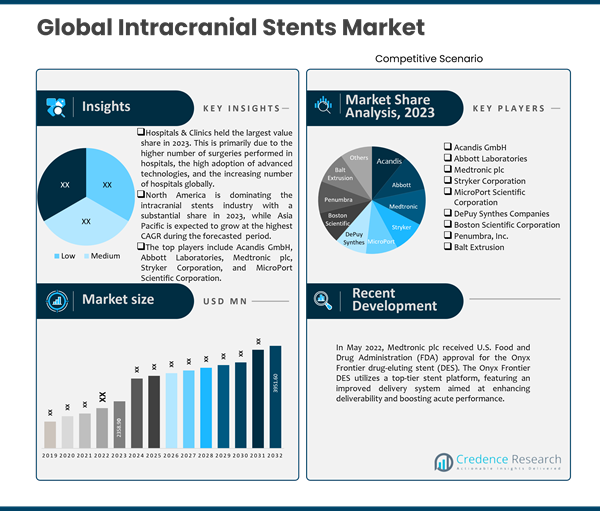
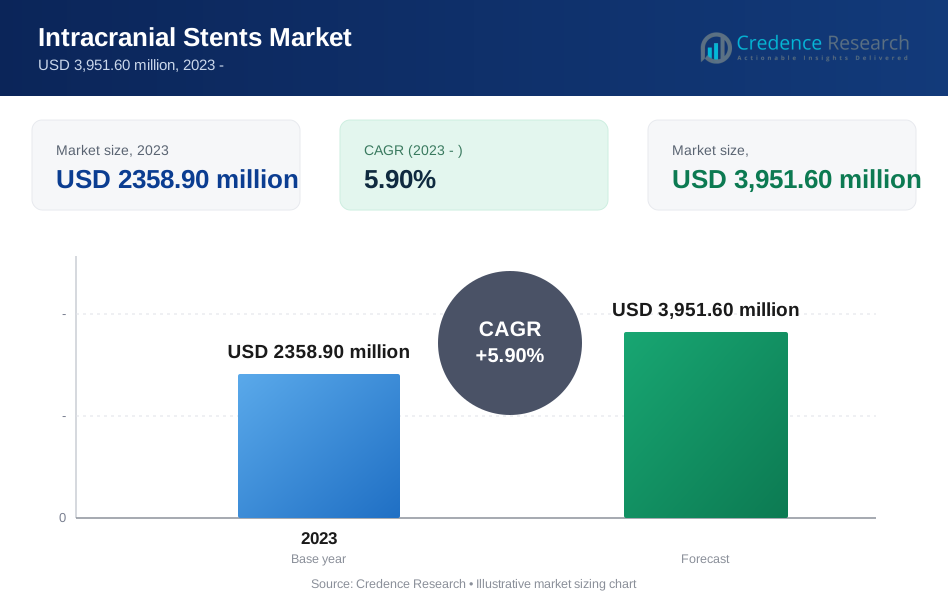
- The global demand for intracranial stents was valued at USD 2358.90 million in 2023 and is expected to reach USD 3951.60 million in 2032, growing at a CAGR of 5.90% between 2024 and 2032.
- In 2023, the self-expanding stents segment was the market leader by type of stents, accounting for the highest share in value 2023, while the balloon-expandable stents segment is expected to grow rapidly throughout the forecast period.
- The polymer-based stents segment is predicted to grow fastest over the projection period, while metallic stents had the largest hardware market share in 2023.
- In terms of application, the intracranial stenosis segment accounted for the highest share, while the intracranial aneurysms segment is anticipated to showcase the highest growth rate.
- The Hospitals & Clinics segment dominates the global need for intracranial stents, accounting for a significant share in 2023, and is predicted to expand at a moderate CAGR.
- North America is dominating the intracranial stents industry, with over one-third of the market in 2023.
- The market's primary possibilities include significant growth potential driven by several factors, including Continuous technological innovations in healthcare devices and advancements in imaging technologies.
Executive Summary
Market Definition
Intracranial stents are specialized medical devices used to treat various conditions within the blood vessels of the brain. These small, mesh-like tubes are designed to provide structural support to the blood vessels, helping to keep them open and ensuring adequate blood flow to the brain.
Intracranial stents are commonly used in the treatment of cerebral aneurysms, arteriovenous malformations, and intracranial stenosis. They can be deployed through minimally invasive procedures, typically involving the insertion of a catheter through a blood vessel in the groin or wrist, which is then navigated to the affected area in the brain. Once in place, the stent expands to fit the vessel, maintaining patency and reducing the risk of stroke or other complications associated with restricted blood flow.
Market Overview
The global intracranial stents market has witnessed steady growth in recent years and is expected to grow at a CAGR of 5.90% between 2024 and 2032. The market was valued at USD 2358.90 million in 2023 and is expected to reach USD 3951.60 million in 2032.
The rising prevalence of stroke is a major driver of this market. Stroke is one of the leading causes of death and long-term disability worldwide. According to the World Stroke Organization report of 2022, over 12.2 million new stroke cases are reported globally each year. This alarming number highlights the urgent need for effective treatment options. These devices help to restore normal blood flow, thereby reducing the damage caused by the stroke and improving patient outcomes.
The rising prevalence of risk factors for stroke, such as hypertension, diabetes, and obesity, is indirectly driving the demand for intracranial stents. As these conditions become more common, particularly in aging populations, the incidence of cerebrovascular diseases is likely to increase, thereby fueling the need for effective treatment options, including intracranial stents.
Moreover, there is an increasing demand for minimally invasive intracranial surgeries. Traditional open brain surgeries come with high risks and long recovery times. This growing preference for less invasive treatment options is propelling the demand for intracranial stents. Additionally, rising technological advancements and modernization in healthcare machinery are providing a significant boost to the market.
Innovations such as the development of flow-diverting stents, which help to re-route blood flow away from aneurysms, and the improvement of stent materials and designs to enhance flexibility and biocompatibility are paving the way for more effective treatments. Additionally, the increasing availability of advanced imaging techniques that aid in precise placement and monitoring of stents is enhancing procedural success rates and patient outcomes.
Governments worldwide are making proactive efforts to address the burden of neurological disorders through funding, awareness programs, and improved healthcare infrastructure, which is also propelling market growth. Initiatives aimed at increasing the availability of specialized stroke centers and expanding access to advanced neurological treatments are creating a conducive environment for the adoption of intracranial stents.
Segmentation by Type of Stents
- Self-expanding stents are the leading segment by software and held the dominant share in value in 2023, attributable to their improved flexibility, conformability, and lower complication rates, making them favorable for minimally invasive procedures.
- The balloon-expandable stents segment is expected to exhibit the highest CAGR during the forecast period. The growth of balloon-expandable stents can be attributed to the innovations in stent design and increased adoption for treating various intracranial conditions are driving this growth.
Segmentation by Material Composition
- In 2023, metallic stents held the largest market share within the hardware segment in terms of value. This dominance is due to their widespread adoption and established clinical efficacy in treating intracranial conditions.
- Polymer-based stents are expected to be the fastest-growing segment. This growth can be attributed to ongoing advancements in polymer technologies, which offer benefits such as improved biocompatibility and reduced risk of complications.
Segmentation by Application
- The intracranial stents segment held the largest market share in terms of value in 2023. this is driven by increasing awareness and screening for intracranial stenosis, advancements in stent technology, and the growing emphasis on secondary stroke prevention.
- The Intracranial Aneurysms segment is anticipated to be the fastest-growing segment within the intracranial stents market. The rising prevalence of intracranial aneurysms, the need for minimally invasive treatment options, and the advancements in stent-assisted coil embolization techniques are major factors contributing to its rapid growth.
Segmentation by End User
- The hospitals & clinics segment held the largest value share in 2023. This is primarily due to the higher number of surgeries performed in hospitals, the high adoption of advanced technologies, and the increasing number of hospitals globally. Hospitals have a more extensive infrastructure and resources to perform complex neurological procedures, leading to their dominance in the market.
- The ambulatory surgical centers (ASCs) segment is anticipated to register the highest CAGR during the projection period. This growth is driven by the increasing preference for minimally invasive surgeries that can be performed in ASCs, which offer cost-effective and convenient options for patients and healthcare providers alike. The shift towards outpatient surgeries and the expansion of ASCs contribute significantly to this trend.
Segmentation by Region
- North America drove the growth of the intracranial stents industry in 2023, fueled by the increasing prevalence of intracranial diseases, particularly strokes, along with a conducive landscape of healthcare research and innovation.
- Rapid urbanization, improvements in healthcare infrastructure, and rising disposable incomes are anticipated to drive Asia Pacific's highest growth rate during the forecasted period.
- The rest of the world, including Latin America, the Middle East, and Africa, supplies the remaining demand for intracranial stents.
North America is currently dominating the intracranial stents market and is expected to dominate throughout the forecast period due to the region’s conducive healthcare landscape. North America, particularly the United States, leads the intracranial stents market due to its increasing prevalence of intracranial diseases, particularly strokes. According to the Centers for Disease Control and Prevention, over 795,000 stroke cases occur annually in the U.S., leading to the high demand for effective treatments such as intracranial stents, particularly with 87% of strokes being ischemic. This demand is fueled by factors including an aging population and the rising incidence of risk factors, including hypertension and diabetes.
Moreover, the U.S. serves as a hub for medical research and development, fostering continuous innovation in intracranial stent technologies. For instance, the development of the PEGASUS HPC stent represents a significant advancement in neurovascular interventions, specifically designed for patients with intracranial aneurysms and stenoses in intracranial atherosclerotic disease (ICAD). Such innovations drive market growth by offering promising treatment options for individuals with neurological conditions.
Additionally, with a robust healthcare system characterized by state-of-the-art facilities, cutting-edge technology, and highly trained medical professionals, North America offers an ideal environment for the adoption and utilization of advanced medical devices such as intracranial stents. Furthermore, the presence of leading medical research institutions and a culture of innovation further accelerates the development and implementation of new medical technologies. Consequently, advancements in healthcare infrastructure in North America contribute significantly to the growth of the intracranial stents market in the region.
On the other hand, the Asia Pacific region presents significant growth opportunities for the intracranial stents market. Rapid urbanization, alongside improvements in healthcare infrastructure and rising disposable incomes, forms a fertile ground for market expansion.
Additionally, escalating research and development activities in the field of brain and neurological disorders, coupled with an increasing number of therapeutic procedures associated with brain health, further drive market growth. Notably, recent developments, such as MicroPort NeuroTech Limited, received market approval from China's National Medical Products Administration (NMPA) in February 2022 for its Neurohawk Stent Thrombectomy Device, highlighting the region's receptivity to advanced medical solutions. This device, a self-expandable clot stent retriever, is used in endovascular invasive thrombectomy procedures to remove large clots in blood vessels.
Moreover, growing awareness of minimally invasive treatment options and the rising healthcare expenditures in the region contribute significantly to market growth. As awareness spreads and healthcare expenditures continue to rise across the Asia Pacific region, the demand for advanced medical interventions, including intracranial stents, is expected to witness sustained growth. Thus, the Asia Pacific region emerges as a dynamic hub driving the evolution of the intracranial stents market, poised for significant expansion in the foreseeable future.
Key Highlights of the Report
The Global Intracranial Stents Market is segmented by type of stents, material composition, application, end user, and region. Self-expanding stents will dominate the market in 2023, holding the largest value share. However, metallic stents are the primary segment by material composition. In addition, Hospitals and clinics are the most demanding end users, and North America leads the market growth.
The global intracranial stents market is growing rapidly, driven by the rising prevalence of stroke, increasing demand for minimally invasive intracranial surgeries, and the expanding senior population. Additionally, advancements in intracranial stent technology, supported by government initiatives and increased R&D activities, are further fueling market expansion. Moreover, efforts by leading manufacturers in the development of innovative stents further highlight the industry’s commitment to advancement.
Nonetheless, While North America is expected to hold the largest market share due to the increasing prevalence of intracranial diseases, particularly strokes, along with a conducive landscape of healthcare research and innovation, Asia Pacific is anticipated to see the fastest growth, driven by Rapid urbanization, alongside improvements in healthcare infrastructure and rising disposable incomes.
What Are The Main Drivers Of The Global Intracranial Stents Market?
The main factors driving the growth of the global intracranial stents market include the rising prevalence of stroke, increasing demand for minimally invasive intracranial surgeries, and the expanding senior population. Additionally, advancements in intracranial stent technology, supported by government initiatives and increased R&D activities, are further fueling market expansion. Moreover, efforts by leading manufacturers in the development of innovative stents further highlight the industry’s commitment to advancement.
What are The Major Challenges Faced By The Global Intracranial Stents Market?
The intracranial stent market faces significant growth challenges due to the high costs associated with procedures. These expenses encompass not only the stent itself but also procedural fees, hospitalization, and post-operative care. Such a comprehensive cost structure poses a considerable financial burden on patients, particularly in low—and middle-income regions. Moreover, the need for specialized equipment and skilled medical personnel further escalates expenses.
What Are The Growth Opportunities In The Global Intracranial Stents Market?
The ongoing evolution of technology presents promising opportunities for the intracranial stents market. Innovations such as bioresorbable, drug-eluting, and flow-diverting stents are elevating treatment standards, ensuring greater efficacy and patient safety. These advancements, alongside enhancements in imaging techniques and minimally invasive surgical procedures, facilitate precise stent placement and monitoring.
Market Drivers
Increase in Prevalence of Neurological Disorders
The increasing incidence of neurological disorders is significantly driving the demand for intracranial stents. According to the World Health Organization (WHO), in 2021, more than 3 billion people worldwide were living with a neurological condition. Among these, stroke is one of the most prevalent and severe conditions, especially common among the geriatric population. The World Stroke Organization report of 2022 indicates that the prevalence of stroke is highest among individuals aged 70 years and above, accounting for 67% of cases, followed by those aged between 15-49 years at 22%. This high incidence of stroke among the elderly population underscores the critical need for effective treatment options such as intracranial stents.
Additionally, the increasing demand for minimally invasive intracranial surgeries is driving market growth. These surgeries are preferred for treating conditions such as strokes, cerebral aneurysms, and other cerebrovascular disorders due to their reduced risk, shorter recovery times, and improved patient outcomes compared to traditional open surgeries. Intracranial stents play a crucial role in these minimally invasive procedures by helping to restore normal blood flow and prevent further neurological damage. The high burden of stroke among the growing geriatric population further amplifies the demand for these advanced medical devices, contributing to market expansion.
Market Restraints
High Costs Associated with Intracranial Stent Procedures
The cost of intracranial stent procedures can be prohibitively expensive, significantly limiting their accessibility, particularly in low- and middle-income countries. The expenses associated with intracranial stents are multifaceted, encompassing the price of the stent itself, the procedural costs, hospitalization, and post-operative care.
This comprehensive cost structure poses a substantial financial burden on patients, often making it difficult for them to afford such treatments. Additionally, healthcare systems, especially those in resource-limited settings, may struggle to provide these high-cost procedures on a widespread basis, further restricting access.
Moreover, financial challenges are compounded by the need for specialized equipment and highly skilled medical personnel to perform these complex procedures, both of which add to the overall expense. In many regions, healthcare funding and insurance coverage may not adequately cover the costs associated with intracranial stents, leading to out-of-pocket expenses that are beyond the reach of many patients.
Consequently, the high-cost barrier can deter patients from seeking this treatment and can also limit the ability of healthcare providers to offer these advanced medical interventions.
Opportunities
Advancements in Healthcare Technology
Continuous technological innovations are driving significant opportunities for the intracranial stents market in the future. Advancements in design, materials, and functionality are revolutionizing the field, leading to enhanced treatment efficacy and safety. The introduction of bioresorbable stents, drug-eluting stents, and flow-diverting stents represents a transformation in intracranial stent technology.
These innovations offer improved biocompatibility, reduced risk of complications, and better long-term outcomes for patients. For example, Bioresorbable stents gradually dissolve over time, eliminating the need for permanent implants and reducing the risk of long-term complications. Also, drug-eluting stents release therapeutic agents to prevent restenosis and promote healing, while flow-diverting stents redirect blood flow away from aneurysms, reducing the risk of rupture.
Moreover, advancements in imaging technologies and minimally invasive surgical techniques are revolutionizing the way intracranial stents are deployed and monitored. High-resolution imaging modalities such as MRI and CT angiography enable more accurate diagnosis and treatment planning, leading to better patient selection and outcomes.
As researchers and manufacturers continue to innovate and refine these technologies, the future of intracranial stents looks promising, with the potential to improve patient outcomes and revolutionize the treatment of cerebrovascular disorders.
Competitive Landscape
Key Players
The global intracranial stents market is highly competitive, with several key players. Some of the major players in the market and their market share are as follows:
- Acandis GmbH
- Abbott Laboratories
- Medtronic plc
- Stryker Corporation
- MicroPort Scientific Corporation
- DePuy Synthes Companies
- Boston Scientific Corporation
- Penumbra, Inc.
- Balt Extrusion
These organizations prioritize product innovation, distribution channel expansion, and mergers and acquisitions to stay competitive.
The global intracranial stents market's key players continually seek to stay ahead by acquisitions and launching new products.
In May 2023, Stryker acquired Cerus Endovascular Ltd., a medical device company specializing in the design and development of neurointerventional devices for the treatment of intracranial aneurysms. Cerus Endovascular’s CE-marked products, the Contour Neurovascular System and the Neqstent Coil Assisted Flow Diverter will expand Stryker’s current portfolio of aneurysm treatment solutions.
In May 2022, Medtronic plc received U.S. Food and Drug Administration (FDA) approval for the Onyx Frontier drug-eluting stent (DES). The Onyx Frontier DES utilizes a top-tier stent platform featuring an improved delivery system that enhances deliverability and boosts acute performance.
How are Companies Performing in the Intracranial Stents Market?
The global intracranial stents market is highly competitive, with several key players.
Startups are playing a pivotal role in the evolution and growth of the intracranial stents market, introducing a wave of innovation and technological advancements that are transforming the treatment landscape for cerebrovascular diseases. These emerging companies are creating stents with enhanced flexibility and precision, tailored to navigate the intricate and delicate blood vessels in the brain. These innovations are crucial in reducing procedural complications and increasing the success rates of intracranial interventions, thus providing safer and more effective treatment options for patients. For instance, NeuroVasc Technologies focuses on developing neurovascular devices designed to treat complex cerebrovascular conditions, ensuring safer and more efficient treatments.
Additionally, these startups' focus on personalized medicine is revolutionizing the approach to intracranial stenting. By utilizing advanced imaging techniques and data analytics, startups are designing stents that cater to each patient's unique anatomical and physiological characteristics. This customization ensures a better fit and improved functionality, leading to superior clinical outcomes. Rapid Medical, for example, has developed the Comaneci adjustable remodeling mesh, which offers tailored support for aneurysm coiling procedures, demonstrating the potential of personalized medical devices in intracranial stenting. For example, NeuroVasc Technologies focuses on developing neurovascular devices designed to treat complex cerebrovascular conditions.
Moreover, By developing stents made from biocompatible and biodegradable materials, these companies aim to minimize the risk of adverse reactions and enhance the long-term efficacy of the devices. This focus on material innovation is essential in addressing the complexities associated with intracranial procedures and improving patient safety. Insera Therapeutics is advancing next-generation neurovascular devices, leveraging cutting-edge materials and design techniques to enhance stroke treatment and reduce complications.
Furthermore, the integration of digital health technologies, such as artificial intelligence and machine learning, is being spearheaded by startups to revolutionize intracranial stenting. These technologies facilitate better planning and execution of procedures, as well as improved post-operative monitoring.
For instance, some startups are developing stents equipped with sensors that provide real-time data on blood flow and stent performance, enabling more precise and effective treatment. Cerebrotech Medical Systems has developed a non-invasive monitoring device that uses AI to detect changes in brain fluid distribution, aiding in the management and follow-up of stent procedures. The contributions of these startups to the intracranial stents market are driving substantial advancements in the field.
Summary of Key Findings
- The rising prevalence of stroke, increasing demand for minimally invasive intracranial surgeries, and the expanding geriatric population are driving the growth of the Intracranial Stents Market. Additionally, advancements in intracranial stent technology, supported by government initiatives and increased R&D activities, are further fueling market expansion. Moreover, efforts by leading manufacturers in the development of innovative stents further highlight the industry’s commitment to advancement.
- Market segmented by type of stents, material composition, application, end user, and region.
- Metallic stents are the most popular, while Hospitals & Clinics remain the primary end user.
- North America is leading market growth; the market is highly competitive, with key players including Acandis GmbH, Abbott Laboratories, Medtronic plc, Stryker Corporation, MicroPort Scientific Corporation, DePuy Synthes Companies, Boston Scientific Corporation, Penumbra, Inc., and Balt Extrusion.
Future Outlook
- Positive outlook for the global intracranial stents market with significant growth potential in the North American region.
- The key drivers accelerating the growth of the Intracranial Stents Market include the rising prevalence of stroke, increasing demand for minimally invasive intracranial surgeries, and the expanding senior population
- During the forecast period, high costs associated with procedures, along with the need for specialized equipment and skilled medical personnel, which further escalates expenses, are expected to restrain the growth of the Intracranial Stents Market.
- Key firms must focus on product innovation, growing market reach, and maintaining competitive pricing to keep ahead of the competition.
How CXOs Can Benefit from the Credence Research Intracranial Stents Market Report
The Credence Research Intracranial Stents Market Report provides CXOs with a comprehensive overview of the market, including:
- Market size and growth forecast: The report provides detailed estimates of the global intracranial stents market size, segmented by type of stents, material composition, application, end user, and region. It also includes forecasts for the market through 2032 based on key trends and drivers.
- Market segmentation: The report segments the Intracranial Stents Market by type of stents, material composition, application, end user, and region. This segmentation provides CXOs with a granular understanding of the market and the opportunities in each segment.
- Competitive Landscape: The report profiles the key players in the Intracranial Stents Market and provides insights into their strategies, product offerings, and financial performance. This information can help CXOs to identify and assess their competition.
- Key trends and drivers: The report identifies and analyzes the key trends and drivers shaping the Intracranial Stents Market. This information can help CXOs make informed decisions about their investments and strategies.
CXOs can use the insights from the Credence Research Intracranial Stents Market Report to:
- Identify growth opportunities: The report can help CXOs identify new growth opportunities in the Intracranial Stents Market. For example, it identifies the growing demand for intracranial stents for minimally invasive techniques for treating neurological disorders.
- Make informed investment decisions: The report can help CXOs make informed investment decisions about intracranial stents. For example, the report provides insights into the key factors to consider when evaluating intracranial stent providers.
- Develop competitive strategies: The report can help CXOs develop competitive strategies for their intracranial stent businesses. For example, it identifies the key strategies that intracranial stent providers are using to differentiate themselves from their competitors.
- Track market developments: The report can help CXOs monitor market developments and stay ahead of the curve. For example, it provides insights into the latest trends and innovations in the Intracranial Stents Market.
Overall, the Credence Research Intracranial Stents Market Report is a valuable resource for CXOs who are looking to gain a deeper understanding of the market and identify opportunities for growth.
Segmentation
-
By Type of Stents
- Self-Expanding Stents
- Balloon-Expandable Stents
-
By Material Composition
- Metallic Stents
- Polymer-Based Stents
-
By Application
- Ischemic Stroke
- Intracranial Aneurysms
- Intracranial Stenosis
-
By End User
- Hospitals & Clinics
- Ambulatory Surgical Centers (ASCs)
-
By Region
- North America
- US
- Canada
- Mexico
- Europe
- Germany
- France
- UK
- Italy
- Spain
- Rest of Europe
- Asia Pacific
- China
- Japan
- India
- South Korea
- South-east Asia
- Rest of Asia Pacific
- Latin America
- Brazil
- Argentina
- Rest of Latin America
- Middle East & Africa
- GCC Countries
- South Africa
- Rest of the Middle East and Africa
- North America
Adjacent Markets
In the Intracranial Stents Market, several adjacent markets have high revenue growth opportunities. The key adjacent markets for Intracranial Stents Market -
Adjacent Markets |
||
| Neurovascular Catheters Market | Thrombectomy Devices Market | Brain Aneurysm Treatment Devices Market |
| Intracranial Balloons Market | Neurothrombectomy Devices Market | Embolization Coils Market |
| Carotid Stenting Devices Market | Neurointerventional Devices Market | Vascular Closure Devices Market |
Request a Free Sample
Fill in your details and we'll send you a free sample report.
- Sample data tables & charts
- Research methodology
Need a Custom Version of This Report?
Tailor the scope, geography, or segments to your exact requirements.
- Custom geography or segment scope
- Direct access to our analyst team
Frequently Asked Questions
What is the current size of the global intracranial stents market?
What is the expected growth rate of the Intracranial Stents Market between 2024 and 2032?
Which application governs the demand for intracranial stents globally?
Which segment is leading the market share in terms of type of stents?
Which end user is expected to post the highest CAGR during the forecast period?
Which region is fueling the growth of the intracranial stents industry?
Who are the major players in the global intracranial stents market?
What are the major market drivers of the intracranial stents industry?
What are the major market restraints of the intracranial stents industry?
What are the major market opportunities of the intracranial stents industry?
Table of Content
Chapter 1. Report Introduction
- 1.1 Report Description & Purpose
- 1.1.1 Report Title & Market Definition
- 1.1.2 Unique Selling Propositions (USP) & Key Differentiators
- 1.1.3 Value Proposition for Stakeholders
- 1.2 Research Objectives
- 1.2.1 Market Sizing Objectives (Volume & Revenue)
- 1.2.2 Segmentation Objectives
- 1.2.3 Competitive Intelligence Objectives
- 1.2.4 Forecast & Scenario Objectives
- 1.3 Report Scope
- 1.3.1 Intracranial Stents Scope – Types & Subtypes Covered
- 1.3.2 Geographic Scope – Regions & Countries Covered
- 1.3.3 Historical Period, Base Year & Forecast Period (2023; forecast to the forecast period)
- 1.3.4 Inclusions & Exclusions
- 1.4 HS Code & Classification Framework
- 1.5 Currency, Units & Pricing Basis
- 1.6 Target Stakeholders
- 1.7 Limitations & Assumptions
Chapter 2. Executive Summary
- 2.1 Global Intracranial Stents Market Snapshot
- 2.1.1 Market Size – Historical (2023) & Forecast (the forecast period) (2023: USD 2358.90 million → forecast year: USD 3,951.60 million)
- 2.1.2 Volume & Revenue – Global Totals
- 2.1.3 Key Market Highlights – Top Five Facts
- 2.2 Intracranial Stents Market Segmentation Snapshot
- 2.2.1 Market Split by Region – 2023 vs.
- 2.3 Competitive Snapshot
- 2.3.1 Top 10 Players by Revenue Share – 2023
- 2.3.2 Top 10 Players by Volume Share – 2023
- 2.3.3 Recent Strategic Developments (18-Month Summary)
- 2.4 Key Investment Highlights & Strategic Conclusions
Chapter 3. Intracranial Stents Market Dynamics & Industry Analysis
- 3.1 Market Overview & Context
- 3.1.1 Intracranial Stents Market Position in the Broader Automotive Value Chain
- 3.1.2 OEM vs. Replacement Market Dynamics
- 3.1.3 Market Maturity & Development Stage by Region
- 3.2 Intracranial Stents Market Drivers
- 3.3 Intracranial Stents Market Restraints & Challenges
- 3.4 Intracranial Stents Market Opportunities
- 3.5 Porter's Five Forces Analysis
- 3.5.1 Threat of New Entrants
- 3.5.2 Bargaining Power of Suppliers
- 3.5.3 Bargaining Power of Buyers
- 3.5.4 Threat of Substitutes
- 3.5.5 Competitive Rivalry – Intensity Assessment
- 3.6 Intracranial Stents Value Chain Analysis
- 3.6.1 Upstream – Raw Material/Input Suppliers
- 3.6.1.1 Raw Material/Input 1
- 3.6.1.2 Raw Material/Input 2
- 3.6.1.3 Raw Material/Input 3
- 3.6.2 Midstream – Production/Manufacturing/Service Delivery
- 3.6.2.1 Production/Process Overview
- 3.6.2.2 Key Facility Locations & Capacity by Manufacturer
- 3.6.3 Downstream – Distribution & End Consumer
- 3.6.3.1 Primary Channel – B2B/OEM
- 3.6.3.2 Secondary Channels – Dealer, Retail, Online, Direct
- 3.6.4 Value Chain Profitability Analysis
- 3.6.1 Upstream – Raw Material/Input Suppliers
- 3.7 PESTEL Analysis
- 3.7.1 Political Factors
- 3.7.2 Economic Factors
- 3.7.3 Social Factors
- 3.7.4 Technological Factors
- 3.7.5 Environmental Factors
- 3.7.6 Legal Factors
- 3.8 Intracranial Stents Supply Chain Analysis
- 3.8.1 Raw Material/Input Supply Risk Assessment
- 3.8.2 Manufacturing Concentration Risk (Geographic Exposure)
- 3.8.3 Trade Disruption Impact Analysis
- 3.9 Regulatory & Policy Landscape
Note: The regulatory and policy landscape section covers regulations based on their applicability to the market, Intracranial Stents category, geography, and scope of the study. Only regulatory frameworks with a material impact on operations, compliance, trade, sustainability, or market access are analyzed in detail.
Chapter 4. Key Investment Pockets & Opportunity Analysis
- 4.1 Intracranial Stents Market Attractiveness Analysis
- 4.1.1 By Region – Investment Attractiveness Matrix (Volume × CAGR)
- 4.2 Absolute Revenue Growth Opportunity
- 4.2.1 By Region – Absolute USD Growth Through the forecast period
- 4.3 Incremental Volume Opportunity
- 4.3.1 By Region – Incremental Volume Through the forecast period
- 4.3.2 Segment – Incremental Volume
- 4.4 Emerging Submarket Opportunity Deep Dive (Subject to Applicability)
- 4.5 Emerging Market Opportunity Scorecards
- 4.5.1 United States
- 4.5.2 Europe
- 4.5.3 Asia
- 4.5.4 Middle East & Africa
Note: Emerging Market Opportunity Scorecards will be included based on relevance and strategic importance. Regions listed are indicative and may vary depending on data availability and market dynamics.
Chapter 5. Intracranial Stents Import-Export Analysis & Trade Flows
- 5.1 Global Trade Overview
- 5.1.1 Global Export Value by Country (2023)
- 5.1.2 Global Export Volume by Country (2023)
- 5.1.3 Global Import Value by Country (2023)
- 5.1.4 Global Import Volume by Country (2023)
- 5.1.5 Net Trade Balance by Country (2023)
- 5.2 Export Analysis – Segment
- 5.2.1 Type 1 (HS Code)
- 5.2.2 Type 2 (HS Code)
- 5.2.3 Type 3 (HS Code)
- 5.2.4 Type 4 (HS Code)
- 5.2.5 Type 5 (HS Code)
- 5.3 Import Analysis – Segment
- 5.3.1 Type 1 (HS Code)
- 5.3.2 Type 2 (HS Code)
- 5.3.3 Type 3 (HS Code)
- 5.3.4 Type 4 (HS Code)
- 5.3.5 Type 5 (HS Code)
- 5.4 Average Unit Trade Prices
- 5.4.1 Average Export Price – Segment & Country
- 5.4.2 Average Import Price – Segment & Source Country
- 5.4.3 Price Trends (2023)
- 5.5 Key Trade Route Analysis
- 5.5.1 Trade Route 1
- 5.5.2 Trade Route 2
- 5.5.3 Trade Route 3
- 5.5.4 Trade Route 4
- 5.5.5 Trade Route 5
- 5.6 Trade Policy Impact Assessment
- 5.6.1 US Anti-Dumping & Section 301 Tariffs
- 5.6.2 EU Customs Union Impact
- 5.6.3 Major Free Trade Agreements
- 5.6.4 USMCA Rules of Origin
Note: Trade policy analysis will be included only where relevant to the Intracranial Stents market.
Chapter 6. Competitive Landscape & Company Benchmarking
- 6.1 Intracranial Stents Market Concentration & Structure
- 6.1.1 Herfindahl-Hirschman Index (HHI) – vs. 2023
- 6.1.2 Tier 1, Tier 2 & Tier 3 Market Structure
- 6.1.3 Global, Regional & Local Player Dynamics
- 6.2 Intracranial Stents Market Share Analysis – 2023
- 6.2.1 Global Revenue Share by Company
- 6.2.2 Global Volume Share by Company
- 6.2.3 Regional Revenue Share
- 6.2.4 Market Share Evolution ( vs. 2023)
- 6.2.5 OEM Segment Share by Company
- 6.2.6 Replacement Segment Share by Company
- 6.3 Production/Delivery Capacity & Facility Analysis
- 6.3.1 Global Installed Capacity
- 6.3.2 Capacity Utilization Rates
- 6.3.3 Production/Output Volume
- 6.3.4 Facility Locations & Capacity Map
- 6.3.5 Planned Capacity Additions
- 6.4 Intracranial Stents Competitive Benchmarking Matrix
- 6.4.1 Revenue, Volume, CAGR & Profitability Comparison
- 6.4.2 Channel Revenue Mix
- 6.4.3 Geographic Revenue Exposure
- 6.4.4 R&D Intensity
- 6.4.5 Sustainability Maturity
- 6.5 Strategic Developments in Intracranial Stents (Last 24 Months)
- 6.5.1 Mergers, Acquisitions & Divestments
- 6.5.2 New Intracranial Stents Launches
- 6.5.3 Facility Expansions
- 6.5.4 Strategic Alliances, Joint Ventures & Partnerships
- 6.5.5 Distribution Expansion & Market Entry
- 6.5.6 Sustainability & ESG Initiatives
- 6.6 Competitive Strategy Mapping
- 6.6.1 Leader, Challenger, Follower & Niche Classification
- 6.6.2 Pricing Strategy Comparison
- 6.6.3 Channel Strategy Matrix
Note: Strategic developments are included based on their materiality and the availability of reliable information.
Chapter 7. Global Intracranial Stents Market – By Distribution Channel
- 7.1 Segment Overview
- 7.1.1 Volume & Revenue Split by Channel (2023 & )
- 7.1.2 Channel Mix Evolution (the forecast period)
Chapter 8. Regional Market Analysis – Global Overview
- 8.1 Global Regional Overview
- 8.1.1 Regional Volume Share
- 8.1.2 Regional Revenue Share
- 8.1.3 Regional Volume by Region
- 8.1.4 Regional Revenue by Region
- 8.1.5 Regional Forecast Through the forecast period
- 8.2 Cross-Regional Segment Analysis
- 8.2.1 By Distribution Channel
- 8.2.2 By Brand/Price Tier
Chapter 9. North America Intracranial Stents Market
- 9.1 United States
- 9.2 Canada
- 9.3 Mexico
Chapter 10. Europe Intracranial Stents Market
- 10.1 Germany
- 10.2 France
- 10.3 Italy
- 10.4 United Kingdom
- 10.5 Spain
- 10.6 Poland
- 10.7 Russia
- 10.8 Netherlands
- 10.9 Belgium
- 10.10 Sweden
- 10.11 Denmark
- 10.12 Norway
- 10.13 Rest of Europe
Chapter 11. Asia Pacific Intracranial Stents Market
- 11.1 China
- 11.2 India
- 11.3 Japan
- 11.4 South Korea
- 11.5 Thailand
- 11.6 Indonesia
- 11.7 Vietnam
- 11.8 Malaysia
- 11.9 Australia
- 11.10 Rest of Asia Pacific
Chapter 12. Latin America Intracranial Stents Market
- 12.1 Brazil
- 12.2 Argentina
- 12.3 Colombia
- 12.4 Chile
- 12.5 Rest of Latin America
Chapter 13. Middle East Intracranial Stents Market
- 13.1 Saudi Arabia
- 13.2 United Arab Emirates
- 13.3 Turkey
- 13.4 Israel
- 13.5 Iran
- 13.6 Rest of the Middle East
Chapter 14. Africa Intracranial Stents Market
- 14.1 South Africa
- 14.2 Egypt
- 14.3 Nigeria
- 14.4 Morocco
- 14.5 Rest of Africa
Chapter 15. Intracranial Stents Company Profiles
- 15.1 [Company 01]
- 15.1.1 Company Overview
- 15.1.2 Key Management Personnel
- 15.1.3 Products & Services Portfolio
- 15.1.4 Financial Performance
- 15.1.5 Key Market Focus & Geographic Presence
- 15.1.6 Recent Developments & Strategic Initiatives
Note: The company profile list is preliminary and may change based on research findings, market developments, data availability, and client requirements.
Chapter 16. Appendices
- Appendix A – List of Abbreviations & Acronyms
- Appendix B – Industry Classification Code Reference – Full Series
- Appendix C – Production & Capacity Data Tables
- Appendix D – End-Use & Demand Base Tables
- Appendix E – Consumption & Replacement Rate Assumptions
- Appendix F – ASP Reference Tables
- Appendix G – Manufacturing & Facility Database
- Appendix H – Import-Export Data Tables
- Appendix I – Regulatory Summary Tables
- Appendix J – Primary Research Participant List (Anonymized)
- Appendix K – Primary Research Questionnaire Framework
- Appendix L – Data Sources & Bibliography
- Appendix M – Market Size Divergence & Source Comparison
Chapter 17. Research Methodology
- 17.1 Research Framework & Philosophy
- 17.2 Secondary Research – Sources, Hierarchy & Data Extraction
- 17.3 Data Modeling – Bottom-Up & Top-Down Market Sizing
- 17.4 Primary Research – Stakeholder Framework, LOI & Sample Sizes
- 17.5 Forecast Methodology – Regression, Scenario & Sensitivity Analysis
- 17.6 Quality Control – Four-Layer Validation Framework
- 17.7 Limitations & Standard Assumptions
- 17.8 Disclaimer
