
Market Overview
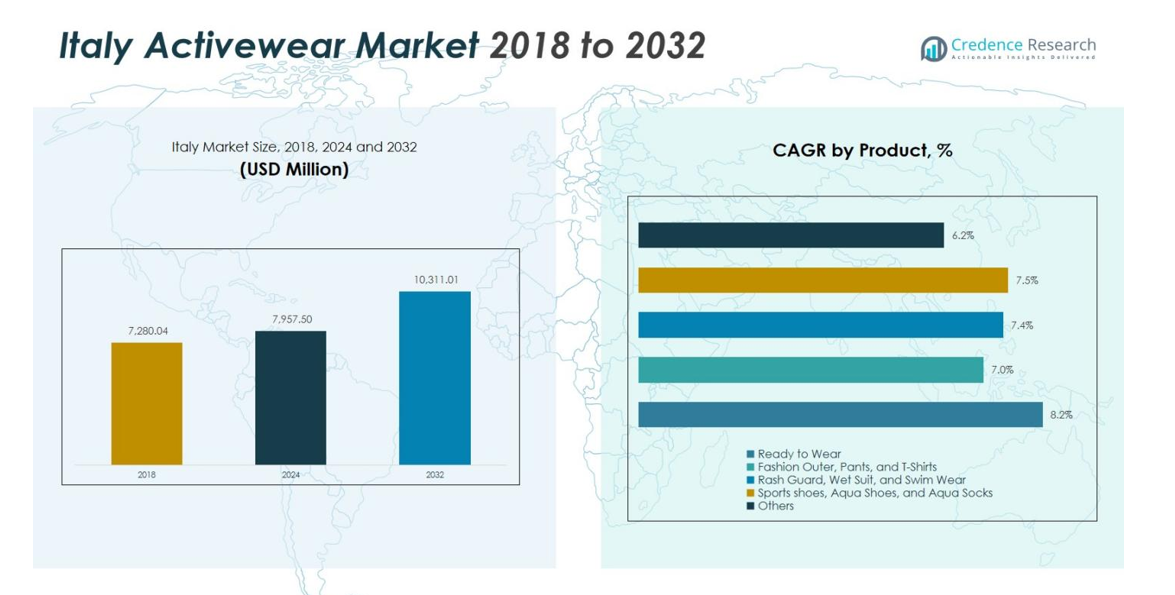
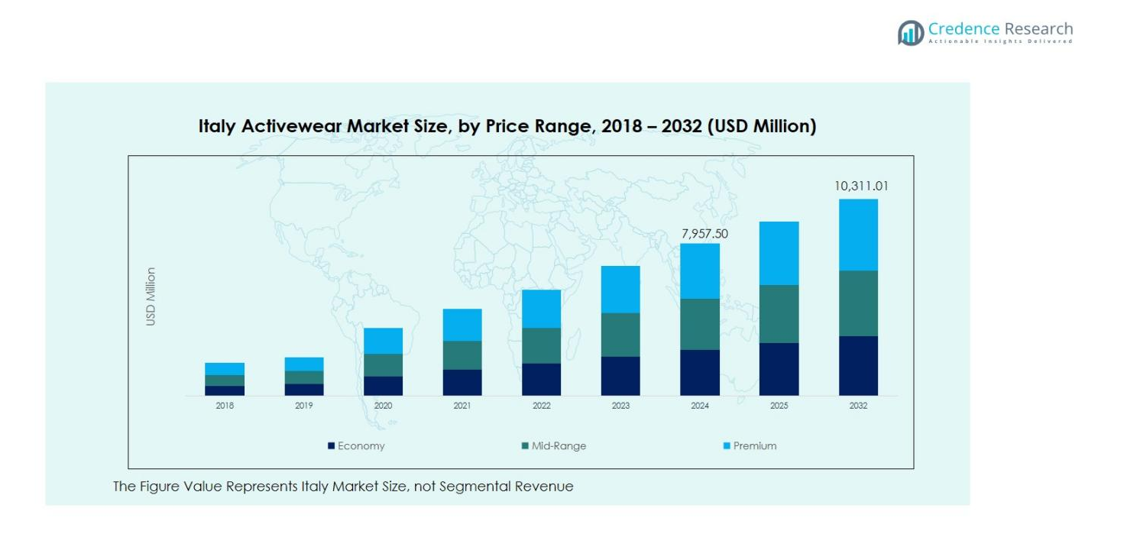
The Italy Activewear Market size was valued at USD 7,280.04 Million in 2018, increasing to USD 7,957.50 Million in 2024, and is anticipated to reach USD 10,311.01 Million by 2032, at a CAGR of 3.29% during the forecast period.
| REPORT ATTRIBUTE | DETAILS |
|---|---|
| Historical Period | 2020-2023 |
| Base Year | 2024 |
| Forecast Period | 2025-2032 |
| India Activewear Market Size 2024 | USD 7,957.50 Million |
| India Activewear Market, CAGR | 3.29% |
| India Activewear Market Size 2032 | USD 10,311.01 Million |
The Italy Activewear Market features leading players such as Adidas, Nike, Puma, Under Armour, and Emporio Armani, which collectively dominate the sector through robust brand equity and wide distribution networks. The market’s highest concentration lies in Northern Italy, which commands around 40% of the total market share, driven by affluent consumers, urban fitness culture, and high retail density. Central Italy follows with about 30% share, benefiting from strong sports participation and lifestyle‑driven purchases. Southern Italy holds nearly 20% share and the Islands account for the remaining 10%, each region reflecting distinct consumer profiles and growth opportunities.
Market Insights
- The Italy Activewear Market size in 2024 stands at USD 7,957.50 Million and is expected to grow at a CAGR of 3.29% through the forecast period to reach USD 10,311.01 Million.
- Rising health and fitness awareness is driving the activewear segment, especially as gym memberships and participation in outdoor activities increase, boosting demand in key segments such as Ready to Wear (with ~35% share) and synthetic‑material garments (~70% material share).
- The trend of athleisure and fashion‑forward activewear is creating new opportunities, with versatility from workout to casual wear and the increasing influence of online channels aiding growth in segments like Polyester fabric (~40% share).
- Major players such as Adidas, Nike, Puma, Under Armour and Emporio Armani are intensifying competition, and regional dominance is concentrated in Northern Italy with 40% share, followed by Central Italy with 30% share.
- High pricing of premium products and price sensitivity in regions like Southern Italy (20% share) and the Islands (10% share) pose restraint, limiting expansion in the economy and mid‑range segments.
Market Segmentation Analysis:
By Product
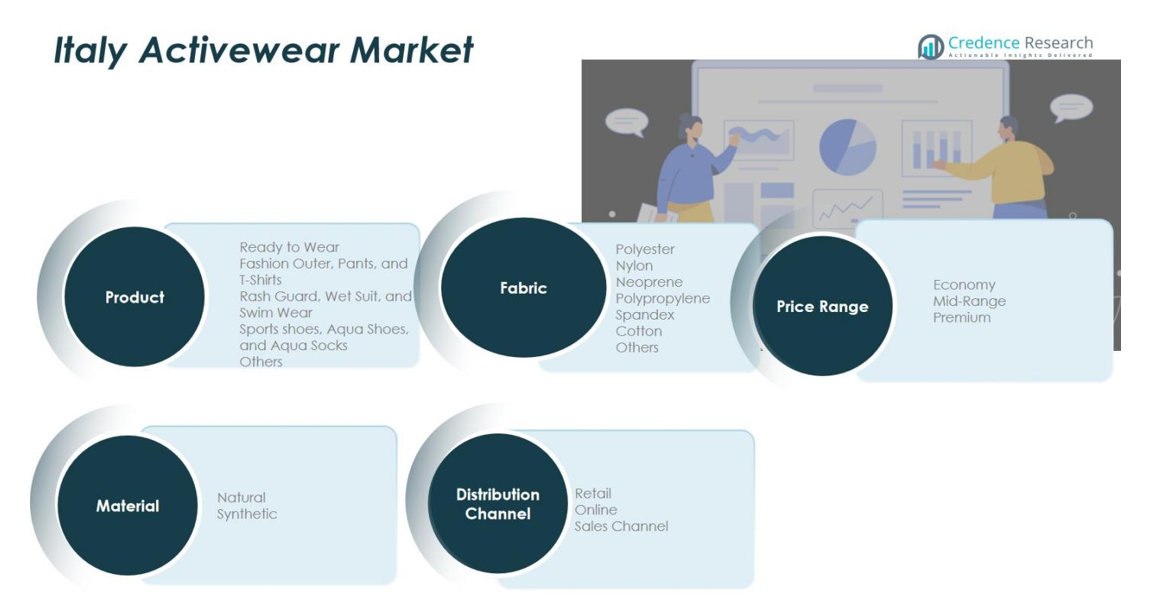
The Italy Activewear Market is characterized by diverse product offerings, with Ready to Wear leading the segment with the largest market share. This sub-segment is valued for its convenience and versatility, catering to the increasing demand for stylish and functional everyday apparel. Fashion Outer, Pants, and T-Shirts hold a significant share as well, driven by consumer preference for comfortable, performance-enhancing clothing. Sports Shoes, Aqua Shoes, and Aqua Socks are also gaining traction, especially in active outdoor sports. Other categories contribute smaller shares but still play a role in the growing market for specialized activewear. Ready to Wear holds a dominant position with 35% of the market share.
- For instance, Kappa, an iconic Italian brand founded in Turin in 1967, is renowned for its bold tracksuits and football kits that blend style with performance, meeting the demand for versatile Ready to Wear options.
By Fabric
In the Italy Activewear Market, Polyester leads the fabric segment, holding a substantial market share due to its durability, moisture-wicking properties, and cost-effectiveness. Polyester-based activewear is highly sought after for both performance and casual wear, especially in athletic settings. Nylon follows closely, known for its strength and lightweight qualities, often used in outdoor sports gear. Spandex is gaining popularity for its stretchability and flexibility, vital for activewear intended for high-mobility activities. Polypropylene and Neoprene are niche but expanding due to their specialized applications. Polyester captures 40% of the fabric segment share.
- For instance, Nike offers popular lines such as the Dri-FIT collection in Italy, which are composed predominantly of polyester fibers to optimize sweat-wicking for athletes.
By Material
The Italy Activewear Market is primarily driven by Synthetic materials, which dominate the material segment due to their advanced performance characteristics such as moisture management, flexibility, and durability. Materials like Spandex and Polyester are central to the development of activewear due to their lightweight, stretchable properties. Natural materials are growing in popularity, especially in eco-conscious product lines, but they still represent a smaller portion of the market. Synthetic materials hold 70% of the material segment share, fueled by ongoing demand for high-performance apparel.
Key Growth Drivers
Rising Health Consciousness
The increasing awareness about health and fitness is a significant driver in the Italy Activewear Market. As more consumers engage in physical activities like gym workouts, yoga, and running, the demand for high-performance, comfortable, and stylish activewear has surged. With an emphasis on maintaining a healthy lifestyle, individuals are investing in activewear that not only enhances their performance but also promotes well-being. This shift in consumer behavior has fueled growth in the sector, especially in the ready-to-wear and sports footwear segments.
- For instance, Diadora, a leading Italian sportswear brand, has successfully combined traditional craftsmanship with modern technical fabrics to offer performance training gear and footwear that cater to both style and functionality, aligning with the growing consumer focus on well-being.
Growing Fashion and Lifestyle Integration
The integration of activewear into daily fashion is another key growth driver in the Italian market. Consumers increasingly seek versatile clothing that can transition seamlessly from workout sessions to casual outings. This trend has led to the rise of athleisure, which combines comfort and style, gaining popularity in urban areas. With major fashion houses launching activewear collections, the market has seen strong growth. The shift towards performance-driven yet fashionable clothing continues to expand the market beyond traditional sports enthusiasts, appealing to a broader consumer base.
- For instance, Fendi's activewear line combines luxury and performance through high-quality materials and stylish designs, appealing to fashion-conscious consumers.
Technological Advancements in Fabric and Design
Advancements in fabric technology and design have propelled the growth of the Italy Activewear Market. Innovations such as moisture-wicking, temperature-regulating, and antimicrobial fabrics have made activewear more comfortable and functional. Additionally, the introduction of sustainable materials, including recycled polyester and organic cotton, has responded to the growing environmental concerns of consumers. These technological enhancements not only improve the performance and durability of activewear but also align with the increasing demand for eco-friendly products, further boosting the market's expansion.
Key Trends & Opportunities
Increase in E-commerce and Online Shopping
The shift towards online shopping presents a significant opportunity for the Italy Activewear Market. E-commerce platforms offer consumers convenience, a wide variety of products, and the ability to compare prices, driving the market’s growth. The COVID-19 pandemic accelerated this trend as consumers turned to online shopping for both essential and non-essential goods. As a result, brands and retailers are investing in digital transformation, optimizing online channels to reach a broader audience. This shift to digital shopping opens new avenues for growth, particularly in niche and sustainable activewear segments.
- For instance, the Italian eco-sustainable activewear brand Y-GLAM crafts its products in small quantities using certified eco-friendly Italian fabrics and markets them through online boutiques and wellness centers focused on conscious shopping.
Sustainability in Activewear
Sustainability has emerged as a key trend in the Italy Activewear Market. With growing consumer awareness about environmental impact, there is a strong demand for eco-friendly products made from recycled and organic materials. Brands that integrate sustainability into their product lines are attracting more environmentally conscious consumers. Additionally, advancements in sustainable manufacturing processes, such as low-waste production techniques, are creating new opportunities in the market. The adoption of circular economy principles and eco-friendly certifications is likely to become a crucial factor in consumer purchasing decisions.
- For instance, Indigo Luna produces leggings and swimwear using Italian recycled Econyl, a material sourced from discarded fishing nets, ensuring both performance and environmental stewardship.
Key Challenges
High Price of Premium Activewear
One of the primary challenges in the Italy Activewear Market is the high cost of premium products. While there is a growing demand for high-quality, technologically advanced activewear, the premium prices associated with these products can limit market growth, particularly among price-sensitive consumers. The rising cost of raw materials, such as sustainable fabrics and high-performance materials, further contributes to the price hike. This creates a barrier to mass-market adoption, especially in the mid-range and economy segments, as consumers may opt for more affordable alternatives instead of high-end options.
Intense Market Competition
The Italy Activewear Market faces intense competition, with both established global brands and local players vying for market share. Major international brands like Adidas, Nike, and Puma dominate the market, while smaller, niche companies are attempting to capture the growing demand for sustainable and innovative products. This competitive landscape pressures companies to differentiate through product innovation, branding, and pricing strategies. With constant innovation required to stay ahead and consumer preferences evolving rapidly, companies must navigate a highly dynamic market to maintain their position and avoid losing relevance.
Regional Analysis
Northern Italy
Northern Italy holds the largest market share in the Activewear Market, accounting for 40% of the total market. This region, including cities like Milan and Turin, is known for its fashion-forward consumer base and a high concentration of fitness enthusiasts. The demand for activewear in Northern Italy is driven by the increasing participation in sports and fitness activities, as well as the growing popularity of athleisure. Additionally, the region’s robust retail and e-commerce channels further contribute to its dominant market position. Premium and eco-friendly activewear segments are particularly popular in this area, reflecting the region's progressive attitude toward sustainability.
Central Italy
Central Italy, including cities such as Rome and Florence, captures 30% of the Italy Activewear Market share. The region benefits from a well-established sports culture and a growing focus on health and fitness, which drives activewear consumption. The demand is primarily concentrated in urban areas, where the lifestyle-driven purchasing decisions align with trends in athleisure. Central Italy also has a significant market for mid-range activewear products, with a growing preference for versatile, stylish, and functional garments that can transition from workouts to daily wear. The online retail channel is increasingly contributing to the growth in this region.
Southern Italy
Southern Italy, with regions such as Naples and Palermo, represents 20% of the market share in the Italy Activewear Market. The demand in this region is primarily driven by the increasing awareness of health and wellness among consumers. While traditionally slower to adopt fitness trends, Southern Italy has seen growing interest in activewear due to rising participation in outdoor activities like hiking and running. Price-sensitive consumers in this region prefer affordable and durable activewear, with the economy and mid-range segments experiencing significant growth. E-commerce is becoming an essential channel for reaching this region’s consumers.
Islands (Sicily and Sardinia)
The Islands of Sicily and Sardinia account for 10% of the Italy Activewear Market. These regions, known for their outdoor recreational activities such as hiking, cycling, and water sports, have seen an increase in demand for activewear products suited to such environments. The market in these areas is growing as local consumers become more health-conscious and engage in fitness routines. However, the demand is still relatively lower compared to mainland regions, with a greater preference for budget-friendly activewear. Retail and local stores remain the dominant channels in these islands, although online shopping is gradually gaining traction.
Market Segmentations:
By Product
- Ready to Wear
- Fashion Outer, Pants, and T-Shirts
- Rash Guard, Wet Suit, and Swim Wear
- Sports Shoes, Aqua Shoes, and Aqua Socks
- Others
By Fabric
- Polyester
- Nylon
- Neoprene
- Polypropylene
- Spandex
- Cotton
- Others
By Material :
- Natural
- Synthetic
By Price Range :
- Economy
- Mid-Range
- Premium
By Distribution Channel
- Retail
- Online
- Others
By Region
- Northern Italy
- Central Italy
- Southern Italy
- Islands
Competitive Landscape
The Italy Activewear Market is highly competitive, with major global brands such as Adidas, Nike, Puma, Under Armour, and Emporio Armani leading the market. These companies dominate the market due to their strong brand recognition, wide product offerings, and extensive distribution networks. Adidas and Nike, in particular, are leaders in both the premium and sports-specific segments, known for their innovative technologies in activewear. Additionally, local players such as Legea and CiaoGym have carved out niches by focusing on specialized athletic gear and catering to regional preferences. The market is also experiencing significant growth in the eco-friendly activewear sector, with brands like Castelli and De Marchi gaining traction by offering sustainable, performance-driven products. The growing trend of athleisure has led to increased competition, forcing brands to focus on product differentiation, fashion-forward designs, and high-performance features. E-commerce platforms and direct-to-consumer sales are becoming increasingly important, reshaping traditional retail strategies in the competitive landscape.
Key Player Analysis
Recent Developments
- In November 2025, Fila opened a new brand‑experience centre in its home town of Biella, Italy - reinforcing its presence and brand‑building in the Italian activewear/sportswear sector.
- In July 2025, Lululemon opened its first store in Milan, Italy - marking the brand’s entry into the Italian activewear market.
- In September 2025, Macron announced a partnership to become the match‑official kit supplier for the United Rugby Championship (URC) from the 2025/26 season.
- In November 2025, Fila opened a new brand experience centre in its hometown of Biella, Italy - refurbishing its historic headquarters building.
Report Coverage
The research report offers an in-depth analysis based on Product, Fabric, Material, Price Range, Distribution Channel and Region. It details leading market players, providing an overview of their business, product offerings, investments, revenue streams, and key applications. Additionally, the report includes insights into the competitive environment, SWOT analysis, current market trends, as well as the primary drivers and constraints. Furthermore, it discusses various factors that have driven market expansion in recent years. The report also explores market dynamics, regulatory scenarios, and technological advancements that are shaping the industry. It assesses the impact of external factors and global economic changes on market growth. Lastly, it provides strategic recommendations for new entrants and established companies to navigate the complexities of the market.
Future Outlook
- The Italy Activewear Market is expected to continue its growth trajectory, driven by increasing consumer participation in fitness and wellness activities.
- Athleisure will remain a dominant trend, with consumers seeking versatile clothing suitable for both active and casual wear.
- Sustainable activewear will become more mainstream as consumers increasingly demand eco-friendly products made from recycled and organic materials.
- The rise of e-commerce will further accelerate, with more brands focusing on online platforms to reach a wider audience across Italy.
- Technological innovations in fabric, such as moisture-wicking and temperature-regulating materials, will enhance product functionality and attract more consumers.
- The demand for premium activewear will rise as consumers prioritize quality, performance, and design in their purchasing decisions.
- Regional disparities in market growth will persist, with Northern Italy continuing to lead in market share due to higher income levels and urbanization.
- There will be a stronger focus on direct-to-consumer channels, enabling brands to build closer relationships with customers and offer personalized experiences.
- Collaboration between activewear brands and fashion designers will intensify, resulting in more high-fashion activewear collections targeting fashion-conscious consumers.
- Increased awareness about mental health and fitness will drive demand for activewear, as consumers view exercise as an essential part of their lifestyle.

Request a Free Sample
Fill in your details and we'll send you a free sample report.
- Sample data tables & charts
- Research methodology
Need a Custom Version of This Report?
Tailor the scope, geography, or segments to your exact requirements.
- Custom geography or segment scope
- Direct access to our analyst team
Frequently Asked Questions
What is the current market size for Italy Activewear Market, and what is its projected size in 2032?
At what Compound Annual Growth Rate is the Italy Activewear Market projected to grow between 2025 and 2032?
Which Italy Activewear Market segment held the largest share in 2024?
What are the primary factors fueling the growth of the Italy Activewear Market?
Who are the leading companies in the Italy Activewear Market?
Which region commanded the largest share of the Italy Activewear Market in 2024?
Table of Content
Chapter 1 Market Segmentation
- 1.1 Segmentation Framework
- 1.1.1 Product and Service Classification
- 1.1.2 Application and End-Use Classification
- 1.1.3 Technology and Solution Classification
- 1.1.4 Customer and Distribution Channel Classification
- 1.1.5 Geographic Segmentation
- 1.1.6 Market Segment Definitions and Boundaries
Chapter 2 Introduction
- 2.1 Report Objectives and Scope
- 2.2 Product Definition and Industry Terminology
- 2.3 Market Inclusions and Exclusions
- 2.4 Research Process
- 2.4.1 Primary Research and Expert Interviews
- 2.4.2 Secondary Research and Source Review
- 2.4.3 Top-Down and Bottom-Up Estimation
- 2.4.4 Data Triangulation and Verification
- 2.5 Market Size Measurement Basis
- 2.5.1 2024: USD 7,957.50 Million → 2032: USD 10,311.01 Million
- 2.6 Historical and Forecast Reference Periods
- 2.6.1 Base Year: 2024
- 2.6.2 Forecast Period: 2024-2032
- 2.7 Research Assumptions and Limitations
Chapter 3 Executive Summary
- 3.1 Market Snapshot and Key Findings
- 3.2 Base-Year Market Size, 2024
- 3.3 Forecast Market Size, 2032
- 3.4 Revenue and Volume Growth Outlook
- 3.5 Key Demand and Supply Indicators
- 3.6 Leading Market Segments
- 3.7 Fastest-Growing Market Opportunities
- 3.8 Regional Performance Highlights
- 3.9 Technology and Industry Transformation
- 3.10 Competitive Landscape Summary
- 3.11 Analyst View and Strategic Implications
Chapter 4 Italy Activewear Market Trends and Developments
- 4.1 Historical Industry Development
- 4.2 Recent Market Trends and Developments
- 4.3 Demand and Customer Behavior Trends
- 4.4 Technology and Product Innovation
- 4.5 Artificial Intelligence, Automation and Digitalization
- 4.6 Local Manufacturing and Supply Chain Realignment
- 4.7 Industry Partnerships, Mergers and Acquisitions
- 4.8 Sustainability and Circular Economy Developments
- 4.9 Government and Private Sector Investment Trends
- 4.10 Emerging Business Models and Commercialization
- 4.11 Industry Developments and Announcements
Chapter 5 Italy Activewear Market Production, Supply and Demand Analysis
- 5.1 Demand Trend and Consumption Analysis
- 5.2 Demand Forecast, 2024-2032
- 5.3 Production and Output Trend
- 5.4 Production and Output Forecast, 2024-2032
- 5.5 Installed Capacity and Capacity Utilization
- 5.6 Company-Wise Production Plants and Statistics
- 5.6.1 Installed Production Capacity
- 5.6.2 Actual Production
- 5.6.3 Planned Capacity and Expansion Targets
- 5.7 Supply Chain Structure and Procurement Trends
- 5.8 Supply-Demand Gap and Bottlenecks
- 5.9 Import Dependence and Sourcing Structure
- 5.10 Contract Manufacturing and Outsourcing
- 5.11 Regional Supply and Demand Concentration
Chapter 6 Italy Activewear Market Pricing Analysis
- 6.1 Pricing Structure and Measurement
- 6.2 Historical Pricing Trends
- 6.3 Pricing Outlook, 2024-2032
- 6.4 Average Selling Price and Unit Economics
- 6.5 Pricing by Product and Market Segment
- 6.6 Geographic Pricing Differences
- 6.7 Key Input, Energy, Labor and Logistics Costs
- 6.8 Contract Pricing and Purchasing Models
- 6.9 Pricing Sensitivity and Competitive Positioning
- 6.10 Price, Margin and Profitability Implications
Chapter 7 Italy Activewear Market Dynamics
- 7.1 Market Growth Drivers
- 7.1.1 Demand-Side Drivers
- 7.1.2 Technology and Innovation Drivers
- 7.1.3 Infrastructure and Investment Drivers
- 7.1.4 Regulatory and Policy Drivers
- 7.2 Market Restraints
- 7.2.1 Cost and Affordability Constraints
- 7.2.2 Technology and Adoption Barriers
- 7.2.3 Supply Chain and Operational Constraints
- 7.3 Market Challenges
- 7.3.1 Competitive Pressure and Margin Erosion
- 7.3.2 Skills, Infrastructure and Implementation Gaps
- 7.4 Emerging Market Opportunities
- 7.5 Market Dynamics Impact and Time-Horizon Assessment
Chapter 8 Italy Activewear Value Chain Analysis
- 8.1 Industry Value Chain Overview
- 8.2 Upstream Suppliers and Critical Inputs
- 8.3 Technology and Component Providers
- 8.4 Manufacturing or Service Delivery
- 8.5 Distribution, Channel Partners and Integrators
- 8.6 Downstream Applications and End Users
- 8.7 Value Addition and Profit Pools
- 8.8 Vertical Integration and Outsourcing
- 8.9 Supplier Concentration and Risk
- 8.10 Supply Chain Localization and Resilience
Chapter 9 Italy Activewear Market Regulations and Policies
- 9.1 Relevant Laws, Standards and Compliance Frameworks
- 9.2 Product, Service, Safety and Quality Requirements
- 9.3 Government Policies, Incentives and Subsidies
- 9.4 Imports, Exports and Trade Barriers
- 9.5 Public Procurement and Local Content Requirements
- 9.6 Environmental and Sustainability Compliance
- 9.7 Upcoming Policy Changes and Market Implications
Chapter 10 Italy Activewear Market Hotspots and Opportunities
- 10.1 Market Opportunity Mapping and Growth Hotspots
- 10.2 High-Growth Applications and Customer Groups
- 10.3 Underserved Markets and White-Space Opportunities
- 10.4 Emerging Technology and Product Opportunities
- 10.5 New Capacity and Investment Hotspots
- 10.6 Market Entry and Expansion Opportunities
- 10.7 Distribution and Partnership Opportunities
- 10.8 Near-Term and Long-Term Commercial Potential
- 10.9 Opportunity Attractiveness and Execution Risks
Chapter 11 Italy Activewear Market Outlook, 2024-2032
- 11.1 Market Size and Analysis
- 11.1.1 Revenue (Market Measurement: 2024: USD 7,957.50 Million → 2032: USD 10,311.01 Million)
- 11.1.2 Market Volume and Quantity Sold
- 11.1.3 Historical Market Size
- 11.1.4 Base-Year Market Size, 2024
- 11.2 Market Forecast, 2024-2032
- 11.2.1 Revenue Forecast to 2032
- 11.2.2 Volume Forecast to 2032
- 11.2.3 CAGR and Year-on-Year Growth
- 11.2.4 Incremental Revenue Opportunity
- 11.3 Forecast Assumptions and Scenario Analysis
- 11.3.1 Base-Case Forecast
- 11.3.2 Optimistic and Conservative Scenarios
- 11.3.3 Technology, Pricing and Policy Sensitivities
- 11.4 Market Attractiveness and Growth Outlook
Chapter 12 Italy Activewear Market Segmentation and Outlook
- 12.1 Segmentation Summary and Market Shares, 2024
- 12.2 Largest and Fastest-Growing Segments
- 12.3 Segment Growth Comparison
- 12.4 Segment Attractiveness and Priority Matrix
Chapter 13 Italy Activewear Geographic Market Outlook, 2024-2032
- 13.1 Domestic Market Distribution and Demand Clusters
- 13.2 State- or Province-Wise Market Size and Forecast, 2024-2032
- 13.3 City and Metropolitan Market Outlook
- 13.4 Industrial, Manufacturing and Commercial Clusters
- 13.5 Geographic Concentration of Key End Users
- 13.6 Local Pricing and Purchasing Differences
- 13.7 Domestic Production Facilities and Capacity Map
- 13.8 Local Infrastructure and Project Pipeline
- 13.9 State-Level Policy and Incentive Differences
- 13.10 Subnational Investment Hotspots and Opportunities
- 13.11 Distribution and Logistics Networks
- 13.12 Domestic Competitive Footprint
Chapter 14 Italy Activewear Technology, Innovation and Sustainability Outlook
- 14.1 Technology Landscape and Maturity
- 14.2 Product, Process and Service Innovation
- 14.3 AI, Automation and Digital Tools in the Industry
- 14.4 Technology Adoption and Performance Benchmarking
- 14.5 Innovation Pipeline and R&D Investment
- 14.6 Patent and Intellectual Property Trends
- 14.7 Energy Efficiency and Resource Management
- 14.8 Sustainability, Recycling and Circularity
- 14.9 Technology Roadmap, 2024-2032
- 14.10 Risks of Obsolescence and Technology Substitution
Chapter 15 Italy Activewear Market Key Strategic Imperatives
- 15.1 Growth and Market Entry Priorities
- 15.2 High-Return Products and Segments
- 15.3 Pricing, Profitability and Cost Optimization
- 15.4 Technology Investment and Product Differentiation
- 15.5 Supply Chain Localization and Resilience
- 15.6 Distribution and Customer Acquisition
- 15.7 Partnership, Acquisition and Capacity Strategy
- 15.8 Regional Expansion Priorities
- 15.9 Short-, Medium- and Long-Term Actions
Chapter 16 Competition Outlook
- 16.1 Industry Competition Characteristics
- 16.2 Market Structure and Concentration
- 16.3 Market Share and Competitive Positioning, 2024
- 16.4 Company-Wise Revenue and Product Benchmarking
- 16.5 Production and Service Capacity Benchmarking
- 16.6 Technology, Pricing and Differentiation
- 16.7 Regional Footprint and Distribution Strength
- 16.8 Mergers, Acquisitions and Strategic Alliances
- 16.9 New Entrants and Competitive Threats
- 16.10 Porter's Five Forces and Industry Attractiveness
- 16.11 Competitive Outlook, 2024-2032
Chapter 17 Company Profiles
- 17.1 Company Coverage and Selection Criteria
- 17.2 Leading Market Participants – Standard Profile Structure
- 17.2.1 Business Description
- 17.2.2 Company Ownership and Geographic Presence
- 17.2.3 Product and Service Portfolio
- 17.2.4 Manufacturing and Operating Footprint
- 17.2.5 Production Capacity and Expansion Plans
- 17.2.6 Financial Performance and Investment
- 17.2.7 Market Share and Competitive Position
- 17.2.8 Technology and Innovation Capabilities
- 17.2.9 Strategic Alliances or Partnerships
- 17.2.10 Recent Developments
- 17.2.11 Growth Strategy and Outlook
- 17.3 Other Relevant Market Participants
Note: Every listed company is profiled on the structure shown under the first company. The company list is preliminary and may change based on research findings, market developments, data availability and client requirements.
Chapter 18 Disclaimer
- 18.1 Research and Forecast Disclaimer
- 18.2 Data Source and Estimation Limitations
Note: The depth of individual sections depends on data availability for this market. Volume, capacity, trade and other unit-based metrics are included where applicable.
