
| REPORT ATTRIBUTE | DETAILS |
|---|---|
| Historical Period | 2019-2022 |
| Base Year | 2023 |
| Forecast Period | 2024-2032 |
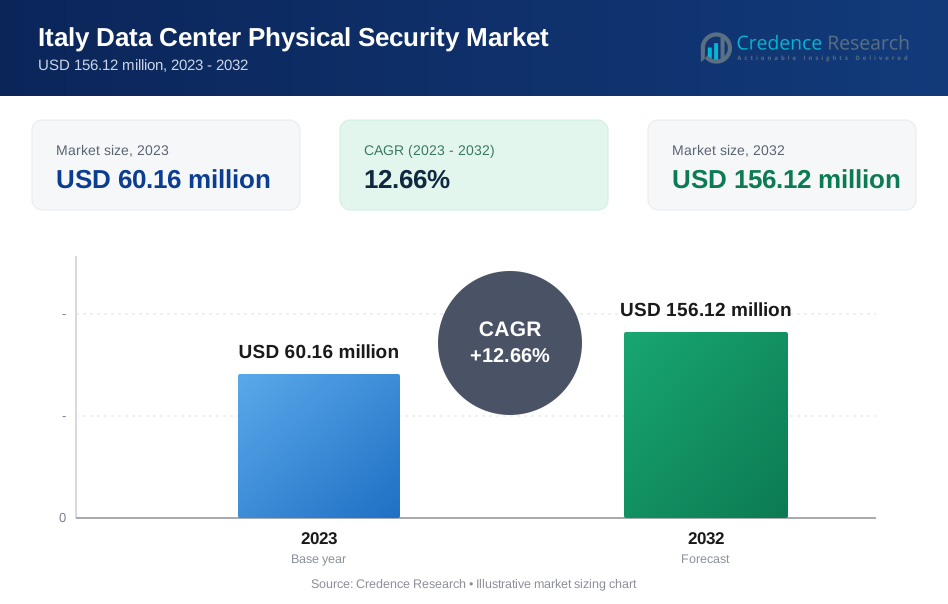
| Italy Data Center Physical Security Market Size 2023 | USD 60.16 million |
| Italy Data Center Physical Security Market, CAGR | 12.66% |
| Italy Data Center Physical Security Market Size 2032 | USD 156.12 million |
Market Overview
The Italy Data Center Physical Security Market is projected to grow from USD 60.16 million in 2023 to an estimated USD 156.12 million by 2032, with a compound annual growth rate (CAGR) of 12.66% from 2024 to 2032. The increasing demand for robust data protection in the face of rising cyber threats and the growing number of data centers in the region are expected to drive this expansion.
Several key factors are driving the growth of the Italy Data Center Physical Security Market. The increasing need for compliance with stringent data protection regulations and the rise in cybercrime incidents have made physical security measures in data centers crucial. Additionally, the ongoing digital transformation across industries, coupled with the rapid expansion of cloud services, has created a heightened focus on securing data storage facilities. The integration of Internet of Things (IoT) technologies, artificial intelligence (AI), and advanced analytics into physical security systems is a notable trend in the market.
Geographically, Italy stands as one of the key hubs for data centers in Europe, with a growing number of both regional and global players investing in the market. Major cities like Milan, Rome, and Turin are witnessing significant developments in data center infrastructure. Key players in the Italy Data Center Physical Security Market include IBM Corporation, Honeywell International Inc., and Schneider Electric, who are leading the charge in providing integrated physical security solutions to meet the growing demands of the sector.
Market Insights
- The Italy Data Center Physical Security Market is projected to grow from USD 60.16 million in 2023 to USD 156.12 million by 2032, driven by the increasing demand for robust data protection and secure data storage.
- Key drivers include the growing need for compliance with data protection regulations, rising cyber threats, and the expansion of cloud services, pushing for advanced security solutions in data centers.
- Integration of advanced technologies like AI, IoT, and analytics into physical security systems is fueling innovation, enabling real-time threat detection and automated security management.
- Despite growth, the market faces challenges such as high costs for advanced security solutions and the complexity of integrating diverse systems into a unified security infrastructure.
- Northern Italy, especially cities like Milan, leads the demand for physical security solutions, with the region hosting a significant number of data centers and technological investments.
- The rise in remote monitoring and cloud-based security systems is transforming how data centers manage and respond to physical security threats, improving flexibility and scalability.
- Major players like IBM, Honeywell, and Schneider Electric are driving the market with integrated security systems, ensuring that data centers meet rising security demands and regulatory standards.
Market Drivers
Increasing Cybersecurity Threats and Need for Comprehensive Protection
The rising frequency and sophistication of cyber threats necessitate enhanced physical security measures in data centers across Italy. For instance, in the first half of 2024, Italy recorded a significant rise in cyberattacks, with healthcare and manufacturing sectors being particularly vulnerable. The Clusit 2024 Mid-Year Report highlighted that Italy experienced a 23% increase in global cyber incidents, averaging nine serious attacks per day. This alarming trend underscores the critical need for data centers to implement robust physical security protocols, such as biometric access controls and advanced surveillance systems, to safeguard against unauthorized access and potential breaches. Cybercriminals often target data centers as a means to breach networks, making it essential for these facilities to adopt multi-layered security solutions. By integrating proactive measures such as intrusion detection systems, data centers can mitigate vulnerabilities and ensure the resilience of critical infrastructure against both physical and cyberattacks. The growing recognition that physical security is an essential component of overall data security is driving market expansion, as organizations increasingly prioritize investments in comprehensive protection strategies.
Compliance with Stringent Data Protection Regulations
Regulatory compliance significantly shapes the demand for physical security solutions in data centers. The European Union's General Data Protection Regulation (GDPR) and Italy's own data protection laws mandate strict measures for securing sensitive data and preventing unauthorized access. As organizations strive to meet these legal requirements, they are investing heavily in technologies that ensure both physical and data security. For instance, many Italian data centers are enhancing their security frameworks by adopting advanced access control systems, video surveillance, and fire detection technologies. Failure to comply with these regulations can lead to substantial financial penalties and reputational damage, prompting organizations to prioritize investments in physical security solutions. Furthermore, as regulatory frameworks around data protection evolve, the demand for advanced security measures that help data centers meet stringent requirements is expected to rise. This compliance-driven approach not only enhances the overall security posture of data centers but also reinforces their commitment to protecting sensitive information, thus fueling growth in the Italy Data Center Physical Security Market.
Growth of Cloud Services and Digital Transformation
The rapid expansion of cloud services is driving a surge in data center construction across Italy. As companies increasingly rely on cloud solutions for data storage and processing, the number of data centers being established has risen dramatically. This growth presents new challenges in securing critical infrastructure against both internal and external threats. The need for robust physical security systems has become paramount to maintaining business continuity and customer trust. For instance, as organizations adopt digital tools more widely, they face heightened risks that necessitate advanced surveillance systems, perimeter protection, and access control technologies. Additionally, the demand for high availability in cloud environments compels data centers to invest more heavily in physical security solutions to prevent disruptions caused by security breaches. This digital transformation not only contributes to the expansion of the market but also emphasizes the importance of integrating physical security measures into the broader operational strategy of organizations leveraging cloud services.
Integration of IoT, AI, and Automation in Physical Security Systems
The integration of advanced technologies such as the Internet of Things (IoT), artificial intelligence (AI), and automation is revolutionizing the physical security landscape within Italian data centers. These innovations enhance efficiency, accuracy, and scalability in monitoring and securing physical assets. For example, AI-powered video surveillance systems can analyze real-time data to detect anomalies like unauthorized access or suspicious behavior with greater precision than traditional methods. IoT-enabled devices such as smart locks and sensors provide real-time alerts when integrated into central monitoring systems, significantly reducing human error risks. Furthermore, automation streamlines the management of security protocols, allowing operators to respond more swiftly to potential threats. As these technologies become more prevalent, the demand for integrated physical security solutions that leverage IoT and AI innovations is expected to rise. This trend not only enhances overall security but also improves operational efficiency by reducing costs associated with manual interventions while minimizing the likelihood of breaches—thus driving further growth in the Italy Data Center Physical Security Market.
Market Trends
Increasing Adoption of AI-Powered Security Solutions
Artificial intelligence (AI) is rapidly becoming an essential component in the physical security solutions deployed in Italy's data centers. AI-driven technologies, such as video surveillance systems that use facial recognition, object detection, and behavior analytics, are revolutionizing the way security is managed. These AI-powered systems offer the ability to analyze vast amounts of data in real-time, providing instant alerts and reducing the need for human intervention. For instance, the integration of AI-powered surveillance systems has demonstrated significant advancements in security management. AI-driven cameras can analyze real-time data to detect unusual behavior patterns, such as unauthorized access attempts or suspicious movements. These systems enhance security by providing immediate alerts to personnel while reducing reliance on manual monitoring, allowing for more efficient resource allocation and quicker response times.As AI technologies continue to evolve, they are expected to become even more integrated into the physical security infrastructure of Italian data centers. This integration not only improves security but also enhances operational efficiency by learning from past incidents to continually refine their effectiveness in detecting and preventing threats. The ongoing adoption of AI solutions is set to transform how data centers manage security challenges in an increasingly complex environment.
Integration of Internet of Things (IoT) for Enhanced Security
The Internet of Things (IoT) is another key trend driving the transformation of physical security in the Italian data center market. IoT-enabled devices, such as smart cameras, motion sensors, access control systems, and smart locks, are increasingly being integrated into the security infrastructure of data centers to provide comprehensive protection. For example, perimeter IoT sensors can detect unauthorized movements and instantly send alerts to security teams, enabling rapid intervention. This interconnectedness not only strengthens security protocols but also provides valuable data analytics that can inform future strategies.The use of IoT devices allows data centers to communicate over a network for real-time monitoring and immediate response to security events. IoT-enabled smart locks can grant or restrict access based on predefined security policies, seamlessly integrating with other technologies. As IoT technology continues to advance, its role in enhancing physical security is set to grow significantly, providing enhanced protection and operational efficiencies. The ability to collect and analyze data on security events further empowers organizations to optimize their operations and adapt quickly to emerging threats.
Rise in Demand for Remote Monitoring and Management Solutions
As remote work and digital operations become more prevalent, the demand for remote monitoring and management solutions for physical security systems has increased significantly. Italian data centers are adopting centralized, cloud-based systems that allow security personnel to monitor and manage physical security measures from any location at any time. This capability is particularly valuable for organizations operating multiple data centers across the country or globally, ensuring consistent security without the need for on-site personnel at all times.For instance, remote monitoring solutions enable teams to observe surveillance footage, manage access control systems, and respond to alerts through a single platform. Additionally, these solutions often incorporate AI capabilities that proactively detect potential threats and trigger automated responses. The trend toward remote monitoring is driven by the need for greater efficiency, scalability, and flexibility in managing security operations. As this demand continues to rise, organizations are increasingly recognizing the benefits of remote management solutions in enhancing their overall security posture while reducing human error.
Focus on Integration and Centralized Security Management
Another notable trend in the Italian data center physical security market is the increasing shift toward integrated security solutions. Data centers are moving away from siloed systems in favor of comprehensive platforms that unify video surveillance, access control, intrusion detection, and environmental monitoring into a single interface. This integration provides a holistic view of all security systems across a facility, enabling more effective responses to potential threats.For example, an integrated system can automatically lock down specific areas of a data center upon detecting an intruder or adjust camera focus based on real-time risk assessments. Centralized management platforms also streamline maintenance and reporting processes while improving coordination among various security functions. The growing complexity of data center security needs drives this demand for integration; as facilities expand and interconnectivity increases, having a unified platform becomes essential. By adopting integrated solutions, Italian data centers can enhance their ability to mitigate risks while ensuring compliance with stringent security standards.
Market Challenges
Integration Complexity and System Compatibility
One of the major challenges facing the Italy Data Center Physical Security Market is the complexity involved in integrating various security systems into a cohesive and functional infrastructure. Data centers often utilize a range of security technologies, including video surveillance, access control systems, and alarm systems, each with different specifications and requirements. Ensuring that these disparate systems can work together seamlessly presents significant challenges, especially when the systems are provided by different vendors or have different software and hardware configurations. For instance, many data centers face compatibility issues when merging various security technologies. This situation necessitates significant technical expertise and careful planning to ensure that all systems function cohesively. The lack of standardization across physical security technologies complicates the creation of effective and easy-to-maintain solutions. Consequently, data center operators in Italy may encounter increased operational complexity and higher costs associated with upgrading or replacing outdated security components. To overcome this challenge, investments in integrated security solutions that provide greater interoperability are essential, which requires additional resources and expertise. Furthermore, integrating new technologies such as AI and IoT into existing systems may involve substantial reengineering efforts, making the process complex and costly.
High Costs of Advanced Security Solutions
The adoption of advanced physical security solutions, such as AI-powered surveillance systems, IoT-enabled devices, and biometric access control, can be cost-prohibitive for some data center operators. While these technologies provide significant improvements in security and operational efficiency, the initial capital investment required for their implementation can be substantial. For small and medium-sized data centers with limited budgets, the financial burden of adopting cutting-edge security solutions poses a significant challenge.For instance, in 2024, it was noted that deploying advanced technology often necessitates substantial capital expenditure that may not be feasible for budget-constrained facilities. Additionally, ongoing maintenance, software updates, and training for staff to effectively operate these advanced systems further increase the total cost of ownership. This high cost can deter data center operators from upgrading their physical security systems or investing in the latest technologies, leaving them vulnerable to emerging threats. While the long-term benefits of enhanced security and reduced risks can justify the investment, the initial financial outlay remains a key challenge for many in the industry.
Market Opportunities
Growth in Data Center Infrastructure and Cloud Adoption
As Italy continues to experience a significant rise in data center construction, driven by the increasing demand for cloud services, there is a notable market opportunity for physical security providers. With the rapid digital transformation across various industries, Italian companies are increasingly relying on cloud computing and data storage solutions, driving the demand for new data centers. For instance, in September 2023, a consortium of Italian companies announced plans to develop a data center in the San Romedio mine in Trento, collaborating with various stakeholders including the University of Trento and IT services firm Deda Group. This initiative reflects the increasing investment in data center infrastructure in Italy, underscoring the growing demand for advanced physical security solutions to protect sensitive data and critical IT systems as these facilities expand. The need for advanced security solutions, including biometric access control, perimeter security, and video surveillance, will escalate, providing a substantial opportunity for vendors to offer cutting-edge security technologies and integrated systems. As new facilities emerge, the focus on safeguarding an expanding volume of sensitive data will further drive growth in the physical security market.
Integration of AI, IoT, and Automation in Physical Security Solutions
The ongoing integration of AI, IoT, and automation within physical security systems presents a promising opportunity for market expansion. Italian data centers are increasingly adopting these advanced technologies to enhance security while improving operational efficiency. AI-powered video surveillance systems, IoT-enabled sensors, and automated access control solutions offer data centers the ability to detect and respond to security threats in real time, significantly reducing human intervention and operational costs. For example, Digital Realty's acquisition of land in Rome in September 2023 marks another significant step towards enhancing Italy's data center landscape. This development not only highlights the growing investments but also emphasizes the need for robust security measures to protect these new facilities. This trend opens doors for physical security vendors to provide innovative, automated, and integrated solutions that meet the evolving needs of modern data centers. As these technologies continue to mature, the demand for intelligent, scalable security systems is expected to increase, offering considerable growth prospects for the market.
Market Segmentation Analysis
By Component:
The solution segment is further divided into Access Control, Video Surveillance, Monitoring and Detection, and Others. Access control systems dominate the market, offering critical protection through authentication technologies such as biometrics, RFID, and key cards. Video surveillance is also a key area of growth, with AI-powered cameras increasingly deployed for monitoring and detecting security threats. Monitoring and detection systems, incorporating sensors and alarms, are gaining traction for their ability to detect unauthorized access or breaches. Other solutions, including fire and environmental monitoring, contribute to ensuring comprehensive physical security in data centers.The services segment is composed of Consulting, System Integration, and Maintenance and Support. Consulting services offer expertise in planning and designing security systems tailored to data centers’ unique requirements. System integration services are essential for combining various security technologies into a unified infrastructure. Maintenance and support services are vital to ensure continuous operation, reduce downtime, and optimize the performance of installed security solutions.
By Data Center Size:
Small Data Centers: Smaller data centers often face budget constraints, leading them to focus on cost-effective security solutions, such as basic video surveillance and access control systems. Despite this, the growing need for data protection and compliance requirements is prompting investment in physical security, even among smaller facilities.Medium-sized data centers typically implement more sophisticated security measures, including integrated systems combining video surveillance, access control, and environmental monitoring. The growth in cloud services and digital operations is driving the adoption of more advanced security technologies within this segment.Large data centers, handling substantial amounts of sensitive data, demand the most advanced and comprehensive physical security solutions. This segment sees higher adoption of AI-driven video surveillance, automated access control systems, and advanced intrusion detection systems to ensure robust protection against increasingly sophisticated threats.
Segments
Based on Component
- Solution
- Access Control
- Video Surveillance
- Monitoring and Detection
- Others
- Services
- Consulting
- System Integration
- Maintenance and Support
Based on Data Center size
- Small Data Centers
- Medium Data Centers
- Large Data Centers
Based on End Use
- BFSI
- Government & Defense
- IT & Telecom
- Healthcare & Life Sciences
- Others
Based on Region
- Milan
- Rome
- Turin
Regional Analysis
Northern Italy (45-50%)
Northern Italy dominates the Data Center Physical Security Market, accounting for approximately 45-50% of the market share. Milan, as the financial and economic hub of Italy, hosts the majority of the country’s data centers and technology infrastructure. The city has attracted a significant amount of international investment, making it the focal point of Italy’s digital transformation. Consequently, the demand for physical security solutions in Milan is substantial, with a focus on advanced systems such as AI-powered video surveillance, biometric access control, and integrated security solutions. Other cities in Northern Italy, such as Turin and Bologna, are also experiencing significant growth in data center construction, further increasing the demand for robust physical security measures.
Central Italy (25-30%)
Central Italy, particularly Rome, accounts for around 25-30% of the market share in the Data Center Physical Security Market. As the political and cultural capital of the country, Rome has a growing number of data centers catering to government and enterprise sectors. The need for high-security standards in data centers in this region is driven by the presence of governmental institutions, financial organizations, and enterprises requiring compliance with data protection regulations. The growing demand for secure data storage solutions is promoting the adoption of physical security technologies such as surveillance systems, perimeter protection, and intrusion detection. Florence and Naples, while smaller in scale, are also contributing to regional growth, with the increasing digitalization of local industries.
Key players
- Axis Communications
- ABB Ltd
- Securitas Technology
- Bosch Sicherheitssysteme GmbH
- Johnson Controls
- Honeywell International Inc.
- Siemens AG
- Schneider Electric
- Cisco Systems Inc.
- Hangzhou Hikvision Digital Technology Co. Ltd
- Dahua Technology Co. Ltd
- Convergint Technologies LLC
Competitive Analysis
The Italy Data Center Physical Security Market is highly competitive, with numerous key players offering innovative solutions to meet the evolving security demands of data centers. Axis Communications, with its strong portfolio of IP-based video surveillance systems, leads the market with its advanced analytics and high-performance cameras. ABB Ltd and Siemens AG are recognized for integrating automation and electrical infrastructure solutions with physical security technologies, providing end-to-end security solutions. Honeywell and Johnson Controls offer comprehensive systems that include access control, surveillance, and integrated security management. Companies like Hikvision and Dahua Technology are also significant players, specializing in cost-effective video surveillance systems with cutting-edge AI capabilities. Bosch and Schneider Electric provide robust security solutions, including environmental monitoring systems, while Cisco Systems and Securitas Technology focus on network-based security solutions. With rapid advancements in AI, IoT, and cloud technologies, the competition among these players continues to intensify, ensuring continual innovation and the expansion of advanced physical security systems for Italy’s data centers.
Recent Developments
- In October 2023, Axis Communications announced enhancements to its video surveillance solutions, focusing on AI integration for improved threat detection and response capabilities. This aligns with the rising trend of utilizing advanced analytics in data center security systems.
- In late 2023, ABB collaborated with local Italian firms to integrate advanced access control systems into new data center projects, ensuring compliance with stringent security regulations.
- In April 2023, Securitas expanded its services by signing a five-year agreement with Microsoft to provide comprehensive security solutions across 31 countries, including Italy. This contract emphasizes integrated risk management and advanced security technologies tailored for data centers.
- In September 2023, Bosch announced that it would introduce new intrusion detection systems specifically designed for data centers, enhancing perimeter security and access control measures.
- In March 2023, Johnson Controls launched a dedicated Data Center Solutions business focusing on providing tailored security and efficiency solutions across more than 150 countries. This initiative aims to address the unique challenges faced by data centers in Italy.
- In November 2023, Honeywell introduced updates to their access control systems that incorporate biometric authentication technologies to bolster security protocols in data centers.
- In December 2023, Siemens unveiled a new suite of integrated security solutions that combine physical and cyber protection for data centers, promoting a holistic approach to facility safety.
- In April 2023, Schneider Electric launched its EcoCare service for Modular Data Centers which includes proactive monitoring and maintenance services aimed at enhancing operational uptime and security compliance.
- In January 2024, Cisco released updates to their network-based video surveillance systems that allow for better integration with existing IT infrastructures in data centers.
Market Concentration and Characteristics
The Italy Data Center Physical Security Market is characterized by a moderate level of market concentration, with a mix of global and regional players competing for market share. Large multinational corporations, such as Honeywell International Inc., Siemens AG, and Axis Communications, dominate the market with their comprehensive and technologically advanced physical security solutions. These companies leverage their global presence, strong product portfolios, and financial resources to offer integrated security systems that include access control, surveillance, monitoring, and detection technologies. However, regional players like Securitas Technology and Convergint Technologies also contribute to the market with tailored solutions that cater to the specific needs of Italian data centers. The market is marked by continuous innovation, driven by the increasing integration of IoT, AI, and automation technologies. As a result, there is significant competition in providing cutting-edge, scalable, and cost-effective security solutions to meet the growing demand for data protection and compliance in Italy’s expanding data center infrastructure.
Report Coverage
The research report offers an in-depth analysis based on Component, Data Center Size, End user and Region. It details leading market players, providing an overview of their business, product offerings, investments, revenue streams, and key applications. Additionally, the report includes insights into the competitive environment, SWOT analysis, current market trends, as well as the primary drivers and constraints. Furthermore, it discusses various factors that have driven market expansion in recent years. The report also explores market dynamics, regulatory scenarios, and technological advancements that are shaping the industry. It assesses the impact of external factors and global economic changes on market growth. Lastly, it provides strategic recommendations for new entrants and established companies to navigate the complexities of the market.
Future Outlook
- AI technologies, including facial recognition and predictive analytics, will increasingly be integrated into data center security systems to enhance threat detection and response efficiency.
- As the demand for cloud services and data storage continues to rise, more data centers will be established, driving the need for enhanced physical security measures across the country.
- IoT-enabled devices, such as smart locks and sensors, will become more prevalent in Italy’s data centers, offering real-time monitoring and automated security management.
- With evolving data protection laws such as GDPR, there will be a stronger emphasis on physical security solutions that help data centers comply with these stringent regulations.
- Remote management of security systems will gain traction, allowing data centers to monitor and manage security across multiple locations, improving operational efficiency and flexibility.
- Cloud-based physical security solutions will grow in popularity, providing scalable, cost-effective, and centralized management of security infrastructure for data centers.
- The adoption of high-definition cameras with AI-powered analytics will grow, offering more advanced monitoring capabilities for detecting and responding to potential threats in real-time.
- Data centers will increasingly seek integrated security platforms that combine video surveillance, access control, and environmental monitoring, improving overall efficiency and security management.
- Security-as-a-Service models will become more common, allowing data centers to outsource their physical security needs to specialized providers, ensuring cost savings and expert management.
- As cybersecurity and physical security become more interconnected, data centers will adopt more sophisticated systems that protect both digital and physical assets from emerging threats.
Request a Free Sample
Fill in your details and we'll send you a free sample report.
- Sample data tables & charts
- Research methodology
Need a Custom Version of This Report?
Tailor the scope, geography, or segments to your exact requirements.
- Custom geography or segment scope
- Direct access to our analyst team
Frequently Asked Questions
What is the market size of the Italy Data Center Physical Security Market in 2023 and 2032?
What factors are driving the growth of the Italy Data Center Physical Security Market?
Which technologies are playing a key role in the Italy Data Center Physical Security Market?
Which regions in Italy are seeing the highest demand for data center physical security solutions?
Who are the key players in the Italy Data Center Physical Security Market?
Table of Content
Chapter 1. Report Introduction
- 1.1 Report Description & Purpose
- 1.1.1 Report Title & Market Definition
- 1.1.2 Unique Selling Propositions (USP) & Key Differentiators
- 1.1.3 Value Proposition for Stakeholders
- 1.2 Research Objectives
- 1.2.1 Market Sizing Objectives (Volume & Revenue)
- 1.2.2 Segmentation Objectives
- 1.2.3 Competitive Intelligence Objectives
- 1.2.4 Forecast & Scenario Objectives
- 1.3 Report Scope
- 1.3.1 Italy Data Center Physical Security Scope – Types & Subtypes Covered
- 1.3.2 Geographic Scope – Regions & Countries Covered
- 1.3.3 Historical Period, Base Year & Forecast Period (2023; forecast to 2032)
- 1.3.4 Inclusions & Exclusions
- 1.4 HS Code & Classification Framework
- 1.5 Currency, Units & Pricing Basis
- 1.6 Target Stakeholders
- 1.7 Limitations & Assumptions
Chapter 2. Executive Summary
- 2.1 Global Italy Data Center Physical Security Market Snapshot
- 2.1.1 Market Size – Historical (2023) & Forecast (2023-2032) (2023: USD 60.16 million → 2032: USD 156.12 million)
- 2.1.2 Volume & Revenue – Global Totals
- 2.1.3 Key Market Highlights – Top Five Facts
- 2.2 Italy Data Center Physical Security Market Segmentation Snapshot
- 2.2.1 Market Split by Region – 2023 vs. 2032
- 2.3 Competitive Snapshot
- 2.3.1 Top 10 Players by Revenue Share – 2023
- 2.3.2 Top 10 Players by Volume Share – 2023
- 2.3.3 Recent Strategic Developments (18-Month Summary)
- 2.4 Key Investment Highlights & Strategic Conclusions
Chapter 3. Italy Data Center Physical Security Market Dynamics & Industry Analysis
- 3.1 Market Overview & Context
- 3.1.1 Italy Data Center Physical Security Market Position in the Broader Automotive Value Chain
- 3.1.2 OEM vs. Replacement Market Dynamics
- 3.1.3 Market Maturity & Development Stage by Region
- 3.2 Italy Data Center Physical Security Market Drivers
- 3.3 Italy Data Center Physical Security Market Restraints & Challenges
- 3.4 Italy Data Center Physical Security Market Opportunities
- 3.5 Porter's Five Forces Analysis
- 3.5.1 Threat of New Entrants
- 3.5.2 Bargaining Power of Suppliers
- 3.5.3 Bargaining Power of Buyers
- 3.5.4 Threat of Substitutes
- 3.5.5 Competitive Rivalry – Intensity Assessment
- 3.6 Italy Data Center Physical Security Value Chain Analysis
- 3.6.1 Upstream – Raw Material/Input Suppliers
- 3.6.1.1 Raw Material/Input 1
- 3.6.1.2 Raw Material/Input 2
- 3.6.1.3 Raw Material/Input 3
- 3.6.2 Midstream – Production/Manufacturing/Service Delivery
- 3.6.2.1 Production/Process Overview
- 3.6.2.2 Key Facility Locations & Capacity by Manufacturer
- 3.6.3 Downstream – Distribution & End Consumer
- 3.6.3.1 Primary Channel – B2B/OEM
- 3.6.3.2 Secondary Channels – Dealer, Retail, Online, Direct
- 3.6.4 Value Chain Profitability Analysis
- 3.6.1 Upstream – Raw Material/Input Suppliers
- 3.7 PESTEL Analysis
- 3.7.1 Political Factors
- 3.7.2 Economic Factors
- 3.7.3 Social Factors
- 3.7.4 Technological Factors
- 3.7.5 Environmental Factors
- 3.7.6 Legal Factors
- 3.8 Italy Data Center Physical Security Supply Chain Analysis
- 3.8.1 Raw Material/Input Supply Risk Assessment
- 3.8.2 Manufacturing Concentration Risk (Geographic Exposure)
- 3.8.3 Trade Disruption Impact Analysis
- 3.9 Regulatory & Policy Landscape
Note: The regulatory and policy landscape section covers regulations based on their applicability to the market, Italy Data Center Physical Security category, geography, and scope of the study. Only regulatory frameworks with a material impact on operations, compliance, trade, sustainability, or market access are analyzed in detail.
Chapter 4. Key Investment Pockets & Opportunity Analysis
- 4.1 Italy Data Center Physical Security Market Attractiveness Analysis
- 4.1.1 By Region – Investment Attractiveness Matrix (Volume × CAGR)
- 4.2 Absolute Revenue Growth Opportunity
- 4.2.1 By Region – Absolute USD Growth Through 2032
- 4.3 Incremental Volume Opportunity
- 4.3.1 By Region – Incremental Volume Through 2032
- 4.3.2 Segment – Incremental Volume
- 4.4 Emerging Submarket Opportunity Deep Dive (Subject to Applicability)
- 4.5 Emerging Market Opportunity Scorecards
- 4.5.1 United States
- 4.5.2 Europe
- 4.5.3 Asia
- 4.5.4 Middle East & Africa
Note: Emerging Market Opportunity Scorecards will be included based on relevance and strategic importance. Regions listed are indicative and may vary depending on data availability and market dynamics.
Chapter 5. Italy Data Center Physical Security Import-Export Analysis & Trade Flows
- 5.1 Global Trade Overview
- 5.1.1 Global Export Value by Country (2023)
- 5.1.2 Global Export Volume by Country (2023)
- 5.1.3 Global Import Value by Country (2023)
- 5.1.4 Global Import Volume by Country (2023)
- 5.1.5 Net Trade Balance by Country (2023)
- 5.2 Export Analysis – Segment
- 5.2.1 Type 1 (HS Code)
- 5.2.2 Type 2 (HS Code)
- 5.2.3 Type 3 (HS Code)
- 5.2.4 Type 4 (HS Code)
- 5.2.5 Type 5 (HS Code)
- 5.3 Import Analysis – Segment
- 5.3.1 Type 1 (HS Code)
- 5.3.2 Type 2 (HS Code)
- 5.3.3 Type 3 (HS Code)
- 5.3.4 Type 4 (HS Code)
- 5.3.5 Type 5 (HS Code)
- 5.4 Average Unit Trade Prices
- 5.4.1 Average Export Price – Segment & Country
- 5.4.2 Average Import Price – Segment & Source Country
- 5.4.3 Price Trends (2023)
- 5.5 Key Trade Route Analysis
- 5.5.1 Trade Route 1
- 5.5.2 Trade Route 2
- 5.5.3 Trade Route 3
- 5.5.4 Trade Route 4
- 5.5.5 Trade Route 5
- 5.6 Trade Policy Impact Assessment
- 5.6.1 US Anti-Dumping & Section 301 Tariffs
- 5.6.2 EU Customs Union Impact
- 5.6.3 Major Free Trade Agreements
- 5.6.4 USMCA Rules of Origin
Note: Trade policy analysis will be included only where relevant to the Italy Data Center Physical Security market.
Chapter 6. Competitive Landscape & Company Benchmarking
- 6.1 Italy Data Center Physical Security Market Concentration & Structure
- 6.1.1 Herfindahl-Hirschman Index (HHI) – vs. 2023
- 6.1.2 Tier 1, Tier 2 & Tier 3 Market Structure
- 6.1.3 Global, Regional & Local Player Dynamics
- 6.2 Italy Data Center Physical Security Market Share Analysis – 2023
- 6.2.1 Global Revenue Share by Company
- 6.2.2 Global Volume Share by Company
- 6.2.3 Regional Revenue Share
- 6.2.4 Market Share Evolution ( vs. 2023)
- 6.2.5 OEM Segment Share by Company
- 6.2.6 Replacement Segment Share by Company
- 6.3 Production/Delivery Capacity & Facility Analysis
- 6.3.1 Global Installed Capacity
- 6.3.2 Capacity Utilization Rates
- 6.3.3 Production/Output Volume
- 6.3.4 Facility Locations & Capacity Map
- 6.3.5 Planned Capacity Additions
- 6.4 Italy Data Center Physical Security Competitive Benchmarking Matrix
- 6.4.1 Revenue, Volume, CAGR & Profitability Comparison
- 6.4.2 Channel Revenue Mix
- 6.4.3 Geographic Revenue Exposure
- 6.4.4 R&D Intensity
- 6.4.5 Sustainability Maturity
- 6.5 Strategic Developments in Italy Data Center Physical Security (Last 24 Months)
- 6.5.1 Mergers, Acquisitions & Divestments
- 6.5.2 New Italy Data Center Physical Security Launches
- 6.5.3 Facility Expansions
- 6.5.4 Strategic Alliances, Joint Ventures & Partnerships
- 6.5.5 Distribution Expansion & Market Entry
- 6.5.6 Sustainability & ESG Initiatives
- 6.6 Competitive Strategy Mapping
- 6.6.1 Leader, Challenger, Follower & Niche Classification
- 6.6.2 Pricing Strategy Comparison
- 6.6.3 Channel Strategy Matrix
Note: Strategic developments are included based on their materiality and the availability of reliable information.
Chapter 7. Global Italy Data Center Physical Security Market – By Distribution Channel
- 7.1 Segment Overview
- 7.1.1 Volume & Revenue Split by Channel (2023 & 2032)
- 7.1.2 Channel Mix Evolution (2023-2032)
Chapter 8. Regional Market Analysis – Global Overview
- 8.1 Global Regional Overview
- 8.1.1 Regional Volume Share
- 8.1.2 Regional Revenue Share
- 8.1.3 Regional Volume by Region
- 8.1.4 Regional Revenue by Region
- 8.1.5 Regional Forecast Through 2032
- 8.2 Cross-Regional Segment Analysis
- 8.2.1 By Distribution Channel
- 8.2.2 By Brand/Price Tier
Chapter 9. North America Italy Data Center Physical Security Market
- 9.1 United States
- 9.2 Canada
- 9.3 Mexico
Chapter 10. Europe Italy Data Center Physical Security Market
- 10.1 Germany
- 10.2 France
- 10.3 Italy
- 10.4 United Kingdom
- 10.5 Spain
- 10.6 Poland
- 10.7 Russia
- 10.8 Netherlands
- 10.9 Belgium
- 10.10 Sweden
- 10.11 Denmark
- 10.12 Norway
- 10.13 Rest of Europe
Chapter 11. Asia Pacific Italy Data Center Physical Security Market
- 11.1 China
- 11.2 India
- 11.3 Japan
- 11.4 South Korea
- 11.5 Thailand
- 11.6 Indonesia
- 11.7 Vietnam
- 11.8 Malaysia
- 11.9 Australia
- 11.10 Rest of Asia Pacific
Chapter 12. Latin America Italy Data Center Physical Security Market
- 12.1 Brazil
- 12.2 Argentina
- 12.3 Colombia
- 12.4 Chile
- 12.5 Rest of Latin America
Chapter 13. Middle East Italy Data Center Physical Security Market
- 13.1 Saudi Arabia
- 13.2 United Arab Emirates
- 13.3 Turkey
- 13.4 Israel
- 13.5 Iran
- 13.6 Rest of the Middle East
Chapter 14. Africa Italy Data Center Physical Security Market
- 14.1 South Africa
- 14.2 Egypt
- 14.3 Nigeria
- 14.4 Morocco
- 14.5 Rest of Africa
Chapter 15. Italy Data Center Physical Security Company Profiles
- 15.1 [Company 01]
- 15.1.1 Company Overview
- 15.1.2 Key Management Personnel
- 15.1.3 Products & Services Portfolio
- 15.1.4 Financial Performance
- 15.1.5 Key Market Focus & Geographic Presence
- 15.1.6 Recent Developments & Strategic Initiatives
Note: The company profile list is preliminary and may change based on research findings, market developments, data availability, and client requirements.
Chapter 16. Appendices
- Appendix A – List of Abbreviations & Acronyms
- Appendix B – Industry Classification Code Reference – Full Series
- Appendix C – Production & Capacity Data Tables
- Appendix D – End-Use & Demand Base Tables
- Appendix E – Consumption & Replacement Rate Assumptions
- Appendix F – ASP Reference Tables
- Appendix G – Manufacturing & Facility Database
- Appendix H – Import-Export Data Tables
- Appendix I – Regulatory Summary Tables
- Appendix J – Primary Research Participant List (Anonymized)
- Appendix K – Primary Research Questionnaire Framework
- Appendix L – Data Sources & Bibliography
- Appendix M – Market Size Divergence & Source Comparison
Chapter 17. Research Methodology
- 17.1 Research Framework & Philosophy
- 17.2 Secondary Research – Sources, Hierarchy & Data Extraction
- 17.3 Data Modeling – Bottom-Up & Top-Down Market Sizing
- 17.4 Primary Research – Stakeholder Framework, LOI & Sample Sizes
- 17.5 Forecast Methodology – Regression, Scenario & Sensitivity Analysis
- 17.6 Quality Control – Four-Layer Validation Framework
- 17.7 Limitations & Standard Assumptions
- 17.8 Disclaimer
