
Market Overview:
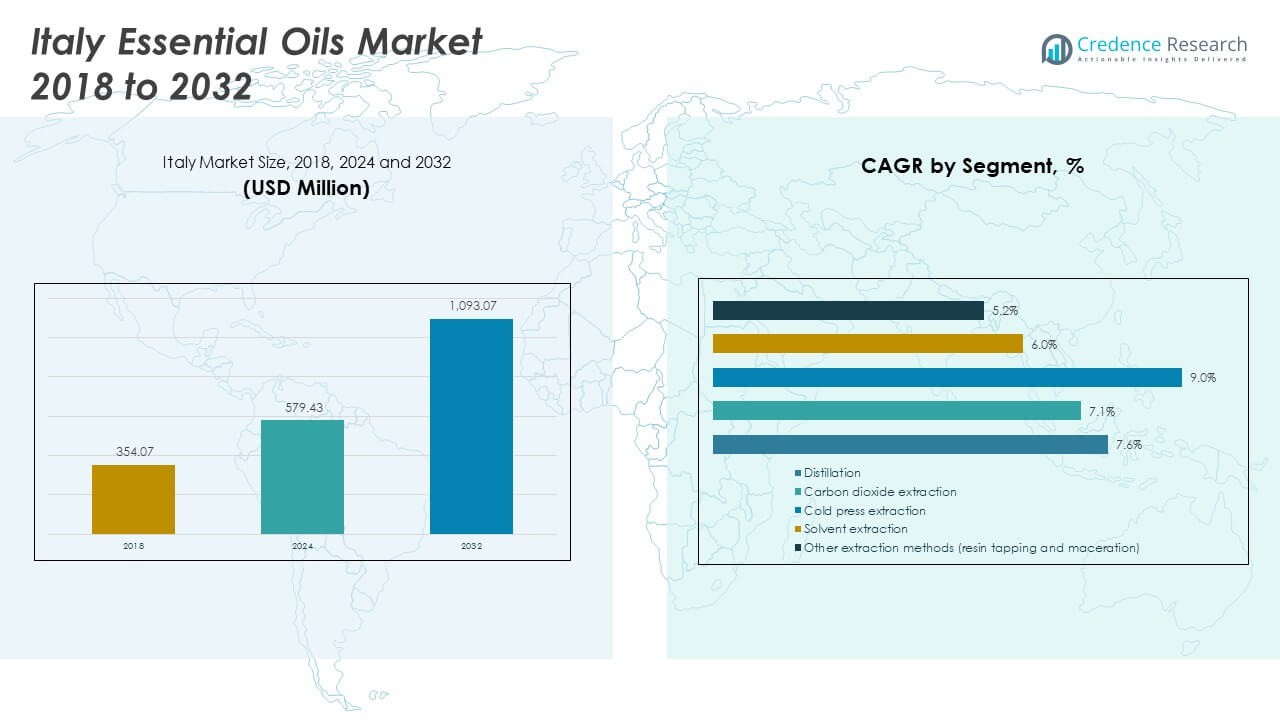
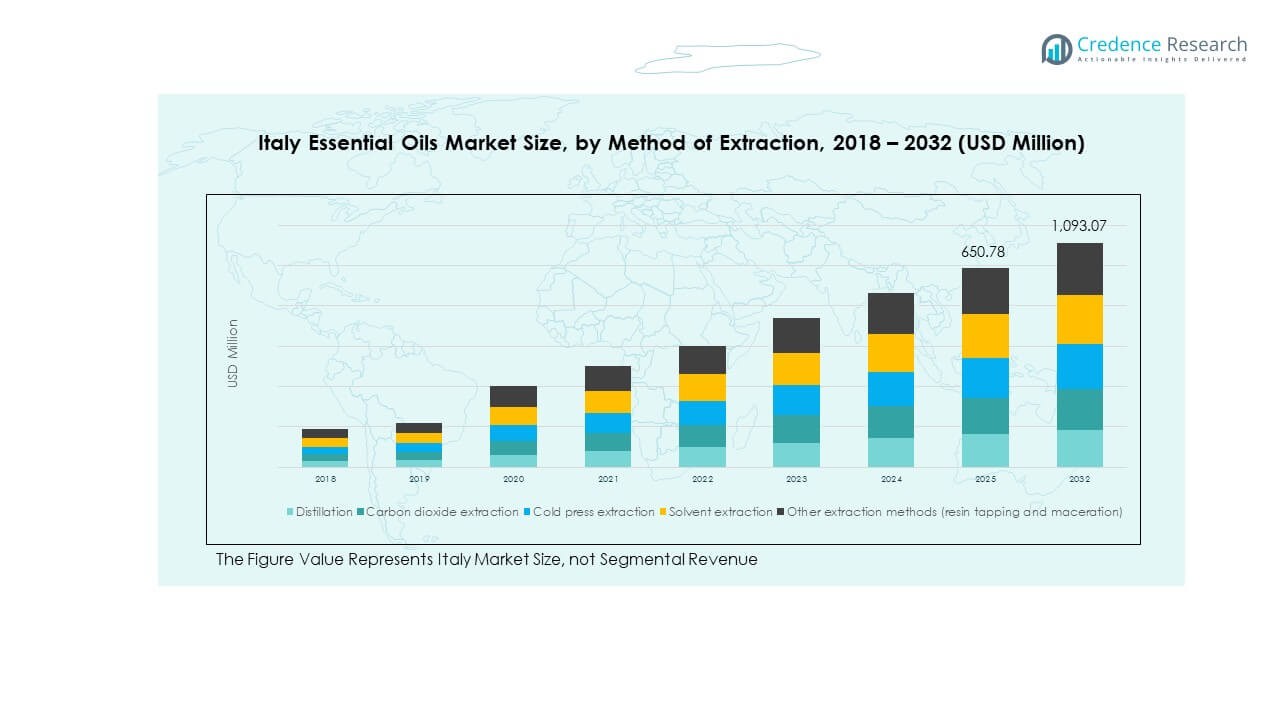
The Italy Wood Essential Oils Market size was valued at USD 354.07 million in 2018, reaching USD 579.43 million in 2024, and is anticipated to hit USD 1,093.07 million by 2032, at a CAGR of 7.69% during the forecast period.
| REPORT ATTRIBUTE | DETAILS |
|---|---|
| Historical Period | 2020-2023 |
| Base Year | 2024 |
| Forecast Period | 2025-2032 |
| Italy Wood Essential Oils Market Size 2024 | USD 579.43 Million |
| Italy Wood Essential Oils Market, CAGR | 7.69% |
| Italy Wood Essential Oils Market Size 2032 | USD 1,093.07 Million |
Growing consumer preference for plant-based and chemical-free solutions fuels the market’s growth. Companies actively invest in R&D to improve extraction processes, enhance oil purity, and broaden product portfolios. Rising wellness awareness encourages adoption in skincare, haircare, and fragrance products. Demand from food and beverages also supports growth, particularly for natural flavoring applications. The shift toward holistic healthcare practices creates new opportunities for Italian producers to expand their offerings.
Geographically, Europe remains the primary hub, with Italy playing a central role due to its strong production base and historical expertise in essential oils. Demand from North America and Asia-Pacific is accelerating, supported by increasing consumer interest in natural remedies and aromatherapy. Emerging regions such as Latin America and the Middle East show rising adoption of wellness and lifestyle products, creating opportunities for Italian exports. Africa’s market is gradually emerging, supported by growing healthcare and personal care industries.
Market Insights:
- The Italy Wood Essential Oils Market was valued at USD 354.07 million in 2018, reached USD 579.43 million in 2024, and is projected to hit USD 1,093.07 million by 2032, growing at a CAGR of 7.69%.
- Europe (38%), North America (27%), and Asia Pacific (22%) hold the top three regional shares, supported by strong demand in cosmetics, aromatherapy, and food applications.
- Asia Pacific is the fastest-growing region with 22% share, fueled by rising disposable incomes, natural skincare adoption, and e-commerce expansion.
- Distillation accounts for the largest share at 40% in 2024, making it the dominant extraction method due to efficiency and widespread use.
- Carbon dioxide extraction holds 25% share in 2024, gaining traction in premium applications where high purity and sustainability are key drivers.
Market Drivers:
Rising Demand from Personal Care and Cosmetics:
The Italy Wood Essential Oils Market is driven by growing demand from cosmetics and personal care. Consumers actively seek natural formulations to avoid chemical-based alternatives in skincare and haircare products. Essential oils provide anti-inflammatory, antibacterial, and soothing benefits, making them desirable in premium ranges. Brands use cedarwood and sandalwood oils for fragrances, moisturizers, and hair care. Italy’s cosmetic industry integrates these oils into both luxury and mass-market products. It encourages stronger supplier relationships. The continuous rise of organic and vegan products supports wider adoption. This driver sustains long-term growth.
- For instance, Italy’s essential oils market is characterized by consumer preference for high-quality, ethically sourced products, with the cosmetics and personal care segment playing a significant role.
Expanding Applications in Food and Beverages:
The food and beverage sector is a key driver of the Italy Wood Essential Oils Market. Natural essential oils serve as flavoring agents in bakery, confectionery, and beverage formulations. They provide both functional and aromatic qualities, boosting their appeal among manufacturers. Consumer demand for clean-label products supports growth in this segment. Oils like cinnamon, anise, and clove are used widely in Italy’s culinary tradition. Companies also target export opportunities for authentic Italian flavors. Strong demand in gourmet and specialty markets further enhances revenues. The food sector continues to expand its reliance on wood essential oils.
- For instance, Natural essential oils serve as flavoring agents in bakery, confectionery, and beverage formulations, providing both functional and aromatic qualities. Consumer demand for clean-label and natural products supports growth in this segment.
Growth of Aromatherapy and Wellness Practices:
The Italy Wood Essential Oils Market benefits from the growing popularity of aromatherapy and holistic wellness. Consumers associate essential oils with relaxation, stress relief, and improved sleep. Wellness centers, spas, and therapy clinics use sandalwood, cedarwood, and pine oils extensively. Rising awareness of mental health encourages adoption of natural solutions. Italy’s cultural affinity for wellness lifestyles strengthens domestic demand. Oils are increasingly available through online and retail channels. Marketing campaigns highlight therapeutic benefits to expand consumer reach. The broader wellness industry ensures consistent demand growth for wood essential oils.
Advancements in Extraction and Production Techniques:
Technological improvements in extraction methods drive efficiency and quality in the Italy Wood Essential Oils Market. Modern distillation and CO₂ extraction methods deliver higher purity levels. Producers are reducing environmental impacts by adopting energy-efficient processes. Enhanced quality assurance helps manufacturers meet strict international standards. Italian companies invest in R&D to diversify oil offerings and improve yield. Export markets prefer high-quality oils, driving innovation in production. Local producers leverage sustainable sourcing practices to attract eco-conscious buyers. Improved techniques strengthen Italy’s global reputation in essential oil supply. These innovations enable long-term competitiveness.
Market Trends:
Rising Popularity of Sustainable and Ethical Sourcing:
The Italy Wood Essential Oils Market is shaped by increasing focus on sustainability. Companies emphasize responsible harvesting of raw materials to protect biodiversity. Ethical sourcing practices attract eco-conscious consumers in domestic and international markets. Certification and traceability programs ensure transparency in the supply chain. Brands highlight fair-trade and organic certifications in marketing campaigns. This trend builds consumer trust and loyalty. Producers collaborate with farmers to adopt sustainable forestry practices. Long-term resource management secures raw material availability. Sustainability has become a defining trend for Italy’s essential oils industry.
- For instance, Fair-trade and organic certifications are leveraged in marketing to build consumer trust and loyalty. Producers collaborate with farmers to adopt sustainable forestry practices to preserve long-term availability of raw materials.
Digitalization and E-commerce Expansion:
The Italy Wood Essential Oils Market experiences significant growth through digital channels. E-commerce platforms expand consumer access to essential oils. Brands establish strong online visibility through social media, influencer marketing, and digital campaigns. Consumers appreciate product information, usage guides, and reviews before making purchases. Online sales offer convenience and product variety. Small and mid-sized businesses gain market exposure through e-commerce platforms. Exporters also benefit from cross-border digital trade. Direct-to-consumer models strengthen brand loyalty. Digital transformation continues to redefine sales and distribution strategies across the industry.
- For instance, Small and mid-sized enterprises benefit greatly from this increased visibility, and exporters leverage cross-border digital trade. Direct-to-consumer sales models strengthen relationships with buyers and are redefining conventional sales and distribution strategies within the industry.
Premiumization and Luxury Product Integration:
Premiumization emerges as a strong trend in the Italy Wood Essential Oils Market. Luxury brands incorporate high-quality essential oils into perfumes, skincare, and haircare products. Italian heritage in fine fragrances boosts demand for sandalwood and cedarwood. Premium oils offer unique aromas and therapeutic qualities, appealing to affluent consumers. Demand for artisanal and handcrafted oils supports niche market growth. Premium positioning allows brands to capture higher margins. Collaborations with luxury fashion and beauty houses expand opportunities. Exclusive packaging enhances consumer experience. Premiumization continues to drive value growth across the industry.
Rising Focus on Health and Preventive Care:
Growing consumer focus on preventive care shapes the Italy Wood Essential Oils Market. Oils are used in products supporting immunity, respiratory health, and stress management. Consumers integrate them into home remedies and wellness routines. Healthcare practitioners recommend natural oils for specific conditions. Rising interest in plant-based alternatives drives acceptance in both personal and medical contexts. Italy’s wellness culture complements this adoption. Educational campaigns highlight health benefits, encouraging wider use. Preventive care demand increases across Europe and Asia-Pacific. The trend ensures sustained relevance for essential oils in health-focused markets.
Market Challenges Analysis:
Regulatory Compliance and Quality Control Pressures:
The Italy Wood Essential Oils Market faces challenges from stringent regulations. The EU enforces strict standards on product safety, labeling, and ingredient authenticity. Companies must ensure compliance across international markets to remain competitive. High costs of certification and testing impact small producers. Adulteration risks damage consumer trust and brand reputation. Maintaining consistent quality requires advanced testing infrastructure. Exporters face additional regulatory hurdles in North America and Asia-Pacific. The industry must invest in regulatory alignment to maintain growth momentum. Compliance complexity creates barriers for new entrants.
Supply Chain Vulnerabilities and Raw Material Constraints:
Raw material availability presents a key challenge for the Italy Wood Essential Oils Market. Seasonal and climatic variations impact wood harvesting. Unsustainable forestry practices threaten long-term resource supply. Geopolitical issues and trade restrictions disrupt supply chains. Rising global demand increases competition for raw materials. Transportation costs also strain profit margins for exporters. Producers face difficulty balancing demand and supply in volatile conditions. Small-scale suppliers are vulnerable to disruptions, impacting the larger ecosystem. Addressing supply chain risks is critical for maintaining market stability.
Market Opportunities:
Growing Export Potential and Global Expansion:
The Italy Wood Essential Oils Market presents opportunities through expanding global exports. Rising demand from North America and Asia-Pacific creates new revenue streams. Italy’s reputation for high-quality oils enhances its competitive edge. Exporters can tap into growing aromatherapy, wellness, and luxury markets abroad. Government trade policies support international expansion. Partnerships with distributors improve access to high-growth regions. Emerging markets in Latin America and Africa offer untapped demand. Strengthening export networks secures long-term opportunities for Italian producers.
Integration into Functional and Innovative Applications:
The Italy Wood Essential Oils Market gains opportunities through new applications. Oils are increasingly used in nutraceuticals, natural cleaning products, and air fresheners. Innovative blends support mental well-being, energy boosting, and sleep enhancement. Companies target functional beverage and dietary supplement sectors. Collaboration with pharma and biotech firms opens specialized applications. Expansion into eco-friendly household products broadens market reach. Continuous R&D ensures differentiation in competitive segments. Integration into diverse industries positions essential oils for steady long-term growth.
Market Segmentation Analysis:
By Type
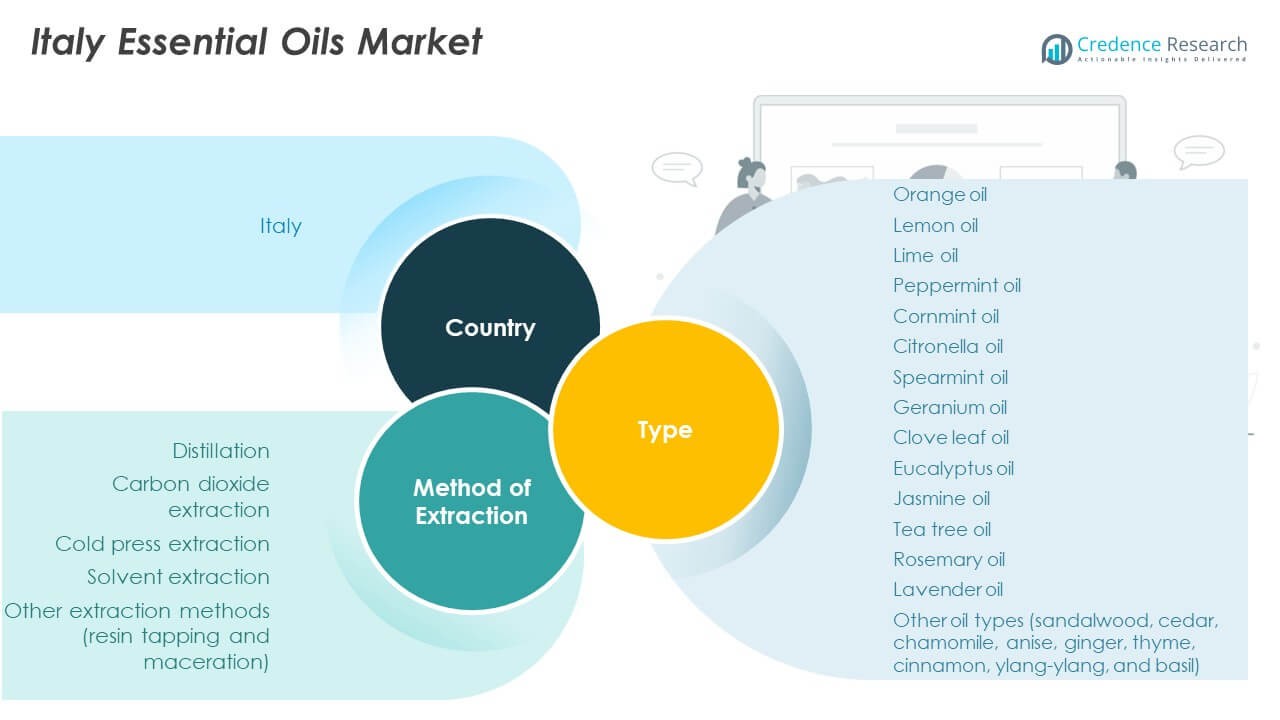
The Italy Wood Essential Oils Market offers a wide variety of oils including sandalwood, cedar, lavender, rosemary, and eucalyptus. These oils are widely used in aromatherapy, cosmetics, and personal care due to their therapeutic benefits and distinctive fragrances. Food and beverage industries rely on citrus-based oils like lemon and orange for natural flavoring. Niche oils such as chamomile, basil, and cinnamon cater to specialized applications, particularly in luxury and wellness products. The diversity of oils enhances the market’s adaptability across multiple industries.
- For instance, Citrus-based oils like lemon and orange are extensively utilized in the food and beverage industries for natural flavoring. Specialized niche oils such as chamomile, basil, and cinnamon cater to luxury and wellness product segments, enhancing the market's adaptability across industries.
By Method of Extraction
Extraction methods significantly shape the market. Distillation remains the most commonly used method due to its efficiency and established reliability. Carbon dioxide extraction is gaining traction, offering high-purity oils favored in premium applications. Cold press extraction is essential for citrus oils, ensuring strong flavor profiles. Solvent extraction supports delicate oils such as jasmine, expanding application possibilities. Sustainable methods like resin tapping and maceration are also emerging, aligning with eco-conscious consumer demand.
- For instance, Carbon dioxide extraction is increasingly favored for high-purity oils used in premium products, while cold press extraction is essential for citrus oils, preserving their potent flavor profiles. Solvent extraction supports delicate oil varieties such as jasmine, expanding their application range.
Segmentation:
By Type
- Orange oil
- Lemon oil
- Lime oil
- Peppermint oil
- Cornmint oil
- Citronella oil
- Spearmint oil
- Geranium oil
- Clove leaf oil
- Eucalyptus oil
- Jasmine oil
- Tea tree oil
- Rosemary oil
- Lavender oil
- Other oils (sandalwood, cedar, chamomile, anise, ginger, thyme, cinnamon, ylang-ylang, basil)
By Method of Extraction
- Distillation
- Carbon dioxide extraction
- Cold press extraction
- Solvent extraction
- Other methods (resin tapping, maceration)
By Country
- Italy (domestic production and consumption)
- Export markets (Europe, North America, Asia-Pacific, Latin America, Middle East, Africa)
Regional Analysis:
Northern Italy
Northern Italy accounts for 45% share of the Italy Wood Essential Oils Market in 2024, making it the leading regional hub. The area is home to advanced manufacturing facilities, strong R&D centers, and well-developed export infrastructure. Milan and Turin act as commercial centers where cosmetics and perfumery companies integrate essential oils into luxury and mass-market products. The Alpine and forested regions provide a steady supply of raw materials like cedar and pine, supporting local production. Export activity is high due to proximity to European markets such as France, Germany, and Switzerland. It strengthens Italy’s leadership by combining natural resource availability with industrial expertise.
Central Italy
Central Italy represents 30% of the market share, supported by cultural traditions, heritage-based perfumery, and artisanal wellness practices. Tuscany and Umbria are well known for their organic production and sustainable farming methods, which align with growing consumer demand for clean-label products. Local companies focus on lavender, rosemary, and chamomile oils, widely used in aromatherapy and skincare. Central Italy also benefits from tourism, as wellness centers and spas increase the use of essential oils in treatments. Small and medium-sized enterprises dominate the regional landscape, focusing on authenticity and niche applications. It maintains steady growth by blending artisanal expertise with rising domestic demand.
Southern Italy and Islands
Southern Italy and the islands contribute 25% share of the Italy Wood Essential Oils Market, driven by diverse agricultural resources and growing wellness adoption. Regions such as Sicily and Calabria specialize in citrus oils, which play a key role in food and fragrance applications. The presence of unique biodiversity supports production of oils like bergamot and anise, which are in demand internationally. Domestic consumption is rising as consumers adopt natural remedies and holistic healthcare. Export opportunities are increasing, supported by regional ports that connect to North Africa and the Middle East. It benefits from expanding cultivation and niche positioning in global markets.
Key Player Analysis:
- Symrise AG
- Givaudan SA
- Firmenich International SA
- Robertet Group
- Mane SA
- BASF SE
- Kerry Group plc
- Biolandes SAS
- Flavex Naturextrakte GmbH
- Ungerer Limited
- Others
Competitive Analysis:
The Italy Wood Essential Oils Market demonstrates a competitive structure with multinational players and regional producers actively shaping growth. Companies such as Symrise AG, Givaudan SA, Firmenich International SA, Robertet Group, Mane SA, BASF SE, and Kerry Group plc dominate through wide product portfolios and global distribution. Italian firms emphasize heritage, purity, and sustainable sourcing to secure consumer trust. It benefits from advanced R&D capabilities that enhance oil extraction efficiency and quality assurance. Competitive intensity is high, with players targeting cosmetics, aromatherapy, and food industries. Strategic partnerships, mergers, and premium product launches reinforce market presence.
Recent Developments:
- In June 2024, Symrise AG presented innovative fragrance ingredients at the World Perfumery Congress, unveiling products such as Neomagnolan, an evolved version of the classic Magnolan ingredient, along with new launches like FROSTWOOD™ and AMBRONOVA™, which enhance its portfolio with woody and floral elements.
- In 2025, Givaudan SA announced the acquisition of a majority stake in Vollmens Fragrances Ltda, a company with strong presence in Latin America, as part of its strategy to expand its footprint with regional customers. This strategic move strengthens Givaudan’s presence in high-growth markets and is expected to close in the second half of 2025.
- Firmenich International SA is progressing with its merger plans with DSM to form DSM-Firmenich, focusing on sustainability and innovation in natural ingredients, which will support its position in the fragrance and essential oils sector.
- Robertet Group continues to lead in natural raw materials, emphasizing sustainability and expertise in essential oils production, including wood-based oils, while providing innovative olfactory solutions for fragrances and aromatherapy.
Report Coverage:
The research report offers an in-depth analysis based on product type, method of extraction, and country-level distribution. It details leading market players, providing an overview of their business, product offerings, investments, revenue streams, and key applications. Additionally, the report includes insights into the competitive environment, SWOT analysis, current market trends, as well as the primary drivers and constraints. Furthermore, it discusses various factors that have driven market expansion in recent years. The report also explores market dynamics, regulatory scenarios, and technological advancements that are shaping the industry. It assesses the impact of external factors and global economic changes on market growth. Lastly, it provides strategic recommendations for new entrants and established companies to navigate the complexities of the market.
Future Outlook:
- Rising demand from personal care and cosmetics will sustain market growth.
- Aromatherapy and wellness practices will expand consumer adoption.
- Export opportunities in Asia Pacific will strengthen Italy’s global role.
- Sustainability and ethical sourcing will remain industry priorities.
- Premiumization will fuel demand for luxury essential oils.
- Technological advancements in extraction will improve product quality.
- E-commerce will continue reshaping distribution channels.
- Regulatory frameworks will influence production and labeling practices.
- Collaboration with pharmaceutical and nutraceutical sectors will create new applications.
- Emerging markets in Africa and Latin America will unlock fresh opportunities.

Request a Free Sample
Fill in your details and we'll send you a free sample report.
- Sample data tables & charts
- Research methodology
Need a Custom Version of This Report?
Tailor the scope, geography, or segments to your exact requirements.
- Custom geography or segment scope
- Direct access to our analyst team
Frequently Asked Questions
What is the current market size for Italy Wood Essential Oils Market, and what is its projected size in 2032?
At what Compound Annual Growth Rate is the Italy Wood Essential Oils Market projected to grow between 2025 and 2032?
Which Italy Wood Essential Oils Market segment held the largest share in 2024?
What are the primary factors fueling the growth of the Italy Wood Essential Oils Market?
Who are the leading companies in the Italy Wood Essential Oils Market?
Which region accounted for the largest share of the Italy Wood Essential Oils Market in 2024?
Table of Content
Chapter 1. Report Introduction
- 1.1 Report Description & Purpose
- 1.1.1 Report Title & Market Definition
- 1.1.2 Unique Selling Propositions (USP) & Key Differentiators
- 1.1.3 Value Proposition for Stakeholders
- 1.2 Research Objectives
- 1.2.1 Market Sizing Objectives (Volume & Revenue) (Volume Where Applicable)
- 1.2.2 Segmentation Objectives
- 1.2.3 Competitive Intelligence Objectives
- 1.2.4 Forecast & Scenario Objectives
- 1.3 Report Scope
- 1.3.1 Italy Wood Essential Oils Scope – Segments & Subsegments Covered
- 1.3.2 Geographic Scope – Selected Country & Subnational Markets Covered
- 1.3.3 Historical Period, Base Year & Forecast Period (2018; forecast to 2032)
- 1.3.4 Inclusions & Exclusions
- 1.4 Industry Classification & Applicable Codes
- 1.5 Currency, Measurement Units & Valuation Basis
- 1.6 Target Stakeholders
- 1.7 Limitations & Assumptions
Chapter 2. Executive Summary
- 2.1 Italy Wood Essential Oils Snapshot
- 2.1.1 Market Size – Historical (2018) & Forecast (2018-2032) (2018: USD 354.07 million → 2032: USD 1,093.07 million)
- 2.1.2 Volume & Revenue – National Totals (Volume Where Applicable)
- 2.1.3 Key Market Highlights – Top Five Facts
- 2.2 Italy Wood Essential Oils Segmentation Snapshot
- 2.2.1 Market Split by Subnational Area – 2018 vs. 2032
- 2.3 Competitive Snapshot
- 2.3.1 Top 10 Players by Revenue Share – 2018
- 2.3.2 Top 10 Players by Volume Share – 2018 (Volume Where Applicable)
- 2.3.3 Recent Strategic Developments (18-Month Summary)
- 2.4 Key Investment Highlights & Strategic Conclusions
Chapter 3. Italy Wood Essential Oils Dynamics & Industry Analysis
- 3.1 Market Overview & Context
- 3.1.1 Italy Wood Essential Oils Position in the Broader Industry Value Chain
- 3.1.2 Demand Structure & Purchasing Dynamics
- 3.1.3 Market Maturity & Development Stage Across Domestic Markets
- 3.2 Italy Wood Essential Oils Drivers
- 3.3 Italy Wood Essential Oils Restraints & Challenges
- 3.4 Italy Wood Essential Oils Opportunities
- 3.5 Porter's Five Forces Analysis
- 3.5.1 Threat of New Entrants
- 3.5.2 Bargaining Power of Suppliers
- 3.5.3 Bargaining Power of Buyers
- 3.5.4 Threat of Substitutes
- 3.5.5 Competitive Rivalry – Intensity Assessment
- 3.6 Italy Wood Essential Oils Value Chain Analysis
- 3.6.1 Upstream – Key Inputs, Resources & Suppliers
- 3.6.1.1 Key Input/Resource 1
- 3.6.1.2 Key Input/Resource 2
- 3.6.1.3 Key Input/Resource 3
- 3.6.2 Midstream – Core Operations & Value Creation
- 3.6.2.1 Operating Model & Process Overview
- 3.6.2.2 Key Operating Locations & Capabilities by Company
- 3.6.3 Downstream – Market Channels & End Users
- 3.6.3.1 Direct Sales & Customer Engagement Channels
- 3.6.3.2 Indirect Sales, Intermediaries & Partner Channels
- 3.6.4 Value Chain Profitability Analysis
- 3.6.1 Upstream – Key Inputs, Resources & Suppliers
- 3.7 PESTEL Analysis
- 3.7.1 Political Factors
- 3.7.2 Economic Factors
- 3.7.3 Social Factors
- 3.7.4 Technological Factors
- 3.7.5 Environmental Factors
- 3.7.6 Legal Factors
- 3.8 Italy Wood Essential Oils Supply Chain Analysis
- 3.8.1 Critical Input & Resource Availability Risk Assessment
- 3.8.2 Supplier & Operational Concentration Risk (Geographic Exposure)
- 3.8.3 Supply & Service Disruption Impact Analysis
- 3.9 National & Subnational Regulatory Landscape
Note: The regulatory and policy landscape section covers regulations based on their applicability to the market, Italy Wood Essential Oils category, geography, and scope of the study. Only regulatory frameworks with a material impact on operations, compliance, trade, sustainability, or market access are analyzed in detail.
Chapter 4. Key Investment Pockets & Opportunity Analysis
- 4.1 Italy Wood Essential Oils Attractiveness Analysis
- 4.1.1 By Subnational Area – Investment Attractiveness Matrix (Market Size × CAGR)
- 4.2 Absolute Revenue Growth Opportunity
- 4.2.1 By Subnational Area – Absolute Revenue Growth Through 2032
- 4.3 Incremental Demand Opportunity
- 4.3.1 By Subnational Area – Incremental Demand Through 2032
- 4.3.2 Segment – Incremental Demand
- 4.4 Emerging Submarket Opportunity Deep Dive (Subject to Applicability)
- 4.5 Priority Domestic Market Opportunity Scorecards
- 4.5.1 Priority Domestic Market 1
- 4.5.2 Priority Domestic Market 2
- 4.5.3 Priority Domestic Market 3
- 4.5.4 Priority Domestic Market 4
Note: Domestic market scorecards cover relevant states, provinces, territories, cities, or economic zones within the selected country. Numbered entries are populated with market names suited to the national administrative structure and research scope. Geographic share tables use one consistent, nonoverlapping set of areas.
Chapter 5. Italy Wood Essential Oils Cross-Border Trade & Market Access Analysis
- 5.1 National Trade & International Partner Overview
- 5.1.1 Export Value by Destination Country (2018)
- 5.1.2 Export Volume by Destination Country (2018) (Where Applicable)
- 5.1.3 Import Value by Source Country (2018)
- 5.1.4 Import Volume by Source Country (2018) (Where Applicable)
- 5.1.5 National & Partner-Country Trade Balances (2018)
- 5.2 Export Analysis – Segment
- 5.2.1 Category 1 (Applicable Classification Code)
- 5.2.2 Category 2 (Applicable Classification Code)
- 5.2.3 Category 3 (Applicable Classification Code)
- 5.2.4 Category 4 (Applicable Classification Code)
- 5.2.5 Category 5 (Applicable Classification Code)
- 5.3 Import Analysis – Segment
- 5.3.1 Category 1 (Applicable Classification Code)
- 5.3.2 Category 2 (Applicable Classification Code)
- 5.3.3 Category 3 (Applicable Classification Code)
- 5.3.4 Category 4 (Applicable Classification Code)
- 5.3.5 Category 5 (Applicable Classification Code)
- 5.4 Cross-Border Pricing & Transaction Benchmarks
- 5.4.1 Export Pricing – Segment & Destination Country
- 5.4.2 Import Pricing – Segment & Source Country
- 5.4.3 Price Trends (2018)
- 5.5 Key Cross-Border Trade & Delivery Routes
- 5.5.1 Cross-Border Trade/Delivery Route 1
- 5.5.2 Cross-Border Trade/Delivery Route 2
- 5.5.3 Cross-Border Trade/Delivery Route 3
- 5.5.4 Cross-Border Trade/Delivery Route 4
- 5.5.5 Cross-Border Trade/Delivery Route 5
- 5.6 Trade Policy & Market Access Impact Assessment
- 5.6.1 Tariff & Non-Tariff Barriers
- 5.6.2 National Participation in Regional Trade & Economic Frameworks
- 5.6.3 Bilateral & Multilateral Trade Agreements
- 5.6.4 Cross-Border Operating, Licensing & Localization Requirements
Note: This chapter covers international trade relevant to Italy Wood Essential Oils in the selected country. Exports are analyzed by destination and imports by source. Domestic interregional flows are excluded from international trade totals. Goods, services, and digital offerings use applicable classifications; volume and route analyses apply only where meaningful.
Chapter 6. Competitive Landscape & Company Benchmarking
- 6.1 Italy Wood Essential Oils Concentration & Structure
- 6.1.1 Herfindahl-Hirschman Index (HHI) – vs. 2018
- 6.1.2 Leading, Mid-Sized & Emerging Player Structure
- 6.1.3 Multinational, National & Local Player Dynamics
- 6.2 Italy Wood Essential Oils Share Analysis – 2018
- 6.2.1 National Revenue Share by Company
- 6.2.2 National Volume Share by Company (Volume Where Applicable)
- 6.2.3 Company Revenue Share by Subnational Area
- 6.2.4 Market Share Evolution ( vs. 2018)
- 6.2.5 Company Market Share by Key Segment
- 6.2.6 Company Market Share by Customer Group
- 6.3 Operating Scale, Capacity & Infrastructure Analysis
- 6.3.1 National Operating Scale & Supply Capacity
- 6.3.2 Resource Utilization & Operating Efficiency
- 6.3.3 Output, Service Delivery & Activity Metrics
- 6.3.4 Operating Footprint & Infrastructure Map
- 6.3.5 Planned Operational & Capacity Expansion
- 6.4 Italy Wood Essential Oils Competitive Benchmarking Matrix
- 6.4.1 Revenue, Growth, Profitability & Operating Metric Comparison
- 6.4.2 Channel Revenue Mix
- 6.4.3 Revenue Exposure Across Domestic Markets
- 6.4.4 R&D Intensity
- 6.4.5 Sustainability Maturity
- 6.5 Strategic Developments in Italy Wood Essential Oils (Last 24 Months)
- 6.5.1 Mergers, Acquisitions & Divestments
- 6.5.2 New Products, Services & Solutions in Italy Wood Essential Oils
- 6.5.3 Operational & Infrastructure Expansions
- 6.5.4 Strategic Alliances, Joint Ventures & Partnerships
- 6.5.5 Distribution Expansion & Market Entry
- 6.5.6 Sustainability & ESG Initiatives
- 6.6 Competitive Strategy Mapping
- 6.6.1 Leader, Challenger, Follower & Niche Classification
- 6.6.2 Pricing Strategy Comparison
- 6.6.3 Channel Strategy Matrix
Note: Strategic developments are included based on their materiality and the availability of reliable information.
Chapter 7. Italy Wood Essential Oils – By Sales & Delivery Channel
- 7.1 Segment Overview
- 7.1.1 Volume & Revenue Split by Channel (2018 & 2032) (Volume Where Applicable)
- 7.1.2 Channel Mix Evolution (2018-2032)
Chapter 8. Subnational Market Analysis – Country Overview
- 8.1 Domestic Geographic Market Overview
- 8.1.1 Subnational Volume Share (Where Applicable)
- 8.1.2 Subnational Revenue Share
- 8.1.3 Market Volume by Subnational Area (Where Applicable)
- 8.1.4 Market Revenue by Subnational Area
- 8.1.5 Subnational Forecasts Through 2032
- 8.2 Cross-Area Segment Analysis Within the Country
- 8.2.1 By Sales & Delivery Channel
- 8.2.2 By Competitive Positioning & Price Tier
Chapter 9. Italy Wood Essential Oils – Priority Domestic Market 1
Chapter 10. Italy Wood Essential Oils – Priority Domestic Market 2
Chapter 11. Italy Wood Essential Oils – Priority Domestic Market 3
Chapter 12. Italy Wood Essential Oils – Priority Domestic Market 4
Chapter 13. Italy Wood Essential Oils Company Profiles
- 13.1 [Company 01]
- 13.1.1 Company Overview
- 13.1.2 Key Management Personnel
- 13.1.3 Products & Services Portfolio
- 13.1.4 Financial Performance
- 13.1.5 Domestic Market Focus & Local Operating Presence
- 13.1.6 Recent Developments & Strategic Initiatives
Note: The company profile list is preliminary and may change based on research findings, market developments, data availability, and client requirements.
Chapter 14. Appendices
- Appendix A – List of Abbreviations & Acronyms
- Appendix B – Industry Classification Code Reference – Full Series
- Appendix C – Supply, Output & Operating Capacity Data Tables
- Appendix D – End-Use & Demand Base Tables
- Appendix E – Demand, Adoption & Usage Assumptions
- Appendix F – Pricing & Revenue Metric Reference Tables
- Appendix G – Company Operations & Infrastructure Database
- Appendix H – Cross-Border Trade & Activity Data Tables (Where Applicable)
- Appendix I – Regulatory Summary Tables
- Appendix J – Primary Research Participant List (Anonymized)
- Appendix K – Primary Research Questionnaire Framework
- Appendix L – Data Sources & Bibliography
- Appendix M – Market Size Divergence & Source Comparison
Chapter 15. Research Methodology
- 15.1 Research Framework & Philosophy
- 15.2 Secondary Research – Sources, Hierarchy & Data Extraction
- 15.3 Data Modeling – National Market Sizing & Subnational Allocation
- 15.4 Primary Research – Stakeholder Framework, LOI & Sample Sizes
- 15.5 Forecast Methodology – Regression, Scenario & Sensitivity Analysis
- 15.6 Quality Control – Four-Layer Validation Framework
- 15.7 Limitations & Standard Assumptions
- 15.8 Disclaimer
