
Market Overview
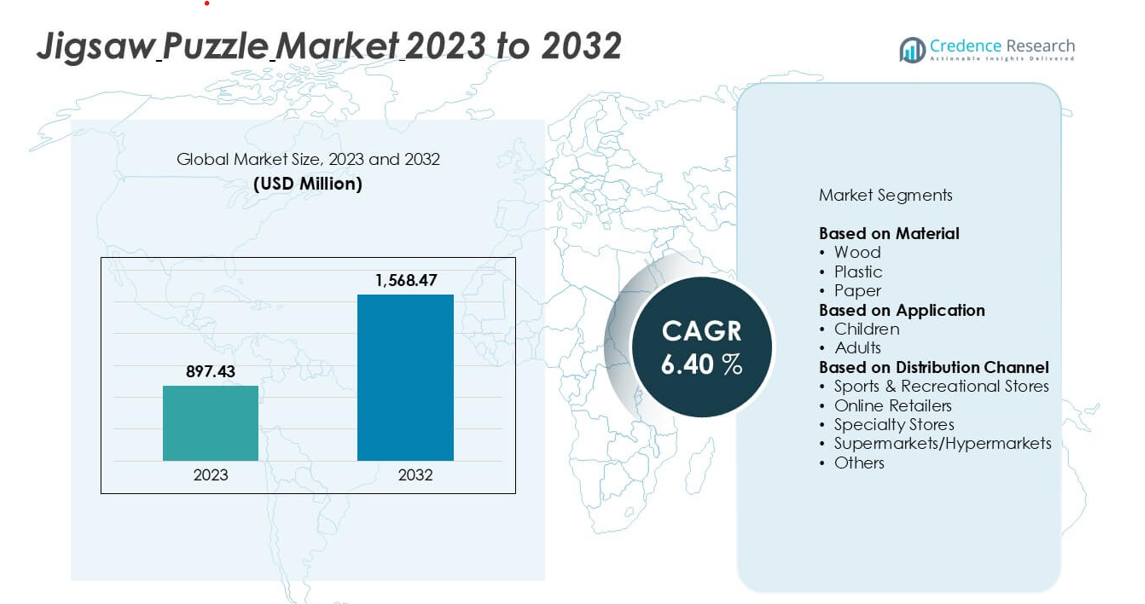
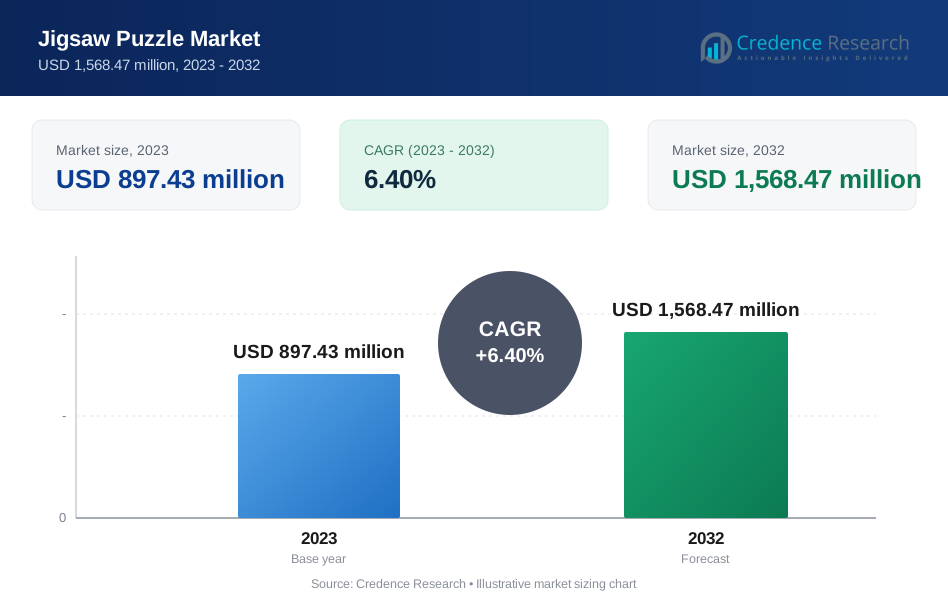
The Jigsaw Puzzle Market was valued at USD 897.43 million in 2023 and is projected to reach USD 1,568.47 million by 2032, growing at a CAGR of 6.40% during the forecast period.
| REPORT ATTRIBUTE | DETAILS |
|---|---|
| Historical Period | 2020-2023 |
| Base Year | 2024 |
| Forecast Period | 2025-2032 |
| Jigsaw Puzzle Market Size 2023 | USD 897.43 million |
| Jigsaw Puzzle Market, CAGR | 6.40% |
| Jigsaw Puzzle Market Size 2032 | USD 1,568.47 million |
The jigsaw puzzle market is led by major players including Ravensburger, Buffalo Games, Educa Borras, Springbok Puzzles, Cobble Hill, Disney, and Schmidt Spiele. These companies dominate through innovation, strong branding, and extensive product ranges catering to both children and adults. Ravensburger leads globally with its premium and educational puzzles, while Buffalo Games and Educa Borras hold significant shares in North America and Europe, respectively. Springbok Puzzles and Cobble Hill specialize in artistic and nostalgic themes, appealing to collectors. Regionally, North America emerged as the largest market in 2024, accounting for 35% of global revenue, followed by Europe with 30%, supported by strong consumer engagement and cultural affinity for puzzles.
Market Insights
- The global jigsaw puzzle market was valued at USD 897.43 million in 2023 and is projected to reach USD 1,568.47 million by 2032, growing at a CAGR of 6.40% during the forecast period.
- Demand is driven by rising interest in educational and cognitive development products among children and adults, alongside the growing popularity of puzzles for relaxation and mindfulness.
- Key trends include the adoption of eco-friendly wooden materials, themed and 3D puzzles, and personalized puzzle designs supported by e-commerce expansion.
- The market is moderately fragmented, with leading players such as Ravensburger, Buffalo Games, Educa Borras, and Schmidt Spiele focusing on design innovation, sustainability, and global retail reach.
- North America led the market with a 35% share in 2024, followed by Europe at 30% and Asia-Pacific at 25%, while the wood-based puzzles segment dominated by holding over 45% of total market revenue.
Market Segmentation Analysis:
By Material
Wood-based jigsaw puzzles dominated the market in 2024, accounting for over 45% of the global share. Their durability, premium finish, and eco-friendly appeal make them highly preferred by both collectors and educators. Wooden puzzles offer long-lasting quality and tactile satisfaction, driving demand in premium and educational categories. Plastic puzzles follow due to their lightweight and washable properties, ideal for younger users. Paper puzzles maintain stable growth, supported by affordability and wide availability in mass retail and promotional segments, especially across emerging economies.
- For instance, Ravensburger produces a line of FSC-certified wooden puzzles, which are made from sustainable, engineered wood (HDF board) and cut with high-precision lasers.
By Application
The adult segment held the largest market share of around 55% in 2024, driven by the rising popularity of puzzles as a mindfulness and stress-relief activity. Adults increasingly view jigsaw puzzles as tools for cognitive engagement and leisure, especially post-pandemic. Manufacturers are introducing complex designs, larger piece counts, and limited-edition sets to appeal to hobbyists and collectors. Meanwhile, the children’s segment continues to grow steadily, supported by the adoption of educational puzzles that enhance motor skills, problem-solving, and visual learning.
- For instance, Cobble Hill Puzzles has released several 2,000-piece puzzle collections, such as the "Happy Thoughts" puzzle featuring artwork by Debi Hron, to support demand from adult hobbyists. The company has also warned against fake social media ads promoting non-existent collections, which have been used to scam customers.
By Distribution Channel
Online retailers dominated the market in 2024 with nearly 40% share, fueled by convenience, product variety, and access to exclusive and customizable designs. E-commerce platforms have expanded puzzle visibility through global shipping, discounts, and digital marketing campaigns. Specialty stores also hold a strong position, offering premium and collectible puzzles that attract enthusiasts. Supermarkets and sports & recreational stores contribute through impulse purchases and gift sales. The “others” category, including toy fairs and craft expos, supports niche marketing and community engagement, further boosting brand awareness.
Key Growth Drivers
Rising Demand for Educational and Cognitive Development Products
Educational puzzles have become essential tools for mental development among children and adults. Parents increasingly purchase jigsaw puzzles to improve spatial reasoning, problem-solving, and memory retention in children. Educational institutions also integrate puzzles into early learning programs to promote cognitive and motor skill growth. Among adults, puzzles are used as brain-training activities to delay cognitive decline and enhance concentration. This growing awareness of mental health and skill development strongly boosts demand across global markets, particularly in North America and Europe, where learning-oriented toys dominate retail shelves.
- For instance, Melissa & Doug produces and sells numerous educational puzzles, including alphabet, number, and map themes, that are used in preschool and early learning settings across the U.S.
Growing Popularity of Puzzles as Stress-Relief and Leisure Activities
Jigsaw puzzles have gained traction as mindfulness tools promoting relaxation and focus. Post-pandemic, adults have turned to puzzles as a calming hobby that reduces digital fatigue. The tactile satisfaction and accomplishment from completing puzzles encourage repeat purchases, particularly of premium and complex designs. Wellness trends and increased time spent indoors have also encouraged puzzle-solving as a form of digital detox. Companies are introducing artistic and nature-themed puzzles, supporting mental well-being. This shift toward self-care and mindful recreation continues to drive steady global demand.
- For instance, Ravensburger reported a successful business year in 2024, with its overall group turnover increasing by 18.2% to €790 million. The company attributed its strong performance to innovation, international expansion, and the success of the new trading card game Disney Lorcana. Its broader marketing campaign, "Moments that connect," reflects consumer demand for togetherness, playful learning, and active relaxation.
Expansion of Online Retail and Customization Options
The rise of e-commerce platforms has transformed puzzle distribution and accessibility. Consumers now enjoy a vast range of puzzles across designs, piece counts, and price points. Online channels also allow easy customization, enabling buyers to create personalized puzzles from photos or digital art. Manufacturers leverage data analytics to identify consumer preferences and offer limited-edition collections. The convenience of online ordering, global delivery, and digital marketing has broadened the customer base, especially among millennials and collectors. The integration of augmented reality and interactive puzzle apps further strengthens digital engagement and sales growth.
Key Trends & Opportunities
Increasing Adoption of Sustainable and Eco-Friendly Materials
Sustainability is shaping product innovation across the jigsaw puzzle market. Manufacturers are replacing plastics with FSC-certified wood and recycled paper to meet consumer demand for eco-conscious toys. The move aligns with global sustainability goals and appeals to environmentally aware buyers. Brands adopting biodegradable coatings and soy-based inks are gaining stronger brand value. Retailers highlight sustainability certifications as selling points, particularly in Europe and North America. This eco-driven shift presents long-term opportunities for manufacturers to reduce costs through local sourcing while enhancing consumer trust and regulatory compliance.
- For instance, Ravensburger has transitioned to using FSC-certified paper and recycled cardboard in its products. By nearly eliminating plastic shrink-wrap packaging, the company has reduced its annual plastic waste by approximately 100 tons across its European factories.
Growing Popularity of Themed and 3D Puzzles
Themed puzzles based on movies, landmarks, and art collections are driving market expansion. Consumers increasingly seek unique, collectible designs that offer both entertainment and decorative appeal. The 3D puzzle segment, featuring architectural and mechanical models, attracts hobbyists and adult learners. This category benefits from advancements in die-cutting and digital printing technologies, improving precision and aesthetics. Partnerships with entertainment franchises, museums, and artists create new licensing opportunities. As experiential and display-oriented puzzles gain momentum, manufacturers can capitalize on niche collector communities and premium product pricing.
Key Challenges
Rising Competition from Digital Entertainment
The dominance of video games, streaming services, and mobile apps has reduced the time consumers dedicate to traditional hobbies like puzzles. Younger demographics often prefer fast-paced digital entertainment, limiting market penetration for physical puzzles. Manufacturers face the challenge of maintaining engagement in an era of instant gratification. To stay relevant, companies must innovate through hybrid products that merge physical and digital play, such as app-integrated or AR-based puzzles. Without such innovation, market growth may slow, particularly in urban and tech-oriented regions.
Fluctuating Raw Material Costs and Supply Chain Disruptions
The jigsaw puzzle industry depends heavily on paperboard, wood, and printing materials. Rising raw material prices and logistical disruptions have increased production costs. Global supply chain instability, particularly post-pandemic, has caused delays in shipments and inventory shortages. Small and mid-sized manufacturers face margin pressure as they struggle to balance quality with affordability. The shift toward sustainable materials also demands higher upfront investment in technology and sourcing. Addressing these challenges requires strategic supplier partnerships, local production expansion, and efficient cost management to maintain competitiveness.
Regional Analysis
North America
North America held the largest share of around 35% in the global jigsaw puzzle market in 2024. Strong consumer interest in educational and leisure activities supports steady growth across the U.S. and Canada. The rising popularity of puzzles for mindfulness and family bonding drives household adoption. Online retail platforms, such as Amazon and Walmart, enhance product accessibility, while premium wooden and collectible puzzles see robust demand. Increasing focus on sustainability and local manufacturing also boosts market competitiveness. Leading brands capitalize on licensing deals and themed puzzles inspired by popular culture.
Europe
Europe accounted for nearly 30% of the global jigsaw puzzle market in 2024, driven by its deep-rooted puzzle culture and strong educational toy demand. Countries like Germany, the U.K., and France lead sales through established puzzle brands and specialty retailers. Growing interest in sustainable wooden puzzles aligns with the region’s eco-conscious consumer base. Seasonal sales, particularly during holidays, contribute significantly to revenues. The region also benefits from a thriving adult hobbyist community, supporting high-value collectible and art-based puzzles. E-commerce adoption and tourism-related souvenir puzzles further enhance growth opportunities.
Asia-Pacific
The Asia-Pacific region captured around 25% of the global market in 2024, driven by rising disposable incomes and expanding middle-class populations in China, Japan, and India. Educational puzzles are highly popular among parents seeking tools for cognitive development. Rapid urbanization and digital retail expansion have increased puzzle visibility across online platforms. Japan leads innovation with advanced 3D and mechanical puzzles, while China’s mass production capabilities lower overall costs. Growing adoption of educational toys and personalized designs continues to propel the regional market. Government support for early learning products further reinforces steady growth.
Latin America
Latin America accounted for nearly 6% of the jigsaw puzzle market in 2024, showing growing traction in Brazil, Mexico, and Argentina. Rising awareness of educational games and family-based leisure activities drives consumer adoption. Local toy manufacturers are expanding affordable puzzle lines for children, boosting retail penetration. E-commerce channels are increasingly influential in urban areas, offering broader product selection. However, limited brand presence and import dependency restrain rapid expansion. The region presents strong potential for global players investing in low-cost production and culturally themed puzzles appealing to local audiences.
Middle East & Africa
The Middle East & Africa region represented about 4% of the global jigsaw puzzle market in 2024. Growth is fueled by increasing family entertainment spending and educational product adoption in the UAE, Saudi Arabia, and South Africa. Online retailing and toy specialty stores are gradually expanding reach, especially among young parents seeking developmental toys. Limited local manufacturing creates opportunities for importers and regional distributors. Rising interest in premium puzzles and eco-friendly materials aligns with urban lifestyle shifts. Although market penetration remains modest, rising literacy and education initiatives indicate steady future expansion.
Market Segmentations:
By Material
- Wood
- Plastic
- Paper
By Application
- Children
- Adults
By Distribution Channel
- Sports & Recreational Stores
- Online Retailers
- Specialty Stores
- Supermarkets/Hypermarkets
- Others
By Geography
- North America
- U.S.
- Canada
- Mexico
- Europe
- UK
- France
- Germany
- Italy
- Spain
- Russia
- Rest of Europe
- Asia Pacific
- China
- Japan
- South Korea
- India
- Australia
- Southeast Asia
- Rest of Asia Pacific
- Latin America
- Brazil
- Argentina
- Rest of Latin America
- Middle East
- GCC Countries
- Israel
- Turkey
- Rest of Middle East
- Africa
- South Africa
- Egypt
- Rest of Africa
Competitive Landscape
The jigsaw puzzle market is moderately fragmented, with global and regional players competing through innovation, design diversity, and brand heritage. Leading companies such as Ravensburger, Buffalo Games, Educa Borras, Springbok Puzzles, and Cobble Hill dominate through strong retail networks, high-quality materials, and licensed collaborations. These brands emphasize educational and artistic themes to attract both adults and children. Disney and Schmidt Spiele strengthen their positions through partnerships with entertainment franchises and eco-friendly production. Emerging players like Robotime, CubicFun, and Hape focus on 3D and wooden puzzles, catering to growing demand for sustainable and interactive formats. Manufacturers are also leveraging online platforms for global reach and personalized offerings. Strategic expansion in e-commerce, along with technological integration such as augmented reality puzzles, enhances brand engagement. Continuous product innovation, licensing, and sustainability initiatives define the competitive dynamics shaping the global jigsaw puzzle industry.
Key Player Analysis
- Springbok Puzzles
- Educa Borras
- Robotime
- Disney
- Artifact Puzzles
- Schmidt Spiele
- Cobble Hill
- CubicFun
- Ravensburger
- Tenyo
- White Mountain Puzzles
- Buffalo Games
- Castorland
- Hape
- Anatolian
- House of Puzzles
- Piatnik
Recent Developments
- In February 2024, Ravensburger announced its lineup of new tabletop games for the year, including several jigsaw puzzle releases. Some notable new puzzles include:
- “All Seasons Flower Shop” 1000-piece puzzle
- “Christmas Cookie Village” 1000-piece puzzle
- “Disney Christmas Eve” 1000-piece puzzle
- “Merry Mushroom Village” 1000-piece puzzle
- In January 2023, Buffalo Games partnered with London-based indie games company Big Potato to distribute each other’s products in the UK and U.S. markets. This partnership will allow Buffalo Games to expand its international reach for its puzzle lines.
- In 2023, Educa Borras expanded its product catalog through the acquisition of toy manufacturer NINCO DESARROLLOS, adding radio-controlled vehicles to its offerings. While not directly related to puzzles, this acquisition demonstrates the company’s growth strategy.
- In 2024, Robotime continues to expand its line of 3D wooden puzzles and miniatures under its four sub-brands: Rolife, Rokr, Robud, and MewooFun. The company has been focusing on innovative, creative, and environmentally-friendly DIY products.
- In 2024, Disney released new licensed puzzle designs in collaboration with various puzzle manufacturers. For example, Ravensburger launched a “Disney Stitch” 1000-piece puzzle as part of its 2024 lineup.
Report Coverage
The research report offers an in-depth analysis based on Material, Application, Distribution Channel and Geography. It details leading market players, providing an overview of their business, product offerings, investments, revenue streams, and key applications. Additionally, the report includes insights into the competitive environment, SWOT analysis, current market trends, as well as the primary drivers and constraints. Furthermore, it discusses various factors that have driven market expansion in recent years. The report also explores market dynamics, regulatory scenarios, and technological advancements that are shaping the industry. It assesses the impact of external factors and global economic changes on market growth. Lastly, it provides strategic recommendations for new entrants and established companies to navigate the complexities of the market.
Future Outlook
- The jigsaw puzzle market will continue to grow steadily through increased consumer interest in educational entertainment.
- Manufacturers will focus on eco-friendly materials such as recycled paper and FSC-certified wood.
- Digital integration, including augmented reality and app-based puzzle experiences, will expand consumer engagement.
- Customizable and photo-based puzzles will attract more online buyers seeking personalized gifts.
- Adult participation will increase as puzzles gain recognition for stress relief and mindfulness benefits.
- Licensing collaborations with entertainment franchises and artists will boost themed puzzle sales.
- E-commerce platforms will remain the dominant sales channel due to convenience and product variety.
- Emerging markets in Asia-Pacific and Latin America will experience strong growth with rising disposable incomes.
- Companies will invest in automation and precision printing to improve product quality and reduce costs.
- Sustainability, innovation, and interactive designs will define the next phase of competitive differentiation in the market.
Request a Free Sample
Fill in your details and we'll send you a free sample report.
- Sample data tables & charts
- Research methodology
Need a Custom Version of This Report?
Tailor the scope, geography, or segments to your exact requirements.
- Custom geography or segment scope
- Direct access to our analyst team
Frequently Asked Questions
What is the projected growth of the global jigsaw puzzle market?
What are the main factors driving the growth of the jigsaw puzzle market?
Which regions are leading the global jigsaw puzzle market?
How is the trend towards sustainability impacting the jigsaw puzzle market?
What role does online retail play in the jigsaw puzzle market?
Table of Content
Chapter 1. Report Introduction
- 1.1 Report Description & Purpose
- 1.1.1 Report Title & Market Definition
- 1.1.2 Unique Selling Propositions (USP) & Key Differentiators
- 1.1.3 Value Proposition for Stakeholders
- 1.2 Research Objectives
- 1.2.1 Market Sizing Objectives (Volume & Revenue) (Volume Where Applicable)
- 1.2.2 Segmentation Objectives
- 1.2.3 Competitive Intelligence Objectives
- 1.2.4 Forecast & Scenario Objectives
- 1.3 Report Scope
- 1.3.1 Jigsaw Puzzle Scope – Segments & Subsegments Covered
- 1.3.2 Geographic Scope – Regions & Countries Covered
- 1.3.3 Historical Period, Base Year & Forecast Period (2023; forecast to 2032)
- 1.3.4 Inclusions & Exclusions
- 1.4 Industry Classification & Applicable Codes
- 1.5 Currency, Measurement Units & Valuation Basis
- 1.6 Target Stakeholders
- 1.7 Limitations & Assumptions
Chapter 2. Executive Summary
- 2.1 Global Jigsaw Puzzle Market Snapshot
- 2.1.1 Market Size – Historical (2023) & Forecast (2023-2032) (2023: USD 897.43 million → 2032: USD 1,568.47 million)
- 2.1.2 Volume & Revenue – Global Totals (Volume Where Applicable)
- 2.1.3 Key Market Highlights – Top Five Facts
- 2.2 Jigsaw Puzzle Market Segmentation Snapshot
- 2.2.1 Market Split by Region – 2023 vs. 2032
- 2.3 Competitive Snapshot
- 2.3.1 Top 10 Players by Revenue Share – 2023
- 2.3.2 Top 10 Players by Volume Share – 2023 (Volume Where Applicable)
- 2.3.3 Recent Strategic Developments (18-Month Summary)
- 2.4 Key Investment Highlights & Strategic Conclusions
Chapter 3. Jigsaw Puzzle Market Dynamics & Industry Analysis
- 3.1 Market Overview & Context
- 3.1.1 Jigsaw Puzzle Market Position in the Broader Industry Value Chain
- 3.1.2 Demand Structure & Purchasing Dynamics
- 3.1.3 Market Maturity & Development Stage by Region
- 3.2 Jigsaw Puzzle Market Drivers
- 3.3 Jigsaw Puzzle Market Restraints & Challenges
- 3.4 Jigsaw Puzzle Market Opportunities
- 3.5 Porter's Five Forces Analysis
- 3.5.1 Threat of New Entrants
- 3.5.2 Bargaining Power of Suppliers
- 3.5.3 Bargaining Power of Buyers
- 3.5.4 Threat of Substitutes
- 3.5.5 Competitive Rivalry – Intensity Assessment
- 3.6 Jigsaw Puzzle Value Chain Analysis
- 3.6.1 Upstream – Key Inputs, Resources & Suppliers
- 3.6.1.1 Key Input/Resource 1
- 3.6.1.2 Key Input/Resource 2
- 3.6.1.3 Key Input/Resource 3
- 3.6.2 Midstream – Core Operations & Value Creation
- 3.6.2.1 Operating Model & Process Overview
- 3.6.2.2 Key Operating Locations & Capabilities by Company
- 3.6.3 Downstream – Market Channels & End Users
- 3.6.3.1 Direct Sales & Customer Engagement Channels
- 3.6.3.2 Indirect Sales, Intermediaries & Partner Channels
- 3.6.4 Value Chain Profitability Analysis
- 3.6.1 Upstream – Key Inputs, Resources & Suppliers
- 3.7 PESTEL Analysis
- 3.7.1 Political Factors
- 3.7.2 Economic Factors
- 3.7.3 Social Factors
- 3.7.4 Technological Factors
- 3.7.5 Environmental Factors
- 3.7.6 Legal Factors
- 3.8 Jigsaw Puzzle Supply Chain Analysis
- 3.8.1 Critical Input & Resource Availability Risk Assessment
- 3.8.2 Supplier & Operational Concentration Risk (Geographic Exposure)
- 3.8.3 Supply & Service Disruption Impact Analysis
- 3.9 Regulatory & Policy Landscape
Note: The regulatory and policy landscape section covers regulations based on their applicability to the market, Jigsaw Puzzle category, geography, and scope of the study. Only regulatory frameworks with a material impact on operations, compliance, trade, sustainability, or market access are analyzed in detail.
Chapter 4. Key Investment Pockets & Opportunity Analysis
- 4.1 Jigsaw Puzzle Market Attractiveness Analysis
- 4.1.1 By Region – Investment Attractiveness Matrix (Market Size × CAGR)
- 4.2 Absolute Revenue Growth Opportunity
- 4.2.1 By Region – Absolute Revenue Growth Through 2032
- 4.3 Incremental Demand Opportunity
- 4.3.1 By Region – Incremental Demand Through 2032
- 4.3.2 Segment – Incremental Demand
- 4.4 Emerging Submarket Opportunity Deep Dive (Subject to Applicability)
- 4.5 Priority Market Opportunity Scorecards
- 4.5.1 United States
- 4.5.2 Europe
- 4.5.3 Asia
- 4.5.4 Middle East & Africa
Note: Priority market opportunity scorecards reflect the geographic scope and strategic relevance of the study. Listed markets are indicative and may be adapted to the industry.
Chapter 5. Jigsaw Puzzle Cross-Border Trade & Market Access Analysis
- 5.1 International Trade & Cross-Border Activity Overview
- 5.1.1 Global Export Value by Country (2023)
- 5.1.2 Global Export Volume by Country (2023) (Volume Where Applicable)
- 5.1.3 Global Import Value by Country (2023)
- 5.1.4 Global Import Volume by Country (2023) (Volume Where Applicable)
- 5.1.5 Net Trade Balance by Country (2023)
- 5.2 Export Analysis – Segment
- 5.2.1 Category 1 (Applicable Classification Code)
- 5.2.2 Category 2 (Applicable Classification Code)
- 5.2.3 Category 3 (Applicable Classification Code)
- 5.2.4 Category 4 (Applicable Classification Code)
- 5.2.5 Category 5 (Applicable Classification Code)
- 5.3 Import Analysis – Segment
- 5.3.1 Category 1 (Applicable Classification Code)
- 5.3.2 Category 2 (Applicable Classification Code)
- 5.3.3 Category 3 (Applicable Classification Code)
- 5.3.4 Category 4 (Applicable Classification Code)
- 5.3.5 Category 5 (Applicable Classification Code)
- 5.4 Cross-Border Pricing & Transaction Benchmarks
- 5.4.1 Export Pricing – Segment & Country
- 5.4.2 Import Pricing – Segment & Source Country
- 5.4.3 Price Trends (2023)
- 5.5 Key Cross-Border Trade & Delivery Routes
- 5.5.1 Cross-Border Trade/Delivery Route 1
- 5.5.2 Cross-Border Trade/Delivery Route 2
- 5.5.3 Cross-Border Trade/Delivery Route 3
- 5.5.4 Cross-Border Trade/Delivery Route 4
- 5.5.5 Cross-Border Trade/Delivery Route 5
- 5.6 Trade Policy & Market Access Impact Assessment
- 5.6.1 Tariff & Non-Tariff Barriers
- 5.6.2 Regional Trade & Economic Integration Frameworks
- 5.6.3 Bilateral & Multilateral Trade Agreements
- 5.6.4 Cross-Border Operating, Licensing & Localization Requirements
Note: This chapter applies where cross-border trade or delivery is relevant to Jigsaw Puzzle. Goods, services, and digital offerings are assessed using applicable classifications and transaction measures. Import-export volumes, trade balances, and route analyses are included only where meaningful to the market.
Chapter 6. Competitive Landscape & Company Benchmarking
- 6.1 Jigsaw Puzzle Market Concentration & Structure
- 6.1.1 Herfindahl-Hirschman Index (HHI) – vs. 2023
- 6.1.2 Leading, Mid-Sized & Emerging Player Structure
- 6.1.3 Global, Regional & Local Player Dynamics
- 6.2 Jigsaw Puzzle Market Share Analysis – 2023
- 6.2.1 Global Revenue Share by Company
- 6.2.2 Global Volume Share by Company (Volume Where Applicable)
- 6.2.3 Regional Revenue Share
- 6.2.4 Market Share Evolution ( vs. 2023)
- 6.2.5 Company Market Share by Key Segment
- 6.2.6 Company Market Share by Customer Group
- 6.3 Operating Scale, Capacity & Infrastructure Analysis
- 6.3.1 Global Operating Scale & Supply Capacity
- 6.3.2 Resource Utilization & Operating Efficiency
- 6.3.3 Output, Service Delivery & Activity Metrics
- 6.3.4 Operating Footprint & Infrastructure Map
- 6.3.5 Planned Operational & Capacity Expansion
- 6.4 Jigsaw Puzzle Competitive Benchmarking Matrix
- 6.4.1 Revenue, Growth, Profitability & Operating Metric Comparison
- 6.4.2 Channel Revenue Mix
- 6.4.3 Geographic Revenue Exposure
- 6.4.4 R&D Intensity
- 6.4.5 Sustainability Maturity
- 6.5 Strategic Developments in Jigsaw Puzzle (Last 24 Months)
- 6.5.1 Mergers, Acquisitions & Divestments
- 6.5.2 New Products, Services & Solutions in Jigsaw Puzzle
- 6.5.3 Operational & Infrastructure Expansions
- 6.5.4 Strategic Alliances, Joint Ventures & Partnerships
- 6.5.5 Distribution Expansion & Market Entry
- 6.5.6 Sustainability & ESG Initiatives
- 6.6 Competitive Strategy Mapping
- 6.6.1 Leader, Challenger, Follower & Niche Classification
- 6.6.2 Pricing Strategy Comparison
- 6.6.3 Channel Strategy Matrix
Note: Strategic developments are included based on their materiality and the availability of reliable information.
Chapter 7. Global Jigsaw Puzzle Market – By Sales & Delivery Channel
- 7.1 Segment Overview
- 7.1.1 Volume & Revenue Split by Channel (2023 & 2032) (Volume Where Applicable)
- 7.1.2 Channel Mix Evolution (2023-2032)
Chapter 8. Regional Market Analysis – Global Overview
- 8.1 Global Regional Overview
- 8.1.1 Regional Volume Share (Volume Where Applicable)
- 8.1.2 Regional Revenue Share
- 8.1.3 Regional Volume by Region (Volume Where Applicable)
- 8.1.4 Regional Revenue by Region
- 8.1.5 Regional Forecast Through 2032
- 8.2 Cross-Regional Segment Analysis
- 8.2.1 By Sales & Delivery Channel
- 8.2.2 By Competitive Positioning & Price Tier
Chapter 9. North America Jigsaw Puzzle Market
- 9.1 United States
- 9.2 Canada
- 9.3 Mexico
Chapter 10. Europe Jigsaw Puzzle Market
- 10.1 Germany
- 10.2 France
- 10.3 Italy
- 10.4 United Kingdom
- 10.5 Spain
- 10.6 Poland
- 10.7 Russia
- 10.8 Netherlands
- 10.9 Belgium
- 10.10 Sweden
- 10.11 Denmark
- 10.12 Norway
- 10.13 Rest of Europe
Chapter 11. Asia Pacific Jigsaw Puzzle Market
- 11.1 China
- 11.2 India
- 11.3 Japan
- 11.4 South Korea
- 11.5 Thailand
- 11.6 Indonesia
- 11.7 Vietnam
- 11.8 Malaysia
- 11.9 Australia
- 11.10 Rest of Asia Pacific
Chapter 12. Latin America Jigsaw Puzzle Market
- 12.1 Brazil
- 12.2 Argentina
- 12.3 Colombia
- 12.4 Chile
- 12.5 Rest of Latin America
Chapter 13. Middle East Jigsaw Puzzle Market
- 13.1 Saudi Arabia
- 13.2 United Arab Emirates
- 13.3 Turkey
- 13.4 Israel
- 13.5 Iran
- 13.6 Rest of the Middle East
Chapter 14. Africa Jigsaw Puzzle Market
- 14.1 South Africa
- 14.2 Egypt
- 14.3 Nigeria
- 14.4 Morocco
- 14.5 Rest of Africa
Chapter 15. Jigsaw Puzzle Company Profiles
- 15.1 [Company 01]
- 15.1.1 Company Overview
- 15.1.2 Key Management Personnel
- 15.1.3 Products & Services Portfolio
- 15.1.4 Financial Performance
- 15.1.5 Key Market Focus & Geographic Presence
- 15.1.6 Recent Developments & Strategic Initiatives
Note: The company profile list is preliminary and may change based on research findings, market developments, data availability, and client requirements.
Chapter 16. Appendices
- Appendix A – List of Abbreviations & Acronyms
- Appendix B – Industry Classification Code Reference – Full Series
- Appendix C – Supply, Output & Operating Capacity Data Tables
- Appendix D – End-Use & Demand Base Tables
- Appendix E – Demand, Adoption & Usage Assumptions
- Appendix F – Pricing & Revenue Metric Reference Tables
- Appendix G – Company Operations & Infrastructure Database
- Appendix H – Cross-Border Trade & Activity Data Tables (Where Applicable)
- Appendix I – Regulatory Summary Tables
- Appendix J – Primary Research Participant List (Anonymized)
- Appendix K – Primary Research Questionnaire Framework
- Appendix L – Data Sources & Bibliography
- Appendix M – Market Size Divergence & Source Comparison
Chapter 17. Research Methodology
- 17.1 Research Framework & Philosophy
- 17.2 Secondary Research – Sources, Hierarchy & Data Extraction
- 17.3 Data Modeling – Bottom-Up & Top-Down Market Sizing
- 17.4 Primary Research – Stakeholder Framework, LOI & Sample Sizes
- 17.5 Forecast Methodology – Regression, Scenario & Sensitivity Analysis
- 17.6 Quality Control – Four-Layer Validation Framework
- 17.7 Limitations & Standard Assumptions
- 17.8 Disclaimer
