
| REPORT ATTRIBUTE | DETAILS |
|---|---|
| Historical Period | 2019-2022 |
| Base Year | 2023 |
| Forecast Period | 2024-2032 |
| Kiln Furniture Market Size 2023 | USD 295.2 Million |
| Kiln Furniture Market, CAGR | 4.80% |
| Kiln Furniture Market Size 2032 | USD 450.16 Million |
Market Insights
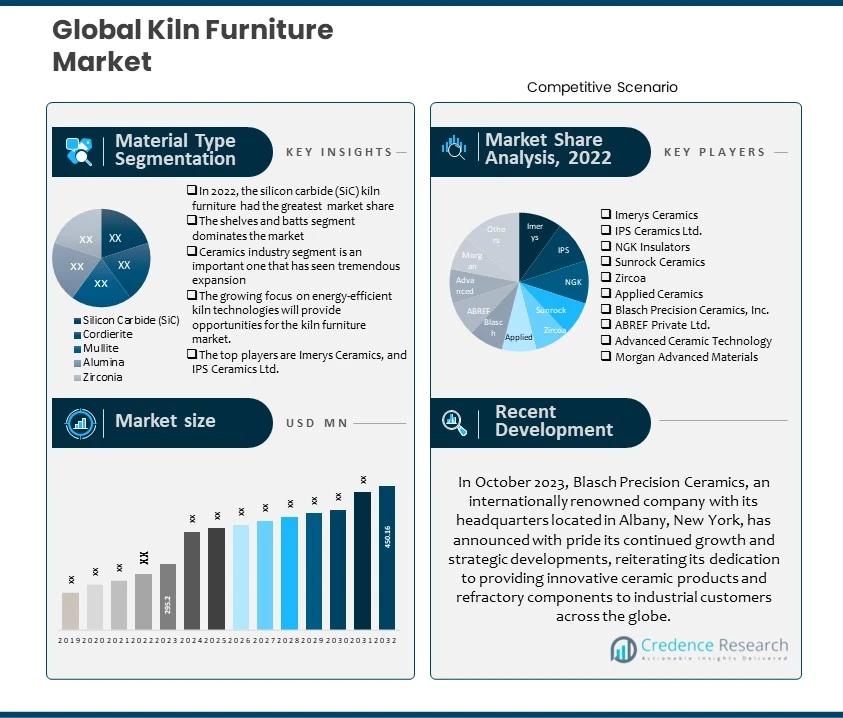
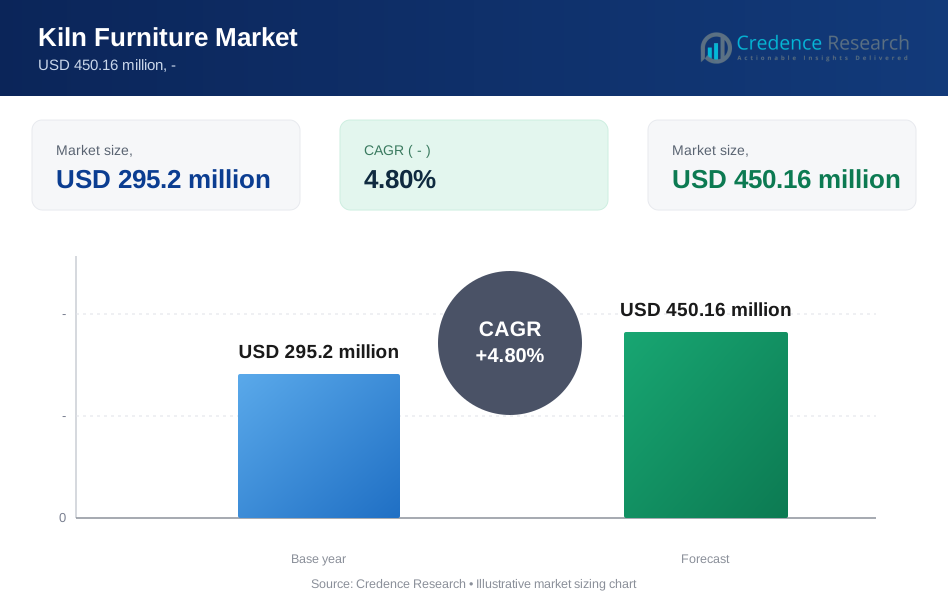
- The global kiln furniture market is expected to grow at a compound annual growth rate (CAGR) of 4.80% between 2024 and 2032, from its estimated USD 295.2 million in 2023 to USD 450.16 million in 2032.
- The significant material type category is silicon carbide (SiC) kiln furniture. On the other hand, cordierite kiln furniture is expected to grow at a strong CAGR.
- During the forecast period, the shelves and batts are anticipated to have the highest compound annual growth rate.
- The CAGR for the ceramics industry is expected to be the highest during the projection period.
- North America dominated the kiln furniture market.
- Regarding the market share of kiln furniture, Europe is expected to come second.
- In the kiln furniture market, Asia Pacific is anticipated to grow fastest.
- The primary drivers of the market are the growing use of sophisticated kiln furniture materials, improvements in kiln productivity and efficiency, and the rising acceptance of technical ceramics in the automotive industry.
- The market is expanding due to a growing focus on energy-efficient kiln technologies and rising demand for advanced ceramics from the electronics and semiconductor industries.
Executive Summary
Market Definition
The kiln furniture market describes the global market that deals with the manufacture, selling, and distribution of specialty tools and accessories used in kiln operations for a range of industries. Kiln furniture refers to a variety of refractory materials and parts made to endure high heat and challenging circumstances in furnaces, kilns, and other thermal processing equipment. Kilns are used in a variety of industries, including electronics, metallurgy, glass, ceramics, and aerospace, as well as fire, sinter, and anneal materials, among others. The market for kiln furniture products may include refractory bricks, trays, shelves, posts, setters, and other support structures needed for holding and moving objects during heat processes.
Market Overview
The kiln furniture sector is estimated to develop at a 4.80% compound annual growth rate (CAGR) between 2024 and 2032, maintaining its current upward trend. The market will continue to develop, rising from its estimated value of USD 295.2 million in 2023 to USD 450.16 million in 2032.
A key component of temperature control is kiln furniture, which is the term for the heat-resistant supports and structures used in kilns during firing processes. Exact control over temperature profiles is crucial in electronics and semiconductor manufacturing to guarantee the quality and functionality of the finished products. For kiln furniture in these kinds of applications, advanced ceramics, which are renowned for their capacity to tolerate elevated temperatures without warping or deteriorating, make a perfect choice. Specialized qualities of advanced ceramics include good electrical insulation, high thermal stability, and resistance to wear and corrosion. In sectors where accuracy and dependability are crucial, such as electronics and semiconductors, these attributes are especially valued.
Additionally, modern ceramics have less contamination and emissions than traditional materials like metals. This is important in industries where semiconductor components and electronic devices can become less functional or perform worse due to even minute contaminants. For kiln furniture, using cutting-edge ceramics reduces the possibility of contamination during the manufacturing process. Higher-performance materials are required for increasingly complex manufacturing processes as the electronics and semiconductor industries develop. This promotes the use of cutting-edge ceramics in numerous other essential parts of these industries, as well as in kiln furniture.
Segmentation by Material Type
- Silicon carbide (SiC) kiln furniture is the market leader by material type. Because of its remarkable thermal tolerance, SiC kiln furniture is appropriate for use in kilns with temperatures up to 2000°C. This characteristic ensures that even in extremely hot conditions, the kiln furniture stays stable and maintains its structural integrity.
- The cordierite kiln furniture category will exhibit a sizable CAGR during the projected period. A kind of refractory material called cordierite is used in industrial kilns to support and arrange ceramic products while they are being fired. An excellent material for kiln furniture, cordierite is a magnesium aluminum silicate mineral with low thermal expansion, high strength at high temperatures, and excellent resistance to thermal shock.
- Other material types, such as mullite, alumina, and zirconia kiln furniture, also contribute to the demand for kiln furniture.
Segmentation by Product Type
- The shelves and batts are more popular in the kiln furniture market. Flat, horizontal surfaces composed of refractory materials like silicon carbide, cordierite, or other ceramics are referred to as shelves in kiln furniture. These materials were picked because they don't warp or distort when exposed to high temperatures. While shelves and batts are comparable, batts are usually thicker and heavier. They provide a level surface for stacking materials in the kiln, much like shelves do.
- The posts and pillars category will likely register a significant CAGR during forecasting. Posts are columns or vertical supports that are usually constructed from refractory materials like alumina, cordierite, or silicon carbide. In order to create layers or shelves for stacking pottery or other ceramic items, these posts are carefully positioned within the kiln. Wherein similar to posts, pillars are typically thicker and taller. They accomplish the same thing by providing support for the kiln shelves and kiln stacking space. Larger kilns or heavy-duty applications requiring extra support and stability frequently use pillars.
- Tubes and setters, crucibles and saggers, and plates and tiles also contribute to the demand for the kiln furniture market.
Segmentation by Application
- It is projected that the ceramics industry will grow at the fastest rate over the projection period. The ceramics industry processes and shapes raw materials like clay, silica, and other minerals into a variety of ceramic products like tiles, pottery, tableware, sanitaryware, and advanced ceramics. These products go through processes like drying, glazing, firing, and shaping.
- Other applications, including the glass industry, metallurgy and heat treatment, electronics and semiconductor manufacturing, and aerospace and defense, also influence the need for kiln furniture.
Segmentation by Region
- North America leads the kiln furniture market. This is due to its abundance of resources, including high-grade clay and refractory materials needed to make kiln furniture.
- Europe is estimated to rank second in market size for kiln furniture.
- The kiln furniture industry is predicted to flourish rapidly in Asia Pacific.
- Regions such as Africa, the Middle East, and Latin America cover the remaining requirement for kiln furniture.
The demand for ceramic goods like tiles, bricks, and sanitaryware is rising as the construction sector grows. Kiln furniture is in high demand because these products frequently require kiln firing during the manufacturing process. Manufacturing facilities that produce ceramic products must expand to meet the growing demand brought about by the expansion of the construction industry. To boost production capacity, this expansion frequently entails purchasing extra kilns and kiln furnishings. Building sectors are expanding significantly in emerging economies, like China, India, and some parts of Southeast Asia, which are rapidly urbanizing and industrializing. As these nations invest in infrastructure and housing projects, their growth increases demand for kiln furniture.
Based on projections, the market for kiln furniture is dominated by North America. The area has highly qualified workers with backgrounds in engineering, manufacturing, and ceramics. These knowledgeable workers aid in the creation of superior kiln furniture items as well as the application of effective production methods. Kiln furniture has a sizable market in North America, driven by a number of industries, including metallurgy, glass, and ceramics. A robust demand encourages investment and innovation in the kiln furniture sector. Manufacturers can cut production costs and lead times by taking advantage of the region's well-developed infrastructure and logistics network, which facilitate the transportation of finished goods and raw materials.
The kiln furniture market in Asia Pacific will expand fastest throughout the forecast. Asia Pacific's construction sector is experiencing rapid growth due to factors such as population expansion, urbanization, and infrastructure development programs. The manufacturing of ceramic tiles, sanitaryware, and other building materials depends on kiln furniture, which promotes market expansion. Asia-Pacific is rapidly becoming an industrialized region, especially in Southeast Asia, China, and India. Kiln furniture is in high demand because of the necessity of using kilns for various processes like glass production, metallurgy, and ceramic manufacturing due to this industrial growth. Ceramic products are becoming more and more in demand across a range of industries, including the automotive, electronics, construction, and healthcare sectors. The necessity for kiln furniture in the area is supported by its crucial role in the ceramics manufacturing process.
Key Highlights of the Report
The global kiln furniture market is segmented by material type, product type, application, and region. Regarding the material type, silicon carbide (SiC) kiln furniture is the market spearhead. Shelves and batts are the top product type category. The ceramics industry category is anticipated to increase at the highest CAGR throughout the projection period. The kiln furniture market is expanding mostly in North America.
The need for high-quality ceramic products in healthcare applications heavily drives the market for kiln furniture. The heat-resistant materials used in kilns to support and shape ceramic ware during firing are referred to as kiln furniture. Ceramics are essential to the healthcare industry because of their inherent qualities, which include biocompatibility, sterilizability, and durability. Because ceramics are biocompatible—that is, they can be used safely inside the human body without causing negative reactions—they are preferred in healthcare applications. Ceramics can also tolerate the high temperatures needed for sterilization procedures like autoclaving. Kiln furniture makes it possible to precisely fire and sterilize ceramic parts used in medical devices, guaranteeing the efficacy and safety of those parts for use in healthcare settings.
The North American region is expected to account for the largest kiln furniture market globally. Kiln furniture manufacturers can operate and expand their businesses with stability and support from North America's generally favorable regulatory environment for manufacturing industries. The Asia Pacific is also assumed to have the market's sharpest growth. Asia-Pacific nations export a large amount of ceramic goods to different parts of the world. The demand for kiln furniture in the region rises in response to the growing global demand for ceramic products, which propels market growth.
Which Key Factors Are Driving The Global Kiln Furniture Market?
The primary drivers of the kiln furniture market are the increase in the production of electronic components, the favorable government policies that support ceramic manufacturing, and the growing demand for kiln furniture in the jewelry and luxury goods sectors.
What Are The Main Challenges Confronting The Kiln Furniture Market Globally?
The high initial costs of kiln furniture, fierce competition from substitute materials like metal and plastic, and environmental issues surrounding the ceramic product manufacturing process are the primary barriers impeding the global kiln furniture industry's growth.
What Market Opportunities Exist For Kiln Furniture Globally?
The potential for the kiln furniture market is being driven by the increasing need for refractory ceramics in the steel and metal processing industries, the growing use of technical ceramics in the renewable energy sector, and the rising demand for technical ceramics in the aerospace and defense sectors.
Market Drivers
Multiple factors propel the kiln furniture industry across the globe. The primary factors propelling the global kiln furniture market are as follows:
Increasing Use of Ceramic Tiles in Both Commercial and Residential Buildings
Ceramic tiles are in greater demand for both commercial and residential buildings as construction activities rise, especially in emerging economies. For the purpose of firing ceramic tiles during the manufacturing process, kiln furniture is necessary. Because of their strength, adaptability, and visual appeal, ceramic tiles are preferred. They are frequently utilized in a number of locations, including bathrooms, kitchens, and outdoor areas. Kiln furniture is in high demand in order to produce the ceramic tiles that are becoming more and more popular. The need for ceramic tile replacement is another factor driving demand for kiln furniture. In order to maintain the demand for kiln furniture over time, property owners frequently replace worn-out or outdated tiles with newer models. Because ceramic tiles are recyclable and energy-efficient, they are a preferred option in construction, where sustainability and environmental friendliness are becoming more and more important. This preference drives the need for kiln furniture to create ecologically friendly ceramic tiles. Global urbanization is increasing the demand for housing and infrastructure, which in turn is driving up the demand for ceramic tiles. In order to satisfy this demand and guarantee effective production procedures, kiln furniture becomes crucial. Customers are becoming more picky about personalized and distinctive designs for their rooms. Because ceramic tiles can be customized in so many ways, different shapes, sizes, and designs need to be accommodated during the manufacturing process. To do this, specialized kiln furniture is needed.
Market Restraints
There are several obstacles that the global kiln furniture market must overcome to continue growing. Among them are the following:
High Initial Investment Costs Associated with Kiln Furniture
Specialized materials and procedures are needed to manufacture kiln furniture, which frequently necessitates a large initial outlay for tools, molds, and raw materials. This may discourage new competitors from entering the market and reduce the pool of suppliers, which would raise prices as a result of less competition. Kiln furniture can be very expensive up front, especially for independent artists or small ceramic studios. This could deter them from purchasing high-quality kiln furniture or drive them to look for less expensive alternatives. It can be difficult for start-ups or new ceramic businesses to set aside money for the purchase of premium kiln furniture because of their tight budgets. This may reduce their capacity for production and possibly their ability to engage in profitable market competition.
Opportunities
There are plenty of potential prospects in the global kiln furniture industry. Among these are the following:
Kiln Furniture Solutions are Becoming Progressively more Possible as the 3D Printing Market Grows
The technology is becoming more widely available and reasonably priced as the 3D printing market grows. This accessibility creates new opportunities for producing intricate designs and complicated shapes, which are frequently needed for kiln furniture. Customizing kiln furniture to meet the unique needs of individual artists or industries is made easy with 3D printing. It follows that producers are able to create customized solutions for various kiln configurations and firing procedures. Without the need for costly tooling or lengthy lead times, manufacturers can quickly iterate and test new designs for kiln furniture due to 3D printing's ability to enable rapid prototyping. This flexibility in product development can result in more rapid innovation and better kiln furniture performance. For the production of kiln furniture, 3D printing provides the freedom to experiment with a wide range of materials, including advanced ceramics and composites. This creates the possibility of creating high-performance, lightweight, and robust kiln furniture solutions that can tolerate the severe temperatures and conditions of the firing process. Long-term cost savings can result from the ability to produce complex shapes with minimal material waste, even though the initial investment in 3D printing technology may be substantial. Further reducing manufacturing costs is the efficient batch production of kiln furniture made possible by the scalability of 3D printing.
Competitive Landscape
Key Players
Several major competitors exist in the fiercely competitive global kiln furniture market. The following are a few of the leading market participants and their market shares:
- Imerys Ceramics
- IPS Ceramics Ltd.
- NGK Insulators
- Sunrock Ceramics
- Zircon
- Applied Ceramics
- Blasch Precision Ceramics, Inc.
- ABREF Private Ltd.
- Advanced Ceramic Technology
- Morgan Advanced Materials
- Olympic Kilns
- Mino Ceramic
- Others
These companies prioritize product innovation, distribution channel expansion, mergers, and acquisitions to remain competitive.
The largest suppliers in the global kiln furniture market continuously work to keep one step ahead of the competition by developing innovative concepts and products.
In January 2023, With an enterprise value of €930 million, Imerys successfully divested its High-Temperature Solution business area (HTS) to Platinum Equity. This global investment group operates businesses in several sectors.
In August 2020, Blasch Precision Ceramics announced OXYTRONTM 015XDII, the most recent iteration of their OXYTRONTM - Oxide Bonded Silicon Carbide, in light of recent advancements in the material. With exceptional non-wetting properties and exceptional resistance to corrosion, wear, and heat shock, OXYTRON 015XDII is engineered for use in nonferrous metallurgical applications.
In August 2020, Imerys announced a deal to buy a majority 60% share, with options to buy the remaining stake, in the Haznedar group, a high-quality manufacturer of monolithic refractories and refractory bricks serving the cement, petrochemical, and iron and steel industries in Turkey. In 2019, this company brought in USD 64 million in revenue (40 percent of which came from exports) and USD 17 million in EBITDA.
Summary of Key Findings
- The growing emphasis on strong and lightweight kiln furniture materials is continuing to influence the market for kiln furniture.
- The market is segmented by material type, product type, application, and region.
- The most popular material type in the market is silicon carbide (SiC) kiln furniture.
- Shelves and batts are the foremost category.
- The ceramics industry is expected to grow the fastest regarding CAGR during the forecast period.
- North America is leading market development; the market is highly competitive with key players including Imerys Ceramics, IPS Ceramics Ltd., NGK Insulators, Sunrock Ceramics, Zircoa, Applied Ceramics, Blasch Precision Ceramics, Inc., ABREF Private Ltd., Advanced Ceramic Technology, Morgan Advanced Materials, Olympic Kilns, Mino Ceramic, and Others.
Future Outlook
- The Kiln furniture industry is expected to increase significantly in North America and has a positive outlook worldwide.
- The global market is growing due to the increase in demand for technical ceramics from the aerospace and defense industries.
- Kiln furniture market growth is expected to be hampered by the shortage of skilled labor for kiln operations during the projected period.
- To stay ahead of the competition, key enterprises must develop new products, expand their market reach, and keep their prices competitive.
How CXOs Can Benefit from the Credence Research Kiln Furniture Market Report
CXOs may get a detailed picture of the market in the Credence Research Kiln Furniture Market Report, which includes:
- Market size and growth forecast: The report provides detailed estimates of the global kiln furniture market size, segmented by material type, product type, application, and region. It also includes forecasts for the market through 2032 based on key trends and drivers.
- Market segmentation: The research report breaks down the market for kiln furniture into segments based on the material type, product type, application, and region. This segmentation provides CXOs with a granular understanding of the market and the opportunities in each segment.
- Competitive landscape: The research report offers a detailed analysis of the major companies in the kiln furniture industry, including information on their business plans, product lines, and earnings. CXOs can use this information to evaluate and identify their competitors.
- Key trends and drivers: The research report identifies and evaluates the main trends and factors influencing the market for kiln furniture. CXOs can use this information to make well-informed choices regarding their plans and investments.
CXOs can use the insights from the Credence Research Kiln Furniture Market Report to:
- Identify growth opportunities: This analysis may help CXOs identify new growth opportunities in the kiln furniture sector. For example, the report identifies the growing demand for kiln furniture from the ceramics industry as a key opportunity.
- Make informed investment decisions: The report helps CXOs choose kiln furniture wisely. For example, the research study provides information on the critical factors to consider while selecting kiln furniture solutions and evaluating kiln furniture suppliers.
- Develop competitive strategies: CXOs can use the research report to develop competitive strategies for their kiln furniture businesses. For example, the research paper outlines the main strategies suppliers utilize to differentiate themselves from competitors.
- Track market developments: This research report may help CXOs stay ahead of the curve by tracking market developments. For instance, it offers insights into the most recent developments and trends in the market for kiln furniture.
In general, CXOs seeking to expand their industry knowledge and spot growth prospects will find the Credence Research Kiln Furniture Market Report a useful tool.
Segmentation
- By Material Type
- Silicon Carbide (SiC) Kiln Furniture
- Cordierite Kiln Furniture
- Mullite Kiln Furniture
- Alumina Kiln Furniture
- Zirconia Kiln Furniture
- By Product Type
- Shelves and Batts
- Posts and Pillars
- Tubes and Setters
- Crucibles and Saggers
- Plates and Tiles
- By Application
- Ceramics Industry
- Glass Industry
- Metallurgy and Heat Treatment
- Electronics and Semiconductor Manufacturing
- Aerospace and Defense
- By Region
- North America
- The U.S.
- Canada
- Mexico
- Europe
- Germany
- France
- The U.K.
- Italy
- Spain
- Rest of Europe
- Asia Pacific
- China
- Japan
- India
- South Korea
- South-east Asia
- Rest of Asia Pacific
- Latin America
- Brazil
- Argentina
- Rest of Latin America
- Middle East & Africa
- GCC Countries
- South Africa
- Rest of Middle East and Africa
- North America
Request a Free Sample
Fill in your details and we'll send you a free sample report.
- Sample data tables & charts
- Research methodology
Need a Custom Version of This Report?
Tailor the scope, geography, or segments to your exact requirements.
- Custom geography or segment scope
- Direct access to our analyst team
Frequently Asked Questions
How much does the global market currently hold for kiln furniture?
What is the kiln furniture market's projected growth rate between 2024 and 2032?
In terms of material type, which market category is leading?
In which region is the market for kiln furniture expanding?
Who are the main players in the global kiln furniture industry?
Table of Content
Chapter 1. Report Introduction
- 1.1 Report Description & Purpose
- 1.1.1 Report Title & Market Definition
- 1.1.2 Unique Selling Propositions (USP) & Key Differentiators
- 1.1.3 Value Proposition for Stakeholders
- 1.2 Research Objectives
- 1.2.1 Market Sizing Objectives (Volume & Revenue)
- 1.2.2 Segmentation Objectives
- 1.2.3 Competitive Intelligence Objectives
- 1.2.4 Forecast & Scenario Objectives
- 1.3 Report Scope
- 1.3.1 Kiln Furniture Scope – Types & Subtypes Covered
- 1.3.2 Geographic Scope – Regions & Countries Covered
- 1.3.3 Historical Period, Base Year & Forecast Period (the historical period; forecast to the forecast period)
- 1.3.4 Inclusions & Exclusions
- 1.4 HS Code & Classification Framework
- 1.5 Currency, Units & Pricing Basis
- 1.6 Target Stakeholders
- 1.7 Limitations & Assumptions
Chapter 2. Executive Summary
- 2.1 Global Kiln Furniture Market Snapshot
- 2.1.1 Market Size – Historical (the historical period) & Forecast (the forecast period) (base year: USD 295.2 million → forecast year: USD 450.16 million)
- 2.1.2 Volume & Revenue – Global Totals
- 2.1.3 Key Market Highlights – Top Five Facts
- 2.2 Kiln Furniture Market Segmentation Snapshot
- 2.2.1 Market Split by Region – vs.
- 2.3 Competitive Snapshot
- 2.3.1 Top 10 Players by Revenue Share –
- 2.3.2 Top 10 Players by Volume Share –
- 2.3.3 Recent Strategic Developments (18-Month Summary)
- 2.4 Key Investment Highlights & Strategic Conclusions
Chapter 3. Kiln Furniture Market Dynamics & Industry Analysis
- 3.1 Market Overview & Context
- 3.1.1 Kiln Furniture Market Position in the Broader Automotive Value Chain
- 3.1.2 OEM vs. Replacement Market Dynamics
- 3.1.3 Market Maturity & Development Stage by Region
- 3.2 Kiln Furniture Market Drivers
- 3.3 Kiln Furniture Market Restraints & Challenges
- 3.4 Kiln Furniture Market Opportunities
- 3.5 Porter's Five Forces Analysis
- 3.5.1 Threat of New Entrants
- 3.5.2 Bargaining Power of Suppliers
- 3.5.3 Bargaining Power of Buyers
- 3.5.4 Threat of Substitutes
- 3.5.5 Competitive Rivalry – Intensity Assessment
- 3.6 Kiln Furniture Value Chain Analysis
- 3.6.1 Upstream – Raw Material/Input Suppliers
- 3.6.1.1 Raw Material/Input 1
- 3.6.1.2 Raw Material/Input 2
- 3.6.1.3 Raw Material/Input 3
- 3.6.2 Midstream – Production/Manufacturing/Service Delivery
- 3.6.2.1 Production/Process Overview
- 3.6.2.2 Key Facility Locations & Capacity by Manufacturer
- 3.6.3 Downstream – Distribution & End Consumer
- 3.6.3.1 Primary Channel – B2B/OEM
- 3.6.3.2 Secondary Channels – Dealer, Retail, Online, Direct
- 3.6.4 Value Chain Profitability Analysis
- 3.6.1 Upstream – Raw Material/Input Suppliers
- 3.7 PESTEL Analysis
- 3.7.1 Political Factors
- 3.7.2 Economic Factors
- 3.7.3 Social Factors
- 3.7.4 Technological Factors
- 3.7.5 Environmental Factors
- 3.7.6 Legal Factors
- 3.8 Kiln Furniture Supply Chain Analysis
- 3.8.1 Raw Material/Input Supply Risk Assessment
- 3.8.2 Manufacturing Concentration Risk (Geographic Exposure)
- 3.8.3 Trade Disruption Impact Analysis
- 3.9 Regulatory & Policy Landscape
Note: The regulatory and policy landscape section covers regulations based on their applicability to the market, Kiln Furniture category, geography, and scope of the study. Only regulatory frameworks with a material impact on operations, compliance, trade, sustainability, or market access are analyzed in detail.
Chapter 4. Key Investment Pockets & Opportunity Analysis
- 4.1 Kiln Furniture Market Attractiveness Analysis
- 4.1.1 By Region – Investment Attractiveness Matrix (Volume × CAGR)
- 4.2 Absolute Revenue Growth Opportunity
- 4.2.1 By Region – Absolute USD Growth Through the forecast period
- 4.3 Incremental Volume Opportunity
- 4.3.1 By Region – Incremental Volume Through the forecast period
- 4.3.2 Segment – Incremental Volume
- 4.4 Emerging Submarket Opportunity Deep Dive (Subject to Applicability)
- 4.5 Emerging Market Opportunity Scorecards
- 4.5.1 United States
- 4.5.2 Europe
- 4.5.3 Asia
- 4.5.4 Middle East & Africa
Note: Emerging Market Opportunity Scorecards will be included based on relevance and strategic importance. Regions listed are indicative and may vary depending on data availability and market dynamics.
Chapter 5. Kiln Furniture Import-Export Analysis & Trade Flows
- 5.1 Global Trade Overview
- 5.1.1 Global Export Value by Country (the historical period)
- 5.1.2 Global Export Volume by Country (the historical period)
- 5.1.3 Global Import Value by Country (the historical period)
- 5.1.4 Global Import Volume by Country (the historical period)
- 5.1.5 Net Trade Balance by Country (the historical period)
- 5.2 Export Analysis – Segment
- 5.2.1 Type 1 (HS Code)
- 5.2.2 Type 2 (HS Code)
- 5.2.3 Type 3 (HS Code)
- 5.2.4 Type 4 (HS Code)
- 5.2.5 Type 5 (HS Code)
- 5.3 Import Analysis – Segment
- 5.3.1 Type 1 (HS Code)
- 5.3.2 Type 2 (HS Code)
- 5.3.3 Type 3 (HS Code)
- 5.3.4 Type 4 (HS Code)
- 5.3.5 Type 5 (HS Code)
- 5.4 Average Unit Trade Prices
- 5.4.1 Average Export Price – Segment & Country
- 5.4.2 Average Import Price – Segment & Source Country
- 5.4.3 Price Trends (the historical period)
- 5.5 Key Trade Route Analysis
- 5.5.1 Trade Route 1
- 5.5.2 Trade Route 2
- 5.5.3 Trade Route 3
- 5.5.4 Trade Route 4
- 5.5.5 Trade Route 5
- 5.6 Trade Policy Impact Assessment
- 5.6.1 US Anti-Dumping & Section 301 Tariffs
- 5.6.2 EU Customs Union Impact
- 5.6.3 Major Free Trade Agreements
- 5.6.4 USMCA Rules of Origin
Note: Trade policy analysis will be included only where relevant to the Kiln Furniture market.
Chapter 6. Competitive Landscape & Company Benchmarking
- 6.1 Kiln Furniture Market Concentration & Structure
- 6.1.1 Herfindahl-Hirschman Index (HHI) – vs.
- 6.1.2 Tier 1, Tier 2 & Tier 3 Market Structure
- 6.1.3 Global, Regional & Local Player Dynamics
- 6.2 Kiln Furniture Market Share Analysis –
- 6.2.1 Global Revenue Share by Company
- 6.2.2 Global Volume Share by Company
- 6.2.3 Regional Revenue Share
- 6.2.4 Market Share Evolution ( vs. )
- 6.2.5 OEM Segment Share by Company
- 6.2.6 Replacement Segment Share by Company
- 6.3 Production/Delivery Capacity & Facility Analysis
- 6.3.1 Global Installed Capacity
- 6.3.2 Capacity Utilization Rates
- 6.3.3 Production/Output Volume
- 6.3.4 Facility Locations & Capacity Map
- 6.3.5 Planned Capacity Additions
- 6.4 Kiln Furniture Competitive Benchmarking Matrix
- 6.4.1 Revenue, Volume, CAGR & Profitability Comparison
- 6.4.2 Channel Revenue Mix
- 6.4.3 Geographic Revenue Exposure
- 6.4.4 R&D Intensity
- 6.4.5 Sustainability Maturity
- 6.5 Strategic Developments in Kiln Furniture (Last 24 Months)
- 6.5.1 Mergers, Acquisitions & Divestments
- 6.5.2 New Kiln Furniture Launches
- 6.5.3 Facility Expansions
- 6.5.4 Strategic Alliances, Joint Ventures & Partnerships
- 6.5.5 Distribution Expansion & Market Entry
- 6.5.6 Sustainability & ESG Initiatives
- 6.6 Competitive Strategy Mapping
- 6.6.1 Leader, Challenger, Follower & Niche Classification
- 6.6.2 Pricing Strategy Comparison
- 6.6.3 Channel Strategy Matrix
Note: Strategic developments are included based on their materiality and the availability of reliable information.
Chapter 7. Global Kiln Furniture Market – By Distribution Channel
- 7.1 Segment Overview
- 7.1.1 Volume & Revenue Split by Channel ( & )
- 7.1.2 Channel Mix Evolution (the forecast period)
Chapter 8. Regional Market Analysis – Global Overview
- 8.1 Global Regional Overview
- 8.1.1 Regional Volume Share
- 8.1.2 Regional Revenue Share
- 8.1.3 Regional Volume by Region
- 8.1.4 Regional Revenue by Region
- 8.1.5 Regional Forecast Through the forecast period
- 8.2 Cross-Regional Segment Analysis
- 8.2.1 By Distribution Channel
- 8.2.2 By Brand/Price Tier
Chapter 9. North America Kiln Furniture Market
- 9.1 United States
- 9.2 Canada
- 9.3 Mexico
Chapter 10. Europe Kiln Furniture Market
- 10.1 Germany
- 10.2 France
- 10.3 Italy
- 10.4 United Kingdom
- 10.5 Spain
- 10.6 Poland
- 10.7 Russia
- 10.8 Netherlands
- 10.9 Belgium
- 10.10 Sweden
- 10.11 Denmark
- 10.12 Norway
- 10.13 Rest of Europe
Chapter 11. Asia Pacific Kiln Furniture Market
- 11.1 China
- 11.2 India
- 11.3 Japan
- 11.4 South Korea
- 11.5 Thailand
- 11.6 Indonesia
- 11.7 Vietnam
- 11.8 Malaysia
- 11.9 Australia
- 11.10 Rest of Asia Pacific
Chapter 12. Latin America Kiln Furniture Market
- 12.1 Brazil
- 12.2 Argentina
- 12.3 Colombia
- 12.4 Chile
- 12.5 Rest of Latin America
Chapter 13. Middle East Kiln Furniture Market
- 13.1 Saudi Arabia
- 13.2 United Arab Emirates
- 13.3 Turkey
- 13.4 Israel
- 13.5 Iran
- 13.6 Rest of the Middle East
Chapter 14. Africa Kiln Furniture Market
- 14.1 South Africa
- 14.2 Egypt
- 14.3 Nigeria
- 14.4 Morocco
- 14.5 Rest of Africa
Chapter 15. Kiln Furniture Company Profiles
- 15.1 [Company 01]
- 15.1.1 Company Overview
- 15.1.2 Key Management Personnel
- 15.1.3 Products & Services Portfolio
- 15.1.4 Financial Performance
- 15.1.5 Key Market Focus & Geographic Presence
- 15.1.6 Recent Developments & Strategic Initiatives
Note: The company profile list is preliminary and may change based on research findings, market developments, data availability, and client requirements.
Chapter 16. Appendices
- Appendix A – List of Abbreviations & Acronyms
- Appendix B – Industry Classification Code Reference – Full Series
- Appendix C – Production & Capacity Data Tables
- Appendix D – End-Use & Demand Base Tables
- Appendix E – Consumption & Replacement Rate Assumptions
- Appendix F – ASP Reference Tables
- Appendix G – Manufacturing & Facility Database
- Appendix H – Import-Export Data Tables
- Appendix I – Regulatory Summary Tables
- Appendix J – Primary Research Participant List (Anonymized)
- Appendix K – Primary Research Questionnaire Framework
- Appendix L – Data Sources & Bibliography
- Appendix M – Market Size Divergence & Source Comparison
Chapter 17. Research Methodology
- 17.1 Research Framework & Philosophy
- 17.2 Secondary Research – Sources, Hierarchy & Data Extraction
- 17.3 Data Modeling – Bottom-Up & Top-Down Market Sizing
- 17.4 Primary Research – Stakeholder Framework, LOI & Sample Sizes
- 17.5 Forecast Methodology – Regression, Scenario & Sensitivity Analysis
- 17.6 Quality Control – Four-Layer Validation Framework
- 17.7 Limitations & Standard Assumptions
- 17.8 Disclaimer
