
Market Overview
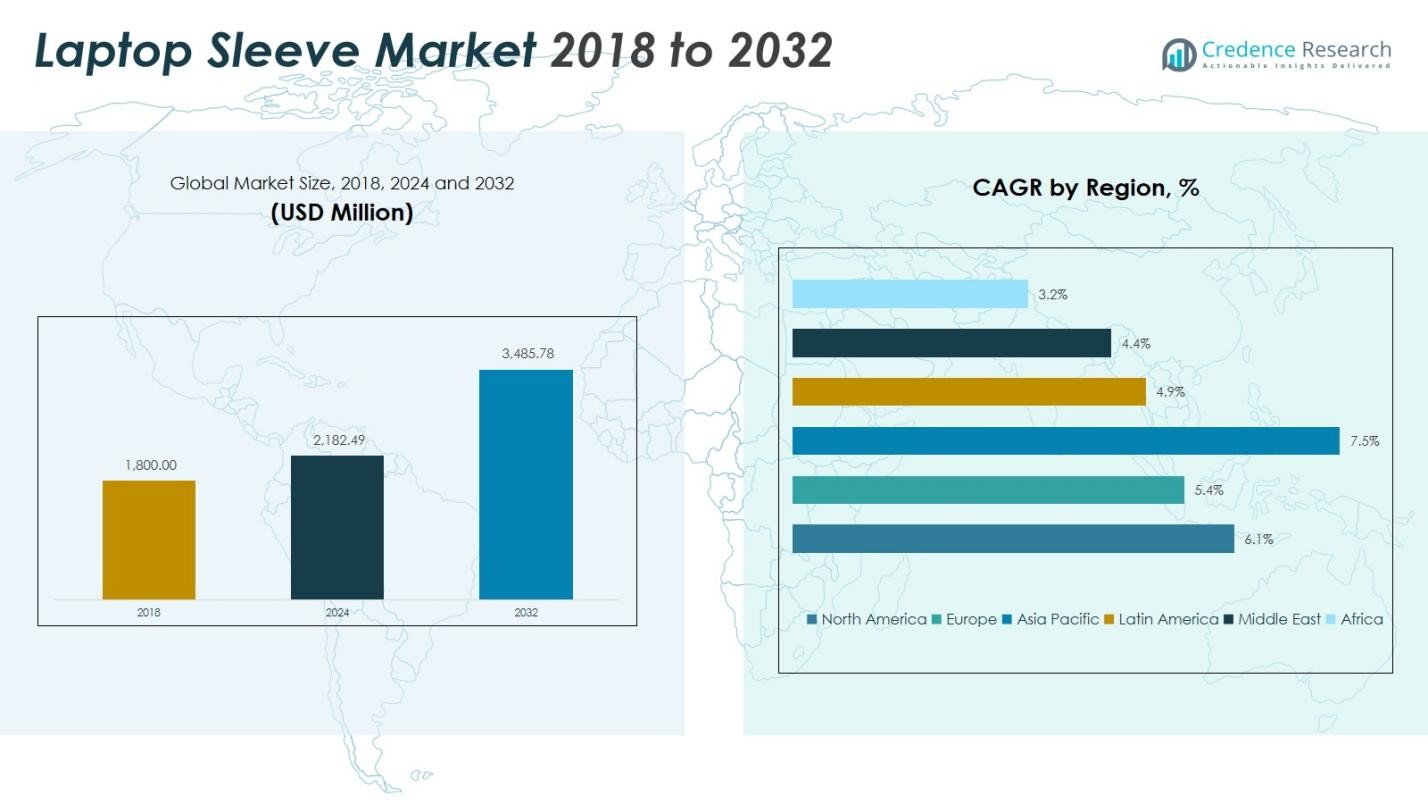
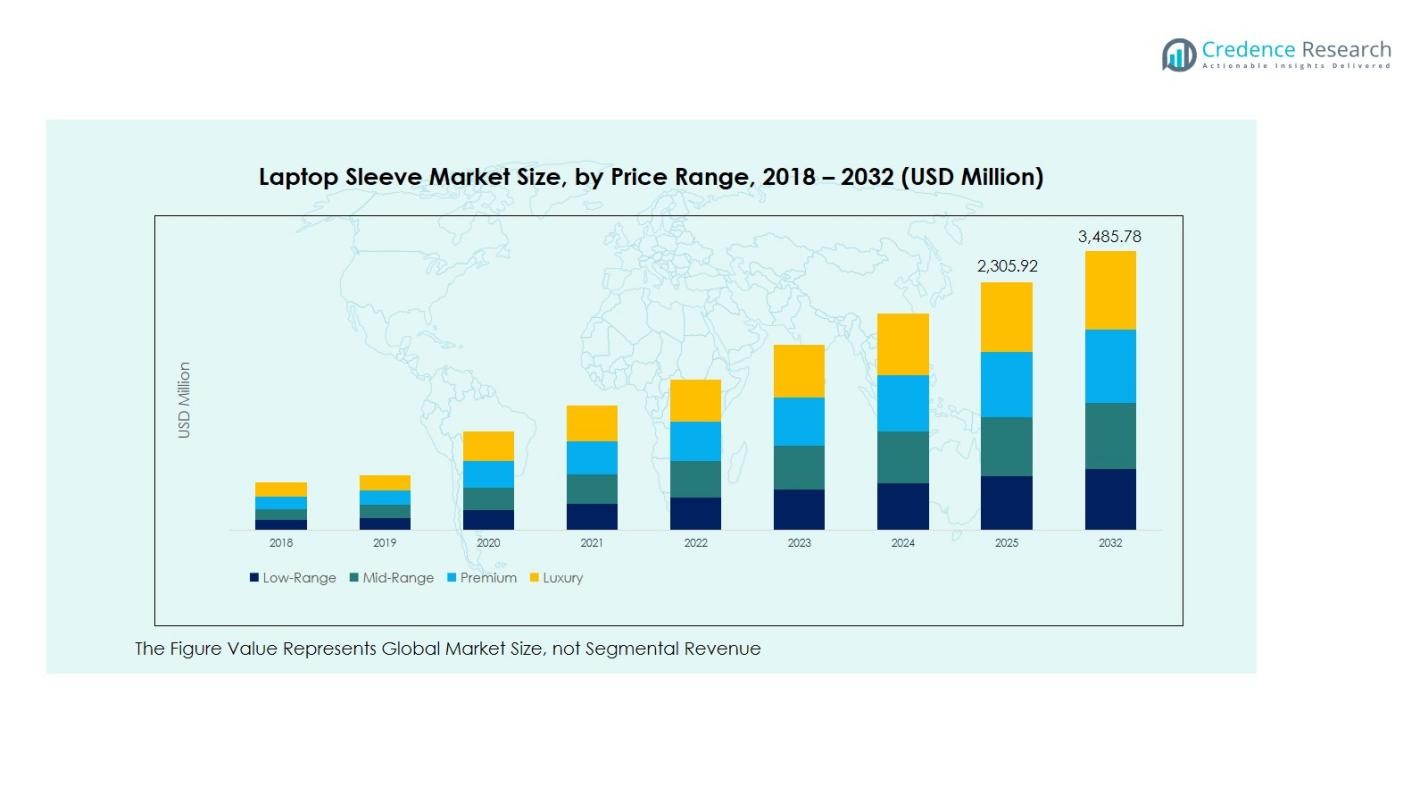
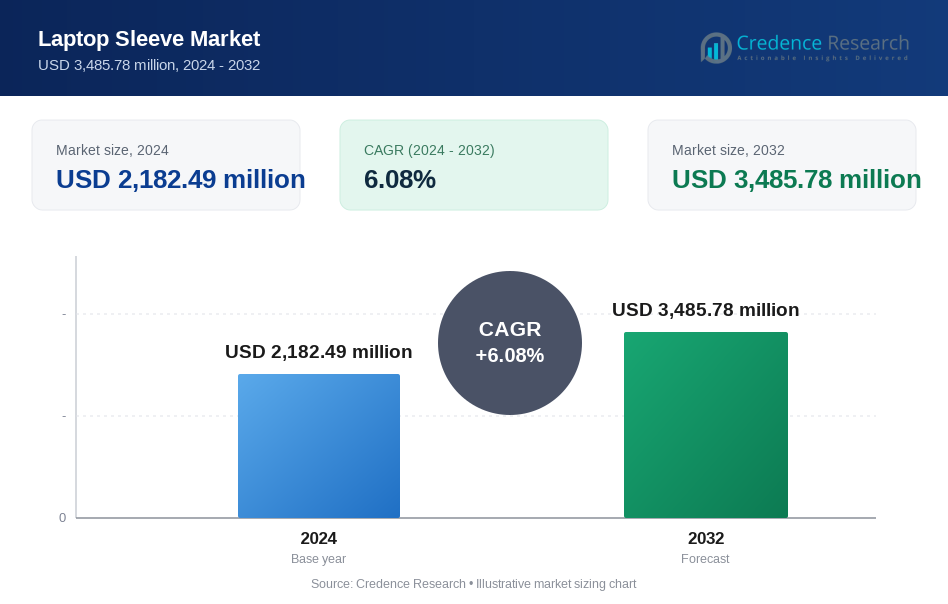
The Laptop Sleeve Market size was valued at USD 1,800.00 Million in 2018, reaching USD 2,182.49 Million in 2024, and is anticipated to grow to USD 3,485.78 Million by 2032, at a CAGR of 6.08% during the forecast period.
| REPORT ATTRIBUTE | DETAILS |
|---|---|
| Historical Period | 2020-2023 |
| Base Year | 2024 |
| Forecast Period | 2025-2032 |
| Laptop Sleeve Market Size 2024 | USD 2,182.49 Million |
| Laptop Sleeve Market, CAGR | 6.08% |
| Laptop Sleeve Market Size 2032 | USD 3,485.78 Million |
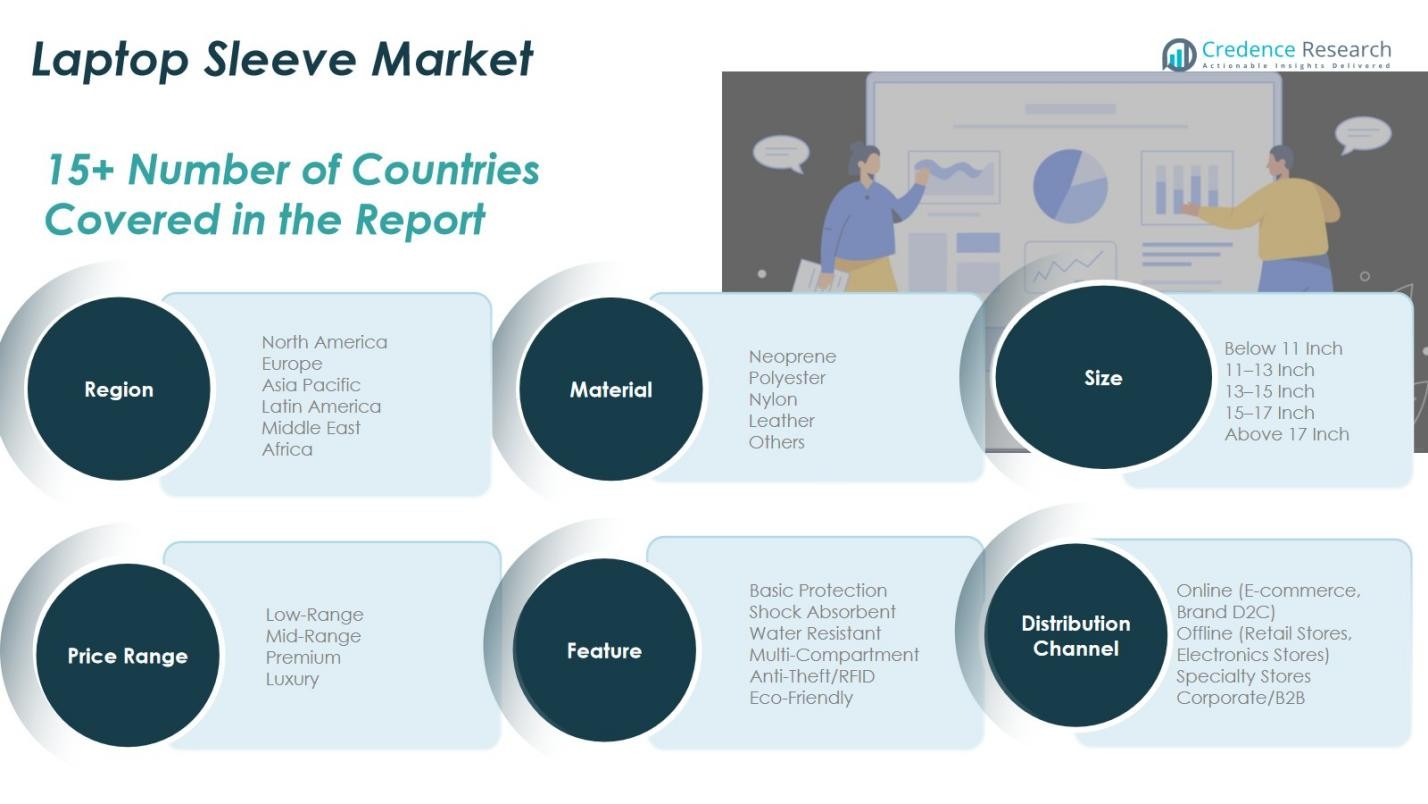
The Laptop Sleeve Market is dominated by key players such as Case Logic, Targus, AmazonBasics, Thule, MOSISO, Inateck, HP, Dell, Lenovo, and Apple. These companies lead the market through continuous product innovation, with a strong emphasis on quality, material variety, and design. North America holds the largest market share, accounting for 30% of the global total, driven by high laptop adoption rates and a preference for premium protective accessories. Europe, with a market share of 22%, follows closely due to rising laptop usage in both professional and educational sectors. Asia Pacific, growing at the fastest pace, accounts for 21% of the market, fueled by increasing disposable incomes and the growing middle class in emerging economies. These regions, alongside the major players, contribute to the dynamic expansion of the laptop sleeve market globally.
 Market Insights
- The market size for the Laptop Sleeve Market reached USD 2,182.49 million in 2024 and is projected to grow to USD 3,485.78 million by 2032 at a CAGR of 08%.
- Growing laptop adoption across professional, educational and personal settings drives demand for protective accessories and boosts the Laptop Sleeve Market.
- Key trends include rising demand for premium materials (like neoprene capturing 37% material share) and the 13–15 inch size segment accounting for 35% of the market, supporting market growth.
- A highly fragmented vendor landscape and intense price competition pose significant restraints to profitability and growth in the Laptop Sleeve Market.
- Regionally, North America leads with 30% share, Europe contributes 22%, and Asia Pacific follows with 21%, shaping the geographic spread and growth of the Laptop Sleeve Market.
Market Segmentation Analysis:
By Material
In the Material segment, the neoprene sub‑segment emerges as the dominant category, capturing 37% of the global laptop sleeve market. Its strength is primarily driven by its resilient and flexible nature, offering robust protection against shocks and scratches while being lightweight and cost‑effective. The growing demand from mobile professionals and students lends strong support to neoprene’s leadership. Secondary materials such as polyester and nylon are gaining traction due to their affordability, while leather caters to the premium segment with aesthetics and durability.
- For instance, the Cosmus Smartex 14.1-inch laptop sleeve utilizes breathable, wrinkle-free neoprene fabric that is water and impact-resistant, providing strong protection from dust and debris.
By Size
Within the Size segment, the 13–15 inch bucket stands out as the dominant sub‑segment, accounting for 35% of the market in 2024. This predominance reflects the broad adoption of laptops in this size class, which strike the right balance between portability and functionality for both professional and personal users. The high demand for compatible protective sleeves underpins this share. Smaller sizes (below 11 inch) and larger formats (above 17 inch) remain niche, although the latter is growing in the gaming and creative workstation space.
- For instance, Dell's mid-range 14-inch laptops that combine compact design with strong processing capabilities, catering to productivity needs.
By End‑User
In the End‑User segment, the Professional/Corporate category holds the largest share, estimated at around 35% in 2024. The driving factors include widespread laptop issuance in corporate settings, a heightened emphasis on device security during transit, and bulk procurement of branded sleeves. The Educational/Institutional and Gaming/Creative segments follow as notable contributors, with their growth supported by remote learning initiatives and high‑performance laptop usage respectively, but neither currently matches the corporate scale.
Key Growth Drivers
Rising Laptop Adoption
The increasing global adoption of laptops for work, education, and leisure is a significant growth driver for the laptop sleeve market. As remote working, digital learning, and portable computing continue to gain momentum, the demand for protective accessories like laptop sleeves is on the rise. The proliferation of laptops across various industries, coupled with the growing need for safeguarding devices from wear and tear, directly impacts the expansion of the laptop sleeve market. This shift has led to a growing consumer awareness of the importance of protection for these portable devices.
- For instance, Microsoft offers education discounts on Surface laptops and accessories, highlighting strong demand from students and educators who prioritize device protection and portability.
Growth of E-Commerce
The expansion of e-commerce platforms is playing a crucial role in the laptop sleeve market's growth. Online retail giants and direct-to-consumer (D2C) brands have made purchasing laptop sleeves more accessible, fostering an increase in market demand. E-commerce platforms allow consumers to explore a variety of styles, materials, and price ranges, boosting the overall market. This trend is further accelerated by the growing preference for online shopping due to convenience, enabling more consumers to purchase laptop sleeves globally, often with enhanced delivery and customization options.
- For instance, Bellroy emphasizes sustainable materials in its laptop sleeves, attracting eco-conscious online shoppers who seek both style and environmental responsibility in their purchases.
Increasing Consumer Preference for Premium Products
A growing consumer trend towards premium, high-quality products is fueling the demand for high-end laptop sleeves, particularly in materials like leather, neoprene, and eco-friendly alternatives. As individuals and professionals are becoming more aware of the value of both aesthetics and functionality, they are investing in durable, stylish, and protective sleeves. This preference for quality over price is encouraging manufacturers to focus on superior materials, offering value-added features such as anti-theft capabilities, water resistance, and multiple compartments, which is contributing significantly to market growth.
Key Trends & Opportunities
Customization and Personalization
There is a rising trend in consumer demand for customized and personalized laptop sleeves. This shift offers significant opportunities for brands to differentiate themselves in a competitive market. Consumers are increasingly seeking sleeves that reflect their personal style, whether through color, material, or even custom designs and logos. With advancements in printing and embroidery technologies, manufacturers are well-positioned to cater to this demand, opening up new revenue streams and fostering greater brand loyalty among tech-savvy buyers.
- For instance, PrintStop enables customers to personalize laptop sleeves with logos and names using advanced online creation tools, ensuring precise designs and brand visibility.
Eco-Friendly Products
Sustainability is emerging as a key trend in the laptop sleeve market, with increasing consumer preference for eco-friendly products. As environmental consciousness grows, manufacturers are responding by offering laptop sleeves made from sustainable materials such as recycled fabrics, biodegradable plastics, and organic cotton. This trend aligns with the broader shift towards green products, providing a significant opportunity for companies to attract environmentally conscious consumers. As more brands adopt sustainable practices, there is potential for increased market penetration, especially among eco-aware millennials and Gen Z.
- For instance,Herschel Supply Co. launched its Eco Collection, featuring laptop sleeves made from 100% recycled post-consumer water bottles, ensuring both durability and reduced environmental impact.
Key Challenges
High Market Fragmentation
The laptop sleeve market faces significant challenges due to its high degree of fragmentation. With numerous small and large players offering a wide variety of products, competition is fierce. This fragmentation often leads to price wars, lowering profit margins for manufacturers, and making it difficult for brands to establish a strong market presence. Moreover, the diversity of consumer preferences across materials, sizes, and designs further complicates the market, making it challenging for any single player to dominate, especially in the face of shifting trends.
Price Sensitivity
Another challenge in the laptop sleeve market is the high level of price sensitivity among consumers. While premium sleeves are gaining traction, a large portion of the market remains price-conscious, particularly in emerging economies. Many consumers are unwilling to pay a premium for a laptop sleeve when cheaper alternatives are available. This creates a competitive pressure for manufacturers to balance cost-efficiency with product quality, all while maintaining a sustainable profit margin. As price-conscious purchasing behavior persists, brands must innovate to offer high-quality products at competitive prices.
Regional Analysis
North America
North America holds a dominant share in the global laptop sleeve market, accounting for 30% of the total market. The market was valued at USD 724.68 million in 2018 and is projected to reach USD 869.06 million by 2024, with a further increase to USD 1,386.30 million by 2032. The region is expected to experience a CAGR of 6.1% during the forecast period. This growth is driven by the increasing adoption of laptops for both professional and personal use, coupled with rising consumer demand for protective accessories. North America's strong market share is further supported by the high purchasing power of consumers and the presence of major laptop brands.
Europe
Europe accounts for a significant portion of the global laptop sleeve market, holding 22% of the market share. The market size was USD 511.20 million in 2018 and is expected to grow to USD 597.51 million by 2024, with a projected market size of USD 905.44 million by 2032. The region is anticipated to witness a CAGR of 5.4%. The increasing adoption of laptops in both professional and academic settings, coupled with a growing emphasis on sustainability, is driving demand for laptop sleeves in Europe. Countries like the UK, Germany, and France are expected to lead this growth.
Asia Pacific
Asia Pacific is the fastest-growing region in the laptop sleeve market, holding a 21% share of the global market. The market was valued at USD 385.20 million in 2018, and it is projected to reach USD 490.72 million by 2024 and USD 875.98 million by 2032, with a remarkable CAGR of 7.5%. The rapid digitalization of education and business, particularly in emerging economies like China and India, is a key driver of growth. The expanding middle class and increasing disposable income across the region, coupled with widespread laptop usage, further contribute to this dynamic growth.
Latin America
Latin America holds a smaller but growing share of the laptop sleeve market, accounting for 5% of the global market. The market size was USD 91.80 million in 2018, with projections to grow to USD 109.98 million by 2024 and USD 159.89 million by 2032, reflecting a CAGR of 4.9%. This growth is largely driven by increasing laptop adoption in the education and corporate sectors, particularly in countries such as Brazil and Mexico. The rise of e-commerce platforms and greater access to online retail further boost demand for laptop sleeves in the region.
Middle East
The Middle East holds a relatively smaller share of the global laptop sleeve market, 3%, with a market size of USD 55.80 million in 2018. The market is expected to grow to USD 62.41 million by 2024 and USD 87.51 million by 2032, reflecting a CAGR of 4.4%. The growing reliance on digital devices for business and leisure, along with the expansion of e-commerce platforms, drives market growth in the region. The UAE and Saudi Arabia are key contributors, with rising demand for tech accessories among professionals and students.
Africa
Africa's laptop sleeve market is still developing, holding 2% of the global market share. Valued at USD 31.32 million in 2018, it is projected to grow to USD 52.83 million by 2024 and USD 70.65 million by 2032, with a CAGR of 3.2%. The growth in this region is attributed to the increasing adoption of laptops in educational institutions and business sectors. E-commerce platforms are also becoming more popular, making laptop sleeves more accessible to consumers, particularly in South Africa and Nigeria. However, price sensitivity remains a challenge in some areas.
Market Segmentations:
By Material:
- Neoprene
- Polyester
- Nylon
- Leather
- Others
By Size:
- Below 11 Inch
- 11–13 Inch
- 13–15 Inch
- 15–17 Inch
- Above 17 Inch
By End-user:
- Professional/Corporate
- Educational/Institutional
- Gaming/Creative Users
- Other
By Price Range:
- Low-Range
- Mid-Range
- Premium
- Luxury
By Feature:
- Basic Protection
- Shock Absorbent
- Water Resistant
- Multi-Compartment
- Anti-Theft/RFID
- Eco-Friendly
By Distribution Channel:
- Online (E-commerce, Brand D2C)
- Offline (Retail Stores, Electronics Stores)
- Specialty Stores
- Corporate/B2B
By Region
- North America
- U.S.
- Canada
- Mexico
- Europe
- Germany
- France
- U.K.
- Italy
- Spain
- Rest of Europe
- Asia Pacific
- China
- Japan
- India
- South Korea
- South-east Asia
- Rest of Asia Pacific
- Latin America
- Brazil
- Argentina
- Rest of Latin America
- Middle East & Africa
- GCC Countries
- South Africa
- Rest of the Middle East and Africa
Competitive Landscape
The laptop sleeve market is highly fragmented, with several global and regional players vying for market share. Key players such as Case Logic, Targus, AmazonBasics, Thule, MOSISO, Inateck, HP, Dell, Lenovo, and Apple dominate the competitive landscape. These companies focus on product innovation, quality, and customer-centric designs to maintain their market presence. The market is characterized by intense competition due to low entry barriers and the wide variety of materials, sizes, and features offered in laptop sleeves. Major players are differentiating themselves through a combination of price, material quality, and product customization, with a strong emphasis on e-commerce for broader reach. Moreover, sustainability is becoming a key differentiator, with brands introducing eco-friendly options to appeal to environmentally conscious consumers. Strategic initiatives such as mergers, acquisitions, and partnerships are also common as players look to strengthen their product portfolios and expand their geographical footprint to capitalize on the growing demand for laptop accessories.
 Key Player Analysis
- Case Logic
- Targus
- AmazonBasics
- Thule
- MOSISO
- Inateck
- HP
- Dell
- Lenovo
- Apple
- Belkin
- Kinmac
- Lacdo
- ProCase
- tomtoc
- Runetz
- RAINYEAR
- iBenzer
- CCPK
- Herschel Supply Co.
Recent Developments
- In April 2025, Eastpak launched a collaboration with Daily Paper, releasing a bag collection that includes bags equipped with built‑in laptop sleeves.
- In December 2024, Targus announced it had expanded its EcoSmart laptop‑bags and tech accessory line (which includes laptop sleeves) with new collections made from recycled materials.
- In July 2022, LenovoPro and Microsoft collaborated with Bynd Artisan to launch a limited‑edition eco‑friendly laptop sleeve.
Report Coverage
The research report offers an in-depth analysis based on Material, Size, Price Range, End User, Feature, Distribution Channel and Region. It details leading market players, providing an overview of their business, product offerings, investments, revenue streams, and key applications. Additionally, the report includes insights into the competitive environment, SWOT analysis, current market trends, as well as the primary drivers and constraints. Furthermore, it discusses various factors that have driven market expansion in recent years. The report also explores market dynamics, regulatory scenarios, and technological advancements that are shaping the industry. It assesses the impact of external factors and global economic changes on market growth. Lastly, it provides strategic recommendations for new entrants and established companies to navigate the complexities of the market.
Future Outlook
- The laptop sleeve market is expected to continue growing as laptop adoption increases globally across various sectors, including education, business, and gaming.
- The demand for eco-friendly laptop sleeves is anticipated to rise due to growing environmental awareness and the push for sustainable products.
- Consumers will increasingly seek premium and customizable options, driven by a preference for personalized and high-quality products.
- E-commerce platforms will remain the dominant sales channel, offering greater accessibility and convenience for customers worldwide.
- The market will see an influx of innovative features such as anti-theft technology, water resistance, and multi-compartment designs to meet evolving consumer needs.
- The rise of remote work and digital learning will continue to fuel demand for laptop accessories, particularly protective sleeves.
- Price sensitivity will remain a significant factor, especially in emerging markets where cost-effective options will drive the demand for budget-friendly sleeves.
- Asia Pacific is expected to maintain its rapid growth trajectory, driven by increasing disposable incomes and the growing middle class in emerging economies.
- The increasing use of laptops for high-performance tasks like gaming and creative work will contribute to higher demand for larger and more protective sleeves.
- Strong competition among brands will lead to continuous product differentiation, with more emphasis on style, protection, and functionality in laptop sleeve offerings.
Request a Free Sample
Fill in your details and we'll send you a free sample report.
- Sample data tables & charts
- Research methodology
Market Dynamics
Rising Laptop Adoption
The increasing use of laptops for work, education, and personal use is driving demand for protective accessories like laptop sleeves, as consumers seek to safeguard their devices from damage and wear.
Growth of E-Commerce
The expansion of online retail platforms has made it easier for consumers to access a wide variety of laptop sleeves, boosting market demand through greater convenience, product variety, and global reach.
Preference for Premium and Customizable Products
Consumers are increasingly seeking high-quality, stylish, and customizable laptop sleeves, encouraging manufacturers to innovate with premium materials, unique designs, and personalization options.
Sustainability and Eco-Friendly Materials
Growing environmental awareness is pushing brands to offer laptop sleeves made from recycled, biodegradable, or organic materials, attracting eco-conscious buyers and opening new market segments.
Remote Work and Digital Learning Trends
The rise of remote work and online education has led to higher laptop usage across demographics, fueling the need for protective and functional sleeves, especially among professionals and students.
Need a Custom Version of This Report?
Tailor the scope, geography, or segments to your exact requirements.
- Custom geography or segment scope
- Direct access to our analyst team
Frequently Asked Questions
What is the current market size for the Laptop Sleeve Market, and what is its projected size in 2032?
At what Compound Annual Growth Rate is the Laptop Sleeve Market projected to grow between 2025 and 2032?
Which Laptop Sleeve Market segment held the largest share in 2024?
What are the primary factors fueling the growth of the Laptop Sleeve Market?
Who are the leading companies in the Laptop Sleeve Market?
Which region commanded the largest share of the Laptop Sleeve Market in 2024?
Table of Content
Chapter 1 Market Segmentation
- 1.1 Segmentation Framework
- 1.1.1 Product and Service Classification
- 1.1.2 Application and End-Use Classification
- 1.1.3 Technology and Solution Classification
- 1.1.4 Customer and Distribution Channel Classification
- 1.1.5 Geographic Segmentation
- 1.1.6 Market Segment Definitions and Boundaries
- 1.2 By Size
- 1.2.1 Below 11 Inch
- 1.2.2 11–13 Inch
- 1.2.3 13–15 Inch
- 1.2.4 15–17 Inch
- 1.2.5 Above 17 Inch
- 1.3 By End-user
- 1.3.1 Professional/Corporate
- 1.3.2 Educational/Institutional
- 1.3.3 Gaming/Creative Users
- 1.3.4 Other
- 1.4 By Material
- 1.4.1 Neoprene
- 1.4.2 Polyester
- 1.4.3 Nylon
- 1.4.4 Leather
- 1.4.5 Others
Chapter 2 Introduction
- 2.1 Report Objectives and Scope
- 2.2 Product Definition and Industry Terminology
- 2.3 Market Inclusions and Exclusions
- 2.4 Research Process
- 2.4.1 Primary Research and Expert Interviews
- 2.4.2 Secondary Research and Source Review
- 2.4.3 Top-Down and Bottom-Up Estimation
- 2.4.4 Data Triangulation and Verification
- 2.5 Market Size Measurement Basis
- 2.5.1 2024: USD 2,182.49 million → 2032: USD 3,485.78 million
- 2.6 Historical and Forecast Reference Periods
- 2.6.1 Base Year: 2024
- 2.6.2 Forecast Period: 2024-2032
- 2.7 Research Assumptions and Limitations
Chapter 3 Executive Summary
- 3.1 Market Snapshot and Key Findings
- 3.2 Base-Year Market Size, 2024
- 3.3 Forecast Market Size, 2032
- 3.4 Revenue and Volume Growth Outlook
- 3.5 Key Demand and Supply Indicators
- 3.6 Leading Market Segments
- 3.7 Fastest-Growing Market Opportunities
- 3.8 Regional Performance Highlights
- 3.9 Technology and Industry Transformation
- 3.10 Competitive Landscape Summary
- 3.11 Analyst View and Strategic Implications
Chapter 4 Global Laptop Sleeve Market Trends and Developments
- 4.1 Historical Industry Development
- 4.2 Recent Market Trends and Developments
- 4.3 Demand and Customer Behavior Trends
- 4.4 Technology and Product Innovation
- 4.5 Artificial Intelligence, Automation and Digitalization
- 4.6 Local Manufacturing and Supply Chain Realignment
- 4.7 Industry Partnerships, Mergers and Acquisitions
- 4.8 Sustainability and Circular Economy Developments
- 4.9 Government and Private Sector Investment Trends
- 4.10 Emerging Business Models and Commercialization
- 4.11 Industry Developments and Announcements
Chapter 5 Global Laptop Sleeve Market Production, Supply and Demand Analysis
- 5.1 Demand Trend and Consumption Analysis
- 5.2 Demand Forecast, 2024-2032
- 5.3 Production and Output Trend
- 5.4 Production and Output Forecast, 2024-2032
- 5.5 Installed Capacity and Capacity Utilization
- 5.6 Company-Wise Production Plants and Statistics
- 5.6.1 Installed Production Capacity
- 5.6.2 Actual Production
- 5.6.3 Planned Capacity and Expansion Targets
- 5.7 Supply Chain Structure and Procurement Trends
- 5.8 Supply-Demand Gap and Bottlenecks
- 5.9 Import Dependence and Sourcing Structure
- 5.10 Contract Manufacturing and Outsourcing
- 5.11 Regional Supply and Demand Concentration
Chapter 6 Global Laptop Sleeve Market Pricing Analysis
- 6.1 Pricing Structure and Measurement
- 6.2 Historical Pricing Trends
- 6.3 Pricing Outlook, 2024-2032
- 6.4 Average Selling Price and Unit Economics
- 6.5 Pricing by Product and Market Segment
- 6.6 Geographic Pricing Differences
- 6.7 Key Input, Energy, Labor and Logistics Costs
- 6.8 Contract Pricing and Purchasing Models
- 6.9 Pricing Sensitivity and Competitive Positioning
- 6.10 Price, Margin and Profitability Implications
Chapter 7 Global Laptop Sleeve Market Dynamics
- 7.1 Market Growth Drivers
- 7.1.1 Demand-Side Drivers
- 7.1.2 Technology and Innovation Drivers
- 7.1.3 Infrastructure and Investment Drivers
- 7.1.4 Regulatory and Policy Drivers
- 7.2 Market Restraints
- 7.2.1 Cost and Affordability Constraints
- 7.2.2 Technology and Adoption Barriers
- 7.2.3 Supply Chain and Operational Constraints
- 7.3 Market Challenges
- 7.3.1 Competitive Pressure and Margin Erosion
- 7.3.2 Skills, Infrastructure and Implementation Gaps
- 7.4 Emerging Market Opportunities
- 7.5 Market Dynamics Impact and Time-Horizon Assessment
Chapter 8 Global Laptop Sleeve Value Chain Analysis
- 8.1 Industry Value Chain Overview
- 8.2 Upstream Suppliers and Critical Inputs
- 8.3 Technology and Component Providers
- 8.4 Manufacturing or Service Delivery
- 8.5 Distribution, Channel Partners and Integrators
- 8.6 Downstream Applications and End Users
- 8.7 Value Addition and Profit Pools
- 8.8 Vertical Integration and Outsourcing
- 8.9 Supplier Concentration and Risk
- 8.10 Supply Chain Localization and Resilience
Chapter 9 Global Laptop Sleeve Market Regulations and Policies
- 9.1 Relevant Laws, Standards and Compliance Frameworks
- 9.2 Product, Service, Safety and Quality Requirements
- 9.3 Government Policies, Incentives and Subsidies
- 9.4 Imports, Exports and Trade Barriers
- 9.5 Public Procurement and Local Content Requirements
- 9.6 Environmental and Sustainability Compliance
- 9.7 Upcoming Policy Changes and Market Implications
Chapter 10 Global Laptop Sleeve Market Hotspots and Opportunities
- 10.1 Market Opportunity Mapping and Growth Hotspots
- 10.2 High-Growth Applications and Customer Groups
- 10.3 Underserved Markets and White-Space Opportunities
- 10.4 Emerging Technology and Product Opportunities
- 10.5 New Capacity and Investment Hotspots
- 10.6 Market Entry and Expansion Opportunities
- 10.7 Distribution and Partnership Opportunities
- 10.8 Near-Term and Long-Term Commercial Potential
- 10.9 Opportunity Attractiveness and Execution Risks
Chapter 11 Global Laptop Sleeve Market Outlook, 2024-2032
- 11.1 Market Size and Analysis
- 11.1.1 Revenue (Market Measurement: 2024: USD 2,182.49 million → 2032: USD 3,485.78 million)
- 11.1.2 Market Volume and Quantity Sold
- 11.1.3 Historical Market Size
- 11.1.4 Base-Year Market Size, 2024
- 11.2 Market Forecast, 2024-2032
- 11.2.1 Revenue Forecast to 2032
- 11.2.2 Volume Forecast to 2032
- 11.2.3 CAGR and Year-on-Year Growth
- 11.2.4 Incremental Revenue Opportunity
- 11.3 Forecast Assumptions and Scenario Analysis
- 11.3.1 Base-Case Forecast
- 11.3.2 Optimistic and Conservative Scenarios
- 11.3.3 Technology, Pricing and Policy Sensitivities
- 11.4 Market Attractiveness and Growth Outlook
Chapter 12 Global Laptop Sleeve Market Segmentation and Outlook
- 12.1 Segmentation Summary and Market Shares, 2024
- 12.2 Largest and Fastest-Growing Segments
- 12.3 By Size - Market Size and Forecast, 2024-2032
- 12.3.1 Segment Definition and Scope
- 12.3.2 Historical Market Size
- 12.3.3 Revenue Forecast, 2024-2032
- 12.3.4 Volume Forecast, 2024-2032
- 12.3.5 Base-Year Market Share, 2024
- 12.3.6 Segment CAGR and Growth Drivers
- 12.3.7 Subsegment Market Size and Forecast
- 12.3.7.1 Below 11 Inch
- 12.3.7.2 11–13 Inch
- 12.3.7.3 13–15 Inch
- 12.3.7.4 15–17 Inch
- 12.3.7.5 Above 17 Inch
- 12.3.8 Subsegment Pricing and Adoption Trends
- 12.3.9 Leading Suppliers and Competition
- 12.3.10 Regional Demand and Opportunities
- 12.4 By End-user - Market Size and Forecast, 2024-2032
- 12.4.1 Segment Definition and Scope
- 12.4.2 Historical Market Size
- 12.4.3 Revenue Forecast, 2024-2032
- 12.4.4 Volume Forecast, 2024-2032
- 12.4.5 Base-Year Market Share, 2024
- 12.4.6 Segment CAGR and Growth Drivers
- 12.4.7 Subsegment Market Size and Forecast
- 12.4.7.1 Professional/Corporate
- 12.4.7.2 Educational/Institutional
- 12.4.7.3 Gaming/Creative Users
- 12.4.7.4 Other
- 12.4.8 Subsegment Pricing and Adoption Trends
- 12.4.9 Leading Suppliers and Competition
- 12.4.10 Regional Demand and Opportunities
- 12.5 By Material - Market Size and Forecast, 2024-2032
- 12.5.1 Segment Definition and Scope
- 12.5.2 Historical Market Size
- 12.5.3 Revenue Forecast, 2024-2032
- 12.5.4 Volume Forecast, 2024-2032
- 12.5.5 Base-Year Market Share, 2024
- 12.5.6 Segment CAGR and Growth Drivers
- 12.5.7 Subsegment Market Size and Forecast
- 12.5.7.1 Neoprene
- 12.5.7.2 Polyester
- 12.5.7.3 Nylon
- 12.5.7.4 Leather
- 12.5.7.5 Others
- 12.5.8 Subsegment Pricing and Adoption Trends
- 12.5.9 Leading Suppliers and Competition
- 12.5.10 Regional Demand and Opportunities
- 12.6 Segment Growth Comparison
- 12.7 Segment Attractiveness and Priority Matrix
Chapter 13 Global Laptop Sleeve End-Use and Application Market Outlook
- 13.1 End-Use Industry and Customer Demand Structure
- 13.2 Leading Applications and Customer Groups
- 13.3 End-Use Market Size, Share and Forecast
- 13.4 Major End-Use Industry Deep Dives
- 13.4.1 Customer Requirements and Use Cases
- 13.4.2 Demand and Replacement Cycles
- 13.4.3 Technical and Regulatory Considerations
- 13.4.4 Purchasing and Procurement Models
- 13.4.5 Leading Vendors and Distribution Channels
- 13.4.6 Forecast and Commercial Opportunities
- 13.5 Emerging Applications and Cross-Segment Demand
- 13.6 End-Use Industry Investment Priorities
Chapter 14 Global Laptop Sleeve Geographic Market Outlook, 2024-2032
- 14.1 Regional Market Size and Share, 2024
- 14.2 Regional Market Forecast, 2024-2032
- 14.3 Regional Pricing, Production and Demand Differences
- 14.4 North America
- 14.4.1 United States
- 14.4.2 Canada
- 14.4.3 Mexico
- 14.5 Europe
- 14.5.1 Germany
- 14.5.2 France
- 14.5.3 Italy
- 14.5.4 United Kingdom
- 14.5.5 Spain
- 14.5.6 Poland
- 14.5.7 Russia
- 14.5.8 Netherlands
- 14.5.9 Belgium
- 14.5.10 Sweden
- 14.5.11 Denmark
- 14.5.12 Norway
- 14.5.13 Rest of Europe
- 14.6 Asia Pacific
- 14.6.1 China
- 14.6.2 India
- 14.6.3 Japan
- 14.6.4 South Korea
- 14.6.5 Thailand
- 14.6.6 Indonesia
- 14.6.7 Vietnam
- 14.6.8 Malaysia
- 14.6.9 Australia
- 14.6.10 Rest of Asia Pacific
- 14.7 Latin America
- 14.7.1 Brazil
- 14.7.2 Argentina
- 14.7.3 Colombia
- 14.7.4 Chile
- 14.7.5 Rest of Latin America
- 14.8 Middle East
- 14.8.1 Saudi Arabia
- 14.8.2 United Arab Emirates
- 14.8.3 Turkey
- 14.8.4 Israel
- 14.8.5 Iran
- 14.8.6 Rest of the Middle East
- 14.9 Africa
- 14.9.1 South Africa
- 14.9.2 Egypt
- 14.9.3 Nigeria
- 14.9.4 Morocco
- 14.9.5 Rest of Africa
- 14.10 Regional Investment, Policy and Supply Chain Differences
- 14.11 Regional Competitive Landscape
- 14.12 Geographic Growth Hotspots
Chapter 15 Global Laptop Sleeve Technology, Innovation and Sustainability Outlook
- 15.1 Technology Landscape and Maturity
- 15.2 Product, Process and Service Innovation
- 15.3 AI, Automation and Digital Tools in the Industry
- 15.4 Technology Adoption and Performance Benchmarking
- 15.5 Innovation Pipeline and R&D Investment
- 15.6 Patent and Intellectual Property Trends
- 15.7 Energy Efficiency and Resource Management
- 15.8 Sustainability, Recycling and Circularity
- 15.9 Technology Roadmap, 2024-2032
- 15.10 Risks of Obsolescence and Technology Substitution
Chapter 16 Global Laptop Sleeve Market Key Strategic Imperatives
- 16.1 Growth and Market Entry Priorities
- 16.2 High-Return Products and Segments
- 16.3 Pricing, Profitability and Cost Optimization
- 16.4 Technology Investment and Product Differentiation
- 16.5 Supply Chain Localization and Resilience
- 16.6 Distribution and Customer Acquisition
- 16.7 Partnership, Acquisition and Capacity Strategy
- 16.8 Regional Expansion Priorities
- 16.9 Short-, Medium- and Long-Term Actions
Chapter 17 Competition Outlook
- 17.1 Industry Competition Characteristics
- 17.2 Market Structure and Concentration
- 17.3 Market Share and Competitive Positioning, 2024
- 17.4 Company-Wise Revenue and Product Benchmarking
- 17.5 Production and Service Capacity Benchmarking
- 17.6 Technology, Pricing and Differentiation
- 17.7 Regional Footprint and Distribution Strength
- 17.8 Mergers, Acquisitions and Strategic Alliances
- 17.9 New Entrants and Competitive Threats
- 17.10 Porter's Five Forces and Industry Attractiveness
- 17.11 Competitive Outlook, 2024-2032
Chapter 18 Company Profiles
- 18.1 Company Coverage and Selection Criteria
- 18.2 Case Logic
- 18.2.1 Business Description
- 18.2.2 Company Ownership and Geographic Presence
- 18.2.3 Product and Service Portfolio
- 18.2.4 Manufacturing and Operating Footprint
- 18.2.5 Production Capacity and Expansion Plans
- 18.2.6 Financial Performance and Investment
- 18.2.7 Market Share and Competitive Position
- 18.2.8 Technology and Innovation Capabilities
- 18.2.9 Strategic Alliances or Partnerships
- 18.2.10 Recent Developments
- 18.2.11 Growth Strategy and Outlook
- 18.3 Targus
- 18.4 AmazonBasics
- 18.5 Thule
- 18.6 MOSISO
- 18.7 Inateck
- 18.8 HP
- 18.9 Dell
- 18.10 Lenovo
- 18.11 Apple
- 18.12 Other Relevant Market Participants
Note: Every listed company is profiled on the structure shown under the first company. The company list is preliminary and may change based on research findings, market developments, data availability and client requirements.
Chapter 19 Disclaimer
- 19.1 Research and Forecast Disclaimer
- 19.2 Data Source and Estimation Limitations
Note: The depth of individual sections depends on data availability for this market. Volume, capacity, trade and other unit-based metrics are included where applicable.

