
Market Overview
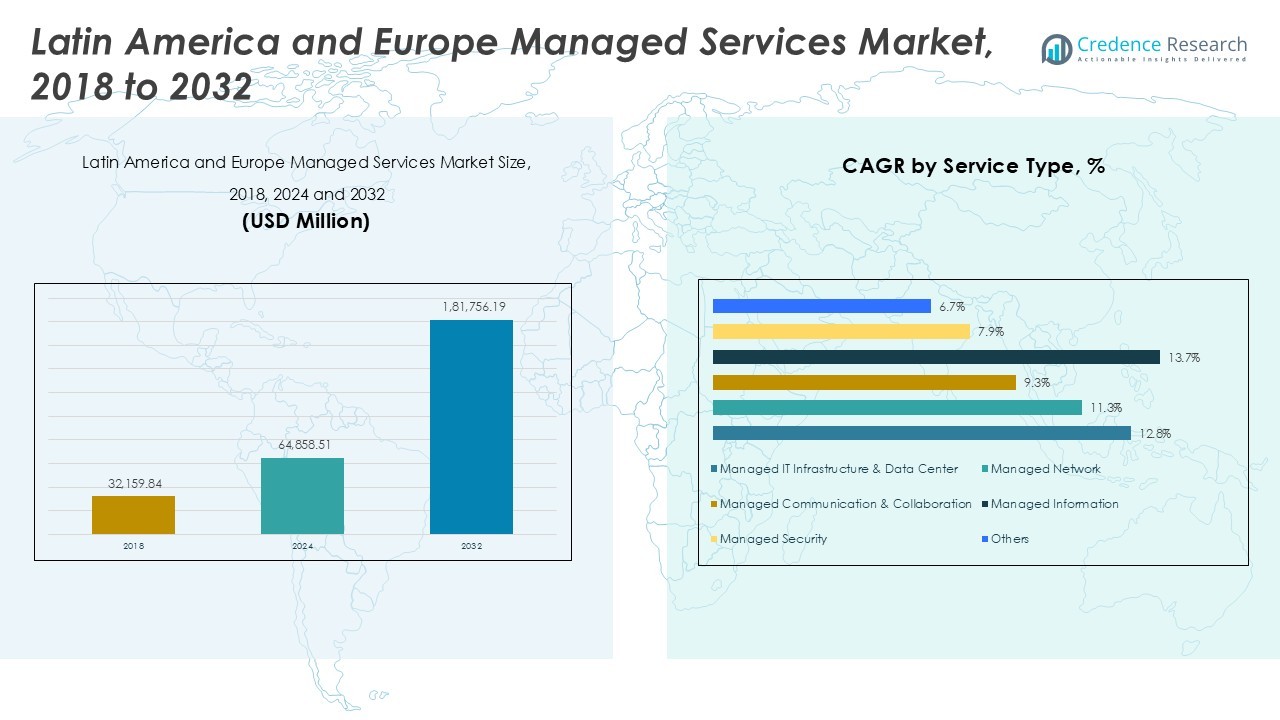
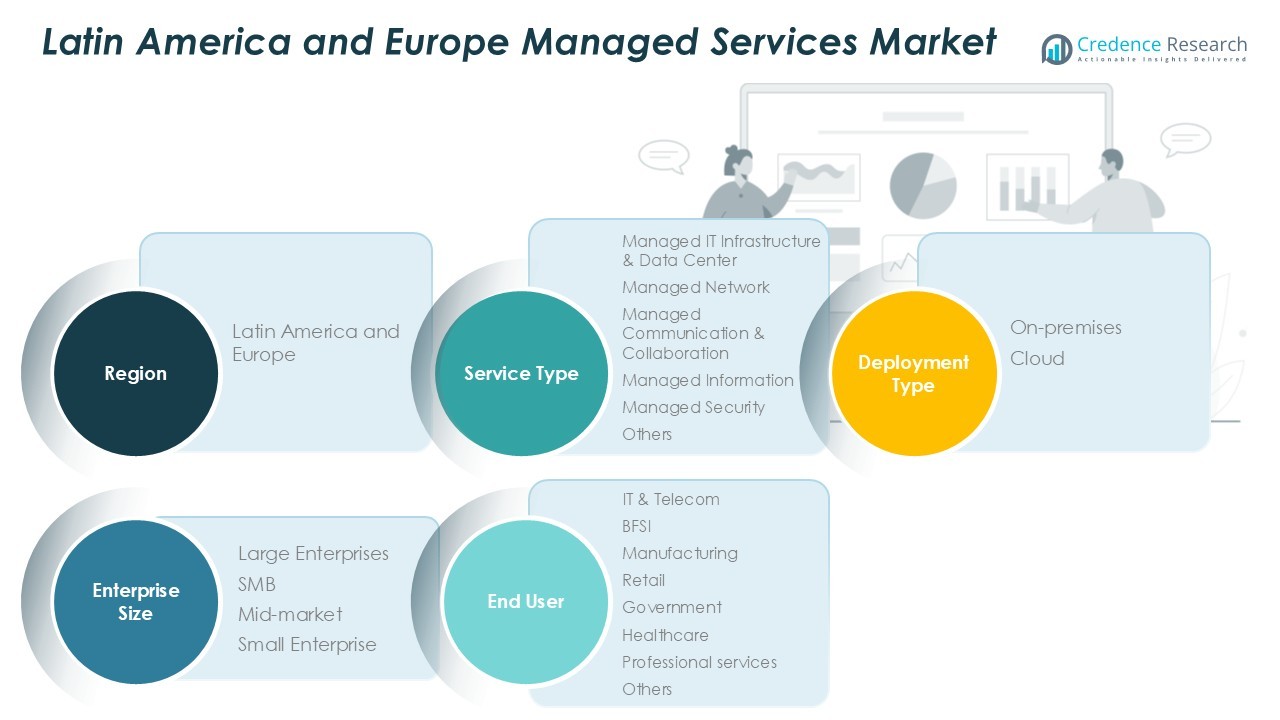
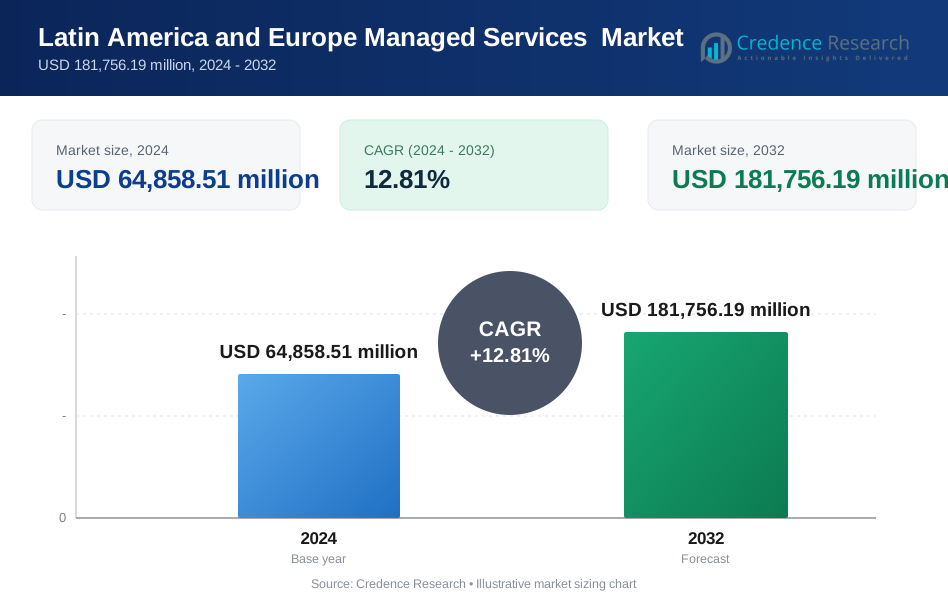
The Latin America and Europe Managed Services Market was valued at USD 32,159.84 million in 2018 and reached USD 64,858.51 million in 2024. It is anticipated to attain USD 181,756.19 million by 2032, expanding at a CAGR of 12.81% during the forecast period.
| REPORT ATTRIBUTE | DETAILS |
|---|---|
| Historical Period | 2020-2023 |
| Base Year | 2024 |
| Forecast Period | 2025-2032 |
| Latin America and Europe Managed Services Market Size 2024 | USD 64,858.51 Million |
| Latin America and Europe Managed Services Market, CAGR | 12.81% |
| Latin America and Europe Managed Services Market Size 2032 | USD 181,756.19 Million |
The Latin America and Europe Managed Services Market is led by major players such as Accenture PLC, IBM Corporation, Cisco Systems Inc., Fujitsu Ltd., HCL Technologies, DXC Technology, Telefonaktiebolaget L M Ericsson, and Tata Consultancy Services (TCS). These companies dominate through comprehensive service portfolios covering cloud management, cybersecurity, and infrastructure optimization. Among the regions, Europe holds the largest market share of 62%, driven by strong digital transformation initiatives and stringent data security regulations. Latin America, accounting for 38% of the market, is rapidly expanding due to rising IT outsourcing demand in countries like Mexico, Chile, and Colombia, supported by increasing cloud adoption and enterprise modernization efforts.
Market Insights
- The Latin America and Europe Managed Services Market was valued at USD 32,159.84 million in 2018, reached USD 64,858.51 million in 2024, and is projected to attain USD 181,756.19 million by 2032, expanding at a CAGR of 12.81% during the forecast period.
- Market growth is primarily driven by the increasing demand for digital transformation, cloud migration, and cybersecurity services among enterprises across multiple industries.
- Key trends include the integration of AI and automation into managed service offerings, growing adoption of hybrid cloud infrastructure, and the rising focus on cost-efficient IT operations.
- The market is highly competitive, with major players such as Accenture, IBM, Cisco, Fujitsu, HCL Technologies, DXC Technology, Ericsson, and TCS leading through advanced technology capabilities and global delivery models.
- Regionally, Europe holds a dominant 62% share due to mature IT infrastructure, while Latin America, with 38%, shows robust growth driven by expanding outsourcing and modernization initiatives.
Market Segmentation Analysis:
By Service Type:
The Managed IT Infrastructure & Data Center segment dominated the Latin America and Europe Managed Services Market in 2024, accounting for over 32% of the total market share. The dominance of this segment stems from the growing demand for efficient data storage, network optimization, and business continuity solutions. Organizations are increasingly outsourcing infrastructure management to reduce operational costs and enhance scalability. Furthermore, the rise in cloud-based data centers and the integration of automation and AI-driven analytics are reinforcing the adoption of managed IT infrastructure services across both regions.
- For instance, Accenture's Cloud First initiative, launched with a $3 billion investment, aims to accelerate clients' move to cloud and digital transformation, highlighting the growing emphasis on cloud infrastructure services.
By Deployment Type:
The cloud-based deployment segment held the largest market share of approximately 58% in 2024, surpassing on-premises models due to its flexibility, scalability, and cost efficiency. Enterprises are shifting toward cloud-managed services to optimize resources and improve accessibility across distributed work environments. The growth of hybrid cloud ecosystems and the increasing reliance on Software-as-a-Service (SaaS) platforms are further fueling adoption. In Latin America and Europe, digital transformation initiatives and robust investments in cloud security infrastructure continue to strengthen this segment’s dominance during the forecast period.
- For instance, IBM's software revenue reached $6.5 billion in Q3 2024, marking a 9.7% year-over-year increase, driven by demand for its hybrid cloud and AI offerings.
By Enterprise Size:
Large enterprises led the market with a share exceeding 45% in 2024, as they prioritize managed services to streamline complex IT operations and x`ensure compliance across multiple geographies. These organizations rely heavily on managed security, data center, and cloud management services to enhance productivity and safeguard digital assets. Meanwhile, small and medium businesses (SMBs) are emerging as a fast-growing segment due to their increasing adoption of cost-effective managed network and communication solutions. Government support for digitalization and cloud adoption among SMBs is also accelerating market penetration in this category.
Key Growth Drivers
Growing Adoption of Cloud Computing and Hybrid IT Infrastructure
The rapid shift toward cloud computing and hybrid IT environments is a primary growth driver for the Latin America and Europe Managed Services Market. Organizations are increasingly adopting managed cloud solutions to enhance agility, reduce capital expenditure, and streamline IT operations. The growing need for scalable infrastructure and seamless data integration across multiple platforms has encouraged businesses to partner with managed service providers (MSPs). This trend is further strengthened by the expansion of data centers and increasing reliance on AI-enabled monitoring tools to optimize network performance.
- For instance, IBM helped Banco do Brasil migrate core banking services to a hybrid cloud, enabling faster data processing and enhanced security controls.
Rising Focus on Cybersecurity and Compliance Management
The escalating frequency of cyber threats and stringent data protection regulations, such as GDPR in Europe, are propelling demand for managed security services. Enterprises are prioritizing advanced security frameworks, including threat intelligence, endpoint protection, and identity management, to safeguard digital assets. Managed service providers play a crucial role in offering continuous threat monitoring and compliance support. This heightened focus on security and regulatory compliance has made cybersecurity management one of the most sought-after service categories in both Latin America and Europe.
- For instance, IBM's managed security services monitor over 150 billion security events each day in more than 130 countries.
Increasing Demand for Cost Efficiency and Operational Optimization
Enterprises are turning to managed services to control rising IT expenses and improve operational efficiency. By outsourcing infrastructure management, network maintenance, and data operations, companies can focus on core business objectives while reducing overhead costs. This trend is particularly significant among mid-sized organizations seeking predictable service costs and minimal downtime. The ability of managed service providers to deliver customized, subscription-based solutions that align with business needs continues to drive market growth across multiple industry verticals.
Key Trends and Opportunities
Expansion of AI and Automation in Managed Services
Artificial intelligence (AI) and automation are transforming the managed services landscape by enabling predictive analytics, self-healing systems, and proactive issue resolution. Service providers are leveraging AI-driven tools to enhance decision-making, reduce manual intervention, and ensure higher service reliability. Automation in network monitoring, incident response, and customer support not only improves efficiency but also reduces response time. The integration of AI-powered analytics presents a significant opportunity for MSPs to deliver more intelligent, value-added services to clients across Latin America and Europe.
- For instance, Telefónica has integrated AI-powered automation in its network management across Latin America, achieving a 30% reduction in manual support tickets through automated troubleshooting.
Growth of Managed Cloud and Edge Computing Solutions
The rising demand for real-time data processing and low-latency applications is fueling the adoption of managed cloud and edge computing services. Businesses are increasingly deploying hybrid cloud models that combine on-premises systems with public and private clouds for flexibility and security. Managed service providers offering integrated cloud and edge management solutions are gaining strong traction, especially in sectors such as telecom, healthcare, and manufacturing. This trend represents a lucrative opportunity for market players to expand their offerings in high-growth digital ecosystems.
- For instance, Microsoft introduced Azure Arc, enabling organizations to centrally manage servers and Kubernetes clusters across on-premises, multi-cloud, and edge environments, serving over 10,000 customers globally as of late 2024.
Key Challenges
Shortage of Skilled IT Professionals
A persistent shortage of skilled IT professionals poses a major challenge to the managed services market in Latin America and Europe. As businesses increasingly adopt advanced technologies like AI, automation, and cloud computing, the demand for specialized technical expertise continues to outpace supply. This talent gap limits service scalability and affects delivery timelines. Many managed service providers are addressing this issue by investing in workforce training and remote operations centers; however, the regional disparity in IT skill development remains a significant barrier to sustained growth.
Integration Complexity with Legacy Systems
Integrating managed services with existing legacy infrastructure remains a significant challenge for many enterprises. Older IT systems often lack compatibility with modern cloud and automation technologies, leading to operational inefficiencies and increased migration costs. Businesses face difficulties in maintaining data consistency and ensuring seamless interoperability across hybrid environments. Managed service providers must invest in advanced integration tools and customized transition strategies to overcome these challenges. Addressing legacy compatibility issues is essential for ensuring the smooth execution of digital transformation initiatives across both regions.
Regional Analysis
Latin America
Latin America accounted for 38% of the total market share in 2024, driven by growing digital transformation initiatives and the rising adoption of cloud and security services across major economies. Mexico led the regional market due to strong enterprise demand for managed IT infrastructure and data center services. Chile and Colombia followed closely, supported by government investments in digital infrastructure and expanding telecom sectors. Argentina and Uruguay are witnessing increasing adoption of managed communication and collaboration services as businesses prioritize operational efficiency and remote work enablement across industries.
Europe
Europe dominated the Latin America and Europe Managed Services Market in 2024 with a 62% market share, supported by a mature IT ecosystem and stringent cybersecurity regulations driving managed security adoption. Spain remains the leading market, propelled by rapid cloud integration and strong enterprise digitalization strategies. Portugal is emerging as a key growth hub with increasing investments in cloud-native solutions and AI-driven managed services. The region’s focus on automation, regulatory compliance, and hybrid cloud deployment continues to reinforce its leadership in the managed services landscape.
Market Segmentations:
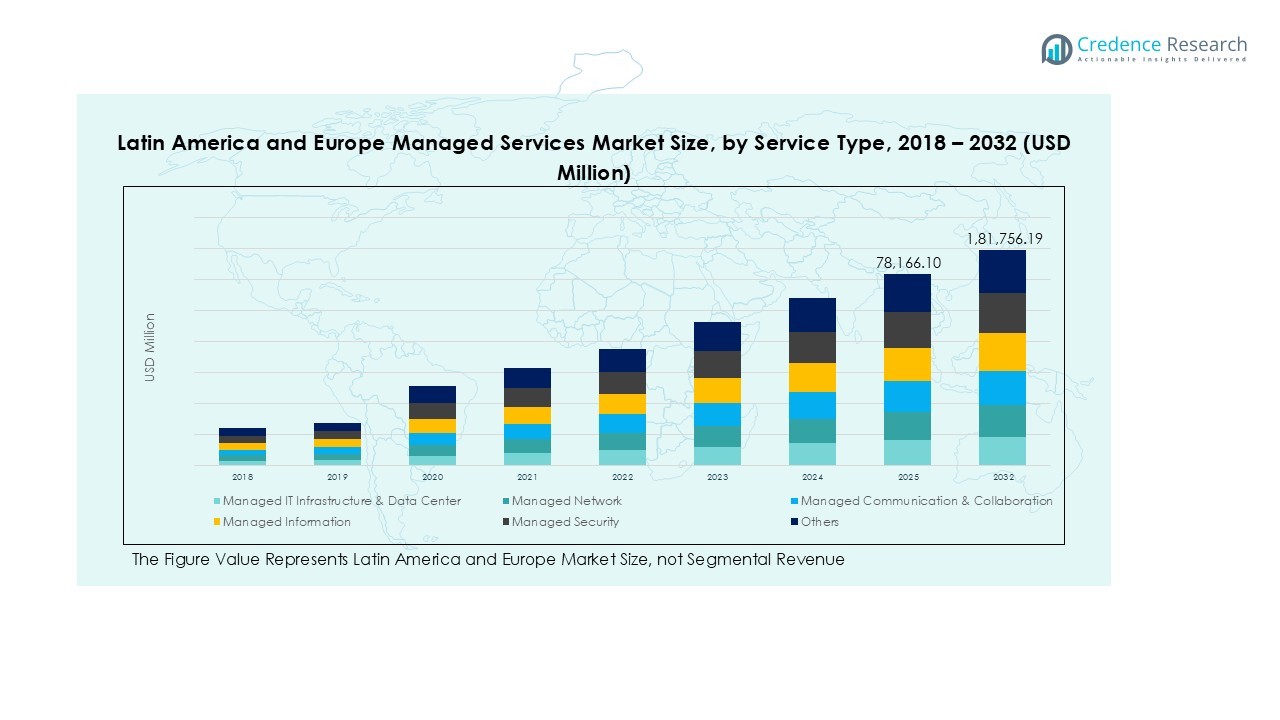
By Service Type
- Managed IT Infrastructure & Data Center
- Managed Network
- Managed Communication & Collaboration
- Managed Information
- Managed Security
- Others
By Deployment Type
- On-premises
- Cloud
By Enterprise Size
- Large Enterprises
- Small and Medium Businesses (SMBs)
- Mid-market
- Small Enterprises
By End User
- IT & Telecom
- BFSI (Banking, Financial Services, and Insurance)
- Manufacturing
- Retail
- Government
- Healthcare
- Professional Services
- Others
By Region
- Latin America
-
- Mexico
- Uruguay
- Argentina
- Chile
- Colombia
- Europe
-
- Spain
- Portugal
Competitive Landscape
The competitive landscape of the Latin America and Europe Managed Services Market is characterized by the presence of major global players such as Accenture PLC, IBM Corporation, Cisco Systems Inc., Fujitsu Ltd., HCL Technologies, DXC Technology, Telefonaktiebolaget L M Ericsson, and Tata Consultancy Services (TCS). These companies maintain strong market positions through diversified service portfolios, extensive regional presence, and strategic partnerships. The market is highly competitive, with players focusing on expanding managed cloud, cybersecurity, and AI-driven automation solutions to enhance client value. Local and regional firms, including Globant, Sonda, Indra Sistemas, Novabase, and Everis (NTT DATA), are strengthening their market foothold through niche offerings and sector-specific solutions. Mergers, acquisitions, and collaborations remain key strategies to improve technological capabilities and broaden service coverage. Additionally, the integration of automation, analytics, and hybrid cloud infrastructure continues to drive innovation, intensifying competition across both regions.
Key Player Analysis
- Accenture PLC
- Cisco Systems Inc.
- IBM Corporation
- HCL Technologies
- Fujitsu Ltd.
- DXC Technology
- Telefonaktiebolaget L M Ericsson
- Tata Consultancy Services (TCS)
Recent Developments
- On October 14, 2025, BLS International inaugurated a new Visa Application Centre in Argentina, marking its expansion into Latin America. This move aims to enhance its presence and service capabilities in the region.
- On May 7, 2025, AWS announced plans to invest $4 billion to establish its first data centers and cloud infrastructure in Chile, marking its third cloud region in Latin America. The project is expected to be operational by the second half of 2026.
- On January 29, 2025, CoreX entered into a definitive agreement to acquire Volteo Digital, a leader in the Latin America and EMEA markets. This acquisition aims to expand CoreX's global coverage of the ServiceNow ecosystem.
- On August 14, 2025, Kinly and Yorktel announced a strategic merger, forming a new workplace experience and collaboration provider. The combined entity aims to enhance managed services and expand offerings across AV, UCC, and UCaaS solutions.
Report Coverage
The research report offers an in-depth analysis based on Service Type, Deployment Type, Enterprise Size, End User and Geography. It details leading market players, providing an overview of their business, product offerings, investments, revenue streams, and key applications. Additionally, the report includes insights into the competitive environment, SWOT analysis, current market trends, as well as the primary drivers and constraints. Furthermore, it discusses various factors that have driven market expansion in recent years. The report also explores market dynamics, regulatory scenarios, and technological advancements that are shaping the industry. It assesses the impact of external factors and global economic changes on market growth. Lastly, it provides strategic recommendations for new entrants and established companies to navigate the complexities of the market.
Future Outlook
- The market is expected to witness strong growth driven by increasing digital transformation initiatives across enterprises.
- Cloud-based managed services will continue to dominate, supported by hybrid IT infrastructure adoption.
- Demand for managed cybersecurity services will rise due to growing regulatory compliance and data protection requirements.
- Large enterprises will remain the primary consumers, while SMBs are expected to adopt managed services at a faster pace.
- Integration of AI and automation will enhance service efficiency and predictive analytics capabilities.
- Industry-specific managed solutions will create new opportunities across BFSI, healthcare, and retail sectors.
- Regional expansion of service providers in emerging Latin American markets will strengthen market penetration.
- Investments in cloud-native and edge computing solutions will accelerate adoption in Europe and Latin America.
- Partnerships, mergers, and acquisitions will remain key strategies for competitive advantage.
- Focus on cost optimization and operational efficiency will drive continued enterprise reliance on managed services.
Request a Free Sample
Fill in your details and we'll send you a free sample report.
- Sample data tables & charts
- Research methodology
Need a Custom Version of This Report?
Tailor the scope, geography, or segments to your exact requirements.
- Custom geography or segment scope
- Direct access to our analyst team
Frequently Asked Questions
What is the current market size for Latin America and Europe Managed Services market, and what is its projected size in 2032?
At what Compound Annual Growth Rate is the Latin America and Europe Managed Services market projected to grow between 2025 and 2032?
Which Latin America and Europe Managed Services market segment held the largest share in 2024?
What are the primary factors fueling the growth of the Latin America and Europe Managed Services market?
Who are the leading companies in the Latin America and Europe Managed Services market?
Which region commanded the largest share of the Latin America and Europe Managed Services market in 2024?
Table of Content
Chapter 1. Report Introduction
- 1.1 Report Description & Purpose
- 1.1.1 Report Title & Market Definition
- 1.1.2 Unique Selling Propositions (USP) & Key Differentiators
- 1.1.3 Value Proposition for Stakeholders
- 1.2 Research Objectives
- 1.2.1 Market Sizing Objectives (Volume & Revenue)
- 1.2.2 Segmentation Objectives
- 1.2.3 Competitive Intelligence Objectives
- 1.2.4 Forecast & Scenario Objectives
- 1.3 Report Scope
- 1.3.1 Latin America and Europe Managed Services Scope – Types & Subtypes Covered
- 1.3.2 Geographic Scope – Regions & Countries Covered
- 1.3.3 Historical Period, Base Year & Forecast Period (2024; forecast to 2032)
- 1.3.4 Inclusions & Exclusions
- 1.4 HS Code & Classification Framework
- 1.5 Currency, Units & Pricing Basis
- 1.6 Target Stakeholders
- 1.7 Limitations & Assumptions
Chapter 2. Executive Summary
- 2.1 Global Latin America and Europe Managed Services Market Snapshot
- 2.1.1 Market Size – Historical (2024) & Forecast (2024-2032) (2024: USD 64,858.51 million → 2032: USD 181,756.19 million)
- 2.1.2 Volume & Revenue – Global Totals
- 2.1.3 Key Market Highlights – Top Five Facts
- 2.2 Latin America and Europe Managed Services Market Segmentation Snapshot
- 2.2.1 Market Split by Region – 2024 vs. 2032
- 2.3 Competitive Snapshot
- 2.3.1 Top 10 Players by Revenue Share – 2024
- 2.3.2 Top 10 Players by Volume Share – 2024
- 2.3.3 Recent Strategic Developments (18-Month Summary)
- 2.4 Key Investment Highlights & Strategic Conclusions
Chapter 3. Latin America and Europe Managed Services Market Dynamics & Industry Analysis
- 3.1 Market Overview & Context
- 3.1.1 Latin America and Europe Managed Services Market Position in the Broader Automotive Value Chain
- 3.1.2 OEM vs. Replacement Market Dynamics
- 3.1.3 Market Maturity & Development Stage by Region
- 3.2 Latin America and Europe Managed Services Market Drivers
- 3.3 Latin America and Europe Managed Services Market Restraints & Challenges
- 3.4 Latin America and Europe Managed Services Market Opportunities
- 3.5 Porter's Five Forces Analysis
- 3.5.1 Threat of New Entrants
- 3.5.2 Bargaining Power of Suppliers
- 3.5.3 Bargaining Power of Buyers
- 3.5.4 Threat of Substitutes
- 3.5.5 Competitive Rivalry – Intensity Assessment
- 3.6 Latin America and Europe Managed Services Value Chain Analysis
- 3.6.1 Upstream – Raw Material/Input Suppliers
- 3.6.1.1 Raw Material/Input 1
- 3.6.1.2 Raw Material/Input 2
- 3.6.1.3 Raw Material/Input 3
- 3.6.2 Midstream – Production/Manufacturing/Service Delivery
- 3.6.2.1 Production/Process Overview
- 3.6.2.2 Key Facility Locations & Capacity by Manufacturer
- 3.6.3 Downstream – Distribution & End Consumer
- 3.6.3.1 Primary Channel – B2B/OEM
- 3.6.3.2 Secondary Channels – Dealer, Retail, Online, Direct
- 3.6.4 Value Chain Profitability Analysis
- 3.6.1 Upstream – Raw Material/Input Suppliers
- 3.7 PESTEL Analysis
- 3.7.1 Political Factors
- 3.7.2 Economic Factors
- 3.7.3 Social Factors
- 3.7.4 Technological Factors
- 3.7.5 Environmental Factors
- 3.7.6 Legal Factors
- 3.8 Latin America and Europe Managed Services Supply Chain Analysis
- 3.8.1 Raw Material/Input Supply Risk Assessment
- 3.8.2 Manufacturing Concentration Risk (Geographic Exposure)
- 3.8.3 Trade Disruption Impact Analysis
- 3.9 Regulatory & Policy Landscape
Note: The regulatory and policy landscape section covers regulations based on their applicability to the market, Latin America and Europe Managed Services category, geography, and scope of the study. Only regulatory frameworks with a material impact on operations, compliance, trade, sustainability, or market access are analyzed in detail.
Chapter 4. Key Investment Pockets & Opportunity Analysis
- 4.1 Latin America and Europe Managed Services Market Attractiveness Analysis
- 4.1.1 By Region – Investment Attractiveness Matrix (Volume × CAGR)
- 4.2 Absolute Revenue Growth Opportunity
- 4.2.1 By Region – Absolute USD Growth Through 2032
- 4.3 Incremental Volume Opportunity
- 4.3.1 By Region – Incremental Volume Through 2032
- 4.3.2 Segment – Incremental Volume
- 4.4 Emerging Submarket Opportunity Deep Dive (Subject to Applicability)
- 4.5 Emerging Market Opportunity Scorecards
- 4.5.1 United States
- 4.5.2 Europe
- 4.5.3 Asia
- 4.5.4 Middle East & Africa
Note: Emerging Market Opportunity Scorecards will be included based on relevance and strategic importance. Regions listed are indicative and may vary depending on data availability and market dynamics.
Chapter 5. Latin America and Europe Managed Services Import-Export Analysis & Trade Flows
- 5.1 Global Trade Overview
- 5.1.1 Global Export Value by Country (2024)
- 5.1.2 Global Export Volume by Country (2024)
- 5.1.3 Global Import Value by Country (2024)
- 5.1.4 Global Import Volume by Country (2024)
- 5.1.5 Net Trade Balance by Country (2024)
- 5.2 Export Analysis – Segment
- 5.2.1 Type 1 (HS Code)
- 5.2.2 Type 2 (HS Code)
- 5.2.3 Type 3 (HS Code)
- 5.2.4 Type 4 (HS Code)
- 5.2.5 Type 5 (HS Code)
- 5.3 Import Analysis – Segment
- 5.3.1 Type 1 (HS Code)
- 5.3.2 Type 2 (HS Code)
- 5.3.3 Type 3 (HS Code)
- 5.3.4 Type 4 (HS Code)
- 5.3.5 Type 5 (HS Code)
- 5.4 Average Unit Trade Prices
- 5.4.1 Average Export Price – Segment & Country
- 5.4.2 Average Import Price – Segment & Source Country
- 5.4.3 Price Trends (2024)
- 5.5 Key Trade Route Analysis
- 5.5.1 Trade Route 1
- 5.5.2 Trade Route 2
- 5.5.3 Trade Route 3
- 5.5.4 Trade Route 4
- 5.5.5 Trade Route 5
- 5.6 Trade Policy Impact Assessment
- 5.6.1 US Anti-Dumping & Section 301 Tariffs
- 5.6.2 EU Customs Union Impact
- 5.6.3 Major Free Trade Agreements
- 5.6.4 USMCA Rules of Origin
Note: Trade policy analysis will be included only where relevant to the Latin America and Europe Managed Services market.
Chapter 6. Competitive Landscape & Company Benchmarking
- 6.1 Latin America and Europe Managed Services Market Concentration & Structure
- 6.1.1 Herfindahl-Hirschman Index (HHI) – vs. 2024
- 6.1.2 Tier 1, Tier 2 & Tier 3 Market Structure
- 6.1.3 Global, Regional & Local Player Dynamics
- 6.2 Latin America and Europe Managed Services Market Share Analysis – 2024
- 6.2.1 Global Revenue Share by Company
- 6.2.2 Global Volume Share by Company
- 6.2.3 Regional Revenue Share
- 6.2.4 Market Share Evolution ( vs. 2024)
- 6.2.5 OEM Segment Share by Company
- 6.2.6 Replacement Segment Share by Company
- 6.3 Production/Delivery Capacity & Facility Analysis
- 6.3.1 Global Installed Capacity
- 6.3.2 Capacity Utilization Rates
- 6.3.3 Production/Output Volume
- 6.3.4 Facility Locations & Capacity Map
- 6.3.5 Planned Capacity Additions
- 6.4 Latin America and Europe Managed Services Competitive Benchmarking Matrix
- 6.4.1 Revenue, Volume, CAGR & Profitability Comparison
- 6.4.2 Channel Revenue Mix
- 6.4.3 Geographic Revenue Exposure
- 6.4.4 R&D Intensity
- 6.4.5 Sustainability Maturity
- 6.5 Strategic Developments in Latin America and Europe Managed Services (Last 24 Months)
- 6.5.1 Mergers, Acquisitions & Divestments
- 6.5.2 New Latin America and Europe Managed Services Launches
- 6.5.3 Facility Expansions
- 6.5.4 Strategic Alliances, Joint Ventures & Partnerships
- 6.5.5 Distribution Expansion & Market Entry
- 6.5.6 Sustainability & ESG Initiatives
- 6.6 Competitive Strategy Mapping
- 6.6.1 Leader, Challenger, Follower & Niche Classification
- 6.6.2 Pricing Strategy Comparison
- 6.6.3 Channel Strategy Matrix
Note: Strategic developments are included based on their materiality and the availability of reliable information.
Chapter 7. Global Latin America and Europe Managed Services Market – By Distribution Channel
- 7.1 Segment Overview
- 7.1.1 Volume & Revenue Split by Channel (2024 & 2032)
- 7.1.2 Channel Mix Evolution (2024-2032)
Chapter 8. Regional Market Analysis – Global Overview
- 8.1 Global Regional Overview
- 8.1.1 Regional Volume Share
- 8.1.2 Regional Revenue Share
- 8.1.3 Regional Volume by Region
- 8.1.4 Regional Revenue by Region
- 8.1.5 Regional Forecast Through 2032
- 8.2 Cross-Regional Segment Analysis
- 8.2.1 By Distribution Channel
- 8.2.2 By Brand/Price Tier
Chapter 9. North America Latin America and Europe Managed Services Market
- 9.1 United States
- 9.2 Canada
- 9.3 Mexico
Chapter 10. Europe Latin America and Europe Managed Services Market
- 10.1 Germany
- 10.2 France
- 10.3 Italy
- 10.4 United Kingdom
- 10.5 Spain
- 10.6 Poland
- 10.7 Russia
- 10.8 Netherlands
- 10.9 Belgium
- 10.10 Sweden
- 10.11 Denmark
- 10.12 Norway
- 10.13 Rest of Europe
Chapter 11. Asia Pacific Latin America and Europe Managed Services Market
- 11.1 China
- 11.2 India
- 11.3 Japan
- 11.4 South Korea
- 11.5 Thailand
- 11.6 Indonesia
- 11.7 Vietnam
- 11.8 Malaysia
- 11.9 Australia
- 11.10 Rest of Asia Pacific
Chapter 12. Latin America Latin America and Europe Managed Services Market
- 12.1 Brazil
- 12.2 Argentina
- 12.3 Colombia
- 12.4 Chile
- 12.5 Rest of Latin America
Chapter 13. Middle East Latin America and Europe Managed Services Market
- 13.1 Saudi Arabia
- 13.2 United Arab Emirates
- 13.3 Turkey
- 13.4 Israel
- 13.5 Iran
- 13.6 Rest of the Middle East
Chapter 14. Africa Latin America and Europe Managed Services Market
- 14.1 South Africa
- 14.2 Egypt
- 14.3 Nigeria
- 14.4 Morocco
- 14.5 Rest of Africa
Chapter 15. Latin America and Europe Managed Services Company Profiles
- 15.1 [Company 01]
- 15.1.1 Company Overview
- 15.1.2 Key Management Personnel
- 15.1.3 Products & Services Portfolio
- 15.1.4 Financial Performance
- 15.1.5 Key Market Focus & Geographic Presence
- 15.1.6 Recent Developments & Strategic Initiatives
Note: The company profile list is preliminary and may change based on research findings, market developments, data availability, and client requirements.
Chapter 16. Appendices
- Appendix A – List of Abbreviations & Acronyms
- Appendix B – Industry Classification Code Reference – Full Series
- Appendix C – Production & Capacity Data Tables
- Appendix D – End-Use & Demand Base Tables
- Appendix E – Consumption & Replacement Rate Assumptions
- Appendix F – ASP Reference Tables
- Appendix G – Manufacturing & Facility Database
- Appendix H – Import-Export Data Tables
- Appendix I – Regulatory Summary Tables
- Appendix J – Primary Research Participant List (Anonymized)
- Appendix K – Primary Research Questionnaire Framework
- Appendix L – Data Sources & Bibliography
- Appendix M – Market Size Divergence & Source Comparison
Chapter 17. Research Methodology
- 17.1 Research Framework & Philosophy
- 17.2 Secondary Research – Sources, Hierarchy & Data Extraction
- 17.3 Data Modeling – Bottom-Up & Top-Down Market Sizing
- 17.4 Primary Research – Stakeholder Framework, LOI & Sample Sizes
- 17.5 Forecast Methodology – Regression, Scenario & Sensitivity Analysis
- 17.6 Quality Control – Four-Layer Validation Framework
- 17.7 Limitations & Standard Assumptions
- 17.8 Disclaimer
