
| REPORT ATTRIBUTE | DETAILS |
|---|---|
| Historical Period | 2020-2023 |
| Base Year | 2024 |
| Forecast Period | 2025-2032 |
| Latin America Digital Oilfield Solutions Market Size 2024 | USD 1,584.39 million |
| Latin America Digital Oilfield Solutions Market,CAGR | 6.14% |
| Latin America Digital Oilfield Solutions Market Size 2032 | USD 2,552.72 million |
Market Overview
The Latin America Digital Oilfield Solutions Market is projected to grow from USD 1,584.39 million in 2024 to an estimated USD 2,552.72 million by 2032, with a compound annual growth rate (CAGR) of 6.14% from 2025 to 2032. This growth is driven by the increasing adoption of advanced digital technologies in the oil and gas industry, such as automation, IoT, cloud computing, and data analytics, which are enhancing operational efficiency and reducing costs in oilfield operations.
Key drivers of market growth include the increasing need for operational efficiency and real-time data analytics in oil and gas operations. Digital technologies offer significant advantages in terms of monitoring, predictive maintenance, and resource management. Moreover, advancements in IoT, AI, and cloud computing are enabling oilfield operators to make data-driven decisions, improving asset performance and reducing downtime. Industry trends such as the shift towards sustainable energy practices and the rise of smart oilfields are also contributing to the market's expansion.
Geographically, Latin America presents significant growth potential due to the region's rich oil reserves and ongoing investments in digitalization. Countries such as Brazil, Mexico, and Argentina are at the forefront of adopting digital oilfield solutions to enhance exploration and production efficiency. Key players in the market include Schlumberger, Halliburton, Baker Hughes, Weatherford, and Siemens, which are focusing on technological advancements and strategic partnerships to maintain their market positions.
Market Insights
- The Latin America Digital Oilfield Solutions Market is projected to grow from USD 1,584.39 million in 2024 to USD 2,552.72 million by 2032, with a CAGR of 6.14% from 2025 to 2032.
- The Global Digital Oilfield Solutions Market is projected to grow from USD31,374.00 million in 2024 to USD 54,897.18 million by 2032, with a CAGR of 7.24% from 2025 to 2032.
- Increased adoption of advanced technologies like AI, IoT, and cloud computing is enhancing operational efficiency and reducing costs in oilfield operations.
- The rising demand for real-time data analytics and predictive maintenance is driving the need for more digital solutions to optimize production and reduce downtime.
- A shift towards sustainable energy practices is also a major factor, with oilfield operators increasingly using digital solutions to meet regulatory and environmental standards.
- Limited infrastructure and connectivity in remote areas of Latin America present challenges in deploying digital oilfield technologies across the region.
- Brazil, Mexico, and Argentina are leading the adoption of digital oilfield solutions, with Brazil dominating the market due to its offshore oil reserves.
- Emerging markets like Colombia and Venezuela present significant growth opportunities as they adopt digital technologies to modernize aging oilfields and attract foreign investments.
Market Drivers
Growing Investments in Oil and Gas Digitalization in Latin America
Latin America has witnessed a significant increase in investments toward the digital transformation of the oil and gas industry, with governments and private companies recognizing the importance of digital oilfield solutions. Many countries in the region, such as Brazil, Mexico, and Argentina, possess abundant oil and gas reserves, attracting foreign investments and technological collaborations. Digitalization initiatives, supported by government policies and regulations, aim to enhance operational capabilities, improve exploration and production efficiency, and ensure sustainable development in the energy sector. For instance, Brazil’s state-owned oil giant, Petrobras, has been investing in digital oilfield solutions to optimize offshore oil production in its pre-salt fields. In Mexico, digital technologies are being utilized to manage aging oil fields and maximize production, while Argentina has been advancing the use of digital oilfield solutions in its shale oil operations. These investments help modernize aging infrastructure, improve safety, and increase productivity, thereby accelerating the digital transformation of oilfields across the region. As a result, increasing investments in digitalization initiatives further support the widespread adoption of digital oilfield solutions in Latin America.
Rising Demand for Sustainable and Smart Oilfields
The growing emphasis on sustainability and environmental regulations is another significant driver of the Latin American digital oilfield solutions market. The shift toward environmentally friendly practices and reducing carbon footprints has gained momentum in the oil and gas industry, with many companies striving to meet stringent regulatory requirements and improve their environmental performance. Digital oilfield solutions support this transition by optimizing resource usage, reducing waste, and minimizing the environmental impact of operations. For instance, smart oilfields powered by digital technologies can improve energy efficiency and reduce the carbon footprint by ensuring that equipment is running at peak efficiency. Furthermore, the ability to monitor emissions, manage water usage, and automate various processes contributes to environmental sustainability. As governments in Latin America push for stricter environmental standards, digital oilfield solutions can enable companies to comply with regulations while maintaining operational profitability. This increased focus on sustainability, alongside the integration of smart technologies, ensures that digital oilfield solutions continue to play a vital role in driving the region’s oil and gas industry toward more efficient and environmentally responsible practices.
Increasing Demand for Operational Efficiency and Cost Reduction
The Latin America Digital Oilfield Solutions Market is driven by the need for improved operational efficiency amid fluctuating oil prices and rising production costs. Companies in the region are increasingly adopting digital technologies to streamline operations and reduce expenses. For instance, automation tools and real-time monitoring systems enable better resource allocation and predictive maintenance, ensuring assets are utilized effectively. Technologies such as IoT sensors and cloud computing play a pivotal role in gathering and analyzing real-time data, allowing operators to make informed decisions. These solutions not only reduce downtime but also enhance energy efficiency, minimizing operational risks. By leveraging these advancements, oilfield operators can mitigate the impact of volatile market conditions while maintaining profitability. The adoption of such technologies underscores the industry's shift toward sustainable and cost-effective practices in response to high operational demands.
Adoption of Advanced Data Analytics and Real-Time Monitoring
The integration of advanced data analytics and real-time monitoring has become a cornerstone for the growth of digital oilfield solutions in Latin America. Historically, oilfield operations struggled with data overload and limited access to actionable insights. For instance, modern digital tools powered by AI and machine learning now enable operators to track performance indicators, predict equipment failures, and identify operational trends. These technologies significantly enhance safety by detecting anomalies early, allowing for swift interventions to prevent accidents or equipment malfunctions. Real-time monitoring not only improves productivity but also facilitates predictive maintenance, extending equipment lifespan and reducing unplanned shutdowns. This shift toward data-driven decision-making reflects a broader industry trend aimed at optimizing operations while ensuring compliance with safety standards. As companies continue to adopt these innovations, they are better positioned to navigate challenges in an increasingly competitive market.
Market Trends
Rise of Smart Oilfields and Digital Twin Technology
The concept of smart oilfields is rapidly gaining traction in the Latin American Digital Oilfield Solutions Market. A smart oilfield integrates advanced digital technologies, such as AI, IoT, cloud computing, and big data analytics, to enhance the monitoring, management, and optimization of oil production. One key aspect of this transformation is the use of Digital Twin technology. A Digital Twin is a virtual replica of a physical asset, system, or process, created by collecting real-time data and using it to simulate the performance of the corresponding real-world entity. In oilfields, Digital Twin technology allows operators to model and simulate the behavior of equipment, machinery, and entire production systems to predict performance, identify inefficiencies, and optimize operations. In Latin America, oil and gas companies are increasingly turning to smart oilfields to increase production efficiency, reduce costs, and improve decision-making. For instance, using Digital Twin technology, oilfields can simulate reservoir performance, optimize drilling and production techniques, and predict maintenance needs. This trend is expected to accelerate as companies in the region look for ways to maximize the value of their existing assets, improve production levels, and ensure the long-term sustainability of their operations.
Focus on Sustainability and Environmental Impact Reduction
Sustainability continues to be a driving force in the Latin America Digital Oilfield Solutions Market, with increasing pressure on oil and gas companies to reduce their environmental footprint and meet stricter regulatory standards. As the global focus on sustainability intensifies, Latin American oilfield operators are incorporating digital solutions that enable them to monitor and control emissions, minimize energy consumption, and optimize resource usage. Technologies such as real-time emissions monitoring, advanced leak detection systems, and automated flare management are becoming integral components of digital oilfields. These solutions help reduce the environmental impact of operations while ensuring compliance with both local and international regulations. In Latin America, countries like Brazil and Argentina are pushing for more sustainable practices in the oil and gas sector, where companies are investing in solutions that help meet carbon reduction goals. Additionally, the digitalization of oilfields allows for better waste management and water conservation, two critical aspects of environmental protection in oil extraction processes. As environmental sustainability becomes an increasingly important factor in investment decisions, digital oilfield solutions are playing a pivotal role in transforming the region’s oil and gas industry to become more eco-friendly and socially responsible.
Integration of Artificial Intelligence (AI) and Machine Learning (ML) for Predictive Maintenance
One of the notable trends in the Latin America Digital Oilfield Solutions Market is the adoption of Artificial Intelligence (AI) and Machine Learning (ML) for predictive maintenance. Traditional maintenance practices often relied on reactive or scheduled interventions, which led to operational inefficiencies and unexpected equipment failures. AI and ML technologies now allow oilfield operators to analyze real-time data from sensors embedded in machinery, identifying patterns that signal potential issues. For instance, machine learning algorithms can predict wear and tear on critical components by processing historical and live data, enabling timely maintenance actions. This approach not only minimizes downtime but also extends the lifespan of vital equipment, a crucial factor in an industry focused on cost reduction and operational efficiency. In Latin America, where oilfields are often located in challenging environments, predictive maintenance powered by AI and ML is revolutionizing equipment management strategies. By optimizing maintenance schedules based on actionable insights, companies enhance safety standards, improve asset reliability, and reduce operational costs-benefits that are driving widespread adoption of these technologies in the region.
Advancement in Internet of Things (IoT) Integration for Real-Time Monitoring and Data Collection
The integration of Internet of Things (IoT) technologies is reshaping the Digital Oilfield Solutions Market in Latin America by enabling real-time monitoring and data collection across oilfield operations. IoT devices such as sensors embedded in equipment capture critical information on parameters like pressure, temperature, and flow rates, which is then transmitted to cloud-based systems for analysis. For instance, operators can remotely monitor the condition of machinery and environmental factors without needing physical inspections, a capability particularly valuable in offshore or remote areas. This seamless connectivity enhances decision-making by providing real-time insights into production rates and equipment health. IoT also facilitates better resource allocation and safety protocols by identifying potential risks before they escalate. In countries like Brazil and Mexico, where oil exploration often occurs under challenging conditions, IoT-driven solutions are proving indispensable for improving operational visibility. The adoption of IoT technologies not only reduces costs but also ensures compliance with environmental standards while optimizing production processes-a transformative trend gaining traction across the Latin American oil and gas sector.
Market Challenges
Limited Infrastructure and Connectivity in Remote Areas
A significant challenge facing the Latin America Digital Oilfield Solutions Market is the limited infrastructure and connectivity in remote or offshore oilfields. Many oil and gas operations in the region are located in challenging environments such as deep-water offshore fields, the Amazon Basin, and remote inland areas. For instance, these areas often suffer from poor internet connectivity and inadequate infrastructure, making the deployment of digital solutions like real-time monitoring systems, IoT sensors, and cloud-based platforms difficult. Reliable communication networks are essential for seamless operation, but the lack of robust infrastructure severely hampers the effectiveness of these technologies. Maintenance and troubleshooting of digital systems in such remote locations can also be time-consuming and costly due to logistical challenges. While digitalization promises significant improvements in efficiency, the lack of basic infrastructure in certain areas of Latin America presents a substantial hurdle to full-scale implementation. Oilfield operators must invest in upgrading infrastructure or collaborate with technology providers to overcome connectivity and infrastructure limitations.
High Initial Investment and Integration Complexity
Another key challenge in the Latin America Digital Oilfield Solutions Market is the high initial investment required for implementing digital technologies and the complexity involved in integrating these systems with existing infrastructure. Many oilfield operators in the region, particularly smaller companies or those with aging assets, face budgetary constraints when it comes to adopting advanced digital solutions. While digital oilfield technologies offer long-term cost savings through efficiency gains, the upfront costs associated with purchasing, installing, and maintaining such systems can be prohibitive. Additionally, integrating new digital technologies into legacy infrastructure can be a complex and time-consuming process. Legacy equipment and systems may not be compatible with new digital solutions, requiring significant modifications or replacements. This integration complexity can lead to delays and added expenses, making it a challenge for companies to justify the investments needed for a smooth digital transformation. Despite the potential benefits, these financial and operational barriers may slow the adoption of digital oilfield solutions across the region.
Market Opportunities
Expansion of Digitalization in Aging Oilfields
A significant market opportunity in the Latin America Digital Oilfield Solutions Market lies in the digitalization of aging oilfields. Many countries in the region, such as Mexico, Venezuela, and Argentina, operate mature and aging oilfields that require modernization to maximize production efficiency. As these fields face declining output, digital solutions such as real-time monitoring, predictive maintenance, and enhanced data analytics offer an effective way to optimize production. Technologies like AI, IoT, and cloud computing can be applied to manage assets more effectively, reduce downtime, and improve recovery rates. By leveraging digital oilfield solutions, operators can extend the life of existing oilfields and increase the profitability of these mature assets. This represents a substantial growth opportunity for both technology providers and oilfield operators looking to maximize value from their aging infrastructure.
Government Support for Digital Transformation Initiatives
Governments in Latin America are increasingly supporting digital transformation initiatives within the oil and gas sector. Countries like Brazil, Mexico, and Colombia have introduced policies to encourage the adoption of digital technologies in their energy sectors to improve efficiency and meet sustainability goals. Additionally, international investments are being directed towards Latin American energy projects, creating a favorable environment for the implementation of digital oilfield solutions. This government backing provides an opportunity for technology providers to capitalize on growing demand for digital solutions aimed at improving operational efficiency, safety, and environmental impact. As regulatory frameworks evolve to support digitalization, the market for digital oilfield technologies in the region is expected to expand significantly, providing substantial growth opportunities for stakeholders involved in the sector.
Market Segmentation Analysis
By Solution:
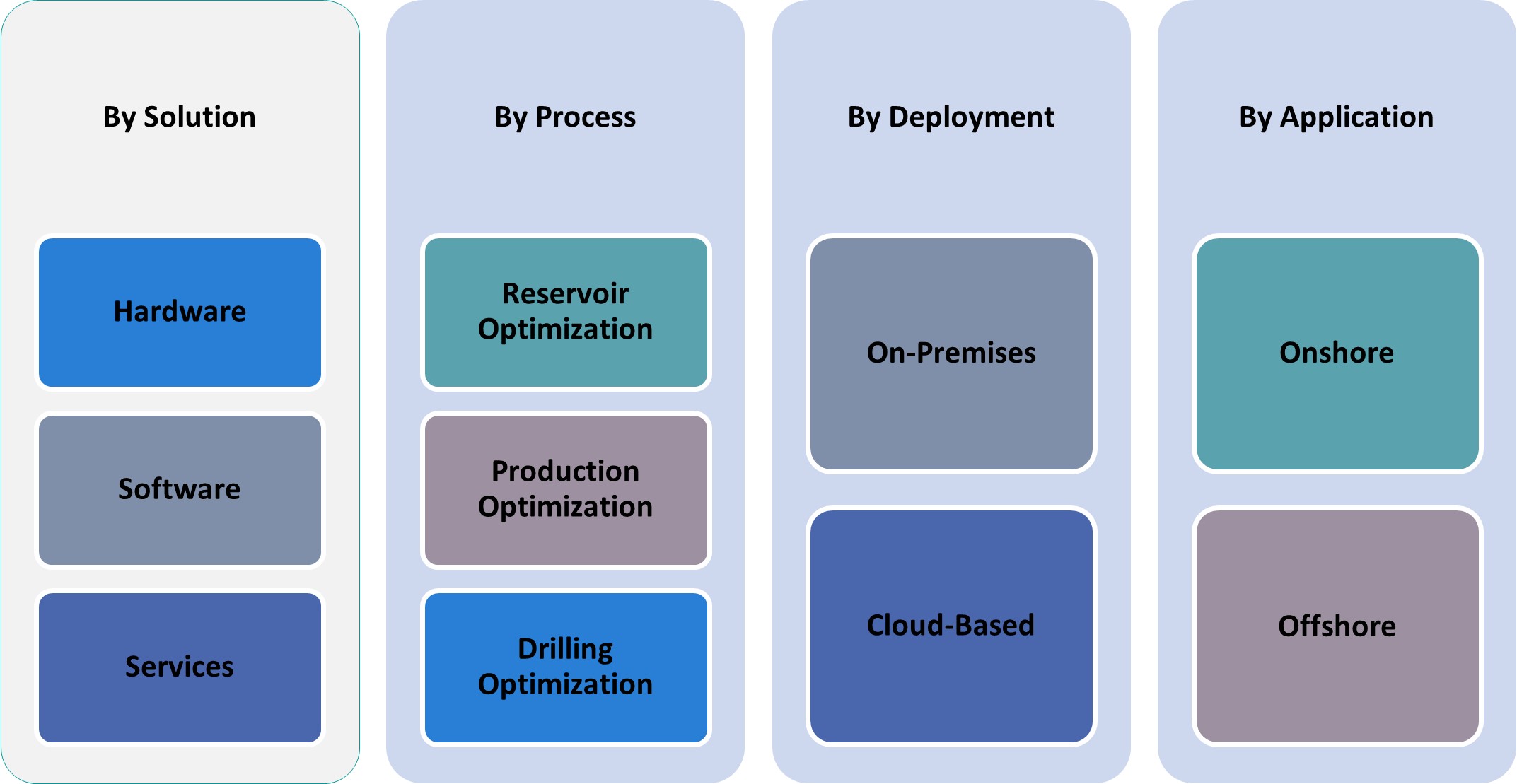
The market is divided into Hardware, Software, and Services. Hardware holds a significant share, driven by the increasing demand for sensors, controllers, and other field devices that enable real-time monitoring and data collection. These devices are integral for efficient oilfield operations. Software solutions are also experiencing strong growth, particularly those that enable data analytics, predictive maintenance, and process optimization. Software solutions include applications for reservoir management, production monitoring, and drilling optimization. Services, which include system integration, consulting, and training, are crucial for the successful implementation of digital solutions, especially as oilfield operators in Latin America adopt and integrate new technologies.
By Application:
The market is categorized into Onshore and Offshore applications. The Onshore segment holds a larger share due to the significant number of onshore oilfields across countries like Mexico, Argentina, and Venezuela. These regions are increasingly adopting digital oilfield solutions to optimize resource extraction and enhance operational efficiency. However, the Offshore segment is also witnessing growth, particularly in countries like Brazil, which boasts vast offshore oil reserves in its pre-salt fields. Offshore oilfields face unique challenges, including harsh environmental conditions and the need for highly specialized equipment. Digital solutions tailored for offshore operations, such as remote monitoring systems and advanced drilling optimization tools, are becoming crucial for enhancing productivity and safety.
Segments
Based on Solution
- Hardware
- Software
- Services
Based on Application
- Onshore
- Offshore
Based on Process
- Reservoir Optimization
- Production Optimization
- Drilling Optimization
Based on Deployment
- On-Premises
- Cloud-Based
Based on Region
- Brazil
- Mexico
- Argentina
- Venezuela
Regional Analysis
Brazil (40%)
Brazil holds the largest share of the Latin America Digital Oilfield Solutions Market, accounting for approximately 40% of the total market value. The country's vast offshore oil reserves, particularly in the pre-salt fields of the Santos Basin, are a major driver of market growth. Brazil’s state-owned oil company, Petrobras, has been at the forefront of adopting digital oilfield solutions to optimize offshore exploration, drilling operations, and production. The government's support for energy sector modernization and the increasing number of offshore projects in the region further fuel the demand for digital oilfield technologies. As a result, Brazil's market continues to expand, with significant investments in both offshore and onshore oilfield digitalization.
Mexico (30%)
Mexico is another key player in the region, holding approximately 30% of the market share. The country has vast untapped reserves, particularly in its onshore fields and shallow-water offshore regions. The Mexican government's energy reforms and the opening up of the oil and gas sector to foreign investments have spurred significant digital transformation initiatives in the country. Mexican oil operators are increasingly adopting digital technologies such as IoT sensors, real-time monitoring, and predictive maintenance systems to improve operational efficiency. Furthermore, state-run companies like PEMEX are exploring new digital solutions to enhance production from mature fields. The region’s focus on digitalization is expected to continue growing as investments in the oil and gas sector increase.
Key players
- Schlumberger Limited
- Halliburton Company
- Baker Hughes Company
- Weatherford International plc
- Emerson Electric Co.
- Siemens AG
- Honeywell International Inc.
- ABB Ltd.
- IBM Corporation
- Yokogawa Electric Corporation
Competitive Analysis
The Latin America Digital Oilfield Solutions Market is highly competitive, with leading players such as Schlumberger, Halliburton, Baker Hughes, and Weatherford dominating the market. These companies offer a wide range of integrated digital solutions, including automation, data analytics, IoT-enabled sensors, and cloud computing, which are essential for optimizing oilfield operations. Schlumberger and Halliburton lead with robust product portfolios and a strong presence in key regions like Brazil and Mexico, where offshore and onshore projects are booming. Competitors like Siemens, Honeywell, and ABB provide complementary technologies that enhance process control and operational efficiency. IBM and Emerson Electric focus on advanced analytics and AI-driven solutions, respectively, further strengthening their positions. The competitive landscape is marked by strategic partnerships, technological innovations, and increasing investments in digitalization, all of which drive the market toward higher levels of operational efficiency, safety, and cost reduction.
Recent Developments
- In March 2025, Schneider Electric unveiled the One Digital Grid Platform, an AI-powered platform designed to enhance grid resiliency and efficiency. This platform is set to be available later in 2025. The company announced a $700 million investment plan in the U.S. to enhance energy infrastructure and AI capabilities.
- In April 2025, ABB India delivered integrated automation and digital solutions for Indian Oil's cross-country pipeline network, enhancing efficiency and safety through real-time monitoring and robust cybersecurity.
- In March 2025, Kongsberg Digital participated in the IPTC 2025, focusing on digital transformation in the oil and gas sector.
- In January 2025, SAP S/4HANA Cloud was highlighted as a key enabler for a smarter, more efficient energy ecosystem in the oil and gas industry.
- In April 2025, Schlumberger (SLB) announced a partnership with Shell to deploy Petrel™ subsurface software across Shell's global assets. This collaboration aims to enhance digital capabilities and operational efficiencies through advanced AI-driven seismic interpretation workflows. This development underscores SLB's ongoing commitment to advancing subsurface digital technology and fostering strategic partnerships in the energy sector.
Market Concentration and Characteristics
The Latin America Digital Oilfield Solutions Market exhibits moderate concentration, with a few large global players such as Schlumberger, Halliburton, Baker Hughes, and Weatherford commanding a significant share of the market. These companies dominate the sector through comprehensive product portfolios, extensive technological expertise, and a strong regional presence, particularly in key markets like Brazil and Mexico. While these leaders maintain competitive advantages, the market is also characterized by increasing involvement from regional players and technology providers specializing in specific digital solutions, such as AI-driven analytics, IoT applications, and cloud computing. The market is marked by intense competition, driven by innovation and strategic partnerships, as companies strive to offer integrated, scalable solutions that improve efficiency, reduce costs, and support sustainability goals. As the demand for digital oilfield technologies grows, both established players and emerging firms are capitalizing on opportunities to cater to the region’s evolving energy needs.
Report Coverage
The research report offers an in-depth analysis based on Solution, Application, Process, Deployment and Region. It details leading market players, providing an overview of their business, product offerings, investments, revenue streams, and key applications. Additionally, the report includes insights into the competitive environment, SWOT analysis, current market trends, as well as the primary drivers and constraints. Furthermore, it discusses various factors that have driven market expansion in recent years. The report also explores market dynamics, regulatory scenarios, and technological advancements that are shaping the industry. It assesses the impact of external factors and global economic changes on market growth. Lastly, it provides strategic recommendations for new entrants and established companies to navigate the complexities of the market.
Future Outlook
- The demand for digital oilfield solutions is expected to grow significantly as oil operators in Latin America continue to modernize their operations, leveraging advanced technologies like AI, IoT, and cloud computing.
- With Brazil's pre-salt offshore fields leading the way, digital solutions will play a critical role in optimizing offshore production, improving safety, and increasing resource recovery in the coming years.
- Smart oilfields, driven by integrated digital technologies such as IoT and AI, are set to become the norm across the region, optimizing drilling, reservoir management, and production monitoring.
- Latin American governments, particularly in Brazil, Mexico, and Argentina, are likely to increase investments in energy sector digitalization to enhance production efficiency, sustainability, and economic competitiveness.
- As regulatory pressures increase, oil and gas companies in the region will adopt digital solutions to monitor emissions, reduce environmental impact, and meet sustainability goals more effectively.
- The growing reliance on real-time data analytics will provide operators with deep insights into reservoir performance and asset optimization, further boosting productivity and decision-making capabilities.
- Predictive maintenance using AI and ML will become increasingly important in reducing operational downtime, preventing failures, and extending the life of critical equipment in both onshore and offshore oilfields.
- Cloud-based solutions will see greater adoption, allowing oil companies to centralize data storage, improve collaboration, and scale operations more efficiently without heavy infrastructure investments.
- Countries such as Colombia, Venezuela, and Argentina will increasingly adopt digital oilfield solutions to modernize their aging infrastructure, improving efficiency and attracting foreign investments.
- As market demand grows, the competitive landscape will intensify, with both established players like Schlumberger and Halliburton and emerging tech providers seeking to innovate and offer customized solutions for the region’s oilfields.

Request a Free Sample
Fill in your details and we'll send you a free sample report.
- Sample data tables & charts
- Research methodology
Market Dynamics
Growing Investments in Oil and Gas Digitalization in Latin America
Governments and private companies in Latin America are increasing investments in digital transformation initiatives, particularly in countries with abundant oil reserves like Brazil, Mexico, and Argentina. These investments are modernizing infrastructure, improving safety, and enhancing operational efficiency, accelerating the adoption of digital oilfield solutions.
Rising Demand for Sustainable and Smart Oilfields
Stricter environmental regulations and a shift toward sustainability are pushing oilfield operators to adopt digital solutions that optimize resource usage, reduce emissions, and minimize environmental impact. Smart oilfields powered by digital technologies help companies meet regulatory standards while maintaining profitability.
Increasing Demand for Operational Efficiency and Cost Reduction
Fluctuating oil prices and rising production costs are driving oilfield operators to implement digital technologies such as automation, IoT, and real-time monitoring. These solutions streamline operations, reduce downtime, and improve energy efficiency, supporting profitability in a competitive market.
Adoption of Advanced Data Analytics and Real-Time Monitoring
The integration of AI, machine learning, and real-time monitoring tools enables operators to predict equipment failures, optimize production, and make data-driven decisions. This enhances safety, extends equipment lifespan, and reduces unplanned shutdowns, making operations more reliable and efficient.
Government Support for Digital Transformation Initiatives
Latin American governments are introducing policies and incentives to encourage digitalization in the oil and gas sector. This support, combined with international investments, creates a favorable environment for the expansion of digital oilfield solutions, especially in modernizing aging oilfields and improving sector competitiveness.
Need a Custom Version of This Report?
Tailor the scope, geography, or segments to your exact requirements.
- Custom geography or segment scope
- Direct access to our analyst team
Frequently Asked Questions
What is the market size of the Latin America Digital Oilfield Solutions Market in 2023 and 2032?
What are the key drivers of growth in the Latin America Digital Oilfield Solutions Market?
What are the major technologies driving growth in this market?
Who are the key players in the Latin America Digital Oilfield Solutions Market?
Table of Content
Chapter 1 Market Segmentation
- 1.1 Segmentation Framework
- 1.1.1 Product and Service Classification
- 1.1.2 Application and End-Use Classification
- 1.1.3 Technology and Solution Classification
- 1.1.4 Customer and Distribution Channel Classification
- 1.1.5 Geographic Segmentation
- 1.1.6 Market Segment Definitions and Boundaries
- 1.2 By Process
- 1.2.1 Reservoir Optimization
- 1.2.2 Production Optimization
- 1.2.3 Drilling Optimization
- 1.3 By Solution
- 1.3.1 Hardware
- 1.3.2 Software
- 1.3.3 Services
- 1.4 By Deployment
- 1.4.1 On-Premises
- 1.4.2 Cloud-Based
- 1.5 By Application
- 1.5.1 Onshore
- 1.5.2 Offshore
Chapter 2 Introduction
- 2.1 Report Objectives and Scope
- 2.2 Product Definition and Industry Terminology
- 2.3 Market Inclusions and Exclusions
- 2.4 Research Process
- 2.4.1 Primary Research and Expert Interviews
- 2.4.2 Secondary Research and Source Review
- 2.4.3 Top-Down and Bottom-Up Estimation
- 2.4.4 Data Triangulation and Verification
- 2.5 Market Size Measurement Basis
- 2.5.1 2024: USD 1,584.39 million → 2032: USD 2,552.72 million
- 2.6 Historical and Forecast Reference Periods
- 2.6.1 Base Year: 2024
- 2.6.2 Forecast Period: 2024-2032
- 2.7 Research Assumptions and Limitations
Chapter 3 Executive Summary
- 3.1 Market Snapshot and Key Findings
- 3.2 Base-Year Market Size, 2024
- 3.3 Forecast Market Size, 2032
- 3.4 Revenue and Volume Growth Outlook
- 3.5 Key Demand and Supply Indicators
- 3.6 Leading Market Segments
- 3.7 Fastest-Growing Market Opportunities
- 3.8 Regional Performance Highlights
- 3.9 Technology and Industry Transformation
- 3.10 Competitive Landscape Summary
- 3.11 Analyst View and Strategic Implications
Chapter 4 Latin America Digital Oilfield Solutions Market Trends and Developments
- 4.1 Historical Industry Development
- 4.2 Recent Market Trends and Developments
- 4.3 Demand and Customer Behavior Trends
- 4.4 Technology and Product Innovation
- 4.5 Artificial Intelligence, Automation and Digitalization
- 4.6 Local Manufacturing and Supply Chain Realignment
- 4.7 Industry Partnerships, Mergers and Acquisitions
- 4.8 Sustainability and Circular Economy Developments
- 4.9 Government and Private Sector Investment Trends
- 4.10 Emerging Business Models and Commercialization
- 4.11 Industry Developments and Announcements
Chapter 5 Latin America Digital Oilfield Solutions Market Production, Supply and Demand Analysis
- 5.1 Demand Trend and Consumption Analysis
- 5.2 Demand Forecast, 2024-2032
- 5.3 Production and Output Trend
- 5.4 Production and Output Forecast, 2024-2032
- 5.5 Installed Capacity and Capacity Utilization
- 5.6 Company-Wise Production Plants and Statistics
- 5.6.1 Installed Production Capacity
- 5.6.2 Actual Production
- 5.6.3 Planned Capacity and Expansion Targets
- 5.7 Supply Chain Structure and Procurement Trends
- 5.8 Supply-Demand Gap and Bottlenecks
- 5.9 Import Dependence and Sourcing Structure
- 5.10 Contract Manufacturing and Outsourcing
- 5.11 Regional Supply and Demand Concentration
Chapter 6 Latin America Digital Oilfield Solutions Market Pricing Analysis
- 6.1 Pricing Structure and Measurement
- 6.2 Historical Pricing Trends
- 6.3 Pricing Outlook, 2024-2032
- 6.4 Average Selling Price and Unit Economics
- 6.5 Pricing by Product and Market Segment
- 6.6 Geographic Pricing Differences
- 6.7 Key Input, Energy, Labor and Logistics Costs
- 6.8 Contract Pricing and Purchasing Models
- 6.9 Pricing Sensitivity and Competitive Positioning
- 6.10 Price, Margin and Profitability Implications
Chapter 7 Latin America Digital Oilfield Solutions Market Dynamics
- 7.1 Market Growth Drivers
- 7.1.1 Demand-Side Drivers
- 7.1.2 Technology and Innovation Drivers
- 7.1.3 Infrastructure and Investment Drivers
- 7.1.4 Regulatory and Policy Drivers
- 7.2 Market Restraints
- 7.2.1 Cost and Affordability Constraints
- 7.2.2 Technology and Adoption Barriers
- 7.2.3 Supply Chain and Operational Constraints
- 7.3 Market Challenges
- 7.3.1 Competitive Pressure and Margin Erosion
- 7.3.2 Skills, Infrastructure and Implementation Gaps
- 7.4 Emerging Market Opportunities
- 7.5 Market Dynamics Impact and Time-Horizon Assessment
Chapter 8 Latin America Digital Oilfield Solutions Value Chain Analysis
- 8.1 Industry Value Chain Overview
- 8.2 Upstream Suppliers and Critical Inputs
- 8.3 Technology and Component Providers
- 8.4 Manufacturing or Service Delivery
- 8.5 Distribution, Channel Partners and Integrators
- 8.6 Downstream Applications and End Users
- 8.7 Value Addition and Profit Pools
- 8.8 Vertical Integration and Outsourcing
- 8.9 Supplier Concentration and Risk
- 8.10 Supply Chain Localization and Resilience
Chapter 9 Latin America Digital Oilfield Solutions Market Regulations and Policies
- 9.1 Relevant Laws, Standards and Compliance Frameworks
- 9.2 Product, Service, Safety and Quality Requirements
- 9.3 Government Policies, Incentives and Subsidies
- 9.4 Imports, Exports and Trade Barriers
- 9.5 Public Procurement and Local Content Requirements
- 9.6 Environmental and Sustainability Compliance
- 9.7 Upcoming Policy Changes and Market Implications
Chapter 10 Latin America Digital Oilfield Solutions Market Hotspots and Opportunities
- 10.1 Market Opportunity Mapping and Growth Hotspots
- 10.2 High-Growth Applications and Customer Groups
- 10.3 Underserved Markets and White-Space Opportunities
- 10.4 Emerging Technology and Product Opportunities
- 10.5 New Capacity and Investment Hotspots
- 10.6 Market Entry and Expansion Opportunities
- 10.7 Distribution and Partnership Opportunities
- 10.8 Near-Term and Long-Term Commercial Potential
- 10.9 Opportunity Attractiveness and Execution Risks
Chapter 11 Latin America Digital Oilfield Solutions Market Outlook, 2024-2032
- 11.1 Market Size and Analysis
- 11.1.1 Revenue (Market Measurement: 2024: USD 1,584.39 million → 2032: USD 2,552.72 million)
- 11.1.2 Market Volume and Quantity Sold
- 11.1.3 Historical Market Size
- 11.1.4 Base-Year Market Size, 2024
- 11.2 Market Forecast, 2024-2032
- 11.2.1 Revenue Forecast to 2032
- 11.2.2 Volume Forecast to 2032
- 11.2.3 CAGR and Year-on-Year Growth
- 11.2.4 Incremental Revenue Opportunity
- 11.3 Forecast Assumptions and Scenario Analysis
- 11.3.1 Base-Case Forecast
- 11.3.2 Optimistic and Conservative Scenarios
- 11.3.3 Technology, Pricing and Policy Sensitivities
- 11.4 Market Attractiveness and Growth Outlook
Chapter 12 Latin America Digital Oilfield Solutions Market Segmentation and Outlook
- 12.1 Segmentation Summary and Market Shares, 2024
- 12.2 Largest and Fastest-Growing Segments
- 12.3 By Process - Market Size and Forecast, 2024-2032
- 12.3.1 Segment Definition and Scope
- 12.3.2 Historical Market Size
- 12.3.3 Revenue Forecast, 2024-2032
- 12.3.4 Volume Forecast, 2024-2032
- 12.3.5 Base-Year Market Share, 2024
- 12.3.6 Segment CAGR and Growth Drivers
- 12.3.7 Subsegment Market Size and Forecast
- 12.3.7.1 Reservoir Optimization
- 12.3.7.2 Production Optimization
- 12.3.7.3 Drilling Optimization
- 12.3.8 Subsegment Pricing and Adoption Trends
- 12.3.9 Leading Suppliers and Competition
- 12.3.10 Regional Demand and Opportunities
- 12.4 By Solution - Market Size and Forecast, 2024-2032
- 12.4.1 Segment Definition and Scope
- 12.4.2 Historical Market Size
- 12.4.3 Revenue Forecast, 2024-2032
- 12.4.4 Volume Forecast, 2024-2032
- 12.4.5 Base-Year Market Share, 2024
- 12.4.6 Segment CAGR and Growth Drivers
- 12.4.7 Subsegment Market Size and Forecast
- 12.4.7.1 Hardware
- 12.4.7.2 Software
- 12.4.7.3 Services
- 12.4.8 Subsegment Pricing and Adoption Trends
- 12.4.9 Leading Suppliers and Competition
- 12.4.10 Regional Demand and Opportunities
- 12.5 By Deployment - Market Size and Forecast, 2024-2032
- 12.5.1 Segment Definition and Scope
- 12.5.2 Historical Market Size
- 12.5.3 Revenue Forecast, 2024-2032
- 12.5.4 Volume Forecast, 2024-2032
- 12.5.5 Base-Year Market Share, 2024
- 12.5.6 Segment CAGR and Growth Drivers
- 12.5.7 Subsegment Market Size and Forecast
- 12.5.7.1 On-Premises
- 12.5.7.2 Cloud-Based
- 12.5.8 Subsegment Pricing and Adoption Trends
- 12.5.9 Leading Suppliers and Competition
- 12.5.10 Regional Demand and Opportunities
- 12.6 By Application - Market Size and Forecast, 2024-2032
- 12.6.1 Segment Definition and Scope
- 12.6.2 Historical Market Size
- 12.6.3 Revenue Forecast, 2024-2032
- 12.6.4 Volume Forecast, 2024-2032
- 12.6.5 Base-Year Market Share, 2024
- 12.6.6 Segment CAGR and Growth Drivers
- 12.6.7 Subsegment Market Size and Forecast
- 12.6.7.1 Onshore
- 12.6.7.2 Offshore
- 12.6.8 Subsegment Pricing and Adoption Trends
- 12.6.9 Leading Suppliers and Competition
- 12.6.10 Regional Demand and Opportunities
- 12.7 Segment Growth Comparison
- 12.8 Segment Attractiveness and Priority Matrix
Chapter 13 Latin America Digital Oilfield Solutions End-Use and Application Market Outlook
- 13.1 End-Use Industry and Customer Demand Structure
- 13.2 Leading Applications and Customer Groups
- 13.3 End-Use Market Size, Share and Forecast
- 13.4 Major End-Use Industry Deep Dives
- 13.4.1 Customer Requirements and Use Cases
- 13.4.2 Demand and Replacement Cycles
- 13.4.3 Technical and Regulatory Considerations
- 13.4.4 Purchasing and Procurement Models
- 13.4.5 Leading Vendors and Distribution Channels
- 13.4.6 Forecast and Commercial Opportunities
- 13.5 Emerging Applications and Cross-Segment Demand
- 13.6 End-Use Industry Investment Priorities
Chapter 14 Latin America Digital Oilfield Solutions Geographic Market Outlook, 2024-2032
- 14.1 Regional Market Size and Country-Level Shares, 2024
- 14.2 Country Market Size Comparison, 2024
- 14.3 Country Market Forecasts, 2024-2032
- 14.4 Subregional Industrial and Demand Clusters
- 14.5 Intra-Regional Pricing and Cost Differences
- 14.6 Cross-Border Trade and Supply Networks
- 14.7 Regional Supply and Demand Balances
- 14.8 Country Opportunity Comparison and Prioritization
Note: Every listed country is covered on the structure shown under the first country.
Chapter 15 Latin America Digital Oilfield Solutions Technology, Innovation and Sustainability Outlook
- 15.1 Technology Landscape and Maturity
- 15.2 Product, Process and Service Innovation
- 15.3 AI, Automation and Digital Tools in the Industry
- 15.4 Technology Adoption and Performance Benchmarking
- 15.5 Innovation Pipeline and R&D Investment
- 15.6 Patent and Intellectual Property Trends
- 15.7 Energy Efficiency and Resource Management
- 15.8 Sustainability, Recycling and Circularity
- 15.9 Technology Roadmap, 2024-2032
- 15.10 Risks of Obsolescence and Technology Substitution
Chapter 16 Latin America Digital Oilfield Solutions Market Key Strategic Imperatives
- 16.1 Growth and Market Entry Priorities
- 16.2 High-Return Products and Segments
- 16.3 Pricing, Profitability and Cost Optimization
- 16.4 Technology Investment and Product Differentiation
- 16.5 Supply Chain Localization and Resilience
- 16.6 Distribution and Customer Acquisition
- 16.7 Partnership, Acquisition and Capacity Strategy
- 16.8 Regional Expansion Priorities
- 16.9 Short-, Medium- and Long-Term Actions
Chapter 17 Competition Outlook
- 17.1 Industry Competition Characteristics
- 17.2 Market Structure and Concentration
- 17.3 Market Share and Competitive Positioning, 2024
- 17.4 Company-Wise Revenue and Product Benchmarking
- 17.5 Production and Service Capacity Benchmarking
- 17.6 Technology, Pricing and Differentiation
- 17.7 Regional Footprint and Distribution Strength
- 17.8 Mergers, Acquisitions and Strategic Alliances
- 17.9 New Entrants and Competitive Threats
- 17.10 Porter's Five Forces and Industry Attractiveness
- 17.11 Competitive Outlook, 2024-2032
Chapter 18 Company Profiles
- 18.1 Company Coverage and Selection Criteria
- 18.2 Schlumberger Limited
- 18.2.1 Business Description
- 18.2.2 Company Ownership and Geographic Presence
- 18.2.3 Product and Service Portfolio
- 18.2.4 Manufacturing and Operating Footprint
- 18.2.5 Production Capacity and Expansion Plans
- 18.2.6 Financial Performance and Investment
- 18.2.7 Market Share and Competitive Position
- 18.2.8 Technology and Innovation Capabilities
- 18.2.9 Strategic Alliances or Partnerships
- 18.2.10 Recent Developments
- 18.2.11 Growth Strategy and Outlook
- 18.3 Halliburton Company
- 18.4 Baker Hughes Company
- 18.5 Weatherford International plc
- 18.6 Emerson Electric Co.
- 18.7 Siemens AG
- 18.8 Honeywell International Inc.
- 18.9 ABB Ltd.
- 18.10 IBM Corporation
- 18.11 Yokogawa Electric Corporation
- 18.12 Other Relevant Market Participants
Note: Every listed company is profiled on the structure shown under the first company. The company list is preliminary and may change based on research findings, market developments, data availability and client requirements.
Chapter 19 Disclaimer
- 19.1 Research and Forecast Disclaimer
- 19.2 Data Source and Estimation Limitations
Note: The depth of individual sections depends on data availability for this market. Volume, capacity, trade and other unit-based metrics are included where applicable.
