
| REPORT ATTRIBUTE | DETAILS |
|---|---|
| Historical Period | 2020-2023 |
| Base Year | 2024 |
| Forecast Period | 2025-2032 |
| Latin America Writing Instruments Market Size 2023 | USD 1,122.00 million |
| Latin America Writing Instruments Market, CAGR | 10.06% |
| Latin America Writing Instruments Market Size 2032 | USD 2,659.61 million |
Market Overview
Latin America Writing Instruments market size was valued at USD 1,122.00 million in 2023 and is anticipated to reach USD 2,659.61 million by 2032, at a CAGR of 10.06% during the forecast period (2023-2032).
The Latin America writing instruments market is driven by several factors, including the growing demand for high-quality stationery products in education, corporate, and personal use. As education systems expand and literacy rates increase across the region, there is a consistent rise in the need for writing tools. Furthermore, the growing trend of personalized and premium writing instruments, coupled with the rise of online retail platforms, is propelling market growth. Additionally, the increasing popularity of sustainable and eco-friendly writing products is shaping consumer preferences, with brands shifting toward environmentally conscious materials. Technological advancements in writing tools, such as ergonomically designed pens and ink innovations, are also contributing to market growth. In line with these trends, the expanding middle class and increasing disposable income are further fueling the demand for premium and branded writing instruments, enhancing the overall market potential in the region.
The Latin America writing instruments market is characterized by a diverse geographical landscape, with key demand driven by countries such as Brazil, Argentina, Mexico, and Colombia. Brazil leads the region due to its large population, expanding middle class, and strong educational sector. Argentina and Mexico also contribute significantly to the market, supported by their growing student populations and corporate sectors. Regional growth is further propelled by rising disposable incomes and a shift toward premium and personalized writing tools, particularly in urban areas. The key players in the market include established brands like Lamy, Montblanc, Waterman, and Faber-Castell, which have a strong presence in the region due to their reputation for quality and innovation. Additionally, local brands such as Cello Pens cater to price-sensitive consumers, offering affordable alternatives. As e-commerce continues to expand, these brands are leveraging digital platforms to reach a broader consumer base.
Market Insights
- The Latin America writing instruments market was valued at USD 1,122 million in 2023 and is projected to reach USD 2,659.61 million by 2032, growing at a CAGR of 10.06% from 2023 to 2032.
- The Global Writing Instruments market was valued at USD 22,000.00 million in 2023 and is expected to reach USD 57,196.01 million by 2032, growing at a CAGR of 11.20% during the forecast period.
- Increased demand in education and corporate sectors drives the market, particularly for pens, pencils, and premium writing tools.
- Consumers are increasingly leaning towards eco-friendly and sustainable writing instruments, creating a demand for recycled and biodegradable products.
- Digital integration of writing tools with smart pens is becoming a growing trend, bridging traditional writing with modern technology.
- Intense competition from low-cost imports and counterfeit products poses a challenge to established brands.
- Brazil dominates the market, followed by Argentina and Mexico, with strong demand from urbanized regions.
- Key players in the market include Lamy, Montblanc, Waterman, Faber-Castell, and local brands like Cello Pens.
Report scope
This report segments the Latin America Writing Instruments Market as follows:
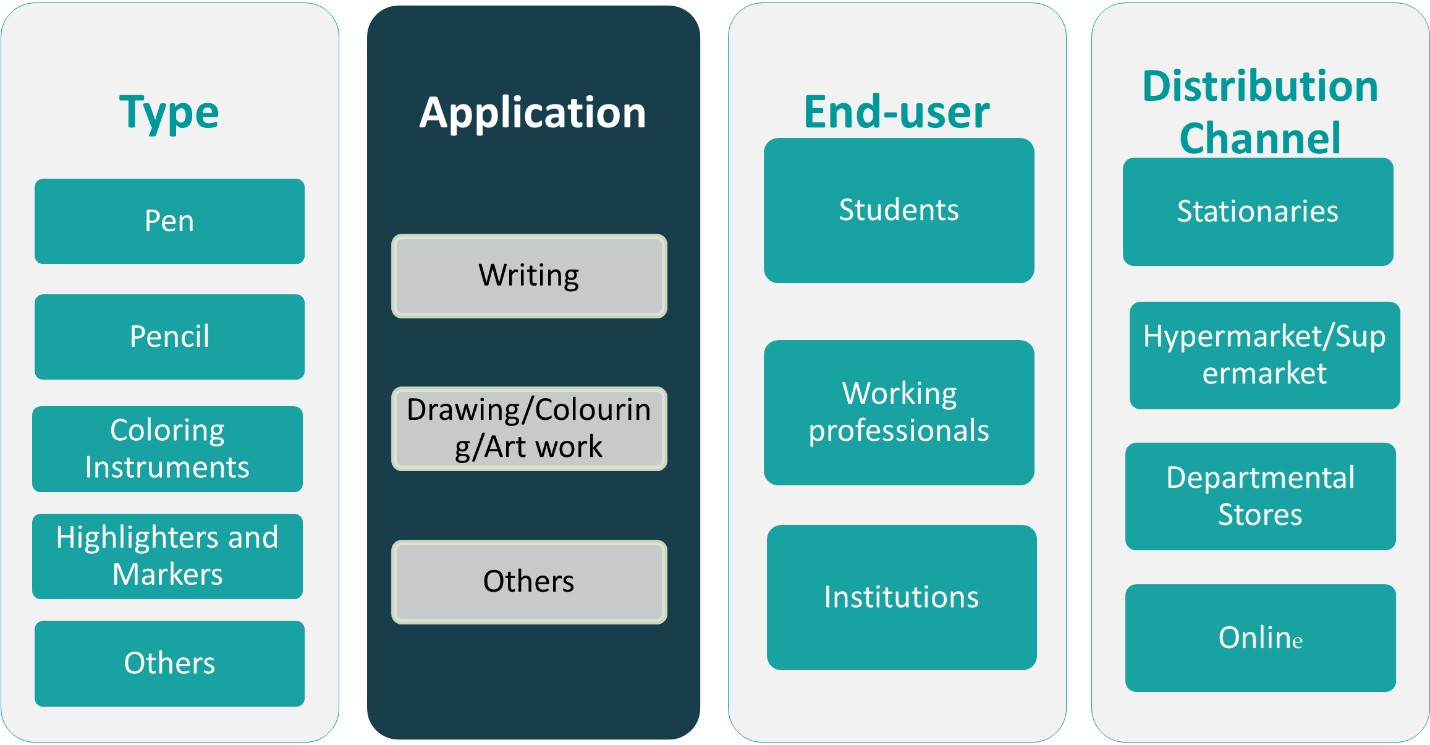
Market Drivers
Growth in Educational and Institutional Demand
The education sector is a significant driver of the Latin America writing instruments market. With rising literacy rates and expanding education systems, the need for writing tools continues to grow. For instance, the Inter-American Development Bank (IDB) highlights that governments in countries like Brazil and Mexico are investing heavily in education infrastructure, leading to increased demand for school supplies such as pens, pencils, and markers. As the number of students in primary, secondary, and tertiary education institutions increases, the market for writing instruments is set to experience consistent growth. Additionally, as educational practices become more modernized, incorporating digital and offline writing tools, students and institutions alike require high-quality writing instruments to enhance learning outcomes.
Rise of Corporate and Professional Use
Another critical driver of the writing instruments market in Latin America is the growing demand from the corporate and professional sectors. As businesses expand and corporate activities become more sophisticated, the need for premium writing tools in offices and meeting spaces grows. Companies are increasingly prioritizing quality stationery for employees and clients, using branded pens, markers, and other tools for both practical and promotional purposes. Corporate gifting, which often involves the distribution of high-end writing instruments, further contributes to the demand. The professional market also benefits from the rise in the number of remote workers, where companies are providing personalized stationery to maintain a professional image even in virtual environments.
Shift Toward Premium and Personalized Writing Instruments
There is a noticeable shift in consumer preference towards premium and personalized writing instruments in Latin America. For instance, Mobility Foresights reports that consumers are increasingly investing in high-quality pens with custom engravings and unique designs. As disposable incomes increase and middle-class populations expand, consumers are more willing to invest in high-quality writing tools. Premium brands offer luxury, durability, and comfort, factors that appeal to consumers seeking long-lasting products. Additionally, the trend toward personalization, whether through engraved names or custom designs, further drives this market segment. Writing instruments are increasingly viewed as a status symbol, especially in professional settings, contributing to the growing demand for premium pens and personalized office supplies. This trend is being fueled by both local and international brands that cater to the desires of affluent consumers who value craftsmanship and exclusivity.
Increasing Awareness of Sustainability and Eco-Friendly Products
Sustainability is becoming an essential factor in consumer decision-making, and the Latin American writing instruments market is no exception. As environmental concerns grow, consumers are increasingly opting for eco-friendly writing products. Brands are responding by introducing writing instruments made from recycled materials, biodegradable plastics, and sustainably sourced components. This trend aligns with the broader global movement toward sustainability, with Latin American consumers becoming more conscious of the environmental impact of their purchases. Moreover, the region's growing middle class, which is more concerned with social responsibility, further drives demand for environmentally friendly writing tools. Companies that focus on eco-friendly innovations and transparent sustainability practices are gaining a competitive edge in the market.
Market Trends
Rise in Digital Integration with Writing Tools
A significant trend in the Latin America writing instruments market is the increasing integration of digital technology with traditional writing tools. For instance, the OECD's report on digital transformation highlights the adoption of smart pens in educational and professional settings, which allow users to digitize handwritten notes seamlessly. The rise of smart pens, which allow users to write on paper while simultaneously capturing the digital version of their notes, is gaining traction. These tools appeal to students, professionals, and tech-savvy consumers who desire a seamless blend of analog and digital functions. This trend reflects the growing importance of versatility and connectivity in modern writing instruments.
Popularity of Eco-Friendly and Sustainable Products
Sustainability continues to be a major trend in the Latin American writing instruments market. As environmental awareness increases, consumers are becoming more inclined to purchase eco-friendly products. Writing instrument manufacturers are responding by developing tools made from recycled materials, biodegradable plastics, and other environmentally responsible resources. For instance, the EU-UNEP project ICSAL promotes the use of recycled and biodegradable materials in consumer products. Additionally, the demand for refillable and reusable pens is growing, as consumers seek products that reduce waste and promote sustainability. Brands that focus on environmentally conscious manufacturing processes and materials are appealing to the growing demographic of eco-conscious consumers. This trend is not only shaping consumer preferences but also influencing corporate strategies, as companies strive to meet the demand for sustainable products while aligning with global sustainability goals.
Emphasis on Ergonomics and Comfort
Another notable trend in the market is the growing focus on ergonomic and comfortable writing instruments. As consumers spend more time writing, whether in educational settings or the workplace, the demand for pens, pencils, and other writing tools that offer improved ergonomics and comfort is on the rise. Manufacturers are introducing products with features such as soft grips, cushioned barrels, and adjustable designs that reduce hand fatigue and enhance the writing experience. This trend is particularly important for students, professionals, and individuals with physical impairments, as it promotes longer periods of writing without discomfort. Ergonomically designed writing instruments are now being marketed not only as tools for productivity but also as products that promote health and well-being.
Growth of Online Retail and E-Commerce Channels
The Latin America writing instruments market is experiencing a shift in purchasing behavior, with an increasing number of consumers turning to online retail platforms. E-commerce is becoming a key channel for purchasing writing instruments, as it provides consumers with greater convenience, a wider variety of products, and the ability to compare prices easily. Online marketplaces and specialized stationery websites are thriving in the region, offering consumers access to both local and international brands. This shift is particularly prominent among younger, tech-savvy consumers who prefer the ease and flexibility of shopping online. As e-commerce continues to expand, brands are adapting by enhancing their digital presence and leveraging online advertising to target potential customers effectively.
Market Challenges Analysis
Economic Instability and Price Sensitivity
One of the major challenges facing the Latin America writing instruments market is economic instability across several countries in the region. For instance, the Inter-American Development Bank (IDB) highlights that inflation and fluctuating exchange rates in countries like Argentina and Venezuela have significantly impacted consumer spending power. These economic factors often result in heightened price sensitivity, with consumers becoming more cautious about their purchases. As a result, demand for premium and branded writing instruments may decrease, as consumers prioritize affordability. Manufacturers may also face challenges in sourcing raw materials at consistent prices, further driving up production costs. This creates a challenging environment for brands to balance product quality and cost while maintaining competitiveness in a price-sensitive market.
Competition from Low-Cost Imports and Counterfeit Products
The Latin American writing instruments market is also facing intense competition from low-cost imports, primarily from Asian markets, which offer writing tools at significantly lower prices. These products often flood the market, making it difficult for local manufacturers and premium brands to maintain their market share. Additionally, the presence of counterfeit products is a growing concern, as counterfeit writing instruments are sold at lower prices, undermining the profitability and brand reputation of legitimate businesses. These challenges make it increasingly difficult for established brands to differentiate themselves, particularly in price-sensitive segments of the market. To remain competitive, companies need to innovate and focus on delivering value through superior quality, brand recognition, and sustainable practices.
Market Opportunities
The Latin America writing instruments market presents several growth opportunities driven by changing consumer preferences and evolving market dynamics. One of the key opportunities lies in the rising demand for premium and personalized writing tools. As disposable incomes in many Latin American countries increase and the middle class expands, consumers are increasingly inclined to invest in high-quality writing instruments that offer superior performance and aesthetics. Furthermore, the growing trend of personalization-such as custom engravings or unique designs-presents an opportunity for brands to cater to consumers seeking products that reflect their individual style or professional identity. Companies that focus on delivering premium, bespoke products can capitalize on this segment, particularly in corporate gifting and high-end retail spaces, where consumers value exclusivity and luxury.
Additionally, the shift toward sustainability is opening doors for companies to innovate with eco-friendly writing instruments. As environmental concerns continue to rise, consumers are becoming more conscious of the environmental impact of their purchases. Brands that prioritize sustainable materials, such as recycled plastics or biodegradable components, have a significant opportunity to capture the growing demand for green products. This trend is not only driven by consumer preferences but also by regulatory pressures encouraging businesses to adopt sustainable practices. By introducing environmentally responsible writing tools, companies can differentiate themselves in a competitive market, build brand loyalty, and appeal to the eco-conscious consumer. The increasing focus on sustainability is particularly relevant in the Latin American market, where environmental awareness is steadily rising across key demographics.
Market Segmentation Analysis:
By Type:
The Latin America writing instruments market is segmented by type into pens, pencils, coloring instruments, highlighters and markers, and others. Among these, pens hold the largest share, driven by their widespread use in both educational and professional environments. Ballpoint pens, gel pens, and fountain pens are popular choices, with brands offering a range of options from budget-friendly to premium products. Pencils are another significant segment, particularly in the education sector, where they are essential for students. With the growing interest in creative activities, the coloring instruments segment, including colored pencils, markers, and crayons, is also expanding, especially with the rise in popularity of adult coloring books and art therapy. Highlighters and markers have gained traction in both corporate and educational settings, driven by their practical application in note-taking, presentations, and document marking. The "Others" category includes niche products like stylus pens and writing tools for specific purposes, such as calligraphy or technical drawing, which cater to specialized market needs.
By Application:
The Latin America writing instruments market is further divided by application into writing, drawing/colouring/artwork, and others. The writing segment dominates the market, driven by the widespread use of writing instruments in daily activities such as education, business, and personal correspondence. Pens and pencils are essential tools for students, professionals, and individuals, contributing to the high demand in this application. The drawing/colouring/artwork segment is growing rapidly, fueled by the increasing popularity of artistic hobbies and creative activities. As more people engage in drawing, coloring, and other forms of art, the demand for high-quality coloring instruments, such as colored pencils, markers, and sketching pens, has surged. This trend is particularly evident in urban areas, where art schools and workshops are flourishing. The "Others" category includes applications for technical drawing, professional note-taking, and specialized uses in design and architecture, further diversifying the market.
Segments:
Based on Type:
- Pen
- Pencil
- Coloring Instruments
- Highlighters and Markers
- Others
Based on Application:
- Writing
- Drawing/Colouring/Art Work
- Others
Based on End- User:
- Students
- Working Professionals
- Institutions
Based on Distribution Channel:
- Stationaries
- Hypermarket/Supermarket
- Departmental Stores
- Online
Based on the Geography:
- Brazil
- Argentina
- Peru
- Chile
- Colombia
- Rest of Latin America
Regional Analysis
Brazil
Brazil leads the market, commanding the largest share due to its significant population, growing middle class, and well-established education sector. As the largest economy in the region, Brazil accounts for approximately 40% of the total market share. The country’s strong demand for writing instruments is driven by its large student population, which requires essential writing tools for educational purposes. Additionally, Brazil’s increasing urbanization and expansion of corporate sectors further boost the demand for premium pens and office supplies. The combination of a vast consumer base and a robust retail infrastructure positions Brazil as the dominant player in the Latin American writing instruments market.
Argentina
Argentina holds the second-largest market share in the region, with approximately 20% of the total market. The demand for writing instruments in Argentina is influenced by its significant educational system and professional sector. Despite experiencing economic volatility, Argentina continues to have a stable demand for basic and premium writing products, especially in urban centers. The growth of e-commerce platforms and online retail also contributes to the expansion of the writing instruments market in Argentina, making it easier for consumers to access a wide variety of products, including eco-friendly options and premium brands. Additionally, the rise of the middle class in Argentina drives the demand for higher-end stationery items.
Peru
Peru, with a market share of around 10%, represents an emerging market in the Latin American writing instruments sector. The growth of Peru’s education system and increasing literacy rates have significantly boosted the demand for writing tools. Additionally, the growing middle class in Peru is beginning to shift towards premium writing instruments, further propelling market growth. The rising influence of digital technology also plays a role in encouraging consumers to invest in higher-quality writing instruments that combine both traditional and digital functions. The increasing availability of international and local brands through retail and e-commerce channels supports market expansion.
Chile and Colombia
Chile and Colombia represent smaller, yet significant, contributors to the Latin American writing instruments market, with respective shares of 8% and 7%. Both countries exhibit steady demand for writing tools due to their well-developed education systems and the increasing trend of professionalization in the corporate sectors. Chile, with a higher per capita income, shows a preference for premium products, including personalized and luxury writing instruments. Meanwhile, Colombia’s growing urban population and expanding middle class fuel demand for affordable and mid-range writing tools. The "Rest of Latin America" category, which includes countries such as Venezuela, Ecuador, and Bolivia, accounts for the remaining market share, approximately 15%. Despite economic challenges, these regions show promising growth in demand for basic writing tools as literacy rates continue to improve.
Key Player Analysis
- Lamy
- Montblanc
- Waterman
- Faber-Castell
- Montegrappa
- Pelikan
- Kaweco
- Diplomat
- Aurora
- Sheaffer
- Cello Pens
Competitive Analysis
The competitive landscape of the Latin America writing instruments market is marked by the presence of both global and local players offering a wide range of products to cater to diverse consumer preferences. Leading international brands like Lamy, Montblanc, Waterman, Faber-Castell, Montegrappa, Pelikan, Kaweco, Diplomat, Aurora, Sheaffer, and Cello Pens dominate the market, each contributing unique value propositions. These brands typically emphasize craftsmanship, ergonomic features, and long-lasting performance to cater to professionals and collectors. In contrast, local players focus on offering affordable writing tools tailored to the mass market, particularly in educational and corporate sectors. These brands often leverage cost advantages and localized manufacturing to provide a broad range of products that meet the demands of price-sensitive consumers. Additionally, as the demand for eco-friendly products rises, several competitors are adapting by incorporating sustainable materials and production practices into their offerings. The market is highly competitive, with established players continuously innovating to stay ahead of emerging trends such as the integration of digital technologies with traditional writing instruments. Retail distribution channels are expanding, with a growing presence of online platforms, which has further intensified competition. Both global and local brands must also navigate challenges like counterfeiting and economic volatility in the region, which may impact pricing strategies and consumer confidence
Recent Developments
- In February 2023, Zebra Pen Corp., a prominent player in the industry, announced its partnership with Liqui-Mark. This collaboration aims to enhance distribution aspects in the market, bringing about a new era of possibilities.
- In July 2023, Montblanc launched its exclusive "Meisterstück 146 LeGrand" fountain pen, featuring a handcrafted design with intricate detailing, addressing the rising demand for personalized, high-end writing tools in luxury segments.
- In April 2022, Zebra Pen Corp. announced the launch of its official website. This step was taken by the company to enhance user experience, increase e-commerce functionality, and improve brand communication, among other objectives.
Market Concentration & Characteristics
The Latin America writing instruments market exhibits moderate market concentration, with a mix of global and regional players competing across various segments. While global brands dominate the premium and luxury markets, local manufacturers hold significant shares in the budget and mass-market categories. The market is characterized by a diverse product offering, ranging from affordable, functional writing tools to high-end, personalized writing instruments. This segmentation allows companies to cater to a wide range of consumer preferences, from students and professionals to collectors and luxury buyers. Additionally, the market is marked by increasing demand for eco-friendly products, pushing companies to innovate with sustainable materials and production methods. The presence of both large multinational companies and smaller local brands contributes to a competitive environment, with innovation and pricing strategies being key factors influencing market dynamics. As e-commerce continues to grow, digital distribution channels are becoming an increasingly important aspect of market characteristics.
Report Coverage
The research report offers an in-depth analysis based on Type, Application, End-User, Distribution Channel and Geography. It details leading market players, providing an overview of their business, product offerings, investments, revenue streams, and key applications. Additionally, the report includes insights into the competitive environment, SWOT analysis, current market trends, as well as the primary drivers and constraints. Furthermore, it discusses various factors that have driven market expansion in recent years. The report also explores market dynamics, regulatory scenarios, and technological advancements that are shaping the industry. It assesses the impact of external factors and global economic changes on market growth. Lastly, it provides strategic recommendations for new entrants and established companies to navigate the complexities of the market.
Future Outlook
- Latin America's writing instrument market is expected to see steady growth driven by increasing urbanization and educational expansion.
- The demand for premium and eco-friendly writing products is anticipated to rise as consumers become more environmentally conscious.
- E-commerce platforms will continue to play a major role in the distribution of writing instruments across the region.
- Technological innovations, such as smart pens and digital writing solutions, are likely to gain traction in the market.
- Rising disposable incomes in key markets like Brazil and Mexico are expected to drive the demand for higher-end writing tools.
- Companies in Latin America will focus on sustainability, with many shifting towards biodegradable materials and responsible manufacturing practices.
- The educational sector’s growth will fuel the demand for affordable and high-quality pens, pencils, and other writing instruments.
- Local manufacturing in Latin America is predicted to increase as companies seek to reduce production costs and avoid import tariffs.
- The region’s growing interest in art and design will boost demand for creative and specialized writing instruments like markers and colored pens.
- Collaborative marketing and brand partnerships with schools and universities will become more common to capture a larger consumer base.

Request a Free Sample
Fill in your details and we'll send you a free sample report.
- Sample data tables & charts
- Research methodology
Market Dynamics
Growth in Educational and Institutional Demand
Expanding education systems and rising literacy rates across Latin America are increasing the need for writing instruments, especially as governments invest in school infrastructure and student populations grow.
Rise of Corporate and Professional Use
The expansion of corporate sectors and professional environments is driving demand for premium and branded writing tools, both for daily office use and as part of corporate gifting strategies.
Shift Toward Premium and Personalized Writing Instruments
As disposable incomes rise and the middle class expands, consumers are increasingly seeking high-quality, personalized, and luxury writing instruments, viewing them as status symbols and investing in custom designs.
Increasing Awareness of Sustainability and Eco-Friendly Products
Growing environmental consciousness is leading consumers to prefer writing instruments made from recycled or biodegradable materials, prompting brands to innovate with sustainable product lines.
Growth of Online Retail and E-Commerce Channels
The increasing adoption of e-commerce platforms in Latin America is making it easier for consumers to access a wide variety of writing instruments, including international and premium brands, thereby expanding market reach.
Need a Custom Version of This Report?
Tailor the scope, geography, or segments to your exact requirements.
- Custom geography or segment scope
- Direct access to our analyst team
Frequently Asked Questions
What is the current size of the Latin America Writing Instruments?
What factors are driving the growth of the Latin America Writing Instruments?
What are some challenges faced by the Latin America Writing Instruments?
Who are the major players in the Latin America Writing Instruments?
Table of Content
Chapter 1 Market Segmentation
- 1.1 Segmentation Framework
- 1.1.1 Product and Service Classification
- 1.1.2 Application and End-Use Classification
- 1.1.3 Technology and Solution Classification
- 1.1.4 Customer and Distribution Channel Classification
- 1.1.5 Geographic Segmentation
- 1.1.6 Market Segment Definitions and Boundaries
- 1.2 By Type
- 1.2.1 Pen
- 1.2.2 Pencil
- 1.2.3 Coloring Instruments
- 1.2.4 Highlighters and Markers
- 1.2.5 Others
- 1.3 By End-User
- 1.3.1 Students
- 1.3.2 Working Professionals
- 1.3.3 Institutions
- 1.4 By Application
- 1.4.1 Writing
- 1.4.2 Drawing/Colouring/Art Work
- 1.4.3 Others
Chapter 2 Introduction
- 2.1 Report Objectives and Scope
- 2.2 Product Definition and Industry Terminology
- 2.3 Market Inclusions and Exclusions
- 2.4 Research Process
- 2.4.1 Primary Research and Expert Interviews
- 2.4.2 Secondary Research and Source Review
- 2.4.3 Top-Down and Bottom-Up Estimation
- 2.4.4 Data Triangulation and Verification
- 2.5 Market Size Measurement Basis
- 2.5.1 2023: USD 1,122.00 million → 2032: USD 2,659.61 million
- 2.6 Historical and Forecast Reference Periods
- 2.6.1 Base Year: 2023
- 2.6.2 Forecast Period: 2023-2032
- 2.7 Research Assumptions and Limitations
Chapter 3 Executive Summary
- 3.1 Market Snapshot and Key Findings
- 3.2 Base-Year Market Size, 2023
- 3.3 Forecast Market Size, 2032
- 3.4 Revenue and Volume Growth Outlook
- 3.5 Key Demand and Supply Indicators
- 3.6 Leading Market Segments
- 3.7 Fastest-Growing Market Opportunities
- 3.8 Regional Performance Highlights
- 3.9 Technology and Industry Transformation
- 3.10 Competitive Landscape Summary
- 3.11 Analyst View and Strategic Implications
Chapter 4 Latin America Writing Instruments Market Trends and Developments
- 4.1 Historical Industry Development
- 4.2 Recent Market Trends and Developments
- 4.3 Demand and Customer Behavior Trends
- 4.4 Technology and Product Innovation
- 4.5 Artificial Intelligence, Automation and Digitalization
- 4.6 Local Manufacturing and Supply Chain Realignment
- 4.7 Industry Partnerships, Mergers and Acquisitions
- 4.8 Sustainability and Circular Economy Developments
- 4.9 Government and Private Sector Investment Trends
- 4.10 Emerging Business Models and Commercialization
- 4.11 Industry Developments and Announcements
Chapter 5 Latin America Writing Instruments Market Production, Supply and Demand Analysis
- 5.1 Demand Trend and Consumption Analysis
- 5.2 Demand Forecast, 2023-2032
- 5.3 Production and Output Trend
- 5.4 Production and Output Forecast, 2023-2032
- 5.5 Installed Capacity and Capacity Utilization
- 5.6 Company-Wise Production Plants and Statistics
- 5.6.1 Installed Production Capacity
- 5.6.2 Actual Production
- 5.6.3 Planned Capacity and Expansion Targets
- 5.7 Supply Chain Structure and Procurement Trends
- 5.8 Supply-Demand Gap and Bottlenecks
- 5.9 Import Dependence and Sourcing Structure
- 5.10 Contract Manufacturing and Outsourcing
- 5.11 Regional Supply and Demand Concentration
Chapter 6 Latin America Writing Instruments Market Pricing Analysis
- 6.1 Pricing Structure and Measurement
- 6.2 Historical Pricing Trends
- 6.3 Pricing Outlook, 2023-2032
- 6.4 Average Selling Price and Unit Economics
- 6.5 Pricing by Product and Market Segment
- 6.6 Geographic Pricing Differences
- 6.7 Key Input, Energy, Labor and Logistics Costs
- 6.8 Contract Pricing and Purchasing Models
- 6.9 Pricing Sensitivity and Competitive Positioning
- 6.10 Price, Margin and Profitability Implications
Chapter 7 Latin America Writing Instruments Market Dynamics
- 7.1 Market Growth Drivers
- 7.1.1 Demand-Side Drivers
- 7.1.2 Technology and Innovation Drivers
- 7.1.3 Infrastructure and Investment Drivers
- 7.1.4 Regulatory and Policy Drivers
- 7.2 Market Restraints
- 7.2.1 Cost and Affordability Constraints
- 7.2.2 Technology and Adoption Barriers
- 7.2.3 Supply Chain and Operational Constraints
- 7.3 Market Challenges
- 7.3.1 Competitive Pressure and Margin Erosion
- 7.3.2 Skills, Infrastructure and Implementation Gaps
- 7.4 Emerging Market Opportunities
- 7.5 Market Dynamics Impact and Time-Horizon Assessment
Chapter 8 Latin America Writing Instruments Value Chain Analysis
- 8.1 Industry Value Chain Overview
- 8.2 Upstream Suppliers and Critical Inputs
- 8.3 Technology and Component Providers
- 8.4 Manufacturing or Service Delivery
- 8.5 Distribution, Channel Partners and Integrators
- 8.6 Downstream Applications and End Users
- 8.7 Value Addition and Profit Pools
- 8.8 Vertical Integration and Outsourcing
- 8.9 Supplier Concentration and Risk
- 8.10 Supply Chain Localization and Resilience
Chapter 9 Latin America Writing Instruments Market Regulations and Policies
- 9.1 Relevant Laws, Standards and Compliance Frameworks
- 9.2 Product, Service, Safety and Quality Requirements
- 9.3 Government Policies, Incentives and Subsidies
- 9.4 Imports, Exports and Trade Barriers
- 9.5 Public Procurement and Local Content Requirements
- 9.6 Environmental and Sustainability Compliance
- 9.7 Upcoming Policy Changes and Market Implications
Chapter 10 Latin America Writing Instruments Market Hotspots and Opportunities
- 10.1 Market Opportunity Mapping and Growth Hotspots
- 10.2 High-Growth Applications and Customer Groups
- 10.3 Underserved Markets and White-Space Opportunities
- 10.4 Emerging Technology and Product Opportunities
- 10.5 New Capacity and Investment Hotspots
- 10.6 Market Entry and Expansion Opportunities
- 10.7 Distribution and Partnership Opportunities
- 10.8 Near-Term and Long-Term Commercial Potential
- 10.9 Opportunity Attractiveness and Execution Risks
Chapter 11 Latin America Writing Instruments Market Outlook, 2023-2032
- 11.1 Market Size and Analysis
- 11.1.1 Revenue (Market Measurement: 2023: USD 1,122.00 million → 2032: USD 2,659.61 million)
- 11.1.2 Market Volume and Quantity Sold
- 11.1.3 Historical Market Size
- 11.1.4 Base-Year Market Size, 2023
- 11.2 Market Forecast, 2023-2032
- 11.2.1 Revenue Forecast to 2032
- 11.2.2 Volume Forecast to 2032
- 11.2.3 CAGR and Year-on-Year Growth
- 11.2.4 Incremental Revenue Opportunity
- 11.3 Forecast Assumptions and Scenario Analysis
- 11.3.1 Base-Case Forecast
- 11.3.2 Optimistic and Conservative Scenarios
- 11.3.3 Technology, Pricing and Policy Sensitivities
- 11.4 Market Attractiveness and Growth Outlook
Chapter 12 Latin America Writing Instruments Market Segmentation and Outlook
- 12.1 Segmentation Summary and Market Shares, 2023
- 12.2 Largest and Fastest-Growing Segments
- 12.3 By Type - Market Size and Forecast, 2023-2032
- 12.3.1 Segment Definition and Scope
- 12.3.2 Historical Market Size
- 12.3.3 Revenue Forecast, 2023-2032
- 12.3.4 Volume Forecast, 2023-2032
- 12.3.5 Base-Year Market Share, 2023
- 12.3.6 Segment CAGR and Growth Drivers
- 12.3.7 Subsegment Market Size and Forecast
- 12.3.7.1 Pen
- 12.3.7.2 Pencil
- 12.3.7.3 Coloring Instruments
- 12.3.7.4 Highlighters and Markers
- 12.3.7.5 Others
- 12.3.8 Subsegment Pricing and Adoption Trends
- 12.3.9 Leading Suppliers and Competition
- 12.3.10 Regional Demand and Opportunities
- 12.4 By End-User - Market Size and Forecast, 2023-2032
- 12.4.1 Segment Definition and Scope
- 12.4.2 Historical Market Size
- 12.4.3 Revenue Forecast, 2023-2032
- 12.4.4 Volume Forecast, 2023-2032
- 12.4.5 Base-Year Market Share, 2023
- 12.4.6 Segment CAGR and Growth Drivers
- 12.4.7 Subsegment Market Size and Forecast
- 12.4.7.1 Students
- 12.4.7.2 Working Professionals
- 12.4.7.3 Institutions
- 12.4.8 Subsegment Pricing and Adoption Trends
- 12.4.9 Leading Suppliers and Competition
- 12.4.10 Regional Demand and Opportunities
- 12.5 By Application - Market Size and Forecast, 2023-2032
- 12.5.1 Segment Definition and Scope
- 12.5.2 Historical Market Size
- 12.5.3 Revenue Forecast, 2023-2032
- 12.5.4 Volume Forecast, 2023-2032
- 12.5.5 Base-Year Market Share, 2023
- 12.5.6 Segment CAGR and Growth Drivers
- 12.5.7 Subsegment Market Size and Forecast
- 12.5.7.1 Writing
- 12.5.7.2 Drawing/Colouring/Art Work
- 12.5.7.3 Others
- 12.5.8 Subsegment Pricing and Adoption Trends
- 12.5.9 Leading Suppliers and Competition
- 12.5.10 Regional Demand and Opportunities
- 12.6 Segment Growth Comparison
- 12.7 Segment Attractiveness and Priority Matrix
Chapter 13 Latin America Writing Instruments End-Use and Application Market Outlook
- 13.1 End-Use Industry and Customer Demand Structure
- 13.2 Leading Applications and Customer Groups
- 13.3 End-Use Market Size, Share and Forecast
- 13.4 Major End-Use Industry Deep Dives
- 13.4.1 Customer Requirements and Use Cases
- 13.4.2 Demand and Replacement Cycles
- 13.4.3 Technical and Regulatory Considerations
- 13.4.4 Purchasing and Procurement Models
- 13.4.5 Leading Vendors and Distribution Channels
- 13.4.6 Forecast and Commercial Opportunities
- 13.5 Emerging Applications and Cross-Segment Demand
- 13.6 End-Use Industry Investment Priorities
Chapter 14 Latin America Writing Instruments Geographic Market Outlook, 2023-2032
- 14.1 Regional Market Size and Country-Level Shares, 2023
- 14.2 Country Market Size Comparison, 2023
- 14.3 Country Market Forecasts, 2023-2032
- 14.4 Subregional Industrial and Demand Clusters
- 14.5 Intra-Regional Pricing and Cost Differences
- 14.6 Cross-Border Trade and Supply Networks
- 14.7 Regional Supply and Demand Balances
- 14.8 Country Opportunity Comparison and Prioritization
Note: Every listed country is covered on the structure shown under the first country.
Chapter 15 Latin America Writing Instruments Technology, Innovation and Sustainability Outlook
- 15.1 Technology Landscape and Maturity
- 15.2 Product, Process and Service Innovation
- 15.3 AI, Automation and Digital Tools in the Industry
- 15.4 Technology Adoption and Performance Benchmarking
- 15.5 Innovation Pipeline and R&D Investment
- 15.6 Patent and Intellectual Property Trends
- 15.7 Energy Efficiency and Resource Management
- 15.8 Sustainability, Recycling and Circularity
- 15.9 Technology Roadmap, 2023-2032
- 15.10 Risks of Obsolescence and Technology Substitution
Chapter 16 Latin America Writing Instruments Market Key Strategic Imperatives
- 16.1 Growth and Market Entry Priorities
- 16.2 High-Return Products and Segments
- 16.3 Pricing, Profitability and Cost Optimization
- 16.4 Technology Investment and Product Differentiation
- 16.5 Supply Chain Localization and Resilience
- 16.6 Distribution and Customer Acquisition
- 16.7 Partnership, Acquisition and Capacity Strategy
- 16.8 Regional Expansion Priorities
- 16.9 Short-, Medium- and Long-Term Actions
Chapter 17 Competition Outlook
- 17.1 Industry Competition Characteristics
- 17.2 Market Structure and Concentration
- 17.3 Market Share and Competitive Positioning, 2023
- 17.4 Company-Wise Revenue and Product Benchmarking
- 17.5 Production and Service Capacity Benchmarking
- 17.6 Technology, Pricing and Differentiation
- 17.7 Regional Footprint and Distribution Strength
- 17.8 Mergers, Acquisitions and Strategic Alliances
- 17.9 New Entrants and Competitive Threats
- 17.10 Porter's Five Forces and Industry Attractiveness
- 17.11 Competitive Outlook, 2023-2032
Chapter 18 Company Profiles
- 18.1 Company Coverage and Selection Criteria
- 18.2 Lamy
- 18.2.1 Business Description
- 18.2.2 Company Ownership and Geographic Presence
- 18.2.3 Product and Service Portfolio
- 18.2.4 Manufacturing and Operating Footprint
- 18.2.5 Production Capacity and Expansion Plans
- 18.2.6 Financial Performance and Investment
- 18.2.7 Market Share and Competitive Position
- 18.2.8 Technology and Innovation Capabilities
- 18.2.9 Strategic Alliances or Partnerships
- 18.2.10 Recent Developments
- 18.2.11 Growth Strategy and Outlook
- 18.3 Montblanc
- 18.4 Waterman
- 18.5 Faber-Castell
- 18.6 Montegrappa
- 18.7 Pelikan
- 18.8 Kaweco
- 18.9 Diplomat
- 18.10 Aurora
- 18.11 Cello Pens
- 18.12 Other Relevant Market Participants
Note: Every listed company is profiled on the structure shown under the first company. The company list is preliminary and may change based on research findings, market developments, data availability and client requirements.
Chapter 19 Disclaimer
- 19.1 Research and Forecast Disclaimer
- 19.2 Data Source and Estimation Limitations
Note: The depth of individual sections depends on data availability for this market. Volume, capacity, trade and other unit-based metrics are included where applicable.

