
Market Overview
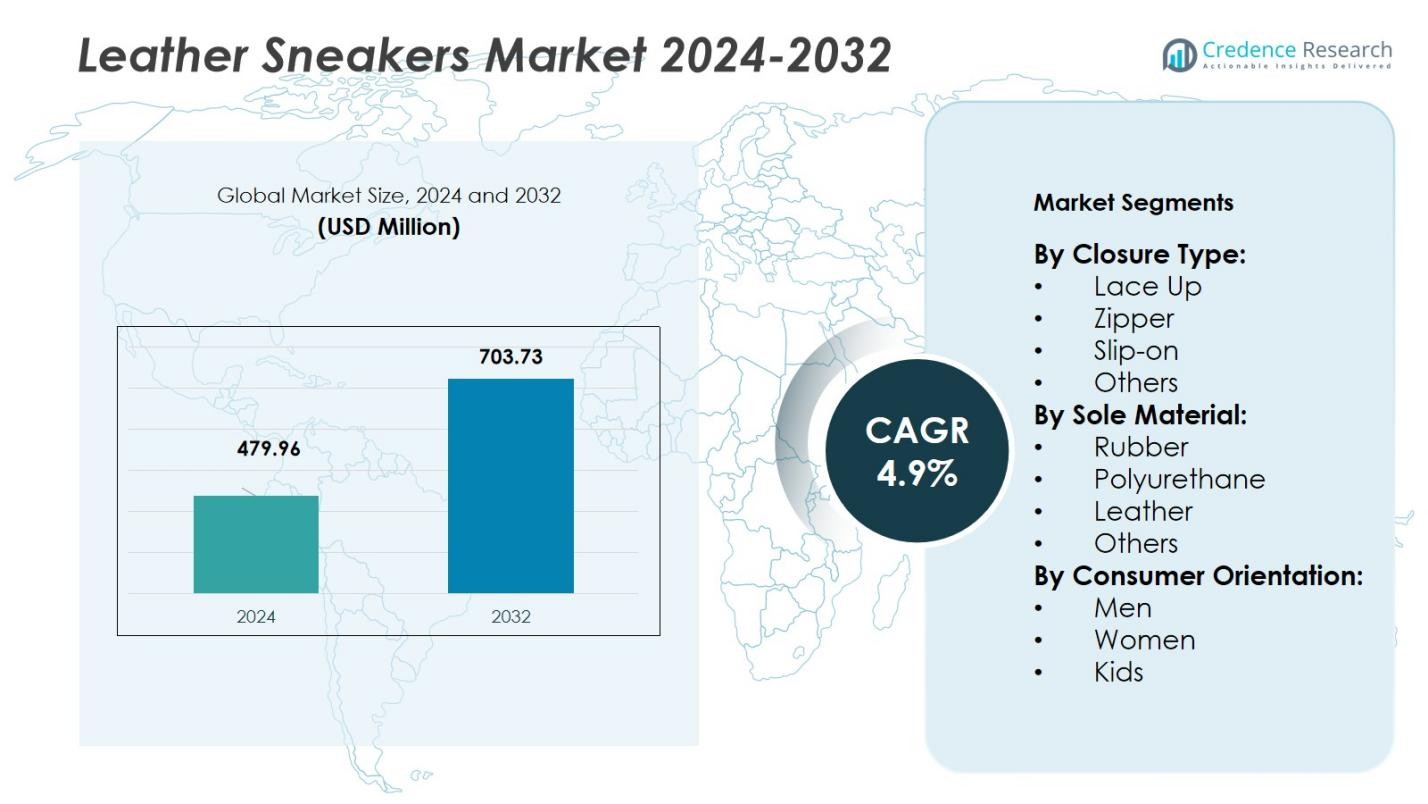
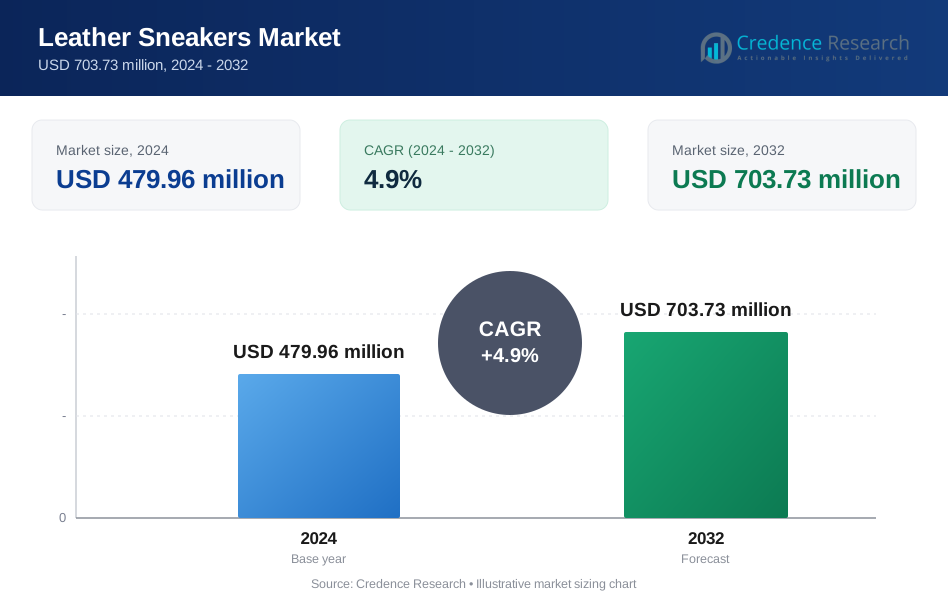
The Leather Sneakers Market size was valued at USD 479.96 million in 2024 and is anticipated to reach USD 703.73 million by 2032, growing at a CAGR of 4.9% during the forecast period.
| REPORT ATTRIBUTE | DETAILS |
|---|---|
| Historical Period | 2020-2023 |
| Base Year | 2024 |
| Forecast Period | 2025-2032 |
| Leather Sneakers Market Size 2024 | USD 479.96 Million |
| Leather Sneakers Market, CAGR | 4.9% |
| Leather Sneakers Market Size 2032 | USD 703.73 Million |
The Leather Sneakers Market features key players such as Prada Holding B.V., LVMH, Allen Edmonds, Kering S.A., Bruno Magli,Cole Haan,Genesco Inc. Hermès International S.A., Salvatore Ferragamo S.p.A., and Crockett & Jones, each leveraging brand heritage and premium positioning to capture value in the segment. Regionally, Europe leads with a 32 % share, driven by the region’s legacy in leather craftsmanship and high‑end footwear culture. North America contributes about 25 %, supported by high disposable income and strong direct‑to‑consumer infrastructure, while Asia‑Pacific holds around 30 % and benefits from rising middle‑class demand and urbanisation.
Market Insights
- The Leather Sneakers Market size was valued at USD 479.96 million in 2024 and is anticipated to reach USD 703.73 million by 2032, growing at a CAGR of 4.9% during the forecast period.
- The increasing demand for stylish yet comfortable footwear is driving the growth of leather sneakers, especially among fashion-conscious consumers looking for versatile and durable options.
- Sustainability is a growing trend, with consumers prioritizing eco-friendly materials, including vegan leather and other sustainable alternatives, offering significant growth opportunities.
- Intense market competition, particularly from fast fashion brands and counterfeit products, is challenging premium leather sneaker manufacturers to differentiate through quality and innovation.
- Europe dominates the global market with a 32% share, followed by Asia-Pacific at 30% and North America at 25%, driven by rising disposable income and fashion trends in key regions.
Market Segmentation Analysis:
By Closure Type:
The Leather Sneakers Market is segmented by closure type into Lace Up, Zipper, Slip-on, and Others. Among these, the Lace-Up sub-segment holds the dominant share, accounting for 60% of the market. Lace-Up shoes are favored due to their customizable fit and classic design, appealing to a broad demographic. The increasing demand for comfort and durability in everyday footwear drives this segment's growth. Additionally, Lace-Up sneakers are often associated with premium leather sneakers, adding to their popularity across various consumer groups, particularly among men and women.
- For instance, Gordon & Bros offers white lace-up sneakers made with 100% genuine leather that combine luxury with durability, targeting the sophisticated consumer seeking both style and comfort.
By Sole Material:
The sole material segment in the Leather Sneakers Market includes Rubber, Polyurethane, Leather, and Others. The Rubber sole sub-segment is the leading category, holding a market share of 45%. Rubber soles are highly preferred for their durability, slip resistance, and comfort, making them ideal for both casual and athletic use. The growing trend for high-performance sneakers, which combine comfort with style, is a key driver for the increased adoption of rubber soles in leather sneakers. This material is favored by both men and women for everyday wear.
- For instance, the HOKA Bondi SR work sneaker combines a water-resistant leather upper with a full-ground-contact rubber outsole engineered with a proprietary slip-resistant compound, targeting service and medical professionals who require high grip on slick floors.
By Consumer Orientation:
The consumer orientation segment of the Leather Sneakers Market is categorized into Men, Women, and Kids. The Men's segment leads with a significant market share of 55%. Men's leather sneakers are driven by the demand for versatile and fashionable footwear suitable for both casual and formal occasions. This sub-segment is propelled by fashion trends, with men seeking premium, durable sneakers that combine comfort with aesthetics. Furthermore, rising disposable incomes and a growing inclination toward high-end footwear contribute to the segment's continued expansion, particularly in North America and Europe.
Key Growth Drivers
Rising Demand for Comfortable and Stylish Footwear
The increasing demand for stylish yet comfortable footwear is one of the primary growth drivers in the Leather Sneakers Market. Consumers are increasingly seeking shoes that combine fashion with functionality, making leather sneakers an ideal choice. As a result, brands are focusing on innovative designs that provide both aesthetic appeal and long-lasting comfort. This trend is further fueled by the growing emphasis on casual and athleisure wear, with leather sneakers becoming a staple in everyday wardrobes for both men and women.
- For instance, Bata India launched a new artisanal collection featuring classic leather derbies and brogues, blending traditional craftsmanship with modern comfort features like Deep Comfort technology, catering to the growing trend of premium, stylish leather footwear.
Expanding Consumer Interest in Premium Footwear
The growing inclination towards premium and luxury footwear is driving the Leather Sneakers Market. Consumers are becoming more willing to invest in high-quality, durable products, with leather sneakers often seen as a long-term investment. High-end brands and designers are capitalizing on this trend by offering leather sneakers with superior craftsmanship, unique designs, and high-end materials. This shift towards premium footwear is especially prominent in developed markets such as North America and Europe, where disposable incomes are rising and consumers are increasingly focused on quality and sustainability.
- For instance, Zegna's Triple Stitch collection features sneakers made from SECONDSKIN leather, suede, and deerskin, blending Italian craftsmanship with comfort and style, appealing to consumers who seek both elegance and functionality.
Evolving Fashion Trends
Evolving fashion trends, particularly in the athleisure and casual wear segments, significantly contribute to the growth of the Leather Sneakers Market. As sneakers transition from strictly athletic footwear to a key component of daily fashion, the demand for leather sneakers is on the rise. The versatility of leather sneakers, which can seamlessly transition from casual to semi-formal attire, has gained significant attention among fashion-conscious consumers. Designers and manufacturers are quick to adapt, introducing new styles and color variations to meet the growing demand for trendy and fashionable leather sneakers.
Key Trends & Opportunities
Sustainability and Eco-Friendly Materials
Sustainability is emerging as a key trend in the Leather Sneakers Market, with an increasing number of consumers prioritizing eco-friendly materials and ethical production practices. Brands are investing in sustainable leather alternatives, such as vegan leather, and promoting transparency in their supply chains. This trend offers substantial growth opportunities for companies that align with the values of environmentally conscious consumers. As awareness of environmental issues rises, brands that focus on eco-friendly production methods are likely to capture a significant market share in the years to come.
- For instance, French brand Veja is known for using upcycled materials and Amazonian wild rubber in its eco-friendly sneaker collections, with transparent sourcing and a carbon footprint assessment shared on its website.
Growth of E-Commerce and Online Retailing
The growth of e-commerce and online retailing presents a major opportunity for the Leather Sneakers Market. With consumers increasingly shopping online, the convenience of purchasing footwear from the comfort of their homes is driving the expansion of the market. Digital platforms allow brands to reach a global audience, and consumers can easily compare products, prices, and customer reviews. As online shopping continues to grow, especially in emerging markets, companies that effectively leverage e-commerce platforms are poised to benefit from increased sales and brand visibility.
- For instance, Nike reported that its “NIKE Direct” (consumer‑facing) revenues reached US$21.5 billion in fiscal 2024, with the e‑commerce/digital component playing a significant strategic role in connecting consumers directly.
Key Challenges
High Cost of Premium Leather
A significant challenge in the Leather Sneakers Market is the high cost of premium leather materials. Leather, especially high-quality and ethically sourced leather, can be expensive, leading to higher production costs. This, in turn, impacts the retail prices of leather sneakers, which may deter budget-conscious consumers. While premium leather is associated with durability and luxury, the cost factor poses a challenge for manufacturers, especially in price-sensitive markets. Companies must balance the use of premium materials with cost-effective production strategies to remain competitive.
Intense Market Competition
The Leather Sneakers Market faces intense competition, with numerous established brands and new entrants vying for market share. As the demand for leather sneakers grows, so does the number of players in the market, making it increasingly difficult for companies to differentiate themselves. Brands must invest heavily in marketing, innovation, and customer loyalty to maintain a competitive edge. Furthermore, the rise of fast fashion and counterfeit products poses a challenge for premium brands, as they must ensure product authenticity and quality to retain consumer trust and market position.
Regional Analysis
North America
The North America region commands a robust share of the global leather sneakers market, at 25 %. The region benefits from high disposable income levels among consumers and a mature athleisure culture that supports frequent sneaker purchases. Premium brands focused on leather footwear have strong brand recognition and retail presence in the U.S. and Canada. Additionally, online retail penetration and direct‑to‑consumer models continue to accelerate sales, while sustainability trends are reinforcing consumer purchase decisions in favour of high‑quality leather sneakers.
Europe
In Europe, the leather sneakers market holds a significant share of 32 %. This dominance stems from the region’s rich heritage in leather craftsmanship, especially in countries such as Italy and France, coupled with the strong presence of luxury footwear brands. European consumers place a high value on design, heritage and artisanal quality, making leather sneakers a staple in both fashion‑driven and casual wardrobes. Growth is fuelled by rising e‑commerce adoption and a growing shift toward premium casual footwear across key continental markets.
Asia Pacific
Asia Pacific is a rapidly growing region in the leather sneakers market, currently holding 30 % share. Growth in China, India and Southeast Asia is being driven by rising middle‑class incomes, rapid urbanisation and increasing exposure to global fashion trends. Younger consumers are embracing sneakers as a lifestyle choice and brands are capitalising on this trend via localised marketing and online channels. The region also offers cost‑efficient manufacturing bases, enabling faster innovation and production of leather sneaker models catering to both regional and export demands.
Latin America
Latin America holds an estimated 8 % share of the global leather sneakers market. Market growth in this region is supported by increasing consumer interest in international brands and expanding retail infrastructure in key countries such as Brazil and Mexico. While economic volatility and import duties pose headwinds, casual footwear trends, rising urban population and growing awareness of premium leather sneakers are providing positive momentum for the region.
Middle East & Africa
The Middle East & Africa region accounts for 5 % of the global leather sneakers market. The region’s growth is underpinned by increasing retail investments in luxury malls, a growing tourism sector and heightened demand for premium status‑driven footwear. Despite economic and infrastructural disparities across the region, affluent consumer segments in Gulf Cooperation Council countries and South Africa are driving uptake of high‑end leather sneaker offerings.
Market Segmentations:
By Closure Type:
- Lace Up
- Zipper
- Slip-on
- Others
By Sole Material:
- Rubber
- Polyurethane
- Leather
- Others
By Consumer Orientation:
- Men
- Women
- Kids
By Region
- North America
- U.S.
- Canada
- Mexico
- Europe
- Germany
- France
- U.K.
- Italy
- Spain
- Rest of Europe
- Asia Pacific
- China
- Japan
- India
- South Korea
- South-east Asia
- Rest of Asia Pacific
- Latin America
- Brazil
- Argentina
- Rest of Latin America
- Middle East & Africa
- GCC Countries
- South Africa
- Rest of the Middle East and Africa
Competitive Landscape
The market sees major players such as Prada Holding B.V., LVMH, Allen Edmonds, Kering S.A., Bruno Magli, Cole Haan, Genesco Inc., Hermès International S.A., Salvatore Ferragamo S.p.A. and Crockett & Jones. These companies dominate competition through strong brand heritage, extensive global distribution networks and premium product positioning. They actively invest in new product launches, collaborations and sustainability initiatives to differentiate themselves and capture discerning consumers. The leather‑sneaker segment places high value on material quality, craftsmanship and design exclusivity; hence, leading firms emphasise these attributes to maintain a competitive edge. At the same time, cost pressures (raw‑material and labour), rapid fashion cycles, and growing entry of fast‑fashion or alternative brands intensify rivalry. Companies are therefore shifting towards direct‑to‑consumer channels and digital engagement to protect margin and loyalty, building partnerships with retailers and online platforms to bolster market reach and adapt to evolving consumer behaviours.
Key Player Analysis
- Hermès International S.A.
- Kering S.A.
- Allen Edmonds
- Salvatore Ferragamo S.p.A.
- Bruno Magli
- Prada Holding B.V.
- Cole Haan
- Crockett & Jones
- LVMH
- Genesco Inc.
Recent Developments
- In January 2025 Toyoda Gosei Co., Ltd. announced a collaboration with ASICS to launch the “SKYHAND OG” sneaker using leather remnants from steering‑wheel manufacturing.
- In October 2025 Jil Sander and PUMA relaunched their “King Avanti” leather sneaker collaboration in premium leather.
- In February 2025 Reebok (under Authentic Brands Group) entered partnerships with Galaxy Universal and Batra Group to accelerate growth in US, Europe and UK markets.
Report Coverage
The research report offers an in-depth analysis based on Clouser Type, Sole Material, Consumer Orientation and Region. It details leading market players, providing an overview of their business, product offerings, investments, revenue streams, and key applications. Additionally, the report includes insights into the competitive environment, SWOT analysis, current market trends, as well as the primary drivers and constraints. Furthermore, it discusses various factors that have driven market expansion in recent years. The report also explores market dynamics, regulatory scenarios, and technological advancements that are shaping the industry. It assesses the impact of external factors and global economic changes on market growth. Lastly, it provides strategic recommendations for new entrants and established companies to navigate the complexities of the market.
Future Outlook
- The market will increasingly benefit from the premiumisation of footwear, as more consumers shift from basic to higher‑quality leather sneakers.
- Online and omnichannel retail frameworks will drive faster growth, enabling brands to capture consumers beyond traditional store networks.
- Sustainable leather, including vegetable‑tanned, recycled or bio‑based materials, will gain traction and become a significant differentiator.
- Emerging economies across Asia‑Pacific, Latin America and Africa will contribute disproportionately to growth as disposable incomes rise and fashion awareness expands.
- Brands will invest further in direct‑to‑consumer (DTC) models and personalised experiences such as customisation and limited‑edition drops to foster loyalty.
- Inclusivity across gender and age segments will fuel diversification of product portfolios, with more offerings focused on women and kids.
- Innovations in manufacturing and supply chain automation will improve efficiency and agility, enabling faster product launches and reduced lead times.
- Strategic collaborations between fashion/luxury brands and sneaker or street‑wear players will widen appeal and generate hype‑driven demand.
- Cost pressures from raw‑material (leather) and labour markets will force brands to optimise sourcing, manufacturing and pricing strategies.
- Regulatory emphasis on ethical sourcing, environmental transparency and circular economy initiatives will require brands to embed sustainability into their core operations and messaging.
Request a Free Sample
Fill in your details and we'll send you a free sample report.
- Sample data tables & charts
- Research methodology
Need a Custom Version of This Report?
Tailor the scope, geography, or segments to your exact requirements.
- Custom geography or segment scope
- Direct access to our analyst team
Frequently Asked Questions
What is the current market size for Leather Sneakers Market, and what is its projected size in 2032?
At what Compound Annual Growth Rate is the Leather Sneakers Market projected to grow between 2025 and 2032?
Which Leather Sneakers Market segment held the largest share in 2024?
What are the primary factors fueling the growth of the Leather Sneakers Market?
Who are the leading companies in the Leather Sneakers Market?
Which region commanded the largest share of the Leather Sneakers Market in 2024?
Table of Content
Chapter 1. Report Introduction
- 1.1 Report Description & Purpose
- 1.1.1 Report Title & Market Definition
- 1.1.2 Unique Selling Propositions (USP) & Key Differentiators
- 1.1.3 Value Proposition for Stakeholders
- 1.2 Research Objectives
- 1.2.1 Market Sizing Objectives (Volume & Revenue)
- 1.2.2 Segmentation Objectives
- 1.2.3 Competitive Intelligence Objectives
- 1.2.4 Forecast & Scenario Objectives
- 1.3 Report Scope
- 1.3.1 Leather Sneakers Scope – Types & Subtypes Covered
- 1.3.2 Geographic Scope – Regions & Countries Covered
- 1.3.3 Historical Period, Base Year & Forecast Period (2024; forecast to 2032)
- 1.3.4 Inclusions & Exclusions
- 1.4 HS Code & Classification Framework
- 1.5 Currency, Units & Pricing Basis
- 1.6 Target Stakeholders
- 1.7 Limitations & Assumptions
Chapter 2. Executive Summary
- 2.1 Global Leather Sneakers Market Snapshot
- 2.1.1 Market Size – Historical (2024) & Forecast (2024-2032) (2024: USD 479.96 million → 2032: USD 703.73 million)
- 2.1.2 Volume & Revenue – Global Totals
- 2.1.3 Key Market Highlights – Top Five Facts
- 2.2 Leather Sneakers Market Segmentation Snapshot
- 2.2.1 Market Split by Region – 2024 vs. 2032
- 2.3 Competitive Snapshot
- 2.3.1 Top 10 Players by Revenue Share – 2024
- 2.3.2 Top 10 Players by Volume Share – 2024
- 2.3.3 Recent Strategic Developments (18-Month Summary)
- 2.4 Key Investment Highlights & Strategic Conclusions
Chapter 3. Leather Sneakers Market Dynamics & Industry Analysis
- 3.1 Market Overview & Context
- 3.1.1 Leather Sneakers Market Position in the Broader Automotive Value Chain
- 3.1.2 OEM vs. Replacement Market Dynamics
- 3.1.3 Market Maturity & Development Stage by Region
- 3.2 Leather Sneakers Market Drivers
- 3.3 Leather Sneakers Market Restraints & Challenges
- 3.4 Leather Sneakers Market Opportunities
- 3.5 Porter's Five Forces Analysis
- 3.5.1 Threat of New Entrants
- 3.5.2 Bargaining Power of Suppliers
- 3.5.3 Bargaining Power of Buyers
- 3.5.4 Threat of Substitutes
- 3.5.5 Competitive Rivalry – Intensity Assessment
- 3.6 Leather Sneakers Value Chain Analysis
- 3.6.1 Upstream – Raw Material/Input Suppliers
- 3.6.1.1 Raw Material/Input 1
- 3.6.1.2 Raw Material/Input 2
- 3.6.1.3 Raw Material/Input 3
- 3.6.2 Midstream – Production/Manufacturing/Service Delivery
- 3.6.2.1 Production/Process Overview
- 3.6.2.2 Key Facility Locations & Capacity by Manufacturer
- 3.6.3 Downstream – Distribution & End Consumer
- 3.6.3.1 Primary Channel – B2B/OEM
- 3.6.3.2 Secondary Channels – Dealer, Retail, Online, Direct
- 3.6.4 Value Chain Profitability Analysis
- 3.6.1 Upstream – Raw Material/Input Suppliers
- 3.7 PESTEL Analysis
- 3.7.1 Political Factors
- 3.7.2 Economic Factors
- 3.7.3 Social Factors
- 3.7.4 Technological Factors
- 3.7.5 Environmental Factors
- 3.7.6 Legal Factors
- 3.8 Leather Sneakers Supply Chain Analysis
- 3.8.1 Raw Material/Input Supply Risk Assessment
- 3.8.2 Manufacturing Concentration Risk (Geographic Exposure)
- 3.8.3 Trade Disruption Impact Analysis
- 3.9 Regulatory & Policy Landscape
Note: The regulatory and policy landscape section covers regulations based on their applicability to the market, Leather Sneakers category, geography, and scope of the study. Only regulatory frameworks with a material impact on operations, compliance, trade, sustainability, or market access are analyzed in detail.
Chapter 4. Key Investment Pockets & Opportunity Analysis
- 4.1 Leather Sneakers Market Attractiveness Analysis
- 4.1.1 By Region – Investment Attractiveness Matrix (Volume × CAGR)
- 4.2 Absolute Revenue Growth Opportunity
- 4.2.1 By Region – Absolute USD Growth Through 2032
- 4.3 Incremental Volume Opportunity
- 4.3.1 By Region – Incremental Volume Through 2032
- 4.3.2 Segment – Incremental Volume
- 4.4 Emerging Submarket Opportunity Deep Dive (Subject to Applicability)
- 4.5 Emerging Market Opportunity Scorecards
- 4.5.1 United States
- 4.5.2 Europe
- 4.5.3 Asia
- 4.5.4 Middle East & Africa
Note: Emerging Market Opportunity Scorecards will be included based on relevance and strategic importance. Regions listed are indicative and may vary depending on data availability and market dynamics.
Chapter 5. Leather Sneakers Import-Export Analysis & Trade Flows
- 5.1 Global Trade Overview
- 5.1.1 Global Export Value by Country (2024)
- 5.1.2 Global Export Volume by Country (2024)
- 5.1.3 Global Import Value by Country (2024)
- 5.1.4 Global Import Volume by Country (2024)
- 5.1.5 Net Trade Balance by Country (2024)
- 5.2 Export Analysis – Segment
- 5.2.1 Type 1 (HS Code)
- 5.2.2 Type 2 (HS Code)
- 5.2.3 Type 3 (HS Code)
- 5.2.4 Type 4 (HS Code)
- 5.2.5 Type 5 (HS Code)
- 5.3 Import Analysis – Segment
- 5.3.1 Type 1 (HS Code)
- 5.3.2 Type 2 (HS Code)
- 5.3.3 Type 3 (HS Code)
- 5.3.4 Type 4 (HS Code)
- 5.3.5 Type 5 (HS Code)
- 5.4 Average Unit Trade Prices
- 5.4.1 Average Export Price – Segment & Country
- 5.4.2 Average Import Price – Segment & Source Country
- 5.4.3 Price Trends (2024)
- 5.5 Key Trade Route Analysis
- 5.5.1 Trade Route 1
- 5.5.2 Trade Route 2
- 5.5.3 Trade Route 3
- 5.5.4 Trade Route 4
- 5.5.5 Trade Route 5
- 5.6 Trade Policy Impact Assessment
- 5.6.1 US Anti-Dumping & Section 301 Tariffs
- 5.6.2 EU Customs Union Impact
- 5.6.3 Major Free Trade Agreements
- 5.6.4 USMCA Rules of Origin
Note: Trade policy analysis will be included only where relevant to the Leather Sneakers market.
Chapter 6. Competitive Landscape & Company Benchmarking
- 6.1 Leather Sneakers Market Concentration & Structure
- 6.1.1 Herfindahl-Hirschman Index (HHI) – vs. 2024
- 6.1.2 Tier 1, Tier 2 & Tier 3 Market Structure
- 6.1.3 Global, Regional & Local Player Dynamics
- 6.2 Leather Sneakers Market Share Analysis – 2024
- 6.2.1 Global Revenue Share by Company
- 6.2.2 Global Volume Share by Company
- 6.2.3 Regional Revenue Share
- 6.2.4 Market Share Evolution ( vs. 2024)
- 6.2.5 OEM Segment Share by Company
- 6.2.6 Replacement Segment Share by Company
- 6.3 Production/Delivery Capacity & Facility Analysis
- 6.3.1 Global Installed Capacity
- 6.3.2 Capacity Utilization Rates
- 6.3.3 Production/Output Volume
- 6.3.4 Facility Locations & Capacity Map
- 6.3.5 Planned Capacity Additions
- 6.4 Leather Sneakers Competitive Benchmarking Matrix
- 6.4.1 Revenue, Volume, CAGR & Profitability Comparison
- 6.4.2 Channel Revenue Mix
- 6.4.3 Geographic Revenue Exposure
- 6.4.4 R&D Intensity
- 6.4.5 Sustainability Maturity
- 6.5 Strategic Developments in Leather Sneakers (Last 24 Months)
- 6.5.1 Mergers, Acquisitions & Divestments
- 6.5.2 New Leather Sneakers Launches
- 6.5.3 Facility Expansions
- 6.5.4 Strategic Alliances, Joint Ventures & Partnerships
- 6.5.5 Distribution Expansion & Market Entry
- 6.5.6 Sustainability & ESG Initiatives
- 6.6 Competitive Strategy Mapping
- 6.6.1 Leader, Challenger, Follower & Niche Classification
- 6.6.2 Pricing Strategy Comparison
- 6.6.3 Channel Strategy Matrix
Note: Strategic developments are included based on their materiality and the availability of reliable information.
Chapter 7. Global Leather Sneakers Market – By Distribution Channel
- 7.1 Segment Overview
- 7.1.1 Volume & Revenue Split by Channel (2024 & 2032)
- 7.1.2 Channel Mix Evolution (2024-2032)
Chapter 8. Regional Market Analysis – Global Overview
- 8.1 Global Regional Overview
- 8.1.1 Regional Volume Share
- 8.1.2 Regional Revenue Share
- 8.1.3 Regional Volume by Region
- 8.1.4 Regional Revenue by Region
- 8.1.5 Regional Forecast Through 2032
- 8.2 Cross-Regional Segment Analysis
- 8.2.1 By Distribution Channel
- 8.2.2 By Brand/Price Tier
Chapter 9. North America Leather Sneakers Market
- 9.1 United States
- 9.2 Canada
- 9.3 Mexico
Chapter 10. Europe Leather Sneakers Market
- 10.1 Germany
- 10.2 France
- 10.3 Italy
- 10.4 United Kingdom
- 10.5 Spain
- 10.6 Poland
- 10.7 Russia
- 10.8 Netherlands
- 10.9 Belgium
- 10.10 Sweden
- 10.11 Denmark
- 10.12 Norway
- 10.13 Rest of Europe
Chapter 11. Asia Pacific Leather Sneakers Market
- 11.1 China
- 11.2 India
- 11.3 Japan
- 11.4 South Korea
- 11.5 Thailand
- 11.6 Indonesia
- 11.7 Vietnam
- 11.8 Malaysia
- 11.9 Australia
- 11.10 Rest of Asia Pacific
Chapter 12. Latin America Leather Sneakers Market
- 12.1 Brazil
- 12.2 Argentina
- 12.3 Colombia
- 12.4 Chile
- 12.5 Rest of Latin America
Chapter 13. Middle East Leather Sneakers Market
- 13.1 Saudi Arabia
- 13.2 United Arab Emirates
- 13.3 Turkey
- 13.4 Israel
- 13.5 Iran
- 13.6 Rest of the Middle East
Chapter 14. Africa Leather Sneakers Market
- 14.1 South Africa
- 14.2 Egypt
- 14.3 Nigeria
- 14.4 Morocco
- 14.5 Rest of Africa
Chapter 15. Leather Sneakers Company Profiles
- 15.1 [Company 01]
- 15.1.1 Company Overview
- 15.1.2 Key Management Personnel
- 15.1.3 Products & Services Portfolio
- 15.1.4 Financial Performance
- 15.1.5 Key Market Focus & Geographic Presence
- 15.1.6 Recent Developments & Strategic Initiatives
Note: The company profile list is preliminary and may change based on research findings, market developments, data availability, and client requirements.
Chapter 16. Appendices
- Appendix A – List of Abbreviations & Acronyms
- Appendix B – Industry Classification Code Reference – Full Series
- Appendix C – Production & Capacity Data Tables
- Appendix D – End-Use & Demand Base Tables
- Appendix E – Consumption & Replacement Rate Assumptions
- Appendix F – ASP Reference Tables
- Appendix G – Manufacturing & Facility Database
- Appendix H – Import-Export Data Tables
- Appendix I – Regulatory Summary Tables
- Appendix J – Primary Research Participant List (Anonymized)
- Appendix K – Primary Research Questionnaire Framework
- Appendix L – Data Sources & Bibliography
- Appendix M – Market Size Divergence & Source Comparison
Chapter 17. Research Methodology
- 17.1 Research Framework & Philosophy
- 17.2 Secondary Research – Sources, Hierarchy & Data Extraction
- 17.3 Data Modeling – Bottom-Up & Top-Down Market Sizing
- 17.4 Primary Research – Stakeholder Framework, LOI & Sample Sizes
- 17.5 Forecast Methodology – Regression, Scenario & Sensitivity Analysis
- 17.6 Quality Control – Four-Layer Validation Framework
- 17.7 Limitations & Standard Assumptions
- 17.8 Disclaimer
