
Market Overview
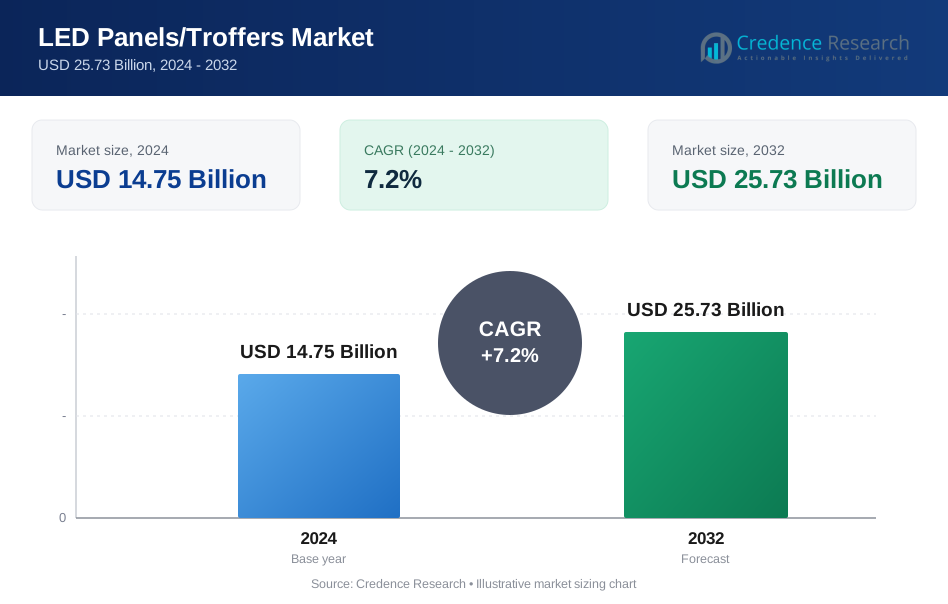
LED Panels/Troffers Market size was valued at USD 14.75 Billion in 2024 and is anticipated to reach USD 25.73 Billion by 2032, at a CAGR of 7.2% during the forecast period.
| REPORT ATTRIBUTE | DETAILS |
|---|---|
| Historical Period | 2020-2023 |
| Base Year | 2024 |
| Forecast Period | 2025-2032 |
| LED Panels/Troffers Market Size 2024 | USD 14.75 Billion |
| LED Panels/Troffers Market, CAGR | 7.2% |
| LED Panels/Troffers Market Size 2032 | USD 25.73 Billion |
LED Panels/Troffers Market holds a strong global footprint, driven by widespread adoption across commercial, industrial, and institutional environments. Leading players including Signify (Philips Lighting), Acuity Brands, Cree Lighting, ams-OSRAM, LG Electronics, Panasonic Corporation, Hubbell Incorporated, Zumtobel Group, Seoul Semiconductor, and Everlight Electronics actively expand their portfolios with energy-efficient and smart-enabled lighting solutions. Asia-Pacific leads the market with 33.6% share, supported by rapid urbanization and large-scale infrastructure development. North America follows with 31.4%, driven by stringent energy-efficiency standards and extensive retrofit projects, while Europe accounts for 27.8%, supported by strong sustainability mandates and modernization programs.

Market Insights
- LED Panels/Troffers Market size reached USD 14.75 Billion in 2024 and is projected to reach USD 25.73 Billion by 2032, expanding at a CAGR of 7.2%.
- Rising demand for energy-efficient lighting in commercial offices, hospitals, and educational facilities drives rapid adoption; recessed LED panels hold the largest share at 42.6%.
- Human-centric lighting, tunable-white technology, and smart IoT-enabled troffers emerge as key trends, with strong uptake across modern workplaces and smart buildings.
- Leading players such as Signify, Acuity Brands, Cree Lighting, and ams-OSRAM strengthen their portfolios through innovation, smart controls, and large-scale project deployments.
- Asia-Pacific leads the market with 33.6% share, followed by North America at 31.4% and Europe at 27.8%, while commercial buildings remain the dominant application segment at 48.3%.
Market Segmentation Analysis
By Product Type
Recessed LED panels dominate the LED Panels/Troffers market with an 42.6% share in 2024, driven by their widespread adoption in commercial offices, educational facilities, and modern retail environments. Their flush-mounted design, energy efficiency, and uniform illumination make them the preferred choice for large-area lighting upgrades and retrofit projects. Demand further accelerates as enterprises increasingly focus on enhancing visual comfort and reducing operational energy costs. LED troffers, particularly 2x2 and 2x4 configurations, also show strong uptake due to standard ceiling-grid compatibility and government-backed energy-efficiency programs.
- For instance, the Philips “Ultra Efficient” LED luminaires launched by Signify consume at least 50% less energy than standard Philips LED equivalents and offer a lifespan of about 50,000 hours, while maintaining comparable light output a big incentive for facility owners aiming to cut operational energy costs.
By Application
Commercial buildings hold the leading position with 48.3% market share, supported by large-scale deployment across offices, malls, hospitality, and coworking spaces. Businesses prioritize LED panels and troffers due to their long lifespan, low maintenance requirements, and ability to deliver consistent brightness suitable for high-activity environments. The shift toward smart workplaces strengthens adoption of tunable white and networked LED systems. Educational and healthcare institutions also contribute significantly as facility managers modernize lighting to improve visibility, reduce glare, and meet updated sustainability and safety standards.
- For instance, Signify’s Interact Office system enables connected LED panels with occupancy sensing and tunable-white control, helping corporate facilities optimize lighting scenes and reduce energy consumption through real-time data insights.
By Distribution Channel
Wholesalers and distributors account for the largest share at 39.7%, reflecting their strong role in bulk procurement for commercial and industrial projects. Their extensive inventory, established contractor networks, and competitive pricing drive continuous demand for LED panels and troffers. Direct B2B sales gain momentum as manufacturers target large enterprises seeking customized lighting solutions with integrated controls. Online retail and e-commerce also expand rapidly due to growing DIY trends and easy access to a wide range of panel configurations, particularly among small businesses and residential buyers.
Key Growth Drivers
Rising Global Demand for Energy-Efficient Lighting Solutions
The global transition toward energy-efficient infrastructure strongly accelerates adoption of LED panels and troffers across commercial, industrial, and institutional environments. Governments continue to enforce stringent energy-performance regulations, phasing out fluorescent fixtures and incentivizing LED retrofits through rebates and tax benefits. LED panels deliver superior lumen output per watt, longer operational life, and reduced heat emission, enabling significant reductions in electricity consumption and maintenance costs. As organizations pursue sustainability certifications such as LEED and BREEAM, energy-efficient lighting upgrades become a priority investment. Modern LED troffers with integrated sensors, dimming functionalities, and smart controls further strengthen demand by supporting automated lighting management and operational efficiency optimization.
- For instance, the European Union formally banned most fluorescent T5 and T8 lamps in August 2023 under the RoHS Directive, prompting large-scale LED retrofit programs across commercial and industrial buildings.
Expansion of Commercial Real Estate and Infrastructure Modernization
Growth in commercial real estate, hospitality spaces, retail outlets, and institutional buildings creates strong demand for LED panels and troffers due to their adaptability, visual comfort, and compatibility with modern interior designs. Global urbanization trends fuel construction of smart offices, coworking hubs, retail chains, and educational campuses where uniform and glare-free illumination is essential. Facility owners increasingly upgrade outdated fluorescent lighting to meet evolving safety, energy, and workplace wellness standards. LED panels with improved CRI, flicker-free output, and tunable-white capabilities enhance occupant productivity, making them a preferred choice for high-performance work environments. Infrastructure modernization initiatives in developing regions further support market uptake as governments invest in sustainable public buildings, transportation hubs, and healthcare facilities.
- For instance, Signify’s Philips LED panel lines with CRI 90 and flicker-free output have been deployed in major office and retail renovation projects, supporting healthier and more productive workspaces.
Rapid Adoption of Smart and Connected Lighting Technologies
The growing shift toward intelligent building ecosystems fuels significant demand for smart LED panels and troffers integrated with IoT, wireless controls, and occupancy-based automation. Businesses adopt smart lighting systems to optimize energy usage, enhance operational visibility, and streamline facility management through centralized dashboards. Features such as daylight harvesting, remote dimming, motion sensing, and predictive maintenance significantly improve building performance and reduce lifecycle costs. Manufacturers increasingly offer networked LED troffers compatible with Zigbee, Bluetooth Mesh, and PoE architectures, accelerating deployment in modern commercial and educational facilities. As smart city programs expand, demand rises for connected lighting that supports data analytics and sustainability tracking.
Key Trends & Opportunities
Growing Preference for Human-Centric and Tunable-White Lighting
A key trend reshaping the LED panels and troffers market is the rising adoption of human-centric lighting systems designed to enhance wellness, productivity, and visual comfort. Tunable-white LED panels allow users to adjust color temperature throughout the day, mimicking natural circadian rhythms and improving workplace performance. Educational institutions and healthcare facilities increasingly adopt these solutions to create adaptive lighting environments that support alertness, recovery, and behavioral regulation. Manufacturers are introducing advanced panel designs with high CRI values, improved diffusion layers, and low-glare output, creating new opportunities in premium lighting applications. As organizations prioritize employee well-being and indoor environmental quality, demand for human-centric LED panels continues to expand.
- For instance, Signify’s Nature Connect system combines tunable-white LED panels with natural-light simulations that have been implemented in offices and healthcare environments to support circadian rhythm alignment and occupant well-being.
Expansion of Retrofit and Modular Lighting Solutions
The accelerating move toward cost-efficient modernization drives a major opportunity in modular and retrofit-friendly LED panels and troffers. Many facilities prefer upgrading existing ceiling grids instead of implementing full-scale lighting redesigns, creating demand for easy-install, plug-and-play LED troffers. Manufacturers are increasingly developing slim-profile panels, edge-lit technologies, and driver-integrated fixtures that minimize installation time and reduce labor costs. Retrofit programs in North America, Europe, and Asia-Pacific further stimulate market growth as governments incentivize replacement of fluorescent fixtures with energy-efficient LED alternatives. Modular systems also support future scalability, enabling integration of sensors, wireless controls, and smart features.
- For instance, Acuity Brands’ Lithonia Lighting® CPX and BLT series troffers are engineered for drop-in retrofit installation in standard 2×2 and 2×4 ceiling grids, significantly reducing labor time through integrated drivers and plug-and-play wiring.
Key Challenges
Price Pressure and Intense Low-Cost Manufacturing Competition
The LED panels and troffers market faces substantial pricing pressure due to the influx of low-cost manufacturers offering competitively priced products. As lighting technologies mature, differentiation becomes increasingly difficult, leading to commoditization of standard panel and troffer models. Price-sensitive customers, particularly in developing regions, often prioritize upfront cost savings over long-term efficiency, impacting revenue growth for established players. Fluctuations in raw material costs, including aluminum, copper, and semiconductor components, further affect production expenses and supply chain stability. Manufacturers must balance cost optimization with innovation and quality assurance to maintain profitability in a highly price-driven environment.
Technical Integration Issues in Smart and Retrofit Installations
Despite the growing adoption of LED lighting, integration challenges persist when deploying advanced LED panels and troffers within existing electrical infrastructure and smart building ecosystems. Retrofits often require adaptation to outdated wiring, ceiling layouts, or incompatible control systems, increasing installation complexity and cost. Smart LED lighting solutions may encounter interoperability issues across communication protocols, limiting seamless automation. Facility managers also face a knowledge gap in managing connected lighting systems, slowing adoption in small and medium-sized buildings. These complexities underscore the need for standardized solutions, simplified installation processes, and better training to ensure smooth deployment of intelligent LED panels.
Regional Analysis
North America
North America holds a substantial position in the LED Panels/Troffers market with 31.4% share, driven by strong adoption across commercial offices, educational institutions, and healthcare facilities. Government-led energy-efficiency regulations, utility rebate programs, and widespread replacement of fluorescent fixtures accelerate market penetration. The region also benefits from rapid uptake of smart and connected lighting systems, particularly in the U.S. Corporate sustainability initiatives and modernization of public infrastructure strengthen demand for high-efficiency LED panels and troffers. Ongoing real estate renovations and expansion of data-driven building management platforms continue to support market growth.
Europe
Europe accounts for 27.8% market share, supported by stringent energy-efficiency legislation, carbon-neutrality commitments, and accelerated modernization of aging buildings. The EU’s directives on lighting efficiency and sustainability encourage widespread deployment of LED panels and troffers across offices, transit hubs, educational centers, and retail facilities. Demand further rises as countries invest heavily in smart city programs and digital public infrastructure. The region’s strong preference for human-centric and low-glare lighting solutions positions advanced LED panels as preferred options. Renovation activities in Western Europe and rapid commercial development in Eastern Europe continue to sustain market expansion.
Asia-Pacific
Asia-Pacific leads the LED Panels/Troffers market with the largest share of 33.6%, driven by massive commercial construction, rapid industrialization, and strong government incentives supporting LED adoption. China, India, Japan, and Southeast Asia witness extensive deployment of LED panels in offices, manufacturing facilities, IT parks, and educational buildings. The region benefits from cost-efficient manufacturing capabilities, enabling faster innovation and competitive pricing. Urbanization and growing investments in smart infrastructure accelerate demand for connected and energy-efficient lighting systems. Expanding retail and corporate sectors, coupled with large-scale retrofit programs, solidify Asia-Pacific’s position as the fastest-growing regional market.
Latin America
Latin America captures 4.9% market share, driven by increasing commercial development and rising adoption of energy-efficient lighting solutions across urban centers. Brazil, Mexico, and Chile lead regional demand as companies upgrade outdated fluorescent fixtures to reduce electricity costs and meet sustainability requirements. Growth is further supported by expanding retail spaces, hospitality projects, and modern office buildings. Although budget constraints limit rapid adoption, government initiatives promoting energy savings and infrastructure modernization help stimulate market penetration. Expanding e-commerce distribution channels also support wider availability of LED panels and troffers in the region.
Middle East & Africa
The Middle East & Africa region accounts for 2.3% market share, supported by infrastructure development across commercial, hospitality, and institutional sectors. Large-scale construction projects in the UAE, Saudi Arabia, and Qatar fuel demand for modern, energy-efficient LED panels and troffers that meet sustainability guidelines for high-performance buildings. Growing investment in smart city initiatives enhances adoption of intelligent lighting systems. In Africa, gradual urbanization and increasing awareness of energy savings contribute to market growth, although adoption rates remain slower due to economic constraints. Government-led efficiency programs continue to strengthen regional opportunities.
Market Segmentations
By Product Type
- Recessed LED Panels
- Surface-Mounted LED Panels
- Suspended LED Panels
- LED Troffers (2x2, 2x4, 1x4 configurations)
By Application
- Commercial Buildings (offices, retail, hospitality)
- Industrial Facilities
- Residential Spaces
- Educational & Healthcare Institutions
By Distribution Channel
- Online Retail & E-Commerce
- Direct Sales (B2B, project-based)
- Specialty Lighting Stores
- Wholesalers & Distributors
By Geography
- North America
- U.S.
- Canada
- Mexico
- Europe
- Germany
- France
- U.K.
- Italy
- Spain
- Rest of Europe
- Asia Pacific
- China
- Japan
- India
- South Korea
- South-east Asia
- Rest of Asia Pacific
- Latin America
- Brazil
- Argentina
- Rest of Latin America
- Middle East & Africa
- GCC Countries
- South Africa
- Rest of the Middle East and Africa
Competitive Landscape
The LED Panels/Troffers market features a diverse and dynamic competitive landscape dominated by global lighting manufacturers and technology-driven entrants focusing on efficiency, design, and connected lighting solutions. Leading companies such as Signify (Philips Lighting), Acuity Brands, Cree Lighting, ams-OSRAM, LG Electronics, Panasonic Corporation, Hubbell Incorporated, Zumtobel Group, Seoul Semiconductor, and Everlight Electronics play a significant role in shaping technology advancements and pricing strategies. These players emphasize product innovation through high-efficiency LED modules, human-centric lighting, tunable-white systems, and IoT-enabled troffers that support smart building integration. Regional manufacturers strengthen market competition by offering cost-effective and customizable LED panel solutions tailored for commercial and industrial applications. Strategic partnerships, acquisitions, and continuous investment in R&D help companies expand their portfolios and address evolving energy-efficiency regulations. As retrofit demand grows and smart infrastructure accelerates globally, vendors increasingly focus on scalable solutions, enhanced distribution networks, and project-based deployments to capture emerging opportunities.
Key Player Analysis
- Signify (Philips Lighting)
- Acuity Brands, Inc.
- Cree Lighting (Ideal Industries)
- ams-OSRAM AG
- LG Electronics
- Panasonic Corporation
- Hubbell Incorporated
- Zumtobel Group AG
- Seoul Semiconductor Co., Ltd.
- Everlight Electronics Co., Ltd.
Recent Developments
- In November 2025, Cooper Lighting Solutions (part of Signify) completed the acquisition of Nemalux a specialist in hazardous-location LED lighting.
- In May 2025, PLUXLED launched a new “Flexible LED Panel Series” designed for curved, irregular or small surfaces indicating demand for more adaptable and architectural-friendly panel lighting.
- In March 2025, Enlighted (part of Siemens) launched “Enlighted Eazy,” a smart lighting-control solution targeting small and medium businesses, boosting prospects for LED panel/troffer adoption.
Report Coverage
The research report offers an in-depth analysis based on Product Type, Application, Distribution Channel and Geography. It details leading market players, providing an overview of their business, product offerings, investments, revenue streams, and key applications. Additionally, the report includes insights into the competitive environment, SWOT analysis, current market trends, as well as the primary drivers and constraints. Furthermore, it discusses various factors that have driven market expansion in recent years. The report also explores market dynamics, regulatory scenarios, and technological advancements that are shaping the industry. It assesses the impact of external factors and global economic changes on market growth. Lastly, it provides strategic recommendations for new entrants and established companies to navigate the complexities of the market.
Future Outlook
- The market will grow steadily as global building upgrades increase demand for energy-efficient lighting.
- Smart LED panels and troffers with IoT connectivity and automation features will see rapid adoption.
- Human-centric and tunable-white lighting will become a preferred choice in workplaces and healthcare settings.
- Retrofit projects will expand as businesses replace fluorescent fixtures to meet efficiency standards.
- Manufacturers will introduce more modular, slim, and quick-install designs to support faster integration.
- Improvements in LED efficacy and optical control will enhance lighting quality and visual comfort.
- Collaborations between lighting brands and smart-building platform providers will strengthen connected ecosystems.
- Price competition will intensify as low-cost manufacturers increase their presence.
- Emerging markets will contribute strongly to growth due to rising commercial construction activities.
- Sustainability regulations and green-building certifications will continue to drive LED panel and troffer adoption.
Request a Free Sample
Fill in your details and we'll send you a free sample report.
- Sample data tables & charts
- Research methodology
Need a Custom Version of This Report?
Tailor the scope, geography, or segments to your exact requirements.
- Custom geography or segment scope
- Direct access to our analyst team
Frequently Asked Questions
What is the current market size for LED Panels/Troffers Market, and what is its projected size in 2032?
At what Compound Annual Growth Rate is the LED Panels/Troffers Market projected to grow between 2024 and 2032?
Which major production region for LED Panels/Troffers?
Which are the major players in global LED Panels/Troffers market?
Which is fastest growing segment in LED Panels/Troffers market?
Who are the leading companies in the LED Panels/Troffers Market?
Table of Content
Chapter 1. Report Introduction
- 1.1 Report Description & Purpose
- 1.1.1 Report Title & Market Definition
- 1.1.2 Unique Selling Propositions (USP) & Key Differentiators
- 1.1.3 Value Proposition for Stakeholders
- 1.2 Research Objectives
- 1.2.1 Market Sizing Objectives (Volume & Revenue) (Volume Where Applicable)
- 1.2.2 Segmentation Objectives
- 1.2.3 Competitive Intelligence Objectives
- 1.2.4 Forecast & Scenario Objectives
- 1.3 Report Scope
- 1.3.1 LED Panels/Troffers Scope – Segments & Subsegments Covered
- 1.3.2 Geographic Scope – Regions & Countries Covered
- 1.3.3 Historical Period, Base Year & Forecast Period (2024; forecast to 2032)
- 1.3.4 Inclusions & Exclusions
- 1.4 Industry Classification & Applicable Codes
- 1.5 Currency, Measurement Units & Valuation Basis
- 1.6 Target Stakeholders
- 1.7 Limitations & Assumptions
Chapter 2. Executive Summary
- 2.1 Global LED Panels/Troffers Market Snapshot
- 2.1.1 Market Size – Historical (2024) & Forecast (2024-2032) (2024: USD 14.75 Billion → 2032: USD 25.73 Billion)
- 2.1.2 Volume & Revenue – Global Totals (Volume Where Applicable)
- 2.1.3 Key Market Highlights – Top Five Facts
- 2.2 LED Panels/Troffers Market Segmentation Snapshot
- 2.2.1 Market Split by Region – 2024 vs. 2032
- 2.3 Competitive Snapshot
- 2.3.1 Top 10 Players by Revenue Share – 2024
- 2.3.2 Top 10 Players by Volume Share – 2024 (Volume Where Applicable)
- 2.3.3 Recent Strategic Developments (18-Month Summary)
- 2.4 Key Investment Highlights & Strategic Conclusions
Chapter 3. LED Panels/Troffers Market Dynamics & Industry Analysis
- 3.1 Market Overview & Context
- 3.1.1 LED Panels/Troffers Market Position in the Broader Industry Value Chain
- 3.1.2 Demand Structure & Purchasing Dynamics
- 3.1.3 Market Maturity & Development Stage by Region
- 3.2 LED Panels/Troffers Market Drivers
- 3.3 LED Panels/Troffers Market Restraints & Challenges
- 3.4 LED Panels/Troffers Market Opportunities
- 3.5 Porter's Five Forces Analysis
- 3.5.1 Threat of New Entrants
- 3.5.2 Bargaining Power of Suppliers
- 3.5.3 Bargaining Power of Buyers
- 3.5.4 Threat of Substitutes
- 3.5.5 Competitive Rivalry – Intensity Assessment
- 3.6 LED Panels/Troffers Value Chain Analysis
- 3.6.1 Upstream – Key Inputs, Resources & Suppliers
- 3.6.1.1 Key Input/Resource 1
- 3.6.1.2 Key Input/Resource 2
- 3.6.1.3 Key Input/Resource 3
- 3.6.2 Midstream – Core Operations & Value Creation
- 3.6.2.1 Operating Model & Process Overview
- 3.6.2.2 Key Operating Locations & Capabilities by Company
- 3.6.3 Downstream – Market Channels & End Users
- 3.6.3.1 Direct Sales & Customer Engagement Channels
- 3.6.3.2 Indirect Sales, Intermediaries & Partner Channels
- 3.6.4 Value Chain Profitability Analysis
- 3.6.1 Upstream – Key Inputs, Resources & Suppliers
- 3.7 PESTEL Analysis
- 3.7.1 Political Factors
- 3.7.2 Economic Factors
- 3.7.3 Social Factors
- 3.7.4 Technological Factors
- 3.7.5 Environmental Factors
- 3.7.6 Legal Factors
- 3.8 LED Panels/Troffers Supply Chain Analysis
- 3.8.1 Critical Input & Resource Availability Risk Assessment
- 3.8.2 Supplier & Operational Concentration Risk (Geographic Exposure)
- 3.8.3 Supply & Service Disruption Impact Analysis
- 3.9 Regulatory & Policy Landscape
Note: The regulatory and policy landscape section covers regulations based on their applicability to the market, LED Panels/Troffers category, geography, and scope of the study. Only regulatory frameworks with a material impact on operations, compliance, trade, sustainability, or market access are analyzed in detail.
Chapter 4. Key Investment Pockets & Opportunity Analysis
- 4.1 LED Panels/Troffers Market Attractiveness Analysis
- 4.1.1 By Region – Investment Attractiveness Matrix (Market Size × CAGR)
- 4.2 Absolute Revenue Growth Opportunity
- 4.2.1 By Region – Absolute Revenue Growth Through 2032
- 4.3 Incremental Demand Opportunity
- 4.3.1 By Region – Incremental Demand Through 2032
- 4.3.2 Segment – Incremental Demand
- 4.4 Emerging Submarket Opportunity Deep Dive (Subject to Applicability)
- 4.5 Priority Market Opportunity Scorecards
- 4.5.1 United States
- 4.5.2 Europe
- 4.5.3 Asia
- 4.5.4 Middle East & Africa
Note: Priority market opportunity scorecards reflect the geographic scope and strategic relevance of the study. Listed markets are indicative and may be adapted to the industry.
Chapter 5. LED Panels/Troffers Cross-Border Trade & Market Access Analysis
- 5.1 International Trade & Cross-Border Activity Overview
- 5.1.1 Global Export Value by Country (2024)
- 5.1.2 Global Export Volume by Country (2024) (Volume Where Applicable)
- 5.1.3 Global Import Value by Country (2024)
- 5.1.4 Global Import Volume by Country (2024) (Volume Where Applicable)
- 5.1.5 Net Trade Balance by Country (2024)
- 5.2 Export Analysis – Segment
- 5.2.1 Category 1 (Applicable Classification Code)
- 5.2.2 Category 2 (Applicable Classification Code)
- 5.2.3 Category 3 (Applicable Classification Code)
- 5.2.4 Category 4 (Applicable Classification Code)
- 5.2.5 Category 5 (Applicable Classification Code)
- 5.3 Import Analysis – Segment
- 5.3.1 Category 1 (Applicable Classification Code)
- 5.3.2 Category 2 (Applicable Classification Code)
- 5.3.3 Category 3 (Applicable Classification Code)
- 5.3.4 Category 4 (Applicable Classification Code)
- 5.3.5 Category 5 (Applicable Classification Code)
- 5.4 Cross-Border Pricing & Transaction Benchmarks
- 5.4.1 Export Pricing – Segment & Country
- 5.4.2 Import Pricing – Segment & Source Country
- 5.4.3 Price Trends (2024)
- 5.5 Key Cross-Border Trade & Delivery Routes
- 5.5.1 Cross-Border Trade/Delivery Route 1
- 5.5.2 Cross-Border Trade/Delivery Route 2
- 5.5.3 Cross-Border Trade/Delivery Route 3
- 5.5.4 Cross-Border Trade/Delivery Route 4
- 5.5.5 Cross-Border Trade/Delivery Route 5
- 5.6 Trade Policy & Market Access Impact Assessment
- 5.6.1 Tariff & Non-Tariff Barriers
- 5.6.2 Regional Trade & Economic Integration Frameworks
- 5.6.3 Bilateral & Multilateral Trade Agreements
- 5.6.4 Cross-Border Operating, Licensing & Localization Requirements
Note: This chapter applies where cross-border trade or delivery is relevant to LED Panels/Troffers. Goods, services, and digital offerings are assessed using applicable classifications and transaction measures. Import-export volumes, trade balances, and route analyses are included only where meaningful to the market.
Chapter 6. Competitive Landscape & Company Benchmarking
- 6.1 LED Panels/Troffers Market Concentration & Structure
- 6.1.1 Herfindahl-Hirschman Index (HHI) – vs. 2024
- 6.1.2 Leading, Mid-Sized & Emerging Player Structure
- 6.1.3 Global, Regional & Local Player Dynamics
- 6.2 LED Panels/Troffers Market Share Analysis – 2024
- 6.2.1 Global Revenue Share by Company
- 6.2.2 Global Volume Share by Company (Volume Where Applicable)
- 6.2.3 Regional Revenue Share
- 6.2.4 Market Share Evolution ( vs. 2024)
- 6.2.5 Company Market Share by Key Segment
- 6.2.6 Company Market Share by Customer Group
- 6.3 Operating Scale, Capacity & Infrastructure Analysis
- 6.3.1 Global Operating Scale & Supply Capacity
- 6.3.2 Resource Utilization & Operating Efficiency
- 6.3.3 Output, Service Delivery & Activity Metrics
- 6.3.4 Operating Footprint & Infrastructure Map
- 6.3.5 Planned Operational & Capacity Expansion
- 6.4 LED Panels/Troffers Competitive Benchmarking Matrix
- 6.4.1 Revenue, Growth, Profitability & Operating Metric Comparison
- 6.4.2 Channel Revenue Mix
- 6.4.3 Geographic Revenue Exposure
- 6.4.4 R&D Intensity
- 6.4.5 Sustainability Maturity
- 6.5 Strategic Developments in LED Panels/Troffers (Last 24 Months)
- 6.5.1 Mergers, Acquisitions & Divestments
- 6.5.2 New Products, Services & Solutions in LED Panels/Troffers
- 6.5.3 Operational & Infrastructure Expansions
- 6.5.4 Strategic Alliances, Joint Ventures & Partnerships
- 6.5.5 Distribution Expansion & Market Entry
- 6.5.6 Sustainability & ESG Initiatives
- 6.6 Competitive Strategy Mapping
- 6.6.1 Leader, Challenger, Follower & Niche Classification
- 6.6.2 Pricing Strategy Comparison
- 6.6.3 Channel Strategy Matrix
Note: Strategic developments are included based on their materiality and the availability of reliable information.
Chapter 7. Global LED Panels/Troffers Market – By Sales & Delivery Channel
- 7.1 Segment Overview
- 7.1.1 Volume & Revenue Split by Channel (2024 & 2032) (Volume Where Applicable)
- 7.1.2 Channel Mix Evolution (2024-2032)
Chapter 8. Regional Market Analysis – Global Overview
- 8.1 Global Regional Overview
- 8.1.1 Regional Volume Share (Volume Where Applicable)
- 8.1.2 Regional Revenue Share
- 8.1.3 Regional Volume by Region (Volume Where Applicable)
- 8.1.4 Regional Revenue by Region
- 8.1.5 Regional Forecast Through 2032
- 8.2 Cross-Regional Segment Analysis
- 8.2.1 By Sales & Delivery Channel
- 8.2.2 By Competitive Positioning & Price Tier
Chapter 9. North America LED Panels/Troffers Market
- 9.1 United States
- 9.2 Canada
- 9.3 Mexico
Chapter 10. Europe LED Panels/Troffers Market
- 10.1 Germany
- 10.2 France
- 10.3 Italy
- 10.4 United Kingdom
- 10.5 Spain
- 10.6 Poland
- 10.7 Russia
- 10.8 Netherlands
- 10.9 Belgium
- 10.10 Sweden
- 10.11 Denmark
- 10.12 Norway
- 10.13 Rest of Europe
Chapter 11. Asia Pacific LED Panels/Troffers Market
- 11.1 China
- 11.2 India
- 11.3 Japan
- 11.4 South Korea
- 11.5 Thailand
- 11.6 Indonesia
- 11.7 Vietnam
- 11.8 Malaysia
- 11.9 Australia
- 11.10 Rest of Asia Pacific
Chapter 12. Latin America LED Panels/Troffers Market
- 12.1 Brazil
- 12.2 Argentina
- 12.3 Colombia
- 12.4 Chile
- 12.5 Rest of Latin America
Chapter 13. Middle East LED Panels/Troffers Market
- 13.1 Saudi Arabia
- 13.2 United Arab Emirates
- 13.3 Turkey
- 13.4 Israel
- 13.5 Iran
- 13.6 Rest of the Middle East
Chapter 14. Africa LED Panels/Troffers Market
- 14.1 South Africa
- 14.2 Egypt
- 14.3 Nigeria
- 14.4 Morocco
- 14.5 Rest of Africa
Chapter 15. LED Panels/Troffers Company Profiles
- 15.1 [Company 01]
- 15.1.1 Company Overview
- 15.1.2 Key Management Personnel
- 15.1.3 Products & Services Portfolio
- 15.1.4 Financial Performance
- 15.1.5 Key Market Focus & Geographic Presence
- 15.1.6 Recent Developments & Strategic Initiatives
Note: The company profile list is preliminary and may change based on research findings, market developments, data availability, and client requirements.
Chapter 16. Appendices
- Appendix A – List of Abbreviations & Acronyms
- Appendix B – Industry Classification Code Reference – Full Series
- Appendix C – Supply, Output & Operating Capacity Data Tables
- Appendix D – End-Use & Demand Base Tables
- Appendix E – Demand, Adoption & Usage Assumptions
- Appendix F – Pricing & Revenue Metric Reference Tables
- Appendix G – Company Operations & Infrastructure Database
- Appendix H – Cross-Border Trade & Activity Data Tables (Where Applicable)
- Appendix I – Regulatory Summary Tables
- Appendix J – Primary Research Participant List (Anonymized)
- Appendix K – Primary Research Questionnaire Framework
- Appendix L – Data Sources & Bibliography
- Appendix M – Market Size Divergence & Source Comparison
Chapter 17. Research Methodology
- 17.1 Research Framework & Philosophy
- 17.2 Secondary Research – Sources, Hierarchy & Data Extraction
- 17.3 Data Modeling – Bottom-Up & Top-Down Market Sizing
- 17.4 Primary Research – Stakeholder Framework, LOI & Sample Sizes
- 17.5 Forecast Methodology – Regression, Scenario & Sensitivity Analysis
- 17.6 Quality Control – Four-Layer Validation Framework
- 17.7 Limitations & Standard Assumptions
- 17.8 Disclaimer
