
| REPORT ATTRIBUTE | DETAILS |
|---|---|
| Historical Period | 2019-2022 |
| Base Year | 2023 |
| Forecast Period | 2024-2032 |
| Metal Spring Market Size 2023 | USD 22.40 million |
| Metal Spring Market, CAGR | 4.20% |
| Metal Spring Market Size 2032 | USD 32.44 million |
Market Overview
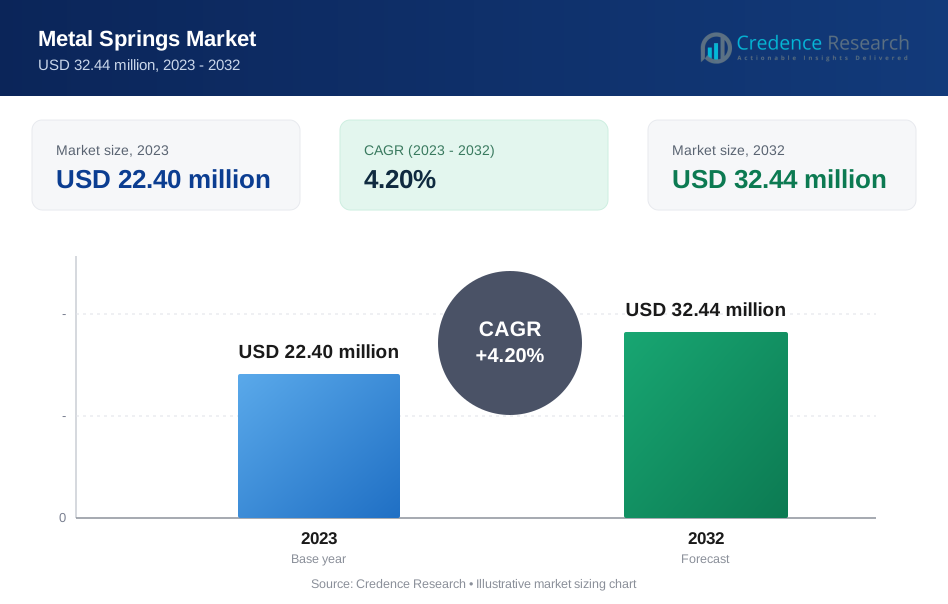
The global Metal Spring Market is projected to grow from USD 22.40 million in 2023 to an estimated USD 32.44 million by 2032, registering a compound annual growth rate (CAGR) of 4.20% from 2024 to 2032. The market's expansion is attributed to the increasing demand for metal springs across various industries, including automotive, aerospace, industrial machinery, and consumer electronics.
Key drivers of the metal spring market include the growing need for lightweight and durable components in the automotive and aerospace sectors, along with the rise in industrial automation. Trends such as miniaturization and customization of springs to meet specific application requirements are also propelling demand. Additionally, the increasing focus on sustainable and energy-efficient manufacturing processes is influencing the adoption of advanced metal spring technologies.
Geographically, the market is dominated by regions such as Asia-Pacific and North America. Asia-Pacific leads due to the robust automotive and industrial base in countries like China, India, and Japan. North America remains a significant market driven by strong aerospace and defense industries. Key players in the global market include NHK Spring Co., Ltd., Lesjöfors AB, Duer Carolina Coil Inc., and Betts Spring Manufacturing, which focus on innovation and strategic partnerships to maintain their competitive edge.
Market Insights
- The global Metal Spring Market is projected to grow from USD 22.40 million in 2023 to USD 32.44 million by 2032, registering a CAGR of 4.20% from 2024 to 2032.
- The growing demand for lightweight and durable components in the automotive and aerospace industries drives market growth, along with rising industrial automation.
- Volatile raw material prices and intense market competition among small and large players pose challenges to sustained profitability.
- Asia-Pacific leads the market, driven by a robust automotive and industrial base, with North America also significant due to its strong aerospace and defense sectors.
- Advancements in CNC machining, additive manufacturing, and high-performance materials are enabling the production of more durable and efficient springs.
- The increasing emphasis on eco-friendly manufacturing processes is influencing the development of recyclable and energy-efficient spring solutions.
- Key players, including NHK Spring Co., Ltd., Lesjöfors AB, and Betts Spring Manufacturing, focus on innovation, strategic collaborations, and expanding their global presence to remain competitive.
Market Drivers
Growing Demand in the Automotive Industry
The automotive industry significantly influences the global metal spring market, as metal springs are essential components in vehicle suspension systems, engines, braking systems, and seating mechanisms. The rising production of passenger and commercial vehicles, particularly in emerging economies, has notably increased the demand for high-performance springs. For instance, the production of electric vehicles (EVs) has led manufacturers to develop specialized springs that can handle unique performance demands, enduring higher loads and varied operational conditions. This is crucial for maintaining vehicle stability and comfort while enhancing fuel efficiency. Automakers are also focusing on lightweighting strategies to improve overall vehicle efficiency, driving the need for advanced spring materials and designs. As a result, the transition to EVs amplifies the demand for innovative spring solutions that meet stringent performance standards.
Advancements in Manufacturing Technologies
Advancements in manufacturing processes and technologies have revolutionized the production of metal springs. Technologies such as CNC (Computer Numerical Control) machining allow for precise customization, improving durability and efficiency in spring design and production. For example, this integration enables manufacturers to create high-quality springs tailored for specific applications, responding to industry demands for components that meet rigorous performance criteria. Additionally, the incorporation of Industry 4.0 principles, including automation and real-time monitoring, enhances production efficiency while reducing costs. This technological evolution not only makes high-quality springs more accessible across various sectors but also supports manufacturers in delivering superior products that align with evolving market needs.
Expansion of Industrial Automation and Robotics
The rapid adoption of industrial automation and robotics across sectors such as manufacturing, logistics, and healthcare has significantly driven the demand for metal springs. Springs are critical components in robotic mechanisms and automation systems, ensuring reliable performance under repetitive motion and variable loads. For instance, as industries invest in automation to enhance productivity and reduce operational costs, the need for durable and high-precision springs continues to rise. This trend is particularly prominent in advanced economies where automation technologies are widely deployed. Furthermore, emerging markets are witnessing increasing investments in industrial modernization, further propelling the demand for specialized spring solutions that cater to diverse applications.
Increased Demand in Aerospace and Defense Sectors
The aerospace and defense industries require metal springs for various applications, including landing gear, engine systems, and weaponry. These sectors demand springs capable of enduring extreme temperatures, high pressures, and rigorous operational conditions while adhering to stringent manufacturing standards. For example, with rising global defense budgets and the expansion of commercial aviation, the demand for high-performance springs is steadily increasing. Additionally, the focus on developing lightweight and fuel-efficient aircraft drives innovation in spring materials and designs. This creates new growth opportunities for manufacturers who can provide advanced spring solutions tailored to meet the specific requirements of these demanding industries.
Market Trends
Adoption of Advanced Materials for Enhanced Performance
The global metal spring market is witnessing a significant shift toward the use of advanced materials to improve durability, performance, and efficiency. High-strength alloys, such as titanium and nickel-based alloys, are increasingly being utilized for applications requiring lightweight yet robust components. These materials provide superior resistance to corrosion, fatigue, and high temperatures, making them ideal for use in industries like aerospace, automotive, and healthcare. For instance, titanium and nickel alloys are known for their exceptional durability; springs made from these materials can withstand extreme conditions while maintaining structural integrity.Additionally, the development of composite springs incorporating carbon fiber materials is gaining traction due to their exceptional strength-to-weight ratio. Studies indicate that carbon fiber springs can weigh up to 70% less than traditional steel springs while delivering comparable performance. As industries prioritize sustainability, recyclable and eco-friendly materials are also becoming a focus, aligning with environmental regulations and consumer preferences. This trend towards advanced materials not only enhances mechanical performance but also supports the industry's commitment to sustainable practices.
Customization and Miniaturization in Spring Design
Customization and miniaturization have emerged as pivotal trends in the metal spring market, driven by diverse application requirements across industries. Manufacturers are increasingly offering tailored solutions to meet specific performance criteria, such as load-bearing capacity, stress tolerance, and dimensional precision. Miniaturized springs are particularly in demand for use in electronics, medical devices, and micromechanical systems. Advanced design software and simulation tools enable manufacturers to create highly precise and reliable springs, ensuring optimal functionality even in complex applications. For example, in the medical sector, custom-designed springs are essential for devices like stents and surgical instruments where space is limited yet performance is critical. This level of customization enhances operational efficiency and longevity of the springs. As industries continue to innovate and integrate compact yet efficient components, the demand for miniaturized solutions is expected to grow further. The ability to produce custom springs not only meets specific needs but also allows manufacturers to differentiate themselves in a competitive market.
Integration of Digital Technologies in Manufacturing
The integration of digital technologies, such as automation, artificial intelligence (AI), and the Internet of Things (IoT), is revolutionizing production processes in the metal spring market. Industry 4.0 principles are enabling manufacturers to enhance efficiency, reduce lead times, and improve product quality. Smart factories equipped with real-time monitoring systems ensure precision in production and enable predictive maintenance of machinery, minimizing downtime.For instance, AI-driven design tools allow for optimization of spring performance by analyzing vast amounts of data to predict potential failures or inefficiencies. This not only reduces material waste but also lowers costs associated with production delays. As the global market becomes increasingly competitive, digital transformation is proving to be a critical factor for manufacturers striving for operational excellence and responsiveness to evolving customer demands. By embracing these technologies, companies can streamline their processes while ensuring high-quality outputs that meet stringent industry standards.
Rising Focus on Electric Vehicles and Renewable Energy Applications
The transition to electric vehicles (EVs) and renewable energy systems is reshaping the demand landscape for metal springs. EVs require specialized springs for suspension systems, battery packs, and electric drivetrains, leading to the development of lightweight and high-performance springs that can endure unique operational stresses. Similarly, the renewable energy sector relies on springs in turbines and solar trackers to ensure stability and efficiency.For instance, lightweight springs designed for EVs contribute significantly to overall vehicle efficiency by reducing weight without compromising performance. Additionally, government incentives supporting EV adoption further bolster this trend. The global push toward sustainability is driving investment in these sectors, presenting significant growth opportunities for spring manufacturers focused on innovation. As industries increasingly prioritize clean energy solutions, the demand for advanced spring technologies will continue to rise, making it a key growth driver for the metal spring market.
Market Challenges
Volatility in Raw Material Prices
One of the significant challenges in the global metal spring market is the volatility in raw material prices, particularly for steel, titanium, and other specialized alloys used in spring production. Fluctuations in material costs are often driven by global supply chain disruptions, geopolitical tensions, and varying demand across industries. For instance, during the COVID-19 pandemic, steel prices in the U.S. surged dramatically due to supply shortages and increased demand from various sectors. In 2023, the World Steel Association reported a notable increase in global steel prices compared to previous years, highlighting how such fluctuations can impact manufacturers' cost structures and profit margins. This unpredictability affects manufacturers' pricing strategies, making it challenging to maintain competitiveness while ensuring product quality. Additionally, reliance on imports for certain high-grade materials in some regions exacerbates cost instability, creating further pressure on manufacturers to optimize their operations and manage expenses effectively.
High Competition and Market Fragmentation
The global metal spring market is highly competitive and fragmented, with numerous players ranging from large-scale manufacturers to small and medium-sized enterprises (SMEs). This intense competition often leads to price wars, putting smaller players at a disadvantage as they struggle to match the pricing of larger companies with economies of scale. For instance, as of early 2024, many manufacturers reported difficulties in maintaining profitability against larger firms that benefit from lower production costs. Furthermore, the increasing demand for customized and high-performance springs requires significant investments in research and development, advanced manufacturing technologies, and skilled labor-resources that may not be feasible for smaller firms. This disparity in capabilities contributes to market consolidation, where larger players dominate, leaving limited opportunities for smaller entities to thrive. These challenges necessitate strategic planning, innovation, and efficiency improvements for manufacturers to navigate the complexities of the global metal spring market while sustaining growth and profitability.
Market Opportunities
Emerging Demand in Renewable Energy and Electric Vehicle (EV) Sectors
The shift toward sustainable energy solutions and electric mobility presents substantial growth opportunities for the metal spring market. In the renewable energy sector, springs are critical components in wind turbines, solar trackers, and other equipment requiring precision and durability under extreme conditions. For instance, in wind turbines, springs are essential for pitch control mechanisms that adjust blade angles to optimize energy capture, highlighting their role in enhancing efficiency and reliability. Additionally, advancements in spring design have led to corrosion-resistant materials, enabling effective performance in harsh environments like offshore wind farms.Similarly, the expanding EV market relies on advanced spring designs for suspension systems and battery modules. Electric vehicles require specialized springs to accommodate unique weight distributions due to battery placements, prompting manufacturers to develop lighter and more durable options using advanced materials like titanium alloys. Governments worldwide are offering incentives to promote EV adoption and renewable energy projects, further fueling investments in these sectors. This transition provides metal spring manufacturers with opportunities to develop innovative products tailored to the unique requirements of these high-growth industries.
Advancements in Materials and Manufacturing Technologies
The increasing adoption of advanced materials, such as titanium alloys and composites, combined with the integration of Industry 4.0 technologies, offers significant market potential. These advancements enable manufacturers to produce springs that are lighter, stronger, and more durable while reducing production costs and environmental impact. For instance, automation and robotics streamline production processes, allowing for intricate spring designs that meet specific application requirements across various industries. Technologies like additive manufacturing and AI-driven design optimization facilitate the development of customized solutions for specialized applications. This evolution supports the rising demand for precision-engineered components while ensuring high standards of quality and efficiency. By leveraging these innovations, market players can differentiate themselves and expand their product portfolios. As a result, they can cater to evolving customer needs, ensuring sustained growth and competitiveness in the global market. The intersection of technological advancements with industry demands positions metal spring manufacturers to thrive in a dynamic landscape.
Market Segmentation Analysis
By Type
The market segmentation by type highlights the dominance of helical springs, extensively used in applications requiring flexibility and load-bearing capacity, such as automotive suspension systems and industrial equipment, driven by their energy storage and repetitive motion capabilities. Leaf springs, valued for their durability and load distribution, find significant use in heavy-duty vehicles and agricultural equipment, with growth fueled by infrastructure and transportation investments, especially in emerging economies. Meanwhile, other types, including torsion springs and wire forms, cater to specialized applications in industries like electronics, aerospace, and healthcare, supported by the rising trend of miniaturization and demand for customized solutions.
By Application
Stainless steel, renowned for its corrosion resistance and high strength, is a preferred material in industries such as automotive, aerospace, and construction, with its use expanding due to the demand for durable, low-maintenance components. Carbon steel remains widely utilized for its cost-effectiveness and versatility, making it ideal for general industrial and consumer applications. Additionally, advanced alloys and composite materials are gaining popularity for their lightweight properties and exceptional performance in high-stress environments, particularly in aerospace and renewable energy systems.
Segments
Based on Type
- Helical Springs
- Leaf Springs
- Others (Torsion Springs, Wire Forms)
Based on Application
- Stainless Steel
- Carbon Steel
- Others
Based on End User
- Automotive and Transportation
- Manufacturing
- Agriculture and Construction
- Others
Based on Region
- Asia-Pacific
- North America
- Europe
- Rest of the World
Regional Analysis
Asia Pacific (38%)
The Asia-Pacific region holds the largest share of the global metal spring market, accounting for approximately 38% of the market in 2023. This dominance is driven by the region's robust automotive and industrial manufacturing base in countries like China, Japan, and India. China leads with extensive production and export activities, while Japan’s advanced manufacturing technologies contribute significantly to the demand for high-performance springs. Additionally, rapid urbanization and infrastructure development across emerging economies in Asia-Pacific further bolster market growth.
North America (28%)
North America follows as a significant market, representing around 28% of the global market share. The region’s strong aerospace and defense industries, coupled with the increasing adoption of advanced manufacturing technologies, drive demand for metal springs. The United States dominates this region due to its focus on innovation and the presence of leading aerospace companies and automakers. The transition to electric vehicles and the expansion of renewable energy projects also create lucrative opportunities for spring manufacturers in North America.
Key players
- GALA GROUP
- Ace Wire Spring & Form Company
- Bal Seal Engineering
- Barnes
- CARL HAAS GmbH
- EBSCO Spring Co.
- FRAUENTHAL HOLDING
- Hendrickson USA, L.L.C
- Ifc Composite GmbH
- JAMNA AUTO INDUSTRIES LIMITED
- John Evans’ Sons Inc.
- Muhr and Bender KG
- Rassini
- Sogefi SpA
Competitive Analysis
The global metal spring market is highly competitive, with several key players focusing on innovation, product quality, and strategic partnerships to maintain their market position. Companies like GALA GROUP, Sogefi SpA, and JAMNA AUTO INDUSTRIES LIMITED leverage advanced manufacturing technologies and diversified product portfolios to cater to various industries such as automotive, aerospace, and industrial machinery. Established players like Hendrickson USA, L.L.C and Muhr and Bender KG emphasize research and development to create durable and efficient springs, meeting evolving customer needs. The market also sees strong competition from regional manufacturers who offer cost-effective and customized solutions. The ongoing emphasis on sustainability and lightweight materials further intensifies the competition, driving companies to adopt cutting-edge technologies and expand their global presence.
Recent Developments
- In September 2024, Gala Precision Engineering successfully launched its initial public offering (IPO), which garnered significant investor interest, being oversubscribed 201 times. The IPO aimed to raise funds for expanding manufacturing facilities and enhancing production capabilities. Following its market debut on September 9, 2024, Gala Precision's shares surged nearly 49%, reflecting strong demand for its precision components, including disc and strip springs and coil springs. This growth positions the company well within the renewable energy and automotive sectors, where it supplies critical components for various applications.
- In February 2024, Ace Wire Spring & Form Company celebrated its 85th anniversary in the custom spring manufacturing industry. The company has maintained its legacy as a family-owned business while expanding its product offerings, which include compression, extension, and torsion springs. This milestone highlights Ace Wire's commitment to quality and innovation in spring manufacturing, ensuring it remains competitive in a rapidly evolving market.
- In January 2024, Kaman Corporation completed its acquisition of Bal Seal Engineering, significantly enhancing its portfolio of engineered products. Bal Seal specializes in precision springs and seals used across various sectors, including aerospace and medical technology. This acquisition is expected to create new opportunities for Kaman to leverage Bal Seal's proprietary technologies and extensive patent portfolio to better serve high-growth markets.
- On November 22, 2024, Barnes Group announced the completion of the sale of its Associated Spring and Hänggi businesses for $175 million. This strategic divestiture is part of Barnes' ongoing portfolio optimization efforts aimed at focusing on higher-margin aerospace markets. The proceeds from this sale will be utilized to reduce debt and strengthen the company's financial position as it continues to pivot towards more profitable growth avenues.
- In March 2024, CARL HAAS GmbH announced advancements in precision engineering capabilities through the integration of new technologies for manufacturing wire and strip springs. This initiative aims to enhance production efficiency and product quality, catering to the growing demands in automotive and medical engineering sectors.
- In December 2024, Hendrickson announced plans to expand its production capabilities for air springs in response to rising demand from the commercial vehicle sector. This expansion aims to enhance supply chain efficiency and meet the growing needs of OEMs.
- In December 2024, Ifc Composite GmbH introduced a new glass fiber leaf spring designed for heavy commercial trucks, achieving significant weight reductions compared to traditional steel components. This innovation positions Ifc Composite as a leader in lightweight spring solutions for heavy-duty application.
- As of January 2025, Jamna Auto Industries reported a decline in net sales year-on-year but is focusing on developing new products with technical support from international partners. The company aims to strengthen its position as a leading manufacturer of suspension solutions for commercial vehicles amid fluctuating market conditions.
- In January 2025, Rassini announced advancements in composite leaf spring technology through a partnership with Hexion for producing lightweight hybrid leaf springs aimed at improving vehicle performance while reducing overall weight-critical for electric vehicle applications.
Market Concentration and Characteristics
The global Metal Spring Market is moderately fragmented, with a mix of large-scale manufacturers and numerous small and medium-sized enterprises (SMEs). Key players focus on innovation, customization, and the integration of advanced materials and manufacturing technologies to gain a competitive edge. While the market is characterized by high competition, established companies leverage economies of scale, extensive distribution networks, and technological expertise to maintain dominance. The demand for precision-engineered and durable springs across industries like automotive, aerospace, and manufacturing underscores the market’s reliance on quality and performance. Additionally, the growing emphasis on sustainability and lightweight materials presents opportunities for new entrants with advanced capabilities, further intensifying competition. The market exhibits regional variations, with Asia-Pacific, North America, and Europe being key contributors, reflecting strong industrial and automotive bases in these regions.
Report Coverage
The research report offers an in-depth analysis based on Type, Application, End user and Region. It details leading market players, providing an overview of their business, product offerings, investments, revenue streams, and key applications. Additionally, the report includes insights into the competitive environment, SWOT analysis, current market trends, as well as the primary drivers and constraints. Furthermore, it discusses various factors that have driven market expansion in recent years. The report also explores market dynamics, regulatory scenarios, and technological advancements that are shaping the industry. It assesses the impact of external factors and global economic changes on market growth. Lastly, it provides strategic recommendations for new entrants and established companies to navigate the complexities of the market.
Future Outlook
- The increasing production of vehicles, including electric and autonomous cars, will drive the demand for advanced metal springs designed for enhanced performance and durability.
- The growth of renewable energy projects, particularly wind and solar power, will boost the adoption of specialized springs in turbines and tracking systems.
- Innovations in lightweight and high-strength materials, such as titanium alloys and composites, will enable the production of more efficient and durable springs for diverse applications.
- The rapid implementation of industrial automation and robotics will create opportunities for precision-engineered springs required in actuators and mechanical systems.
- Industries like electronics and healthcare will increasingly demand customized and miniaturized springs, fueling innovation in design and manufacturing processes.
- Rising global defense budgets and advancements in aerospace technology will drive the need for high-performance springs capable of withstanding extreme operational conditions.
- The adoption of smart manufacturing technologies, including AI and IoT, will improve production efficiency and enable the development of springs with superior quality and reliability.
- Rapid industrialization, urbanization, and infrastructure development in emerging markets will provide significant growth opportunities for spring manufacturers.
- The increasing focus on sustainability will encourage the development of recyclable and environmentally friendly spring materials, aligning with global environmental goals.
- Key players will likely engage in collaborations and partnerships to expand their market presence, enhance product portfolios, and address evolving customer needs across various industries.
Request a Free Sample
Fill in your details and we'll send you a free sample report.
- Sample data tables & charts
- Research methodology
Need a Custom Version of This Report?
Tailor the scope, geography, or segments to your exact requirements.
- Custom geography or segment scope
- Direct access to our analyst team
Frequently Asked Questions
What is the market size of the global Metal Spring Market in 2023 and its forecast for 2032?
What are the major industries driving the demand for metal springs?
Which regions dominate the global Metal Spring Market?
Who are the major players in this Market?
Table of Content
Chapter 1. Report Introduction
- 1.1 Report Description & Purpose
- 1.1.1 Report Title & Market Definition
- 1.1.2 Unique Selling Propositions (USP) & Key Differentiators
- 1.1.3 Value Proposition for Stakeholders
- 1.2 Research Objectives
- 1.2.1 Market Sizing Objectives (Volume & Revenue) (Volume Where Applicable)
- 1.2.2 Segmentation Objectives
- 1.2.3 Competitive Intelligence Objectives
- 1.2.4 Forecast & Scenario Objectives
- 1.3 Report Scope
- 1.3.1 Metal Springs Scope – Segments & Subsegments Covered
- 1.3.2 Geographic Scope – Regions & Countries Covered
- 1.3.3 Historical Period, Base Year & Forecast Period (2023; forecast to 2032)
- 1.3.4 Inclusions & Exclusions
- 1.4 Industry Classification & Applicable Codes
- 1.5 Currency, Measurement Units & Valuation Basis
- 1.6 Target Stakeholders
- 1.7 Limitations & Assumptions
Chapter 2. Executive Summary
- 2.1 Global Metal Springs Market Snapshot
- 2.1.1 Market Size – Historical (2023) & Forecast (2023-2032) (2023: USD 22.40 million → 2032: USD 32.44 million)
- 2.1.2 Volume & Revenue – Global Totals (Volume Where Applicable)
- 2.1.3 Key Market Highlights – Top Five Facts
- 2.2 Metal Springs Market Segmentation Snapshot
- 2.2.1 Market Split by Region – 2023 vs. 2032
- 2.3 Competitive Snapshot
- 2.3.1 Top 10 Players by Revenue Share – 2023
- 2.3.2 Top 10 Players by Volume Share – 2023 (Volume Where Applicable)
- 2.3.3 Recent Strategic Developments (18-Month Summary)
- 2.4 Key Investment Highlights & Strategic Conclusions
Chapter 3. Metal Springs Market Dynamics & Industry Analysis
- 3.1 Market Overview & Context
- 3.1.1 Metal Springs Market Position in the Broader Industry Value Chain
- 3.1.2 Demand Structure & Purchasing Dynamics
- 3.1.3 Market Maturity & Development Stage by Region
- 3.2 Metal Springs Market Drivers
- 3.3 Metal Springs Market Restraints & Challenges
- 3.4 Metal Springs Market Opportunities
- 3.5 Porter's Five Forces Analysis
- 3.5.1 Threat of New Entrants
- 3.5.2 Bargaining Power of Suppliers
- 3.5.3 Bargaining Power of Buyers
- 3.5.4 Threat of Substitutes
- 3.5.5 Competitive Rivalry – Intensity Assessment
- 3.6 Metal Springs Value Chain Analysis
- 3.6.1 Upstream – Key Inputs, Resources & Suppliers
- 3.6.1.1 Key Input/Resource 1
- 3.6.1.2 Key Input/Resource 2
- 3.6.1.3 Key Input/Resource 3
- 3.6.2 Midstream – Core Operations & Value Creation
- 3.6.2.1 Operating Model & Process Overview
- 3.6.2.2 Key Operating Locations & Capabilities by Company
- 3.6.3 Downstream – Market Channels & End Users
- 3.6.3.1 Direct Sales & Customer Engagement Channels
- 3.6.3.2 Indirect Sales, Intermediaries & Partner Channels
- 3.6.4 Value Chain Profitability Analysis
- 3.6.1 Upstream – Key Inputs, Resources & Suppliers
- 3.7 PESTEL Analysis
- 3.7.1 Political Factors
- 3.7.2 Economic Factors
- 3.7.3 Social Factors
- 3.7.4 Technological Factors
- 3.7.5 Environmental Factors
- 3.7.6 Legal Factors
- 3.8 Metal Springs Supply Chain Analysis
- 3.8.1 Critical Input & Resource Availability Risk Assessment
- 3.8.2 Supplier & Operational Concentration Risk (Geographic Exposure)
- 3.8.3 Supply & Service Disruption Impact Analysis
- 3.9 Regulatory & Policy Landscape
Note: The regulatory and policy landscape section covers regulations based on their applicability to the market, Metal Springs category, geography, and scope of the study. Only regulatory frameworks with a material impact on operations, compliance, trade, sustainability, or market access are analyzed in detail.
Chapter 4. Key Investment Pockets & Opportunity Analysis
- 4.1 Metal Springs Market Attractiveness Analysis
- 4.1.1 By Region – Investment Attractiveness Matrix (Market Size × CAGR)
- 4.2 Absolute Revenue Growth Opportunity
- 4.2.1 By Region – Absolute Revenue Growth Through 2032
- 4.3 Incremental Demand Opportunity
- 4.3.1 By Region – Incremental Demand Through 2032
- 4.3.2 Segment – Incremental Demand
- 4.4 Emerging Submarket Opportunity Deep Dive (Subject to Applicability)
- 4.5 Priority Market Opportunity Scorecards
- 4.5.1 United States
- 4.5.2 Europe
- 4.5.3 Asia
- 4.5.4 Middle East & Africa
Note: Priority market opportunity scorecards reflect the geographic scope and strategic relevance of the study. Listed markets are indicative and may be adapted to the industry.
Chapter 5. Metal Springs Cross-Border Trade & Market Access Analysis
- 5.1 International Trade & Cross-Border Activity Overview
- 5.1.1 Global Export Value by Country (2023)
- 5.1.2 Global Export Volume by Country (2023) (Volume Where Applicable)
- 5.1.3 Global Import Value by Country (2023)
- 5.1.4 Global Import Volume by Country (2023) (Volume Where Applicable)
- 5.1.5 Net Trade Balance by Country (2023)
- 5.2 Export Analysis – Segment
- 5.2.1 Category 1 (Applicable Classification Code)
- 5.2.2 Category 2 (Applicable Classification Code)
- 5.2.3 Category 3 (Applicable Classification Code)
- 5.2.4 Category 4 (Applicable Classification Code)
- 5.2.5 Category 5 (Applicable Classification Code)
- 5.3 Import Analysis – Segment
- 5.3.1 Category 1 (Applicable Classification Code)
- 5.3.2 Category 2 (Applicable Classification Code)
- 5.3.3 Category 3 (Applicable Classification Code)
- 5.3.4 Category 4 (Applicable Classification Code)
- 5.3.5 Category 5 (Applicable Classification Code)
- 5.4 Cross-Border Pricing & Transaction Benchmarks
- 5.4.1 Export Pricing – Segment & Country
- 5.4.2 Import Pricing – Segment & Source Country
- 5.4.3 Price Trends (2023)
- 5.5 Key Cross-Border Trade & Delivery Routes
- 5.5.1 Cross-Border Trade/Delivery Route 1
- 5.5.2 Cross-Border Trade/Delivery Route 2
- 5.5.3 Cross-Border Trade/Delivery Route 3
- 5.5.4 Cross-Border Trade/Delivery Route 4
- 5.5.5 Cross-Border Trade/Delivery Route 5
- 5.6 Trade Policy & Market Access Impact Assessment
- 5.6.1 Tariff & Non-Tariff Barriers
- 5.6.2 Regional Trade & Economic Integration Frameworks
- 5.6.3 Bilateral & Multilateral Trade Agreements
- 5.6.4 Cross-Border Operating, Licensing & Localization Requirements
Note: This chapter applies where cross-border trade or delivery is relevant to Metal Springs. Goods, services, and digital offerings are assessed using applicable classifications and transaction measures. Import-export volumes, trade balances, and route analyses are included only where meaningful to the market.
Chapter 6. Competitive Landscape & Company Benchmarking
- 6.1 Metal Springs Market Concentration & Structure
- 6.1.1 Herfindahl-Hirschman Index (HHI) – vs. 2023
- 6.1.2 Leading, Mid-Sized & Emerging Player Structure
- 6.1.3 Global, Regional & Local Player Dynamics
- 6.2 Metal Springs Market Share Analysis – 2023
- 6.2.1 Global Revenue Share by Company
- 6.2.2 Global Volume Share by Company (Volume Where Applicable)
- 6.2.3 Regional Revenue Share
- 6.2.4 Market Share Evolution ( vs. 2023)
- 6.2.5 Company Market Share by Key Segment
- 6.2.6 Company Market Share by Customer Group
- 6.3 Operating Scale, Capacity & Infrastructure Analysis
- 6.3.1 Global Operating Scale & Supply Capacity
- 6.3.2 Resource Utilization & Operating Efficiency
- 6.3.3 Output, Service Delivery & Activity Metrics
- 6.3.4 Operating Footprint & Infrastructure Map
- 6.3.5 Planned Operational & Capacity Expansion
- 6.4 Metal Springs Competitive Benchmarking Matrix
- 6.4.1 Revenue, Growth, Profitability & Operating Metric Comparison
- 6.4.2 Channel Revenue Mix
- 6.4.3 Geographic Revenue Exposure
- 6.4.4 R&D Intensity
- 6.4.5 Sustainability Maturity
- 6.5 Strategic Developments in Metal Springs (Last 24 Months)
- 6.5.1 Mergers, Acquisitions & Divestments
- 6.5.2 New Products, Services & Solutions in Metal Springs
- 6.5.3 Operational & Infrastructure Expansions
- 6.5.4 Strategic Alliances, Joint Ventures & Partnerships
- 6.5.5 Distribution Expansion & Market Entry
- 6.5.6 Sustainability & ESG Initiatives
- 6.6 Competitive Strategy Mapping
- 6.6.1 Leader, Challenger, Follower & Niche Classification
- 6.6.2 Pricing Strategy Comparison
- 6.6.3 Channel Strategy Matrix
Note: Strategic developments are included based on their materiality and the availability of reliable information.
Chapter 7. Global Metal Springs Market – By Sales & Delivery Channel
- 7.1 Segment Overview
- 7.1.1 Volume & Revenue Split by Channel (2023 & 2032) (Volume Where Applicable)
- 7.1.2 Channel Mix Evolution (2023-2032)
Chapter 8. Regional Market Analysis – Global Overview
- 8.1 Global Regional Overview
- 8.1.1 Regional Volume Share (Volume Where Applicable)
- 8.1.2 Regional Revenue Share
- 8.1.3 Regional Volume by Region (Volume Where Applicable)
- 8.1.4 Regional Revenue by Region
- 8.1.5 Regional Forecast Through 2032
- 8.2 Cross-Regional Segment Analysis
- 8.2.1 By Sales & Delivery Channel
- 8.2.2 By Competitive Positioning & Price Tier
Chapter 9. North America Metal Springs Market
- 9.1 United States
- 9.2 Canada
- 9.3 Mexico
Chapter 10. Europe Metal Springs Market
- 10.1 Germany
- 10.2 France
- 10.3 Italy
- 10.4 United Kingdom
- 10.5 Spain
- 10.6 Poland
- 10.7 Russia
- 10.8 Netherlands
- 10.9 Belgium
- 10.10 Sweden
- 10.11 Denmark
- 10.12 Norway
- 10.13 Rest of Europe
Chapter 11. Asia Pacific Metal Springs Market
- 11.1 China
- 11.2 India
- 11.3 Japan
- 11.4 South Korea
- 11.5 Thailand
- 11.6 Indonesia
- 11.7 Vietnam
- 11.8 Malaysia
- 11.9 Australia
- 11.10 Rest of Asia Pacific
Chapter 12. Latin America Metal Springs Market
- 12.1 Brazil
- 12.2 Argentina
- 12.3 Colombia
- 12.4 Chile
- 12.5 Rest of Latin America
Chapter 13. Middle East Metal Springs Market
- 13.1 Saudi Arabia
- 13.2 United Arab Emirates
- 13.3 Turkey
- 13.4 Israel
- 13.5 Iran
- 13.6 Rest of the Middle East
Chapter 14. Africa Metal Springs Market
- 14.1 South Africa
- 14.2 Egypt
- 14.3 Nigeria
- 14.4 Morocco
- 14.5 Rest of Africa
Chapter 15. Metal Springs Company Profiles
- 15.1 [Company 01]
- 15.1.1 Company Overview
- 15.1.2 Key Management Personnel
- 15.1.3 Products & Services Portfolio
- 15.1.4 Financial Performance
- 15.1.5 Key Market Focus & Geographic Presence
- 15.1.6 Recent Developments & Strategic Initiatives
Note: The company profile list is preliminary and may change based on research findings, market developments, data availability, and client requirements.
Chapter 16. Appendices
- Appendix A – List of Abbreviations & Acronyms
- Appendix B – Industry Classification Code Reference – Full Series
- Appendix C – Supply, Output & Operating Capacity Data Tables
- Appendix D – End-Use & Demand Base Tables
- Appendix E – Demand, Adoption & Usage Assumptions
- Appendix F – Pricing & Revenue Metric Reference Tables
- Appendix G – Company Operations & Infrastructure Database
- Appendix H – Cross-Border Trade & Activity Data Tables (Where Applicable)
- Appendix I – Regulatory Summary Tables
- Appendix J – Primary Research Participant List (Anonymized)
- Appendix K – Primary Research Questionnaire Framework
- Appendix L – Data Sources & Bibliography
- Appendix M – Market Size Divergence & Source Comparison
Chapter 17. Research Methodology
- 17.1 Research Framework & Philosophy
- 17.2 Secondary Research – Sources, Hierarchy & Data Extraction
- 17.3 Data Modeling – Bottom-Up & Top-Down Market Sizing
- 17.4 Primary Research – Stakeholder Framework, LOI & Sample Sizes
- 17.5 Forecast Methodology – Regression, Scenario & Sensitivity Analysis
- 17.6 Quality Control – Four-Layer Validation Framework
- 17.7 Limitations & Standard Assumptions
- 17.8 Disclaimer
