
Market Overview
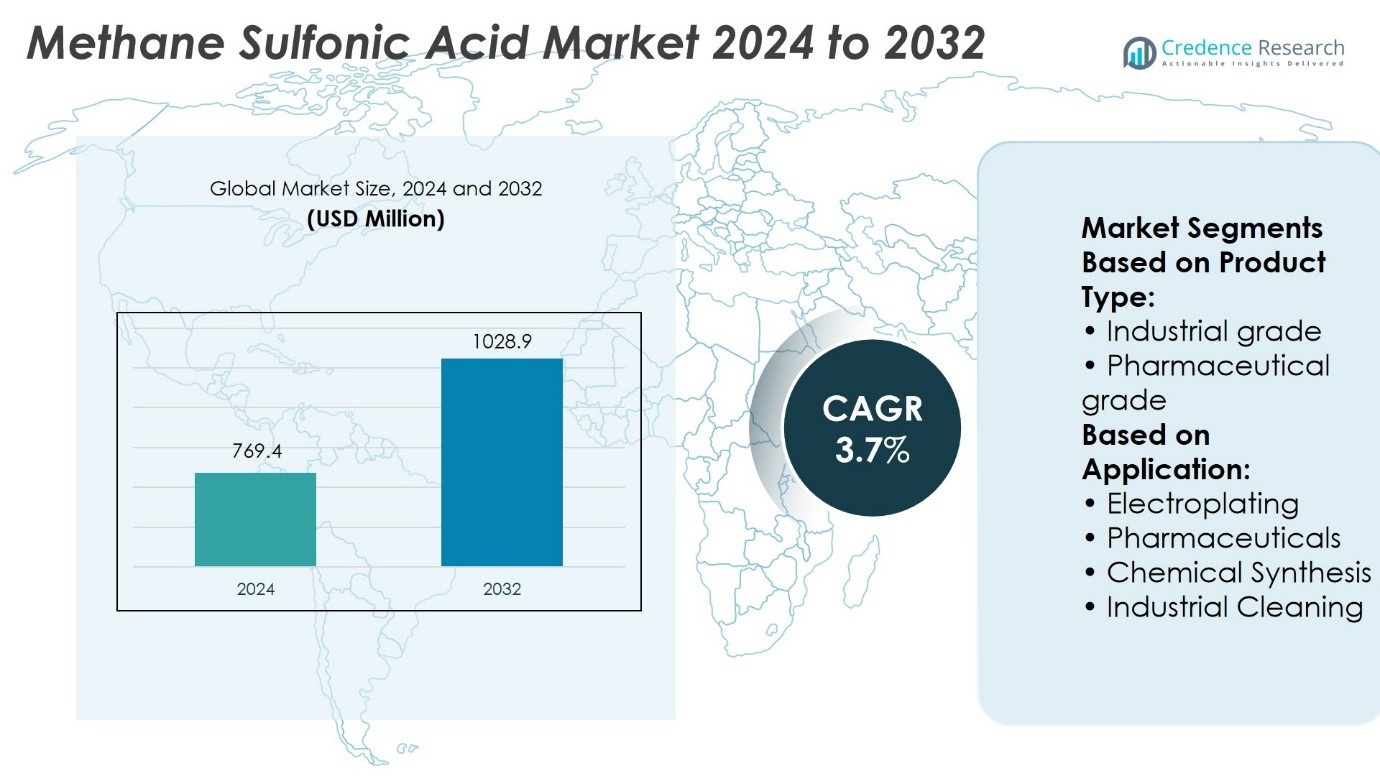
Methane Sulfonic Acid Market size was valued at USD 769.4 million in 2024 and is anticipated to reach USD 1028.9 million by 2032, at a CAGR of 3.7% during the forecast period.
| REPORT ATTRIBUTE | DETAILS |
|---|---|
| Historical Period | 2020-2024 |
| Base Year | 2024 |
| Forecast Period | 2025-2032 |
| Methane Sulfonic Acid Market Size 2024 | USD 769.4 Million |
| Methane Sulfonic Acid Market, CAGR | 3.7% |
| Methane Sulfonic Acid Market Size 2032 | USD 1028.9 Million |
The Methane Sulfonic Acid Market grows through rising demand in pharmaceuticals, electroplating, and energy storage, supported by its biodegradability and low toxicity compared to conventional acids. It acts as a key catalyst in high-purity drug synthesis, strengthens performance in redox flow batteries, and improves plating quality in electronics and automotive industries. Regulatory shifts toward green chemistry accelerate its replacement of mineral acids, while industrial users adopt it to meet stricter sustainability standards. Continuous research and investment in advanced applications reinforce its role as a versatile chemical, ensuring strong alignment with evolving industrial, environmental, and technological requirements.
The Methane Sulfonic Acid Market shows strong geographical presence, with Asia-Pacific leading due to high demand from pharmaceuticals, electronics, and electroplating industries, while North America and Europe maintain steady growth through regulatory-driven adoption and advanced chemical applications. Latin America and Middle East & Africa represent emerging markets supported by expanding agrochemical and industrial sectors. Key players include Arkema, BASF, Ataman Chemicals, BLDpharm, CDH Fine Chemicals, Finar Chemicals, Glentham Life Sciences, Haihang Industry, Hebei Yanuo Bioscience, and Hydrite Chemical Co.
Market Insights
- The Methane Sulfonic Acid Market size was valued at USD 769.4 million in 2024 and is anticipated to reach USD 1028.9 million by 2032, at a CAGR of 3.7%.
- Rising demand in pharmaceuticals, electroplating, and energy storage drives market expansion due to its biodegradability and low toxicity.
- Trends highlight its role in high-purity drug synthesis, redox flow batteries, and electronics plating, supported by stricter sustainability standards.
- Competition features global leaders and regional suppliers focusing on purity, compliance, and cost competitiveness.
- Market restraints include high production costs, raw material price fluctuations, and stringent regulatory compliance.
- Asia-Pacific leads with strong adoption across pharma and electronics, while North America and Europe sustain growth through innovation and green policies.
- Latin America and Middle East & Africa emerge as growing regions with rising agrochemical and industrial demand supported by expanding infrastructure.
Market Drivers
Expanding Applications in Electroplating and Metal Surface Treatment
The Methane Sulfonic Acid Market grows on strong demand from the electroplating industry. It supports environmentally safer alternatives to conventional mineral acids by offering high solubility and biodegradability. Electroplating of tin, lead, and precious metals relies on its stable conductivity and low toxicity profile. Manufacturers value its ability to improve current efficiency and reduce sludge generation. Electronics and automotive industries use it extensively for component finishing and corrosion resistance. Rising investments in sustainable plating processes strengthen its adoption in large-scale industrial operations.
- For instance, BASF partnered with JenaBatteries to develop a redox flow battery (RFB) technology tailored for stationary energy storage. The system supports capacities of 400 kWh per unit, with scalable capacities.
Rising Use in Pharmaceuticals and Fine Chemicals
The Methane Sulfonic Acid Market benefits from increasing usage in pharmaceutical synthesis and fine chemical production. It functions as an efficient catalyst for esterification and polymerization reactions, ensuring higher yields with fewer byproducts. Drug manufacturers adopt it for producing antibiotics, cardiovascular drugs, and vitamins with greater purity levels. The compound’s low volatility and strong acid strength provide a safer alternative to traditional acids in synthesis. Its role in green chemistry drives innovation in eco-friendly drug formulations. Growth in contract manufacturing organizations further elevates demand for efficient and compliant catalysts.
- For instance, MSA-based electrolytes have demonstrated storage densities around 40 Wh per kilogram at the laboratory scale-specifically in soluble-lead flow systems tested with electrode sizes.
Strong Demand from Renewable Energy and Battery Manufacturing
The Methane Sulfonic Acid Market gains momentum from its role in renewable energy and energy storage technologies. It enhances performance in redox flow batteries by delivering high ionic conductivity and stable electrolyte composition. Battery producers choose it for systems requiring long cycle life and low maintenance. Growing renewable integration increases reliance on scalable energy storage solutions. Governments promote it as part of energy transition policies that target reduced carbon emissions. Large-scale projects in solar and wind storage underline the importance of this acid in enabling sustainable infrastructure.
Expansion in Agrochemicals and Industrial Cleaning Solutions
The Methane Sulfonic Acid Market advances through its expanding role in agrochemicals and specialty cleaning formulations. It helps in the synthesis of herbicides and pesticides with higher effectiveness and environmental compatibility. Its high solubility supports uniform formulations that improve crop yield performance. In industrial cleaning, it provides low corrosivity toward metals while maintaining strong descaling action. Manufacturers adopt it for cleaning systems in food processing, medical devices, and precision machinery. Regulatory support for eco-friendly cleaning solutions strengthens market penetration across diverse industries.
Market Trends
Increasing Focus on Green Chemistry and Sustainable Production
The Methane Sulfonic Acid Market reflects a clear trend toward sustainable chemical processes. It replaces conventional mineral acids that generate hazardous byproducts, aligning with stricter environmental regulations. Producers emphasize its high biodegradability and low toxicity to meet green chemistry standards. Research initiatives target wider adoption in industrial catalysis that requires safe, recyclable acids. Demand grows from industries seeking to lower their environmental footprint without compromising performance. Companies highlight it as a preferred option for meeting global sustainability commitments.
- For instance, Arkema’s AMSA (Anhydrous Methanesulfonic Acid) is engineered for high-purity applications. Their production process achieves a water content below 5,000 ppm, while simultaneously limiting key impurities to 2 ppm for minimal methyl and ethyl mesylates (MMS and EMS).
Growing Role in Energy Storage and Advanced Batteries
The Methane Sulfonic Acid Market expands with its rising importance in energy storage applications. It serves as a stable electrolyte in redox flow batteries used for renewable energy integration. Battery developers focus on it for delivering high conductivity and long operational life. Projects in solar and wind sectors adopt this technology to ensure reliable grid support. Large-scale installations underscore its ability to provide cost-effective energy storage. Ongoing investments in renewable infrastructure amplify its presence in next-generation battery systems.
- For instance, BASF invested a double-digit million euro amount at least 50,000 metric tons per year EUR to expand MSA production capacities at its Verbund site in Ludwigshafen, enabling increased supply of high-purity, biodegradable acid.
Expanding Use in High-Performance Electronics and Plating
The Methane Sulfonic Acid Market benefits from growing reliance on it in electronics manufacturing. Electroplating for semiconductors and printed circuit boards requires precise surface finishing, where it offers superior conductivity. Industries select it to reduce sludge formation and improve bath stability. Automotive and aerospace producers adopt plating solutions that meet higher durability standards. The trend reflects a move toward efficient, low-waste processes across global supply chains. Its application supports high-value sectors that prioritize quality and sustainability.
Rising Application in Pharmaceuticals and Fine Chemicals
The Methane Sulfonic Acid Market strengthens its position in pharmaceutical and fine chemical production. It functions as a catalyst that delivers high yields and fewer impurities in complex reactions. Drug manufacturers rely on it for producing antibiotics, vitamins, and specialty compounds. Contract research and manufacturing organizations integrate it into scalable processes for global supply. Growth in biologics and specialty formulations increases reliance on efficient, compliant acid catalysts. Its expanding use highlights the trend toward safer and more sustainable production pathways.
Market Challenges Analysis
High Production Costs and Limited Availability of Raw Materials
The Methane Sulfonic Acid Market faces challenges linked to high production costs and dependence on specialized raw materials. Manufacturers require advanced processing facilities to maintain purity standards demanded by pharmaceuticals and electronics. Limited suppliers of methane and sulfur-based inputs create price volatility across regions. Small and medium-scale producers struggle to compete with larger companies that operate integrated value chains. High costs reduce adoption in industries with strict cost efficiency requirements. It restricts market expansion in regions where alternatives remain more economical.
Stringent Regulatory Frameworks and Substitution Risks
The Methane Sulfonic Acid Market encounters hurdles from strict environmental and safety regulations. Governments impose rigorous compliance requirements on chemical handling, storage, and waste management. Smaller companies face financial strain from the high cost of meeting these standards. Substitution risks also impact long-term adoption, with competing acids offering lower prices in certain applications. Industries sensitive to cost often select alternatives despite lower environmental performance. It challenges producers to balance regulatory compliance with competitive pricing strategies.
Market Opportunities
Expanding Role in Renewable Energy Storage and Green Technologies
The Methane Sulfonic Acid Market presents strong opportunities in renewable energy storage and sustainable industrial applications. It supports the development of redox flow batteries that deliver reliable performance for solar and wind integration. Governments and private investors prioritize energy storage solutions that align with low-emission goals. Its high conductivity and stability position it as a key electrolyte for next-generation systems. Growing emphasis on clean technologies widens its use across infrastructure and transportation projects. It creates avenues for manufacturers to target high-growth sectors committed to sustainability.
Rising Adoption in Pharmaceuticals and Specialty Chemicals
The Methane Sulfonic Acid Market gains new opportunities from the expanding pharmaceutical and specialty chemical industries. It serves as a catalyst that enables high-yield, low-impurity synthesis of critical compounds. Contract manufacturing organizations adopt it to improve scalability and meet regulatory standards in drug development. The growing demand for advanced formulations, including biologics and specialty medicines, enhances its relevance. Specialty chemical producers value its role in eco-friendly synthesis, creating scope for broader adoption. It strengthens prospects for companies that focus on compliance-driven, high-value applications.
Market Segmentation Analysis:
By Product Type
The Methane Sulfonic Acid Market divides into industrial grade and pharmaceutical grade, each serving distinct end-use industries. Industrial grade dominates with extensive use in electroplating, industrial cleaning, and large-scale chemical synthesis. Manufacturers prefer it for its stability, high solubility, and low environmental impact compared to mineral acids. Demand remains strong in electronics, automotive, and metal finishing industries that rely on high-quality surface treatment. Pharmaceutical grade focuses on producing drugs, intermediates, and specialty chemicals that require precise purity levels. Drug manufacturers adopt it for efficient synthesis of antibiotics, vitamins, and cardiovascular treatments. It highlights the dual role of methane sulfonic acid as both a bulk industrial input and a high-value pharmaceutical catalyst.
- For instance, CDH Fine Chemicals offers MSA for synthesis featuring a verified assay (alkalimetrically) of 98.0%, a molecular weight of 96.10 g/mol, and is available in four standardized packaging formats.
By Application
The Methane Sulfonic Acid Market shows diverse adoption across electroplating, pharmaceuticals, chemical synthesis, and industrial cleaning. Electroplating represents one of the largest segments, where it ensures stable conductivity, low sludge formation, and improved plating quality. Electronics, aerospace, and automotive industries depend on it for precision coating and corrosion resistance. In pharmaceuticals, it functions as a catalyst that delivers high yields and fewer impurities in complex synthesis, strengthening its role in modern drug development. Chemical synthesis industries adopt it to replace conventional acids, benefiting from its biodegradability and strong acid strength. Industrial cleaning is another important segment, where it provides efficient descaling while remaining less corrosive to metals than traditional options. It secures rising demand across high-performance applications that prioritize sustainability, efficiency, and compliance.
- For instance, a pilot process documented reported a methane sulfonic acid production capacity of 20 million metric tons per year (i.e., 20 metric tons/year), demonstrating early-stage scaling potential for applications including electroplating and formulation research.
Segments:
Based on Product Type:
- Industrial grade
- Pharmaceutical grade
Based on Application:
- Electroplating
- Pharmaceuticals
- Chemical Synthesis
- Industrial Cleaning
Based on the Geography:
- North America
- U.S.
- Canada
- Mexico
- Europe
- Germany
- France
- U.K.
- Italy
- Spain
- Rest of Europe
- Asia Pacific
- China
- Japan
- India
- South Korea
- South-east Asia
- Rest of Asia Pacific
- Latin America
- Brazil
- Argentina
- Rest of Latin America
- Middle East & Africa
- GCC Countries
- South Africa
- Rest of the Middle East and Africa
Regional Analysis
North America
North America accounts for 19.7% of the global market in 2025. The United States leads with extensive use in pharmaceuticals, biotech, and advanced chemical synthesis. Canada contributes with regulatory-driven adoption in specialty chemicals and green manufacturing. Strict safety and environmental standards accelerate substitution of mineral acids. Drug development, renewable energy, and high-value industrial applications sustain steady growth. The region’s focus on innovation and compliance ensures a stable market base.
Europe
Europe holds a market share of 17.3% in 2025, with some estimates placing it closer to 21%. Germany leads with about one-third of the regional market, followed by France, the UK, Italy, and Spain. Strong environmental regulations drive adoption in pharmaceuticals, specialty chemicals, and precision plating. The region prioritizes clean manufacturing and low-waste processes. High industrial standards in automotive and electronics sectors sustain demand. Europe remains a mature but steadily growing market.
Asia-Pacific
Asia-Pacific holds the largest share of the Methane Sulfonic Acid Market at 45.6% in 2024. China drives demand through large-scale electronics, electroplating, and pharmaceutical production. India strengthens adoption with strong pharmaceutical exports and agrochemical demand. Japan and South Korea rely on high-purity grades for semiconductors, batteries, and advanced coatings. Taiwan contributes through its packaging and foundry operations. Rapid industrialization, coupled with sustainability policies, positions Asia-Pacific as the most dominant region.
Latin America
Latin America represents 5.9% of global share in 2025. Brazil dominates, followed by Argentina, Colombia, and Chile. Expanding agrochemical industries and pharmaceutical investments create strong demand for methane sulfonic acid. The region’s role in global agricultural exports reinforces need for eco-friendly herbicides and catalysts. Infrastructure development and industrial growth expand opportunities. High growth projections make it a promising market for producers targeting emerging economies.
Middle East & Africa
Middle East & Africa account for 5% to 7% of the global share, equal to around USD 50 million in 2025. Saudi Arabia and UAE lead the regional market, followed by Egypt and South Africa. Applications include metal finishing, refinery processes, and pharmaceuticals. Limited local production results in high import reliance, creating opportunities for new manufacturing investments. Economic diversification and growing chemical sectors increase adoption. Rising sustainability awareness also supports gradual market expansion.
Key Player Analysis
- Hydrite Chemical Co.
- Haihang Industry Co., Ltd.
- BASF
- Glentham Life Sciences
- Hebei Yanuo Bioscience Co Ltd
- Arkema
- Ataman Chemicals
- BLDpharm
- Finar Chemicals
- CDH Fine Chemicals
Competitive Analysis
The competitive landscape of the Methane Sulfonic Acid Market features include Arkema, Ataman Chemicals, BASF, BLDpharm, CDH Fine Chemicals, Finar Chemicals, Glentham Life Sciences, Haihang Industry Co., Ltd., Hebei Yanuo Bioscience Co Ltd, and Hydrite Chemical Co. The Methane Sulfonic Acid Market demonstrates a competitive environment shaped by innovation, sustainability, and regulatory compliance. Producers focus on delivering high-purity grades that meet the stringent requirements of pharmaceuticals, electronics, and advanced chemical synthesis. Companies differentiate through advancements in green chemistry, emphasizing biodegradable and low-toxicity solutions that replace traditional mineral acids. Investments in expanding production capacities, particularly in Asia-Pacific and North America, strengthen supply reliability for fast-growing end-use industries. Competition also extends to pricing strategies, with regional suppliers addressing cost-sensitive markets while global leaders target high-value applications. The market reflects a balance between established producers consolidating their position and emerging firms capturing opportunities in niche and developing sectors.
Recent Developments
- In June 2025, VAUDE and BASF unveiled the TRAILCONTROL ZERO 20+ bike backpack, made with Ultramid® ZeroPCF, a polyamide 6 with a net-zero carbon footprint. Produced using renewable electricity and bio-based feedstock via an ISCC+ certified mass balance approach, the material matches conventional polyamide in performance but excels in sustainability.
- In June 2025, Arkema received ISCC PLUS certification for its waterborne acrylic resin production in Saint Charles, Louisiana (USA). These mass balance-certified resins contain up to 90% bio-attributed content, supporting sustainable solutions in coatings, adhesives, mobility, infrastructure, and more.
- In December 2023, Arkema partners with a leading pharmaceutical company to develop a new drug using MSA as a key ingredient. This collaboration could significantly increase MSA demand in the healthcare sector.
- In November 2023, Hubei Xingchi expands its MSA production capacity by 20%, aiming to capture a larger share of the growing industrial segment.
Market Concentration & Characteristics
The Methane Sulfonic Acid Market reflects a moderately concentrated structure with a mix of global chemical corporations and regional producers shaping competition. It is characterized by high barriers to entry due to stringent regulatory standards, the need for advanced production technology, and the requirement for consistent product purity. Large multinational companies dominate with extensive R&D investments, global distribution networks, and strong integration across value chains, while smaller firms compete by serving niche applications and regional demand. It demonstrates strong alignment with green chemistry principles, offering biodegradable and low-toxicity alternatives to conventional acids. Demand concentration remains high in pharmaceuticals, electroplating, and energy storage applications, where reliability and compliance play a critical role. It continues to evolve through innovation in sustainable production, expansion of high-purity grades, and partnerships across industries seeking eco-friendly and efficient chemical solutions.
Report Coverage
The research report offers an in-depth analysis based on Product Type, Application and Geography. It details leading market players, providing an overview of their business, product offerings, investments, revenue streams, and key applications. Additionally, the report includes insights into the competitive environment, SWOT analysis, current market trends, as well as the primary drivers and constraints. Furthermore, it discusses various factors that have driven market expansion in recent years. The report also explores market dynamics, regulatory scenarios, and technological advancements that are shaping the industry. It assesses the impact of external factors and global economic changes on market growth. Lastly, it provides strategic recommendations for new entrants and established companies to navigate the complexities of the market.
Future Outlook
- The Methane Sulfonic Acid Market will expand with rising adoption in green chemistry applications.
- It will gain traction in energy storage through wider use in redox flow batteries.
- Demand will increase in pharmaceuticals due to its role in high-purity drug synthesis.
- It will see stronger use in electroplating for electronics, automotive, and aerospace industries.
- Producers will invest in sustainable and low-emission manufacturing technologies.
- Regulatory frameworks will continue to favor it over conventional mineral acids.
- Emerging economies will drive growth through expanding industrial and chemical infrastructure.
- Strategic partnerships between chemical firms and battery manufacturers will strengthen its applications.
- Research on advanced catalysts and specialty chemicals will enhance its relevance.
- It will maintain steady demand from industrial cleaning solutions aligned with eco-friendly standards.

Request a Free Sample
Fill in your details and we'll send you a free sample report.
- Sample data tables & charts
- Research methodology
Market Dynamics
Expanding Applications in Electroplating and Metal Surface Treatment
Methane sulfonic acid is increasingly used in electroplating due to its high solubility, stable conductivity, and low toxicity, offering an environmentally safer alternative to mineral acids. Its ability to improve plating quality and reduce sludge generation is driving adoption in electronics, automotive, and metal finishing industries.
Rising Use in Pharmaceuticals and Fine Chemicals
The market benefits from its role as an efficient catalyst in pharmaceutical synthesis, enabling high-purity drug production with fewer byproducts. Its low volatility and strong acid strength make it a preferred choice for manufacturers seeking safer, eco-friendly alternatives in drug and specialty chemical synthesis.
Strong Demand from Renewable Energy and Battery Manufacturing
Methane sulfonic acid is gaining traction as a key electrolyte in redox flow batteries, supporting the growth of renewable energy storage solutions. Its high ionic conductivity and stability are critical for battery systems requiring long cycle life and low maintenance, aligning with global energy transition policies.
Expansion in Agrochemicals and Industrial Cleaning Solutions
The acid's high solubility and low corrosivity make it valuable in agrochemical formulations and industrial cleaning, supporting eco-friendly herbicide synthesis and efficient descaling. Regulatory support for sustainable cleaning and agricultural solutions is boosting its adoption across these sectors.
Increasing Focus on Green Chemistry and Sustainable Production
Stricter environmental regulations and industry sustainability goals are accelerating the replacement of conventional mineral acids with methane sulfonic acid. Its biodegradability and low toxicity help companies meet green chemistry standards and reduce their environmental footprint.
Need a Custom Version of This Report?
Tailor the scope, geography, or segments to your exact requirements.
- Custom geography or segment scope
- Direct access to our analyst team
Frequently Asked Questions
What is the current market size for Methane Sulfonic Acid Market, and what is its projected size in 2032?
At what Compound Annual Growth Rate is the Methane Sulfonic Acid Market projected to grow between 2025 and 2032?
Which Methane Sulfonic Acid Market segment held the largest share in 2024?
What are the primary factors fueling the growth of the Methane Sulfonic Acid Market?
Who are the leading companies in the Methane Sulfonic Acid Market?
Which region commanded the largest share of the Methane Sulfonic Acid Market in 2024?
Table of Content
Chapter 1 Market Segmentation
- 1.1 Segmentation Framework
- 1.1.1 Product and Service Classification
- 1.1.2 Application and End-Use Classification
- 1.1.3 Technology and Solution Classification
- 1.1.4 Customer and Distribution Channel Classification
- 1.1.5 Geographic Segmentation
- 1.1.6 Market Segment Definitions and Boundaries
- 1.2 By Application
- 1.2.1 Electroplating
- 1.2.2 Pharmaceuticals
- 1.2.3 Chemical Synthesis
- 1.2.4 Industrial Cleaning
- 1.3 By Product Type
- 1.3.1 Industrial grade
- 1.3.2 Pharmaceutical grade
Chapter 2 Introduction
- 2.1 Report Objectives and Scope
- 2.2 Product Definition and Industry Terminology
- 2.3 Market Inclusions and Exclusions
- 2.4 Research Process
- 2.4.1 Primary Research and Expert Interviews
- 2.4.2 Secondary Research and Source Review
- 2.4.3 Top-Down and Bottom-Up Estimation
- 2.4.4 Data Triangulation and Verification
- 2.5 Market Size Measurement Basis
- 2.5.1 2024: USD 769.4 million → 2032: USD 1028.9 million
- 2.6 Historical and Forecast Reference Periods
- 2.6.1 Base Year: 2024
- 2.6.2 Forecast Period: 2024-2032
- 2.7 Research Assumptions and Limitations
Chapter 3 Executive Summary
- 3.1 Market Snapshot and Key Findings
- 3.2 Base-Year Market Size, 2024
- 3.3 Forecast Market Size, 2032
- 3.4 Revenue and Volume Growth Outlook
- 3.5 Key Demand and Supply Indicators
- 3.6 Leading Market Segments
- 3.7 Fastest-Growing Market Opportunities
- 3.8 Regional Performance Highlights
- 3.9 Technology and Industry Transformation
- 3.10 Competitive Landscape Summary
- 3.11 Analyst View and Strategic Implications
Chapter 4 Global Methane Sulfonic Acid Market Trends and Developments
- 4.1 Historical Industry Development
- 4.2 Recent Market Trends and Developments
- 4.3 Demand and Customer Behavior Trends
- 4.4 Technology and Product Innovation
- 4.5 Artificial Intelligence, Automation and Digitalization
- 4.6 Local Manufacturing and Supply Chain Realignment
- 4.7 Industry Partnerships, Mergers and Acquisitions
- 4.8 Sustainability and Circular Economy Developments
- 4.9 Government and Private Sector Investment Trends
- 4.10 Emerging Business Models and Commercialization
- 4.11 Industry Developments and Announcements
Chapter 5 Global Methane Sulfonic Acid Market Production, Supply and Demand Analysis
- 5.1 Demand Trend and Consumption Analysis
- 5.2 Demand Forecast, 2024-2032
- 5.3 Production and Output Trend
- 5.4 Production and Output Forecast, 2024-2032
- 5.5 Installed Capacity and Capacity Utilization
- 5.6 Company-Wise Production Plants and Statistics
- 5.6.1 Installed Production Capacity
- 5.6.2 Actual Production
- 5.6.3 Planned Capacity and Expansion Targets
- 5.7 Supply Chain Structure and Procurement Trends
- 5.8 Supply-Demand Gap and Bottlenecks
- 5.9 Import Dependence and Sourcing Structure
- 5.10 Contract Manufacturing and Outsourcing
- 5.11 Regional Supply and Demand Concentration
Chapter 6 Global Methane Sulfonic Acid Market Pricing Analysis
- 6.1 Pricing Structure and Measurement
- 6.2 Historical Pricing Trends
- 6.3 Pricing Outlook, 2024-2032
- 6.4 Average Selling Price and Unit Economics
- 6.5 Pricing by Product and Market Segment
- 6.6 Geographic Pricing Differences
- 6.7 Key Input, Energy, Labor and Logistics Costs
- 6.8 Contract Pricing and Purchasing Models
- 6.9 Pricing Sensitivity and Competitive Positioning
- 6.10 Price, Margin and Profitability Implications
Chapter 7 Global Methane Sulfonic Acid Market Dynamics
- 7.1 Market Growth Drivers
- 7.1.1 Demand-Side Drivers
- 7.1.2 Technology and Innovation Drivers
- 7.1.3 Infrastructure and Investment Drivers
- 7.1.4 Regulatory and Policy Drivers
- 7.2 Market Restraints
- 7.2.1 Cost and Affordability Constraints
- 7.2.2 Technology and Adoption Barriers
- 7.2.3 Supply Chain and Operational Constraints
- 7.3 Market Challenges
- 7.3.1 Competitive Pressure and Margin Erosion
- 7.3.2 Skills, Infrastructure and Implementation Gaps
- 7.4 Emerging Market Opportunities
- 7.5 Market Dynamics Impact and Time-Horizon Assessment
Chapter 8 Global Methane Sulfonic Acid Value Chain Analysis
- 8.1 Industry Value Chain Overview
- 8.2 Upstream Suppliers and Critical Inputs
- 8.3 Technology and Component Providers
- 8.4 Manufacturing or Service Delivery
- 8.5 Distribution, Channel Partners and Integrators
- 8.6 Downstream Applications and End Users
- 8.7 Value Addition and Profit Pools
- 8.8 Vertical Integration and Outsourcing
- 8.9 Supplier Concentration and Risk
- 8.10 Supply Chain Localization and Resilience
Chapter 9 Global Methane Sulfonic Acid Market Regulations and Policies
- 9.1 Relevant Laws, Standards and Compliance Frameworks
- 9.2 Product, Service, Safety and Quality Requirements
- 9.3 Government Policies, Incentives and Subsidies
- 9.4 Imports, Exports and Trade Barriers
- 9.5 Public Procurement and Local Content Requirements
- 9.6 Environmental and Sustainability Compliance
- 9.7 Upcoming Policy Changes and Market Implications
Chapter 10 Global Methane Sulfonic Acid Market Hotspots and Opportunities
- 10.1 Market Opportunity Mapping and Growth Hotspots
- 10.2 High-Growth Applications and Customer Groups
- 10.3 Underserved Markets and White-Space Opportunities
- 10.4 Emerging Technology and Product Opportunities
- 10.5 New Capacity and Investment Hotspots
- 10.6 Market Entry and Expansion Opportunities
- 10.7 Distribution and Partnership Opportunities
- 10.8 Near-Term and Long-Term Commercial Potential
- 10.9 Opportunity Attractiveness and Execution Risks
Chapter 11 Global Methane Sulfonic Acid Market Outlook, 2024-2032
- 11.1 Market Size and Analysis
- 11.1.1 Revenue (Market Measurement: 2024: USD 769.4 million → 2032: USD 1028.9 million)
- 11.1.2 Market Volume and Quantity Sold
- 11.1.3 Historical Market Size
- 11.1.4 Base-Year Market Size, 2024
- 11.2 Market Forecast, 2024-2032
- 11.2.1 Revenue Forecast to 2032
- 11.2.2 Volume Forecast to 2032
- 11.2.3 CAGR and Year-on-Year Growth
- 11.2.4 Incremental Revenue Opportunity
- 11.3 Forecast Assumptions and Scenario Analysis
- 11.3.1 Base-Case Forecast
- 11.3.2 Optimistic and Conservative Scenarios
- 11.3.3 Technology, Pricing and Policy Sensitivities
- 11.4 Market Attractiveness and Growth Outlook
Chapter 12 Global Methane Sulfonic Acid Market Segmentation and Outlook
- 12.1 Segmentation Summary and Market Shares, 2024
- 12.2 Largest and Fastest-Growing Segments
- 12.3 By Application - Market Size and Forecast, 2024-2032
- 12.3.1 Segment Definition and Scope
- 12.3.2 Historical Market Size
- 12.3.3 Revenue Forecast, 2024-2032
- 12.3.4 Volume Forecast, 2024-2032
- 12.3.5 Base-Year Market Share, 2024
- 12.3.6 Segment CAGR and Growth Drivers
- 12.3.7 Subsegment Market Size and Forecast
- 12.3.7.1 Electroplating
- 12.3.7.2 Pharmaceuticals
- 12.3.7.3 Chemical Synthesis
- 12.3.7.4 Industrial Cleaning
- 12.3.8 Subsegment Pricing and Adoption Trends
- 12.3.9 Leading Suppliers and Competition
- 12.3.10 Regional Demand and Opportunities
- 12.4 By Product Type - Market Size and Forecast, 2024-2032
- 12.4.1 Segment Definition and Scope
- 12.4.2 Historical Market Size
- 12.4.3 Revenue Forecast, 2024-2032
- 12.4.4 Volume Forecast, 2024-2032
- 12.4.5 Base-Year Market Share, 2024
- 12.4.6 Segment CAGR and Growth Drivers
- 12.4.7 Subsegment Market Size and Forecast
- 12.4.7.1 Industrial grade
- 12.4.7.2 Pharmaceutical grade
- 12.4.8 Subsegment Pricing and Adoption Trends
- 12.4.9 Leading Suppliers and Competition
- 12.4.10 Regional Demand and Opportunities
- 12.5 Segment Growth Comparison
- 12.6 Segment Attractiveness and Priority Matrix
Chapter 13 Global Methane Sulfonic Acid End-Use and Application Market Outlook
- 13.1 End-Use Industry and Customer Demand Structure
- 13.2 Leading Applications and Customer Groups
- 13.3 End-Use Market Size, Share and Forecast
- 13.4 Major End-Use Industry Deep Dives
- 13.4.1 Customer Requirements and Use Cases
- 13.4.2 Demand and Replacement Cycles
- 13.4.3 Technical and Regulatory Considerations
- 13.4.4 Purchasing and Procurement Models
- 13.4.5 Leading Vendors and Distribution Channels
- 13.4.6 Forecast and Commercial Opportunities
- 13.5 Emerging Applications and Cross-Segment Demand
- 13.6 End-Use Industry Investment Priorities
Chapter 14 Global Methane Sulfonic Acid Geographic Market Outlook, 2024-2032
- 14.1 Regional Market Size and Share, 2024
- 14.2 Regional Market Forecast, 2024-2032
- 14.3 Regional Pricing, Production and Demand Differences
- 14.4 North America
- 14.4.1 United States
- 14.4.2 Canada
- 14.4.3 Mexico
- 14.5 Europe
- 14.5.1 Germany
- 14.5.2 France
- 14.5.3 Italy
- 14.5.4 United Kingdom
- 14.5.5 Spain
- 14.5.6 Poland
- 14.5.7 Russia
- 14.5.8 Netherlands
- 14.5.9 Belgium
- 14.5.10 Sweden
- 14.5.11 Denmark
- 14.5.12 Norway
- 14.5.13 Rest of Europe
- 14.6 Asia Pacific
- 14.6.1 China
- 14.6.2 India
- 14.6.3 Japan
- 14.6.4 South Korea
- 14.6.5 Thailand
- 14.6.6 Indonesia
- 14.6.7 Vietnam
- 14.6.8 Malaysia
- 14.6.9 Australia
- 14.6.10 Rest of Asia Pacific
- 14.7 Latin America
- 14.7.1 Brazil
- 14.7.2 Argentina
- 14.7.3 Colombia
- 14.7.4 Chile
- 14.7.5 Rest of Latin America
- 14.8 Middle East
- 14.8.1 Saudi Arabia
- 14.8.2 United Arab Emirates
- 14.8.3 Turkey
- 14.8.4 Israel
- 14.8.5 Iran
- 14.8.6 Rest of the Middle East
- 14.9 Africa
- 14.9.1 South Africa
- 14.9.2 Egypt
- 14.9.3 Nigeria
- 14.9.4 Morocco
- 14.9.5 Rest of Africa
- 14.10 Regional Investment, Policy and Supply Chain Differences
- 14.11 Regional Competitive Landscape
- 14.12 Geographic Growth Hotspots
Chapter 15 Global Methane Sulfonic Acid Technology, Innovation and Sustainability Outlook
- 15.1 Technology Landscape and Maturity
- 15.2 Product, Process and Service Innovation
- 15.3 AI, Automation and Digital Tools in the Industry
- 15.4 Technology Adoption and Performance Benchmarking
- 15.5 Innovation Pipeline and R&D Investment
- 15.6 Patent and Intellectual Property Trends
- 15.7 Energy Efficiency and Resource Management
- 15.8 Sustainability, Recycling and Circularity
- 15.9 Technology Roadmap, 2024-2032
- 15.10 Risks of Obsolescence and Technology Substitution
Chapter 16 Global Methane Sulfonic Acid Market Key Strategic Imperatives
- 16.1 Growth and Market Entry Priorities
- 16.2 High-Return Products and Segments
- 16.3 Pricing, Profitability and Cost Optimization
- 16.4 Technology Investment and Product Differentiation
- 16.5 Supply Chain Localization and Resilience
- 16.6 Distribution and Customer Acquisition
- 16.7 Partnership, Acquisition and Capacity Strategy
- 16.8 Regional Expansion Priorities
- 16.9 Short-, Medium- and Long-Term Actions
Chapter 17 Competition Outlook
- 17.1 Industry Competition Characteristics
- 17.2 Market Structure and Concentration
- 17.3 Market Share and Competitive Positioning, 2024
- 17.4 Company-Wise Revenue and Product Benchmarking
- 17.5 Production and Service Capacity Benchmarking
- 17.6 Technology, Pricing and Differentiation
- 17.7 Regional Footprint and Distribution Strength
- 17.8 Mergers, Acquisitions and Strategic Alliances
- 17.9 New Entrants and Competitive Threats
- 17.10 Porter's Five Forces and Industry Attractiveness
- 17.11 Competitive Outlook, 2024-2032
Chapter 18 Company Profiles
- 18.1 Company Coverage and Selection Criteria
- 18.2 Arkema
- 18.2.1 Business Description
- 18.2.2 Company Ownership and Geographic Presence
- 18.2.3 Product and Service Portfolio
- 18.2.4 Manufacturing and Operating Footprint
- 18.2.5 Production Capacity and Expansion Plans
- 18.2.6 Financial Performance and Investment
- 18.2.7 Market Share and Competitive Position
- 18.2.8 Technology and Innovation Capabilities
- 18.2.9 Strategic Alliances or Partnerships
- 18.2.10 Recent Developments
- 18.2.11 Growth Strategy and Outlook
- 18.3 BASF
- 18.4 Ataman Chemicals
- 18.5 BLDpharm
- 18.6 CDH Fine Chemicals
- 18.7 Finar Chemicals
- 18.8 Glentham Life Sciences
- 18.9 Haihang Industry
- 18.10 Hebei Yanuo Bioscience
- 18.11 Hydrite Chemical Co.
- 18.12 Other Relevant Market Participants
Note: Every listed company is profiled on the structure shown under the first company. The company list is preliminary and may change based on research findings, market developments, data availability and client requirements.
Chapter 19 Disclaimer
- 19.1 Research and Forecast Disclaimer
- 19.2 Data Source and Estimation Limitations
Note: The depth of individual sections depends on data availability for this market. Volume, capacity, trade and other unit-based metrics are included where applicable.

