| REPORT ATTRIBUTE | DETAILS |
|---|---|
| Historical Period | 2020-2023 |
| Base Year | 2024 |
| Forecast Period | 2025-2032 |
| Mexico Digital Oilfield Solutions Market Size 2024 | USD 791.19 million |
| Mexico Digital Oilfield Solutions Market, CAGR | 5.81% |
| Mexico Digital Oilfield Solutions Market Size 2032 | USD 1,243.25 million |
Market Overview
The Mexico Digital Oilfield Solutions Market is projected to grow from USD 791.19 million in 2024 to an estimated USD 1,243.25 million by 2032, with a compound annual growth rate (CAGR) of 5.81% from 2025 to 2032. This growth is driven by the increasing adoption of digital technologies within the oil and gas sector, including advanced sensors, data analytics, and real-time monitoring systems.
Market drivers include the ongoing digital transformation of the oil and gas industry, which aims to improve operational efficiency and reduce environmental impact. Furthermore, the rising demand for cost-effective solutions and the need for better data-driven decision-making processes are fueling the adoption of digital oilfield technologies. Key trends in the market include the growing use of IoT, AI, and machine learning for predictive maintenance, real-time data analysis, and automation in oilfield operations.
Geographically, Mexico is witnessing significant advancements in its oil and gas sector, supported by favorable government policies and investment in digital infrastructure. The market is driven by key players such as Schlumberger Limited, Halliburton Company, Baker Hughes Company, and Weatherford International, who are focusing on offering innovative and scalable digital solutions for oilfield management. These companies are actively investing in Mexico’s energy sector, contributing to the development and growth of digital oilfield solutions in the region.
Market Insights
- The Mexico Digital Oilfield Solutions Market is expected to grow from USD 791.19 million in 2024 to USD 1,243.25 million by 2032, driven by a 5.81% CAGR from 2025 to 2032.
- The Global Digital Oilfield Solutions Market is projected to grow from USD31,374.00 million in 2024 to USD 54,897.18 million by 2032, with a CAGR of 7.24% from 2025 to 2032.
- Digital transformation in the oil and gas industry, increasing efficiency, and the need for cost-effective, data-driven decision-making are fueling market growth.
- IoT, AI, and machine learning are critical technologies enabling real-time monitoring, predictive maintenance, and automation in Mexico's oilfields.
- High initial investment costs and concerns over data security are key challenges hindering the widespread adoption of digital oilfield solutions.
- Central Mexico dominates the market due to its large onshore oilfields, while offshore fields in Southeastern Mexico offer substantial growth opportunities.
- Major companies like Schlumberger, Halliburton, Baker Hughes, and Weatherford are leading the digital oilfield solutions market with innovative and scalable offerings.
- Favorable policies and investments in digital infrastructure by the Mexican government are accelerating the adoption of digital technologies in the energy sector.
Market Drivers
Government Initiatives and Support for Energy Sector Modernization
Government policies and initiatives in Mexico are also playing a pivotal role in driving the adoption of digital oilfield solutions. The Mexican government has actively encouraged modernization and diversification within the country’s oil and gas sector, particularly after the landmark 2013 energy reforms. These reforms were aimed at attracting foreign investments, increasing oil and gas production, and improving the overall efficiency of the sector. As part of these reforms, the government has made significant investments in modernizing infrastructure and enhancing digital technologies in energy management. Additionally, the government has incentivized the use of innovative technologies that can reduce environmental impact, improve safety, and optimize production. In line with these initiatives, the government’s growing commitment to digitalization has catalyzed the adoption of digital oilfield solutions across Mexico. Furthermore, the regulatory environment is becoming increasingly conducive to the integration of digital technologies in the oil and gas sector. As the Mexican oil and gas industry continues to evolve with the support of these government initiatives, digital oilfield solutions are expected to gain greater traction, further contributing to the growth of the market.
Need for Enhanced Data-Driven Decision Making and Real-Time Monitoring
The demand for data-driven decision-making is another key driver of the Mexico Digital Oilfield Solutions Market. As the complexity of oil and gas operations increases, companies are recognizing the need to make informed decisions based on real-time data. The ability to gather, analyze, and act on data in real time is critical for optimizing operations and ensuring long-term sustainability. Digital oilfield solutions provide a comprehensive suite of tools for real-time monitoring, allowing operators to track various parameters such as pressure, temperature, and flow rates across multiple assets simultaneously. The implementation of sensors, drones, and other monitoring technologies enables companies to track equipment performance and field conditions with a level of precision that was previously not possible. This data-driven approach allows operators to make timely decisions on production optimization, safety measures, and resource management, minimizing operational risks and improving field performance. Additionally, real-time data can help companies identify and resolve problems before they escalate into major issues, significantly reducing the costs associated with unplanned downtime. The shift toward data-centric operations in the Mexican oil and gas sector is driving the widespread adoption of digital oilfield solutions, as companies seek to leverage these technologies for better decision-making, enhanced productivity, and improved profitability.
Increased Demand for Operational Efficiency and Cost Reduction
One of the primary drivers of the Mexico Digital Oilfield Solutions Market is the oil and gas industry’s increasing demand for operational efficiency and cost reduction. As competition intensifies in the global energy sector, Mexican operators are adopting strategies to maximize production from mature oilfields while minimizing costs. For instance, traditional methods of oilfield management are proving inadequate in addressing these challenges, prompting a shift toward digital solutions. Technologies such as real-time data monitoring, predictive analytics, and automation are enabling companies to streamline operations, reduce downtime, and optimize resource allocation. By leveraging these tools, operators can monitor assets in real time, detect potential issues early, and prevent costly repairs or disruptions. Furthermore, automation and advanced analytics minimize human error, enhancing precision in critical tasks like drilling and production while facilitating predictive maintenance to mitigate risks. This growing reliance on digital oilfield technologies is not only improving operational efficiency but also giving companies a competitive edge in an evolving market.
Technological Advancements and Industry Digitization
Technological advancements are significantly driving the growth of digital oilfield solutions in Mexico. Over the past decade, the global oil and gas industry has embraced transformative technologies like IoT, AI, Machine Learning (ML), and Big Data analytics. For instance, these innovations allow operators to gain real-time insights into oilfield conditions, optimize production processes, and improve safety measures. In Mexico, both state-owned enterprises and private operators are increasingly integrating these technologies to modernize their operations. IoT devices are being used for equipment monitoring and data collection to facilitate predictive maintenance and performance optimization. AI and ML algorithms analyze this data to identify patterns and forecast potential failures, enabling informed decision-making. These advancements are reshaping oilfield management by enhancing efficiency, reducing costs, and driving demand for digital solutions. Additionally, Mexico’s investments in technological infrastructure are accelerating this trend as companies seek to boost productivity while aligning with environmental sustainability goals through digital transformation initiatives.
Market Trends
Increasing Investment in Digital Twin Technologies
Another emerging trend in the Mexico Digital Oilfield Solutions Market is the growing interest in Digital Twin technologies. A Digital Twin is a virtual replica of a physical asset, system, or process, which allows operators to simulate, analyze, and predict the performance of oilfield equipment and operations. By using real-time data and advanced modeling techniques, Digital Twin technology enables oil and gas companies to gain a deeper understanding of the behavior and performance of their assets. This technology has the potential to revolutionize asset management and operational decision-making by providing a detailed, dynamic representation of an oilfield’s equipment, processes, and infrastructure. In Mexico, Digital Twin technology is being increasingly adopted as part of the broader trend toward digitalization and automation in the oil and gas sector. The ability to simulate various scenarios and test strategies in a virtual environment before implementing them in the real world helps operators reduce risk, improve efficiency, and enhance safety. Additionally, Digital Twin technology is being used to improve asset lifecycle management by enabling predictive maintenance, optimizing energy consumption, and extending the operational lifespan of key equipment. As the benefits of Digital Twin technologies become more evident, it is expected that more oil and gas companies in Mexico will invest in this cutting-edge solution to enhance their operations.
Sustainability and Environmental Awareness Driving Digital Innovation
The increasing focus on sustainability and reducing the environmental impact of oilfield operations is another key trend influencing the Mexico Digital Oilfield Solutions Market. The global oil and gas industry is under growing pressure to improve its environmental performance, and Mexico is no exception. As part of their efforts to address environmental concerns, many oil operators in Mexico are turning to digital technologies to optimize energy use, reduce emissions, and minimize waste. Digital solutions such as real-time monitoring systems, data analytics, and AI are being employed to enhance resource management, reduce flaring, and improve energy efficiency. For example, AI-driven solutions are helping operators monitor and reduce methane emissions, which are a significant contributor to greenhouse gas emissions. Additionally, IoT devices are being used to track energy consumption across operations, enabling companies to identify areas for improvement and optimize the use of resources. As the Mexican government places increasing emphasis on sustainability and environmental regulations, digital oilfield solutions are becoming a vital tool in helping oil and gas companies comply with these standards. By adopting digital technologies that support sustainability goals, operators can improve their environmental performance while also enhancing operational efficiency and reducing costs.
Growing Adoption of Artificial Intelligence and Machine Learning
One of the most prominent trends in the Mexico Digital Oilfield Solutions Market is the increasing integration of Artificial Intelligence (AI) and Machine Learning (ML) technologies. These advancements are transforming oilfield operations by enabling predictive analytics and real-time data processing. For instance, AI-powered predictive maintenance systems are being utilized to forecast equipment failures before they occur, significantly reducing downtime and maintenance costs. In Mexico, oil and gas operators are leveraging these technologies to analyze vast amounts of data generated by sensors and monitoring systems, identifying patterns and anomalies that would otherwise go unnoticed. Additionally, ML algorithms are optimizing drilling operations by analyzing geological data to determine the most efficient techniques. As the industry continues to embrace AI and ML, these technologies are expected to play an increasingly integral role in enhancing operational efficiency, improving safety measures, and boosting overall productivity in Mexican oilfields. The development of AI-based solutions provides oil operators with precise tools for decision-making, enabling better cost control and resource management while addressing challenges posed by aging infrastructure and fluctuating energy demands.
Increased Focus on IoT Integration for Real-Time Monitoring and Automation
The integration of Internet of Things (IoT) technologies is another key trend shaping the Mexico Digital Oilfield Solutions Market. IoT devices such as sensors, smart meters, and automated systems are revolutionizing how oilfields are monitored and managed. For instance, these devices collect real-time data on operational parameters like temperature, pressure, flow rate, and equipment performance, transmitting it directly to centralized control systems. This allows operators to remotely monitor oilfield activities with greater accuracy and respond promptly to potential issues. In Mexico, the adoption of IoT is driven by the need for real-time monitoring and automation to enhance operational efficiency. IoT-enabled automation is streamlining processes such as fluid injection, production optimization, and drilling operations while reducing manual intervention and improving safety standards. Furthermore, the data collected by IoT devices feeds into machine learning algorithms, enhancing predictive maintenance capabilities and optimizing operations further. As IoT technologies evolve, their application in Mexico’s oilfields is anticipated to expand significantly, offering new opportunities for automation, improved asset management, and operational efficiency amidst growing energy demands.
Market Challenges
High Initial Investment and Implementation Costs
One of the significant challenges facing the Mexico Digital Oilfield Solutions Market is the high initial investment required for adopting and implementing digital technologies. For instance, companies must allocate substantial resources to acquire advanced equipment, integrate IoT sensors, and implement AI-driven analytics. This financial burden is particularly challenging for smaller operators or those with limited budgets in Mexico's oil and gas sector. Additionally, integrating these technologies into existing systems often necessitates specialized expertise and time, further complicating the process. While digital solutions promise long-term benefits like cost savings and enhanced efficiency, the upfront costs remain a barrier. Moreover, the evolving regulatory landscape in Mexico, including stringent data localization requirements and compliance with cybersecurity standards, adds another layer of complexity for companies looking to digitize their operations. These factors collectively slow the adoption of digital oilfield solutions despite their potential to improve operational perfornce and productivity.
Data Security and Privacy Concerns
Another key challenge in the Mexico Digital Oilfield Solutions Market is the growing concern around data security and privacy. As oil and gas companies increasingly rely on digital technologies and real-time data monitoring, they are also becoming more vulnerable to cyber threats and data breaches. The integration of IoT devices, AI, and cloud-based platforms in oilfield operations generates vast amounts of sensitive data, which makes it an attractive target for cyberattacks. Ensuring the security of this data and protecting against unauthorized access or tampering is crucial, especially given the potential consequences of security breaches, including operational disruptions, financial losses, and reputational damage. In Mexico, where digital infrastructure may not be as robust as in other regions, companies face additional challenges in implementing secure systems and complying with data privacy regulations. As digital oilfield solutions continue to evolve, ensuring that these technologies are secure and resilient against cyber threats will be a critical consideration for companies operating in Mexico’s oil and gas industry.
Market Opportunities
Expansion of Digital Infrastructure and Technological Integration
The ongoing expansion of digital infrastructure in Mexico presents a significant market opportunity for digital oilfield solutions. As the Mexican government continues to invest in modernizing the country’s energy sector, including oil and gas operations, there is an increasing need for advanced technological solutions that enhance efficiency and reduce environmental impact. The expansion of high-speed internet connectivity, the adoption of 5G technology, and the growth of cloud computing capabilities create an ideal environment for deploying digital oilfield solutions such as real-time monitoring, predictive maintenance, and automation systems. This technological integration not only enables improved operational efficiency but also supports sustainable practices by allowing for better resource management and reduced energy consumption. Companies that invest in these digital technologies can leverage these advancements to gain a competitive edge in the market, optimize their operations, and meet the growing demand for sustainable energy solutions.
Rising Demand for Predictive Maintenance and Cost Optimization
Another key opportunity in the Mexico Digital Oilfield Solutions Market is the rising demand for predictive maintenance and cost optimization. As oil and gas companies in Mexico seek to improve operational efficiency and reduce maintenance costs, predictive maintenance powered by AI and machine learning presents a valuable opportunity. These technologies help operators forecast potential equipment failures before they occur, allowing for timely maintenance and minimizing costly downtime. Additionally, by optimizing production processes and reducing waste, digital oilfield solutions can drive cost efficiencies throughout the entire oilfield lifecycle. This trend is particularly relevant for Mexican oil and gas companies looking to maintain competitiveness amidst fluctuating oil prices and increasing pressure to reduce operational costs. The ability to adopt cost-effective, data-driven strategies offers substantial growth potential for companies providing digital oilfield solutions in Mexico.
Market Segmentation Analysis
By Solution
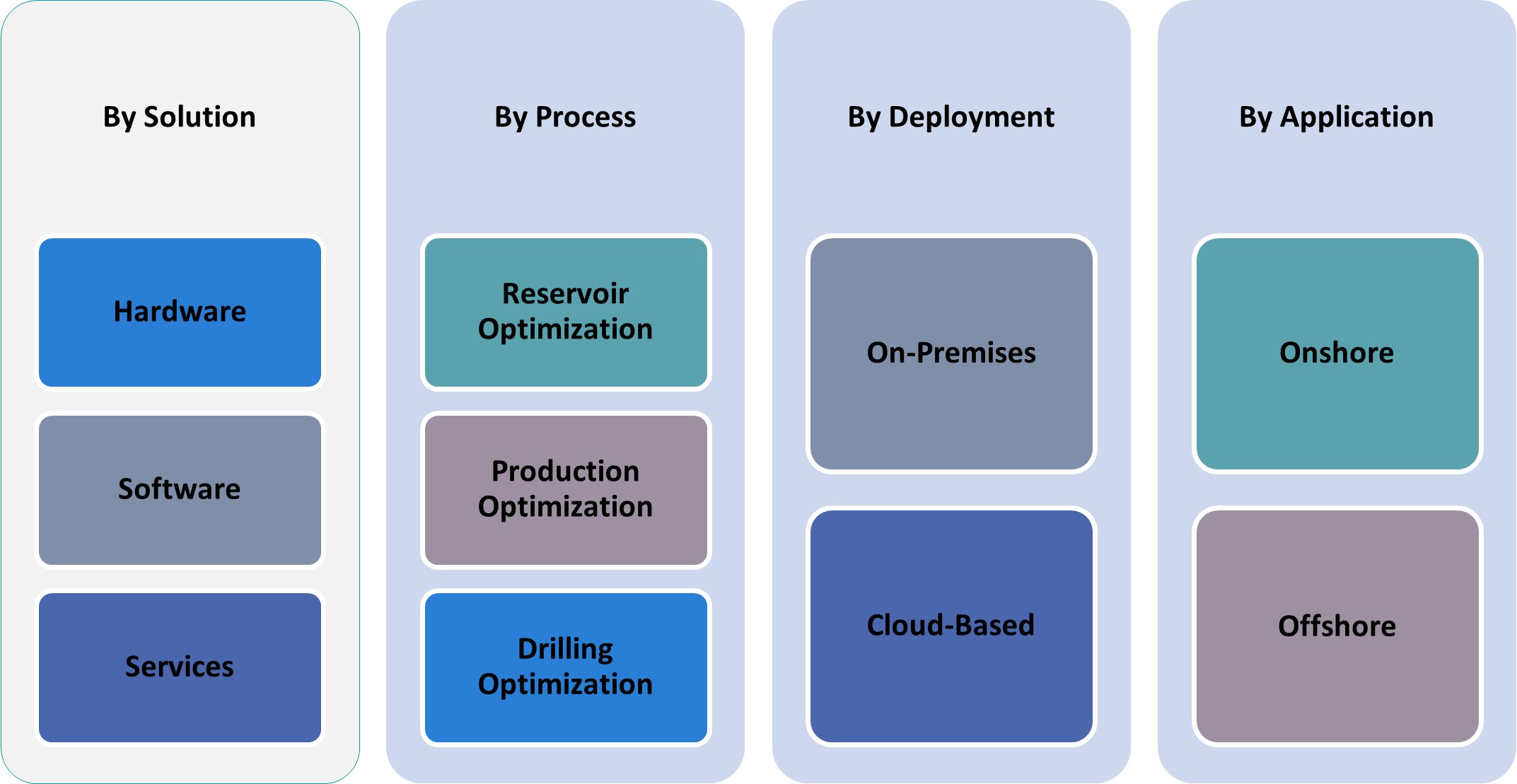
The market is divided into three primary solutions: hardware, software, and services. The hardware segment, accounting for 53.3% of the market, includes IoT sensors, drilling equipment, and monitoring devices that are essential for collecting data and enabling real-time operational control. Software solutions include advanced analytics, AI-driven platforms, and real-time data processing systems that are integral for decision-making and optimization in oilfield operations. Services include consulting, training, maintenance, and system integration services, supporting the implementation and operationalization of digital technologies in oilfields.
By Application
The market is also segmented by application into onshore and offshore operations. The onshore segment dominates the market due to Mexico's significant onshore oilfields and their strategic importance to the country’s energy sector. Offshore operations also present substantial growth potential, particularly as Mexico looks to increase its offshore oil and gas production capacity. As offshore drilling becomes more technologically advanced, digital solutions for remote monitoring, real-time decision-making, and automation are becoming increasingly critical.
Segments
Based on Solution
- Hardware
- Software
- Services
Based on Application
- Onshore
- Offshore
Based on Process
- Reservoir Optimization
- Production Optimization
- Drilling Optimization
Based on Deployment
- On-Premises
- Cloud-Based
Based on Region
- Central Mexico
- Northern Mexico
- Southeastern Mexico
- Southern Mexico
Regional Analysis
Central Mexico (45%)
Central Mexico is the dominant region in the Digital Oilfield Solutions Market, accounting for approximately 45% of the market share. This region is home to the majority of Mexico's active oilfields, including the significant onshore fields in states like Veracruz, Tabasco, and Chiapas. The region's established infrastructure, proximity to major refineries, and significant oil production make it a key focus for digital transformation. Central Mexico is experiencing strong adoption of digital oilfield solutions such as real-time monitoring systems, IoT devices, and predictive maintenance tools to optimize production and reduce operational costs. The presence of large state-owned companies like PEMEX and private operators looking to modernize their operations has accelerated the demand for advanced digital technologies. As a result, Central Mexico is expected to continue to dominate the market, contributing to its steady growth.
Northern Mexico (25%)
Northern Mexico, representing approximately 25% of the market share, is another key region driving the adoption of digital oilfield solutions. This area includes the regions around the Burgos Basin and the Chihuahua Basin, which have been increasingly focused on shale oil production. The Northern region benefits from both onshore and offshore opportunities, and its growing investment in exploration and production projects is driving the demand for digital technologies. Real-time data analytics, IoT-enabled devices, and advanced software for resource management are being integrated into both existing and new projects in this region. Furthermore, Northern Mexico has seen increasing collaboration between private operators and international companies, further accelerating the use of digital solutions.
Key players
- Schlumberger Limited
- Halliburton Company
- Baker Hughes Company
- Weatherford International plc
- Emerson Electric Co.
- Honeywell International Inc.
- Rockwell Automation, Inc.
- ABB Ltd.
- IBM Corporation
- GE Digital
Competitive Analysis
The Mexico Digital Oilfield Solutions Market is highly competitive, with several global leaders driving innovation and technological advancements. Schlumberger, Halliburton, and Baker Hughes are dominant players, providing a wide range of advanced digital solutions, including IoT-enabled sensors, predictive maintenance tools, and real-time data analytics. These companies leverage their global experience and technological expertise to strengthen their presence in Mexico, particularly in both onshore and offshore operations. Weatherford and Emerson Electric are also notable competitors, offering specialized automation and optimization solutions for the oil and gas sector. Emerging players like Honeywell and Rockwell Automation are focusing on integrating AI and machine learning technologies into their offerings, aiming to improve operational efficiency and sustainability. Companies such as IBM and GE Digital focus on data analytics and cloud-based solutions, helping oilfield operators optimize production and reduce costs. The market is becoming increasingly collaborative, with partnerships and alliances forming to deliver more integrated and scalable digital solutions.
Recent Developments
- In March 2025, Schneider Electric unveiled the One Digital Grid Platform, an AI-powered platform designed to enhance grid resiliency and efficiency. This platform is set to be available later in 2025. The company announced a $700 million investment plan in the U.S. to enhance energy infrastructure and AI capabilities.
- In April 2025, ABB India delivered integrated automation and digital solutions for IndianOil's cross-country pipeline network, enhancing efficiency and safety through real-time monitoring and robust cybersecurity.
- In March 2025, Kongsberg Digital participated in the IPTC 2025, focusing on digital transformation in the oil and gas sector.
- In January 2025, SAP S/4HANA Cloud was highlighted as a key enabler for a smarter, more efficient energy ecosystem in the oil and gas industry.
- In April 2025, Schlumberger (SLB) announced a partnership with Shell to deploy Petrel™ subsurface software across Shell's global assets. This collaboration aims to enhance digital capabilities and operational efficiencies through advanced AI-driven seismic interpretation workflows. This development underscores SLB's ongoing commitment to advancing subsurface digital technology and fostering strategic partnerships in the energy sector.
Market Concentration and Characteristics
The Mexico Digital Oilfield Solutions Market exhibits moderate market concentration, with several large global players such as Schlumberger, Halliburton, and Baker Hughes dominating the landscape. These companies hold a significant share of the market due to their extensive technological capabilities, global experience, and established relationships with key oil and gas operators. However, the market is also witnessing the emergence of smaller, specialized firms that provide niche solutions in areas like predictive maintenance, automation, and data analytics. The market is characterized by rapid technological advancements, with increasing demand for IoT integration, AI-driven optimization, and cloud-based platforms. Companies are focusing on developing scalable, flexible, and cost-efficient solutions to meet the specific needs of the Mexican oil and gas sector. As digitalization in oilfields continues to grow, the market is expected to see increased competition, collaboration, and innovation, driving further adoption of advanced digital technologies.
Report Coverage
The research report offers an in-depth analysis based on Solution, Application, Process, Deployment and Region. It details leading market players, providing an overview of their business, product offerings, investments, revenue streams, and key applications. Additionally, the report includes insights into the competitive environment, SWOT analysis, current market trends, as well as the primary drivers and constraints. Furthermore, it discusses various factors that have driven market expansion in recent years. The report also explores market dynamics, regulatory scenarios, and technological advancements that are shaping the industry. It assesses the impact of external factors and global economic changes on market growth. Lastly, it provides strategic recommendations for new entrants and established companies to navigate the complexities of the market.
Future Outlook
- Mexico’s oil and gas sector will continue to increase investments in digital transformation, driving demand for advanced digital oilfield solutions to enhance operational efficiency.
- The adoption of IoT devices will grow, enabling real-time data monitoring, predictive maintenance, and improved asset management across both onshore and offshore fields in Mexico.
- Artificial Intelligence (AI) and Machine Learning (ML) will see increased implementation to improve decision-making, optimize drilling operations, and predict equipment failures.
- Mexico’s focus on expanding offshore oilfields will drive demand for digital solutions, particularly for real-time monitoring, remote operations, and production optimization in the Gulf of Mexico.
- The drive for sustainability will continue to shape the market, with digital solutions helping reduce environmental impact, minimize waste, and optimize energy use in oilfield operations.
- Mexico’s government will likely continue its support for energy sector modernization, providing incentives and policies that promote the adoption of digital technologies within the oil and gas industry.
- The shift towards cloud-based platforms will accelerate, offering scalability, cost-effectiveness, and seamless integration for companies looking to enhance data processing and storage capabilities.
- Strategic partnerships and alliances between digital solution providers and oil companies will increase, fostering innovation, sharing expertise, and driving the development of advanced technologies tailored to Mexico’s oilfields.
- Data-driven solutions will dominate the future, with an emphasis on optimizing drilling, production, and reservoir management using big data, analytics, and predictive models.
- As more players enter the market, competition will intensify, leading to faster technological advancements and the introduction of more diverse and specialized digital solutions to cater to the evolving needs of Mexico's oil and gas sector.

Request a Free Sample
Fill in your details and we'll send you a free sample report.
- Sample data tables & charts
- Research methodology
Market Dynamics
Government Initiatives and Support for Energy Sector Modernization
The Mexican government’s active policies and investments in digital infrastructure, following energy reforms, are accelerating the adoption of digital oilfield solutions by incentivizing modernization, efficiency, and environmental sustainability in the oil and gas sector.
Need for Enhanced Data-Driven Decision Making and Real-Time Monitoring
As oilfield operations become more complex, companies are increasingly relying on real-time data analytics and monitoring technologies to optimize production, improve safety, and minimize downtime, driving demand for digital oilfield solutions.
Increased Demand for Operational Efficiency and Cost Reduction
Competitive pressures and the need to maximize output from mature oilfields are pushing Mexican operators to adopt digital solutions that streamline operations, reduce human error, and enable predictive maintenance, resulting in significant cost savings.
Technological Advancements and Industry Digitization
Rapid advancements in IoT, AI, machine learning, and big data analytics are enabling oil and gas companies in Mexico to modernize their operations, improve asset management, and achieve higher productivity through digital transformation.
Expansion of Digital Infrastructure and Technological Integration
Ongoing investments in high-speed connectivity, cloud computing, and automation are creating a favorable environment for the deployment of advanced digital oilfield solutions, supporting both operational efficiency and sustainability goals.
Need a Custom Version of This Report?
Tailor the scope, geography, or segments to your exact requirements.
- Custom geography or segment scope
- Direct access to our analyst team
Frequently Asked Questions
What is the projected market size of the Mexico Digital Oilfield Solutions Market in 2023 and 2032?
What are the main drivers of the Mexico Digital Oilfield Solutions Market?
Who are the key players in the Mexico Digital Oilfield Solutions Market?
What is the geographic focus of the Mexico Digital Oilfield Solutions Market?
Table of Content
Chapter 1 Market Segmentation
- 1.1 Segmentation Framework
- 1.1.1 Product and Service Classification
- 1.1.2 Application and End-Use Classification
- 1.1.3 Technology and Solution Classification
- 1.1.4 Customer and Distribution Channel Classification
- 1.1.5 Geographic Segmentation
- 1.1.6 Market Segment Definitions and Boundaries
- 1.2 By Process
- 1.2.1 Reservoir Optimization
- 1.2.2 Production Optimization
- 1.2.3 Drilling Optimization
- 1.3 By Solution
- 1.3.1 Hardware
- 1.3.2 Software
- 1.3.3 Services
- 1.4 By Deployment
- 1.4.1 On-Premises
- 1.4.2 Cloud-Based
- 1.5 By Application
- 1.5.1 Onshore
- 1.5.2 Offshore
Chapter 2 Introduction
- 2.1 Report Objectives and Scope
- 2.2 Product Definition and Industry Terminology
- 2.3 Market Inclusions and Exclusions
- 2.4 Research Process
- 2.4.1 Primary Research and Expert Interviews
- 2.4.2 Secondary Research and Source Review
- 2.4.3 Top-Down and Bottom-Up Estimation
- 2.4.4 Data Triangulation and Verification
- 2.5 Market Size Measurement Basis
- 2.5.1 2024: USD 791.19 million → 2032: USD 1,243.25 million
- 2.6 Historical and Forecast Reference Periods
- 2.6.1 Base Year: 2024
- 2.6.2 Forecast Period: 2024-2032
- 2.7 Research Assumptions and Limitations
Chapter 3 Executive Summary
- 3.1 Market Snapshot and Key Findings
- 3.2 Base-Year Market Size, 2024
- 3.3 Forecast Market Size, 2032
- 3.4 Revenue and Volume Growth Outlook
- 3.5 Key Demand and Supply Indicators
- 3.6 Leading Market Segments
- 3.7 Fastest-Growing Market Opportunities
- 3.8 Regional Performance Highlights
- 3.9 Technology and Industry Transformation
- 3.10 Competitive Landscape Summary
- 3.11 Analyst View and Strategic Implications
Chapter 4 Mexico Digital Oilfield Solutions Market Trends and Developments
- 4.1 Historical Industry Development
- 4.2 Recent Market Trends and Developments
- 4.3 Demand and Customer Behavior Trends
- 4.4 Technology and Product Innovation
- 4.5 Artificial Intelligence, Automation and Digitalization
- 4.6 Local Manufacturing and Supply Chain Realignment
- 4.7 Industry Partnerships, Mergers and Acquisitions
- 4.8 Sustainability and Circular Economy Developments
- 4.9 Government and Private Sector Investment Trends
- 4.10 Emerging Business Models and Commercialization
- 4.11 Industry Developments and Announcements
Chapter 5 Mexico Digital Oilfield Solutions Market Production, Supply and Demand Analysis
- 5.1 Demand Trend and Consumption Analysis
- 5.2 Demand Forecast, 2024-2032
- 5.3 Production and Output Trend
- 5.4 Production and Output Forecast, 2024-2032
- 5.5 Installed Capacity and Capacity Utilization
- 5.6 Company-Wise Production Plants and Statistics
- 5.6.1 Installed Production Capacity
- 5.6.2 Actual Production
- 5.6.3 Planned Capacity and Expansion Targets
- 5.7 Supply Chain Structure and Procurement Trends
- 5.8 Supply-Demand Gap and Bottlenecks
- 5.9 Import Dependence and Sourcing Structure
- 5.10 Contract Manufacturing and Outsourcing
- 5.11 Regional Supply and Demand Concentration
Chapter 6 Mexico Digital Oilfield Solutions Market Pricing Analysis
- 6.1 Pricing Structure and Measurement
- 6.2 Historical Pricing Trends
- 6.3 Pricing Outlook, 2024-2032
- 6.4 Average Selling Price and Unit Economics
- 6.5 Pricing by Product and Market Segment
- 6.6 Geographic Pricing Differences
- 6.7 Key Input, Energy, Labor and Logistics Costs
- 6.8 Contract Pricing and Purchasing Models
- 6.9 Pricing Sensitivity and Competitive Positioning
- 6.10 Price, Margin and Profitability Implications
Chapter 7 Mexico Digital Oilfield Solutions Market Dynamics
- 7.1 Market Growth Drivers
- 7.1.1 Demand-Side Drivers
- 7.1.2 Technology and Innovation Drivers
- 7.1.3 Infrastructure and Investment Drivers
- 7.1.4 Regulatory and Policy Drivers
- 7.2 Market Restraints
- 7.2.1 Cost and Affordability Constraints
- 7.2.2 Technology and Adoption Barriers
- 7.2.3 Supply Chain and Operational Constraints
- 7.3 Market Challenges
- 7.3.1 Competitive Pressure and Margin Erosion
- 7.3.2 Skills, Infrastructure and Implementation Gaps
- 7.4 Emerging Market Opportunities
- 7.5 Market Dynamics Impact and Time-Horizon Assessment
Chapter 8 Mexico Digital Oilfield Solutions Value Chain Analysis
- 8.1 Industry Value Chain Overview
- 8.2 Upstream Suppliers and Critical Inputs
- 8.3 Technology and Component Providers
- 8.4 Manufacturing or Service Delivery
- 8.5 Distribution, Channel Partners and Integrators
- 8.6 Downstream Applications and End Users
- 8.7 Value Addition and Profit Pools
- 8.8 Vertical Integration and Outsourcing
- 8.9 Supplier Concentration and Risk
- 8.10 Supply Chain Localization and Resilience
Chapter 9 Mexico Digital Oilfield Solutions Market Regulations and Policies
- 9.1 Relevant Laws, Standards and Compliance Frameworks
- 9.2 Product, Service, Safety and Quality Requirements
- 9.3 Government Policies, Incentives and Subsidies
- 9.4 Imports, Exports and Trade Barriers
- 9.5 Public Procurement and Local Content Requirements
- 9.6 Environmental and Sustainability Compliance
- 9.7 Upcoming Policy Changes and Market Implications
Chapter 10 Mexico Digital Oilfield Solutions Market Hotspots and Opportunities
- 10.1 Market Opportunity Mapping and Growth Hotspots
- 10.2 High-Growth Applications and Customer Groups
- 10.3 Underserved Markets and White-Space Opportunities
- 10.4 Emerging Technology and Product Opportunities
- 10.5 New Capacity and Investment Hotspots
- 10.6 Market Entry and Expansion Opportunities
- 10.7 Distribution and Partnership Opportunities
- 10.8 Near-Term and Long-Term Commercial Potential
- 10.9 Opportunity Attractiveness and Execution Risks
Chapter 11 Mexico Digital Oilfield Solutions Market Outlook, 2024-2032
- 11.1 Market Size and Analysis
- 11.1.1 Revenue (Market Measurement: 2024: USD 791.19 million → 2032: USD 1,243.25 million)
- 11.1.2 Market Volume and Quantity Sold
- 11.1.3 Historical Market Size
- 11.1.4 Base-Year Market Size, 2024
- 11.2 Market Forecast, 2024-2032
- 11.2.1 Revenue Forecast to 2032
- 11.2.2 Volume Forecast to 2032
- 11.2.3 CAGR and Year-on-Year Growth
- 11.2.4 Incremental Revenue Opportunity
- 11.3 Forecast Assumptions and Scenario Analysis
- 11.3.1 Base-Case Forecast
- 11.3.2 Optimistic and Conservative Scenarios
- 11.3.3 Technology, Pricing and Policy Sensitivities
- 11.4 Market Attractiveness and Growth Outlook
Chapter 12 Mexico Digital Oilfield Solutions Market Segmentation and Outlook
- 12.1 Segmentation Summary and Market Shares, 2024
- 12.2 Largest and Fastest-Growing Segments
- 12.3 By Process - Market Size and Forecast, 2024-2032
- 12.3.1 Segment Definition and Scope
- 12.3.2 Historical Market Size
- 12.3.3 Revenue Forecast, 2024-2032
- 12.3.4 Volume Forecast, 2024-2032
- 12.3.5 Base-Year Market Share, 2024
- 12.3.6 Segment CAGR and Growth Drivers
- 12.3.7 Subsegment Market Size and Forecast
- 12.3.7.1 Reservoir Optimization
- 12.3.7.2 Production Optimization
- 12.3.7.3 Drilling Optimization
- 12.3.8 Subsegment Pricing and Adoption Trends
- 12.3.9 Leading Suppliers and Competition
- 12.3.10 Regional Demand and Opportunities
- 12.4 By Solution - Market Size and Forecast, 2024-2032
- 12.4.1 Segment Definition and Scope
- 12.4.2 Historical Market Size
- 12.4.3 Revenue Forecast, 2024-2032
- 12.4.4 Volume Forecast, 2024-2032
- 12.4.5 Base-Year Market Share, 2024
- 12.4.6 Segment CAGR and Growth Drivers
- 12.4.7 Subsegment Market Size and Forecast
- 12.4.7.1 Hardware
- 12.4.7.2 Software
- 12.4.7.3 Services
- 12.4.8 Subsegment Pricing and Adoption Trends
- 12.4.9 Leading Suppliers and Competition
- 12.4.10 Regional Demand and Opportunities
- 12.5 By Deployment - Market Size and Forecast, 2024-2032
- 12.5.1 Segment Definition and Scope
- 12.5.2 Historical Market Size
- 12.5.3 Revenue Forecast, 2024-2032
- 12.5.4 Volume Forecast, 2024-2032
- 12.5.5 Base-Year Market Share, 2024
- 12.5.6 Segment CAGR and Growth Drivers
- 12.5.7 Subsegment Market Size and Forecast
- 12.5.7.1 On-Premises
- 12.5.7.2 Cloud-Based
- 12.5.8 Subsegment Pricing and Adoption Trends
- 12.5.9 Leading Suppliers and Competition
- 12.5.10 Regional Demand and Opportunities
- 12.6 By Application - Market Size and Forecast, 2024-2032
- 12.6.1 Segment Definition and Scope
- 12.6.2 Historical Market Size
- 12.6.3 Revenue Forecast, 2024-2032
- 12.6.4 Volume Forecast, 2024-2032
- 12.6.5 Base-Year Market Share, 2024
- 12.6.6 Segment CAGR and Growth Drivers
- 12.6.7 Subsegment Market Size and Forecast
- 12.6.7.1 Onshore
- 12.6.7.2 Offshore
- 12.6.8 Subsegment Pricing and Adoption Trends
- 12.6.9 Leading Suppliers and Competition
- 12.6.10 Regional Demand and Opportunities
- 12.7 Segment Growth Comparison
- 12.8 Segment Attractiveness and Priority Matrix
Chapter 13 Mexico Digital Oilfield Solutions End-Use and Application Market Outlook
- 13.1 End-Use Industry and Customer Demand Structure
- 13.2 Leading Applications and Customer Groups
- 13.3 End-Use Market Size, Share and Forecast
- 13.4 Major End-Use Industry Deep Dives
- 13.4.1 Customer Requirements and Use Cases
- 13.4.2 Demand and Replacement Cycles
- 13.4.3 Technical and Regulatory Considerations
- 13.4.4 Purchasing and Procurement Models
- 13.4.5 Leading Vendors and Distribution Channels
- 13.4.6 Forecast and Commercial Opportunities
- 13.5 Emerging Applications and Cross-Segment Demand
- 13.6 End-Use Industry Investment Priorities
Chapter 14 Mexico Digital Oilfield Solutions Geographic Market Outlook, 2024-2032
- 14.1 Domestic Market Distribution and Demand Clusters
- 14.2 State- or Province-Wise Market Size and Forecast, 2024-2032
- 14.3 City and Metropolitan Market Outlook
- 14.4 Industrial, Manufacturing and Commercial Clusters
- 14.5 Geographic Concentration of Key End Users
- 14.6 Local Pricing and Purchasing Differences
- 14.7 Domestic Production Facilities and Capacity Map
- 14.8 Local Infrastructure and Project Pipeline
- 14.9 State-Level Policy and Incentive Differences
- 14.10 Subnational Investment Hotspots and Opportunities
- 14.11 Distribution and Logistics Networks
- 14.12 Domestic Competitive Footprint
Chapter 15 Mexico Digital Oilfield Solutions Technology, Innovation and Sustainability Outlook
- 15.1 Technology Landscape and Maturity
- 15.2 Product, Process and Service Innovation
- 15.3 AI, Automation and Digital Tools in the Industry
- 15.4 Technology Adoption and Performance Benchmarking
- 15.5 Innovation Pipeline and R&D Investment
- 15.6 Patent and Intellectual Property Trends
- 15.7 Energy Efficiency and Resource Management
- 15.8 Sustainability, Recycling and Circularity
- 15.9 Technology Roadmap, 2024-2032
- 15.10 Risks of Obsolescence and Technology Substitution
Chapter 16 Mexico Digital Oilfield Solutions Market Key Strategic Imperatives
- 16.1 Growth and Market Entry Priorities
- 16.2 High-Return Products and Segments
- 16.3 Pricing, Profitability and Cost Optimization
- 16.4 Technology Investment and Product Differentiation
- 16.5 Supply Chain Localization and Resilience
- 16.6 Distribution and Customer Acquisition
- 16.7 Partnership, Acquisition and Capacity Strategy
- 16.8 Regional Expansion Priorities
- 16.9 Short-, Medium- and Long-Term Actions
Chapter 17 Competition Outlook
- 17.1 Industry Competition Characteristics
- 17.2 Market Structure and Concentration
- 17.3 Market Share and Competitive Positioning, 2024
- 17.4 Company-Wise Revenue and Product Benchmarking
- 17.5 Production and Service Capacity Benchmarking
- 17.6 Technology, Pricing and Differentiation
- 17.7 Regional Footprint and Distribution Strength
- 17.8 Mergers, Acquisitions and Strategic Alliances
- 17.9 New Entrants and Competitive Threats
- 17.10 Porter's Five Forces and Industry Attractiveness
- 17.11 Competitive Outlook, 2024-2032
Chapter 18 Company Profiles
- 18.1 Company Coverage and Selection Criteria
- 18.2 Schlumberger Limited
- 18.2.1 Business Description
- 18.2.2 Company Ownership and Geographic Presence
- 18.2.3 Product and Service Portfolio
- 18.2.4 Manufacturing and Operating Footprint
- 18.2.5 Production Capacity and Expansion Plans
- 18.2.6 Financial Performance and Investment
- 18.2.7 Market Share and Competitive Position
- 18.2.8 Technology and Innovation Capabilities
- 18.2.9 Strategic Alliances or Partnerships
- 18.2.10 Recent Developments
- 18.2.11 Growth Strategy and Outlook
- 18.3 Halliburton Company
- 18.4 Baker Hughes Company
- 18.5 Weatherford International plc
- 18.6 Emerson Electric Co.
- 18.7 Honeywell International Inc.
- 18.8 Rockwell Automation, Inc.
- 18.9 ABB Ltd.
- 18.10 IBM Corporation
- 18.11 GE Digital
- 18.12 Other Relevant Market Participants
Note: Every listed company is profiled on the structure shown under the first company. The company list is preliminary and may change based on research findings, market developments, data availability and client requirements.
Chapter 19 Disclaimer
- 19.1 Research and Forecast Disclaimer
- 19.2 Data Source and Estimation Limitations
Note: The depth of individual sections depends on data availability for this market. Volume, capacity, trade and other unit-based metrics are included where applicable.