Market Overview
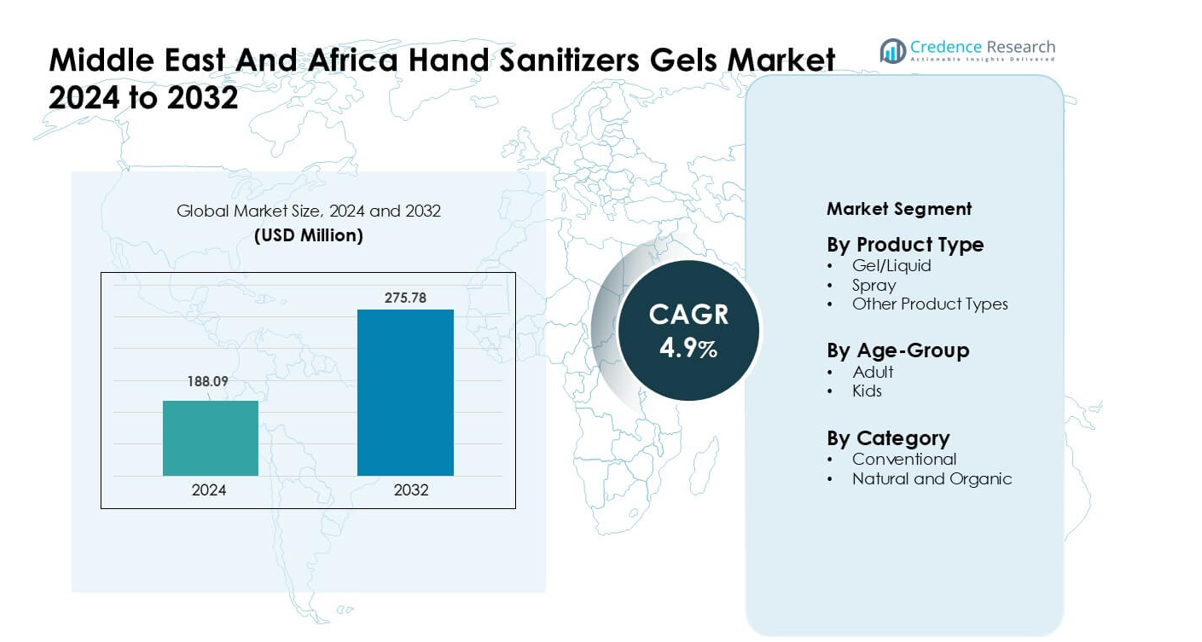
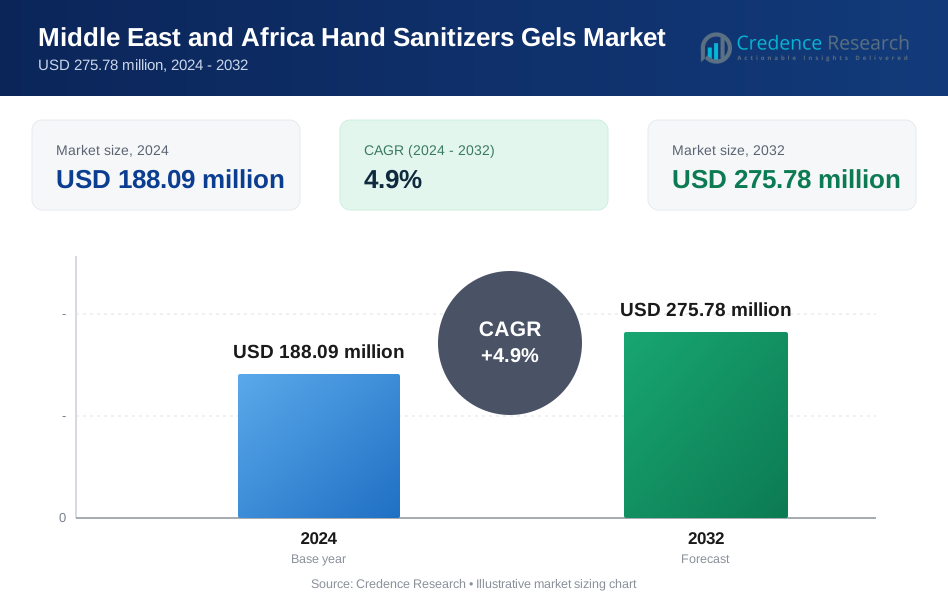
Middle East and Africa Hand Sanitizers Gels Market was valued at USD 188.09 million in 2024 and is anticipated to reach USD 275.78 million by 2032, growing at a CAGR of 4.9% during the forecast period.
| REPORT ATTRIBUTE | DETAILS |
|---|---|
| Historical Period | 2020-2023 |
| Base Year | 2024 |
| Forecast Period | 2025-2032 |
| Middle East and Africa Hand Sanitizers Gels Market Size 2024 | USD 188.09 million |
| Middle East and Africa Hand Sanitizers Gels Market, CAGR | 4.9% |
| Middle East and Africa Hand Sanitizers Gels Market Size 2032 | USD 275.78 million |
The Middle East and Africa hand sanitizers gels market is supported by major companies such as The Clorox Company, Procter & Gamble, Cleenol Group Limited, S.C. Johnson and Son, Inc., The Himalaya Drug Company, Henkel AG & Company KGaA, Reckitt Benckiser Group Plc., and 3M Company. These players strengthen market growth through broad product portfolios, strong retail distribution, and continued investment in skin-friendly and alcohol-based gel formulations. GCC countries led the market in 2024 with about 41% share, driven by high hygiene awareness, advanced healthcare systems, and sustained demand across public facilities, workplaces, and transport hubs.
Market Insights:
- The Middle East and Africa Hand Sanitizers Gels Market was valued at USD 188.09 million in 2024 and is projected to reach USD 275.78 million by 2032, expanding at a CAGR of 4.9%.
- Growing hygiene awareness across hospitals, schools, malls, and workplaces drives demand, with gel/liquid formats leading the product segment with about 63% share due to strong user trust and wide availability.
- Natural and skin-friendly formulations continue to trend upward as buyers prefer alcohol-based gels enriched with mild ingredients, while portable packs gain traction among commuters and office workers.
- Competition remains strong as major players expand product lines, strengthen pharmacy and retail networks, and introduce value-added packaging, although price sensitivity and uneven distribution restrain adoption in low-income regions.
- GCC countries dominated the regional landscape with nearly 41% share, supported by high public hygiene standards and tourism recovery, while North Africa and Sub-Saharan Africa show steady growth driven by expanding retail access and public-health campaigns.
Market Segmentation Analysis:
By Product Type
Gel and liquid formats dominated the Middle East and Africa hand sanitizers gels market in 2024 with about 63% share. Buyers preferred these products because gel-based sanitizers offer easy spread, fast absorption, and stronger consumer trust built during pandemic years. Healthcare centers, schools, and public facilities continued to stock gel units due to simple dosing and wide brand availability. Spray formats grew in travel and office use, yet their share stayed lower because many buyers viewed gel packs as more effective for routine hygiene. Other product types held limited traction due to weak visibility and narrow distribution.
- For instance, according to the regional market report, gel and liquid formulations together accounted for 81.66 % of the total 2024 revenue in the Middle East & Africa hand-sanitizer market
By Age-Group
Adults held the dominant position in 2024 with nearly 78% share of the Middle East and Africa hand sanitizers gels market. Demand remained high as workplaces, transport hubs, and hospitals kept strict hygiene rules. Adults also purchased more gel units for offices, public travel, and household safety. Kids’ usage increased in schools and childcare centers, but the segment maintained a smaller share because parents continued to rely on adult-targeted products with higher alcohol content and broader availability. Rising school hygiene drives supported steady growth for kids’ sanitizing gels.
- For instance, the same regional report indicates that adults captured 89.51% of the hand sanitizer market share in 2024 across Middle East & Africa.
By Category
Conventional sanitizers led the category segment in 2024 with about 71% share across the Middle East and Africa hand sanitizers gels market. Users favored these products due to strong antimicrobial performance, affordable pricing, and wide distribution in pharmacies and retail chains. Public institutions, clinics, and transport bodies continued bulk purchases of conventional gels because they meet standard alcohol-level requirements. Natural and organic gels gained attention among sensitive-skin users, yet their share stayed smaller due to higher costs and fewer regional brands offering certified clean-label formulations.
Key Growth Drivers:
Growing Hygiene Awareness Across Public and Private Spaces
Rising hygiene awareness remained a major growth driver for the Middle East and Africa hand sanitizers gels market. Governments continued to promote hand-cleaning habits in hospitals, airports, schools, and public transport, which expanded steady product usage. Workplaces maintained sanitizing stations to reduce illness-related absenteeism and enhance safety compliance. Retail chains and hospitality businesses also adopted gel units as part of routine customer-facing hygiene. Public campaigns, especially in Gulf countries, strengthened long-term hand-care behavior. These initiatives kept demand stable even after the pandemic phase and encouraged repeat purchases among both individual buyers and institutional users.
- For instance, In airports and transport hubs in Gulf countries such as United Arab Emirates and Saudi Arabia, public health advisories recommended regular hand-rub with alcohol-based sanitizers (70–90 % ethanol or isopropanol), aligning with WHO-backed protocols for effective hygiene in public spaces.
Expansion of Healthcare Infrastructure and Infection-Control Protocols
Growing healthcare investments supported consistent demand for hand sanitizers gels across the region. Hospitals, clinics, and diagnostic centers continued to follow strict infection-control protocols that required high-volume gel procurement. Nations in the Gulf expanded medical facilities, which increased usage among doctors, nurses, and visitors. Long-term care centers, dialysis units, and maternity clinics also relied on gel-based sanitizers for regular patient interactions. Rising focus on hospital-acquired infection control encouraged larger tenders for alcohol-based gels. This healthcare growth provided a stable institutional demand base and strengthened the market’s long-term consumption pattern.
- For instance, a 2023–2024 systematic review of hand-hygiene compliance across the Eastern Mediterranean region revealed that before recent interventions, only roughly 32% of healthcare workers adhered consistently to hand hygiene guidelines illustrating both the challenge and the scope for improved sanitization practices.
Rise in Travel, Retail, and Commercial Activities
Travel and commercial activity growth created another strong driver for the Middle East and Africa hand sanitizers gels market. Airports, malls, hotels, and corporate offices continued to maintain sanitizing points to support safe movement. Tourism rebound in Gulf states increased demand for portable gel packs among travelers and hospitality operators. Retail stores placed sanitizing units at entry points, which increased everyday product visibility. Events, exhibitions, and sports gatherings further boosted bulk purchases. This rise in mobility and commercial engagement ensured steady gel usage across public-facing sectors and expanded opportunities for branded consumer packs.
Key Trends & Opportunities:
Shift Toward Natural, Mild, and Skin-Friendly Formulations
One key trend in the Middle East and Africa hand sanitizers gels market is rising interest in natural and skin-friendly formulations. Buyers with sensitive skin prefer alcohol-based gels enriched with aloe vera, glycerin, or plant-derived agents. Brands are launching paraben-free and fragrance-free variants to meet this demand. Premium retailers highlight gentle-care sanitizers as lifestyle products rather than emergency hygiene tools. This shift creates an opportunity for companies offering dermatologically tested, organic, or halal-certified gel lines. The trend is especially strong among urban consumers and parents seeking mild formulas for kids.
- For instance, a regional analysis notes that “natural and skin-friendly” sanitizer variants those combining alcohol disinfection with moisturizing components like aloe vera, glycerin, or vitamin E have become a distinct sub-segment within the MEA market.
Growth of Portable and Value-Added Packaging Formats
Another trend shaping the market is rapid growth of portable and value-added packaging formats. Brands are introducing pocket-size tubes, clip-on packs, refill pouches, and multi-pack bundles to support daily mobility. These variants appeal to office workers, students, and travelers who prefer quick and easy access to gel units. Packaging innovations also help companies differentiate in a saturated segment and improve retail shelf visibility. Refillable dispensers offer an opportunity for institutional buyers seeking cost-efficient hygiene solutions. This evolution in packaging supports higher usage frequency and expands brand penetration across diverse retail channels.
- For instance, Manufacturers are responding by introducing refill pouches and smaller bottle/pocket sizes, which make it easier for offices, travel-heavy consumers, and institutions to restock efficiently
Key Challenges:
Rising Price Sensitivity and Limited Affordability in Select Regions
Price sensitivity remains a key challenge across several Middle East and Africa markets. In low-income regions, buyers often prioritize cost over brand quality, which limits adoption of premium sanitizing gels. Currency fluctuations and import dependence also raise production and retail prices. Many hospitals and clinics choose low-priced bulk packs, reducing margins for manufacturers. Smaller brands struggle to compete with low-cost imports, leading to market fragmentation. This price pressure can hinder expansion of advanced or natural-ingredient gels and restrict product upgrades in cost-constrained markets.
Supply Chain Gaps and Uneven Retail Distribution
Uneven distribution remains another challenge in the Middle East and Africa hand sanitizers gels market. Remote areas face weaker retail networks, supply delays, and inconsistent product availability. Local manufacturers often depend on imported raw materials, which creates vulnerability to disruptions. Cross-border logistics issues and regulatory differences add further delays. Pharmacies and modern stores in urban areas benefit from better stocking, but rural outlets remain underserved. These gaps limit market penetration and reduce brand visibility. Companies must strengthen local partnerships and distribution routes to overcome these constraints.
Regional Analysis:
GCC Countries
GCC countries held the largest share in the Middle East and Africa hand sanitizers gels market in 2024 with about 41%. Strong healthcare spending, strict hygiene rules, and high product awareness supported steady demand across hospitals, malls, offices, and airports. UAE and Saudi Arabia maintained widespread sanitizing stations in public locations, which kept gel-based formats in constant use. Tourism recovery and higher workplace mobility further increased consumption. Premium and natural gel varieties gained visibility as urban buyers shifted toward mild and skin-friendly options, while bulk institutional orders ensured stable year-round usage.
Rest of Middle East
The rest of the Middle East accounted for nearly 26% share in 2024, driven by rising hygiene awareness in schools, transport facilities, and government offices. Countries such as Jordan, Iraq, and Lebanon saw higher adoption through public-health campaigns that promoted routine hand cleaning. Retail pharmacies and supermarkets expanded gel offerings, boosting accessibility for urban buyers. Healthcare centers continued large-volume procurement to maintain infection-control standards. Growth remained moderate due to economic pressures, yet improving supply chains and partnerships with local distributors strengthened market presence across key cities.
South Africa
South Africa captured about 19% share in the 2024 market, supported by growing demand in Egypt, Morocco, and Algeria. Public institutions, hospitals, and clinics increased purchases to follow stricter hygiene rules introduced during pandemic years. Rising urbanization and expanding retail outlets improved access to affordable gel packs. Youth and working professionals used travel-size gels for daily commuting, which maintained steady consumer-level demand. However, price sensitivity in some areas slowed premium product sales. Local production expansion and private-label sanitizers helped offset import costs and improved availability across major urban centers.
Market Segmentations:
By Product Type
- Gel/Liquid
- Spray
- Other Product Types
By Age-Group
- Adult
- Kids
By Category
- Conventional
- Natural and Organic
By Geography
- GCC Countries
- South Africa
- Rest of the Middle East and Africa
Competitive Landscape:
The competitive landscape of the Middle East and Africa hand sanitizers gels market features a mix of global brands and regional manufacturers that compete through product quality, distribution strength, and formulation innovation. Companies such as The Clorox Company, Procter & Gamble, Cleenol Group Limited, S.C. Johnson and Son, Inc., The Himalaya Drug Company, Henkel AG & Company KGaA, Reckitt Benckiser Group Plc., and 3M Company maintain strong visibility across pharmacies, supermarkets, and institutional supply chains. These players focus on alcohol-based gels with reliable antimicrobial performance, skin-friendly additives, and varied packaging sizes to meet consumer and commercial needs. Many brands invest in dermatologically tested formulas and natural ingredient blends to address rising demand for gentle-care sanitizers. Regional manufacturers strengthen their presence through cost-effective offerings and expanding retail partnerships. Competitive strategies also include promotional campaigns, localized marketing, and broader e-commerce penetration to capture urban and suburban customers across key markets.
Key Player Analysis:
- The Clorox Company
- Procter & Gamble
- Cleenol Group Limited
- C. Johnson and Son, Inc.
- The Himalaya Drug Company
- Henkel AG & Company, KGaA
- Reckitt Benckiser Group Plc.
- 3M Company
Recent Developments:
- In September 2025, Clorox launched CloroxPro Screen+ Sanitizing … (implicitly including sanitizing solutions) as per its corporate news updates.
- In February 2024, Cleenol opened its first factory outside the UK located in the Gulf region as part of its international expansion, indicating direct manufacturing presence closer to MEA markets
- In November 2023, Henkel AG & Company, KGaA launched its “Ecodetergent” hand sanitizer gel. The gel uses plant-based alcohol and biodegradable ingredients to target sustainable hygiene demand, including in Middle East and Africa channels where Henkel is a listed hand sanitizer player
Report Coverage:
The research report offers an in-depth analysis based on Product Type, Age- Group, Category and Geography. It details leading market players, providing an overview of their business, product offerings, investments, revenue streams, and key applications. Additionally, the report includes insights into the competitive environment, SWOT analysis, current market trends, as well as the primary drivers and constraints. Furthermore, it discusses various factors that have driven market expansion in recent years. The report also explores market dynamics, regulatory scenarios, and technological advancements that are shaping the industry. It assesses the impact of external factors and global economic changes on market growth. Lastly, it provides strategic recommendations for new entrants and established companies to navigate the complexities of the market.
Future Outlook:
- Demand will stay stable as hygiene habits remain part of daily routines.
- Institutional buyers will continue bulk purchasing for hospitals, offices, and schools.
- Natural and gentle-care gel formulations will gain wider acceptance among adults and kids.
- Brands will expand portable and refillable packaging options for mobile users.
- E-commerce sales will grow as consumers shift to convenient online buying.
- Local manufacturers will increase production to reduce import dependence.
- Price competition will intensify as value-focused products enter the market.
- Public-health programs will strengthen awareness in underserved regions.
- Premium gel variants will see gradual growth in urban and high-income areas.
- Regional distribution networks will improve, supporting deeper market penetration.
Request a Free Sample
Fill in your details and we'll send you a free sample report.
- Sample data tables & charts
- Research methodology
Need a Custom Version of This Report?
Tailor the scope, geography, or segments to your exact requirements.
- Custom geography or segment scope
- Direct access to our analyst team
Frequently Asked Questions
What is the current market size for Middle East And Africa Hand Sanitizers Gels Market, and what is its projected size in 2032?
At what Compound Annual Growth Rate is Middle East And Africa Hand Sanitizers Gels Market projected to grow between 2024 and 2032?
Which Middle East And Africa Hand Sanitizers Gels Market segment held the largest share in 2024?
What are the primary factors fueling the growth of Middle East And Africa Hand Sanitizers Gels Market?
Who are the leading companies in Middle East And Africa Hand Sanitizers Gels Market?
Table of Content
Chapter 1 Market Segmentation
- 1.1 Segmentation Framework
- 1.1.1 Product and Service Classification
- 1.1.2 Application and End-Use Classification
- 1.1.3 Technology and Solution Classification
- 1.1.4 Customer and Distribution Channel Classification
- 1.1.5 Geographic Segmentation
- 1.1.6 Market Segment Definitions and Boundaries
Chapter 2 Introduction
- 2.1 Report Objectives and Scope
- 2.2 Product Definition and Industry Terminology
- 2.3 Market Inclusions and Exclusions
- 2.4 Research Process
- 2.4.1 Primary Research and Expert Interviews
- 2.4.2 Secondary Research and Source Review
- 2.4.3 Top-Down and Bottom-Up Estimation
- 2.4.4 Data Triangulation and Verification
- 2.5 Market Size Measurement Basis
- 2.5.1 2024: USD 188.09 million → 2032: USD 275.78 million
- 2.6 Historical and Forecast Reference Periods
- 2.6.1 Base Year: 2024
- 2.6.2 Forecast Period: 2024-2032
- 2.7 Research Assumptions and Limitations
Chapter 3 Executive Summary
- 3.1 Market Snapshot and Key Findings
- 3.2 Base-Year Market Size, 2024
- 3.3 Forecast Market Size, 2032
- 3.4 Revenue and Volume Growth Outlook
- 3.5 Key Demand and Supply Indicators
- 3.6 Leading Market Segments
- 3.7 Fastest-Growing Market Opportunities
- 3.8 Regional Performance Highlights
- 3.9 Technology and Industry Transformation
- 3.10 Competitive Landscape Summary
- 3.11 Analyst View and Strategic Implications
Chapter 4 Middle East and Africa Hand Sanitizers Gels Market Trends and Developments
- 4.1 Historical Industry Development
- 4.2 Recent Market Trends and Developments
- 4.3 Demand and Customer Behavior Trends
- 4.4 Technology and Product Innovation
- 4.5 Artificial Intelligence, Automation and Digitalization
- 4.6 Local Manufacturing and Supply Chain Realignment
- 4.7 Industry Partnerships, Mergers and Acquisitions
- 4.8 Sustainability and Circular Economy Developments
- 4.9 Government and Private Sector Investment Trends
- 4.10 Emerging Business Models and Commercialization
- 4.11 Industry Developments and Announcements
Chapter 5 Middle East and Africa Hand Sanitizers Gels Market Production, Supply and Demand Analysis
- 5.1 Demand Trend and Consumption Analysis
- 5.2 Demand Forecast, 2024-2032
- 5.3 Production and Output Trend
- 5.4 Production and Output Forecast, 2024-2032
- 5.5 Installed Capacity and Capacity Utilization
- 5.6 Company-Wise Production Plants and Statistics
- 5.6.1 Installed Production Capacity
- 5.6.2 Actual Production
- 5.6.3 Planned Capacity and Expansion Targets
- 5.7 Supply Chain Structure and Procurement Trends
- 5.8 Supply-Demand Gap and Bottlenecks
- 5.9 Import Dependence and Sourcing Structure
- 5.10 Contract Manufacturing and Outsourcing
- 5.11 Regional Supply and Demand Concentration
Chapter 6 Middle East and Africa Hand Sanitizers Gels Market Pricing Analysis
- 6.1 Pricing Structure and Measurement
- 6.2 Historical Pricing Trends
- 6.3 Pricing Outlook, 2024-2032
- 6.4 Average Selling Price and Unit Economics
- 6.5 Pricing by Product and Market Segment
- 6.6 Geographic Pricing Differences
- 6.7 Key Input, Energy, Labor and Logistics Costs
- 6.8 Contract Pricing and Purchasing Models
- 6.9 Pricing Sensitivity and Competitive Positioning
- 6.10 Price, Margin and Profitability Implications
Chapter 7 Middle East and Africa Hand Sanitizers Gels Market Dynamics
- 7.1 Market Growth Drivers
- 7.1.1 Demand-Side Drivers
- 7.1.2 Technology and Innovation Drivers
- 7.1.3 Infrastructure and Investment Drivers
- 7.1.4 Regulatory and Policy Drivers
- 7.2 Market Restraints
- 7.2.1 Cost and Affordability Constraints
- 7.2.2 Technology and Adoption Barriers
- 7.2.3 Supply Chain and Operational Constraints
- 7.3 Market Challenges
- 7.3.1 Competitive Pressure and Margin Erosion
- 7.3.2 Skills, Infrastructure and Implementation Gaps
- 7.4 Emerging Market Opportunities
- 7.5 Market Dynamics Impact and Time-Horizon Assessment
Chapter 8 Middle East and Africa Hand Sanitizers Gels Value Chain Analysis
- 8.1 Industry Value Chain Overview
- 8.2 Upstream Suppliers and Critical Inputs
- 8.3 Technology and Component Providers
- 8.4 Manufacturing or Service Delivery
- 8.5 Distribution, Channel Partners and Integrators
- 8.6 Downstream Applications and End Users
- 8.7 Value Addition and Profit Pools
- 8.8 Vertical Integration and Outsourcing
- 8.9 Supplier Concentration and Risk
- 8.10 Supply Chain Localization and Resilience
Chapter 9 Middle East and Africa Hand Sanitizers Gels Market Regulations and Policies
- 9.1 Relevant Laws, Standards and Compliance Frameworks
- 9.2 Product, Service, Safety and Quality Requirements
- 9.3 Government Policies, Incentives and Subsidies
- 9.4 Imports, Exports and Trade Barriers
- 9.5 Public Procurement and Local Content Requirements
- 9.6 Environmental and Sustainability Compliance
- 9.7 Upcoming Policy Changes and Market Implications
Chapter 10 Middle East and Africa Hand Sanitizers Gels Market Hotspots and Opportunities
- 10.1 Market Opportunity Mapping and Growth Hotspots
- 10.2 High-Growth Applications and Customer Groups
- 10.3 Underserved Markets and White-Space Opportunities
- 10.4 Emerging Technology and Product Opportunities
- 10.5 New Capacity and Investment Hotspots
- 10.6 Market Entry and Expansion Opportunities
- 10.7 Distribution and Partnership Opportunities
- 10.8 Near-Term and Long-Term Commercial Potential
- 10.9 Opportunity Attractiveness and Execution Risks
Chapter 11 Middle East and Africa Hand Sanitizers Gels Market Outlook, 2024-2032
- 11.1 Market Size and Analysis
- 11.1.1 Revenue (Market Measurement: 2024: USD 188.09 million → 2032: USD 275.78 million)
- 11.1.2 Market Volume and Quantity Sold
- 11.1.3 Historical Market Size
- 11.1.4 Base-Year Market Size, 2024
- 11.2 Market Forecast, 2024-2032
- 11.2.1 Revenue Forecast to 2032
- 11.2.2 Volume Forecast to 2032
- 11.2.3 CAGR and Year-on-Year Growth
- 11.2.4 Incremental Revenue Opportunity
- 11.3 Forecast Assumptions and Scenario Analysis
- 11.3.1 Base-Case Forecast
- 11.3.2 Optimistic and Conservative Scenarios
- 11.3.3 Technology, Pricing and Policy Sensitivities
- 11.4 Market Attractiveness and Growth Outlook
Chapter 12 Middle East and Africa Hand Sanitizers Gels Market Segmentation and Outlook
- 12.1 Segmentation Summary and Market Shares, 2024
- 12.2 Largest and Fastest-Growing Segments
- 12.3 Segment Growth Comparison
- 12.4 Segment Attractiveness and Priority Matrix
Chapter 13 Middle East and Africa Hand Sanitizers Gels Geographic Market Outlook, 2024-2032
- 13.1 Regional Market Size and Country-Level Shares, 2024
- 13.2 Country Market Size Comparison, 2024
- 13.3 Country Market Forecasts, 2024-2032
- 13.4 Subregional Industrial and Demand Clusters
- 13.5 Intra-Regional Pricing and Cost Differences
- 13.6 Cross-Border Trade and Supply Networks
- 13.7 Regional Supply and Demand Balances
- 13.8 Country Opportunity Comparison and Prioritization
Note: Every listed country is covered on the structure shown under the first country.
Chapter 14 Middle East and Africa Hand Sanitizers Gels Technology, Innovation and Sustainability Outlook
- 14.1 Technology Landscape and Maturity
- 14.2 Product, Process and Service Innovation
- 14.3 AI, Automation and Digital Tools in the Industry
- 14.4 Technology Adoption and Performance Benchmarking
- 14.5 Innovation Pipeline and R&D Investment
- 14.6 Patent and Intellectual Property Trends
- 14.7 Energy Efficiency and Resource Management
- 14.8 Sustainability, Recycling and Circularity
- 14.9 Technology Roadmap, 2024-2032
- 14.10 Risks of Obsolescence and Technology Substitution
Chapter 15 Middle East and Africa Hand Sanitizers Gels Market Key Strategic Imperatives
- 15.1 Growth and Market Entry Priorities
- 15.2 High-Return Products and Segments
- 15.3 Pricing, Profitability and Cost Optimization
- 15.4 Technology Investment and Product Differentiation
- 15.5 Supply Chain Localization and Resilience
- 15.6 Distribution and Customer Acquisition
- 15.7 Partnership, Acquisition and Capacity Strategy
- 15.8 Regional Expansion Priorities
- 15.9 Short-, Medium- and Long-Term Actions
Chapter 16 Competition Outlook
- 16.1 Industry Competition Characteristics
- 16.2 Market Structure and Concentration
- 16.3 Market Share and Competitive Positioning, 2024
- 16.4 Company-Wise Revenue and Product Benchmarking
- 16.5 Production and Service Capacity Benchmarking
- 16.6 Technology, Pricing and Differentiation
- 16.7 Regional Footprint and Distribution Strength
- 16.8 Mergers, Acquisitions and Strategic Alliances
- 16.9 New Entrants and Competitive Threats
- 16.10 Porter's Five Forces and Industry Attractiveness
- 16.11 Competitive Outlook, 2024-2032
Chapter 17 Company Profiles
- 17.1 Company Coverage and Selection Criteria
- 17.2 Leading Market Participants – Standard Profile Structure
- 17.2.1 Business Description
- 17.2.2 Company Ownership and Geographic Presence
- 17.2.3 Product and Service Portfolio
- 17.2.4 Manufacturing and Operating Footprint
- 17.2.5 Production Capacity and Expansion Plans
- 17.2.6 Financial Performance and Investment
- 17.2.7 Market Share and Competitive Position
- 17.2.8 Technology and Innovation Capabilities
- 17.2.9 Strategic Alliances or Partnerships
- 17.2.10 Recent Developments
- 17.2.11 Growth Strategy and Outlook
- 17.3 Other Relevant Market Participants
Note: Every listed company is profiled on the structure shown under the first company. The company list is preliminary and may change based on research findings, market developments, data availability and client requirements.
Chapter 18 Disclaimer
- 18.1 Research and Forecast Disclaimer
- 18.2 Data Source and Estimation Limitations
Note: The depth of individual sections depends on data availability for this market. Volume, capacity, trade and other unit-based metrics are included where applicable.