
| REPORT ATTRIBUTE | DETAILS |
|---|---|
| Historical Period | 2020-2023 |
| Base Year | 2024 |
| Forecast Period | 2025-2032 |
| Middle East Writing Instruments Market Size 2023 | USD 456.50 million |
| Middle East Writing Instruments Market, CAGR | 8.52% |
| Middle East Writing Instruments Market Size 2032 | USD 955.17 million |
Market Overview
Middle East Writing Instruments market size was valued at USD 456.50 million in 2023 and is anticipated to reach USD 955.17 million by 2032, at a CAGR of 8.52% during the forecast period (2023-2032).
The Middle East writing instruments market is primarily driven by increasing educational investments and rising literacy rates across the region, particularly in countries like the UAE and Saudi Arabia. Government initiatives to enhance education infrastructure and the growing number of schools and universities have significantly fueled demand for quality writing tools. Additionally, the corporate sector’s expansion and a surge in office setups are contributing to sustained sales of pens, markers, and other writing instruments. Market trends indicate a growing preference for premium and personalized writing tools, supported by the rising gifting culture and brand-conscious consumer behavior. Moreover, eco-friendly and refillable products are gaining traction as sustainability becomes a key purchasing criterion among consumers. Digital integration, such as smart pens and stylus-compatible devices, is also emerging as a niche but growing trend, catering to tech-savvy students and professionals. These factors collectively shape a dynamic and evolving market landscape in the Middle East.
The Middle East writing instruments market is diverse, with demand driven by regions like the UAE, Saudi Arabia, Turkey, and Israel, each exhibiting unique consumer preferences and growth trends. In the UAE, the market is buoyed by the high purchasing power and demand for premium products, while Saudi Arabia's market growth is closely tied to its large educational and corporate sectors. Israel's market is influenced by its advanced education system and technology sector, while Turkey’s diverse population drives both affordability and premium product demand. Key players in the market include global brands like Lamy, Montblanc, Waterman, Faber-Castell, Montegrappa, and Pelikan, alongside regional brands such as Cello Pens. These companies focus on delivering high-quality, innovative products that cater to various segments, including premium and eco-friendly writing tools, as well as expanding their footprint through both traditional retail channels and e-commerce platforms.
Market Insights
- The Middle East writing instruments market was valued at USD 456.50 million in 2023 and is expected to reach USD 955.17 million by 2032, growing at a CAGR of 8.52% during the forecast period (2023-2032).
- The Global Writing Instruments market was valued at USD 22,000.00 million in 2023 and is expected to reach USD 57,196.01 million by 2032, growing at a CAGR of 11.20% during the forecast period.
- The market is driven by increasing demand in education, corporate sectors, and premium writing tools, especially in the UAE, Saudi Arabia, and Turkey.
- Rising disposable incomes and the growing trend for luxury and branded writing instruments contribute to the market's expansion.
- Key trends include a shift towards eco-friendly products, personalized writing instruments, and digital writing tools like smart pens and styluses.
- Competition is high, with global brands like Lamy, Montblanc, and Waterman competing alongside regional brands such as Cello Pens.
- Market restraints include rising raw material costs, supply chain disruptions, and competition from digital alternatives like tablets and smartphones.
- Regional analysis highlights strong demand in the UAE, KSA, and Israel, with emerging growth opportunities in Turkey and the rest of the Middle East.
Report scope
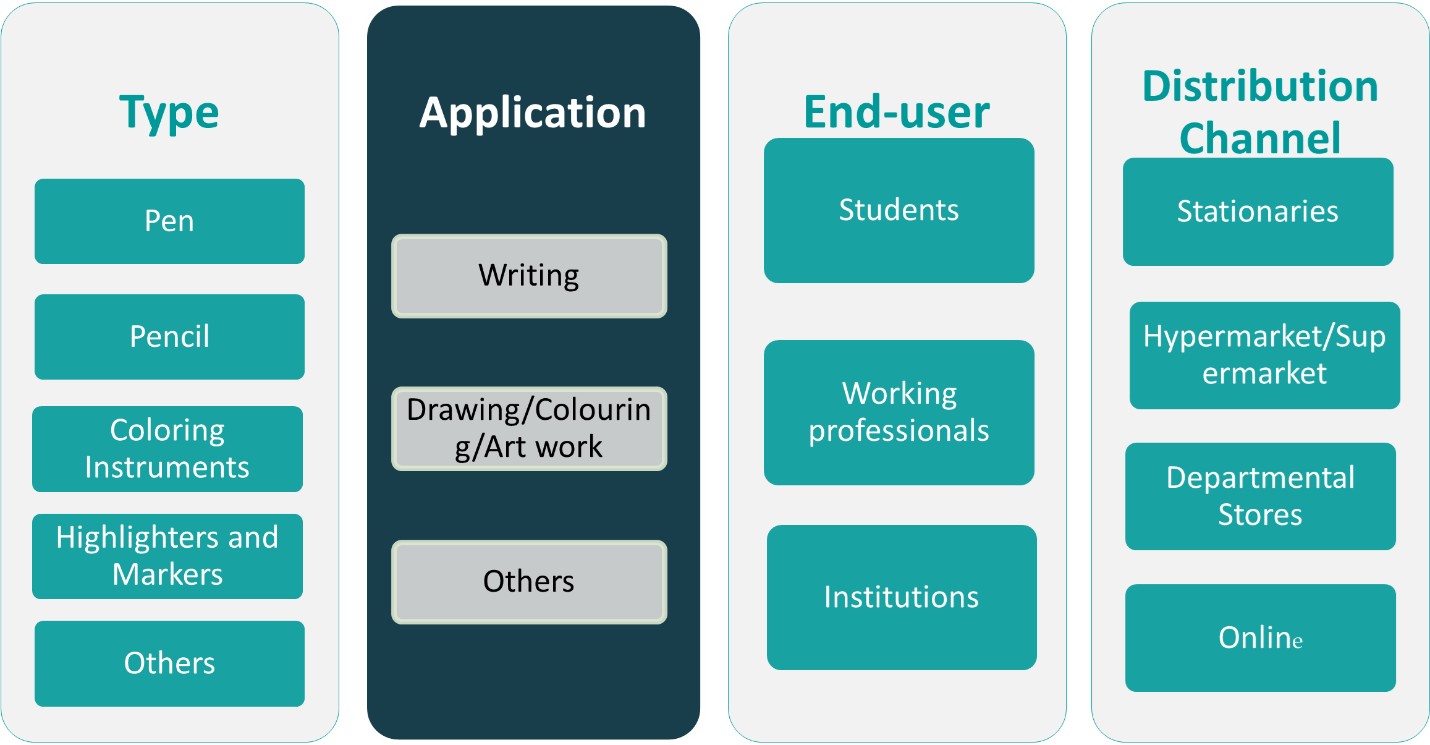
This report segments the Middle East Writing Instruments Market as follows:
Market Drivers
Rising Educational Investments and Literacy Rates
One of the key drivers of the Middle East writing instruments market is the region’s growing focus on education and literacy. For instance, Saudi Arabia’s Vision 2030 initiative emphasizes significant investments in educational infrastructure, including the construction of new schools and universities, as highlighted by the Ministry of Education. These efforts include building new schools and universities, improving learning facilities, and integrating modern teaching methodologies. As a result, the student population continues to grow, leading to a consistent rise in the consumption of writing instruments such as pens, pencils, and markers. Additionally, national literacy campaigns and adult education programs are further fueling the demand for basic writing tools, particularly in rural and underserved regions. This strong emphasis on education not only supports market growth but also encourages the development and distribution of affordable and innovative writing products.
Expanding Corporate Sector and Professional Usage
The rapid expansion of the corporate sector across the Middle East is another crucial factor driving the demand for writing instruments. For instance, the Dubai Chamber of Commerce highlights the growth of free economic zones, which has led to an increase in office establishments and the need for stationery supplies. As businesses in industries such as finance, construction, healthcare, and retail continue to grow, there is an increasing need for office stationery and writing tools for day-to-day professional use. Moreover, business events, seminars, and conferences often involve corporate gifting, where branded writing instruments are used as promotional tools. These trends indicate a steady demand from the professional segment, creating new opportunities for manufacturers and distributors across the Middle East.
Growing Demand for Premium and Personalized Products
A noticeable shift in consumer behavior towards premium and customized writing instruments is also driving market growth. In countries with higher disposable income levels, such as the UAE and Qatar, consumers are increasingly seeking branded, high-quality writing tools for personal and professional use. This trend is particularly strong among students, working professionals, and gift buyers who value aesthetics, durability, and performance. Personalized pens and designer stationery are becoming popular as corporate gifts, academic awards, and luxury accessories. As a result, global and regional brands are introducing product lines with elegant designs, superior ink technology, and ergonomic features to cater to these evolving preferences. The growing gifting culture and focus on individual expression are expected to continue boosting this segment.
Sustainability and Technological Integration
Environmental consciousness is increasingly influencing purchasing decisions, driving demand for eco-friendly writing instruments. Manufacturers are responding by introducing products made from recycled materials, biodegradable components, and refillable ink systems. This shift aligns with broader sustainability goals promoted by regional governments and appeals to environmentally aware consumers. Additionally, the integration of technology is opening new avenues for innovation in the writing instruments market. Smart pens, stylus-enabled devices, and hybrid digital tools are gaining popularity among students, designers, and professionals seeking more interactive and efficient ways to write or draw. These tech-driven innovations, although still a niche, are expected to grow steadily and diversify the product offerings in the Middle East market.
Market Trends
Shift Toward Premium and Branded Writing Instruments
A prominent trend in the Middle East writing instruments market is the increasing consumer preference for premium and branded products. For instance, the Dubai Chamber of Commerce highlights the rising demand for high-quality pens as symbols of professionalism and status, particularly in the UAE and Saudi Arabia. Premium pens are increasingly viewed as symbols of status and professionalism, and they are frequently used for executive gifting, awards, and personal collections. Global brands are capitalizing on this trend by launching limited-edition pens, luxury gift sets, and customized engravings to appeal to this upscale clientele. This shift is driving product innovation and encouraging greater brand competition in the market.
Rising Popularity of Personalized and Gift-Oriented Products
The demand for personalized writing instruments has grown significantly across the Middle East, fueled by both individual consumers and the corporate gifting culture. For instance, the Middle East Council of Shopping Centres highlights the growing trend of customized pens and stationery used as promotional merchandise or employee appreciation gifts. Companies frequently use customized pens and stationery as promotional merchandise or employee appreciation gifts, adding logos, names, and messages for a personalized touch. At the same time, consumers are purchasing engraved pens and stylized stationery for birthdays, graduations, and other special occasions. This trend has opened new opportunities for both global and local manufacturers to offer tailored solutions and value-added services. The popularity of online platforms has further made customization more accessible, boosting sales and brand engagement.
Sustainability Driving Product Development
Sustainability is becoming a key trend influencing product development in the Middle East writing instruments market. With increasing awareness of environmental concerns, consumers are actively seeking eco-friendly alternatives such as pens made from recycled plastics, biodegradable materials, and refillable ink systems. Educational institutions and corporate organizations are also aligning with sustainability goals by choosing greener office supplies. In response, manufacturers are redesigning product lines to reduce environmental impact and are marketing these offerings as environmentally responsible choices. This trend not only supports environmental conservation but also enhances brand reputation and customer loyalty in a competitive market.
Emergence of Smart and Digital Writing Tools
As technology continues to reshape traditional markets, the adoption of smart and digital writing tools is slowly gaining momentum in the Middle East. Smart pens, styluses, and digital notebooks that integrate handwriting with digital devices are increasingly appealing to tech-savvy students, professionals, and designers. These tools enhance productivity, support remote learning, and offer seamless integration with mobile and cloud platforms. Though still a niche segment, the demand for digitally enabled writing instruments is expected to rise as digital literacy increases and hybrid learning environments become more common across the region. This trend is likely to drive long-term innovation and diversification in the writing instruments market.
Market Challenges Analysis
Competition from Digital Alternatives
One of the significant challenges facing the Middle East writing instruments market is the growing preference for digital alternatives, particularly in the education and professional sectors. For instance, the UAE's Telecommunications and Digital Government Regulatory Authority (TDRA) highlights the increasing adoption of e-learning platforms and digital note-taking applications in schools and universities. With the rapid adoption of tablets, smartphones, and laptops, many students and professionals are opting for digital devices that eliminate the need for traditional writing instruments. EThis shift to digital alternatives is posing a direct threat to the demand for conventional writing instruments, especially among tech-savvy younger generations who prioritize convenience and efficiency. The increasing penetration of digital tools is expected to continue, creating a competitive pressure on traditional writing instrument manufacturers to innovate and differentiate their products.
Volatile Raw Material Prices and Supply Chain Disruptions
Another significant challenge in the Middle East writing instruments market is the volatility in raw material prices and ongoing supply chain disruptions. The production of writing instruments heavily relies on raw materials such as plastic, ink, and metal, whose prices can fluctuate due to various global factors, including geopolitical tensions, trade restrictions, and environmental regulations. These fluctuations increase manufacturing costs and may lead to higher retail prices, affecting price-sensitive consumers. Additionally, supply chain disruptions, especially those triggered by global events like the COVID-19 pandemic, have caused delays in production and delivery, impacting inventory levels and customer satisfaction. As a result, manufacturers face challenges in maintaining competitive pricing while ensuring a steady supply of high-quality products. Addressing these challenges requires strategic sourcing, cost management, and adaptive supply chain practices.
Market Opportunities
The Middle East writing instruments market presents several promising opportunities driven by the region’s evolving economic and cultural dynamics. With the continued expansion of the educational sector, particularly in countries like Saudi Arabia and the UAE, there is a growing demand for writing tools at all levels, from primary schools to higher education institutions. As governments focus on enhancing literacy and education infrastructure, the need for affordable and quality writing instruments is on the rise. This creates significant opportunities for manufacturers to supply products that cater to the diverse needs of students and educational institutions. Additionally, the corporate sector’s rapid growth across industries like finance, construction, and technology creates a sustained demand for office stationery and writing products, particularly in the professional sector where quality and branding matter. The expansion of SMEs and the rise in corporate gifting further enhance opportunities for customized and premium writing instruments.
Another opportunity lies in the increasing trend toward sustainability and eco-conscious consumer behavior. As environmental awareness grows in the Middle East, consumers are becoming more inclined to choose eco-friendly and sustainable writing tools. This trend offers manufacturers a chance to innovate with biodegradable materials, refillable ink systems, and products made from recycled content. Additionally, the rise in personalized and branded writing instruments presents a lucrative opportunity for companies to cater to niche markets such as luxury gift segments, promotional items for businesses, and educational awards. The growing interest in digital tools also offers opportunities for manufacturers to develop hybrid products, such as smart pens and stylus-compatible writing instruments, which appeal to tech-savvy consumers seeking multifunctional devices. These evolving market trends position the region’s writing instruments sector for growth, innovation, and diversification.
Market Segmentation Analysis:
By Type:
The Middle East writing instruments market is diverse, with several product types driving growth across various consumer segments. The pen segment holds the largest market share, given its widespread use in schools, offices, and homes for general writing purposes. Pens are available in various designs, from basic ballpoint pens to high-end luxury options, appealing to different income groups. The pencil segment also remains significant, primarily in the educational sector, where it is used for writing and sketching, particularly among students. With a growing interest in art and creativity, the demand for coloring instruments such as crayons, markers, and colored pencils has also risen. This is particularly evident in the increased popularity of art-based hobbies and the expansion of art education in schools. Highlighters and markers are another key category, with applications in office environments, education, and personal use for emphasis and organizing information. Other segments, including specialized writing tools such as fountain pens and styluses, contribute to the market but account for a smaller portion of overall sales.
By Application:
The market for writing instruments in the Middle East can also be segmented based on application, with significant demand in writing, drawing/colouring/artwork, and other categories. Writing remains the dominant application, fueled by the continued use of traditional writing instruments in both educational and professional settings. Schools, universities, and corporate offices form the bulk of demand for pens, pencils, and other writing tools. The growing interest in arts and creative expression, particularly among young adults and children, has driven substantial growth in the drawing/colouring/artwork segment. This trend is reinforced by an expanding culture of art and design education across the region. Additionally, the increasing popularity of digital tools for design and creativity is also influencing this segment. Other applications, such as note-taking, highlighting, and special-use writing instruments, continue to hold relevance, especially in corporate and educational environments, where multifunctionality and ease of use are key priorities. This diverse set of applications highlights the dynamic nature of the market in the Middle East.
Segments:
Based on Type:
- Pen
- Pencil
- Coloring Instruments
- Highlighters and Markers
- Others
Based on Application:
- Writing
- Drawing/Colouring/Art Work
- Others
Based on End- User:
- Students
- Working Professionals
- Institutions
Based on Distribution Channel:
- Stationaries
- Hypermarket/Supermarket
- Departmental Stores
- Online
Based on the Geography:
- UAE
- KSA
- Israel
- Turkey
- Iran
- Rest of Middle East
Regional Analysis
UAE
The UAE holds a significant share of the Middle East writing instruments market, accounting for approximately 25% of the regional market. This can be attributed to the country’s high literacy rate, a booming education sector, and a robust corporate environment. The UAE’s strong demand for writing instruments is driven by both its expanding educational institutions and the corporate sector, with a high emphasis on quality and premium products. Additionally, the UAE’s growing expatriate population and its status as a hub for international trade contribute to the diverse demand for writing instruments. As the country's retail and e-commerce sectors continue to expand, the UAE remains a leading market for both basic and premium writing tools, along with personalized stationery and gift items.
Saudi Arabia (KSA)
Saudi Arabia (KSA) follows closely, accounting for around 22% of the market share in the Middle East. As the largest economy in the region, Saudi Arabia’s market for writing instruments is driven by the growth of its education sector, government initiatives aimed at improving literacy, and the increasing number of businesses and SMEs. The country’s focus on Vision 2030, which emphasizes education and economic diversification, has led to an upsurge in demand for writing tools, particularly in urban areas like Riyadh and Jeddah. Furthermore, the popularity of high-quality pens, including luxury writing instruments, is rising as disposable incomes increase. This growing demand for premium products positions KSA as a key market for manufacturers.
Israel
Israel’s market, though smaller than the UAE and KSA, holds a substantial share of approximately 15%. Israel’s demand for writing instruments is primarily driven by its advanced education system, technology sector, and thriving arts community. The country’s educational institutions, both public and private, contribute significantly to the market, especially in cities like Tel Aviv and Jerusalem. Additionally, the growing trend of digital integration in education and workplaces is influencing the demand for digital pens and smart writing instruments. Despite its smaller market size, Israel represents a niche yet lucrative market for high-tech, premium, and personalized writing tools.
Turkey
Turkey accounts for around 18% of the Middle East writing instruments market, with a diverse demand across both the educational and professional sectors. The country's strong manufacturing base, along with a large student population and an expanding middle class, continues to drive the demand for affordable yet reliable writing tools. Turkey's growing e-commerce sector also plays a significant role in the distribution of writing instruments, as consumers increasingly prefer the convenience of online shopping. The market in Turkey is characterized by a mix of affordable local brands and international premium offerings, making it a dynamic and competitive market in the region.
Rest of the Middle East
The rest of the Middle East, which includes countries like Iran, Lebanon, and Egypt, collectively holds the remaining 20% of the market share. Iran, in particular, has seen steady growth in demand due to its large population and educational needs, although economic challenges have slightly limited its growth compared to other regions. Nonetheless, the overall growth in education and literacy rates across this region, along with a rising demand for premium products, supports the potential for market expansion.
Key Player Analysis
- Lamy
- Montblanc
- Waterman
- Faber-Castell
- Montegrappa
- Pelikan
- Kaweco
- Diplomat
- Aurora
- Sheaffer
- Cello Pens
Competitive Analysis
The competitive landscape of the Middle East writing instruments market is marked by the presence of both global and regional brands. Leading players such as Lamy, Montblanc, Waterman, Faber-Castell, Montegrappa, Pelikan, Kaweco, Diplomat, Aurora, Sheaffer, and Cello Pens dominate the market with a wide range of products catering to various consumer segments. These companies focus on product innovation, quality, and brand loyalty to maintain their market positions. Premium writing tools, including luxury pens and high-end designs, are particularly popular in the corporate gifting and professional use sectors. In contrast, more affordable writing instruments cater to the mass market, with significant demand in educational and office settings. The market also sees competition from eco-friendly and sustainable writing tools as consumer preferences shift towards environmentally conscious products. In addition, there is a growing demand for customized and personalized writing instruments, particularly in the promotional products sector. Players are leveraging online retail platforms to reach a broader customer base, offering convenience and a wider product range. Innovation in digital writing tools, such as smart pens and styluses, has created an opportunity for companies to diversify their offerings and attract tech-savvy consumers. To maintain a competitive edge, brands are increasingly incorporating advanced features, enhancing user experience, and improving their supply chain strategies. This intense competition encourages continuous product development, aiming to meet the evolving needs of both individual and corporate customers in the region.
Recent Developments
- In February 2023, Zebra Pen Corp., a prominent player in the industry, announced its partnership with Liqui-Mark. This collaboration aims to enhance distribution aspects in the market, bringing about a new era of possibilities.
- In July 2023, Montblanc launched its exclusive "Meisterstück 146 LeGrand" fountain pen, featuring a handcrafted design with intricate detailing, addressing the rising demand for personalized, high-end writing tools in luxury segments.
- In April 2022, Zebra Pen Corp. announced the launch of its official website. This step was taken by the company to enhance user experience, increase e-commerce functionality, and improve brand communication, among other objectives.
Market Concentration & Characteristics
The market concentration of writing instruments in the Middle East is relatively fragmented, with a mix of both global and regional players competing for market share. Large multinational brands dominate the premium segment, offering luxury pens and high-end writing tools, while local brands often focus on affordability and catering to mass-market demands, especially in the educational sector. The market is characterized by a broad range of product offerings, from basic pens and pencils to specialized writing instruments like markers, highlighters, and digital tools. Consumer preferences are shifting towards personalization and sustainability, leading companies to innovate with eco-friendly materials and customizable designs. Despite the presence of numerous competitors, the market remains competitive due to increasing demand from the growing education sector, corporate gifting, and retail channels. The rise of online retail platforms is further enhancing accessibility, enabling brands to reach a wider audience across the region.
Report Coverage
The research report offers an in-depth analysis based on Type, Application, End-User, Distribution Channel and Geography. It details leading market players, providing an overview of their business, product offerings, investments, revenue streams, and key applications. Additionally, the report includes insights into the competitive environment, SWOT analysis, current market trends, as well as the primary drivers and constraints. Furthermore, it discusses various factors that have driven market expansion in recent years. The report also explores market dynamics, regulatory scenarios, and technological advancements that are shaping the industry. It assesses the impact of external factors and global economic changes on market growth. Lastly, it provides strategic recommendations for new entrants and established companies to navigate the complexities of the market.
Future Outlook
- The Middle East writing instruments market is expected to witness steady growth driven by increasing demand for quality stationery in both educational and corporate sectors.
- Technological advancements in writing instrument design and functionality will lead to the development of more ergonomic and sustainable products.
- Rising literacy rates and the expansion of educational institutions in the region will drive the demand for writing instruments.
- With the increasing preference for premium writing instruments, manufacturers will focus on offering more luxurious and personalized options.
- The growing trend towards e-learning and digitalization may lead to a shift in demand for traditional writing instruments.
- The region's expanding retail sector, particularly e-commerce, will contribute to the easy availability and accessibility of writing instruments.
- The demand for eco-friendly and sustainable products will lead to the introduction of biodegradable and recyclable writing tools.
- The corporate sector's growing emphasis on gifting high-quality writing instruments will fuel market growth.
- The rising disposable income and changing lifestyle patterns will increase the adoption of premium and high-end writing products.
- The market will see increasing competition as both local and global players enter the region, bringing innovative products and competitive pricing strategies.

Request a Free Sample
Fill in your details and we'll send you a free sample report.
- Sample data tables & charts
- Research methodology
Market Dynamics
Rising Educational Investments and Literacy Rates
Government initiatives across the Middle East, such as Saudi Arabia’s Vision 2030, are increasing investments in educational infrastructure and literacy programs, leading to a growing student population and higher demand for writing instruments in schools and universities.
Expanding Corporate Sector and Professional Usage
The rapid growth of the corporate sector, especially in countries like the UAE and Saudi Arabia, is driving demand for office stationery and writing tools, with businesses requiring quality products for daily operations and corporate gifting.
Growing Demand for Premium and Personalized Products
Higher disposable incomes and a strong gifting culture in markets like the UAE and Qatar are fueling demand for premium, branded, and personalized writing instruments, especially for executive gifting and luxury segments.
Sustainability and Technological Integration
Increasing environmental awareness is pushing manufacturers to offer eco-friendly, refillable, and biodegradable writing instruments, while the adoption of smart pens and digital writing tools is attracting tech-savvy consumers and diversifying product offerings.
Expansion of Retail and E-commerce Channels
The growth of organized retail and e-commerce platforms in the Middle East is making a wide range of writing instruments more accessible, supporting both mass-market and premium product sales across the region.
Need a Custom Version of This Report?
Tailor the scope, geography, or segments to your exact requirements.
- Custom geography or segment scope
- Direct access to our analyst team
Frequently Asked Questions
What is the current size of the Middle East Writing Instruments?
What factors are driving the growth of the Middle East Writing Instruments?
What are some challenges faced by the Middle East Writing Instruments?
Who are the major players in the Middle East Writing Instruments?
Table of Content
Chapter 1 Market Segmentation
- 1.1 Segmentation Framework
- 1.1.1 Product and Service Classification
- 1.1.2 Application and End-Use Classification
- 1.1.3 Technology and Solution Classification
- 1.1.4 Customer and Distribution Channel Classification
- 1.1.5 Geographic Segmentation
- 1.1.6 Market Segment Definitions and Boundaries
- 1.2 By Type
- 1.2.1 Pen
- 1.2.2 Pencil
- 1.2.3 Coloring Instruments
- 1.2.4 Highlighters and Markers
- 1.2.5 Others
- 1.3 By End-User
- 1.3.1 Students
- 1.3.2 Working Professionals
- 1.3.3 Institutions
- 1.4 By Application
- 1.4.1 Writing
- 1.4.2 Drawing/Colouring/Art Work
- 1.4.3 Others
Chapter 2 Introduction
- 2.1 Report Objectives and Scope
- 2.2 Product Definition and Industry Terminology
- 2.3 Market Inclusions and Exclusions
- 2.4 Research Process
- 2.4.1 Primary Research and Expert Interviews
- 2.4.2 Secondary Research and Source Review
- 2.4.3 Top-Down and Bottom-Up Estimation
- 2.4.4 Data Triangulation and Verification
- 2.5 Market Size Measurement Basis
- 2.5.1 2023: USD 456.50 million → 2032: USD 955.17 million
- 2.6 Historical and Forecast Reference Periods
- 2.6.1 Base Year: 2023
- 2.6.2 Forecast Period: 2023-2032
- 2.7 Research Assumptions and Limitations
Chapter 3 Executive Summary
- 3.1 Market Snapshot and Key Findings
- 3.2 Base-Year Market Size, 2023
- 3.3 Forecast Market Size, 2032
- 3.4 Revenue and Volume Growth Outlook
- 3.5 Key Demand and Supply Indicators
- 3.6 Leading Market Segments
- 3.7 Fastest-Growing Market Opportunities
- 3.8 Regional Performance Highlights
- 3.9 Technology and Industry Transformation
- 3.10 Competitive Landscape Summary
- 3.11 Analyst View and Strategic Implications
Chapter 4 Middle East Writing Instruments Market Trends and Developments
- 4.1 Historical Industry Development
- 4.2 Recent Market Trends and Developments
- 4.3 Demand and Customer Behavior Trends
- 4.4 Technology and Product Innovation
- 4.5 Artificial Intelligence, Automation and Digitalization
- 4.6 Local Manufacturing and Supply Chain Realignment
- 4.7 Industry Partnerships, Mergers and Acquisitions
- 4.8 Sustainability and Circular Economy Developments
- 4.9 Government and Private Sector Investment Trends
- 4.10 Emerging Business Models and Commercialization
- 4.11 Industry Developments and Announcements
Chapter 5 Middle East Writing Instruments Market Production, Supply and Demand Analysis
- 5.1 Demand Trend and Consumption Analysis
- 5.2 Demand Forecast, 2023-2032
- 5.3 Production and Output Trend
- 5.4 Production and Output Forecast, 2023-2032
- 5.5 Installed Capacity and Capacity Utilization
- 5.6 Company-Wise Production Plants and Statistics
- 5.6.1 Installed Production Capacity
- 5.6.2 Actual Production
- 5.6.3 Planned Capacity and Expansion Targets
- 5.7 Supply Chain Structure and Procurement Trends
- 5.8 Supply-Demand Gap and Bottlenecks
- 5.9 Import Dependence and Sourcing Structure
- 5.10 Contract Manufacturing and Outsourcing
- 5.11 Regional Supply and Demand Concentration
Chapter 6 Middle East Writing Instruments Market Pricing Analysis
- 6.1 Pricing Structure and Measurement
- 6.2 Historical Pricing Trends
- 6.3 Pricing Outlook, 2023-2032
- 6.4 Average Selling Price and Unit Economics
- 6.5 Pricing by Product and Market Segment
- 6.6 Geographic Pricing Differences
- 6.7 Key Input, Energy, Labor and Logistics Costs
- 6.8 Contract Pricing and Purchasing Models
- 6.9 Pricing Sensitivity and Competitive Positioning
- 6.10 Price, Margin and Profitability Implications
Chapter 7 Middle East Writing Instruments Market Dynamics
- 7.1 Market Growth Drivers
- 7.1.1 Demand-Side Drivers
- 7.1.2 Technology and Innovation Drivers
- 7.1.3 Infrastructure and Investment Drivers
- 7.1.4 Regulatory and Policy Drivers
- 7.2 Market Restraints
- 7.2.1 Cost and Affordability Constraints
- 7.2.2 Technology and Adoption Barriers
- 7.2.3 Supply Chain and Operational Constraints
- 7.3 Market Challenges
- 7.3.1 Competitive Pressure and Margin Erosion
- 7.3.2 Skills, Infrastructure and Implementation Gaps
- 7.4 Emerging Market Opportunities
- 7.5 Market Dynamics Impact and Time-Horizon Assessment
Chapter 8 Middle East Writing Instruments Value Chain Analysis
- 8.1 Industry Value Chain Overview
- 8.2 Upstream Suppliers and Critical Inputs
- 8.3 Technology and Component Providers
- 8.4 Manufacturing or Service Delivery
- 8.5 Distribution, Channel Partners and Integrators
- 8.6 Downstream Applications and End Users
- 8.7 Value Addition and Profit Pools
- 8.8 Vertical Integration and Outsourcing
- 8.9 Supplier Concentration and Risk
- 8.10 Supply Chain Localization and Resilience
Chapter 9 Middle East Writing Instruments Market Regulations and Policies
- 9.1 Relevant Laws, Standards and Compliance Frameworks
- 9.2 Product, Service, Safety and Quality Requirements
- 9.3 Government Policies, Incentives and Subsidies
- 9.4 Imports, Exports and Trade Barriers
- 9.5 Public Procurement and Local Content Requirements
- 9.6 Environmental and Sustainability Compliance
- 9.7 Upcoming Policy Changes and Market Implications
Chapter 10 Middle East Writing Instruments Market Hotspots and Opportunities
- 10.1 Market Opportunity Mapping and Growth Hotspots
- 10.2 High-Growth Applications and Customer Groups
- 10.3 Underserved Markets and White-Space Opportunities
- 10.4 Emerging Technology and Product Opportunities
- 10.5 New Capacity and Investment Hotspots
- 10.6 Market Entry and Expansion Opportunities
- 10.7 Distribution and Partnership Opportunities
- 10.8 Near-Term and Long-Term Commercial Potential
- 10.9 Opportunity Attractiveness and Execution Risks
Chapter 11 Middle East Writing Instruments Market Outlook, 2023-2032
- 11.1 Market Size and Analysis
- 11.1.1 Revenue (Market Measurement: 2023: USD 456.50 million → 2032: USD 955.17 million)
- 11.1.2 Market Volume and Quantity Sold
- 11.1.3 Historical Market Size
- 11.1.4 Base-Year Market Size, 2023
- 11.2 Market Forecast, 2023-2032
- 11.2.1 Revenue Forecast to 2032
- 11.2.2 Volume Forecast to 2032
- 11.2.3 CAGR and Year-on-Year Growth
- 11.2.4 Incremental Revenue Opportunity
- 11.3 Forecast Assumptions and Scenario Analysis
- 11.3.1 Base-Case Forecast
- 11.3.2 Optimistic and Conservative Scenarios
- 11.3.3 Technology, Pricing and Policy Sensitivities
- 11.4 Market Attractiveness and Growth Outlook
Chapter 12 Middle East Writing Instruments Market Segmentation and Outlook
- 12.1 Segmentation Summary and Market Shares, 2023
- 12.2 Largest and Fastest-Growing Segments
- 12.3 By Type - Market Size and Forecast, 2023-2032
- 12.3.1 Segment Definition and Scope
- 12.3.2 Historical Market Size
- 12.3.3 Revenue Forecast, 2023-2032
- 12.3.4 Volume Forecast, 2023-2032
- 12.3.5 Base-Year Market Share, 2023
- 12.3.6 Segment CAGR and Growth Drivers
- 12.3.7 Subsegment Market Size and Forecast
- 12.3.7.1 Pen
- 12.3.7.2 Pencil
- 12.3.7.3 Coloring Instruments
- 12.3.7.4 Highlighters and Markers
- 12.3.7.5 Others
- 12.3.8 Subsegment Pricing and Adoption Trends
- 12.3.9 Leading Suppliers and Competition
- 12.3.10 Regional Demand and Opportunities
- 12.4 By End-User - Market Size and Forecast, 2023-2032
- 12.4.1 Segment Definition and Scope
- 12.4.2 Historical Market Size
- 12.4.3 Revenue Forecast, 2023-2032
- 12.4.4 Volume Forecast, 2023-2032
- 12.4.5 Base-Year Market Share, 2023
- 12.4.6 Segment CAGR and Growth Drivers
- 12.4.7 Subsegment Market Size and Forecast
- 12.4.7.1 Students
- 12.4.7.2 Working Professionals
- 12.4.7.3 Institutions
- 12.4.8 Subsegment Pricing and Adoption Trends
- 12.4.9 Leading Suppliers and Competition
- 12.4.10 Regional Demand and Opportunities
- 12.5 By Application - Market Size and Forecast, 2023-2032
- 12.5.1 Segment Definition and Scope
- 12.5.2 Historical Market Size
- 12.5.3 Revenue Forecast, 2023-2032
- 12.5.4 Volume Forecast, 2023-2032
- 12.5.5 Base-Year Market Share, 2023
- 12.5.6 Segment CAGR and Growth Drivers
- 12.5.7 Subsegment Market Size and Forecast
- 12.5.7.1 Writing
- 12.5.7.2 Drawing/Colouring/Art Work
- 12.5.7.3 Others
- 12.5.8 Subsegment Pricing and Adoption Trends
- 12.5.9 Leading Suppliers and Competition
- 12.5.10 Regional Demand and Opportunities
- 12.6 Segment Growth Comparison
- 12.7 Segment Attractiveness and Priority Matrix
Chapter 13 Middle East Writing Instruments End-Use and Application Market Outlook
- 13.1 End-Use Industry and Customer Demand Structure
- 13.2 Leading Applications and Customer Groups
- 13.3 End-Use Market Size, Share and Forecast
- 13.4 Major End-Use Industry Deep Dives
- 13.4.1 Customer Requirements and Use Cases
- 13.4.2 Demand and Replacement Cycles
- 13.4.3 Technical and Regulatory Considerations
- 13.4.4 Purchasing and Procurement Models
- 13.4.5 Leading Vendors and Distribution Channels
- 13.4.6 Forecast and Commercial Opportunities
- 13.5 Emerging Applications and Cross-Segment Demand
- 13.6 End-Use Industry Investment Priorities
Chapter 14 Middle East Writing Instruments Geographic Market Outlook, 2023-2032
- 14.1 Regional Market Size and Country-Level Shares, 2023
- 14.2 Country Market Size Comparison, 2023
- 14.3 Country Market Forecasts, 2023-2032
- 14.4 Subregional Industrial and Demand Clusters
- 14.5 Intra-Regional Pricing and Cost Differences
- 14.6 Cross-Border Trade and Supply Networks
- 14.7 Regional Supply and Demand Balances
- 14.8 Country Opportunity Comparison and Prioritization
Note: Every listed country is covered on the structure shown under the first country.
Chapter 15 Middle East Writing Instruments Technology, Innovation and Sustainability Outlook
- 15.1 Technology Landscape and Maturity
- 15.2 Product, Process and Service Innovation
- 15.3 AI, Automation and Digital Tools in the Industry
- 15.4 Technology Adoption and Performance Benchmarking
- 15.5 Innovation Pipeline and R&D Investment
- 15.6 Patent and Intellectual Property Trends
- 15.7 Energy Efficiency and Resource Management
- 15.8 Sustainability, Recycling and Circularity
- 15.9 Technology Roadmap, 2023-2032
- 15.10 Risks of Obsolescence and Technology Substitution
Chapter 16 Middle East Writing Instruments Market Key Strategic Imperatives
- 16.1 Growth and Market Entry Priorities
- 16.2 High-Return Products and Segments
- 16.3 Pricing, Profitability and Cost Optimization
- 16.4 Technology Investment and Product Differentiation
- 16.5 Supply Chain Localization and Resilience
- 16.6 Distribution and Customer Acquisition
- 16.7 Partnership, Acquisition and Capacity Strategy
- 16.8 Regional Expansion Priorities
- 16.9 Short-, Medium- and Long-Term Actions
Chapter 17 Competition Outlook
- 17.1 Industry Competition Characteristics
- 17.2 Market Structure and Concentration
- 17.3 Market Share and Competitive Positioning, 2023
- 17.4 Company-Wise Revenue and Product Benchmarking
- 17.5 Production and Service Capacity Benchmarking
- 17.6 Technology, Pricing and Differentiation
- 17.7 Regional Footprint and Distribution Strength
- 17.8 Mergers, Acquisitions and Strategic Alliances
- 17.9 New Entrants and Competitive Threats
- 17.10 Porter's Five Forces and Industry Attractiveness
- 17.11 Competitive Outlook, 2023-2032
Chapter 18 Company Profiles
- 18.1 Company Coverage and Selection Criteria
- 18.2 Lamy
- 18.2.1 Business Description
- 18.2.2 Company Ownership and Geographic Presence
- 18.2.3 Product and Service Portfolio
- 18.2.4 Manufacturing and Operating Footprint
- 18.2.5 Production Capacity and Expansion Plans
- 18.2.6 Financial Performance and Investment
- 18.2.7 Market Share and Competitive Position
- 18.2.8 Technology and Innovation Capabilities
- 18.2.9 Strategic Alliances or Partnerships
- 18.2.10 Recent Developments
- 18.2.11 Growth Strategy and Outlook
- 18.3 Montblanc
- 18.4 Waterman
- 18.5 Faber-Castell
- 18.6 Montegrappa
- 18.7 Pelikan
- 18.8 Kaweco
- 18.9 Diplomat
- 18.10 Aurora
- 18.11 Cello Pens
- 18.12 Other Relevant Market Participants
Note: Every listed company is profiled on the structure shown under the first company. The company list is preliminary and may change based on research findings, market developments, data availability and client requirements.
Chapter 19 Disclaimer
- 19.1 Research and Forecast Disclaimer
- 19.2 Data Source and Estimation Limitations
Note: The depth of individual sections depends on data availability for this market. Volume, capacity, trade and other unit-based metrics are included where applicable.

