
Market Overview
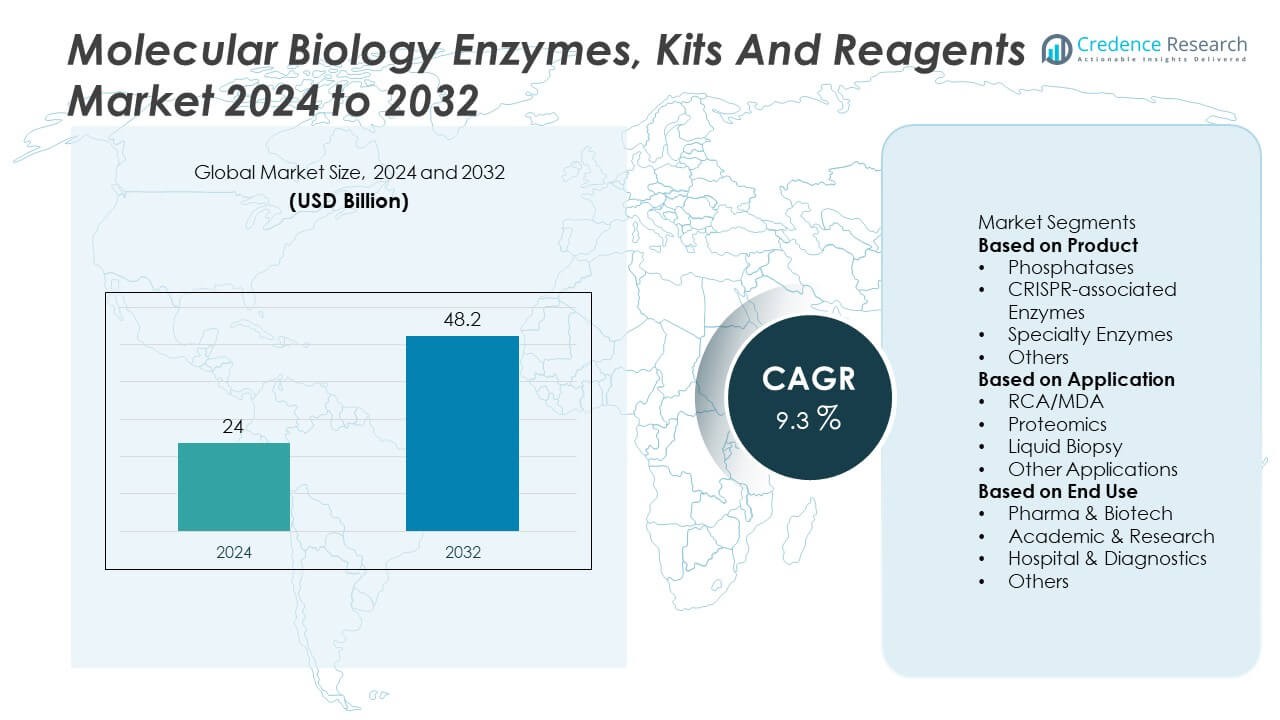
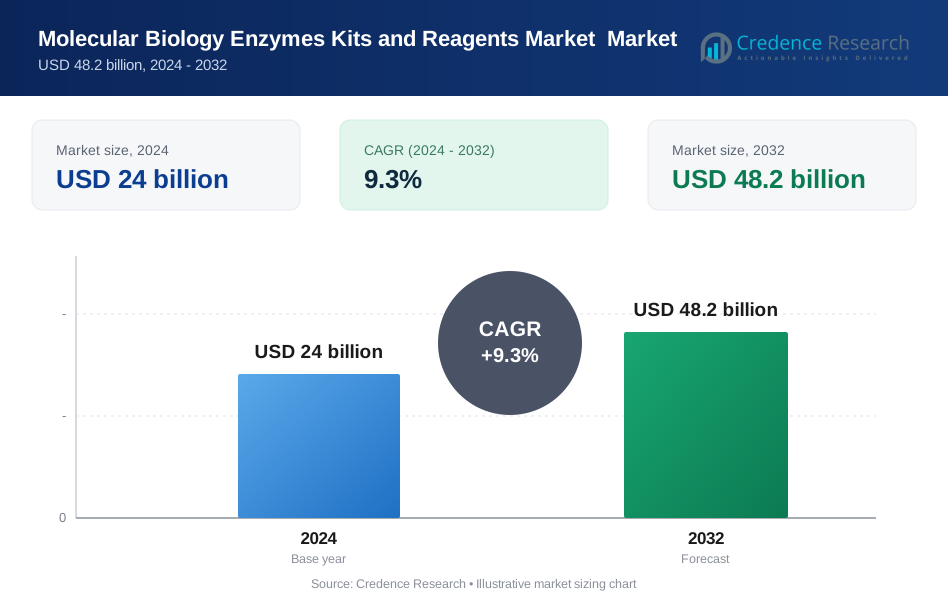
The Molecular Biology Enzymes, Kits, and Reagents Market was valued at USD 24 billion in 2024 and is projected to reach USD 48.2 billion by 2032, growing at a CAGR of 9.3% during the forecast period.
| REPORT ATTRIBUTE | DETAILS |
|---|---|
| Historical Period | 2020-2023 |
| Base Year | 2024 |
| Forecast Period | 2025-2032 |
| Molecular Biology Enzymes, Kits, and Reagents Market Size 2024 | USD 24 Billion |
| Molecular Biology Enzymes, Kits, and Reagents Market, CAGR | 9.3% |
| Molecular Biology Enzymes, Kits, and Reagents Market Size 2032 | USD 48.2 Billion |
The molecular biology enzymes, kits, and reagents market is led by major players including Takara Bio, Inc., Agilent Technologies, Inc., Bio-Rad Laboratories, Inc., Promega Corporation, QIAGEN, Illumina, Inc., New England Biolabs, Merck KGaA, F. Hoffmann-La Roche Ltd., and Thermo Fisher Scientific, Inc. These companies dominate through advanced product portfolios, strong R&D investments, and strategic collaborations across biotechnology and diagnostics sectors. North America holds the leading regional position with a 39.2% share in 2024, supported by extensive research infrastructure and high adoption of genomic technologies. Europe follows with a 30.1% share, driven by government-funded life science programs, while Asia-Pacific captures 22.8%, emerging rapidly through expanding biopharma research and healthcare modernization.
Market Insights
- The molecular biology enzymes, kits, and reagents market was valued at USD 24 billion in 2024 and is projected to reach USD 48.2 billion by 2032, growing at a CAGR of 9.3%.
- Rising demand for genomic and proteomic research, driven by advances in personalized medicine and diagnostics, continues to boost market growth across developed and emerging economies.
- Increasing adoption of automation, AI-based workflows, and CRISPR technologies is shaping market trends, enhancing laboratory efficiency and accuracy.
- Key players such as Thermo Fisher Scientific, QIAGEN, Merck KGaA, and Illumina are investing in R&D, partnerships, and product innovation to strengthen market presence and technology leadership.
- North America leads with a 39.2% share, followed by Europe at 30.1% and Asia-Pacific at 22.8%, while the specialty enzymes segment dominates product categories with 46.8% share, supported by its critical role in PCR, sequencing, and proteomic applications.
Market Segmentation Analysis:
By Product
The specialty enzymes segment dominates the molecular biology enzymes, kits, and reagents market, accounting for 46.8% share in 2024. Its leadership stems from the increasing use of polymerases, ligases, and restriction enzymes in genomic research and molecular diagnostics. Growing applications in PCR amplification, sequencing, and cloning drive demand. Continuous development of high-fidelity and heat-stable enzymes enhances research efficiency and accuracy. Expanding use in next-generation sequencing and genetic modification studies further strengthens this segment’s position over phosphatases, CRISPR-associated enzymes, and other enzyme categories.
- For instance, Thermo Fisher Scientific, Inc.’s Platinum SuperFi II DNA Polymerase offers a fidelity greater than 300× that of Taq DNA Polymerase when assessed by NGS-based error-rate analysis.
By Application
The proteomics segment leads the market with 41.2% share in 2024. Its dominance is attributed to the growing demand for protein identification, biomarker discovery, and drug target analysis. The rising integration of mass spectrometry and advanced analytical workflows boosts the use of reagents and kits designed for protein analysis. Expanding pharmaceutical R&D and personalized medicine initiatives further support this segment. Liquid biopsy and RCA/MDA applications are also gaining traction as precision medicine and non-invasive testing technologies advance.
- For instance, Illumina, Inc.’s Protein Prep assay can quantify around 9,500 unique human protein targets from a single plasma or serum sample using NGS-based workflows.
By End Use
Pharma & biotech companies hold the largest market share of 52.4% in 2024. Their dominance is driven by rising investments in drug discovery, genetic research, and biopharmaceutical production. The demand for efficient and reliable enzyme-based kits and reagents is increasing to support large-scale testing and process development. Additionally, expanding collaborations between biotech firms and academic institutions are accelerating innovation. Hospital and diagnostic laboratories are also growing rapidly due to the rising adoption of molecular assays for disease detection and monitoring.
Key Growth Drivers
Rising Demand for Genomic and Proteomic Research
The expanding focus on genomics and proteomics is driving strong demand for molecular biology enzymes, kits, and reagents. Increased investment in genetic sequencing, biomarker discovery, and protein profiling supports product adoption. Research institutions and pharmaceutical companies are utilizing advanced molecular tools for precision medicine, drug development, and diagnostics. This surge in R&D activities accelerates the need for high-quality, efficient enzymes and reagents that enable accurate and reproducible molecular analysis.
- For instance, New England Biolabs reported their engineered ligase profile enabled assembly of more than 20 DNA fragments in a single reaction with over 90 % success rate for a 24-fragment construct.
Technological Advancements in Molecular Biology Tools
Continuous innovation in enzyme engineering, next-generation sequencing (NGS), and PCR technologies enhances performance and reliability in molecular biology workflows. Modern enzyme formulations with higher specificity and stability are improving experimental accuracy. Integration of automation and digital systems streamlines laboratory operations, reducing manual errors and boosting throughput. These advancements make molecular tools more accessible and cost-effective, fostering their use across academic, clinical, and industrial research environments.
- For instance, Agilent Technologies’s D5000 ScreenTape assay achieved detection sensitivity down to 5 pg/µL DNA, with sizing precision of about 3.8% CV for a 1,000 bp fragment.
Expanding Applications in Clinical Diagnostics and Biopharma
Growing utilization of molecular biology enzymes in diagnostics and biopharmaceutical manufacturing is a major growth driver. Enzyme-based kits play a vital role in liquid biopsy, infectious disease testing, and genetic screening. Biopharma companies rely on high-quality reagents for recombinant protein production and therapeutic development. Increasing focus on personalized medicine and rapid diagnostic assays further propels demand, strengthening the clinical and industrial importance of these molecular products.
Key Trends & Opportunities
Growing Adoption of CRISPR and Gene Editing Technologies
CRISPR-associated enzymes are gaining prominence as researchers increasingly apply gene editing for therapeutic and agricultural innovation. The rising use of CRISPR-Cas systems enhances demand for specialized molecular reagents. Companies are investing in developing high-precision enzymes and ready-to-use kits that simplify complex genome editing workflows. This trend presents strong opportunities for market players to expand portfolios and tap into emerging synthetic biology applications.
- For instance, Merck KGaA announced that it now holds 22 CRISPR-related patents across nine geographies, underpinning its genome-editing reagent portfolio.
Increasing Integration of Automation and AI in Molecular Workflows
Automation and artificial intelligence are reshaping molecular biology laboratories. Automated liquid handling systems, AI-assisted data analysis, and cloud-based platforms are improving accuracy and operational efficiency. These technologies optimize reagent usage and speed up result interpretation, enabling high-throughput experimentation. The trend supports wider adoption of molecular biology tools in diagnostics, drug discovery, and academic research by reducing complexity and enhancing reproducibility.
- For instance, Thermo Fisher Scientific, Inc. introduced a real-time PCR automation solution capable of processing up to 6 000 samples in a single day, enabling significantly scaled throughput for molecular workflows.
Key Challenges
High Cost of Advanced Molecular Reagents and Kits
The significant cost of specialized enzymes and reagent kits limits accessibility in small and mid-sized laboratories. Premium-grade molecular biology products require expensive manufacturing and quality control processes, increasing overall pricing. This creates affordability challenges, particularly in emerging economies. Limited funding for academic and public research institutions further constrains large-scale adoption of advanced molecular tools, slowing market penetration.
Storage and Stability Constraints of Molecular Products
Molecular biology enzymes and reagents often require stringent storage conditions, including controlled temperatures and handling protocols. Improper storage can degrade enzyme activity and compromise test accuracy. These stability issues raise logistical challenges for distribution and long-term inventory management. The need for cold-chain storage and specialized packaging increases operational costs, especially in regions with limited laboratory infrastructure.
Regional Analysis
North America
North America dominates the molecular biology enzymes, kits, and reagents market with a 39.2% share in 2024. The region’s leadership is driven by robust biotechnology and pharmaceutical industries, high R&D expenditure, and early adoption of advanced molecular tools. The United States leads the market with significant investments in genomic research, proteomics, and personalized medicine initiatives. Growing funding from organizations such as the NIH and rapid integration of automation in laboratories further strengthen market growth. Canada also contributes through expanding academic research and strong collaborations with global biotech firms.
Europe
Europe holds a 30.1% share in the molecular biology enzymes, kits, and reagents market in 2024. The region benefits from strong public funding for life science research and a well-established academic infrastructure. Countries like Germany, the U.K., and France are key contributors, emphasizing proteomics, genomic sequencing, and molecular diagnostics. The growing adoption of CRISPR technologies and biomarker research supports the expansion of reagent demand. Additionally, the presence of leading companies such as Qiagen and Merck enhances Europe’s innovation ecosystem, driving continuous technological development and broader research applications.
Asia-Pacific
Asia-Pacific accounts for 22.8% of the molecular biology enzymes, kits, and reagents market in 2024. Rapid growth in the biotechnology sector across China, Japan, and India fuels strong demand for molecular tools. Government-led genomic initiatives and increasing investments in precision medicine are accelerating adoption. The region is also witnessing a surge in biopharmaceutical production and academic research output. Affordable manufacturing capabilities and strategic collaborations between local and global firms are boosting supply chain efficiency. Rising healthcare expenditure and disease awareness further position Asia-Pacific as a key growth hub for molecular diagnostics.
Latin America
Latin America captures 4.7% of the molecular biology enzymes, kits, and reagents market in 2024. The region is experiencing steady growth supported by improving research infrastructure and greater focus on disease diagnostics. Brazil and Mexico lead the market, driven by academic research expansion and adoption of molecular tools in healthcare. Increasing partnerships with global biotech firms are enabling access to high-quality reagents and enzyme technologies. However, limited funding for large-scale research and high product costs pose challenges to rapid adoption across the region.
Middle East & Africa
The Middle East & Africa region holds a 3.2% share in the molecular biology enzymes, kits, and reagents market in 2024. Growth is supported by rising investments in laboratory infrastructure, healthcare modernization, and infectious disease research. Countries such as Saudi Arabia, the UAE, and South Africa are increasingly adopting molecular testing technologies in diagnostics and academic research. The establishment of new research centers and collaborations with international biotech companies are strengthening market presence. However, limited technical expertise and infrastructure gaps continue to restrain wider adoption of advanced molecular biology products.
Market Segmentations:
By Product
- Phosphatases
- CRISPR-associated Enzymes
- Specialty Enzymes
- Others
By Application
- RCA/MDA
- Proteomics
- Liquid Biopsy
- Other Applications
By End Use
- Pharma & Biotech
- Academic & Research
- Hospital & Diagnostics
- Others
By Geography
- North America
- U.S.
- Canada
- Mexico
- Europe
- Germany
- France
- U.K.
- Italy
- Spain
- Rest of Europe
- Asia Pacific
- China
- Japan
- India
- South Korea
- South-east Asia
- Rest of Asia Pacific
- Latin America
- Brazil
- Argentina
- Rest of Latin America
- Middle East & Africa
- GCC Countries
- South Africa
- Rest of the Middle East and Africa
Competitive Landscape
The competitive landscape of the molecular biology enzymes, kits, and reagents market is defined by the strong presence of leading players such as Takara Bio, Inc., Agilent Technologies, Inc., Bio-Rad Laboratories, Inc., Promega Corporation, QIAGEN, Illumina, Inc., New England Biolabs, Merck KGaA, F. Hoffmann-La Roche Ltd., and Thermo Fisher Scientific, Inc. These companies focus on product innovation, technological enhancement, and strategic collaborations to strengthen their market positions. Continuous advancements in enzyme formulations, next-generation sequencing, and molecular diagnostics are driving competition. Players are expanding their product portfolios with high-performance reagents, CRISPR-based kits, and automation-compatible solutions. Partnerships with research institutes and biopharmaceutical companies are enabling innovation in precision medicine and genetic research. Mergers and acquisitions remain key strategies to broaden geographical presence and improve supply chain efficiency. The overall market is evolving toward high-quality, reliable, and cost-effective molecular solutions that enhance research productivity and diagnostic accuracy worldwide.
Key Player Analysis
- Takara Bio, Inc.
- Agilent Technologies, Inc.
- Bio-Rad Laboratories, Inc.
- Promega Corporation
- QIAGEN
- Illumina, Inc.
- New England Biolabs
- Merck KGaA
- Hoffmann-La Roche Ltd.
- Thermo Fisher Scientific, Inc.
Recent Developments
- In October 2025, Illumina released its 5-base solution enabling simultaneous detection of genomic variants and DNA methylation in a single workflow.
- In April 2025, QIAGEN N.V. launched the QIAprep & Plasmodium Kit enabling detection of all five malaria-causing parasites in a streamlined workflow via qPCR.
- In November 2024, Takara Bio announced a high-throughput, cost-effective qPCR system (with associated kits and reagents) for clinical research.
- In October 2024, Takara Bio, Inc. expanded its Gothenburg site to offer customised molecular biology products including PCR and qPCR enzymes.
Report Coverage
The research report offers an in-depth analysis based on Product, Application, End Use and Geography. It details leading market players, providing an overview of their business, product offerings, investments, revenue streams, and key applications. Additionally, the report includes insights into the competitive environment, SWOT analysis, current market trends, as well as the primary drivers and constraints. Furthermore, it discusses various factors that have driven market expansion in recent years. The report also explores market dynamics, regulatory scenarios, and technological advancements that are shaping the industry. It assesses the impact of external factors and global economic changes on market growth. Lastly, it provides strategic recommendations for new entrants and established companies to navigate the complexities of the market.
Future Outlook
- Demand for molecular biology reagents will grow with rising genomic and proteomic research activities.
- Adoption of automation and AI-based platforms will enhance laboratory productivity and precision.
- CRISPR and gene editing technologies will open new opportunities in therapeutic and agricultural research.
- Next-generation sequencing and PCR advancements will continue to drive innovation in diagnostics.
- Biopharmaceutical companies will expand enzyme and reagent usage in drug discovery and vaccine development.
- Point-of-care molecular testing will gain traction in clinical and decentralized settings.
- Emerging economies will experience rapid adoption through healthcare modernization and research funding.
- Partnerships between academia and industry will accelerate development of advanced molecular tools.
- Sustainable and high-stability reagents will see rising demand for eco-efficient operations.
- Expansion of digital and cloud-based laboratory solutions will improve workflow integration and data management.
Request a Free Sample
Fill in your details and we'll send you a free sample report.
- Sample data tables & charts
- Research methodology
Need a Custom Version of This Report?
Tailor the scope, geography, or segments to your exact requirements.
- Custom geography or segment scope
- Direct access to our analyst team
Frequently Asked Questions
What is the current market size for Molecular Biology Enzymes, Kits and Reagents Market, and what is its projected size in 2032?
At what Compound Annual Growth Rate is the Molecular Biology Enzymes, Kits and Reagents Market projected to grow between 2025 and 2032?
Which Molecular Biology Enzymes, Kits and Reagents Market segment held the largest share in 2024?
What are the primary factors fueling the growth of the Molecular Biology Enzymes, Kits and Reagents Market?
Who are the leading companies in the Molecular Biology Enzymes, Kits and Reagents Market?
Which region commanded the largest share of the Molecular Biology Enzymes, Kits and Reagents Market in 2024?
Table of Content
Chapter 1. Report Introduction
- 1.1 Report Description & Purpose
- 1.1.1 Report Title & Market Definition
- 1.1.2 Unique Selling Propositions (USP) & Key Differentiators
- 1.1.3 Value Proposition for Stakeholders
- 1.2 Research Objectives
- 1.2.1 Market Sizing Objectives (Volume & Revenue) (Volume Where Applicable)
- 1.2.2 Segmentation Objectives
- 1.2.3 Competitive Intelligence Objectives
- 1.2.4 Forecast & Scenario Objectives
- 1.3 Report Scope
- 1.3.1 Molecular Biology Enzymes Kits and Reagents Market Scope – Segments & Subsegments Covered
- 1.3.2 Geographic Scope – Regions & Countries Covered
- 1.3.3 Historical Period, Base Year & Forecast Period (2024; forecast to 2032)
- 1.3.4 Inclusions & Exclusions
- 1.4 Industry Classification & Applicable Codes
- 1.5 Currency, Measurement Units & Valuation Basis
- 1.6 Target Stakeholders
- 1.7 Limitations & Assumptions
Chapter 2. Executive Summary
- 2.1 Global Molecular Biology Enzymes Kits and Reagents Market Market Snapshot
- 2.1.1 Market Size – Historical (2024) & Forecast (2024-2032) (2024: USD 24 billion → 2032: USD 48.2 billion)
- 2.1.2 Volume & Revenue – Global Totals (Volume Where Applicable)
- 2.1.3 Key Market Highlights – Top Five Facts
- 2.2 Molecular Biology Enzymes Kits and Reagents Market Market Segmentation Snapshot
- 2.2.1 Market Split by Region – 2024 vs. 2032
- 2.3 Competitive Snapshot
- 2.3.1 Top 10 Players by Revenue Share – 2024
- 2.3.2 Top 10 Players by Volume Share – 2024 (Volume Where Applicable)
- 2.3.3 Recent Strategic Developments (18-Month Summary)
- 2.4 Key Investment Highlights & Strategic Conclusions
Chapter 3. Molecular Biology Enzymes Kits and Reagents Market Market Dynamics & Industry Analysis
- 3.1 Market Overview & Context
- 3.1.1 Molecular Biology Enzymes Kits and Reagents Market Market Position in the Broader Industry Value Chain
- 3.1.2 Demand Structure & Purchasing Dynamics
- 3.1.3 Market Maturity & Development Stage by Region
- 3.2 Molecular Biology Enzymes Kits and Reagents Market Market Drivers
- 3.3 Molecular Biology Enzymes Kits and Reagents Market Market Restraints & Challenges
- 3.4 Molecular Biology Enzymes Kits and Reagents Market Market Opportunities
- 3.5 Porter's Five Forces Analysis
- 3.5.1 Threat of New Entrants
- 3.5.2 Bargaining Power of Suppliers
- 3.5.3 Bargaining Power of Buyers
- 3.5.4 Threat of Substitutes
- 3.5.5 Competitive Rivalry – Intensity Assessment
- 3.6 Molecular Biology Enzymes Kits and Reagents Market Value Chain Analysis
- 3.6.1 Upstream – Key Inputs, Resources & Suppliers
- 3.6.1.1 Key Input/Resource 1
- 3.6.1.2 Key Input/Resource 2
- 3.6.1.3 Key Input/Resource 3
- 3.6.2 Midstream – Core Operations & Value Creation
- 3.6.2.1 Operating Model & Process Overview
- 3.6.2.2 Key Operating Locations & Capabilities by Company
- 3.6.3 Downstream – Market Channels & End Users
- 3.6.3.1 Direct Sales & Customer Engagement Channels
- 3.6.3.2 Indirect Sales, Intermediaries & Partner Channels
- 3.6.4 Value Chain Profitability Analysis
- 3.6.1 Upstream – Key Inputs, Resources & Suppliers
- 3.7 PESTEL Analysis
- 3.7.1 Political Factors
- 3.7.2 Economic Factors
- 3.7.3 Social Factors
- 3.7.4 Technological Factors
- 3.7.5 Environmental Factors
- 3.7.6 Legal Factors
- 3.8 Molecular Biology Enzymes Kits and Reagents Market Supply Chain Analysis
- 3.8.1 Critical Input & Resource Availability Risk Assessment
- 3.8.2 Supplier & Operational Concentration Risk (Geographic Exposure)
- 3.8.3 Supply & Service Disruption Impact Analysis
- 3.9 Regulatory & Policy Landscape
Note: The regulatory and policy landscape section covers regulations based on their applicability to the market, Molecular Biology Enzymes Kits and Reagents Market category, geography, and scope of the study. Only regulatory frameworks with a material impact on operations, compliance, trade, sustainability, or market access are analyzed in detail.
Chapter 4. Key Investment Pockets & Opportunity Analysis
- 4.1 Molecular Biology Enzymes Kits and Reagents Market Market Attractiveness Analysis
- 4.1.1 By Region – Investment Attractiveness Matrix (Market Size × CAGR)
- 4.2 Absolute Revenue Growth Opportunity
- 4.2.1 By Region – Absolute Revenue Growth Through 2032
- 4.3 Incremental Demand Opportunity
- 4.3.1 By Region – Incremental Demand Through 2032
- 4.3.2 Segment – Incremental Demand
- 4.4 Emerging Submarket Opportunity Deep Dive (Subject to Applicability)
- 4.5 Priority Market Opportunity Scorecards
- 4.5.1 United States
- 4.5.2 Europe
- 4.5.3 Asia
- 4.5.4 Middle East & Africa
Note: Priority market opportunity scorecards reflect the geographic scope and strategic relevance of the study. Listed markets are indicative and may be adapted to the industry.
Chapter 5. Molecular Biology Enzymes Kits and Reagents Market Cross-Border Trade & Market Access Analysis
- 5.1 International Trade & Cross-Border Activity Overview
- 5.1.1 Global Export Value by Country (2024)
- 5.1.2 Global Export Volume by Country (2024) (Volume Where Applicable)
- 5.1.3 Global Import Value by Country (2024)
- 5.1.4 Global Import Volume by Country (2024) (Volume Where Applicable)
- 5.1.5 Net Trade Balance by Country (2024)
- 5.2 Export Analysis – Segment
- 5.2.1 Category 1 (Applicable Classification Code)
- 5.2.2 Category 2 (Applicable Classification Code)
- 5.2.3 Category 3 (Applicable Classification Code)
- 5.2.4 Category 4 (Applicable Classification Code)
- 5.2.5 Category 5 (Applicable Classification Code)
- 5.3 Import Analysis – Segment
- 5.3.1 Category 1 (Applicable Classification Code)
- 5.3.2 Category 2 (Applicable Classification Code)
- 5.3.3 Category 3 (Applicable Classification Code)
- 5.3.4 Category 4 (Applicable Classification Code)
- 5.3.5 Category 5 (Applicable Classification Code)
- 5.4 Cross-Border Pricing & Transaction Benchmarks
- 5.4.1 Export Pricing – Segment & Country
- 5.4.2 Import Pricing – Segment & Source Country
- 5.4.3 Price Trends (2024)
- 5.5 Key Cross-Border Trade & Delivery Routes
- 5.5.1 Cross-Border Trade/Delivery Route 1
- 5.5.2 Cross-Border Trade/Delivery Route 2
- 5.5.3 Cross-Border Trade/Delivery Route 3
- 5.5.4 Cross-Border Trade/Delivery Route 4
- 5.5.5 Cross-Border Trade/Delivery Route 5
- 5.6 Trade Policy & Market Access Impact Assessment
- 5.6.1 Tariff & Non-Tariff Barriers
- 5.6.2 Regional Trade & Economic Integration Frameworks
- 5.6.3 Bilateral & Multilateral Trade Agreements
- 5.6.4 Cross-Border Operating, Licensing & Localization Requirements
Note: This chapter applies where cross-border trade or delivery is relevant to Molecular Biology Enzymes Kits and Reagents Market . Goods, services, and digital offerings are assessed using applicable classifications and transaction measures. Import-export volumes, trade balances, and route analyses are included only where meaningful to the market.
Chapter 6. Competitive Landscape & Company Benchmarking
- 6.1 Molecular Biology Enzymes Kits and Reagents Market Market Concentration & Structure
- 6.1.1 Herfindahl-Hirschman Index (HHI) – vs. 2024
- 6.1.2 Leading, Mid-Sized & Emerging Player Structure
- 6.1.3 Global, Regional & Local Player Dynamics
- 6.2 Molecular Biology Enzymes Kits and Reagents Market Market Share Analysis – 2024
- 6.2.1 Global Revenue Share by Company
- 6.2.2 Global Volume Share by Company (Volume Where Applicable)
- 6.2.3 Regional Revenue Share
- 6.2.4 Market Share Evolution ( vs. 2024)
- 6.2.5 Company Market Share by Key Segment
- 6.2.6 Company Market Share by Customer Group
- 6.3 Operating Scale, Capacity & Infrastructure Analysis
- 6.3.1 Global Operating Scale & Supply Capacity
- 6.3.2 Resource Utilization & Operating Efficiency
- 6.3.3 Output, Service Delivery & Activity Metrics
- 6.3.4 Operating Footprint & Infrastructure Map
- 6.3.5 Planned Operational & Capacity Expansion
- 6.4 Molecular Biology Enzymes Kits and Reagents Market Competitive Benchmarking Matrix
- 6.4.1 Revenue, Growth, Profitability & Operating Metric Comparison
- 6.4.2 Channel Revenue Mix
- 6.4.3 Geographic Revenue Exposure
- 6.4.4 R&D Intensity
- 6.4.5 Sustainability Maturity
- 6.5 Strategic Developments in Molecular Biology Enzymes Kits and Reagents Market (Last 24 Months)
- 6.5.1 Mergers, Acquisitions & Divestments
- 6.5.2 New Products, Services & Solutions in Molecular Biology Enzymes Kits and Reagents Market
- 6.5.3 Operational & Infrastructure Expansions
- 6.5.4 Strategic Alliances, Joint Ventures & Partnerships
- 6.5.5 Distribution Expansion & Market Entry
- 6.5.6 Sustainability & ESG Initiatives
- 6.6 Competitive Strategy Mapping
- 6.6.1 Leader, Challenger, Follower & Niche Classification
- 6.6.2 Pricing Strategy Comparison
- 6.6.3 Channel Strategy Matrix
Note: Strategic developments are included based on their materiality and the availability of reliable information.
Chapter 7. Global Molecular Biology Enzymes Kits and Reagents Market Market – By Sales & Delivery Channel
- 7.1 Segment Overview
- 7.1.1 Volume & Revenue Split by Channel (2024 & 2032) (Volume Where Applicable)
- 7.1.2 Channel Mix Evolution (2024-2032)
Chapter 8. Regional Market Analysis – Global Overview
- 8.1 Global Regional Overview
- 8.1.1 Regional Volume Share (Volume Where Applicable)
- 8.1.2 Regional Revenue Share
- 8.1.3 Regional Volume by Region (Volume Where Applicable)
- 8.1.4 Regional Revenue by Region
- 8.1.5 Regional Forecast Through 2032
- 8.2 Cross-Regional Segment Analysis
- 8.2.1 By Sales & Delivery Channel
- 8.2.2 By Competitive Positioning & Price Tier
Chapter 9. North America Molecular Biology Enzymes Kits and Reagents Market Market
- 9.1 United States
- 9.2 Canada
- 9.3 Mexico
Chapter 10. Europe Molecular Biology Enzymes Kits and Reagents Market Market
- 10.1 Germany
- 10.2 France
- 10.3 Italy
- 10.4 United Kingdom
- 10.5 Spain
- 10.6 Poland
- 10.7 Russia
- 10.8 Netherlands
- 10.9 Belgium
- 10.10 Sweden
- 10.11 Denmark
- 10.12 Norway
- 10.13 Rest of Europe
Chapter 11. Asia Pacific Molecular Biology Enzymes Kits and Reagents Market Market
- 11.1 China
- 11.2 India
- 11.3 Japan
- 11.4 South Korea
- 11.5 Thailand
- 11.6 Indonesia
- 11.7 Vietnam
- 11.8 Malaysia
- 11.9 Australia
- 11.10 Rest of Asia Pacific
Chapter 12. Latin America Molecular Biology Enzymes Kits and Reagents Market Market
- 12.1 Brazil
- 12.2 Argentina
- 12.3 Colombia
- 12.4 Chile
- 12.5 Rest of Latin America
Chapter 13. Middle East Molecular Biology Enzymes Kits and Reagents Market Market
- 13.1 Saudi Arabia
- 13.2 United Arab Emirates
- 13.3 Turkey
- 13.4 Israel
- 13.5 Iran
- 13.6 Rest of the Middle East
Chapter 14. Africa Molecular Biology Enzymes Kits and Reagents Market Market
- 14.1 South Africa
- 14.2 Egypt
- 14.3 Nigeria
- 14.4 Morocco
- 14.5 Rest of Africa
Chapter 15. Molecular Biology Enzymes Kits and Reagents Market Company Profiles
- 15.1 [Company 01]
- 15.1.1 Company Overview
- 15.1.2 Key Management Personnel
- 15.1.3 Products & Services Portfolio
- 15.1.4 Financial Performance
- 15.1.5 Key Market Focus & Geographic Presence
- 15.1.6 Recent Developments & Strategic Initiatives
Note: The company profile list is preliminary and may change based on research findings, market developments, data availability, and client requirements.
Chapter 16. Appendices
- Appendix A – List of Abbreviations & Acronyms
- Appendix B – Industry Classification Code Reference – Full Series
- Appendix C – Supply, Output & Operating Capacity Data Tables
- Appendix D – End-Use & Demand Base Tables
- Appendix E – Demand, Adoption & Usage Assumptions
- Appendix F – Pricing & Revenue Metric Reference Tables
- Appendix G – Company Operations & Infrastructure Database
- Appendix H – Cross-Border Trade & Activity Data Tables (Where Applicable)
- Appendix I – Regulatory Summary Tables
- Appendix J – Primary Research Participant List (Anonymized)
- Appendix K – Primary Research Questionnaire Framework
- Appendix L – Data Sources & Bibliography
- Appendix M – Market Size Divergence & Source Comparison
Chapter 17. Research Methodology
- 17.1 Research Framework & Philosophy
- 17.2 Secondary Research – Sources, Hierarchy & Data Extraction
- 17.3 Data Modeling – Bottom-Up & Top-Down Market Sizing
- 17.4 Primary Research – Stakeholder Framework, LOI & Sample Sizes
- 17.5 Forecast Methodology – Regression, Scenario & Sensitivity Analysis
- 17.6 Quality Control – Four-Layer Validation Framework
- 17.7 Limitations & Standard Assumptions
- 17.8 Disclaimer
