
Market Overview:
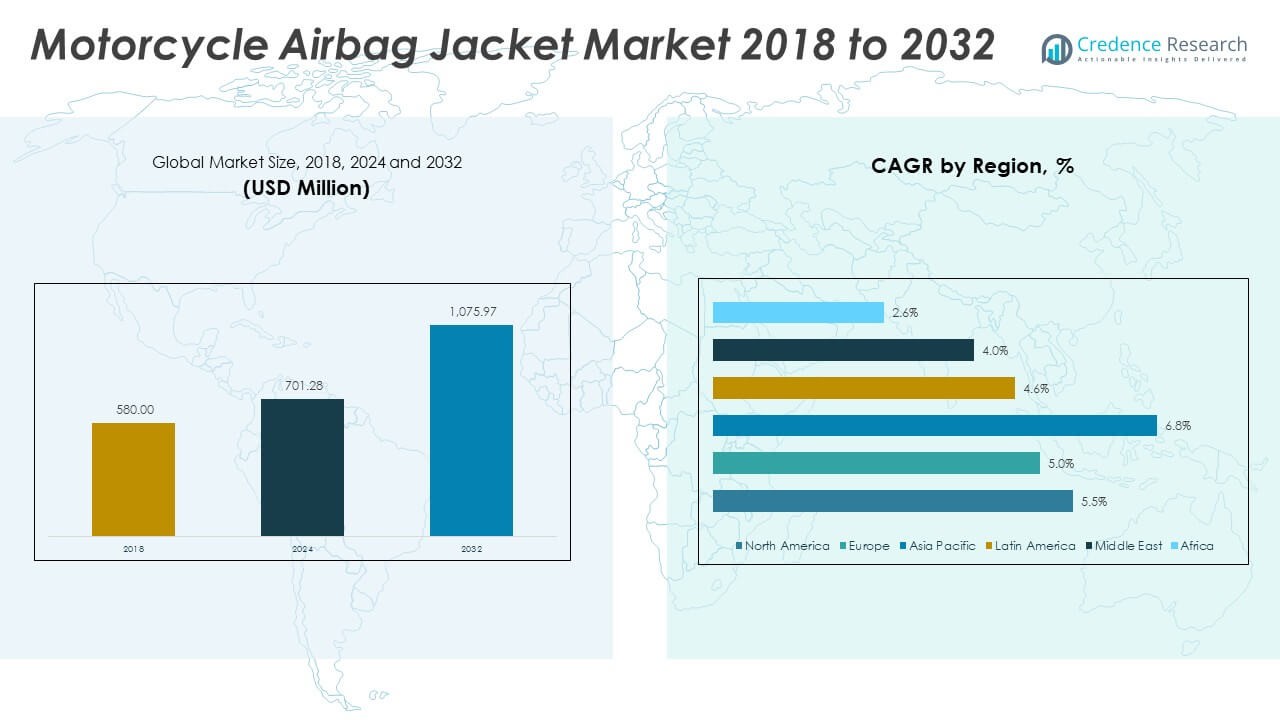
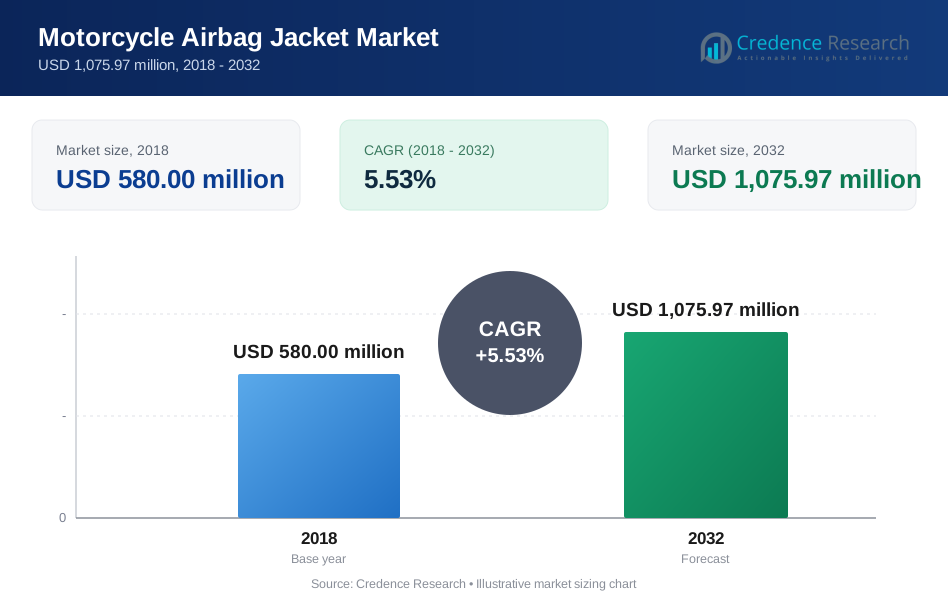
The Global Motorcycle Airbag Jacket Market size was valued at USD 580.00 million in 2018, reaching USD 701.28 million in 2024, and is anticipated to grow to USD 1,075.97 million by 2032, at a CAGR of 5.53% during the forecast period.
| REPORT ATTRIBUTE | DETAILS |
|---|---|
| Historical Period | 2020-2023 |
| Base Year | 2024 |
| Forecast Period | 2025-2032 |
| Motorcycle Airbag Jacket Market Size 2024 | USD 701.28 Million |
| Motorcycle Airbag Jacket Market, CAGR | 5.53% |
| Motorcycle Airbag Jacket Market Size 2032 | USD 1,075.97 Million |
The market is expanding due to rising demand for advanced rider safety systems, strict road safety regulations, and increased awareness of protective gear among motorcyclists. Growing disposable incomes and the popularity of high-performance motorcycles are encouraging adoption. Leading manufacturers are focusing on integrating smart sensor technologies, offering lightweight designs, and ensuring comfort, which further boosts market penetration across both premium and mid-range segments.
Regionally, Europe leads the market due to strong road safety norms, high motorcycle ownership, and early adoption of advanced rider protection technologies. North America follows, supported by strong demand from adventure and touring riders. Asia-Pacific is emerging as the fastest-growing region, driven by rising motorcycle sales, increasing accident rates, and growing awareness of personal safety across countries such as India, Japan, and China.
Market Insights:
- The Global Motorcycle Airbag Jacket Market was valued at USD 580.0 million in 2018, reached USD 701.3 million in 2024, and is projected to grow to USD 1,076.0 million by 2032, registering a CAGR of 5.53%.
- Europe led with 36% share in 2024, supported by strict road safety regulations, advanced rider culture, and strong presence of premium brands. North America followed with 26%, driven by recreational riders and safety-focused regulations, while Asia Pacific held 25%, fueled by rising motorcycle ownership and urban adoption.
- Asia Pacific is the fastest-growing region with a CAGR of 6.8%, driven by expanding middle-class income, accident prevention awareness, and strong demand from India, China, and Japan.
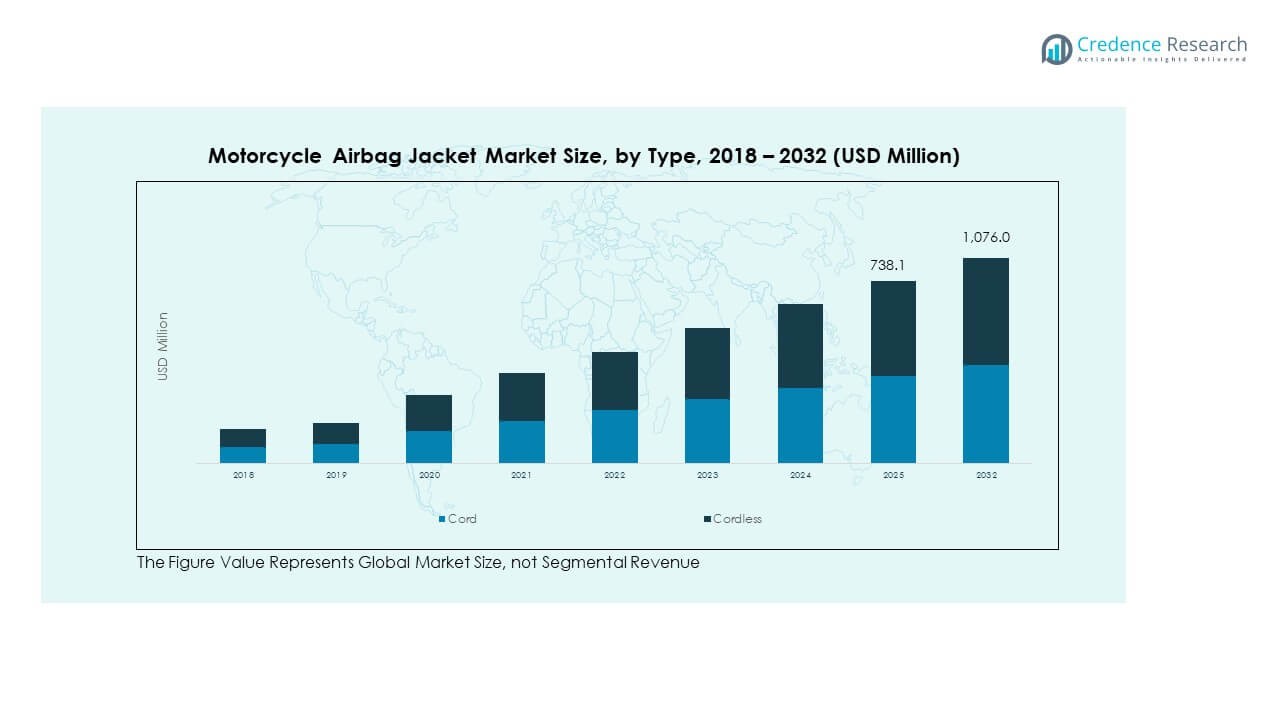
- By type, Cordless models accounted for about 56% share in 2024, gaining preference for wireless sensors, ease of use, and higher comfort.
- Corded models represented around 44% share in 2024, maintaining relevance due to affordability and reliability among price-sensitive consumers.
Market Drivers:
Growing Focus on Road Safety Regulations and Rider Protection:
The Global Motorcycle Airbag Jacket Market is supported by strong road safety regulations worldwide. Governments in developed and emerging nations are enforcing stricter standards for protective gear. Rising awareness among riders about accident prevention encourages demand for advanced jackets. Manufacturers align their products with safety certifications to build trust among buyers. Insurance providers also promote adoption by linking protective gear to lower premiums. It benefits riders with improved safety and peace of mind. Strong policy enforcement drives consumer behavior toward protective equipment. It positions airbag jackets as a critical segment in modern motorcycle safety.
- For instance, Europe has rapidly adopted mandatory CE certifications specific to motorcycle airbag jackets, requiring compliance with stringent impact protection standards, which has increased trust and adoption. Rising awareness among riders about accident prevention encourages demand for advanced jackets. Manufacturers align their products with safety certifications to build trust among buyers
Rising Popularity of High-Performance Motorcycles and Adventure Riding:
The market benefits from increasing sales of high-performance and adventure motorcycles. Riders of these segments value advanced safety features as part of their lifestyle. Growing demand for premium bikes in North America, Europe, and Asia fuels adoption. Motorcycle clubs and touring communities promote the use of airbag jackets during long rides. Adventure tourism in emerging markets creates higher demand for innovative safety gear. It allows companies to expand their presence in both premium and mid-range product lines. Rising motorcycle exports also create opportunities for suppliers of protective equipment. The growing link between leisure riding and safety gear accelerates market growth.
- For example, Triumph's 400cc range grew by 43.13% year-on-year in May 2025, from 2,117 units to 3,030 units, while Royal Enfield recorded an increase in total sales during the 2025 financial year, with notable sales performance in its 350cc segment.
Technological Innovations in Airbag Systems and Smart Wearable Features:
Innovation drives adoption across different rider demographics. Smart jackets now use advanced sensors, accelerometers, and gyroscopes for accurate impact detection. Wireless connectivity adds functionality such as alerts and data tracking. Miniaturized systems make jackets lighter and more comfortable for daily use. Manufacturers focus on easy deployment and reusability after an accident. It builds trust among riders who expect reliability in protective wear. Integration of IoT features appeals to technology-driven consumers. Partnerships with tech firms improve product performance and functionality. Continuous innovation makes airbag jackets more attractive to mainstream riders.
Increasing Disposable Incomes and Growing Consumer Lifestyle Preferences:
Rising disposable incomes in developing regions create higher spending on safety gear. Younger riders prioritize protective equipment as part of lifestyle choices. Premium and semi-premium jackets see rising sales in urban centers. Growth in e-commerce improves accessibility to international safety brands. It allows consumers to explore advanced options not available locally. Marketing campaigns highlight style and comfort alongside safety benefits. Motorcycle events and sports sponsorships expand awareness across global audiences. Lifestyle-driven consumer demand supports long-term growth for protective gear.
Market Trends:
Expansion of Smart Connected Gear and Wearable Integration in Motorcycling:
The Global Motorcycle Airbag Jacket Market is experiencing a shift toward connected safety gear. Manufacturers embed Bluetooth and app-controlled functions into modern jackets. Riders can monitor safety status and battery life through mobile applications. Integration with navigation systems enhances rider convenience. It combines safety with technology and lifestyle features. Younger riders view connected gear as part of modern motorcycling. Companies collaborate with wearable tech brands to deliver advanced functions. Smart integration transforms airbag jackets into multi-functional riding gear.
- Alpinestars, for instance, integrated Bluetooth connectivity allowing riders to monitor system status, battery life, and crash deployment data via their mobile app, providing real-time diagnostics. Riders can monitor safety status and battery life through mobile applications. Integration with navigation system enhances rider convenience.
Customization and Design-Oriented Approaches to Appeal to Style-Conscious Riders:
Growing consumer demand for customization influences market expansion. Jackets are now available in varied designs, colors, and fits. Style-conscious riders prefer protective gear that blends with fashion. It drives manufacturers to focus on aesthetics along with safety. Collaboration with fashion brands strengthens appeal in premium segments. Companies experiment with lightweight fabrics and ergonomic structures. Personalization features like modular designs expand consumer choices. The mix of safety and fashion broadens acceptance among wider rider groups.
- For instance, Furygan Fury Evolution Of airbag jacket offers modular designs with detachable electronics and a range of customization options for ergonomic fits and lightweight fabrics, providing flexibility and style without compromising protection. Style-conscious riders prefer protective gear that blends with fashion. It drives manufacturers to focus on aesthetics along with safety.
Sustainability Initiatives and Eco-Friendly Materials in Protective Gear:
The market adapts to global sustainability movements by shifting to eco-friendly materials. Manufacturers explore recycled fabrics and biodegradable components in jacket production. Green branding appeals to environmentally aware consumers in urban markets. It improves the social responsibility profile of motorcycle gear companies. Regulatory focus on sustainability further promotes eco-friendly innovation. Global supply chains support sourcing of sustainable raw materials. This trend reshapes consumer perception toward safety and environmental balance. Sustainable jackets strengthen competitive advantage for leading brands.
Expanding Distribution Through Digital Channels and E-Commerce Platforms:
E-commerce platforms play a crucial role in market reach. Global brands use digital channels to penetrate emerging regions. Online product reviews build trust among first-time buyers. It improves visibility for innovative features and new launches. Subscription-based sales models offer affordability and convenience. Riders access premium gear through global online marketplaces. Digital promotions expand awareness beyond traditional retail channels. The rise of online retail supports steady demand growth worldwide.
Market Challenges Analysis:
High Cost of Products and Limited Adoption in Price-Sensitive Markets:
The Global Motorcycle Airbag Jacket Market faces challenges due to high product costs. Advanced sensor technology and premium fabrics make jackets expensive. Price-sensitive consumers in developing markets find it difficult to afford. Limited awareness about benefits adds to slow adoption rates. It restricts penetration in regions with large two-wheeler populations. Lack of subsidies or insurance incentives further limits demand. Manufacturers struggle to balance safety innovation with affordability. High cost remains a barrier to mass-market adoption.
Technical Limitations and Reliability Concerns Among End Users:
The market also deals with technical limitations in deployment systems. Malfunction risks or delayed deployments reduce rider confidence. Harsh weather conditions affect sensor accuracy in some products. It creates doubts among consumers about reliability. Reusability and maintenance challenges also limit appeal. Riders hesitate to invest in products requiring expensive aftercare. Technical complexity restricts use in rural and non-premium segments. Manufacturers must address reliability to improve adoption and trust.
Market Opportunities:
Expanding Growth Potential in Emerging Economies and Urban Centers:
The Global Motorcycle Airbag Jacket Market presents opportunities in rapidly urbanizing economies. Rising motorcycle ownership in Asia and Latin America supports new sales. Expanding middle-class populations boost demand for affordable protective gear. It allows manufacturers to introduce entry-level product lines. Urban centers act as key distribution hubs for international brands. Localized marketing campaigns increase visibility among first-time buyers. Growing safety awareness fuels adoption in these high-potential regions.
Rising Collaborations Between Motorcycle OEMs and Gear Manufacturers:
Collaborations between motorcycle manufacturers and gear companies open growth opportunities. OEM partnerships integrate airbag jackets into new bike purchase packages. It strengthens consumer confidence and accelerates adoption rates. Manufacturers gain wider exposure through brand association. Co-marketing initiatives build trust among young and premium buyers. It enhances the appeal of motorcycles as complete lifestyle solutions. Strategic collaborations drive sales momentum in global markets.
Market Segmentation Analysis:
By Type
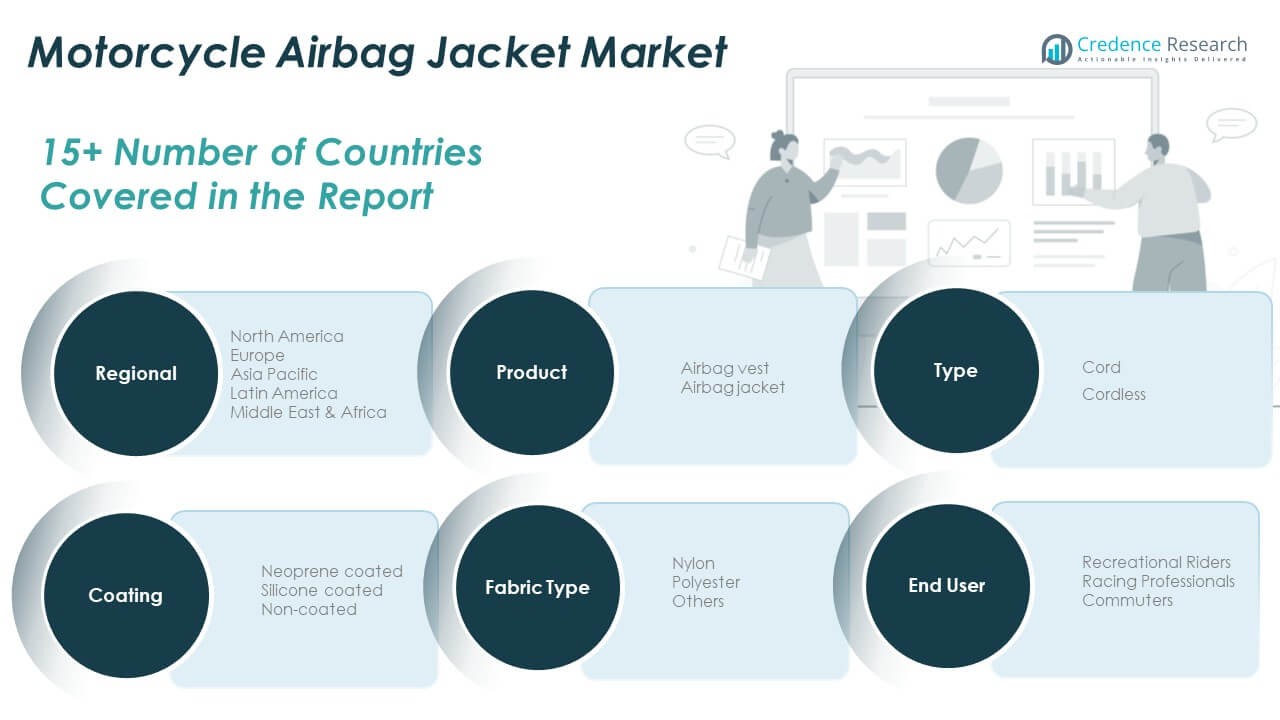
The Global Motorcycle Airbag Jacket Market is divided into cord and cordless types. Cord models hold steady demand due to affordability and proven reliability. Cordless systems are gaining traction with advanced wireless sensors, easy usability, and comfort, appealing to premium buyers. It creates a balance between traditional designs and innovation-driven offerings.
- For instance, Alpinestars and Dainese have pioneered wireless airbag systems with embedded accelerometer and gyroscope technologies that enable deployment within milliseconds without connection to the bike, offering enhanced rider mobility.
By Product
Airbag vests and airbag jackets form the core product categories. Airbag jackets dominate due to integrated protection, design appeal, and wider consumer acceptance. Airbag vests, being lighter and more flexible, are preferred by entry-level users and commuters. It diversifies the adoption base across different rider needs.
- For example, IXS’s IPRO 1.0 airbag vest delivers lightweight and low-profile protection integrated with smart sensors targeted at everyday riders and racers. It diversifies the adoption base across different rider needs.
By End-User
Recreational riders contribute a major share, driven by lifestyle choices and leisure riding culture. Racing professionals demand high-end models with precision safety standards. Commuters represent a growing segment, supported by rising urban safety awareness. It ensures balanced growth across professional and casual use.
By Fabric Type
Nylon and polyester dominate fabric selection due to durability, abrasion resistance, and affordability. High-performance riders prefer nylon for its strength, while polyester appeals to cost-conscious buyers. Other fabrics, including blends, offer lightweight comfort. It supports product innovation and customization.
By Coating
Neoprene-coated and silicone-coated jackets ensure durability, water resistance, and improved usability in harsh conditions. Non-coated options attract price-sensitive buyers with affordable protection. It gives manufacturers room to target diverse consumer profiles.
Segmentation:
- By Type
- Cord
- Cordless
- By Product
- Airbag Vest
- Airbag Jacket
- By End-User
- Recreational Riders
- Racing Professionals
- Commuters
- By Fabric Type
- Nylon
- Polyester
- Others
- By Coating
- Neoprene Coated
- Silicone Coated
- Non-Coated
- By Region
- North America (U.S., Canada, Mexico)
- Europe (UK, France, Germany, Italy, Spain, Russia, Rest of Europe)
- Asia Pacific (China, Japan, South Korea, India, Australia, Southeast Asia, Rest of Asia Pacific)
- Latin America (Brazil, Argentina, Rest of Latin America)
- Middle East (GCC Countries, Israel, Turkey, Rest of Middle East)
- Africa (South Africa, Egypt, Rest of Africa)
Regional Analysis:
North America
The North America Motorcycle Airbag Jacket Market size was valued at USD 152.12 million in 2018 to USD 182.05 million in 2024 and is anticipated to reach USD 280.79 million by 2032, at a CAGR of 5.5% during the forecast period. North America accounts for around 26% market share in 2024. The Global Motorcycle Airbag Jacket Market benefits from high adoption in this region due to a strong culture of motorcycle sports and adventure riding. Strict road safety laws encourage greater use of protective gear, boosting the uptake of advanced jackets. Premium motorcycle ownership supports strong demand for technologically advanced models. It is also driven by consumer preference for wireless and connected systems. Insurance-linked benefits strengthen purchasing motivation. Strong distribution through both retail and e-commerce further improves accessibility. The U.S. leads demand, supported by its large base of recreational and professional riders.
Europe
The Europe Motorcycle Airbag Jacket Market size was valued at USD 216.92 million in 2018 to USD 255.10 million in 2024 and is anticipated to reach USD 376.32 million by 2032, at a CAGR of 5.0% during the forecast period. Europe contributes 36% market share in 2024, the highest among all regions. The Global Motorcycle Airbag Jacket Market gains traction here due to strict safety regulations and early adoption of rider protection systems. Strong presence of premium brands such as Alpinestars and Dainese boosts regional growth. High consumer spending supports the purchase of advanced safety jackets. It is also supported by government-led campaigns to reduce road fatalities. Demand is concentrated in Germany, France, Italy, and the UK due to established motorcycle cultures. Racing sports also fuel adoption of high-performance models. Europe maintains leadership with consistent innovation and product development.
Asia Pacific
The Asia Pacific Motorcycle Airbag Jacket Market size was valued at USD 141.06 million in 2018 to USD 178.16 million in 2024 and is anticipated to reach USD 301.81 million by 2032, at a CAGR of 6.8% during the forecast period. Asia Pacific holds around 25% market share in 2024, making it a fast-emerging region. The Global Motorcycle Airbag Jacket Market in this region benefits from rising motorcycle ownership in India, China, and Southeast Asia. Growing accident rates create urgency for advanced safety equipment. Increasing disposable incomes in urban centers drive adoption of premium jackets. It is further supported by strong e-commerce expansion across regional markets. Japan leads technological innovation, while India and Southeast Asia create volume demand. Motorcycle sports events and touring culture also stimulate growth. Asia Pacific is projected to record the fastest growth among all regions.
Latin America
The Latin America Motorcycle Airbag Jacket Market size was valued at USD 39.44 million in 2018 to USD 47.26 million in 2024 and is anticipated to reach USD 67.65 million by 2032, at a CAGR of 4.6% during the forecast period. Latin America represents 7% market share in 2024. The Global Motorcycle Airbag Jacket Market in this region is shaped by rising urbanization and motorcycle dependence for daily commuting. Growing awareness of road safety supports gradual adoption of airbag jackets. Brazil dominates demand, supported by its large two-wheeler fleet. It is further strengthened by international brands entering local markets. Economic constraints limit premium product adoption, yet affordable models are gaining traction. Rising popularity of motor sports also drives targeted sales. Regional growth remains steady with growing insurance and safety initiatives.
Middle East
The Middle East Motorcycle Airbag Jacket Market size was valued at USD 19.72 million in 2018 to USD 22.16 million in 2024 and is anticipated to reach USD 30.24 million by 2032, at a CAGR of 4.0% during the forecast period. Middle East holds around 3% market share in 2024. The Global Motorcycle Airbag Jacket Market gains traction here through rising motorcycle sports and tourism. High disposable incomes in GCC countries favor premium safety gear adoption. It is also supported by strong penetration of European and Japanese brands. Saudi Arabia and UAE dominate demand due to their active motorsport culture. Expansion of motorcycle clubs further strengthens awareness. However, extreme climate conditions affect adoption of certain product types. Opportunities exist in premium and luxury segments due to strong lifestyle demand.
Africa
The Africa Motorcycle Airbag Jacket Market size was valued at USD 9.74 million in 2018 to USD 16.55 million in 2024 and is anticipated to reach USD 21.16 million by 2032, at a CAGR of 2.6% during the forecast period. Africa accounts for around 2% market share in 2024. The Global Motorcycle Airbag Jacket Market here is at a nascent stage with limited penetration. Affordability remains a key challenge, restricting adoption to urban elites. South Africa leads demand, driven by stronger safety awareness. It is supported by a growing base of motorcycle sports enthusiasts. Wider regions remain dependent on low-cost helmets and basic gear. Rising road accidents highlight the potential for gradual market growth. Africa offers long-term opportunities as incomes and safety awareness improve.
Key Player Analysis:
- Alpinestars
- Dainese S.p.A.
- Helite
- Furigana
- RST Moto
- IXS
- Yamaha Motor Co., Ltd.
- Mugen Denko Co. Ltd.
Competitive Analysis:
The Global Motorcycle Airbag Jacket Market is moderately consolidated with competition among global and regional manufacturers. Leading players include Alpinestars, Dainese S.p.A., Helite, Yamaha Motor Co., Ltd., and Mugen Denko Co. Ltd., alongside emerging companies that target niche markets. Strong R&D investments focus on sensor accuracy, lightweight materials, and reusable deployment systems. It is shaped by premium brands emphasizing advanced safety integration and mid-range companies offering affordability. Collaborations with motorcycle OEMs and distributors enhance market presence. Brand reputation, regulatory certifications, and product innovation serve as key differentiators, creating a competitive advantage for established firms.
Recent Developments:
- Mugen Denko Co. Ltd. is known for its affiliation with motorcycle airbag jacket manufacturing, with scheduled releases such as a winter airbag jacket set for mid-September 2025. The company collaborates with affiliates like YKK Fastening Products for technologically advanced airbag apparel in the motorcycle market.
- Helite has been innovating continuously for off-road riders, particularly for the Dakar event in 2025. The company developed the Off Road airbag waistcoat designed for extreme conditions with breathable, ultra-resistant fabric, removable sleeves, and reliable electronic detection with rapid deployment and easy recharge capabilities. This innovation focuses on comfort and protection for long-duration and varying temperature rides.
- In March 2025, Alpinestars launched the Tech-Air 5 Plasma airbag system, which is over 25% lighter than its predecessor. This wearable airbag vest offers full upper-body protection including the chest, ribs, back, and shoulders using advanced Nucleon Plasma technology. It features simple activation, Bluetooth connectivity, a lithium-ion battery with 30 hours of riding time, and app integration for monitoring and updates. The product is set for international availability from October 2025.
Report Coverage:
The research report offers an in-depth analysis based on Type, Product, End-User, Fabric, Coating, and Region. It details leading market players, providing an overview of their business, product offerings, investments, revenue streams, and key applications. Additionally, the report includes insights into the competitive environment, SWOT analysis, current market trends, as well as the primary drivers and constraints. Furthermore, it discusses various factors that have driven market expansion in recent years. The report also explores market dynamics, regulatory scenarios, and technological advancements that are shaping the industry. It assesses the impact of external factors and global economic changes on market growth. Lastly, it provides strategic recommendations for new entrants and established companies to navigate the complexities of the market.
Future Outlook:
- Rising adoption of wireless airbag jackets in premium segments
- Increasing integration of IoT and smart wearable technologies
- Growing popularity of commuter-friendly lightweight models
- Expansion of distribution through digital and e-commerce platforms
- Strong growth in Asia Pacific driven by motorcycle ownership
- Europe maintaining leadership through strict safety regulations
- Collaborations between motorcycle OEMs and safety gear firms
- Sustainability initiatives with eco-friendly fabrics and coatings
- Product diversification targeting lifestyle and racing professionals
- Long-term opportunities in emerging markets with urbanization growth
Request a Free Sample
Fill in your details and we'll send you a free sample report.
- Sample data tables & charts
- Research methodology
Need a Custom Version of This Report?
Tailor the scope, geography, or segments to your exact requirements.
- Custom geography or segment scope
- Direct access to our analyst team
Frequently Asked Questions
What is the current market size for Global Motorcycle Airbag Jacket Market, and what is its projected size in 2032?
At what Compound Annual Growth Rate is the Global Motorcycle Airbag Jacket Market projected to grow between 2025 and 2032?
Which Global Motorcycle Airbag Jacket Market segment held the largest share in 2024?
What are the primary factors fueling the growth of the Global Motorcycle Airbag Jacket Market?
Who are the leading companies in the Global Motorcycle Airbag Jacket Market?
Which region commanded the largest share of the Global Motorcycle Airbag Jacket Market in 2024?
Table of Content
Chapter 1. Report Introduction
- 1.1 Report Description & Purpose
- 1.1.1 Report Title & Market Definition
- 1.1.2 Unique Selling Propositions (USP) & Key Differentiators
- 1.1.3 Value Proposition for Stakeholders
- 1.2 Research Objectives
- 1.2.1 Market Sizing Objectives (Volume & Revenue)
- 1.2.2 Segmentation Objectives
- 1.2.3 Competitive Intelligence Objectives
- 1.2.4 Forecast & Scenario Objectives
- 1.3 Report Scope
- 1.3.1 Motorcycle Airbag Jacket Scope – Types & Subtypes Covered
- 1.3.2 Geographic Scope – Regions & Countries Covered
- 1.3.3 Historical Period, Base Year & Forecast Period (2018; forecast to 2032)
- 1.3.4 Inclusions & Exclusions
- 1.4 HS Code & Classification Framework
- 1.5 Currency, Units & Pricing Basis
- 1.6 Target Stakeholders
- 1.7 Limitations & Assumptions
Chapter 2. Executive Summary
- 2.1 Global Motorcycle Airbag Jacket Market Snapshot
- 2.1.1 Market Size – Historical (2018) & Forecast (2018-2032) (2018: USD 580.00 million → 2032: USD 1,075.97 million)
- 2.1.2 Volume & Revenue – Global Totals
- 2.1.3 Key Market Highlights – Top Five Facts
- 2.2 Motorcycle Airbag Jacket Market Segmentation Snapshot
- 2.2.1 Market Split by Region – 2018 vs. 2032
- 2.3 Competitive Snapshot
- 2.3.1 Top 10 Players by Revenue Share – 2018
- 2.3.2 Top 10 Players by Volume Share – 2018
- 2.3.3 Recent Strategic Developments (18-Month Summary)
- 2.4 Key Investment Highlights & Strategic Conclusions
Chapter 3. Motorcycle Airbag Jacket Market Dynamics & Industry Analysis
- 3.1 Market Overview & Context
- 3.1.1 Motorcycle Airbag Jacket Market Position in the Broader Automotive Value Chain
- 3.1.2 OEM vs. Replacement Market Dynamics
- 3.1.3 Market Maturity & Development Stage by Region
- 3.2 Motorcycle Airbag Jacket Market Drivers
- 3.3 Motorcycle Airbag Jacket Market Restraints & Challenges
- 3.4 Motorcycle Airbag Jacket Market Opportunities
- 3.5 Porter's Five Forces Analysis
- 3.5.1 Threat of New Entrants
- 3.5.2 Bargaining Power of Suppliers
- 3.5.3 Bargaining Power of Buyers
- 3.5.4 Threat of Substitutes
- 3.5.5 Competitive Rivalry – Intensity Assessment
- 3.6 Motorcycle Airbag Jacket Value Chain Analysis
- 3.6.1 Upstream – Raw Material/Input Suppliers
- 3.6.1.1 Raw Material/Input 1
- 3.6.1.2 Raw Material/Input 2
- 3.6.1.3 Raw Material/Input 3
- 3.6.2 Midstream – Production/Manufacturing/Service Delivery
- 3.6.2.1 Production/Process Overview
- 3.6.2.2 Key Facility Locations & Capacity by Manufacturer
- 3.6.3 Downstream – Distribution & End Consumer
- 3.6.3.1 Primary Channel – B2B/OEM
- 3.6.3.2 Secondary Channels – Dealer, Retail, Online, Direct
- 3.6.4 Value Chain Profitability Analysis
- 3.6.1 Upstream – Raw Material/Input Suppliers
- 3.7 PESTEL Analysis
- 3.7.1 Political Factors
- 3.7.2 Economic Factors
- 3.7.3 Social Factors
- 3.7.4 Technological Factors
- 3.7.5 Environmental Factors
- 3.7.6 Legal Factors
- 3.8 Motorcycle Airbag Jacket Supply Chain Analysis
- 3.8.1 Raw Material/Input Supply Risk Assessment
- 3.8.2 Manufacturing Concentration Risk (Geographic Exposure)
- 3.8.3 Trade Disruption Impact Analysis
- 3.9 Regulatory & Policy Landscape
Note: The regulatory and policy landscape section covers regulations based on their applicability to the market, Motorcycle Airbag Jacket category, geography, and scope of the study. Only regulatory frameworks with a material impact on operations, compliance, trade, sustainability, or market access are analyzed in detail.
Chapter 4. Key Investment Pockets & Opportunity Analysis
- 4.1 Motorcycle Airbag Jacket Market Attractiveness Analysis
- 4.1.1 By Region – Investment Attractiveness Matrix (Volume × CAGR)
- 4.2 Absolute Revenue Growth Opportunity
- 4.2.1 By Region – Absolute USD Growth Through 2032
- 4.3 Incremental Volume Opportunity
- 4.3.1 By Region – Incremental Volume Through 2032
- 4.3.2 Segment – Incremental Volume
- 4.4 Emerging Submarket Opportunity Deep Dive (Subject to Applicability)
- 4.5 Emerging Market Opportunity Scorecards
- 4.5.1 United States
- 4.5.2 Europe
- 4.5.3 Asia
- 4.5.4 Middle East & Africa
Note: Emerging Market Opportunity Scorecards will be included based on relevance and strategic importance. Regions listed are indicative and may vary depending on data availability and market dynamics.
Chapter 5. Motorcycle Airbag Jacket Import-Export Analysis & Trade Flows
- 5.1 Global Trade Overview
- 5.1.1 Global Export Value by Country (2018)
- 5.1.2 Global Export Volume by Country (2018)
- 5.1.3 Global Import Value by Country (2018)
- 5.1.4 Global Import Volume by Country (2018)
- 5.1.5 Net Trade Balance by Country (2018)
- 5.2 Export Analysis – Segment
- 5.2.1 Type 1 (HS Code)
- 5.2.2 Type 2 (HS Code)
- 5.2.3 Type 3 (HS Code)
- 5.2.4 Type 4 (HS Code)
- 5.2.5 Type 5 (HS Code)
- 5.3 Import Analysis – Segment
- 5.3.1 Type 1 (HS Code)
- 5.3.2 Type 2 (HS Code)
- 5.3.3 Type 3 (HS Code)
- 5.3.4 Type 4 (HS Code)
- 5.3.5 Type 5 (HS Code)
- 5.4 Average Unit Trade Prices
- 5.4.1 Average Export Price – Segment & Country
- 5.4.2 Average Import Price – Segment & Source Country
- 5.4.3 Price Trends (2018)
- 5.5 Key Trade Route Analysis
- 5.5.1 Trade Route 1
- 5.5.2 Trade Route 2
- 5.5.3 Trade Route 3
- 5.5.4 Trade Route 4
- 5.5.5 Trade Route 5
- 5.6 Trade Policy Impact Assessment
- 5.6.1 US Anti-Dumping & Section 301 Tariffs
- 5.6.2 EU Customs Union Impact
- 5.6.3 Major Free Trade Agreements
- 5.6.4 USMCA Rules of Origin
Note: Trade policy analysis will be included only where relevant to the Motorcycle Airbag Jacket market.
Chapter 6. Competitive Landscape & Company Benchmarking
- 6.1 Motorcycle Airbag Jacket Market Concentration & Structure
- 6.1.1 Herfindahl-Hirschman Index (HHI) – vs. 2018
- 6.1.2 Tier 1, Tier 2 & Tier 3 Market Structure
- 6.1.3 Global, Regional & Local Player Dynamics
- 6.2 Motorcycle Airbag Jacket Market Share Analysis – 2018
- 6.2.1 Global Revenue Share by Company
- 6.2.2 Global Volume Share by Company
- 6.2.3 Regional Revenue Share
- 6.2.4 Market Share Evolution ( vs. 2018)
- 6.2.5 OEM Segment Share by Company
- 6.2.6 Replacement Segment Share by Company
- 6.3 Production/Delivery Capacity & Facility Analysis
- 6.3.1 Global Installed Capacity
- 6.3.2 Capacity Utilization Rates
- 6.3.3 Production/Output Volume
- 6.3.4 Facility Locations & Capacity Map
- 6.3.5 Planned Capacity Additions
- 6.4 Motorcycle Airbag Jacket Competitive Benchmarking Matrix
- 6.4.1 Revenue, Volume, CAGR & Profitability Comparison
- 6.4.2 Channel Revenue Mix
- 6.4.3 Geographic Revenue Exposure
- 6.4.4 R&D Intensity
- 6.4.5 Sustainability Maturity
- 6.5 Strategic Developments in Motorcycle Airbag Jacket (Last 24 Months)
- 6.5.1 Mergers, Acquisitions & Divestments
- 6.5.2 New Motorcycle Airbag Jacket Launches
- 6.5.3 Facility Expansions
- 6.5.4 Strategic Alliances, Joint Ventures & Partnerships
- 6.5.5 Distribution Expansion & Market Entry
- 6.5.6 Sustainability & ESG Initiatives
- 6.6 Competitive Strategy Mapping
- 6.6.1 Leader, Challenger, Follower & Niche Classification
- 6.6.2 Pricing Strategy Comparison
- 6.6.3 Channel Strategy Matrix
Note: Strategic developments are included based on their materiality and the availability of reliable information.
Chapter 7. Global Motorcycle Airbag Jacket Market – By Distribution Channel
- 7.1 Segment Overview
- 7.1.1 Volume & Revenue Split by Channel (2018 & 2032)
- 7.1.2 Channel Mix Evolution (2018-2032)
Chapter 8. Regional Market Analysis – Global Overview
- 8.1 Global Regional Overview
- 8.1.1 Regional Volume Share
- 8.1.2 Regional Revenue Share
- 8.1.3 Regional Volume by Region
- 8.1.4 Regional Revenue by Region
- 8.1.5 Regional Forecast Through 2032
- 8.2 Cross-Regional Segment Analysis
- 8.2.1 By Distribution Channel
- 8.2.2 By Brand/Price Tier
Chapter 9. North America Motorcycle Airbag Jacket Market
- 9.1 United States
- 9.2 Canada
- 9.3 Mexico
Chapter 10. Europe Motorcycle Airbag Jacket Market
- 10.1 Germany
- 10.2 France
- 10.3 Italy
- 10.4 United Kingdom
- 10.5 Spain
- 10.6 Poland
- 10.7 Russia
- 10.8 Netherlands
- 10.9 Belgium
- 10.10 Sweden
- 10.11 Denmark
- 10.12 Norway
- 10.13 Rest of Europe
Chapter 11. Asia Pacific Motorcycle Airbag Jacket Market
- 11.1 China
- 11.2 India
- 11.3 Japan
- 11.4 South Korea
- 11.5 Thailand
- 11.6 Indonesia
- 11.7 Vietnam
- 11.8 Malaysia
- 11.9 Australia
- 11.10 Rest of Asia Pacific
Chapter 12. Latin America Motorcycle Airbag Jacket Market
- 12.1 Brazil
- 12.2 Argentina
- 12.3 Colombia
- 12.4 Chile
- 12.5 Rest of Latin America
Chapter 13. Middle East Motorcycle Airbag Jacket Market
- 13.1 Saudi Arabia
- 13.2 United Arab Emirates
- 13.3 Turkey
- 13.4 Israel
- 13.5 Iran
- 13.6 Rest of the Middle East
Chapter 14. Africa Motorcycle Airbag Jacket Market
- 14.1 South Africa
- 14.2 Egypt
- 14.3 Nigeria
- 14.4 Morocco
- 14.5 Rest of Africa
Chapter 15. Motorcycle Airbag Jacket Company Profiles
- 15.1 [Company 01]
- 15.1.1 Company Overview
- 15.1.2 Key Management Personnel
- 15.1.3 Products & Services Portfolio
- 15.1.4 Financial Performance
- 15.1.5 Key Market Focus & Geographic Presence
- 15.1.6 Recent Developments & Strategic Initiatives
Note: The company profile list is preliminary and may change based on research findings, market developments, data availability, and client requirements.
Chapter 16. Appendices
- Appendix A – List of Abbreviations & Acronyms
- Appendix B – Industry Classification Code Reference – Full Series
- Appendix C – Production & Capacity Data Tables
- Appendix D – End-Use & Demand Base Tables
- Appendix E – Consumption & Replacement Rate Assumptions
- Appendix F – ASP Reference Tables
- Appendix G – Manufacturing & Facility Database
- Appendix H – Import-Export Data Tables
- Appendix I – Regulatory Summary Tables
- Appendix J – Primary Research Participant List (Anonymized)
- Appendix K – Primary Research Questionnaire Framework
- Appendix L – Data Sources & Bibliography
- Appendix M – Market Size Divergence & Source Comparison
Chapter 17. Research Methodology
- 17.1 Research Framework & Philosophy
- 17.2 Secondary Research – Sources, Hierarchy & Data Extraction
- 17.3 Data Modeling – Bottom-Up & Top-Down Market Sizing
- 17.4 Primary Research – Stakeholder Framework, LOI & Sample Sizes
- 17.5 Forecast Methodology – Regression, Scenario & Sensitivity Analysis
- 17.6 Quality Control – Four-Layer Validation Framework
- 17.7 Limitations & Standard Assumptions
- 17.8 Disclaimer
