
Market Overview:
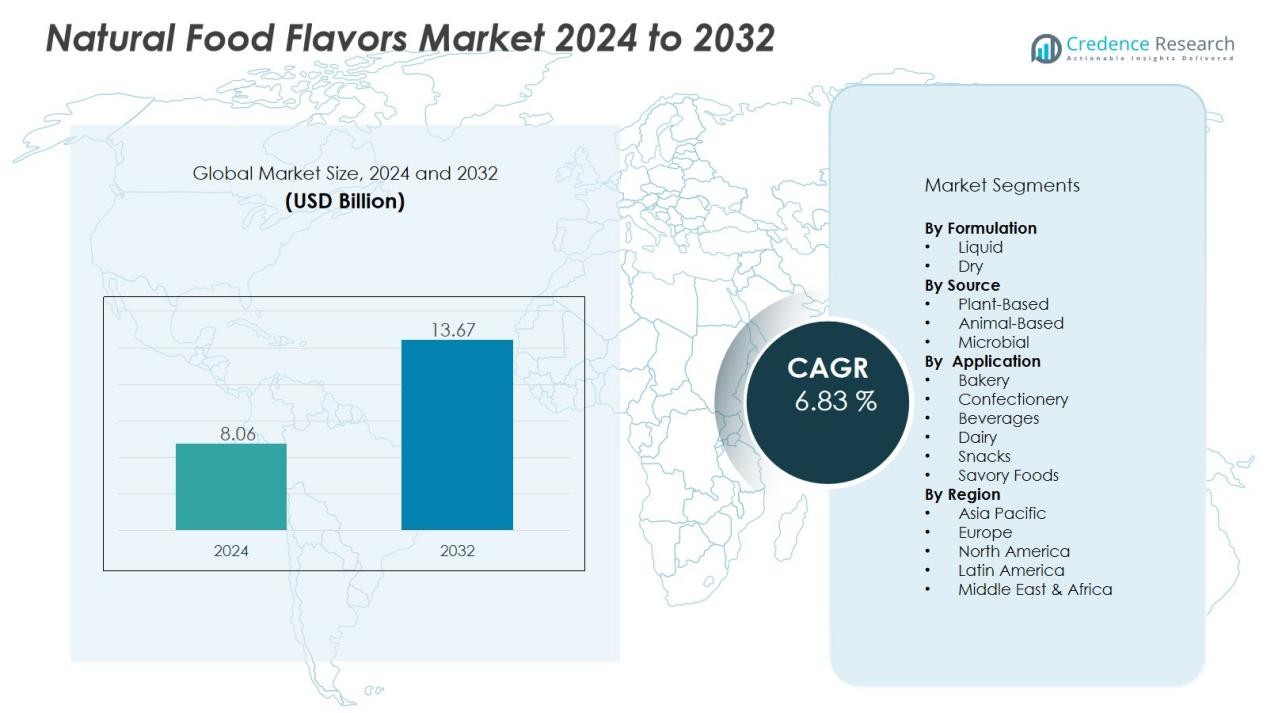
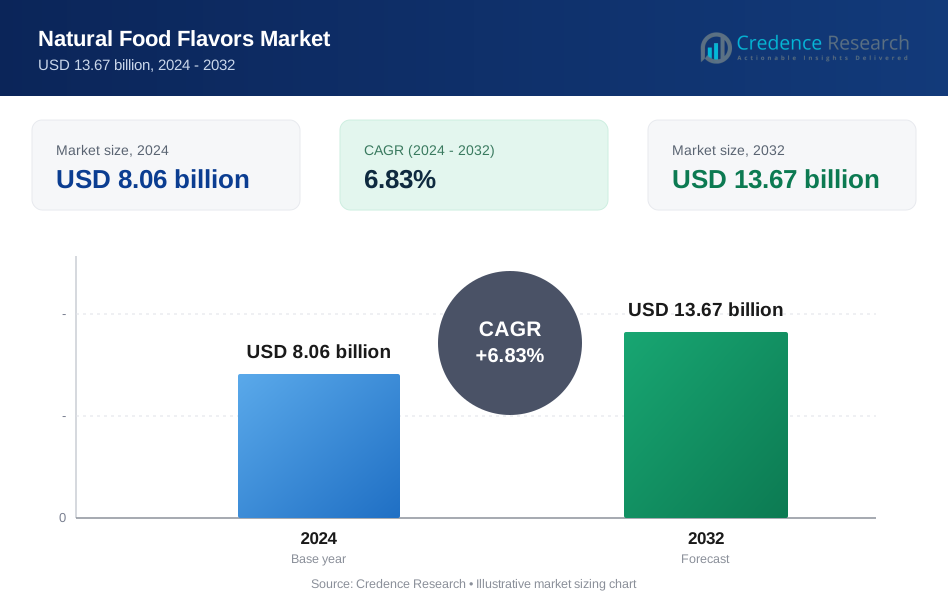
The natural food flavors market size was valued at USD 8.06 billion in 2024 and is anticipated to reach USD 13.67 billion by 2032, at a CAGR of 6.83 % during the forecast period (2024-2032).
| REPORT ATTRIBUTE | DETAILS |
|---|---|
| Historical Period | 2020-2023 |
| Base Year | 2024 |
| Forecast Period | 2025-2032 |
| Natural Food Flavors Market Size 2024 | USD 8.06 Billion |
| Natural Food Flavors Market, CAGR | 6.83 % |
| Natural Food Flavors Market Size 2032 | USD 13.67 Billion |
The market is supported by strong drivers such as rising health consciousness, regulatory support for natural ingredients, and rapid innovation in extraction technologies. Food manufacturers are reformulating products to meet demand for transparency and natural ingredients. Expanding applications in bakery, dairy, beverages, snacks, and ready-to-eat meals further enhance adoption. Growing awareness of food safety and sustainability also accelerates the shift toward plant-based and natural flavoring agents.
Regionally, North America and Europe dominate due to high consumer awareness, strict food safety regulations, and strong adoption of natural and organic products. Asia-Pacific is the fastest-growing region, driven by rapid urbanization, rising disposable incomes, and increasing processed food consumption in countries such as China, India, and Japan. Latin America and the Middle East & Africa also show potential, supported by expanding food industries and a gradual shift toward healthier product formulations.
Market Insights:
- The natural food flavors market was valued at USD 8.06 billion in 2024 and is expected to reach USD 13.67 billion by 2032, expanding at a CAGR of 6.83%.
- Rising consumer demand for clean-label and health-oriented products is driving strong adoption of plant-based flavors and boosting brand loyalty.
- Governments and food authorities support the shift to natural ingredients through strict safety and compliance standards that encourage reformulation.
- Expanding applications across bakery, dairy, beverages, confectionery, and ready-to-eat meals enhance the adaptability and growth of natural flavors.
- Advancements in enzymatic and biotechnological extraction technologies improve efficiency, preserve authenticity, and extend shelf life of flavor solutions.
- High production costs and raw material supply constraints pose challenges, creating volatility in pricing and sourcing.
- North America holds 32% share and Europe 28%, while Asia-Pacific at 27% is the fastest-growing, with Latin America at 7% and Middle East & Africa at 6% showing steady progress.
Market Drivers:
Rising Consumer Demand for Clean-Label and Health-Oriented Products:
The natural food flavors market benefits from growing consumer interest in clean-label products. Shoppers prefer foods with fewer artificial additives, boosting the use of plant-based flavors. It supports product transparency, which strengthens consumer trust and brand loyalty. The trend is reinforced by rising health awareness and a preference for natural ingredients over synthetic ones.
- For instance, Bell Flavors & Fragrances developed a line of USDA Kettle Crafted Meat Flavors, which enhance natural broth flavor profiles while maintaining clean-label status, with shelf life up to 12 months and no use of MSG or hydrolyzed vegetable protein.
Strong Regulatory Support and Industry Compliance Standards :
Governments and food authorities encourage the adoption of natural ingredients by setting strict safety guidelines. The natural food flavors market gains traction due to regulatory pressure against synthetic flavoring agents. It drives manufacturers to invest in reformulation that aligns with compliance standards. This shift supports safer food production and strengthens the credibility of natural flavor offerings.
- For instance, Custom Flavors accelerated its expansion by breaking ground on a new 53,000-square-foot processing facility scheduled for completion in November 2025, tripling its innovation space to meet growing demand from regulatory-driven reformulations eliminating artificial dyes and flavors in foods across the US.
Expanding Applications Across Food and Beverage Segments :
Demand spans across bakery, dairy, beverages, confectionery, and savory foods. The natural food flavors market benefits from its adaptability in enhancing taste without artificial chemicals. It enables manufacturers to introduce innovative product lines that meet diverse consumer preferences. Growth is further supported by rising demand in ready-to-eat meals and convenience foods.
Advancements in Extraction and Flavor Development Technologies:
Modern extraction methods such as enzymatic and biotechnological processes improve efficiency and quality. The natural food flavors market advances through technologies that preserve authenticity and stability of flavors. It allows manufacturers to maintain taste consistency while scaling production. Innovation ensures longer shelf life and enables wider applications across global food industries.
Market Trends:
Growing Preference for Plant-Based and Sustainable Flavor Sources:
The natural food flavors market is witnessing a strong shift toward plant-based and sustainable sources. Consumers prefer flavors derived from fruits, herbs, and spices that align with vegan and eco-conscious lifestyles. It reflects rising interest in ethical consumption and sustainable food production. Manufacturers focus on sourcing raw materials responsibly to address environmental concerns and enhance brand value. The trend is also driven by increasing popularity of plant-based diets in major markets. Companies are reformulating traditional products with natural, eco-friendly flavoring solutions to meet evolving expectations. This shift highlights sustainability as a central driver of innovation in natural food flavor development.
- For instance, Blue Pacific Flavors sources certified organic and natural flavors from sustainable botanical origins, emphasizing carbon footprint reduction and local community partnerships, customizing over 200 beverage and food flavor profiles annually with a focus on sustainability
Rising Popularity of Exotic and Functional Flavor Innovations:
Global demand for exotic, ethnic, and functional flavors is expanding rapidly. The natural food flavors market adapts by introducing flavors inspired by global cuisines, botanicals, and superfoods. It supports consumer interest in unique taste experiences and health-focused formulations. Functional flavors with added benefits, such as stress relief or immunity support, are gaining traction. Manufacturers invest in research to combine flavor authenticity with nutritional value. Food and beverage brands leverage these innovations to differentiate their offerings in competitive markets. The trend underlines how flavor innovation creates both sensory appeal and added functional value for consumers.
- For instance, Swiss startup Nectariss extracts white truffle essence using patented technology, maintaining purity and potency in natural truffle flavors for over 100 product batches annually.
Market Challenges Analysis:
High Production Costs and Supply Chain Complexities:
The natural food flavors market faces cost-related challenges due to complex extraction processes. Obtaining flavors from fruits, herbs, and spices requires advanced technology and skilled expertise. It leads to higher production expenses compared to synthetic alternatives. Seasonal dependency and limited raw material availability add further pressure on supply stability. Rising global demand for natural ingredients often outpaces supply, creating volatility in pricing. These factors make cost management and reliable sourcing critical hurdles for manufacturers.
Stringent Regulations and Shelf-Life Limitations:
Strict food safety and labeling regulations increase compliance costs for manufacturers. The natural food flavors market encounters challenges in meeting global standards that vary across regions. It requires continuous testing, certification, and adherence to regulatory frameworks. Shelf-life limitations of natural flavors also restrict product applications in certain food categories. Ensuring stability and taste consistency without artificial preservatives remains a persistent issue. These regulatory and technical constraints limit the speed of product innovation and market expansion.
Market Opportunities:
Rising Demand for Functional and Health-Focused Flavors:
The natural food flavors market presents opportunities through the integration of functional and health-enhancing ingredients. Consumers increasingly seek products that combine taste with wellness benefits. It enables manufacturers to develop flavors infused with botanicals, adaptogens, and superfoods that support immunity and mental well-being. Demand for natural flavors in fortified beverages, plant-based snacks, and nutritional supplements continues to rise. This creates space for innovation in product formulation that aligns with both taste and health priorities. Companies that capitalize on functional flavor trends can build stronger consumer loyalty.
Expansion in Emerging Markets and Clean-Label Innovations:
Emerging economies offer growth potential with rising urbanization and disposable incomes driving processed food demand. The natural food flavors market is positioned to grow as consumers in these regions adopt healthier lifestyles. It provides opportunities for global and regional players to expand portfolios and establish local sourcing partnerships. Clean-label innovations also unlock prospects in bakery, dairy, and ready-to-eat meals where transparency is a key differentiator. Brands investing in cost-efficient technologies and scalable solutions can penetrate new markets effectively. This combination of regional growth and product innovation supports long-term expansion.
Market Segmentation Analysis:
By Formulation:
The natural food flavors market is segmented into liquid and dry formulations. Liquid flavors dominate due to their ease of blending and strong suitability for beverages, dairy, and sauces. It offers high solubility and delivers consistent taste across a wide range of products. Dry formulations are gaining traction in bakery, confectionery, and ready-to-eat meals due to better shelf stability and convenient handling. Manufacturers focus on enhancing both formats to meet diverse industry requirements.
- For example, Sensapure Flavors custom liquid and dry flavor production blends leverage six spray dryers and extensive R&D to optimize product stability and sensory delivery across beverage and bakery applications, enabling tailored flavor solutions with lead times as short as 5 weeks.
By Source:
The market includes plant-based, animal-based, and microbial sources. Plant-based flavors hold the largest share, driven by consumer preference for vegan and clean-label products. It benefits from growing demand for fruit, spice, and herb extracts in global food and beverage industries. Animal-derived flavors retain relevance in meat and dairy applications but face regulatory and consumer scrutiny. Microbial fermentation is emerging as a cost-efficient and sustainable source of natural flavors. This mix of sources supports market adaptability across varied applications.
- For instance, companies like Givaudan utilize microbial fermentation technology to produce bio-engineered flavor ingredients, scaling production capacity to exceed 100 tons annually, while reducing resource consumption compared to traditional extraction methods, reflecting ongoing advances in precision fermentation.
By Application:
Applications span bakery, confectionery, beverages, dairy, snacks, and savory foods. Beverages lead the natural food flavors market due to strong adoption in juices, soft drinks, and functional drinks. It gains momentum from consumer demand for refreshing and natural taste experiences. Dairy and bakery sectors follow closely, using natural extracts for flavor enhancement and innovation. Savory foods and snacks also present strong potential, supported by rising demand for authentic and ethnic flavor profiles.
Segmentations:
By Formulation:
- Liquid
- Dry
By Source:
- Plant-Based
- Animal-Based
- Microbial
By Application:
- Bakery
- Confectionery
- Beverages
- Dairy
- Snacks
- Savory Foods
By Region:
- North America
- U.S.
- Canada
- Mexico
- Europe
- Germany
- France
- U.K.
- Italy
- Spain
- Rest of Europe
- Asia Pacific
- China
- Japan
- India
- South Korea
- South-east Asia
- Rest of Asia Pacific
- Latin America
- Brazil
- Argentina
- Rest of Latin America
- Middle East & Africa
- GCC Countries
- South Africa
- Rest of the Middle East and Africa
Regional Analysis:
North America and Europe:
North America holds 32% share of the natural food flavors market in 2024, while Europe accounts for 28%. These regions lead due to strict food safety regulations and strong consumer demand for clean-label products. It benefits from established food processing industries and advanced R&D capabilities. Rising adoption of organic and plant-based diets further drives natural flavor demand. Companies in these regions focus heavily on reformulation to replace synthetic ingredients. The growth is reinforced by mature retail networks that prioritize transparency and natural sourcing.
Asia-Pacific:
Asia-Pacific represents 27% share of the natural food flavors market in 2024 and is the fastest-growing region. Strong demand in China, India, and Japan drives this momentum through increasing urbanization and dietary shifts. It benefits from rising disposable incomes and higher consumption of processed and convenience foods. Local manufacturers collaborate with global players to expand access to natural flavor solutions. Government support for healthier food formulations adds further growth opportunities. Expanding e-commerce platforms also accelerate consumer access to natural and plant-based products.
Latin America and Middle East & Africa:
Latin America captures 7% share of the natural food flavors market in 2024, while the Middle East & Africa hold 6%. Both regions show steady progress with rising adoption of packaged food and beverage products. It is supported by growing awareness of health benefits linked to natural ingredients. Increasing investments by international food companies expand availability of natural flavor options. Rising middle-class populations contribute to stronger demand for clean-label and premium products. These regions remain important frontiers for future industry expansion.
Key Player Analysis:
- Givaudan
- Tate Lyle
- Sensient Technologies
- Synergy Flavors
- Wild Flavors and Specialty Ingredients
- Firmenich
- Kerry Group
- Robertet
- Symrise AG
- Huabao International
- International Flavors Fragrances
- Frutarom Industries
- Mane
- Olam International
Competitive Analysis:
The natural food flavors market is highly competitive with both global and regional players focusing on innovation and portfolio expansion. Key participants include Givaudan, Tate & Lyle, Sensient Technologies, Synergy Flavors, Wild Flavors and Specialty Ingredients, Firmenich, Kerry Group, Robertet, and Symrise AG. It is shaped by continuous investments in research to develop clean-label, sustainable, and functional flavor solutions. Companies target growth through mergers, acquisitions, and strategic partnerships to strengthen their presence across regions. Firms also emphasize sustainable sourcing and advanced extraction technologies to meet consumer demand for transparency and quality. The competitive landscape is further defined by diversification across beverage, dairy, bakery, and snack segments. Strong distribution networks and collaborations with food manufacturers provide players an advantage in securing long-term growth opportunities.
Recent Developments:
- In June 2024, Givaudan completed the acquisition of b.kolormakeup & skincare, expanding its capabilities in makeup and skincare products.
- In November 2024, Tate & Lyle completed the acquisition of CP Kelco, a nature-based ingredient supplier, enhancing their market offerings.
- In February 2025, Sensient Technologies acquired Biolie, a French biotechnology firm focusing on natural ingredient extraction to enhance active color lines.
Report Coverage:
The research report offers an in-depth analysis based on Formulation, Source, Application and Region. It details leading Market players, providing an overview of their business, product offerings, investments, revenue streams, and key applications. Additionally, the report includes insights into the competitive environment, SWOT analysis, current Market trends, as well as the primary drivers and constraints. Furthermore, it discusses various factors that have driven Market expansion in recent years. The report also explores Market dynamics, regulatory scenarios, and technological advancements that are shaping the industry. It assesses the impact of external factors and global economic changes on Market growth. Lastly, it provides strategic recommendations for new entrants and established companies to navigate the complexities of the Market.
Future Outlook:
- The natural food flavors market will witness strong adoption as consumer preference shifts toward clean-label products.
- It will see continuous innovation in flavor extraction technologies to improve quality and efficiency.
- Global food manufacturers will reformulate portfolios to replace synthetic flavors with natural alternatives.
- Plant-based and vegan product launches will boost demand for fruit, herb, and spice-derived flavors.
- It will gain momentum from the rising popularity of functional foods with added health benefits.
- Expansion into beverages, dairy, and ready-to-eat meals will create new growth avenues.
- Regional players will collaborate with global firms to strengthen sourcing and distribution networks.
- It will experience stronger demand from emerging economies with rising urbanization and processed food intake.
- Brands will invest in sustainable sourcing practices to align with environmental and ethical expectations.
- It will remain driven by consumer demand for authenticity, transparency, and healthier product choices across categories.
Request a Free Sample
Fill in your details and we'll send you a free sample report.
- Sample data tables & charts
- Research methodology
Need a Custom Version of This Report?
Tailor the scope, geography, or segments to your exact requirements.
- Custom geography or segment scope
- Direct access to our analyst team
Frequently Asked Questions
What is the current market size for the natural food flavors market, and what is its projected size in 2032?
At what Compound Annual Growth Rate is the natural food flavors market projected to grow between 2024 and 2032?
Which natural food flavors market segment held the largest share in 2024?
What are the primary factors fueling the growth of the natural food flavors market?
Who are the leading companies in the natural food flavors market?
Which region commanded the largest share of the natural food flavors market in 2024?
Table of Content
Chapter 1. Report Introduction
- 1.1 Report Description & Purpose
- 1.1.1 Report Title & Market Definition
- 1.1.2 Unique Selling Propositions (USP) & Key Differentiators
- 1.1.3 Value Proposition for Stakeholders
- 1.2 Research Objectives
- 1.2.1 Market Sizing Objectives (Volume & Revenue) (Volume Where Applicable)
- 1.2.2 Segmentation Objectives
- 1.2.3 Competitive Intelligence Objectives
- 1.2.4 Forecast & Scenario Objectives
- 1.3 Report Scope
- 1.3.1 Natural Food Flavors Scope – Segments & Subsegments Covered
- 1.3.2 Geographic Scope – Regions & Countries Covered
- 1.3.3 Historical Period, Base Year & Forecast Period (2024; forecast to 2032)
- 1.3.4 Inclusions & Exclusions
- 1.4 Industry Classification & Applicable Codes
- 1.5 Currency, Measurement Units & Valuation Basis
- 1.6 Target Stakeholders
- 1.7 Limitations & Assumptions
Chapter 2. Executive Summary
- 2.1 Global Natural Food Flavors Market Snapshot
- 2.1.1 Market Size – Historical (2024) & Forecast (2024-2032) (2024: USD 8.06 billion → 2032: USD 13.67 billion)
- 2.1.2 Volume & Revenue – Global Totals (Volume Where Applicable)
- 2.1.3 Key Market Highlights – Top Five Facts
- 2.2 Natural Food Flavors Market Segmentation Snapshot
- 2.2.1 Market Split by Region – 2024 vs. 2032
- 2.3 Competitive Snapshot
- 2.3.1 Top 10 Players by Revenue Share – 2024
- 2.3.2 Top 10 Players by Volume Share – 2024 (Volume Where Applicable)
- 2.3.3 Recent Strategic Developments (18-Month Summary)
- 2.4 Key Investment Highlights & Strategic Conclusions
Chapter 3. Natural Food Flavors Market Dynamics & Industry Analysis
- 3.1 Market Overview & Context
- 3.1.1 Natural Food Flavors Market Position in the Broader Industry Value Chain
- 3.1.2 Demand Structure & Purchasing Dynamics
- 3.1.3 Market Maturity & Development Stage by Region
- 3.2 Natural Food Flavors Market Drivers
- 3.3 Natural Food Flavors Market Restraints & Challenges
- 3.4 Natural Food Flavors Market Opportunities
- 3.5 Porter's Five Forces Analysis
- 3.5.1 Threat of New Entrants
- 3.5.2 Bargaining Power of Suppliers
- 3.5.3 Bargaining Power of Buyers
- 3.5.4 Threat of Substitutes
- 3.5.5 Competitive Rivalry – Intensity Assessment
- 3.6 Natural Food Flavors Value Chain Analysis
- 3.6.1 Upstream – Key Inputs, Resources & Suppliers
- 3.6.1.1 Key Input/Resource 1
- 3.6.1.2 Key Input/Resource 2
- 3.6.1.3 Key Input/Resource 3
- 3.6.2 Midstream – Core Operations & Value Creation
- 3.6.2.1 Operating Model & Process Overview
- 3.6.2.2 Key Operating Locations & Capabilities by Company
- 3.6.3 Downstream – Market Channels & End Users
- 3.6.3.1 Direct Sales & Customer Engagement Channels
- 3.6.3.2 Indirect Sales, Intermediaries & Partner Channels
- 3.6.4 Value Chain Profitability Analysis
- 3.6.1 Upstream – Key Inputs, Resources & Suppliers
- 3.7 PESTEL Analysis
- 3.7.1 Political Factors
- 3.7.2 Economic Factors
- 3.7.3 Social Factors
- 3.7.4 Technological Factors
- 3.7.5 Environmental Factors
- 3.7.6 Legal Factors
- 3.8 Natural Food Flavors Supply Chain Analysis
- 3.8.1 Critical Input & Resource Availability Risk Assessment
- 3.8.2 Supplier & Operational Concentration Risk (Geographic Exposure)
- 3.8.3 Supply & Service Disruption Impact Analysis
- 3.9 Regulatory & Policy Landscape
Note: The regulatory and policy landscape section covers regulations based on their applicability to the market, Natural Food Flavors category, geography, and scope of the study. Only regulatory frameworks with a material impact on operations, compliance, trade, sustainability, or market access are analyzed in detail.
Chapter 4. Key Investment Pockets & Opportunity Analysis
- 4.1 Natural Food Flavors Market Attractiveness Analysis
- 4.1.1 By Region – Investment Attractiveness Matrix (Market Size × CAGR)
- 4.2 Absolute Revenue Growth Opportunity
- 4.2.1 By Region – Absolute Revenue Growth Through 2032
- 4.3 Incremental Demand Opportunity
- 4.3.1 By Region – Incremental Demand Through 2032
- 4.3.2 Segment – Incremental Demand
- 4.4 Emerging Submarket Opportunity Deep Dive (Subject to Applicability)
- 4.5 Priority Market Opportunity Scorecards
- 4.5.1 United States
- 4.5.2 Europe
- 4.5.3 Asia
- 4.5.4 Middle East & Africa
Note: Priority market opportunity scorecards reflect the geographic scope and strategic relevance of the study. Listed markets are indicative and may be adapted to the industry.
Chapter 5. Natural Food Flavors Cross-Border Trade & Market Access Analysis
- 5.1 International Trade & Cross-Border Activity Overview
- 5.1.1 Global Export Value by Country (2024)
- 5.1.2 Global Export Volume by Country (2024) (Volume Where Applicable)
- 5.1.3 Global Import Value by Country (2024)
- 5.1.4 Global Import Volume by Country (2024) (Volume Where Applicable)
- 5.1.5 Net Trade Balance by Country (2024)
- 5.2 Export Analysis – Segment
- 5.2.1 Category 1 (Applicable Classification Code)
- 5.2.2 Category 2 (Applicable Classification Code)
- 5.2.3 Category 3 (Applicable Classification Code)
- 5.2.4 Category 4 (Applicable Classification Code)
- 5.2.5 Category 5 (Applicable Classification Code)
- 5.3 Import Analysis – Segment
- 5.3.1 Category 1 (Applicable Classification Code)
- 5.3.2 Category 2 (Applicable Classification Code)
- 5.3.3 Category 3 (Applicable Classification Code)
- 5.3.4 Category 4 (Applicable Classification Code)
- 5.3.5 Category 5 (Applicable Classification Code)
- 5.4 Cross-Border Pricing & Transaction Benchmarks
- 5.4.1 Export Pricing – Segment & Country
- 5.4.2 Import Pricing – Segment & Source Country
- 5.4.3 Price Trends (2024)
- 5.5 Key Cross-Border Trade & Delivery Routes
- 5.5.1 Cross-Border Trade/Delivery Route 1
- 5.5.2 Cross-Border Trade/Delivery Route 2
- 5.5.3 Cross-Border Trade/Delivery Route 3
- 5.5.4 Cross-Border Trade/Delivery Route 4
- 5.5.5 Cross-Border Trade/Delivery Route 5
- 5.6 Trade Policy & Market Access Impact Assessment
- 5.6.1 Tariff & Non-Tariff Barriers
- 5.6.2 Regional Trade & Economic Integration Frameworks
- 5.6.3 Bilateral & Multilateral Trade Agreements
- 5.6.4 Cross-Border Operating, Licensing & Localization Requirements
Note: This chapter applies where cross-border trade or delivery is relevant to Natural Food Flavors. Goods, services, and digital offerings are assessed using applicable classifications and transaction measures. Import-export volumes, trade balances, and route analyses are included only where meaningful to the market.
Chapter 6. Competitive Landscape & Company Benchmarking
- 6.1 Natural Food Flavors Market Concentration & Structure
- 6.1.1 Herfindahl-Hirschman Index (HHI) – vs. 2024
- 6.1.2 Leading, Mid-Sized & Emerging Player Structure
- 6.1.3 Global, Regional & Local Player Dynamics
- 6.2 Natural Food Flavors Market Share Analysis – 2024
- 6.2.1 Global Revenue Share by Company
- 6.2.2 Global Volume Share by Company (Volume Where Applicable)
- 6.2.3 Regional Revenue Share
- 6.2.4 Market Share Evolution ( vs. 2024)
- 6.2.5 Company Market Share by Key Segment
- 6.2.6 Company Market Share by Customer Group
- 6.3 Operating Scale, Capacity & Infrastructure Analysis
- 6.3.1 Global Operating Scale & Supply Capacity
- 6.3.2 Resource Utilization & Operating Efficiency
- 6.3.3 Output, Service Delivery & Activity Metrics
- 6.3.4 Operating Footprint & Infrastructure Map
- 6.3.5 Planned Operational & Capacity Expansion
- 6.4 Natural Food Flavors Competitive Benchmarking Matrix
- 6.4.1 Revenue, Growth, Profitability & Operating Metric Comparison
- 6.4.2 Channel Revenue Mix
- 6.4.3 Geographic Revenue Exposure
- 6.4.4 R&D Intensity
- 6.4.5 Sustainability Maturity
- 6.5 Strategic Developments in Natural Food Flavors (Last 24 Months)
- 6.5.1 Mergers, Acquisitions & Divestments
- 6.5.2 New Products, Services & Solutions in Natural Food Flavors
- 6.5.3 Operational & Infrastructure Expansions
- 6.5.4 Strategic Alliances, Joint Ventures & Partnerships
- 6.5.5 Distribution Expansion & Market Entry
- 6.5.6 Sustainability & ESG Initiatives
- 6.6 Competitive Strategy Mapping
- 6.6.1 Leader, Challenger, Follower & Niche Classification
- 6.6.2 Pricing Strategy Comparison
- 6.6.3 Channel Strategy Matrix
Note: Strategic developments are included based on their materiality and the availability of reliable information.
Chapter 7. Global Natural Food Flavors Market – By Sales & Delivery Channel
- 7.1 Segment Overview
- 7.1.1 Volume & Revenue Split by Channel (2024 & 2032) (Volume Where Applicable)
- 7.1.2 Channel Mix Evolution (2024-2032)
Chapter 8. Regional Market Analysis – Global Overview
- 8.1 Global Regional Overview
- 8.1.1 Regional Volume Share (Volume Where Applicable)
- 8.1.2 Regional Revenue Share
- 8.1.3 Regional Volume by Region (Volume Where Applicable)
- 8.1.4 Regional Revenue by Region
- 8.1.5 Regional Forecast Through 2032
- 8.2 Cross-Regional Segment Analysis
- 8.2.1 By Sales & Delivery Channel
- 8.2.2 By Competitive Positioning & Price Tier
Chapter 9. North America Natural Food Flavors Market
- 9.1 United States
- 9.2 Canada
- 9.3 Mexico
Chapter 10. Europe Natural Food Flavors Market
- 10.1 Germany
- 10.2 France
- 10.3 Italy
- 10.4 United Kingdom
- 10.5 Spain
- 10.6 Poland
- 10.7 Russia
- 10.8 Netherlands
- 10.9 Belgium
- 10.10 Sweden
- 10.11 Denmark
- 10.12 Norway
- 10.13 Rest of Europe
Chapter 11. Asia Pacific Natural Food Flavors Market
- 11.1 China
- 11.2 India
- 11.3 Japan
- 11.4 South Korea
- 11.5 Thailand
- 11.6 Indonesia
- 11.7 Vietnam
- 11.8 Malaysia
- 11.9 Australia
- 11.10 Rest of Asia Pacific
Chapter 12. Latin America Natural Food Flavors Market
- 12.1 Brazil
- 12.2 Argentina
- 12.3 Colombia
- 12.4 Chile
- 12.5 Rest of Latin America
Chapter 13. Middle East Natural Food Flavors Market
- 13.1 Saudi Arabia
- 13.2 United Arab Emirates
- 13.3 Turkey
- 13.4 Israel
- 13.5 Iran
- 13.6 Rest of the Middle East
Chapter 14. Africa Natural Food Flavors Market
- 14.1 South Africa
- 14.2 Egypt
- 14.3 Nigeria
- 14.4 Morocco
- 14.5 Rest of Africa
Chapter 15. Natural Food Flavors Company Profiles
- 15.1 [Company 01]
- 15.1.1 Company Overview
- 15.1.2 Key Management Personnel
- 15.1.3 Products & Services Portfolio
- 15.1.4 Financial Performance
- 15.1.5 Key Market Focus & Geographic Presence
- 15.1.6 Recent Developments & Strategic Initiatives
Note: The company profile list is preliminary and may change based on research findings, market developments, data availability, and client requirements.
Chapter 16. Appendices
- Appendix A – List of Abbreviations & Acronyms
- Appendix B – Industry Classification Code Reference – Full Series
- Appendix C – Supply, Output & Operating Capacity Data Tables
- Appendix D – End-Use & Demand Base Tables
- Appendix E – Demand, Adoption & Usage Assumptions
- Appendix F – Pricing & Revenue Metric Reference Tables
- Appendix G – Company Operations & Infrastructure Database
- Appendix H – Cross-Border Trade & Activity Data Tables (Where Applicable)
- Appendix I – Regulatory Summary Tables
- Appendix J – Primary Research Participant List (Anonymized)
- Appendix K – Primary Research Questionnaire Framework
- Appendix L – Data Sources & Bibliography
- Appendix M – Market Size Divergence & Source Comparison
Chapter 17. Research Methodology
- 17.1 Research Framework & Philosophy
- 17.2 Secondary Research – Sources, Hierarchy & Data Extraction
- 17.3 Data Modeling – Bottom-Up & Top-Down Market Sizing
- 17.4 Primary Research – Stakeholder Framework, LOI & Sample Sizes
- 17.5 Forecast Methodology – Regression, Scenario & Sensitivity Analysis
- 17.6 Quality Control – Four-Layer Validation Framework
- 17.7 Limitations & Standard Assumptions
- 17.8 Disclaimer
