Natural Menthol Crystals Market Overview:
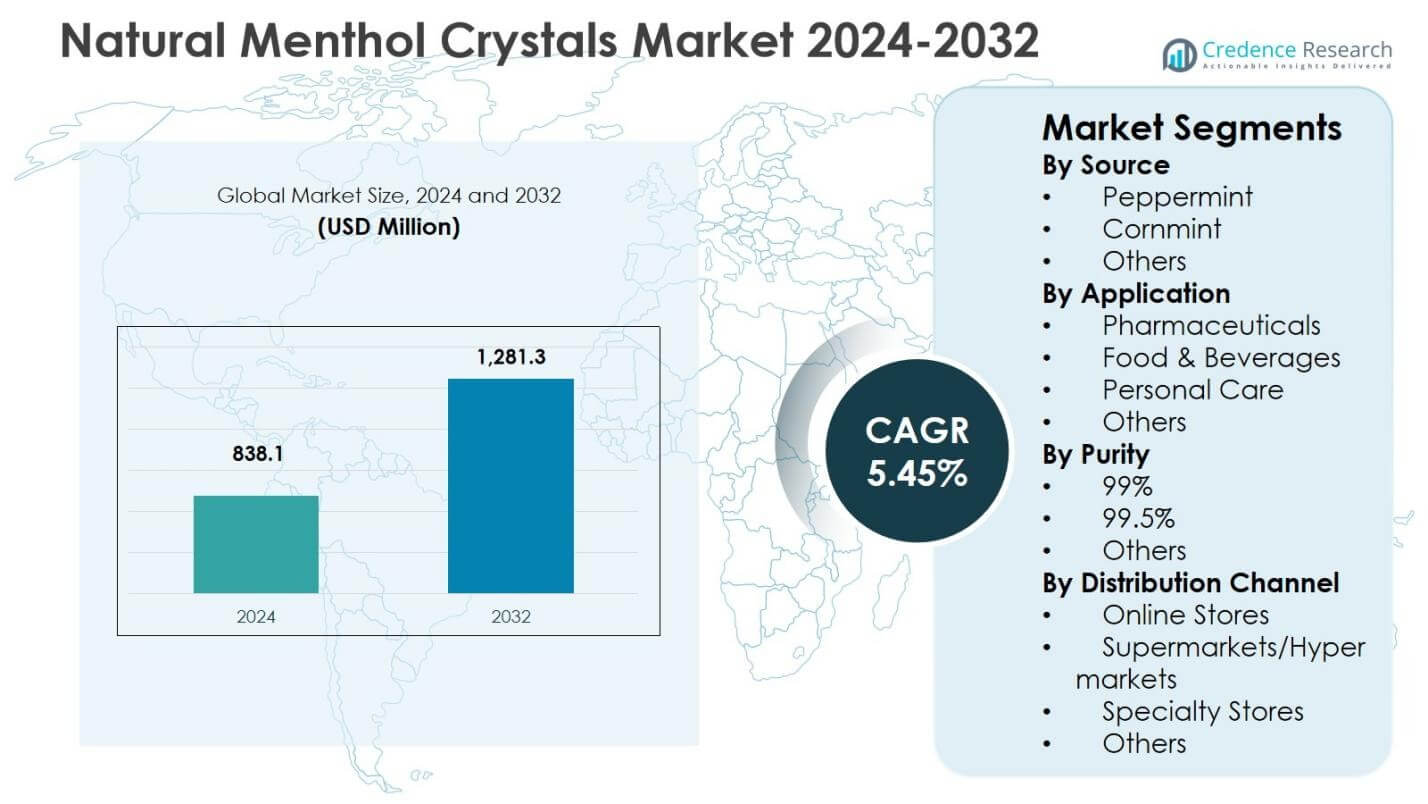
Natural Menthol Crystals Market size was valued at USD 838.1 million in 2024 and is anticipated to reach USD 1,281.3 million by 2032, expanding at a CAGR of 5.45% during the forecast period.
| REPORT ATTRIBUTE |
DETAILS |
| Historical Period |
2020-2023 |
| Base Year |
2024 |
| Forecast Period |
2025-2032 |
| Natural Menthol Crystals Market Size 2024 |
USD 838.1 million |
| Natural Menthol Crystals Market, CAGR |
5.45% |
| Natural Menthol Crystals Market Size 2032 |
USD 1,281.3 million |
Natural Menthol Crystals Market Insights
- Market growth is driven by strong demand from pharmaceuticals and OTC healthcare, where menthol is widely used in inhalers, balms, syrups, and lozenges, with the pharmaceuticals segment holding a 41.6% share in 2024.
- Clean-label preference is strengthening demand across personal care and food applications, while cornmint dominates the source segment with a 68.4% share due to high yield and cost efficiency.
- Leading manufacturers focus on purity optimization, scalable production, and regulatory compliance, with high-purity 99% menthol crystals accounting for a 52.7% segment share in 2024.
- Asia-Pacific leads with a 42.9% regional share supported by large-scale cultivation, followed by North America at 21.4% and Europe at 18.7%, driven by healthcare demand and natural ingredient adoption.
Natural Menthol Crystals Market Segmentation Analysis:
By Source
By source, the Natural Menthol Crystals Market is led by the cornmint segment, which accounted for 72.4% of the total market share in 2024, driven by its higher menthol yield, cost-efficient cultivation, and large-scale availability across Asia. Cornmint-based menthol is widely preferred by pharmaceutical, food, and personal care manufacturers due to consistent quality and stable supply chains. Peppermint held a 21.1% share, supported by premium aroma profiles and natural positioning, while other sources contributed 6.5%, mainly serving niche and regional demand with limited commercial scalability.
- For instance, Arora Aromatics Private Limited produces natural menthol crystals from cornmint (Mentha arvensis), achieving NLT 97% L-menthol content for use in pharmaceuticals, confectionery, and cough drops.
By Application
By application, pharmaceuticals dominated the Natural Menthol Crystals Market with a 38.6% share in 2024, supported by strong demand for menthol in cough syrups, inhalers, topical analgesics, and decongestants. The segment benefits from rising respiratory disorders, expanding OTC drug consumption, and regulatory acceptance of natural menthol. Food and beverages accounted for 27.9%, driven by confectionery and flavored products, while personal care held 25.4% due to oral care and cosmetics usage. Other applications represented 8.1%, primarily in aromatherapy and industrial uses.
- For instance, Vicks VapoRub by Procter & Gamble incorporates 2.6% menthol as a cough suppressant and topical analgesic, combined with camphor and eucalyptus oil for chest rub relief.
By Purity
By purity, the 99% purity segment held the dominant share of 64.2% in 2024, as it offers an optimal balance between performance, regulatory compliance, and cost efficiency across pharmaceuticals and personal care formulations. Manufacturers favor this grade for large-volume production due to consistent crystallization and stability. The 99.5% purity segment accounted for 28.7%, driven by premium pharmaceutical and export-oriented demand requiring higher refinement standards. Other purity grades represented 7.1%, mainly catering to specialized industrial and customized formulation requirements.
Access crucial information at unmatched prices!
Request your sample report today & start making informed decisions powered by Credence Research Inc.!
Download Sample
Key Growth Drivers
Expanding Pharmaceutical and OTC Healthcare Demand
The Natural Menthol Crystals Market is strongly driven by rising demand from the pharmaceutical and over-the-counter healthcare sector. Menthol’s proven cooling, analgesic, decongestant, and soothing properties support its extensive use in cough syrups, inhalers, topical pain relievers, balms, and lozenges. Increasing prevalence of respiratory disorders, seasonal flu, and common cold conditions continues to expand consumption across both prescription and OTC formulations. Growth in self-medication trends and wider availability of menthol-based products through retail and online pharmacies further reinforce demand. Regulatory preference for plant-derived excipients also supports sustained adoption in pharmaceutical manufacturing.
- For instance, Cadila Pharmaceuticals incorporates menthol in its N-T-Tus-T Cough Syrup to soothe throat irritation and relieve cough associated with hoarseness. The formulation combines menthol with herbal ingredients like licorice and holy basil for symptomatic relief in common cold conditions.
Rising Consumption in Personal Care and Cosmetics
Growing usage in personal care and cosmetic products remains a major growth driver for the Natural Menthol Crystals Market. Menthol is widely incorporated into skincare, haircare, oral care, and hygiene products for its cooling sensation, antimicrobial benefits, and fragrance enhancement. Increasing consumer preference for natural and clean-label ingredients significantly supports demand for plant-based menthol over synthetic alternatives. Expanding urban populations, rising disposable incomes, and higher awareness of premium personal care products are accelerating adoption. Manufacturers increasingly promote menthol-infused formulations in shampoos, creams, toothpastes, and soaps, strengthening long-term market expansion.
- For instance, Colgate MaxFresh Cooling Crystals Toothpaste uses menthol for intense cooling and super freshness that fights cavities and reduces germ buildup. The blue gel with dissolving crystals delivers an icy minty burst during brushing.
Strong Demand from Food and Beverage Flavoring Applications
The expanding food and beverage industry is another key driver supporting growth of the Natural Menthol Crystals Market. Menthol is extensively used as a flavoring and cooling agent in confectionery, chewing gum, oral refreshers, beverages, and functional foods. Rising consumption of mint-based products, particularly in emerging economies, continues to boost volume demand. Growing interest in natural flavoring solutions, combined with regulatory scrutiny over synthetic additives, favors the adoption of natural menthol crystals. Innovation in functional foods and sugar-free confectionery further enhances the role of menthol as a preferred sensory ingredient.
Key Trends & Opportunities
Shift Toward Natural and Clean-Label Ingredients
A prominent trend shaping the Natural Menthol Crystals Market is the accelerating shift toward natural, clean-label, and plant-based ingredients across industries. Consumers increasingly favor products with transparent sourcing and minimal chemical processing, driving manufacturers to replace synthetic menthol with natural alternatives. This trend creates strong opportunities for suppliers focusing on sustainable farming, traceability, and organic certification. Food, pharmaceutical, and personal care brands actively promote natural menthol as a value-added ingredient, enhancing brand differentiation. The growing global emphasis on wellness, safety, and environmental responsibility continues to open new avenues for premium and specialty menthol crystal products.
- For instance, Kelvin Natural Mint Pvt. Ltd. produces high-quality menthol crystals from Mentha arvensis oil, meeting BP/USP/JP/EP standards for medicinal products such as cough syrups and balms. With over 27 years of experience, the company ensures organic quality and purity up to 99% for pharmaceutical formulations.
Expansion Opportunities in Emerging Economies
Emerging economies present significant growth opportunities for the Natural Menthol Crystals Market due to expanding pharmaceutical manufacturing, rising personal care consumption, and increasing food processing activities. Countries across Asia-Pacific, Latin America, and parts of Africa benefit from favorable climatic conditions for mint cultivation, supporting local supply chains. Government support for herbal and natural product industries further strengthens market potential. Rising awareness of menthol-based health benefits and increasing access to consumer goods accelerate demand. Investments in processing infrastructure and export-oriented production also position emerging markets as both major consumers and global suppliers.
- For instance, Hindustan Mint & Agro Products Pvt. Ltd., based in Uttar Pradesh, India, operates a 127,500 sq. ft. state-of-the-art facility for menthol crystals production from Mentha arvensis oil.
Key Challenges
Volatility in Raw Material Supply and Pricing
One of the major challenges affecting the Natural Menthol Crystals Market is volatility in raw material availability and pricing. Mint cultivation is highly dependent on climatic conditions, rainfall patterns, and agricultural productivity, making supply susceptible to weather disruptions. Fluctuations in crop yield directly impact menthol production volumes and cost structures. Additionally, rising input costs such as labor, fertilizers, and transportation place pressure on profit margins. Dependence on specific geographic regions for cornmint and peppermint cultivation further increases supply risk, creating uncertainty for manufacturers and downstream users.
Regulatory Compliance and Quality Standardization
Regulatory complexity and quality standardization present ongoing challenges for the Natural Menthol Crystals Market. Pharmaceutical, food, and cosmetic applications require strict compliance with purity, safety, and labeling standards across different regions. Variations in regulatory frameworks increase the cost and complexity of international trade. Maintaining consistent quality, purity levels, and traceability across batches is critical, particularly for high-purity menthol grades. Smaller producers often face difficulties meeting stringent certification and documentation requirements, which can limit market access and intensify competition from well-established, compliant suppliers.
Regional Analysis
North America
North America accounted for 21.4% of the Natural Menthol Crystals Market in 2024, supported by strong demand from pharmaceutical, personal care, and food processing industries. The region benefits from high consumption of OTC healthcare products such as inhalers, balms, and cough formulations that extensively use menthol crystals. Growing preference for natural and clean-label ingredients in cosmetics and oral care further strengthens market penetration. The presence of established personal care brands and advanced regulatory compliance frameworks ensures consistent demand for high-purity menthol grades. Continuous product innovation and premiumization trends sustain steady market expansion across the region.
Europe
Europe represented 18.7% of the Natural Menthol Crystals Market in 2024, driven by stringent regulations favoring natural ingredients and sustainable sourcing. Strong demand from pharmaceuticals, cosmetics, and food flavoring applications supports regional growth. European consumers show high awareness of plant-based and herbal formulations, increasing adoption of natural menthol over synthetic alternatives. The region also benefits from a well-developed cosmetics and personal care industry emphasizing premium, organic, and wellness-oriented products. Regulatory emphasis on quality, purity, and traceability further strengthens demand for refined menthol crystals across Western and Central European markets.
Asia-Pacific
Asia-Pacific dominated the Natural Menthol Crystals Market with a 42.9% share in 2024, supported by large-scale mint cultivation, cost-effective production, and strong domestic consumption. India and China serve as major production hubs due to favorable climatic conditions and established agricultural supply chains. Rising pharmaceutical manufacturing, expanding personal care markets, and growing food processing industries significantly boost demand. Increasing export activities and global sourcing from Asia-Pacific producers further reinforce regional leadership. Growing population, rising disposable income, and increasing awareness of natural healthcare products continue to accelerate long-term market growth in the region.
Latin America
Latin America accounted for 9.6% of the Natural Menthol Crystals Market in 2024, driven by expanding pharmaceutical and personal care sectors. Rising consumption of mint-flavored confectionery, oral care products, and topical healthcare formulations supports steady demand. Countries such as Brazil and Mexico are witnessing increased adoption of natural ingredients in cosmetics and wellness products. Growing investment in food processing and rising awareness of herbal remedies contribute to market development. Favorable trade relationships and increasing imports of menthol crystals further strengthen the region’s position within the global market landscape.
Middle East & Africa
The Middle East & Africa held an 7.4% share of the Natural Menthol Crystals Market in 2024, supported by growing pharmaceutical consumption and expanding personal care markets. Increasing demand for cooling and soothing products in hot climatic conditions boosts menthol usage across healthcare and hygiene applications. Rising urbanization and improving access to consumer goods contribute to market growth. The region also benefits from increasing imports to support food flavoring and oral care industries. Gradual expansion of pharmaceutical manufacturing and wellness-focused product offerings supports stable market development across key countries.
Natural Menthol Crystals Market Segmentations:
By Source
- Peppermint
- Cornmint
- Others
By Application
- Pharmaceuticals
- Food & Beverages
- Personal Care
- Others
By Purity
By Distribution Channel
- Online Stores
- Supermarkets/Hypermarkets
- Specialty Stores
- Others
By Geography
- North America
- Europe
- Germany
- France
- U.K.
- Italy
- Spain
- Rest of Europe
- Asia Pacific
- China
- Japan
- India
- South Korea
- South-east Asia
- Rest of Asia Pacific
- Latin America
- Brazil
- Argentina
- Rest of Latin America
- Middle East & Africa
- GCC Countries
- South Africa
- Rest of the Middle East and Africa
Competitive Landscape
Competitive landscape in the Natural Menthol Crystals Market is characterized by the presence of key players such as BASF SE, Symrise AG, Takasago International Corporation, Arora Aromatics Pvt. Ltd., Fengle Perfume Co., Ltd., Agson Global Pvt. Ltd., Silverline Chemicals Ltd., Nectar Lifesciences Ltd., Bhagat Aromatics Ltd., and KM Chemicals. These companies focus on strengthening their positions through capacity expansion, vertical integration with mint cultivation, and consistent quality assurance to meet pharmaceutical, food, and personal care standards. Leading players emphasize high-purity menthol production, supply reliability, and compliance with international regulatory norms. Strategic partnerships with distributors, investments in sustainable sourcing, and expansion into emerging markets support competitive differentiation. The market remains moderately consolidated, with established players leveraging scale and global reach, while regional manufacturers compete through cost efficiency, localized supply chains, and growing export-oriented production capabilities.
Shape Your Report to Specific Countries or Regions & Enjoy 30% Off!
Key Player Analysis
- Bhagat Aromatics Ltd.
- Takasago International Corporation
- Silverline Chemicals Ltd.
- Arora Aromatics Pvt. Ltd.
- KM Chemicals
- Symrise AG
- Fengle Perfume Co., Ltd.
- Agson Global Pvt. Ltd.
- BASF SE
- Nectar Lifesciences Ltd.
Recent Developments
- In August 2025, Takasago Europe GmbH entered into a new partnership with food innovation accelerator Food Harbour Hamburg to expand its flavor development network and support product innovation with its flavor portfolio.
- In April 2025, BASF Aroma Ingredients launched L-Menthol FCC rPCF, its first aroma ingredient with a reduced product carbon footprint, aimed at supporting customers’ sustainability goals while delivering high-quality menthol functionality.
- In December 2024, Colgate launched a new MaxFresh range featuring heart-shaped cooling crystals enhanced with natural menthol for oral care, blending refreshment, fruity flavors, and visual appeal.
Report Coverage
The research report offers an in-depth analysis based on Source, Application, Purity, Distribution Channel and Geography. It details leading market players, providing an overview of their business, product offerings, investments, revenue streams, and key applications. Additionally, the report includes insights into the competitive environment, SWOT analysis, current market trends, as well as the primary drivers and constraints. Furthermore, it discusses various factors that have driven market expansion in recent years. The report also explores market dynamics, regulatory scenarios, and technological advancements that are shaping the industry. It assesses the impact of external factors and global economic changes on market growth. Lastly, it provides strategic recommendations for new entrants and established companies to navigate the complexities of the market.
Future Outlook
- Demand will steadily increase due to expanding pharmaceutical and OTC healthcare product consumption.
- Personal care and cosmetic manufacturers will intensify usage of natural menthol in clean-label formulations.
- Food and beverage applications will grow with rising demand for natural flavoring and cooling agents.
- Asia-Pacific will continue to lead production and exports supported by strong mint cultivation capacity.
- Technological improvements in extraction and purification will enhance yield and quality consistency.
- High-purity menthol grades will gain wider adoption in regulated pharmaceutical and cosmetic applications.
- Sustainable farming and traceable sourcing practices will become critical for supplier competitiveness.
- Emerging markets will offer strong growth potential driven by urbanization and rising consumer awareness.
- Regulatory compliance and quality certifications will increasingly influence supplier selection.
- Strategic partnerships and capacity expansions will shape long-term market positioning.



