
Market Overview:
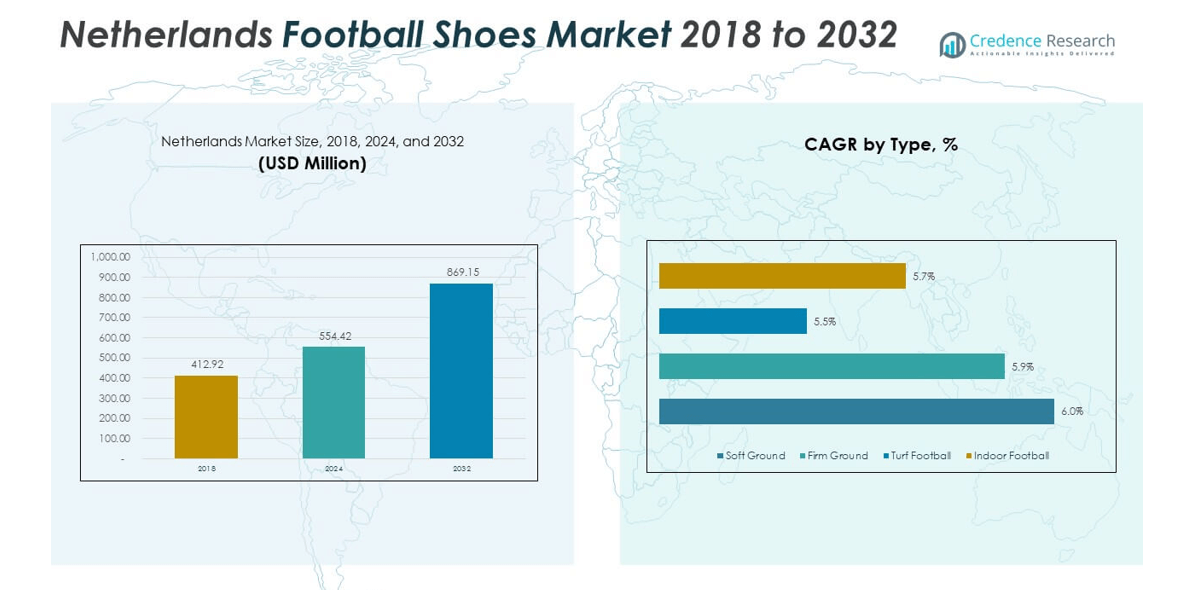
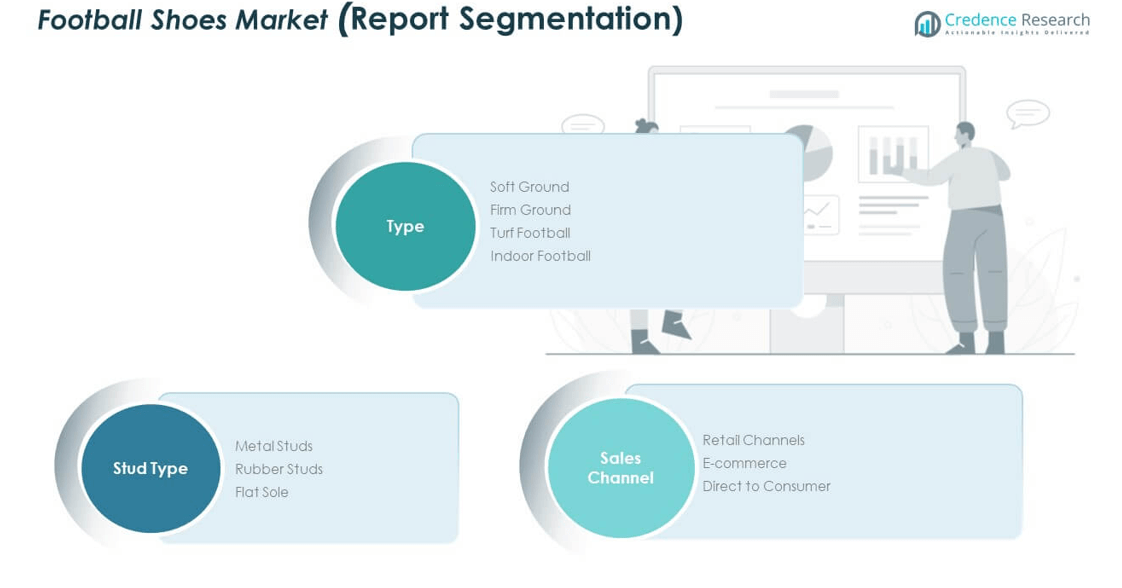
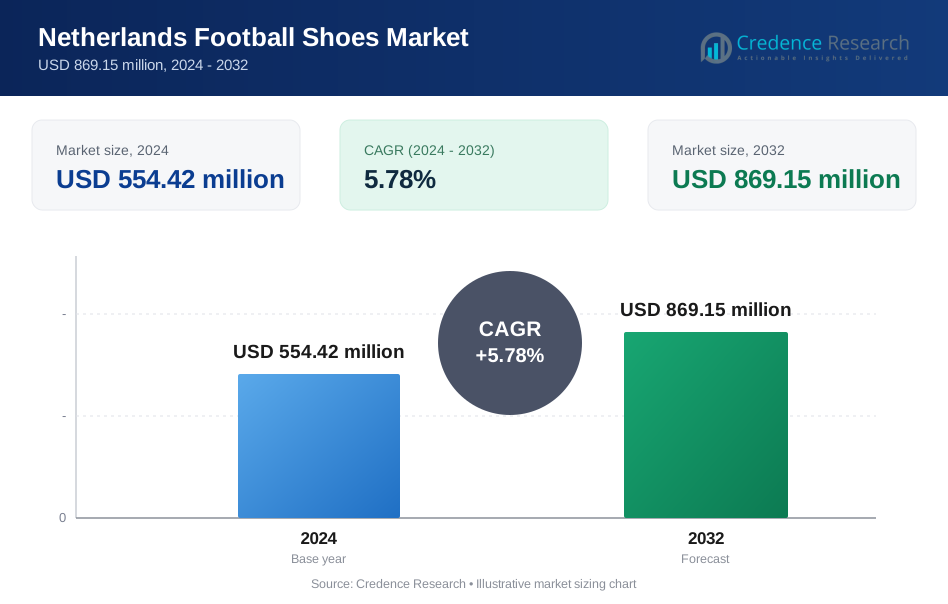
The Netherlands Football Shoes Market size was valued at USD 412.92 million in 2018 to USD 554.42 million in 2024 and is anticipated to reach USD 869.15 million by 2032, at a CAGR of 5.78% during the forecast period.
| REPORT ATTRIBUTE | DETAILS |
|---|---|
| Historical Period | 2020-2023 |
| Base Year | 2024 |
| Forecast Period | 2025-2032 |
| Netherlands Football Shoes Market Size 2024 | USD 554.42 million |
| Netherlands Football Shoes Market, CAGR | 5.78% |
| Netherlands Football Shoes Market Size 2032 | USD 869.15 million |
The market is driven by strong participation in football across professional, amateur, and youth levels. Expanding grassroots initiatives, academies, and school programs encourage consistent demand for quality footwear. Leading companies invest in lightweight materials, improved sole technology, and customized designs to support performance. Sustainability trends push brands to adopt eco-friendly materials, aligning with consumer preferences for responsible production. E-commerce growth and retail partnerships also strengthen product accessibility. It continues to benefit from innovation, marketing strategies, and rising interest in sports culture.
Western Europe leads the Netherlands Football Shoes Market due to established leagues, professional clubs, and advanced sports infrastructure. Strong consumer loyalty to global brands and rising demand for premium footwear drive consistent growth in this subregion. Central Europe is emerging, supported by expanding semi-professional leagues and urbanization. Eastern Europe shows potential, fueled by affordability-based demand and grassroots-level football initiatives. It reflects a geographically diverse market where mature regions dominate high-value sales, while emerging ones add new growth momentum.
Market Insights
- The Netherlands Football Shoes Market was valued at USD 412.92 million in 2018, reached USD 554.42 million in 2024, and is projected to achieve USD 869.15 million by 2032, growing at a CAGR of 5.78%.
- Western Europe held 52% share in 2024, leading due to strong football culture and advanced sports infrastructure, followed by Central Europe at 31% with rising leagues, and Eastern Europe at 17% driven by affordability-based demand.
- Central Europe is the fastest-growing subregion with a 31% share, supported by semi-professional league expansion, urbanization, and growing adoption through e-commerce and grassroots programs.
- By type, firm ground shoes accounted for the largest segment at 41%, supported by widespread use across natural grass pitches and professional-level play.
- Turf football and indoor football shoes together represented 37% of the total share, reflecting growth from artificial surfaces and the popularity of futsal in urban areas.
Market Drivers
Growing Participation in Football Across Youth and Amateur Levels
Youth participation continues to expand through structured school programs and community clubs. Grassroots initiatives create a strong demand for affordable yet durable football shoes. Government-backed sports development schemes strengthen accessibility and interest among younger demographics. Professional academies raise performance expectations, encouraging players to seek advanced shoe technology. Parents increasingly prioritize quality footwear to reduce injury risks. The Netherlands Football Shoes Market benefits from this rising involvement at all competitive levels. Growing awareness of sports health pushes consistent replacement of footwear. Retailers respond with broad product ranges tailored for skill progression.
Technological Innovations Driving Performance and Product Differentiation
Manufacturers develop lightweight soles, breathable uppers, and ergonomic fits to enhance player comfort. Companies incorporate advanced traction patterns to adapt to artificial turf and natural grass. Innovative cushioning improves shock absorption, reducing strain on athletes’ joints. Smart design features increase speed and agility, appealing to professional and semi-professional players. The Netherlands Football Shoes Market integrates research-driven improvements into mainstream offerings. Innovation allows brands to differentiate in a highly competitive retail environment. Customization technology attracts athletes seeking personalized fit and style. Enhanced durability strengthens long-term customer loyalty.
- For example, in June 2024, Adidas reintroduced the F50 football boot as part of its Advancement Pack, engineered for game-changing speed. The new model featured Sprintframe 360 soleplates, Fibertouch synthetic uppers, and Sprintweb textured zones to enhance traction, control, and acceleration.
Rising Influence of Sustainability in Material Choices
Brands shift toward eco-friendly designs by introducing recycled and bio-based materials. Environment-conscious players prefer footwear with lower carbon footprints. Shoe manufacturers experiment with plant-based polymers and sustainable leathers. These advancements align with the Netherlands’ broader commitment to green practices. The Netherlands Football Shoes Market integrates sustainability into premium product lines. Transparent sourcing builds brand credibility in a socially aware consumer base. Sports retailers promote sustainable models as premium alternatives. Consumer trust strengthens when environmental responsibility combines with performance.
- For example, FastFeetGrinded, a Dutch company, operates a fully automated Shoe Recycling Machine capable of processing up to 2,500 shoes per hour, converting discarded footwear into reusable raw materials such as foam, rubber, and textiles for new applications including sports flooring and playgrounds.
Expansion of Retail Channels and Online Accessibility
E-commerce platforms expand consumer reach through exclusive models and discount-driven campaigns. Online product visualization tools simplify the decision-making process. Direct-to-consumer models ensure faster product launches and improved after-sales services. Physical outlets maintain relevance through in-store customization and experiential promotions. The Netherlands Football Shoes Market adapts to omni-channel retail strategies. Collaborations between clubs and brands drive exclusive sales opportunities. Seasonal campaigns aligned with tournaments boost consumer enthusiasm. Accessibility in both online and offline channels keeps demand consistent.
Market Trends
Integration of Smart Features and Connected Technologies
Smart sensors embedded in football shoes track movement, speed, and performance metrics. Athletes analyze real-time data to refine training and match strategies. Wearable integration with apps improves personalized coaching experiences. Professional clubs adopt these products to monitor player development. The Netherlands Football Shoes Market embraces digital adoption for performance-driven buyers. Connected footwear appeals to youth players aspiring for professional standards. Innovation in this space strengthens premium product categories. Data-driven insights redefine expectations of modern athletic footwear.
Emergence of Limited Edition Collaborations and Exclusive Collections
Luxury appeal increases through brand collaborations with football stars and clubs. Limited edition releases generate strong consumer demand and brand loyalty. Exclusive collections align with tournament seasons and major football events. Social media campaigns amplify the appeal of these time-bound models. The Netherlands Football Shoes Market thrives on this culture of exclusivity. Players view limited models as lifestyle statements beyond sports. Retailers use scarcity-driven launches to maintain competitive advantage. Consumer excitement elevates sales velocity during release windows.
Shift Toward Lifestyle Integration and Streetwear Influence
Football shoes expand beyond the pitch to influence casual wear trends. Youth consumers embrace versatile models for both sports and fashion. Design aesthetics highlight bold colorways and crossover appeal with streetwear. Endorsements from fashion influencers expand reach outside traditional sports circles. The Netherlands Football Shoes Market adapts to this fusion of performance and lifestyle. Brands position football footwear as part of broader style identities. Hybrid functionality supports both athletic and leisure activities. Market traction strengthens when shoes appeal to wider lifestyle communities.
- For example, in September 2024, PUMA and Manchester City partnered with Noel Gallagher to launch the “Definitely City” kit. The authentic version featured ULTRAWEAVE fabric for lightweight performance, while replicas offered fan-friendly designs inspired by Oasis’ Definitely Maybe album.
Growing Demand for Women’s and Girls’ Football Footwear
Women’s football gains recognition at both amateur and professional levels. Clubs and federations invest in promoting female participation. Footwear manufacturers create dedicated lines catering to anatomical needs of female athletes. Marketing campaigns highlight women’s sports achievements to inspire younger audiences. The Netherlands Football Shoes Market capitalizes on this demographic expansion. Increased visibility of women’s leagues drives fresh demand cycles. Specialized product ranges elevate inclusivity and accessibility. Retailers dedicate more shelf space to women-specific football footwear.
- For example, in June 2025 Mizuno launched the Wave Prophecy Morelia Neo, unveiling a hybrid silhouette that blends the heritage Morelia’s K-leather style with the futuristic Wave Prophecy soleplate technology. It dropped in an all-black colourway to celebrate Morelia’s 40-year anniversary, and debut sales began on June 27, 2025 via Mizuno and select retailers.
Market Challenges Analysis
High Competition and Price Sensitivity Across Consumer Segments
The market faces strong competition among global and local brands. Companies often struggle to maintain margins under intense pricing pressure. Discount-driven campaigns lower profitability while raising customer expectations. Players with limited budgets opt for low-cost imports over premium models. The Netherlands Football Shoes Market must balance affordability with technological enhancements. Retailers face difficulties in differentiating products in a crowded marketplace. Constant innovation raises production costs that smaller firms cannot sustain. Competitive rivalry remains a core challenge for long-term stability.
Rapid Shifts in Consumer Preferences and Supply Chain Disruptions
Unpredictable shifts in fashion trends impact footwear demand patterns. Players frequently switch brand loyalty based on endorsements or peer influence. Supply chain disruptions delay product launches and seasonal campaigns. Rising costs of raw materials strain manufacturer profitability. The Netherlands Football Shoes Market encounters risks tied to global logistics challenges. Demand volatility during off-seasons creates inventory management issues. Smaller retailers face risks of unsold stock accumulation. Market stability requires agility and strong supplier partnerships.
Market Opportunities
Expanding Role of Customization and Personal Fit Solutions
Customization emerges as a key growth driver across all buyer segments. Consumers demand unique designs reflecting personal style preferences. Technology enables custom fitting to reduce injury risks and improve comfort. Retailers provide 3D scanning to create tailored shoe structures. The Netherlands Football Shoes Market can leverage this trend to strengthen premium sales. Personalized models carry higher price acceptance among professional players. Younger demographics embrace customized aesthetics for individuality. Expansion of this segment ensures strong repeat purchase cycles.
Increasing Potential from International Events and Grassroots Programs
International tournaments create strong peaks in consumer enthusiasm. Events such as European Championships inspire large-scale product demand. Grassroots programs across schools and academies maintain steady interest year-round. These initiatives help grow long-term adoption in urban and rural areas. The Netherlands Football Shoes Market benefits from consistent visibility through sponsorships. Brands align launches with major events to maximize sales. Expanding female participation adds another layer of opportunity. Market players who integrate sports promotion with product innovation gain durable growth.
Market Segmentation Analysis
By type, firm ground shoes dominate the Netherlands Football Shoes Market due to their suitability across natural pitches. Soft ground models remain popular among professional players in wetter conditions, while turf football shoes cater to the growing use of artificial surfaces. Indoor football shoes hold steady demand, driven by rising participation in futsal and urban sports centers. Each type reflects performance needs shaped by surface variation and playing intensity. It maintains strong product diversity across all consumer levels.
- For instance, a peer-reviewed biomechanical evaluation using Adidas F-series boots on artificial turf measured plantar pressure values in 29 footballers and found that studded Adidas models provided safer pressure distribution patterns across the foot compared to bladed designs, supporting their widespread adoption on firm natural and artificial pitches.
By stud design, metal studs retain significance for competitive matches requiring maximum grip. Rubber studs hold wider adoption in recreational play for comfort and safety. Flat sole shoes continue to attract indoor players and those seeking multipurpose use. The Netherlands Football Shoes Market balances innovation with durability in these categories. It adapts to evolving footwear technology while meeting both professional and grassroots requirements.
- For instance, laboratory testing found the Nike Vision (SG) model with metal studs delivered the highest peak rotational traction among nine leading football boots (56.5 N·m on natural rye grass and 58.7 N·m on hybrid turf), while the Adidas Nemesis AG model with artificial grass studs recorded the lowest traction across both surfaces, providing concrete references for stud design choice across play conditions.
By sales channel, retail stores remain influential with their role in providing in-store trials and direct customer experience. E-commerce platforms expand rapidly, offering convenience and wider product choices to digital-savvy consumers. Direct-to-consumer sales grow as brands push exclusive collections and better price control through official outlets. It reflects a multi-channel ecosystem that strengthens accessibility across urban and rural markets. Consumer expectations for speed, customization, and availability drive ongoing adjustments in sales strategies.
Segmentation
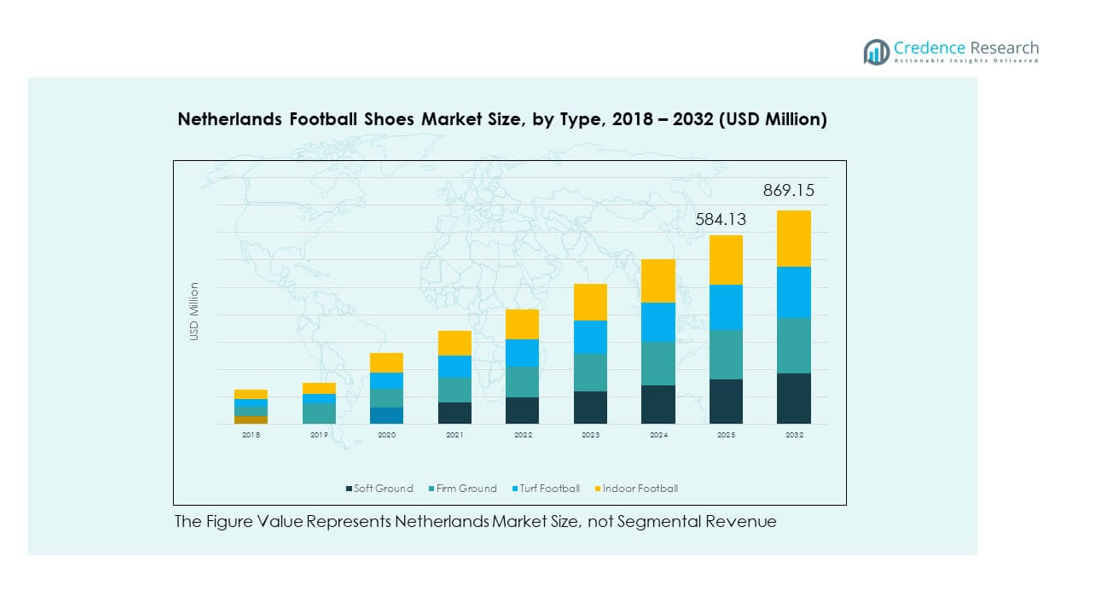
By Type
- Soft Ground
- Firm Ground
- Turf Football
- Indoor Football
By Stud
- Metal Studs
- Rubber Studs
- Flat Sole
By Sales Channel
- Retail Channels
- E-commerce
- Direct to Consumer
Regional Analysis
Western Europe
Western Europe holds the largest share of the Netherlands Football Shoes Market, accounting for 52%. Strong football culture in the Netherlands, Germany, and France drives steady demand. Well-developed retail infrastructure and advanced training academies strengthen adoption of premium footwear. Global brands maintain flagship outlets and exclusive partnerships with top clubs. Consumers in this region display strong preference for innovative, lightweight, and sustainable designs. It continues to be the primary growth hub, supported by high disposable incomes and brand loyalty.
Central Europe
Central Europe secures 31% of the market, led by Poland, Austria, and Switzerland. Expanding football leagues and semi-professional clubs fuel rising interest in performance footwear. Local retailers and e-commerce platforms create accessibility for diverse consumer segments. Players in this region show growing interest in customization and hybrid models suited for mixed surfaces. The Netherlands Football Shoes Market gains traction here through targeted campaigns and regional sponsorships. Ongoing urbanization and government-backed sports programs support further expansion across these countries.
Eastern Europe
Eastern Europe accounts for 17% of the total market share. Countries such as Hungary, Romania, and the Czech Republic show increasing participation in youth football. Affordability remains the key demand driver, with consumers prioritizing durable yet cost-effective shoes. International brands face strong competition from local players offering budget-friendly alternatives. It shows potential for steady growth as female participation in football expands. Regional tournaments and grassroots initiatives enhance visibility and drive market penetration.
Key Player Analysis
- Nike Inc.
- Adidas AG
- Puma SE
- Umbro
- Quick
- Lotto Sport Italia
- New Balance
- Bona Footwear Co., Ltd
- Skechers
- Sokito
- Other Key Players
Competitive Analysis
The Netherlands Football Shoes Market is characterized by intense rivalry among global giants and regional brands. Nike, Adidas, and Puma dominate the competitive landscape through consistent innovation, strong marketing campaigns, and sponsorship deals with clubs and athletes. These companies focus on lightweight designs, sustainable materials, and advanced sole technologies to differentiate offerings. Mid-tier players such as Umbro, Lotto Sport Italia, and Quick target affordability and niche consumer groups to sustain relevance. It reflects a balance between high-end premium demand and growing interest in cost-effective solutions. Local firms and emerging brands such as Sokito and Bona Footwear expand visibility through digital-first strategies and sustainable product lines. E-commerce platforms increase competition by enabling smaller players to reach broader audiences. The competitive environment remains dynamic, shaped by brand reputation, product innovation, and strategic collaborations with football associations.
Recent Developments
- In May 2025, Nike Inc. launched the Hypervenom RGN football boot. The boot revives the original Hypervenom’s mesh and Gripskin technology, combined with a modern plate to improve performance. It debuted in a Bright Citrus colorway that pays homage to the classic orange and black original. Nike made the Hypervenom RGN available starting May 29, 2025 through its ecommerce site and retail stores.
- In September 2025, PUMA collaborated with Dutch football star Memphis Depay to launch the MD51 ULTRA boots, a limited-edition football shoe release celebrating Depay’s record as the Netherlands’ all-time leading men’s scorer. Only 51 pairs were created, each dedicated to an influential figure in Depay’s life, highlighting a unique intersection of sports achievement, personalization, and exclusive product design.
Report Coverage
The research report offers an in-depth analysis based on Type, Stud and Sales Channel. It details leading market players, providing an overview of their business, product offerings, investments, revenue streams, and key applications. Additionally, the report includes insights into the competitive environment, SWOT analysis, current market trends, as well as the primary drivers and constraints. Furthermore, it discusses various factors that have driven market expansion in recent years. The report also explores market dynamics, regulatory scenarios, and technological advancements that are shaping the industry. It assesses the impact of external factors and global economic changes on market growth. Lastly, it provides strategic recommendations for new entrants and established companies to navigate the complexities of the market.
Future Outlook
- Rising adoption of sustainable materials will redefine product innovation and strengthen eco-friendly positioning.
- Expansion of women’s football leagues will drive growth in female-focused footwear collections.
- Integration of digital technologies, including smart sensors, will enhance performance monitoring.
- Exclusive collaborations with football clubs and athletes will reinforce brand visibility.
- Growth of grassroots programs will sustain long-term demand across youth categories.
- Omni-channel retail strategies will improve consumer access through online and offline platforms.
- Emerging demand in Central and Eastern Europe will diversify regional revenue sources.
- Customization trends will push premium product sales and improve customer loyalty.
- Marketing strategies focused on lifestyle appeal will expand the market beyond sports.
- Strategic mergers and product launches will reshape the competitive landscape.
Request a Free Sample
Fill in your details and we'll send you a free sample report.
- Sample data tables & charts
- Research methodology
Need a Custom Version of This Report?
Tailor the scope, geography, or segments to your exact requirements.
- Custom geography or segment scope
- Direct access to our analyst team
Frequently Asked Questions
What is the current market size for Netherlands Football Shoes Market, and what is its projected size in 2032?
At what Compound Annual Growth Rate is the Netherlands Football Shoes Market projected to grow between 2024 and 2032?
Which Netherlands Football Shoes Market segment held the largest share in 2024?
What are the primary factors fueling the growth of the Netherlands Football Shoes Market?
Who are the leading companies in the Netherlands Football Shoes Market?
Table of Content
Chapter 1. Report Introduction
- 1.1 Report Description & Purpose
- 1.1.1 Report Title & Market Definition
- 1.1.2 Unique Selling Propositions (USP) & Key Differentiators
- 1.1.3 Value Proposition for Stakeholders
- 1.2 Research Objectives
- 1.2.1 Market Sizing Objectives (Volume & Revenue)
- 1.2.2 Segmentation Objectives
- 1.2.3 Competitive Intelligence Objectives
- 1.2.4 Forecast & Scenario Objectives
- 1.3 Report Scope
- 1.3.1 Netherlands Football Shoes Scope – Types & Subtypes Covered
- 1.3.2 Geographic Scope – Regions & Countries Covered
- 1.3.3 Historical Period, Base Year & Forecast Period (2024; forecast to 2032)
- 1.3.4 Inclusions & Exclusions
- 1.4 HS Code & Classification Framework
- 1.5 Currency, Units & Pricing Basis
- 1.6 Target Stakeholders
- 1.7 Limitations & Assumptions
Chapter 2. Executive Summary
- 2.1 Global Netherlands Football Shoes Market Snapshot
- 2.1.1 Market Size – Historical (2024) & Forecast (2024-2032) (2024: USD 554.42 million → 2032: USD 869.15 million)
- 2.1.2 Volume & Revenue – Global Totals
- 2.1.3 Key Market Highlights – Top Five Facts
- 2.2 Netherlands Football Shoes Market Segmentation Snapshot
- 2.2.1 Market Split by Region – 2024 vs. 2032
- 2.3 Competitive Snapshot
- 2.3.1 Top 10 Players by Revenue Share – 2024
- 2.3.2 Top 10 Players by Volume Share – 2024
- 2.3.3 Recent Strategic Developments (18-Month Summary)
- 2.4 Key Investment Highlights & Strategic Conclusions
Chapter 3. Netherlands Football Shoes Market Dynamics & Industry Analysis
- 3.1 Market Overview & Context
- 3.1.1 Netherlands Football Shoes Market Position in the Broader Automotive Value Chain
- 3.1.2 OEM vs. Replacement Market Dynamics
- 3.1.3 Market Maturity & Development Stage by Region
- 3.2 Netherlands Football Shoes Market Drivers
- 3.3 Netherlands Football Shoes Market Restraints & Challenges
- 3.4 Netherlands Football Shoes Market Opportunities
- 3.5 Porter's Five Forces Analysis
- 3.5.1 Threat of New Entrants
- 3.5.2 Bargaining Power of Suppliers
- 3.5.3 Bargaining Power of Buyers
- 3.5.4 Threat of Substitutes
- 3.5.5 Competitive Rivalry – Intensity Assessment
- 3.6 Netherlands Football Shoes Value Chain Analysis
- 3.6.1 Upstream – Raw Material/Input Suppliers
- 3.6.1.1 Raw Material/Input 1
- 3.6.1.2 Raw Material/Input 2
- 3.6.1.3 Raw Material/Input 3
- 3.6.2 Midstream – Production/Manufacturing/Service Delivery
- 3.6.2.1 Production/Process Overview
- 3.6.2.2 Key Facility Locations & Capacity by Manufacturer
- 3.6.3 Downstream – Distribution & End Consumer
- 3.6.3.1 Primary Channel – B2B/OEM
- 3.6.3.2 Secondary Channels – Dealer, Retail, Online, Direct
- 3.6.4 Value Chain Profitability Analysis
- 3.6.1 Upstream – Raw Material/Input Suppliers
- 3.7 PESTEL Analysis
- 3.7.1 Political Factors
- 3.7.2 Economic Factors
- 3.7.3 Social Factors
- 3.7.4 Technological Factors
- 3.7.5 Environmental Factors
- 3.7.6 Legal Factors
- 3.8 Netherlands Football Shoes Supply Chain Analysis
- 3.8.1 Raw Material/Input Supply Risk Assessment
- 3.8.2 Manufacturing Concentration Risk (Geographic Exposure)
- 3.8.3 Trade Disruption Impact Analysis
- 3.9 Regulatory & Policy Landscape
Note: The regulatory and policy landscape section covers regulations based on their applicability to the market, Netherlands Football Shoes category, geography, and scope of the study. Only regulatory frameworks with a material impact on operations, compliance, trade, sustainability, or market access are analyzed in detail.
Chapter 4. Key Investment Pockets & Opportunity Analysis
- 4.1 Netherlands Football Shoes Market Attractiveness Analysis
- 4.1.1 By Region – Investment Attractiveness Matrix (Volume × CAGR)
- 4.2 Absolute Revenue Growth Opportunity
- 4.2.1 By Region – Absolute USD Growth Through 2032
- 4.3 Incremental Volume Opportunity
- 4.3.1 By Region – Incremental Volume Through 2032
- 4.3.2 Segment – Incremental Volume
- 4.4 Emerging Submarket Opportunity Deep Dive (Subject to Applicability)
- 4.5 Emerging Market Opportunity Scorecards
- 4.5.1 United States
- 4.5.2 Europe
- 4.5.3 Asia
- 4.5.4 Middle East & Africa
Note: Emerging Market Opportunity Scorecards will be included based on relevance and strategic importance. Regions listed are indicative and may vary depending on data availability and market dynamics.
Chapter 5. Netherlands Football Shoes Import-Export Analysis & Trade Flows
- 5.1 Global Trade Overview
- 5.1.1 Global Export Value by Country (2024)
- 5.1.2 Global Export Volume by Country (2024)
- 5.1.3 Global Import Value by Country (2024)
- 5.1.4 Global Import Volume by Country (2024)
- 5.1.5 Net Trade Balance by Country (2024)
- 5.2 Export Analysis – Segment
- 5.2.1 Type 1 (HS Code)
- 5.2.2 Type 2 (HS Code)
- 5.2.3 Type 3 (HS Code)
- 5.2.4 Type 4 (HS Code)
- 5.2.5 Type 5 (HS Code)
- 5.3 Import Analysis – Segment
- 5.3.1 Type 1 (HS Code)
- 5.3.2 Type 2 (HS Code)
- 5.3.3 Type 3 (HS Code)
- 5.3.4 Type 4 (HS Code)
- 5.3.5 Type 5 (HS Code)
- 5.4 Average Unit Trade Prices
- 5.4.1 Average Export Price – Segment & Country
- 5.4.2 Average Import Price – Segment & Source Country
- 5.4.3 Price Trends (2024)
- 5.5 Key Trade Route Analysis
- 5.5.1 Trade Route 1
- 5.5.2 Trade Route 2
- 5.5.3 Trade Route 3
- 5.5.4 Trade Route 4
- 5.5.5 Trade Route 5
- 5.6 Trade Policy Impact Assessment
- 5.6.1 US Anti-Dumping & Section 301 Tariffs
- 5.6.2 EU Customs Union Impact
- 5.6.3 Major Free Trade Agreements
- 5.6.4 USMCA Rules of Origin
Note: Trade policy analysis will be included only where relevant to the Netherlands Football Shoes market.
Chapter 6. Competitive Landscape & Company Benchmarking
- 6.1 Netherlands Football Shoes Market Concentration & Structure
- 6.1.1 Herfindahl-Hirschman Index (HHI) – vs. 2024
- 6.1.2 Tier 1, Tier 2 & Tier 3 Market Structure
- 6.1.3 Global, Regional & Local Player Dynamics
- 6.2 Netherlands Football Shoes Market Share Analysis – 2024
- 6.2.1 Global Revenue Share by Company
- 6.2.2 Global Volume Share by Company
- 6.2.3 Regional Revenue Share
- 6.2.4 Market Share Evolution ( vs. 2024)
- 6.2.5 OEM Segment Share by Company
- 6.2.6 Replacement Segment Share by Company
- 6.3 Production/Delivery Capacity & Facility Analysis
- 6.3.1 Global Installed Capacity
- 6.3.2 Capacity Utilization Rates
- 6.3.3 Production/Output Volume
- 6.3.4 Facility Locations & Capacity Map
- 6.3.5 Planned Capacity Additions
- 6.4 Netherlands Football Shoes Competitive Benchmarking Matrix
- 6.4.1 Revenue, Volume, CAGR & Profitability Comparison
- 6.4.2 Channel Revenue Mix
- 6.4.3 Geographic Revenue Exposure
- 6.4.4 R&D Intensity
- 6.4.5 Sustainability Maturity
- 6.5 Strategic Developments in Netherlands Football Shoes (Last 24 Months)
- 6.5.1 Mergers, Acquisitions & Divestments
- 6.5.2 New Netherlands Football Shoes Launches
- 6.5.3 Facility Expansions
- 6.5.4 Strategic Alliances, Joint Ventures & Partnerships
- 6.5.5 Distribution Expansion & Market Entry
- 6.5.6 Sustainability & ESG Initiatives
- 6.6 Competitive Strategy Mapping
- 6.6.1 Leader, Challenger, Follower & Niche Classification
- 6.6.2 Pricing Strategy Comparison
- 6.6.3 Channel Strategy Matrix
Note: Strategic developments are included based on their materiality and the availability of reliable information.
Chapter 7. Global Netherlands Football Shoes Market – By Distribution Channel
- 7.1 Segment Overview
- 7.1.1 Volume & Revenue Split by Channel (2024 & 2032)
- 7.1.2 Channel Mix Evolution (2024-2032)
Chapter 8. Regional Market Analysis – Global Overview
- 8.1 Global Regional Overview
- 8.1.1 Regional Volume Share
- 8.1.2 Regional Revenue Share
- 8.1.3 Regional Volume by Region
- 8.1.4 Regional Revenue by Region
- 8.1.5 Regional Forecast Through 2032
- 8.2 Cross-Regional Segment Analysis
- 8.2.1 By Distribution Channel
- 8.2.2 By Brand/Price Tier
Chapter 9. North America Netherlands Football Shoes Market
- 9.1 United States
- 9.2 Canada
- 9.3 Mexico
Chapter 10. Europe Netherlands Football Shoes Market
- 10.1 Germany
- 10.2 France
- 10.3 Italy
- 10.4 United Kingdom
- 10.5 Spain
- 10.6 Poland
- 10.7 Russia
- 10.8 Netherlands
- 10.9 Belgium
- 10.10 Sweden
- 10.11 Denmark
- 10.12 Norway
- 10.13 Rest of Europe
Chapter 11. Asia Pacific Netherlands Football Shoes Market
- 11.1 China
- 11.2 India
- 11.3 Japan
- 11.4 South Korea
- 11.5 Thailand
- 11.6 Indonesia
- 11.7 Vietnam
- 11.8 Malaysia
- 11.9 Australia
- 11.10 Rest of Asia Pacific
Chapter 12. Latin America Netherlands Football Shoes Market
- 12.1 Brazil
- 12.2 Argentina
- 12.3 Colombia
- 12.4 Chile
- 12.5 Rest of Latin America
Chapter 13. Middle East Netherlands Football Shoes Market
- 13.1 Saudi Arabia
- 13.2 United Arab Emirates
- 13.3 Turkey
- 13.4 Israel
- 13.5 Iran
- 13.6 Rest of the Middle East
Chapter 14. Africa Netherlands Football Shoes Market
- 14.1 South Africa
- 14.2 Egypt
- 14.3 Nigeria
- 14.4 Morocco
- 14.5 Rest of Africa
Chapter 15. Netherlands Football Shoes Company Profiles
- 15.1 [Company 01]
- 15.1.1 Company Overview
- 15.1.2 Key Management Personnel
- 15.1.3 Products & Services Portfolio
- 15.1.4 Financial Performance
- 15.1.5 Key Market Focus & Geographic Presence
- 15.1.6 Recent Developments & Strategic Initiatives
Note: The company profile list is preliminary and may change based on research findings, market developments, data availability, and client requirements.
Chapter 16. Appendices
- Appendix A – List of Abbreviations & Acronyms
- Appendix B – Industry Classification Code Reference – Full Series
- Appendix C – Production & Capacity Data Tables
- Appendix D – End-Use & Demand Base Tables
- Appendix E – Consumption & Replacement Rate Assumptions
- Appendix F – ASP Reference Tables
- Appendix G – Manufacturing & Facility Database
- Appendix H – Import-Export Data Tables
- Appendix I – Regulatory Summary Tables
- Appendix J – Primary Research Participant List (Anonymized)
- Appendix K – Primary Research Questionnaire Framework
- Appendix L – Data Sources & Bibliography
- Appendix M – Market Size Divergence & Source Comparison
Chapter 17. Research Methodology
- 17.1 Research Framework & Philosophy
- 17.2 Secondary Research – Sources, Hierarchy & Data Extraction
- 17.3 Data Modeling – Bottom-Up & Top-Down Market Sizing
- 17.4 Primary Research – Stakeholder Framework, LOI & Sample Sizes
- 17.5 Forecast Methodology – Regression, Scenario & Sensitivity Analysis
- 17.6 Quality Control – Four-Layer Validation Framework
- 17.7 Limitations & Standard Assumptions
- 17.8 Disclaimer
