
Market Overview:
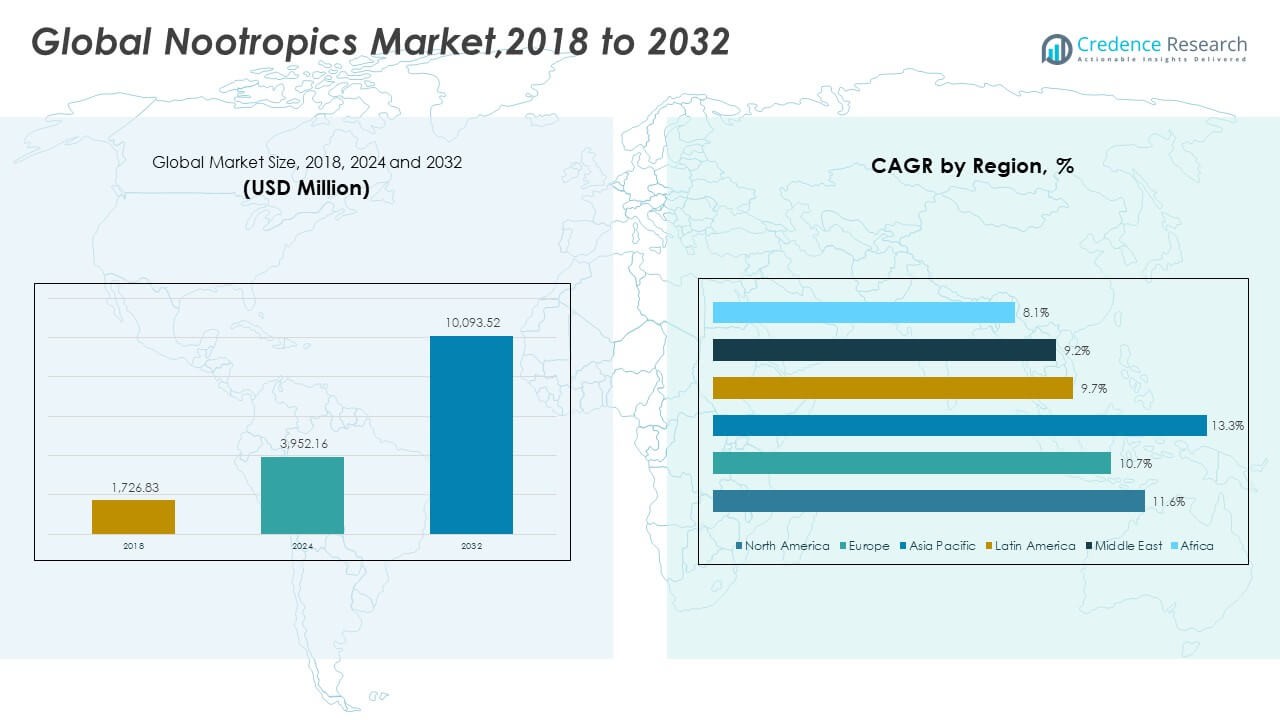
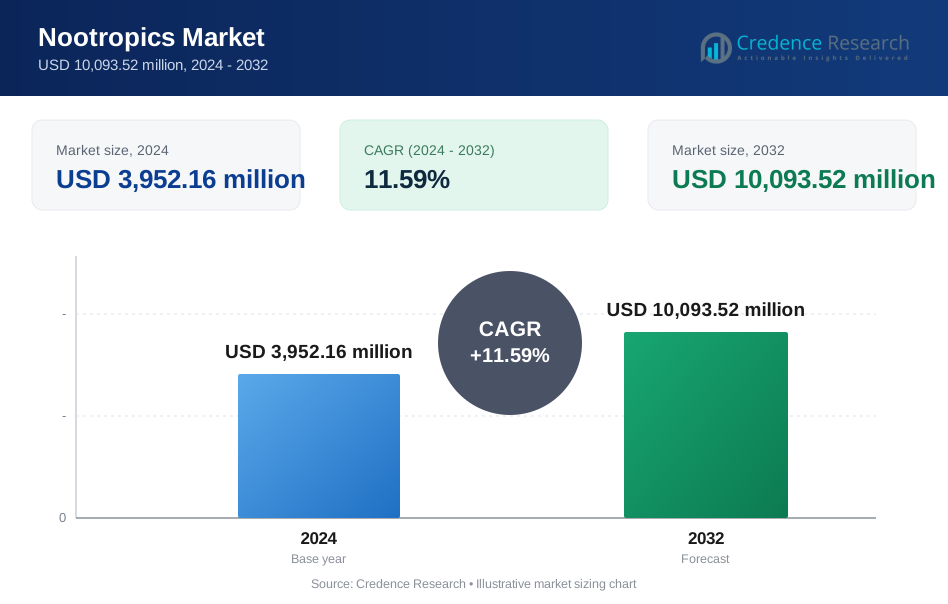
The Global Nootropics Market size was valued at USD 1,726.83 million in 2018 to USD 3,952.16 million in 2024 and is anticipated to reach USD 10,093.52 million by 2032, at a CAGR of 11.59% during the forecast period.
| REPORT ATTRIBUTE | DETAILS |
|---|---|
| Historical Period | 2020-2023 |
| Base Year | 2024 |
| Forecast Period | 2025-2032 |
| Nootropics Market Size 2024 | USD 3,952.16 Million |
| Nootropics Market, CAGR | 11.59% |
| Nootropics Market Size 2032 | USD 10,093.52 Million |
Rising consumer focus on brain health, cognitive enhancement, and stress management continues to drive strong demand for nootropic supplements. The growing prevalence of mental fatigue linked to digital lifestyles has pushed consumers toward products improving memory, focus, and mental performance. Increased investment in research, natural formulations, and adaptogenic ingredients supports innovation in premium blends. It benefits from social media-driven awareness and expanding access to nootropics through online and specialty wellness stores.
North America leads the market, supported by established brands, advanced retail networks, and high awareness of mental wellness products. Europe follows with strong regulatory oversight and a growing shift toward herbal and clinically tested formulations. Asia Pacific shows the fastest growth due to rising disposable incomes, widespread adoption among students and professionals, and regional integration of traditional medicine systems. Latin America, the Middle East, and Africa are emerging steadily with expanding health supplement retail presence and increasing focus on preventive wellness.
Market Insights:
- The Global Nootropics Market was valued at USD 1,726.83 million in 2018, reached USD 3,952.16 million in 2024, and is projected to attain USD 10,093.52 million by 2032, growing at a CAGR of 11.59%.
- North America leads with around 43% share, supported by advanced consumer awareness, digital retail expansion, and presence of top supplement brands. Europe holds roughly 26%, benefiting from regulatory transparency and demand for clean-label herbal formulations.
- Asia Pacific accounts for about 23% of total share and is the fastest-growing region due to rising disposable incomes, young consumer demographics, and integration of traditional medicine practices.
- Synthetic and natural nootropics collectively represent over 50% of total segmental share, driven by proven performance and strong consumer preference for herbal alternatives.
- Adaptogens and stimulants together hold about 30% of segmental share, supported by growing adoption among professionals and fitness-focused users seeking mental endurance and stress resilience.
Market Drivers
Rising Focus on Mental Performance and Cognitive Wellbeing
The Global Nootropics Market is driven by the growing awareness of brain health and mental performance optimization among working professionals, students, and older adults. Increasing competition in academic and professional environments pushes consumers toward supplements that support focus, memory, and alertness. The aging population also contributes to demand, with higher adoption among individuals seeking to delay cognitive decline. Consumers are turning to both prescription and over-the-counter nootropics for consistent cognitive support. Lifestyle changes, higher stress levels, and digital work fatigue intensify interest in mental clarity products. It continues to benefit from the mainstream acceptance of cognitive enhancers promoted through social media and wellness influencers.
Growing Adoption of Natural and Plant-Based Nootropic Ingredients
Consumers increasingly prefer herbal and natural alternatives such as ginkgo biloba, bacopa monnieri, and panax ginseng due to safety concerns over synthetic ingredients. The clean-label movement supports the transition toward formulations backed by traditional medicine and scientific validation. Manufacturers are investing in R&D to create standardized, clinically supported extracts with measurable cognitive benefits. It gains traction through products combining herbal compounds with vitamins and amino acids to boost mental energy. The preference for sustainable sourcing practices also strengthens the credibility of natural product lines. This shift enhances trust among health-conscious consumers and fuels product innovation across categories.
- For instance, Monteloeder S.L., a SuanNutra subsidiary, launched MINDREVIVE™, a clinically tested botanical blend containing sage and Japanese pagoda tree extract, proven to improve short-term memory and mental focus in adults.
Expanding E-Commerce and Direct-to-Consumer Channels
Digital retailing has transformed the accessibility of nootropic supplements worldwide, expanding market reach beyond pharmacies and physical stores. Online platforms allow consumers to compare formulations, read verified reviews, and subscribe to personalized health plans. It benefits from targeted marketing campaigns and data-driven personalization that improve customer retention. Subscription models and bundle offers drive recurring sales across regions. Influencer-led branding campaigns on platforms such as Instagram and YouTube accelerate awareness among young consumers. Regulatory easing on supplement sales through digital platforms also boosts international penetration and cross-border sales.
- For instance, Mind Lab Pro, developed by Opti-Nutra Ltd., is sold primarily through its official online platform and global e-commerce channels. The brand highlights third-party testing and transparent ingredient labeling to assure product quality and consumer trust.
Integration of Nootropics in Functional Foods and Beverages
Nootropic ingredients are increasingly integrated into daily consumables like energy drinks, coffee blends, and snack bars to enhance convenience and appeal. The move blurs boundaries between nutrition and cognitive performance enhancement. It attracts health-focused consumers seeking balanced lifestyles without depending solely on pills. Functional beverage companies are developing caffeine-free alternatives using adaptogens and amino acids for sustained focus. The trend supports wider consumer acceptance of brain-boosting ingredients in everyday diets. Partnerships between supplement brands and beverage producers amplify product diversification.
Market Trends
Technological Innovation and Customized Supplement Formulations
Technological advancements in biosciences and nutrigenomics are driving personalized nootropic solutions tailored to individual metabolic profiles. Consumers increasingly demand data-backed formulations aligned with their genetic makeup and lifestyle factors. The Global Nootropics Market evolves toward precision nutrition models integrating AI-based tracking for cognitive performance. It fosters collaboration between supplement developers, digital health platforms, and diagnostic service providers. Wearable integration and biometric feedback systems improve user engagement and trust. Brands employing customized algorithms to adjust nutrient blends stand out in competitive markets.
Rising Popularity of Adaptogens and Stress-Relief Compounds
Adaptogenic herbs like ashwagandha, rhodiola, and lion’s mane are gaining global recognition for their stress-moderating and mood-enhancing effects. The market benefits from rising consumer preference for holistic mental wellness solutions over stimulant-based alternatives. Functional beverages infused with adaptogens cater to corporate professionals and students managing burnout. It capitalizes on the convergence of wellness, mindfulness, and cognitive care under one category. Health-conscious consumers view adaptogens as daily resilience boosters supporting productivity. The trend strengthens brand differentiation and product diversity in premium wellness segments.
- For example, Four Sigmatic applies standardized extraction methods to maximize active compounds in its lion’s mane and reishi mushroom products. The company publishes documentation of its bioactive extraction process and conducts consistent product testing to ensure reliable potency, catering to consumers who seek verified adaptogenic compounds that support mental clarity and stress relief.
Clinical Research Expansion and Evidence-Based Product Validation
Manufacturers and research institutes are investing in clinical studies to validate the safety and efficacy of cognitive enhancement ingredients. Evidence-based labeling strengthens consumer confidence and regulatory compliance. It aligns with global standards requiring proof of bioavailability, long-term safety, and dosage accuracy. Partnerships between nutraceutical firms and universities accelerate product innovation cycles. Clinical trials covering neuroprotection and neurotransmitter modulation attract investor confidence. Verified claims on memory enhancement and mood balance drive demand from healthcare practitioners and informed consumers.
Shifting Consumer Behavior Toward Preventive Brain Health
Younger consumers are prioritizing preventive brain health strategies as part of long-term wellness goals. The market adapts to early adoption trends among Gen Z and Millennials, who link cognitive wellness with productivity. It reflects a broader societal move from reactive treatment to proactive enhancement. Mental fatigue from digital exposure and multitasking lifestyles increases product appeal. Companies promote transparency and education around responsible nootropic usage. Preventive care models expand retail presence across pharmacies and online wellness ecosystems.
- For instance, Neurohacker Collective, known for its flagship product Qualia Mind, conducted a randomized, double-blind, placebo-controlled clinical trial registered under NCT04389723. The study demonstrated significant improvements in reasoning, memory, and concentration scores, confirming the product’s measurable cognitive enhancement effects.
Market Challenges Analysis
Regulatory Ambiguity and Quality Control Concerns Across Regions
The Global Nootropics Market faces challenges due to inconsistent regulatory frameworks governing ingredient classification and product labeling. Some compounds fall between dietary supplements and pharmaceuticals, creating confusion in compliance requirements. It encounters quality disparities caused by limited enforcement in developing regions. Counterfeit and adulterated formulations pose safety risks, eroding consumer trust. Manufacturers must navigate varying health claims standards across markets like the U.S., EU, and Asia. Establishing robust testing protocols and transparent supply chains becomes critical for credibility.
Consumer Skepticism and Limited Clinical Standardization
Many consumers remain cautious about efficacy claims due to insufficient standardization in clinical evaluation methods. Differences in ingredient potency, dosage, and bioavailability complicate result reproducibility. It hinders consistent adoption among healthcare professionals and regulatory approval bodies. Lack of long-term data also limits endorsement by mainstream medical organizations. The market requires more uniform scientific benchmarks and public education to dispel misconceptions. Addressing misinformation online and aligning marketing with verified research are key to sustainable growth.
Market Opportunities
Growing Integration with Digital Wellness Ecosystems
The integration of cognitive health supplements into digital wellness platforms creates new engagement models for consumers. Apps tracking focus, mood, and sleep patterns enable personalized dosage recommendations. It benefits from the rising use of subscription-based digital health ecosystems. Data analytics help brands refine formulations and predict consumption trends. The collaboration between wearable device makers and nootropic producers opens opportunities for real-time performance monitoring.
Emergence of Nootropic Beverages and Everyday Nutrition Products
The expansion of functional beverages and snacks fortified with cognitive enhancers offers large-scale growth potential. Busy consumers prefer convenient nutrition formats that blend cognitive benefits with lifestyle needs. It allows beverage companies to diversify portfolios and enter premium wellness niches. New formulations combining vitamins, amino acids, and adaptogens appeal to mainstream consumers. Partnerships with food manufacturers and retailers enhance brand visibility and distribution.
Market Segmentation Analysis:
The Global Nootropics Market is segmented across product type, targeted cognitive function, formulation method, and consumer demographics.
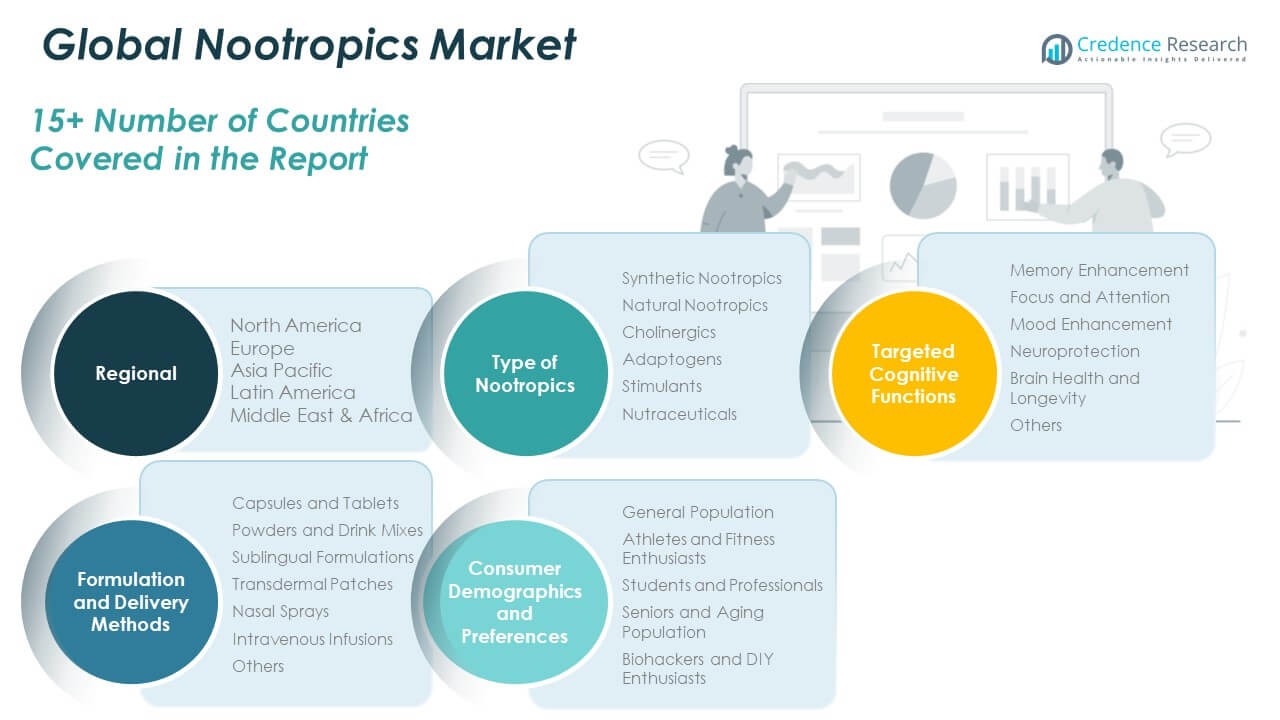
By type, synthetic nootropics hold a significant share due to their fast-acting effects and clinically proven ingredients used in pharmaceuticals and dietary supplements. Natural nootropics are expanding rapidly, driven by demand for herbal and clean-label formulations using plant-based extracts such as ginseng, bacopa, and rhodiola. Cholinergics and stimulants remain vital for improving memory, learning capacity, and energy levels, while adaptogens and nutraceuticals gain traction for stress resilience and long-term cognitive balance.
- For instance, Piracetam, one of the earliest clinically studied nootropics, has demonstrated benefits in reducing postoperative cognitive dysfunction. A randomized, placebo-controlled study involving 250 children undergoing general anesthesia reported improved cognitive outcomes with Piracetam administration, supporting its therapeutic potential.
By targeted cognitive function, memory enhancement and focus applications dominate, supported by widespread use among students and professionals. Mood enhancement and neuroprotection segments show rising demand as consumers prioritize mental wellness and brain aging prevention. Brain health and longevity-focused products attract older populations seeking sustained cognitive maintenance. It continues to benefit from scientific innovation linking neuroprotective compounds with preventive healthcare.
By formulation, capsules and tablets lead due to dosing convenience and standardized concentration. Powders, drink mixes, and sublingual formulations appeal to active users seeking rapid absorption and flexible consumption. Emerging delivery methods like transdermal patches and nasal sprays are creating premium niches for advanced bioavailability.
- For instance, pharmacokinetic studies have shown that Huperzine A tablets demonstrate effective absorption and central nervous system penetration. In healthy volunteers, a 0.4 mg oral dose achieved peak plasma concentration within about one hour, confirming its efficient bioavailability and suitability for cognitive support applications.
By consumer demographics, students and professionals account for major usage, followed by athletes adopting focus-boosting blends for performance. The general population increasingly incorporates nootropics into wellness routines, while seniors and biohackers represent high-growth segments focused on longevity and cognitive optimization.
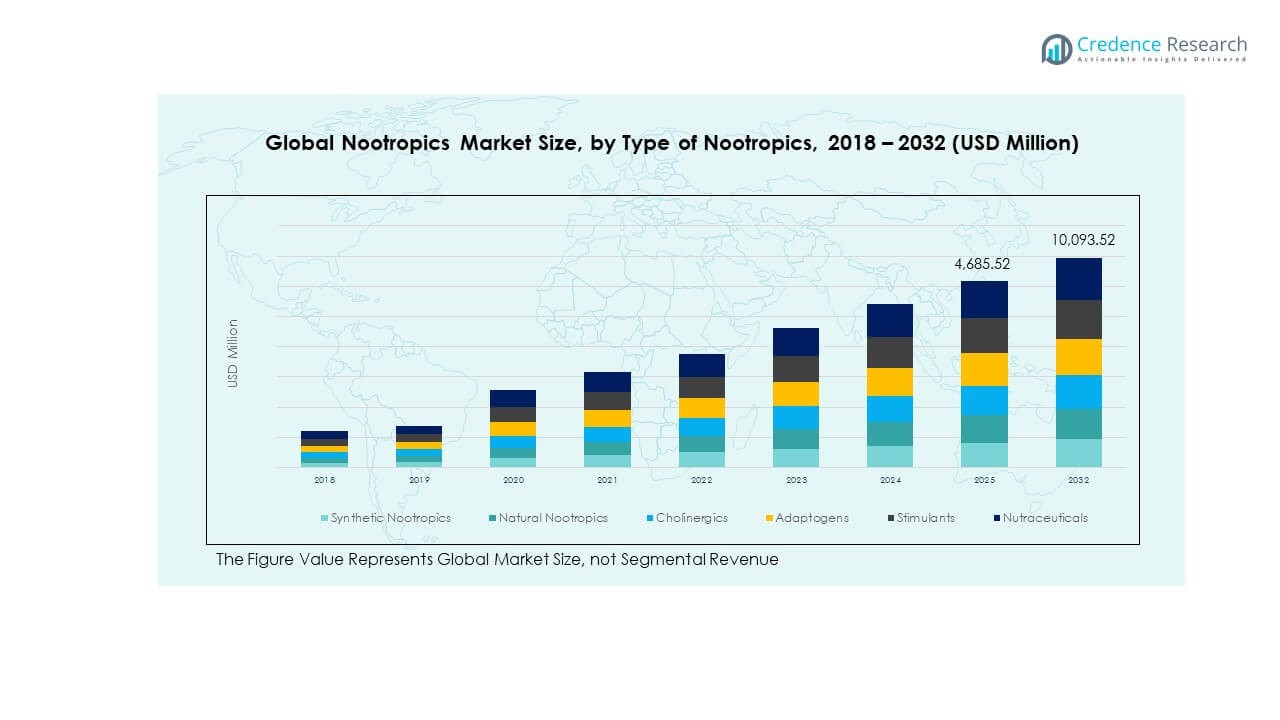
Segmentation:
By Type of Nootropics
- Synthetic Nootropics
- Natural Nootropics
- Cholinergics
- Adaptogens
- Stimulants
- Nutraceuticals
By Targeted Cognitive Functions
- Memory Enhancement
- Focus and Attention
- Mood Enhancement
- Neuroprotection
- Brain Health and Longevity
- Others
By Formulation and Delivery Methods
- Capsules and Tablets
- Powders and Drink Mixes
- Sublingual Formulations
- Transdermal Patches
- Nasal Sprays
- Intravenous Infusions
- Others
By Consumer Demographics and Preferences
- General Population
- Athletes and Fitness Enthusiasts
- Students and Professionals
- Seniors and Aging Population
- Biohackers and DIY Enthusiasts
By Region
- North America
- U.S.
- Canada
- Mexico
- Europe
- Germany
- France
- U.K.
- Italy
- Spain
- Rest of Europe
- Asia Pacific
- China
- Japan
- India
- South Korea
- South-east Asia
- Rest of Asia Pacific
- Latin America
- Brazil
- Argentina
- Rest of Latin America
- Middle East & Africa
- GCC Countries
- South Africa
- Rest of the Middle East and Africa
Regional Analysis:
North America
The North America Global Nootropics Market size was valued at USD 764.12 million in 2018 to USD 1,730.91 million in 2024 and is anticipated to reach USD 4,432.72 million by 2032, at a CAGR of 11.6% during the forecast period. North America holds nearly 43% of the global market share due to advanced consumer awareness and strong adoption of mental performance supplements. The region benefits from the presence of major brands, extensive retail networks, and widespread e-commerce penetration. It continues to expand through university-driven research and the growing popularity of personalized nutrition. The U.S. leads regional growth, supported by active innovation in smart drugs and cognitive beverages. Regulatory clarity for dietary supplements under FDA guidelines enhances investor confidence. Demand for clean-label and stimulant-free nootropics is increasing across the U.S. and Canada. The market’s maturity enables continuous innovation through partnerships and clinical testing collaborations.
Europe
The Europe Global Nootropics Market size was valued at USD 477.20 million in 2018 to USD 1,051.74 million in 2024 and is anticipated to reach USD 2,524.57 million by 2032, at a CAGR of 10.7% during the forecast period. Europe accounts for nearly 26% of global revenue, supported by the region’s focus on preventive health and natural ingredient formulations. The EU’s strict regulatory environment drives manufacturers toward clinically validated and traceable formulations. It benefits from rising consumer preference for plant-based and herbal blends over synthetic stimulants. Germany, the UK, and France dominate product innovation and nutraceutical development. Demand among aging populations for neuroprotective and anti-fatigue supplements remains strong. Companies are investing in R&D centers and strategic partnerships with health institutes. Digital wellness and e-pharmacy platforms are also enhancing product accessibility.
Asia Pacific
The Asia Pacific Global Nootropics Market size was valued at USD 339.05 million in 2018 to USD 839.75 million in 2024 and is anticipated to reach USD 2,423.66 million by 2032, at a CAGR of 13.3% during the forecast period. The region represents about 23% of total market share and is the fastest-growing segment worldwide. Rising disposable incomes and rapid urbanization across China, India, and Japan drive market expansion. It is supported by increasing mental health awareness and demand for performance-enhancing products among students and professionals. The region also benefits from traditional medicine systems like Ayurveda and Traditional Chinese Medicine, which integrate natural nootropics. Local producers emphasize affordable formulations to reach mass consumers. Expanding online retail networks and government support for functional foods strengthen market penetration. The growing middle-class demographic continues to shape demand for cognitive wellness solutions.
Latin America
The Latin America Global Nootropics Market size was valued at USD 73.30 million in 2018 to USD 165.45 million in 2024 and is anticipated to reach USD 368.44 million by 2032, at a CAGR of 9.7% during the forecast period. Latin America contributes roughly 4% of the total global share, driven by expanding consumer interest in health supplements and lifestyle wellness. Brazil and Mexico are leading markets with increasing adoption among young professionals and athletes. It benefits from rising imports of U.S. and European supplement brands and localized production partnerships. Economic growth and digitalization enable direct-to-consumer distribution models. Health-conscious urban populations are fueling awareness of brain-boosting products. Retail pharmacy chains and online platforms are improving product reach across the region. The trend toward preventive health spending supports long-term regional stability.
Middle East
The Middle East Global Nootropics Market size was valued at USD 48.56 million in 2018 to USD 101.64 million in 2024 and is anticipated to reach USD 219.20 million by 2032, at a CAGR of 9.2% during the forecast period. The region holds around 2% of the global share and shows steady growth supported by rising disposable incomes and growing awareness of cognitive wellness. GCC countries lead market expansion, with higher adoption in urban centers such as Dubai, Riyadh, and Doha. It gains momentum through increasing gym memberships and performance enhancement trends among youth. Government initiatives promoting nutrition and mental health programs aid product acceptance. Multinational supplement brands are strengthening regional partnerships with pharmacies and health retailers. Online retail platforms are simplifying cross-border trade. Demand for natural and halal-certified nootropics is also increasing.
Africa
The Africa Global Nootropics Market size was valued at USD 24.58 million in 2018 to USD 62.67 million in 2024 and is anticipated to reach USD 124.93 million by 2032, at a CAGR of 8.1% during the forecast period. Africa contributes close to 2% of total market share and is in the early growth stage. Rising health awareness and expanding retail infrastructure are improving supplement accessibility. South Africa remains the most developed market with a growing fitness and wellness community. It experiences rising imports of international brands supported by local e-commerce adoption. The market is gradually opening to herbal and plant-based nootropics suited to regional preferences. Increasing middle-class income and education levels are fostering consumer trust in dietary supplements. Continued investment in healthcare distribution channels and urban wellness programs enhances growth prospects.
Key Player Analysis:
- Onnit Labs, Inc.
- Reckitt Benckiser Group PLC
- Mind Lab Pro
- TruBrain
- Neu Mind, LLC
- Mental Mojo, LLC
- NooCube
Competitive Analysis:
Companies such as Onnit Labs, Inc., Reckitt Benckiser Group PLC, Mind Lab Pro (Opti-Nutra Ltd), TruBrain and HVMN Inc. dominate the market. They invest heavily in R&D, build brand credibility, and expand global distribution. These players face intense rivalry because product differentiation remains subtle and many companies compete on branding, pricing and ingredient provenance. Smaller niche firms often challenge incumbents by focusing on plant-based nootropics, clean labels and direct-to-consumer channels. New entrants need strong research and regulatory assurance to gain traction. It operates in a fragmented environment where alliances, mergers and strategic partnerships shape competitive dynamics. Strategic agility and strong supply-chain transparency become key success factors.
Recent Developments:
- In July 2025, BioAdaptives, Inc. announced the national launch of NeuroRush™, a next-generation adaptogenic nootropic combining Rhodiola Rosea, Ashwagandha, Bacopa Monnieri, Panax Ginseng and Mucuna Pruriens designed for mental clarity, focus and stress resilience.
- In October 2024, Monteloeder, S.L., a subsidiary of SUANNUTRA, released MINDREVIVE, a botanical formulation designed to improve short-term memory and cognitive function in adults. This product combines standardized extracts from sage and Japanese pagoda tree, backed by scientific and traditional botanical research, positioning it as a natural and effective cognitive support option.
Report Coverage:
The research report offers an in-depth analysis based on product type, targeted cognitive function, formulation method, and consumer demographics. It details leading market players, providing an overview of their business, product offerings, investments, revenue streams, and key applications. Additionally, the report includes insights into the competitive environment, SWOT analysis, current market trends, as well as the primary drivers and constraints. Furthermore, it discusses various factors that have driven market expansion in recent years. The report also explores market dynamics, regulatory scenarios, and technological advancements that are shaping the industry. It assesses the impact of external factors and global economic changes on market growth. Lastly, it provides strategic recommendations for new entrants and established companies to navigate the complexities of the market.
Future Outlook:
- Demand for cognitive enhancement supplements will expand as mental performance becomes a key wellness priority.
- Innovation in adaptogenic and natural ingredients will shape future product portfolios and consumer trust.
- Integration of AI and biometric feedback will drive personalized nootropic solutions and tailored dosing systems.
- E-commerce and direct-to-consumer channels will strengthen brand accessibility and customer retention.
- Regulatory alignment across key markets will enhance product standardization and quality assurance.
- Partnerships between nutraceutical firms and research institutions will foster clinically validated product launches.
- Functional foods and beverages infused with nootropics will evolve into mainstream nutrition trends.
- Rising mental health awareness will increase adoption among students, professionals, and aging populations.
- Asia Pacific will continue to lead growth with expanding consumer awareness and digital retail penetration.
- Sustainable sourcing and transparent labeling will remain critical to long-term market credibility.
Request a Free Sample
Fill in your details and we'll send you a free sample report.
- Sample data tables & charts
- Research methodology
Need a Custom Version of This Report?
Tailor the scope, geography, or segments to your exact requirements.
- Custom geography or segment scope
- Direct access to our analyst team
Frequently Asked Questions
What is the current market size for Global Nootropics Market, and what is its projected size in 2032?
At what Compound Annual Growth Rate is the Global Nootropics Market projected to grow between 2024 and 2032?
Which Global Nootropics Market segment held the largest share in 2024?
What are the primary factors fueling the growth of the Global Nootropics Market?
Who are the leading companies in the Global Nootropics Market?
Which region commanded the largest share of the Global Nootropics Market in 2024?
Table of Content
Chapter 1. Report Introduction
- 1.1 Report Description & Purpose
- 1.1.1 Report Title & Market Definition
- 1.1.2 Unique Selling Propositions (USP) & Key Differentiators
- 1.1.3 Value Proposition for Stakeholders
- 1.2 Research Objectives
- 1.2.1 Market Sizing Objectives (Volume & Revenue)
- 1.2.2 Segmentation Objectives
- 1.2.3 Competitive Intelligence Objectives
- 1.2.4 Forecast & Scenario Objectives
- 1.3 Report Scope
- 1.3.1 Nootropics Scope – Types & Subtypes Covered
- 1.3.2 Geographic Scope – Regions & Countries Covered
- 1.3.3 Historical Period, Base Year & Forecast Period (2024; forecast to 2032)
- 1.3.4 Inclusions & Exclusions
- 1.4 HS Code & Classification Framework
- 1.5 Currency, Units & Pricing Basis
- 1.6 Target Stakeholders
- 1.7 Limitations & Assumptions
Chapter 2. Executive Summary
- 2.1 Global Nootropics Market Snapshot
- 2.1.1 Market Size – Historical (2024) & Forecast (2024-2032) (2024: USD 3,952.16 million → 2032: USD 10,093.52 million)
- 2.1.2 Volume & Revenue – Global Totals
- 2.1.3 Key Market Highlights – Top Five Facts
- 2.2 Nootropics Market Segmentation Snapshot
- 2.2.1 Market Split by Region – 2024 vs. 2032
- 2.3 Competitive Snapshot
- 2.3.1 Top 10 Players by Revenue Share – 2024
- 2.3.2 Top 10 Players by Volume Share – 2024
- 2.3.3 Recent Strategic Developments (18-Month Summary)
- 2.4 Key Investment Highlights & Strategic Conclusions
Chapter 3. Nootropics Market Dynamics & Industry Analysis
- 3.1 Market Overview & Context
- 3.1.1 Nootropics Market Position in the Broader Automotive Value Chain
- 3.1.2 OEM vs. Replacement Market Dynamics
- 3.1.3 Market Maturity & Development Stage by Region
- 3.2 Nootropics Market Drivers
- 3.3 Nootropics Market Restraints & Challenges
- 3.4 Nootropics Market Opportunities
- 3.5 Porter's Five Forces Analysis
- 3.5.1 Threat of New Entrants
- 3.5.2 Bargaining Power of Suppliers
- 3.5.3 Bargaining Power of Buyers
- 3.5.4 Threat of Substitutes
- 3.5.5 Competitive Rivalry – Intensity Assessment
- 3.6 Nootropics Value Chain Analysis
- 3.6.1 Upstream – Raw Material/Input Suppliers
- 3.6.1.1 Raw Material/Input 1
- 3.6.1.2 Raw Material/Input 2
- 3.6.1.3 Raw Material/Input 3
- 3.6.2 Midstream – Production/Manufacturing/Service Delivery
- 3.6.2.1 Production/Process Overview
- 3.6.2.2 Key Facility Locations & Capacity by Manufacturer
- 3.6.3 Downstream – Distribution & End Consumer
- 3.6.3.1 Primary Channel – B2B/OEM
- 3.6.3.2 Secondary Channels – Dealer, Retail, Online, Direct
- 3.6.4 Value Chain Profitability Analysis
- 3.6.1 Upstream – Raw Material/Input Suppliers
- 3.7 PESTEL Analysis
- 3.7.1 Political Factors
- 3.7.2 Economic Factors
- 3.7.3 Social Factors
- 3.7.4 Technological Factors
- 3.7.5 Environmental Factors
- 3.7.6 Legal Factors
- 3.8 Nootropics Supply Chain Analysis
- 3.8.1 Raw Material/Input Supply Risk Assessment
- 3.8.2 Manufacturing Concentration Risk (Geographic Exposure)
- 3.8.3 Trade Disruption Impact Analysis
- 3.9 Regulatory & Policy Landscape
Note: The regulatory and policy landscape section covers regulations based on their applicability to the market, Nootropics category, geography, and scope of the study. Only regulatory frameworks with a material impact on operations, compliance, trade, sustainability, or market access are analyzed in detail.
Chapter 4. Key Investment Pockets & Opportunity Analysis
- 4.1 Nootropics Market Attractiveness Analysis
- 4.1.1 By Region – Investment Attractiveness Matrix (Volume × CAGR)
- 4.2 Absolute Revenue Growth Opportunity
- 4.2.1 By Region – Absolute USD Growth Through 2032
- 4.3 Incremental Volume Opportunity
- 4.3.1 By Region – Incremental Volume Through 2032
- 4.3.2 Segment – Incremental Volume
- 4.4 Emerging Submarket Opportunity Deep Dive (Subject to Applicability)
- 4.5 Emerging Market Opportunity Scorecards
- 4.5.1 United States
- 4.5.2 Europe
- 4.5.3 Asia
- 4.5.4 Middle East & Africa
Note: Emerging Market Opportunity Scorecards will be included based on relevance and strategic importance. Regions listed are indicative and may vary depending on data availability and market dynamics.
Chapter 5. Nootropics Import-Export Analysis & Trade Flows
- 5.1 Global Trade Overview
- 5.1.1 Global Export Value by Country (2024)
- 5.1.2 Global Export Volume by Country (2024)
- 5.1.3 Global Import Value by Country (2024)
- 5.1.4 Global Import Volume by Country (2024)
- 5.1.5 Net Trade Balance by Country (2024)
- 5.2 Export Analysis – Segment
- 5.2.1 Type 1 (HS Code)
- 5.2.2 Type 2 (HS Code)
- 5.2.3 Type 3 (HS Code)
- 5.2.4 Type 4 (HS Code)
- 5.2.5 Type 5 (HS Code)
- 5.3 Import Analysis – Segment
- 5.3.1 Type 1 (HS Code)
- 5.3.2 Type 2 (HS Code)
- 5.3.3 Type 3 (HS Code)
- 5.3.4 Type 4 (HS Code)
- 5.3.5 Type 5 (HS Code)
- 5.4 Average Unit Trade Prices
- 5.4.1 Average Export Price – Segment & Country
- 5.4.2 Average Import Price – Segment & Source Country
- 5.4.3 Price Trends (2024)
- 5.5 Key Trade Route Analysis
- 5.5.1 Trade Route 1
- 5.5.2 Trade Route 2
- 5.5.3 Trade Route 3
- 5.5.4 Trade Route 4
- 5.5.5 Trade Route 5
- 5.6 Trade Policy Impact Assessment
- 5.6.1 US Anti-Dumping & Section 301 Tariffs
- 5.6.2 EU Customs Union Impact
- 5.6.3 Major Free Trade Agreements
- 5.6.4 USMCA Rules of Origin
Note: Trade policy analysis will be included only where relevant to the Nootropics market.
Chapter 6. Competitive Landscape & Company Benchmarking
- 6.1 Nootropics Market Concentration & Structure
- 6.1.1 Herfindahl-Hirschman Index (HHI) – vs. 2024
- 6.1.2 Tier 1, Tier 2 & Tier 3 Market Structure
- 6.1.3 Global, Regional & Local Player Dynamics
- 6.2 Nootropics Market Share Analysis – 2024
- 6.2.1 Global Revenue Share by Company
- 6.2.2 Global Volume Share by Company
- 6.2.3 Regional Revenue Share
- 6.2.4 Market Share Evolution ( vs. 2024)
- 6.2.5 OEM Segment Share by Company
- 6.2.6 Replacement Segment Share by Company
- 6.3 Production/Delivery Capacity & Facility Analysis
- 6.3.1 Global Installed Capacity
- 6.3.2 Capacity Utilization Rates
- 6.3.3 Production/Output Volume
- 6.3.4 Facility Locations & Capacity Map
- 6.3.5 Planned Capacity Additions
- 6.4 Nootropics Competitive Benchmarking Matrix
- 6.4.1 Revenue, Volume, CAGR & Profitability Comparison
- 6.4.2 Channel Revenue Mix
- 6.4.3 Geographic Revenue Exposure
- 6.4.4 R&D Intensity
- 6.4.5 Sustainability Maturity
- 6.5 Strategic Developments in Nootropics (Last 24 Months)
- 6.5.1 Mergers, Acquisitions & Divestments
- 6.5.2 New Nootropics Launches
- 6.5.3 Facility Expansions
- 6.5.4 Strategic Alliances, Joint Ventures & Partnerships
- 6.5.5 Distribution Expansion & Market Entry
- 6.5.6 Sustainability & ESG Initiatives
- 6.6 Competitive Strategy Mapping
- 6.6.1 Leader, Challenger, Follower & Niche Classification
- 6.6.2 Pricing Strategy Comparison
- 6.6.3 Channel Strategy Matrix
Note: Strategic developments are included based on their materiality and the availability of reliable information.
Chapter 7. Global Nootropics Market – By Distribution Channel
- 7.1 Segment Overview
- 7.1.1 Volume & Revenue Split by Channel (2024 & 2032)
- 7.1.2 Channel Mix Evolution (2024-2032)
Chapter 8. Regional Market Analysis – Global Overview
- 8.1 Global Regional Overview
- 8.1.1 Regional Volume Share
- 8.1.2 Regional Revenue Share
- 8.1.3 Regional Volume by Region
- 8.1.4 Regional Revenue by Region
- 8.1.5 Regional Forecast Through 2032
- 8.2 Cross-Regional Segment Analysis
- 8.2.1 By Distribution Channel
- 8.2.2 By Brand/Price Tier
Chapter 9. North America Nootropics Market
- 9.1 United States
- 9.2 Canada
- 9.3 Mexico
Chapter 10. Europe Nootropics Market
- 10.1 Germany
- 10.2 France
- 10.3 Italy
- 10.4 United Kingdom
- 10.5 Spain
- 10.6 Poland
- 10.7 Russia
- 10.8 Netherlands
- 10.9 Belgium
- 10.10 Sweden
- 10.11 Denmark
- 10.12 Norway
- 10.13 Rest of Europe
Chapter 11. Asia Pacific Nootropics Market
- 11.1 China
- 11.2 India
- 11.3 Japan
- 11.4 South Korea
- 11.5 Thailand
- 11.6 Indonesia
- 11.7 Vietnam
- 11.8 Malaysia
- 11.9 Australia
- 11.10 Rest of Asia Pacific
Chapter 12. Latin America Nootropics Market
- 12.1 Brazil
- 12.2 Argentina
- 12.3 Colombia
- 12.4 Chile
- 12.5 Rest of Latin America
Chapter 13. Middle East Nootropics Market
- 13.1 Saudi Arabia
- 13.2 United Arab Emirates
- 13.3 Turkey
- 13.4 Israel
- 13.5 Iran
- 13.6 Rest of the Middle East
Chapter 14. Africa Nootropics Market
- 14.1 South Africa
- 14.2 Egypt
- 14.3 Nigeria
- 14.4 Morocco
- 14.5 Rest of Africa
Chapter 15. Nootropics Company Profiles
- 15.1 [Company 01]
- 15.1.1 Company Overview
- 15.1.2 Key Management Personnel
- 15.1.3 Products & Services Portfolio
- 15.1.4 Financial Performance
- 15.1.5 Key Market Focus & Geographic Presence
- 15.1.6 Recent Developments & Strategic Initiatives
Note: The company profile list is preliminary and may change based on research findings, market developments, data availability, and client requirements.
Chapter 16. Appendices
- Appendix A – List of Abbreviations & Acronyms
- Appendix B – Industry Classification Code Reference – Full Series
- Appendix C – Production & Capacity Data Tables
- Appendix D – End-Use & Demand Base Tables
- Appendix E – Consumption & Replacement Rate Assumptions
- Appendix F – ASP Reference Tables
- Appendix G – Manufacturing & Facility Database
- Appendix H – Import-Export Data Tables
- Appendix I – Regulatory Summary Tables
- Appendix J – Primary Research Participant List (Anonymized)
- Appendix K – Primary Research Questionnaire Framework
- Appendix L – Data Sources & Bibliography
- Appendix M – Market Size Divergence & Source Comparison
Chapter 17. Research Methodology
- 17.1 Research Framework & Philosophy
- 17.2 Secondary Research – Sources, Hierarchy & Data Extraction
- 17.3 Data Modeling – Bottom-Up & Top-Down Market Sizing
- 17.4 Primary Research – Stakeholder Framework, LOI & Sample Sizes
- 17.5 Forecast Methodology – Regression, Scenario & Sensitivity Analysis
- 17.6 Quality Control – Four-Layer Validation Framework
- 17.7 Limitations & Standard Assumptions
- 17.8 Disclaimer
