
Market Overview
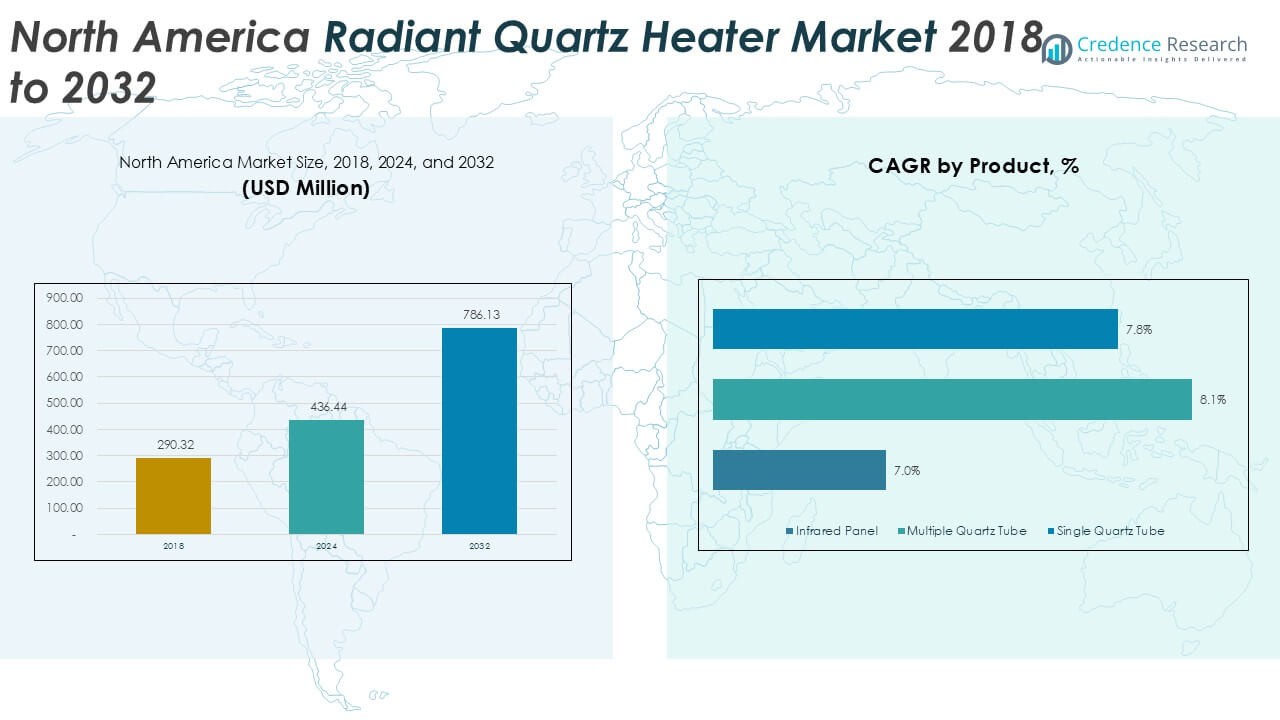
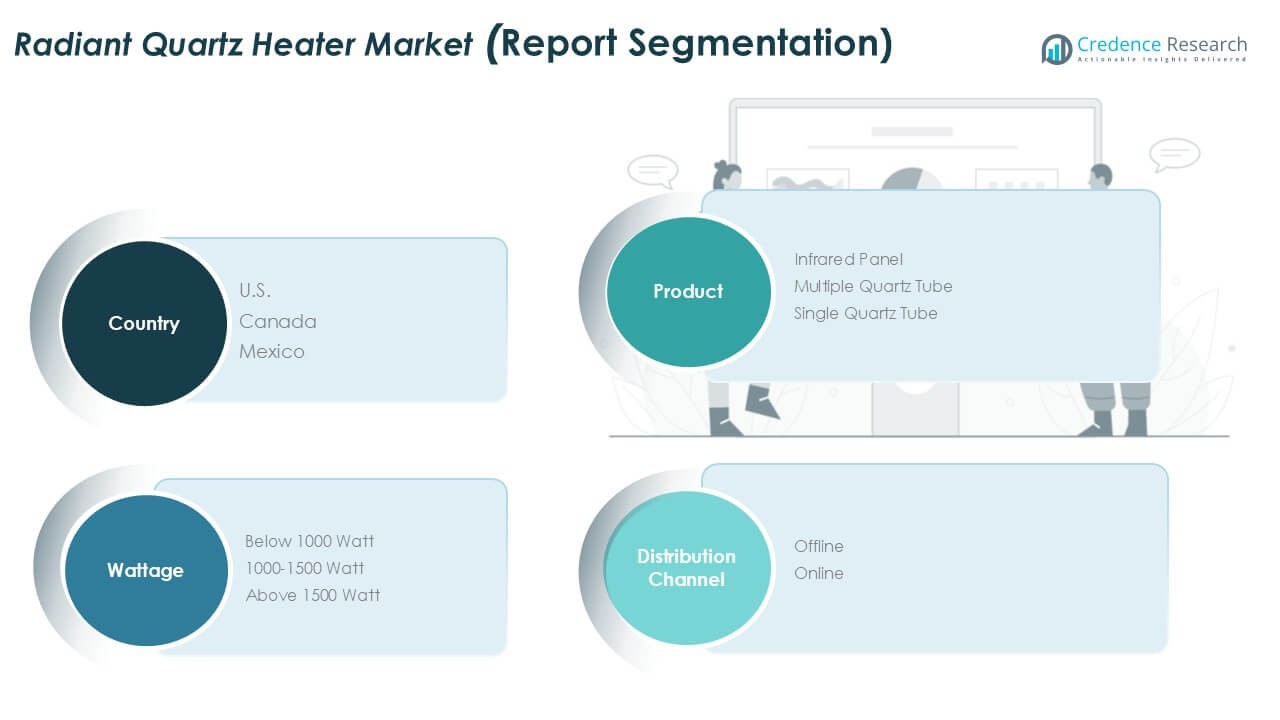
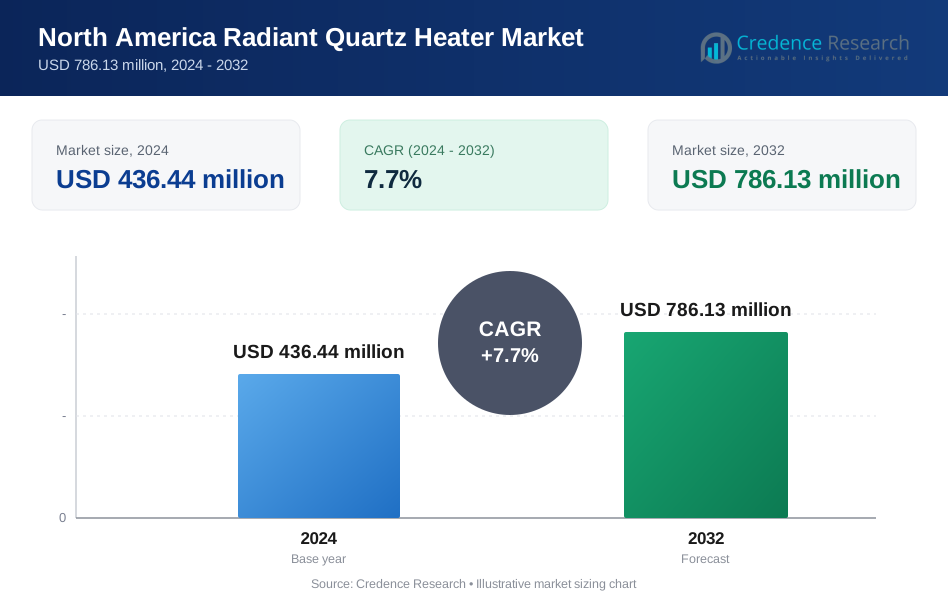
North America Radiant Quartz Heater market size was valued at USD 290.32 million in 2018 to USD 436.44 million in 2024 and is anticipated to reach USD 786.13 million by 2032, at a CAGR of 7.7% during the forecast period.
| REPORT ATTRIBUTE | DETAILS |
|---|---|
| Historical Period | 2020-2023 |
| Base Year | 2024 |
| Forecast Period | 2025-2032 |
| North America Radiant Quartz Heater Market Size 2024 | USD 436.44 Million |
| North America Radiant Quartz Heater Market, CAGR | 7.7% |
| North America Radiant Quartz Heater Market Size 2032 | USD 786.13 Million |
The North America radiant quartz heater market is led by established appliance and heating equipment manufacturers. Major players include De’Longhi Appliance, Honeywell International, Lasko Products, Vornado Air, Duraflame, Pelonis Technologies, TPI Corporation, Backer Hotwatt, Sunpentown International, and Jaye Industry. These companies compete through energy efficiency, safety compliance, product design, and strong retail presence. The United States dominates the regional landscape, accounting for exactly 72% of total market share, driven by high residential adoption and replacement demand. Canada follows with an 18% share, supported by prolonged winter heating needs, while Mexico holds around 10%, reflecting emerging demand in colder and high-altitude regions.
Market Insights
- The North America radiant quartz heater market reached USD 436.44 million in 2024 and is projected to reach USD 786.13 million by 2032, growing at a CAGR of 7.7% during the forecast period, supported by steady residential and light commercial demand across the region.
- Rising demand for energy-efficient and instant space-heating solutions drives market growth, as consumers prefer quartz heaters for quick warmth, lower energy loss, and suitability for targeted indoor and semi-outdoor heating applications.
- Key market trends include growth of smart and design-oriented heaters, rising online sales penetration, and increasing adoption of mid-wattage models, with the 1000–1500-watt segment holding nearly 48% share and multiple quartz tube products accounting for about 45% share.
- Competitive intensity remains high, with players focusing on pricing, safety certifications, design differentiation, and retail reach, while private-label products and seasonal promotions increase price competition.
- Regionally, the United States leads with about 72% market share, followed by Canada at around 18% and Mexico at nearly 10%, reflecting climate conditions, income levels, and heating demand patterns.
Market Segmentation Analysis:
By Product
The product segment includes infrared panels, multiple quartz tube heaters, and single quartz tube heaters. Multiple quartz tube heaters dominate this segment, holding about 45% market share. Strong dominance comes from higher heat output and faster warm-up performance. These heaters suit large rooms, garages, and commercial spaces. Infrared panels see rising use in modern homes due to slim design. Single quartz tube models remain popular in low-cost residential use. Demand growth is driven by energy efficiency, instant heating, and improved safety features across product designs.
- For instance, Havells India offers specific models like the Havells Ember 1200-Watt room Heater or the Havells Inclino Halogen Room Heater, which feature three quartz or halogen heating tubes respectively, typically with a total output of 1,200 W. These radiant heaters provide instant heat output, warming up within.
By Wattage Segment
The wattage segment covers below 1000 watt, 1000–1500 watt, and above 1500-watt heaters. The 1000–1500-watt range leads the market with nearly 48% share. This range balances heating power with energy savings. Consumers prefer this category for bedrooms and living spaces. Below 1000-watt units serve small rooms and spot heating needs. Above 1500-watt models support workshops and commercial areas. Growth drivers include rising electricity cost awareness and demand for efficient mid-power heating solutions.
- For instance, Bajaj Electricals markets quartz (radiant) heaters in the 1,200 W range that can provide instant, focused warmth to individuals and objects within their line of sight, making a small, enclosed room feel warmer quickly, although they do not typically raise the overall ambient room temperature by 6–8 °C within just 10 minutes through air convection alone.
By Distribution Channel
Distribution channels include offline and online sales formats. Offline channels dominate with about 62% market share. Physical stores allow product inspection and immediate purchase. Many buyers prefer in-store advice for heating products. Specialty appliance stores and home improvement chains drive offline sales. Online channels grow faster due to discounts and wider product choice. E-commerce platforms attract urban and tech-savvy consumers. Growth drivers include expanding retail networks, seasonal promotions, and rising trust in online appliance purchases.
Key Growth Drivers
Rising Demand for Energy-Efficient Space Heating
Growing focus on energy efficiency strongly drives the North America radiant quartz heater market. Households seek heating solutions that reduce electricity consumption. Radiant quartz heaters convert power directly into heat with minimal loss. This efficiency lowers operating costs for users. Governments promote energy-conscious appliances through standards and labeling programs. Consumers increasingly replace older convection heaters with radiant alternatives. Quartz heaters provide instant warmth without preheating time. This feature improves comfort during cold seasons. Commercial spaces value lower energy bills and fast heating response. Rising electricity prices further accelerate demand for efficient heating products. Manufacturers invest in improved reflector designs and quartz materials. These upgrades enhance heat transfer efficiency. Energy efficiency remains a core purchase criterion across residential and light commercial segments.
- For instance, Dr. Infrared Heater’s DR-968 quartz infrared heater operates at 1,500 watts (or 5,200 BTUs of heat output), delivers heat within seconds using a dual heating system (infrared quartz tube + PTC), and is effectively rated to warm spaces up to 400 square feet as a supplemental zone heater, which can reduce reliance on central heating.
Growth in Residential Renovation and Home Comfort Spending
Rising home renovation activity supports market growth across North America. Consumers invest more in comfort-focused home upgrades. Radiant quartz heaters fit well into renovation projects. Compact size supports easy installation in existing spaces. Many homeowners add heaters to basements, garages, and patios. Quartz heaters deliver localized heating without ductwork changes. This benefit reduces renovation complexity and cost. Increased remote work boosts demand for home office heating. Homeowners prioritize personal comfort and temperature control. Seasonal climate variation strengthens replacement demand. Aging housing stock also drives heater upgrades. Retail promotions during winter further support sales. Residential demand remains a stable growth pillar for the market.
- For instance, Bromic Heating’s Platinum Electric quartz heater delivers 2,300 watts of radiant output, provides quick, targeted heat, and is suitable for supporting outdoor patios and renovated living areas.
Expansion of Commercial and Semi-Outdoor Applications
Commercial adoption drives steady demand for radiant quartz heaters. Restaurants, warehouses, and workshops use radiant heating for targeted warmth. Quartz heaters perform well in semi-open environments. Radiant heat remains effective despite airflow or drafts. This advantage supports use in patios and loading areas. Hospitality businesses use heaters to extend outdoor seating seasons. Retail stores deploy heaters for spot heating. Industrial users value quick heat-up and durability. Quartz heaters reduce energy waste in large spaces. Facility managers prefer focused heating over whole-area systems. Growing commercial construction supports long-term demand. These applications expand the market beyond residential reliance.
Key Trends & Opportunities
Shift Toward Smart and Design-Oriented Heater Models
Smart and design-focused products create strong growth opportunities. Consumers favor heaters with modern appearance and slim profiles. Infrared panel-style quartz heaters match contemporary interiors. Smart thermostats and timers improve temperature control. Remote operation enhances user convenience and safety. App-based control supports energy monitoring. Design upgrades help brands target premium segments. Manufacturers differentiate products through aesthetics and features. Smart integration supports higher average selling prices. Retailers highlight smart heaters during seasonal campaigns. Urban consumers show strong interest in connected appliances. This trend opens value-driven opportunities across residential markets.
- For instance, Heat Storm’s HS-1500-PHX WiFi infrared quartz heater operates at 1,500 watts, supports 2.4 GHz Wi-Fi, and allows temperature adjustment from 40°F to 99°F through a mobile app.
Rapid Growth of Online Sales Channels
Online channels present a major growth opportunity. E-commerce platforms expand product reach across regions. Consumers compare prices and specifications easily online. Reviews influence heater purchase decisions strongly. Online-only models attract price-sensitive buyers. Seasonal discounts boost digital sales volumes. Direct-to-consumer strategies improve brand margins. Improved logistics support bulky appliance delivery. Return policies build buyer confidence. Younger consumers prefer online appliance purchases. Manufacturers invest in digital marketing and product listings. Online growth complements traditional retail channels. This channel expansion accelerates overall market penetration.
Key Challenges
High Competition and Price Sensitivity
Intense competition presents a key market challenge. Many brands offer similar quartz heater models. Price comparison pressures reduce profit margins. Consumers often prioritize cost over brand loyalty. Entry-level products dominate volume sales. Premium differentiation remains difficult for new entrants. Retail promotions intensify price competition during winter. Private-label products increase competitive pressure. Manufacturers face rising material and logistics costs. Passing costs to consumers remains challenging. Smaller players struggle to sustain margins. Continuous innovation becomes necessary to remain competitive. Price sensitivity limits aggressive pricing strategies across segments.
Safety Concerns and Regulatory Compliance
Safety concerns pose another key challenge. Quartz heaters operate at high surface temperatures. Improper use can increase burn or fire risks. Regulatory bodies enforce strict safety standards. Compliance increases product development and testing costs. Manufacturers must meet electrical and thermal safety norms. Product recalls can harm brand reputation. Consumer awareness of safety certifications continues to rise. Poor-quality imports create negative perceptions. Retailers prefer certified and tested products. Educating consumers on safe usage remains essential. Ongoing compliance adds operational complexity. Safety requirements shape product design and market entry strategies.
Regional Analysis
United States
The United States dominates the North America radiant quartz heater market, accounting for about 72% market share. Strong demand comes from residential and light commercial sectors. Cold winters in northern states increase seasonal heater purchases. Home renovation activity supports steady replacement demand. Consumers favor energy-efficient and smart heater models. Large retail chains and e-commerce platforms drive wide product availability. Commercial use in warehouses, garages, and hospitality venues further supports sales. Regulatory focus on energy efficiency shapes product design. The U.S. remains the primary revenue contributor and innovation hub in the regional market.
Canada
Canada holds nearly 18% share of the North America radiant quartz heater market. Long and harsh winters create consistent heating demand. Residential adoption remains strong across urban and suburban areas. Consumers prefer mid-wattage heaters for indoor use. Energy efficiency plays a key role in purchase decisions. Government energy standards influence product selection. Retail appliance stores dominate distribution, supported by growing online sales. Commercial demand exists in workshops and small businesses. Seasonal replacement cycles support stable growth. Canada offers steady volume demand with strong emphasis on safety and performance.
Mexico
Mexico accounts for around 10% of the North America radiant quartz heater market. Demand concentrates in northern and high-altitude regions. Residential usage drives most sales, focused on portable heaters. Price sensitivity influences product selection strongly. Single quartz tube and lower wattage models remain popular. Offline retail channels dominate distribution. Commercial adoption remains limited but growing in workshops and small facilities. Urbanization supports gradual market expansion. Energy cost awareness increases interest in efficient heating options. Mexico represents an emerging growth region with long-term demand potential.
Market Segmentations:
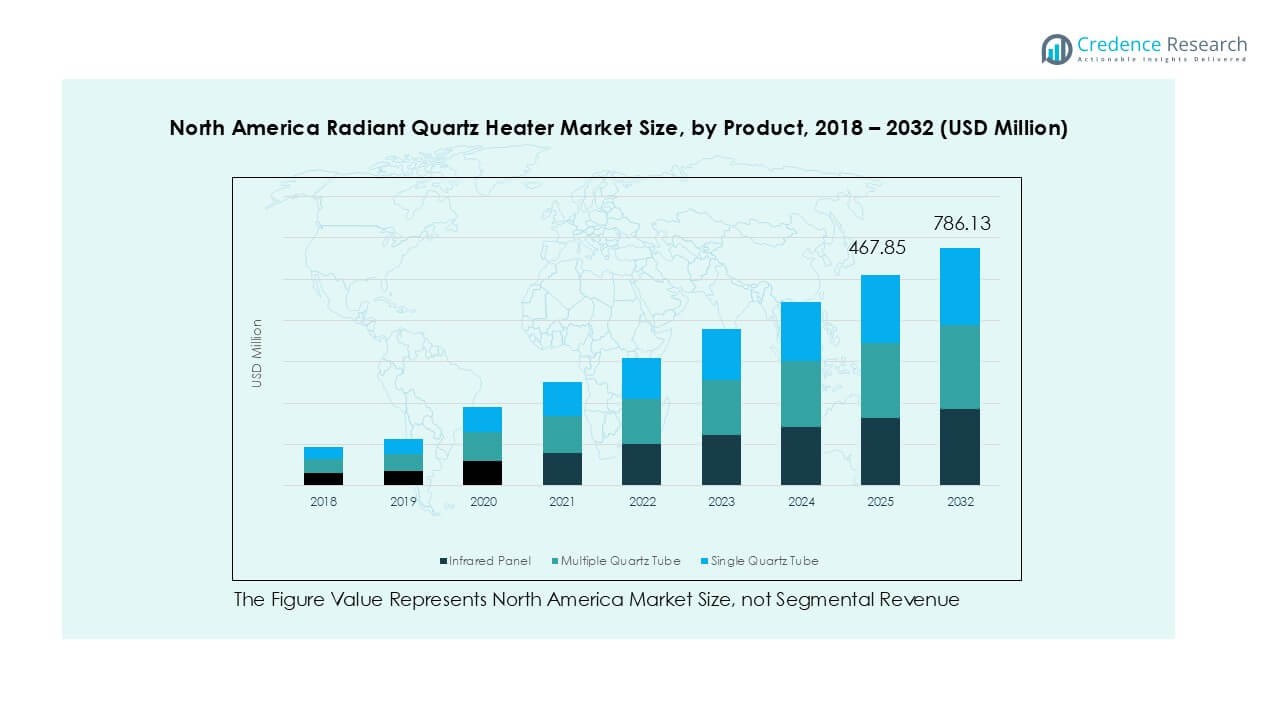
By Product
- Infrared Panel
- Multiple Quartz Tube
- Single Quartz Tube
By Wattage Segment
- Below 1000 Watt
- 1000–1500 Watt
- Above 1500 Watt
By Distribution Channel
- Offline
- Online
By Geography
- United States
- Canada
- Mexico
Competitive Landscape
The North America radiant quartz heater market shows moderate fragmentation with strong brand competition. Established appliance manufacturers and specialized heating companies dominate sales. Key players compete on product efficiency, safety features, and price positioning. Companies focus on residential and light commercial segments for volume growth. Retail presence across home improvement chains strengthens brand visibility. Online channels increase competitive intensity through price transparency. Product differentiation centers on wattage options, smart controls, and design. Manufacturers invest in compliance with safety and energy standards. Seasonal demand drives aggressive promotions and new model launches. Strategic focus remains on cost optimization and portfolio expansion.
Key Player Analysis
- Backer Hotwatt, Inc.
- Jaye Industry Co., Ltd
- De'Longhi Appliance S.r.l.
- Honeywell International Inc.
- Lasko Products, LLC
- TPI Corporation
- Pelonis Technologies, Inc.
- Duraflame, Inc.
- Vornado Air, LLC
- Sunpentown International, Inc.
Recent Developments
- In June 2023, The European Union revised its overarching Energy Efficiency Directive, and new, stricter Ecodesign standards for local space heaters, including radiant heaters, were adopted in April 2024 and will apply from July 1, 2025.
- In January 2023, Honeywell announced a new line of smart radiant quartz heaters with integrated Wi-Fi capabilities.
Report Coverage
The research report offers an in-depth analysis based on Product, Wattage Segment, Distribution Channel and Geography. It details leading market players, providing an overview of their business, product offerings, investments, revenue streams, and key applications. Additionally, the report includes insights into the competitive environment, SWOT analysis, current market trends, as well as the primary drivers and constraints. Furthermore, it discusses various factors that have driven market expansion in recent years. The report also explores market dynamics, regulatory scenarios, and technological advancements that are shaping the industry. It assesses the impact of external factors and global economic changes on market growth. Lastly, it provides strategic recommendations for new entrants and established companies to navigate the complexities of the market.
Future Outlook
- Demand will rise steadily due to increasing focus on energy-efficient space heating.
- Residential replacement cycles will remain a key driver of market expansion.
- Smart controls and connected features will gain wider adoption.
- Design-focused and slim-profile heaters will attract premium buyers.
- Mid-wattage models will continue to dominate household applications.
- Online sales channels will grow faster than offline retail.
- Commercial and semi-outdoor usage will expand across hospitality spaces.
- Safety standards will increasingly influence product design and innovation.
- Price competition will remain intense among mass-market brands.
- The United States will continue to lead regional demand and innovation.
Request a Free Sample
Fill in your details and we'll send you a free sample report.
- Sample data tables & charts
- Research methodology
Need a Custom Version of This Report?
Tailor the scope, geography, or segments to your exact requirements.
- Custom geography or segment scope
- Direct access to our analyst team
Frequently Asked Questions
What is the current market size for the North America Radiant Quartz Heater market, and what is its projected size in 2032?
At what Compound Annual Growth Rate is the North America Radiant Quartz Heater market projected to grow between 2024 and 2032?
Which North America Radiant Quartz Heater market segment held the largest share in 2024?
What are the primary factors fueling the growth of the North America Radiant Quartz Heater market?
Who are the leading companies in the North America Radiant Quartz Heater market?
Which region commanded the largest share of the North America Radiant Quartz Heater market in 2024?
Table of Content
Chapter 1. Report Introduction
- 1.1 Report Description & Purpose
- 1.1.1 Report Title & Market Definition
- 1.1.2 Unique Selling Propositions (USP) & Key Differentiators
- 1.1.3 Value Proposition for Stakeholders
- 1.2 Research Objectives
- 1.2.1 Market Sizing Objectives (Volume & Revenue) (Volume Where Applicable)
- 1.2.2 Segmentation Objectives
- 1.2.3 Competitive Intelligence Objectives
- 1.2.4 Forecast & Scenario Objectives
- 1.3 Report Scope
- 1.3.1 North America Radiant Quartz Heater Scope – Segments & Subsegments Covered
- 1.3.2 Geographic Scope – Selected Region & Countries Covered
- 1.3.3 Historical Period, Base Year & Forecast Period (2024; forecast to 2032)
- 1.3.4 Inclusions & Exclusions
- 1.4 Industry Classification & Applicable Codes
- 1.5 Currency, Measurement Units & Valuation Basis
- 1.6 Target Stakeholders
- 1.7 Limitations & Assumptions
Chapter 2. Executive Summary
- 2.1 North America Radiant Quartz Heater Snapshot
- 2.1.1 Market Size – Historical (2024) & Forecast (2024-2032) (2024: USD 436.44 million → 2032: USD 786.13 million)
- 2.1.2 Volume & Revenue – Regional Totals (Volume Where Applicable)
- 2.1.3 Key Market Highlights – Top Five Facts
- 2.2 North America Radiant Quartz Heater Segmentation Snapshot
- 2.2.1 Market Split by Country – 2024 vs. 2032
- 2.3 Competitive Snapshot
- 2.3.1 Top 10 Players by Revenue Share – 2024
- 2.3.2 Top 10 Players by Volume Share – 2024 (Volume Where Applicable)
- 2.3.3 Recent Strategic Developments (18-Month Summary)
- 2.4 Key Investment Highlights & Strategic Conclusions
Chapter 3. North America Radiant Quartz Heater Dynamics & Industry Analysis
- 3.1 Market Overview & Context
- 3.1.1 North America Radiant Quartz Heater Position in the Broader Industry Value Chain
- 3.1.2 Demand Structure & Purchasing Dynamics
- 3.1.3 Market Maturity & Development Stage by Country
- 3.2 North America Radiant Quartz Heater Drivers
- 3.3 North America Radiant Quartz Heater Restraints & Challenges
- 3.4 North America Radiant Quartz Heater Opportunities
- 3.5 Porter's Five Forces Analysis
- 3.5.1 Threat of New Entrants
- 3.5.2 Bargaining Power of Suppliers
- 3.5.3 Bargaining Power of Buyers
- 3.5.4 Threat of Substitutes
- 3.5.5 Competitive Rivalry – Intensity Assessment
- 3.6 North America Radiant Quartz Heater Value Chain Analysis
- 3.6.1 Upstream – Key Inputs, Resources & Suppliers
- 3.6.1.1 Key Input/Resource 1
- 3.6.1.2 Key Input/Resource 2
- 3.6.1.3 Key Input/Resource 3
- 3.6.2 Midstream – Core Operations & Value Creation
- 3.6.2.1 Operating Model & Process Overview
- 3.6.2.2 Key Operating Locations & Capabilities by Company
- 3.6.3 Downstream – Market Channels & End Users
- 3.6.3.1 Direct Sales & Customer Engagement Channels
- 3.6.3.2 Indirect Sales, Intermediaries & Partner Channels
- 3.6.4 Value Chain Profitability Analysis
- 3.6.1 Upstream – Key Inputs, Resources & Suppliers
- 3.7 PESTEL Analysis
- 3.7.1 Political Factors
- 3.7.2 Economic Factors
- 3.7.3 Social Factors
- 3.7.4 Technological Factors
- 3.7.5 Environmental Factors
- 3.7.6 Legal Factors
- 3.8 North America Radiant Quartz Heater Supply Chain Analysis
- 3.8.1 Critical Input & Resource Availability Risk Assessment
- 3.8.2 Supplier & Operational Concentration Risk (Geographic Exposure)
- 3.8.3 Supply & Service Disruption Impact Analysis
- 3.9 Regional & Country Regulatory Landscape
Note: The regulatory and policy landscape section covers regulations based on their applicability to the market, North America Radiant Quartz Heater category, geography, and scope of the study. Only regulatory frameworks with a material impact on operations, compliance, trade, sustainability, or market access are analyzed in detail.
Chapter 4. Key Investment Pockets & Opportunity Analysis
- 4.1 North America Radiant Quartz Heater Attractiveness Analysis
- 4.1.1 By Country – Investment Attractiveness Matrix (Market Size × CAGR)
- 4.2 Absolute Revenue Growth Opportunity
- 4.2.1 By Country – Absolute Revenue Growth Through 2032
- 4.3 Incremental Demand Opportunity
- 4.3.1 By Country – Incremental Demand Through 2032
- 4.3.2 Segment – Incremental Demand
- 4.4 Emerging Submarket Opportunity Deep Dive (Subject to Applicability)
- 4.5 Priority Country Opportunity Scorecards
- 4.5.1 Priority Country 1
- 4.5.2 Priority Country 2
- 4.5.3 Priority Country 3
- 4.5.4 Priority Country 4
Note: Priority countries are selected from within the region covered by the study. Numbered entries are indicative and are populated with relevant country names based on market size, growth potential, and strategic relevance.
Chapter 5. North America Radiant Quartz Heater Cross-Border Trade & Market Access Analysis
- 5.1 Intra-Regional & Extra-Regional Trade Overview
- 5.1.1 Regional Export Value by Country (2024)
- 5.1.2 Regional Export Volume by Country (2024) (Volume Where Applicable)
- 5.1.3 Regional Import Value by Country (2024)
- 5.1.4 Regional Import Volume by Country (2024) (Volume Where Applicable)
- 5.1.5 Net Trade Balance by Country (2024)
- 5.2 Export Analysis – Segment
- 5.2.1 Category 1 (Applicable Classification Code)
- 5.2.2 Category 2 (Applicable Classification Code)
- 5.2.3 Category 3 (Applicable Classification Code)
- 5.2.4 Category 4 (Applicable Classification Code)
- 5.2.5 Category 5 (Applicable Classification Code)
- 5.3 Import Analysis – Segment
- 5.3.1 Category 1 (Applicable Classification Code)
- 5.3.2 Category 2 (Applicable Classification Code)
- 5.3.3 Category 3 (Applicable Classification Code)
- 5.3.4 Category 4 (Applicable Classification Code)
- 5.3.5 Category 5 (Applicable Classification Code)
- 5.4 Cross-Border Pricing & Transaction Benchmarks
- 5.4.1 Export Pricing – Segment & Country
- 5.4.2 Import Pricing – Segment & Source Country
- 5.4.3 Price Trends (2024)
- 5.5 Key Cross-Border Trade & Delivery Routes
- 5.5.1 Cross-Border Trade/Delivery Route 1
- 5.5.2 Cross-Border Trade/Delivery Route 2
- 5.5.3 Cross-Border Trade/Delivery Route 3
- 5.5.4 Cross-Border Trade/Delivery Route 4
- 5.5.5 Cross-Border Trade/Delivery Route 5
- 5.6 Trade Policy & Market Access Impact Assessment
- 5.6.1 Tariff & Non-Tariff Barriers
- 5.6.2 Regional Trade & Economic Integration Frameworks
- 5.6.3 Bilateral & Multilateral Trade Agreements
- 5.6.4 Cross-Border Operating, Licensing & Localization Requirements
Note: Cross-border analysis applies where relevant to North America Radiant Quartz Heater. Country trade flows distinguish intra-regional activity from trade with markets outside the region. Regional external trade totals exclude intra-regional flows to avoid double counting. Classifications and transaction measures follow the market scope; volume and route analyses apply only where meaningful.
Chapter 6. Competitive Landscape & Company Benchmarking
- 6.1 North America Radiant Quartz Heater Concentration & Structure
- 6.1.1 Herfindahl-Hirschman Index (HHI) – vs. 2024
- 6.1.2 Leading, Mid-Sized & Emerging Player Structure
- 6.1.3 Global, Regional & Local Player Dynamics
- 6.2 North America Radiant Quartz Heater Share Analysis – 2024
- 6.2.1 Regional Revenue Share by Company
- 6.2.2 Regional Volume Share by Company (Volume Where Applicable)
- 6.2.3 Company Revenue Share by Country
- 6.2.4 Market Share Evolution ( vs. 2024)
- 6.2.5 Company Market Share by Key Segment
- 6.2.6 Company Market Share by Customer Group
- 6.3 Operating Scale, Capacity & Infrastructure Analysis
- 6.3.1 Regional Operating Scale & Supply Capacity
- 6.3.2 Resource Utilization & Operating Efficiency
- 6.3.3 Output, Service Delivery & Activity Metrics
- 6.3.4 Operating Footprint & Infrastructure Map
- 6.3.5 Planned Operational & Capacity Expansion
- 6.4 North America Radiant Quartz Heater Competitive Benchmarking Matrix
- 6.4.1 Revenue, Growth, Profitability & Operating Metric Comparison
- 6.4.2 Channel Revenue Mix
- 6.4.3 Revenue Exposure by Country Within the Region
- 6.4.4 R&D Intensity
- 6.4.5 Sustainability Maturity
- 6.5 Strategic Developments in North America Radiant Quartz Heater (Last 24 Months)
- 6.5.1 Mergers, Acquisitions & Divestments
- 6.5.2 New Products, Services & Solutions in North America Radiant Quartz Heater
- 6.5.3 Operational & Infrastructure Expansions
- 6.5.4 Strategic Alliances, Joint Ventures & Partnerships
- 6.5.5 Distribution Expansion & Market Entry
- 6.5.6 Sustainability & ESG Initiatives
- 6.6 Competitive Strategy Mapping
- 6.6.1 Leader, Challenger, Follower & Niche Classification
- 6.6.2 Pricing Strategy Comparison
- 6.6.3 Channel Strategy Matrix
Note: Strategic developments are included based on their materiality and the availability of reliable information.
Chapter 7. North America Radiant Quartz Heater – By Sales & Delivery Channel
- 7.1 Segment Overview
- 7.1.1 Volume & Revenue Split by Channel (2024 & 2032) (Volume Where Applicable)
- 7.1.2 Channel Mix Evolution (2024-2032)
Chapter 8. Country Market Analysis – Regional Overview
- 8.1 Country Market Overview Within the Region
- 8.1.1 Country Volume Share Within the Region (Where Applicable)
- 8.1.2 Country Revenue Share Within the Region
- 8.1.3 Market Volume by Country (Where Applicable)
- 8.1.4 Market Revenue by Country
- 8.1.5 Country Forecasts Through 2032
- 8.2 Cross-Country Segment Analysis
- 8.2.1 By Sales & Delivery Channel
- 8.2.2 By Competitive Positioning & Price Tier
Chapter 9. North America Radiant Quartz Heater – Priority Country 1
Chapter 10. North America Radiant Quartz Heater – Priority Country 2
Chapter 11. North America Radiant Quartz Heater – Priority Country 3
Chapter 12. North America Radiant Quartz Heater – Priority Country 4
Chapter 13. North America Radiant Quartz Heater Company Profiles
- 13.1 [Company 01]
- 13.1.1 Company Overview
- 13.1.2 Key Management Personnel
- 13.1.3 Products & Services Portfolio
- 13.1.4 Financial Performance
- 13.1.5 Regional Market Focus & Country Presence
- 13.1.6 Recent Developments & Strategic Initiatives
Note: The company profile list is preliminary and may change based on research findings, market developments, data availability, and client requirements.
Chapter 14. Appendices
- Appendix A – List of Abbreviations & Acronyms
- Appendix B – Industry Classification Code Reference – Full Series
- Appendix C – Supply, Output & Operating Capacity Data Tables
- Appendix D – End-Use & Demand Base Tables
- Appendix E – Demand, Adoption & Usage Assumptions
- Appendix F – Pricing & Revenue Metric Reference Tables
- Appendix G – Company Operations & Infrastructure Database
- Appendix H – Cross-Border Trade & Activity Data Tables (Where Applicable)
- Appendix I – Regulatory Summary Tables
- Appendix J – Primary Research Participant List (Anonymized)
- Appendix K – Primary Research Questionnaire Framework
- Appendix L – Data Sources & Bibliography
- Appendix M – Market Size Divergence & Source Comparison
Chapter 15. Research Methodology
- 15.1 Research Framework & Philosophy
- 15.2 Secondary Research – Sources, Hierarchy & Data Extraction
- 15.3 Data Modeling – Country-Level Estimates & Regional Aggregation
- 15.4 Primary Research – Stakeholder Framework, LOI & Sample Sizes
- 15.5 Forecast Methodology – Regression, Scenario & Sensitivity Analysis
- 15.6 Quality Control – Four-Layer Validation Framework
- 15.7 Limitations & Standard Assumptions
- 15.8 Disclaimer
