
Market Overview
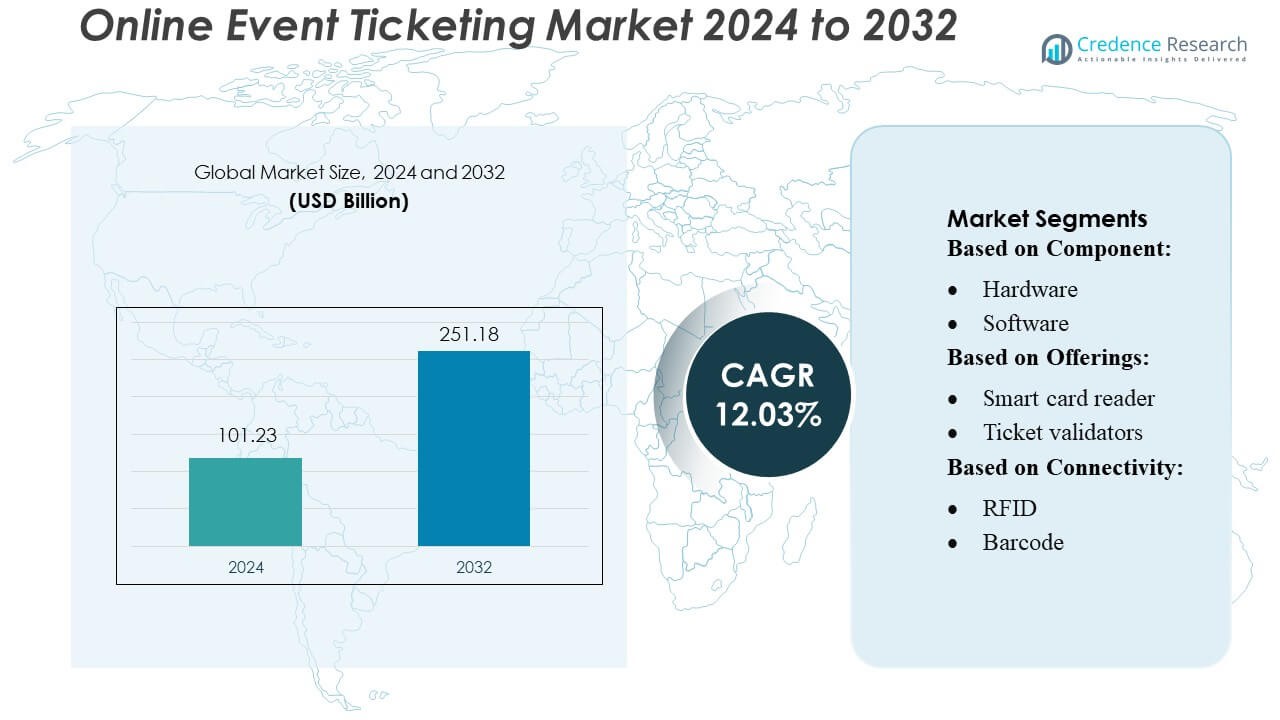
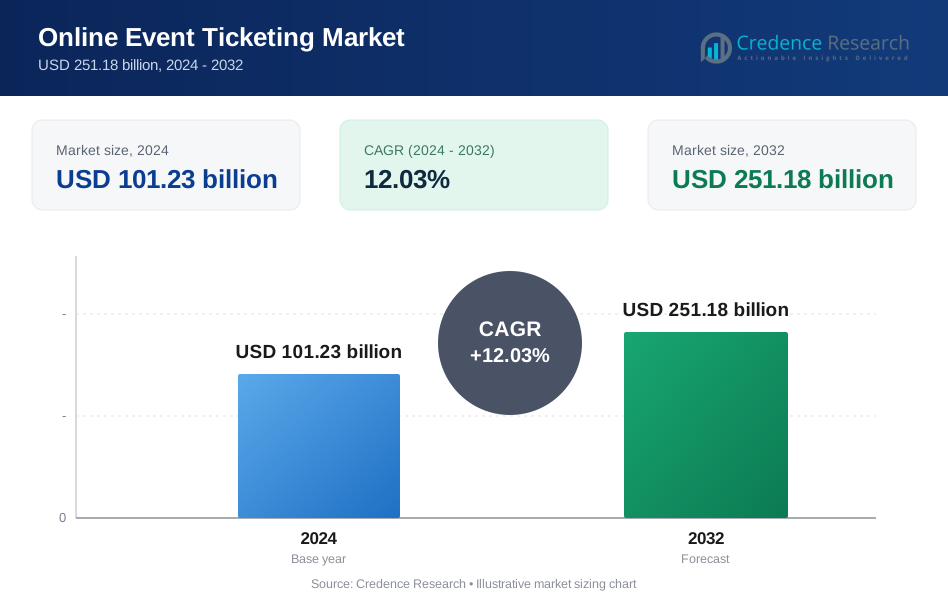
Online Event Ticketing Market size was valued USD 101.23 billion in 2024 and is anticipated to reach USD 251.18 billion by 2032, at a CAGR of 12.03% during the forecast period.
| REPORT ATTRIBUTE | DETAILS |
|---|---|
| Historical Period | 2020-2023 |
| Base Year | 2024 |
| Forecast Period | 2025-2032 |
| Online Event Ticketing Market Size 2024 | USD 101.23 Billion |
| Online Event Ticketing Market, CAGR | 12.03% |
| Online Event Ticketing Market Size 2032 | USD 251.18 Billion |
The online event ticketing market is highly competitive, and companies such as TickPick LLC, AOL Inc. (Yahoo), Cineplex Inc., Cinemark Holdings, Inc., PVR Ltd., VOX Cinemas, KyaZoonga, Inc., Carnival Cinemas, EasyMovies, and Bigtree aggressively vie for market share. These firms differentiate themselves by investing in mobile-first platforms, AI-driven pricing, loyalty programs, and real-time seat selection. Many also explore partnerships with event organizers and venue chains to broaden distribution. North America leads the market, accounting for approximately 38.8% of global revenue, leveraging its advanced digital infrastructure, mature entertainment industry, and high disposable incomes.
Market Insights
- The online event ticketing market reached USD 101.23 billion in 2024 and is projected to hit USD 251.18 billion by 2032, expanding at a 12.03% CAGR, driven by rising digital adoption and increasing demand for seamless ticketing experiences.
- Growing use of mobile-first platforms accelerates market growth, with mobile channels accounting for the majority of online ticket bookings due to convenience and faster checkout.
- Competitive activity intensifies as leading companies invest in AI-driven pricing, loyalty programs, and real-time seat selection, while forming partnerships with venues and event organizers to expand reach.
- Market restraints include high platform fees, fraud risks, and inconsistent digital infrastructure in emerging regions, which slow adoption and limit platform accessibility for some users.
- North America leads the global market with 38.8% share, supported by strong digital infrastructure, while Asia-Pacific registers the fastest growth; cinema ticketing remains a dominant segment, benefitting from expanding entertainment spending and digital payments.
Market Segmentation Analysis:
By Component
In the component segment, software holds the dominant market share, accounting for the largest portion of overall adoption in online event ticketing. Its leadership is driven by the rapid shift toward cloud-based ticketing platforms, automated seat selection, integrated payment systems, and real-time analytics used by event organizers. Software solutions also enable smooth mobile ticket delivery, fraud detection, and multi-channel distribution, making them essential for managing large volumes of digital attendees. As digital engagement increases, organizers prioritize flexible, scalable software over hardware-heavy systems, reinforcing its leading position.
- For instance, TickPick LLC implemented an AI-powered fraud detection system (Adaptive Checkout) in partnership with Riskified, which enabled it to recover $3 million in previously declined orders within three months.
By Offerings
Within offerings, ticket validators and mobile ticketing terminals represent the largest sub-segment, holding a significant share of market deployments. Their dominance is driven by widespread use at concerts, sports events, and entertainment venues where fast check-ins and secure verification are critical. Portable validation devices simplify crowd management, reduce entry bottlenecks, and support QR/barcode scanning and contactless checking. Operators prefer these solutions because they integrate easily with mobile apps and cloud back-ends, enabling smoother operations and reducing staffing needs. Their growing adoption reinforces their leadership in the offerings category.
- For instance, Cinemark Holdings, Inc. enhanced its mobile ticketing infrastructure by expanding support for digital validation across its U.S. circuit, and its official mobile app has been downloaded more than 10,000,000 times, enabling large-scale deployment of QR and barcode scanning at entry points.
By Connectivity
In the connectivity segment, barcode technology remains the dominant sub-segment, holding the highest share of active ticketing transactions. Its leadership is supported by low implementation cost, universal smartphone compatibility, and quick scanning capability across venues of all sizes. Barcodes also require minimal hardware investment and integrate easily with mobile apps, making them the preferred choice for digital event tickets. While RFID and NFC are growing, barcode systems remain the most widely adopted due to their simplicity, reliability, and ease of deployment, particularly for high-volume events and budget-sensitive organizers.
Key Growth Drivers
Rising Adoption of Mobile Ticketing
Mobile penetration and smartphone-based transactions continue to accelerate the shift toward digital ticketing. Consumers prefer app-based platforms that offer seamless browsing, instant purchasing, and secure digital ticket storage. Event organizers benefit from real-time sales insights, dynamic pricing options, and the elimination of physical ticket distribution. The widespread use of QR codes and mobile wallets enhances user convenience, reduces waiting times, and minimizes fraud risks. As mobile-first behavior expands across entertainment and sports sectors, mobile ticketing remains a major driver for market growth.
- For instance, KyaZoonga, Inc. demonstrated the scalability of mobile ticketing by managing ticketing operations for 49 international cricket matches and processing more than 2,000,000 tickets during the ICC Cricket World Cup, showcasing the operational strength of mobile-first platforms.
Expansion of Live Events and Entertainment Ecosystem
The global rise in concerts, festivals, sports leagues, and exhibitions significantly boosts demand for online ticketing platforms. Organizers increasingly digitize ticket distribution to reach wider audiences, manage high-volume bookings, and reduce operational overheads. Online systems allow flexible seat management, promotional discounting, and personalized communication, strengthening event engagement. Growth in hybrid events and large-scale entertainment productions further elevates the need for automated ticketing solutions. This expanding event ecosystem provides strong momentum for online ticketing adoption across geographies.
- For instance, Cineplex Inc. documented its ability to scale by serving 8.4 million guests in just the first quarter of 2025, leveraging its new mobile app and digital event-cinema offerings to streamline bookings and boost registration for alternative programming.
Advancements in Secure Digital Payment Infrastructure
Improved payment infrastructure—such as UPI, digital wallets, tokenization, and instant settlements—greatly enhances user trust in online ticketing. Platforms benefit from faster checkout processes, reduced transaction failures, and enhanced transparency through secure gateways. Enhanced fraud monitoring and two-factor authentication add layers of protection, encouraging first-time digital users. As regulatory bodies promote cashless transactions and fintech integrations mature, consumers increasingly shift to online channels for ticket purchases. These technological improvements form a foundational driver for steady market expansion.
Key Trends & Opportunities
Increasing Use of AI for Personalization and Dynamic Pricing
AI-driven engines are transforming how platforms forecast demand, personalize recommendations, and optimize ticket prices. Event organizers use machine learning models to adjust pricing based on real-time demand, seat availability, and historical buying patterns. Personalized marketing—such as targeted notifications and curated event lists—boosts conversions and reduces cart abandonment. This trend creates opportunities for platforms to enhance user engagement and improve revenue management. As AI tools become more accessible, personalized ticketing experiences will remain a key opportunity for market differentiation.
- For instance, AOL Inc. (Yahoo) enhances personalization performance across its digital ecosystem through its AI-powered Yahoo Advertising platform, which processes over 200 billion daily data signals to refine audience targeting and recommendation accuracy—demonstrating how large-scale AI capabilities directly support more dynamic and customized ticketing experiences.
Growth of Contactless and Smart Access Solutions
Adoption of QR codes, NFC-based passes, and RFID wristbands is reshaping entry management at events. These technologies enable fast, touch-free access control, reduce queue times, and minimize ticket fraud. Organizers increasingly deploy digital validation devices to streamline operations, particularly at large venues and festivals. The rising preference for frictionless check-ins supports opportunities for platforms to integrate advanced access tools into their services. This trend aligns with global moves toward hygienic, technology-led experiences, especially in high-traffic entertainment environments.
- For instance, VOX Cinemas supports contactless e-ticket scanning across its network of 573 cinema screens, leveraging digital ticket validation through its mobile app to enable smooth, touch-free entry across its venues.
Expansion of Cross-Platform and Omnichannel Ticketing
Consumers expect ticket access across apps, websites, kiosks, and partner channels, prompting platforms to invest in omnichannel capabilities. Integration with social media, streaming platforms, and travel apps allows broader event visibility and more convenient purchasing. Organizers leverage these interconnected systems to boost reach and create bundled offerings such as travel-and-event packages. This opportunity strengthens customer engagement and opens new revenue streams. As digital ecosystems expand, cross-platform ticket distribution will remain a major trend within the market.
Key Challenges
High Incidence of Fraud and Scalping Activities
Despite improvements in digital security, the market continues to face challenges related to counterfeit tickets, unauthorized reselling, and large-scale bot-driven bulk purchases. These issues impact consumer trust and strain platform operations. Organizers must invest heavily in secure verification systems, anti-bot technologies, and authentication protocols to mitigate risks. Fraud also increases customer service overheads and disputes, affecting brand reputation. Addressing these persistent threats remains a key challenge, especially during high-demand events where unauthorized resale activity peaks.
Infrastructure Gaps in Emerging Markets
While digital adoption is rising, many developing regions still face challenges such as inconsistent internet connectivity, limited digital payment adoption, and low smartphone penetration. These factors restrict the shift from offline to online ticketing. Smaller organizers may lack resources to adopt automated ticketing systems, slowing market expansion. Furthermore, regulatory inconsistencies and fragmented payment ecosystems add complexity for platform operators. Bridging these infrastructure gaps is essential for broader market penetration, but remains a major challenge in underserved areas.
Regional Analysis
North America
North America holds the largest share of the online event ticketing market, accounting for around 38–39% of global revenue. The strong position comes from widespread internet access, high smartphone usage, and a mature entertainment industry with frequent concerts, sports events, and theatre shows. Major companies such as Ticketmaster and Eventbrite lead the market, offering secure digital payments and mobile ticketing options. Consumers in the region prefer online booking because it is fast, reliable, and convenient. Continuous investments in digital platforms and strong demand for live events help North America maintain its leading role.
Europe
Europe accounts for about 27% of the global online event ticketing market. The region benefits from strong digital infrastructure and a large number of cultural, music, and sports events. Countries such as the United Kingdom, Germany, and France contribute heavily to online ticket sales. Consumers increasingly prefer mobile and digital tickets, especially for concerts, festivals, and football matches. Clear regulations and data protection laws help strengthen user trust in online platforms. As digital adoption increases and more events shift to online booking systems, Europe continues to remain a major and stable market.
Asia-Pacific
Asia-Pacific holds around 24–30% of the global online event ticketing market and is the fastest-growing region. Rising internet use, a young population, and strong smartphone growth support rapid expansion. Countries such as China, India, Japan, and Australia drive the majority of sales. Digital payments, especially mobile wallets and super-apps, make booking easier and more popular. The growing interest in concerts, sports events, and entertainment shows also boosts demand. As more people shift to online purchasing and hybrid events increase, Asia-Pacific continues to show strong growth potential.
Latin America
Latin America represents a smaller but rising portion of the market, with a steadily growing share driven mainly by Brazil, Mexico, and Argentina. Online event ticketing adoption is increasing as internet access and mobile payment options expand. More consumers now book tickets online for concerts, sports, and cultural festivals due to improving platform reliability and convenience. Local ticketing companies and regional apps are gaining popularity as they offer localized pricing and secure transactions. Although the market share is lower compared with other regions, Latin America is becoming a promising growth area as digital usage continues to rise.
Middle East & Africa
The Middle East & Africa region captures about 5–11% of the global online event ticketing market. Growth is supported by increasing smartphone ownership, rising disposable incomes, and strong interest in entertainment events, cultural festivals, and sports tournaments. Countries such as the UAE, Saudi Arabia, South Africa, and Egypt lead adoption. Governments are investing heavily in digital transformation, making online payments and mobile ticketing more secure and accessible. As more venues adopt QR-based and contactless ticketing systems, the region’s online event ticketing market continues to expand gradually.
Market Segmentations:
By Component:
- Hardware
- Software
By Offerings:
- Smart card reader
- Ticket validators
By Connectivity:
- RFID
- Barcode
By Geography
- North America
- U.S.
- Canada
- Mexico
- Europe
- Germany
- France
- U.K.
- Italy
- Spain
- Rest of Europe
- Asia Pacific
- China
- Japan
- India
- South Korea
- South-east Asia
- Rest of Asia Pacific
- Latin America
- Brazil
- Argentina
- Rest of Latin America
- Middle East & Africa
- GCC Countries
- South Africa
- Rest of the Middle East and Africa
Competitive Landscape
The competitive landscape of the online event ticketing market features a diverse mix of global and regional companies, including TickPick LLC, Cinemark Holdings, Inc., KyaZoonga, Inc., Cineplex Inc., AOL Inc. (Yahoo), VOX Cinemas, PVR LTD., Carnival Cinemas, EasyMovies, and Bigtree. The online event ticketing market is characterized by rapid digital transformation, strong mobile adoption, and increasing demand for seamless booking experiences. Companies compete by enhancing platform reliability, expanding digital payment options, and integrating real-time seat selection and personalized recommendations. Advanced technologies such as AI-driven pricing, automated fraud detection, and secure QR-based ticketing strengthen user trust and reduce operational risks. Market participants are also focusing on loyalty programs, cross-platform integration, and partnerships with entertainment venues to broaden their reach. As consumers shift toward mobile-first ticketing, competitive advantage increasingly depends on user-friendly interfaces, fast checkout processes, and consistent customer support. Continuous innovation, strategic collaborations, and differentiated service offerings shape the evolving competitive dynamics, enabling firms to capture growth opportunities in both mature and emerging markets.
Key Player Analysis
- TickPick LLC
- Cinemark Holdings, Inc.
- KyaZoonga, Inc.
- Cineplex Inc.
- AOL Inc. (Yahoo)
- VOX Cinemas
- PVR LTD.
- Carnival Cinemas
- EasyMovies
- Bigtree
Recent Developments
- In January 2025, HID (part of the ASSA ABLOY Group) announced it had signed an agreement to acquire the companies 3millID Corporation and Third Millennium Systems Ltd. The acquisition aimed to expand HID's physical access control portfolio by adding specialized multi-technology readers and secure, encrypted mobile access credentials, particularly benefiting customers transitioning from older systems.
- In October 2024, Cubic Transportation Systems (CTS) secured a contract with the Tasmanian government to implement a new smart ticketing system for its public transport network. This multiyear agreement aims to provide more convenient and accessible fare payment options, leveraging Cubic's account-based ticketing technology, which is also used in Queensland.
- In September 2024, FPT IS and Mastercard signed a partnership to integrate an open-loop EMV electronic payment system for Ho Chi Minh City's Metro Line 1. This collaboration, formalized by a Memorandum of Understanding (MoU), will allow passengers to pay fares using bank cards, QR codes, or citizen ID cards, which is expected to streamline traffic management and ticketing.
- In July 2024, Conduent Transportation will modernize Saint-Étienne Métropole's STAS bus and tram network by implementing a new account-based ticketing system and installing various new equipment to improve efficiency and accessibility. The three-phase improvement process will enhance regional interoperability and introduce mobile ticketing options.
Report Coverage
The research report offers an in-depth analysis based on Component, Offerings, Connectivity and Geography. It details leading market players, providing an overview of their business, product offerings, investments, revenue streams, and key applications. Additionally, the report includes insights into the competitive environment, SWOT analysis, current market trends, as well as the primary drivers and constraints. Furthermore, it discusses various factors that have driven market expansion in recent years. The report also explores market dynamics, regulatory scenarios, and technological advancements that are shaping the industry. It assesses the impact of external factors and global economic changes on market growth. Lastly, it provides strategic recommendations for new entrants and established companies to navigate the complexities of the market.
Future Outlook
- The market will continue shifting toward mobile-first ticketing as smartphone usage and digital wallets expand.
- AI-driven personalization will improve event recommendations and dynamic pricing accuracy.
- Hybrid and virtual events will maintain steady demand for online booking platforms.
- Contactless and QR-based ticketing will become the standard for security and convenience.
- Integration with social media and super-apps will enhance event discovery and faster ticket purchases.
- Cloud-based platforms will support faster scaling and improved real-time inventory management.
- Subscription models and loyalty programs will gain traction to drive customer retention.
- Stronger fraud prevention tools will emerge as platforms adopt blockchain and advanced verification.
- Localized ticketing solutions will grow in emerging markets with rising digital adoption.
- Strategic partnerships between event organizers, venues, and tech platforms will shape competitive advantage.
Request a Free Sample
Fill in your details and we'll send you a free sample report.
- Sample data tables & charts
- Research methodology
Need a Custom Version of This Report?
Tailor the scope, geography, or segments to your exact requirements.
- Custom geography or segment scope
- Direct access to our analyst team
Frequently Asked Questions
What is the current market size for the Online Event Ticketing Market, and what is its projected size in 2032?
At what Compound Annual Growth Rate is the Online Event Ticketing Market projected to grow between 2025 and 2032?
Which Online Event Ticketing Market segment held the largest share in 2024?
What are the primary factors fueling the growth of the Online Event Ticketing Market?
Who are the leading companies in the Online Event Ticketing Market?
Which region commanded the largest share of the Online Event Ticketing Market in 2024?
Table of Content
Chapter 1. Report Introduction
- 1.1 Report Description & Purpose
- 1.1.1 Report Title & Market Definition
- 1.1.2 Unique Selling Propositions (USP) & Key Differentiators
- 1.1.3 Value Proposition for Stakeholders
- 1.2 Research Objectives
- 1.2.1 Market Sizing Objectives (Volume & Revenue)
- 1.2.2 Segmentation Objectives
- 1.2.3 Competitive Intelligence Objectives
- 1.2.4 Forecast & Scenario Objectives
- 1.3 Report Scope
- 1.3.1 Online Event Ticketing Scope – Types & Subtypes Covered
- 1.3.2 Geographic Scope – Regions & Countries Covered
- 1.3.3 Historical Period, Base Year & Forecast Period (2024; forecast to 2032)
- 1.3.4 Inclusions & Exclusions
- 1.4 HS Code & Classification Framework
- 1.5 Currency, Units & Pricing Basis
- 1.6 Target Stakeholders
- 1.7 Limitations & Assumptions
Chapter 2. Executive Summary
- 2.1 Global Online Event Ticketing Market Snapshot
- 2.1.1 Market Size – Historical (2024) & Forecast (2024-2032) (2024: USD 101.23 billion → 2032: USD 251.18 billion)
- 2.1.2 Volume & Revenue – Global Totals
- 2.1.3 Key Market Highlights – Top Five Facts
- 2.2 Online Event Ticketing Market Segmentation Snapshot
- 2.2.1 Market Split by Region – 2024 vs. 2032
- 2.3 Competitive Snapshot
- 2.3.1 Top 10 Players by Revenue Share – 2024
- 2.3.2 Top 10 Players by Volume Share – 2024
- 2.3.3 Recent Strategic Developments (18-Month Summary)
- 2.4 Key Investment Highlights & Strategic Conclusions
Chapter 3. Online Event Ticketing Market Dynamics & Industry Analysis
- 3.1 Market Overview & Context
- 3.1.1 Online Event Ticketing Market Position in the Broader Automotive Value Chain
- 3.1.2 OEM vs. Replacement Market Dynamics
- 3.1.3 Market Maturity & Development Stage by Region
- 3.2 Online Event Ticketing Market Drivers
- 3.3 Online Event Ticketing Market Restraints & Challenges
- 3.4 Online Event Ticketing Market Opportunities
- 3.5 Porter's Five Forces Analysis
- 3.5.1 Threat of New Entrants
- 3.5.2 Bargaining Power of Suppliers
- 3.5.3 Bargaining Power of Buyers
- 3.5.4 Threat of Substitutes
- 3.5.5 Competitive Rivalry – Intensity Assessment
- 3.6 Online Event Ticketing Value Chain Analysis
- 3.6.1 Upstream – Raw Material/Input Suppliers
- 3.6.1.1 Raw Material/Input 1
- 3.6.1.2 Raw Material/Input 2
- 3.6.1.3 Raw Material/Input 3
- 3.6.2 Midstream – Production/Manufacturing/Service Delivery
- 3.6.2.1 Production/Process Overview
- 3.6.2.2 Key Facility Locations & Capacity by Manufacturer
- 3.6.3 Downstream – Distribution & End Consumer
- 3.6.3.1 Primary Channel – B2B/OEM
- 3.6.3.2 Secondary Channels – Dealer, Retail, Online, Direct
- 3.6.4 Value Chain Profitability Analysis
- 3.6.1 Upstream – Raw Material/Input Suppliers
- 3.7 PESTEL Analysis
- 3.7.1 Political Factors
- 3.7.2 Economic Factors
- 3.7.3 Social Factors
- 3.7.4 Technological Factors
- 3.7.5 Environmental Factors
- 3.7.6 Legal Factors
- 3.8 Online Event Ticketing Supply Chain Analysis
- 3.8.1 Raw Material/Input Supply Risk Assessment
- 3.8.2 Manufacturing Concentration Risk (Geographic Exposure)
- 3.8.3 Trade Disruption Impact Analysis
- 3.9 Regulatory & Policy Landscape
Note: The regulatory and policy landscape section covers regulations based on their applicability to the market, Online Event Ticketing category, geography, and scope of the study. Only regulatory frameworks with a material impact on operations, compliance, trade, sustainability, or market access are analyzed in detail.
Chapter 4. Key Investment Pockets & Opportunity Analysis
- 4.1 Online Event Ticketing Market Attractiveness Analysis
- 4.1.1 By Region – Investment Attractiveness Matrix (Volume × CAGR)
- 4.2 Absolute Revenue Growth Opportunity
- 4.2.1 By Region – Absolute USD Growth Through 2032
- 4.3 Incremental Volume Opportunity
- 4.3.1 By Region – Incremental Volume Through 2032
- 4.3.2 Segment – Incremental Volume
- 4.4 Emerging Submarket Opportunity Deep Dive (Subject to Applicability)
- 4.5 Emerging Market Opportunity Scorecards
- 4.5.1 United States
- 4.5.2 Europe
- 4.5.3 Asia
- 4.5.4 Middle East & Africa
Note: Emerging Market Opportunity Scorecards will be included based on relevance and strategic importance. Regions listed are indicative and may vary depending on data availability and market dynamics.
Chapter 5. Online Event Ticketing Import-Export Analysis & Trade Flows
- 5.1 Global Trade Overview
- 5.1.1 Global Export Value by Country (2024)
- 5.1.2 Global Export Volume by Country (2024)
- 5.1.3 Global Import Value by Country (2024)
- 5.1.4 Global Import Volume by Country (2024)
- 5.1.5 Net Trade Balance by Country (2024)
- 5.2 Export Analysis – Segment
- 5.2.1 Type 1 (HS Code)
- 5.2.2 Type 2 (HS Code)
- 5.2.3 Type 3 (HS Code)
- 5.2.4 Type 4 (HS Code)
- 5.2.5 Type 5 (HS Code)
- 5.3 Import Analysis – Segment
- 5.3.1 Type 1 (HS Code)
- 5.3.2 Type 2 (HS Code)
- 5.3.3 Type 3 (HS Code)
- 5.3.4 Type 4 (HS Code)
- 5.3.5 Type 5 (HS Code)
- 5.4 Average Unit Trade Prices
- 5.4.1 Average Export Price – Segment & Country
- 5.4.2 Average Import Price – Segment & Source Country
- 5.4.3 Price Trends (2024)
- 5.5 Key Trade Route Analysis
- 5.5.1 Trade Route 1
- 5.5.2 Trade Route 2
- 5.5.3 Trade Route 3
- 5.5.4 Trade Route 4
- 5.5.5 Trade Route 5
- 5.6 Trade Policy Impact Assessment
- 5.6.1 US Anti-Dumping & Section 301 Tariffs
- 5.6.2 EU Customs Union Impact
- 5.6.3 Major Free Trade Agreements
- 5.6.4 USMCA Rules of Origin
Note: Trade policy analysis will be included only where relevant to the Online Event Ticketing market.
Chapter 6. Competitive Landscape & Company Benchmarking
- 6.1 Online Event Ticketing Market Concentration & Structure
- 6.1.1 Herfindahl-Hirschman Index (HHI) – vs. 2024
- 6.1.2 Tier 1, Tier 2 & Tier 3 Market Structure
- 6.1.3 Global, Regional & Local Player Dynamics
- 6.2 Online Event Ticketing Market Share Analysis – 2024
- 6.2.1 Global Revenue Share by Company
- 6.2.2 Global Volume Share by Company
- 6.2.3 Regional Revenue Share
- 6.2.4 Market Share Evolution ( vs. 2024)
- 6.2.5 OEM Segment Share by Company
- 6.2.6 Replacement Segment Share by Company
- 6.3 Production/Delivery Capacity & Facility Analysis
- 6.3.1 Global Installed Capacity
- 6.3.2 Capacity Utilization Rates
- 6.3.3 Production/Output Volume
- 6.3.4 Facility Locations & Capacity Map
- 6.3.5 Planned Capacity Additions
- 6.4 Online Event Ticketing Competitive Benchmarking Matrix
- 6.4.1 Revenue, Volume, CAGR & Profitability Comparison
- 6.4.2 Channel Revenue Mix
- 6.4.3 Geographic Revenue Exposure
- 6.4.4 R&D Intensity
- 6.4.5 Sustainability Maturity
- 6.5 Strategic Developments in Online Event Ticketing (Last 24 Months)
- 6.5.1 Mergers, Acquisitions & Divestments
- 6.5.2 New Online Event Ticketing Launches
- 6.5.3 Facility Expansions
- 6.5.4 Strategic Alliances, Joint Ventures & Partnerships
- 6.5.5 Distribution Expansion & Market Entry
- 6.5.6 Sustainability & ESG Initiatives
- 6.6 Competitive Strategy Mapping
- 6.6.1 Leader, Challenger, Follower & Niche Classification
- 6.6.2 Pricing Strategy Comparison
- 6.6.3 Channel Strategy Matrix
Note: Strategic developments are included based on their materiality and the availability of reliable information.
Chapter 7. Global Online Event Ticketing Market – By Distribution Channel
- 7.1 Segment Overview
- 7.1.1 Volume & Revenue Split by Channel (2024 & 2032)
- 7.1.2 Channel Mix Evolution (2024-2032)
Chapter 8. Regional Market Analysis – Global Overview
- 8.1 Global Regional Overview
- 8.1.1 Regional Volume Share
- 8.1.2 Regional Revenue Share
- 8.1.3 Regional Volume by Region
- 8.1.4 Regional Revenue by Region
- 8.1.5 Regional Forecast Through 2032
- 8.2 Cross-Regional Segment Analysis
- 8.2.1 By Distribution Channel
- 8.2.2 By Brand/Price Tier
Chapter 9. North America Online Event Ticketing Market
- 9.1 United States
- 9.2 Canada
- 9.3 Mexico
Chapter 10. Europe Online Event Ticketing Market
- 10.1 Germany
- 10.2 France
- 10.3 Italy
- 10.4 United Kingdom
- 10.5 Spain
- 10.6 Poland
- 10.7 Russia
- 10.8 Netherlands
- 10.9 Belgium
- 10.10 Sweden
- 10.11 Denmark
- 10.12 Norway
- 10.13 Rest of Europe
Chapter 11. Asia Pacific Online Event Ticketing Market
- 11.1 China
- 11.2 India
- 11.3 Japan
- 11.4 South Korea
- 11.5 Thailand
- 11.6 Indonesia
- 11.7 Vietnam
- 11.8 Malaysia
- 11.9 Australia
- 11.10 Rest of Asia Pacific
Chapter 12. Latin America Online Event Ticketing Market
- 12.1 Brazil
- 12.2 Argentina
- 12.3 Colombia
- 12.4 Chile
- 12.5 Rest of Latin America
Chapter 13. Middle East Online Event Ticketing Market
- 13.1 Saudi Arabia
- 13.2 United Arab Emirates
- 13.3 Turkey
- 13.4 Israel
- 13.5 Iran
- 13.6 Rest of the Middle East
Chapter 14. Africa Online Event Ticketing Market
- 14.1 South Africa
- 14.2 Egypt
- 14.3 Nigeria
- 14.4 Morocco
- 14.5 Rest of Africa
Chapter 15. Online Event Ticketing Company Profiles
- 15.1 [Company 01]
- 15.1.1 Company Overview
- 15.1.2 Key Management Personnel
- 15.1.3 Products & Services Portfolio
- 15.1.4 Financial Performance
- 15.1.5 Key Market Focus & Geographic Presence
- 15.1.6 Recent Developments & Strategic Initiatives
Note: The company profile list is preliminary and may change based on research findings, market developments, data availability, and client requirements.
Chapter 16. Appendices
- Appendix A – List of Abbreviations & Acronyms
- Appendix B – Industry Classification Code Reference – Full Series
- Appendix C – Production & Capacity Data Tables
- Appendix D – End-Use & Demand Base Tables
- Appendix E – Consumption & Replacement Rate Assumptions
- Appendix F – ASP Reference Tables
- Appendix G – Manufacturing & Facility Database
- Appendix H – Import-Export Data Tables
- Appendix I – Regulatory Summary Tables
- Appendix J – Primary Research Participant List (Anonymized)
- Appendix K – Primary Research Questionnaire Framework
- Appendix L – Data Sources & Bibliography
- Appendix M – Market Size Divergence & Source Comparison
Chapter 17. Research Methodology
- 17.1 Research Framework & Philosophy
- 17.2 Secondary Research – Sources, Hierarchy & Data Extraction
- 17.3 Data Modeling – Bottom-Up & Top-Down Market Sizing
- 17.4 Primary Research – Stakeholder Framework, LOI & Sample Sizes
- 17.5 Forecast Methodology – Regression, Scenario & Sensitivity Analysis
- 17.6 Quality Control – Four-Layer Validation Framework
- 17.7 Limitations & Standard Assumptions
- 17.8 Disclaimer
