
Market Overview
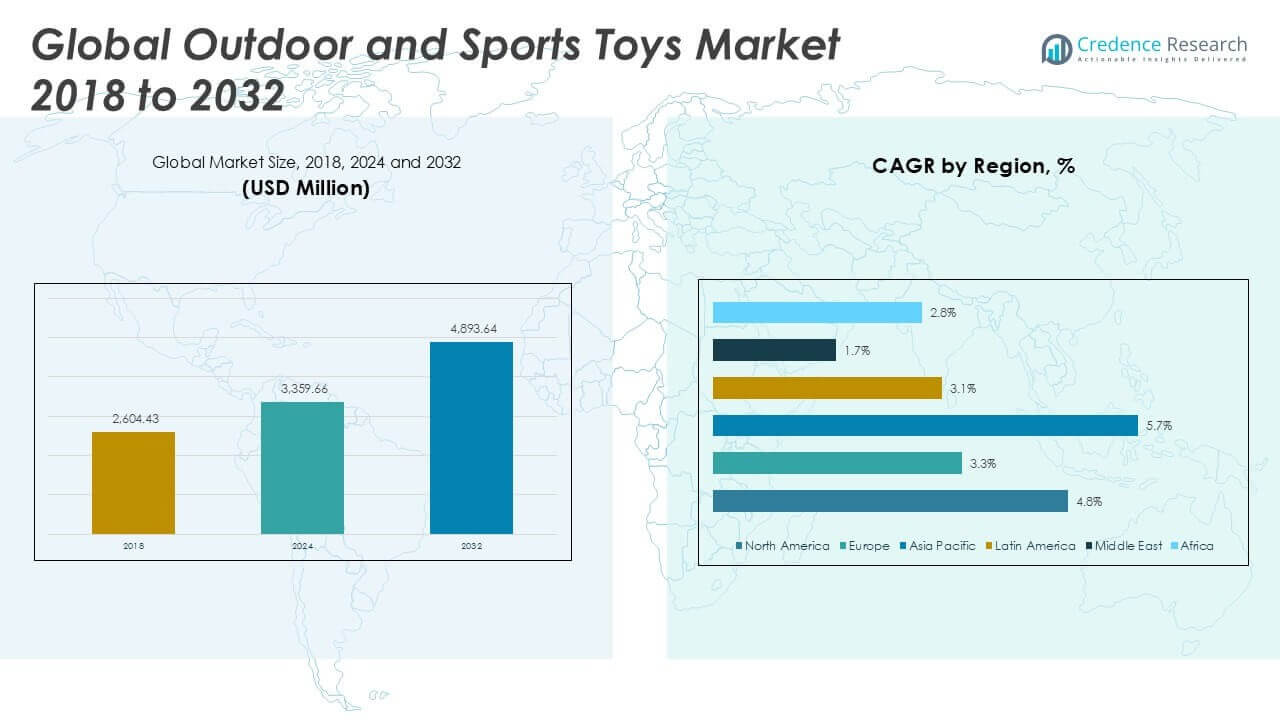
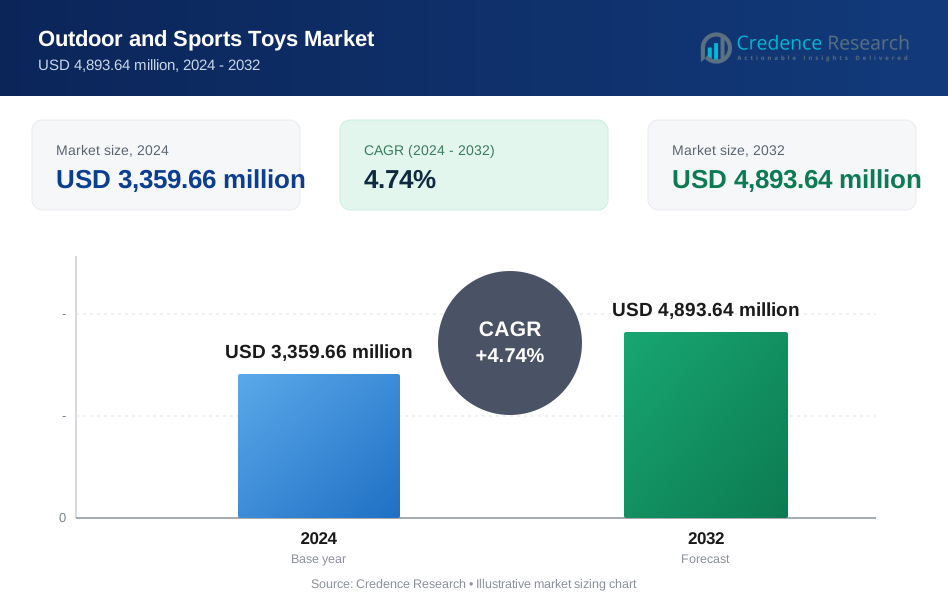
Outdoor and Sports Toys Market size was valued at USD 2,604.43 million in 2018 to USD 3,359.66 million in 2024 and is anticipated to reach USD 4,893.64 million by 2032, at a CAGR of 4.81% during the forecast period.
| REPORT ATTRIBUTE | DETAILS |
|---|---|
| Historical Period | 2020-2023 |
| Base Year | 2024 |
| Forecast Period | 2025-2032 |
| Outdoor and Sports Toys Market Size 2024 | USD 3,359.66 million |
| Outdoor and Sports Toys Market, CAGR | 4.74% |
| Outdoor and Sports Toys Market Size 2032 | USD 4,893.64 million |
The Outdoor and Sports Toys Market is experiencing steady growth due to rising awareness of the health and developmental benefits associated with active play among children. Parents increasingly prioritize outdoor activities to promote physical fitness, social interaction, and overall well-being, fueling demand for innovative and engaging products. Manufacturers respond by introducing toys that combine traditional outdoor play with new technologies, such as interactive and smart features, enhancing appeal across age groups. The expansion of e-commerce platforms broadens market access, allowing consumers to explore a wider range of options and supporting global sales growth. Seasonal trends, such as increased purchasing during holidays and summer months, also drive market momentum. Sustainability concerns influence both product design and material choices, with a noticeable shift toward eco-friendly offerings. Together, these drivers and trends position the Outdoor and Sports Toys Market for sustained expansion in an evolving recreational landscape.
The Outdoor and Sports Toys Market demonstrates strong geographic diversity, with significant demand originating from North America, Europe, and Asia Pacific. North America leads market growth due to high consumer spending on recreational activities and a strong culture of outdoor play. Europe follows with robust sales driven by health-conscious consumers and a well-established sports infrastructure. Asia Pacific exhibits rapid expansion, supported by rising disposable incomes, urbanization, and a growing youth population. Each region displays unique preferences influenced by climate, lifestyle, and local traditions, encouraging manufacturers to tailor offerings accordingly. Key players shaping the market include Hasbro, Mattel, and Radio Flyer, recognized for their broad product portfolios and commitment to innovation. Little Tikes also stands out for its durable and imaginative outdoor products targeting younger children. These companies drive competition and set industry benchmarks through product development and strategic partnerships.
Market Insights
- The Outdoor and Sports Toys Market is valued at USD 3,359.66 million in 2024 and projected to reach USD 4,893.64 million by 2032, with a CAGR of 4.74%.
- Increasing focus on physical fitness and active lifestyles among children and families drives steady demand for outdoor and sports toys.
- Product innovations include interactive features, smart connectivity, and technology integration, appealing to tech-savvy consumers.
- Rising popularity of eco-friendly and sustainable materials influences both product design and consumer preferences.
- Leading players such as Hasbro, Mattel, Radio Flyer, and Little Tikes maintain competitive strength through diverse product portfolios and global reach.
- Market restraints include competition from digital entertainment and ongoing supply chain disruptions impacting product availability.
- North America and Europe exhibit high demand due to established outdoor recreation cultures, while Asia Pacific presents rapid growth opportunities driven by urbanization and increasing disposable income.
Market Drivers
Increasing Emphasis on Physical Activity and Healthy Lifestyles
The Outdoor and Sports Toys Market benefit from a global shift towards active, healthy living, especially among younger populations. Rising rates of childhood obesity and sedentary lifestyles prompt parents, educators, and governments to encourage outdoor play and physical exercise. Toys designed to stimulate physical activity, such as bikes, scooters, and sports kits, see growing popularity among families seeking holistic development for children. Awareness campaigns and public health initiatives highlight the importance of movement, further driving demand. It creates an environment where outdoor and sports toys become integral tools for fitness and wellness routines. The market gains strong support from institutions promoting regular exercise, reinforcing the value of play-based learning and active recreation.
- For instance, parental concerns about childhood obesity and sedentary lifestyles have driven demand for outdoor sports toys that promote physical activity and social interaction.
Innovation and Integration of Technology in Outdoor Toys
Manufacturers in the Outdoor and Sports Toys Market respond to evolving consumer preferences by integrating technology into traditional toys. Interactive features, such as app connectivity, motion sensors, and augmented reality, create new play experiences that attract children accustomed to digital entertainment. The market witnesses a surge in products that combine physical movement with digital engagement, offering both fun and skill development. Technology-driven toys maintain relevance in a competitive market by addressing changing expectations and capturing the attention of tech-savvy families. The introduction of customizable and interactive elements boosts repeat purchases and brand loyalty. It encourages ongoing product development and keeps the market dynamic.
- For instance, technological advancements such as augmented reality and smart sensors are transforming traditional outdoor sports toys and enhancing the play experience for children.
Expansion of E-commerce and Global Distribution Channels
E-commerce platforms play a vital role in shaping the growth trajectory of the Outdoor and Sports Toys Market. Online retail enables manufacturers and brands to reach a broader consumer base, transcending geographical limitations and seasonal fluctuations. The convenience of home delivery and access to a wide product selection drive online sales, supported by targeted digital marketing and consumer reviews. It enables small and emerging brands to compete effectively alongside established players. Global distribution partnerships and multi-channel strategies enhance visibility and accessibility. This shift to digital retail supports rapid market expansion and adaptation to evolving consumer behaviors.
Rising Demand for Eco-Friendly and Sustainable Products
Sustainability trends significantly influence the Outdoor and Sports Toys Market as environmentally conscious consumers seek safer, greener alternatives. Manufacturers introduce products using recycled, biodegradable, or sustainably sourced materials to appeal to eco-aware buyers. The market aligns with broader societal shifts towards environmental responsibility, with regulatory frameworks encouraging sustainable practices in manufacturing and packaging. It reflects a growing preference for toys free from harmful chemicals and single-use plastics. Certifications and eco-labels increase consumer trust and support purchasing decisions. Commitment to sustainability positions companies as leaders in responsible innovation, driving long-term market value.
Market Trends
Adoption of Smart and Interactive Outdoor Toys
The Outdoor and Sports Toys Market Market is witnessing a noticeable shift towards smart and interactive products that enhance user engagement. Manufacturers incorporate advanced features such as Bluetooth connectivity, motion sensors, and augmented reality to create immersive play experiences. These innovations appeal to digitally native children, blending physical activity with interactive entertainment. The market observes a growing preference for toys that support both solo and group play, promoting social interaction and teamwork. It drives the development of app-enabled equipment, digitally tracked sports gear, and adaptive outdoor games. This trend aligns with the evolving expectations of parents and children, ensuring sustained interest in the product category.
Rising Popularity of Themed and Licensed Products
Branded outdoor and sports toys featuring popular characters and franchises gain traction, strengthening brand loyalty and driving repeat purchases. Collaborations with entertainment companies bring familiar themes to sports sets, ride-ons, and garden games, appealing to children’s interests. The Outdoor and Sports Toys Market Market benefits from the marketing strength and wide reach of major movie, TV, and gaming franchises. These partnerships introduce limited edition products, exclusive collections, and seasonal releases that stimulate demand. It supports differentiation in a competitive landscape and taps into fan-driven trends. The market leverages storytelling and character-driven experiences to increase the emotional appeal of outdoor play.
- For instance, collaborations with entertainment companies have led to increased sales of licensed outdoor toys featuring characters from blockbuster films.
Focus on Sustainability and Eco-Friendly Materials
Sustainable practices and eco-friendly materials represent a defining trend in the Outdoor and Sports Toys Market Market. Consumers show increasing interest in toys made from recycled plastics, sustainably sourced wood, and biodegradable components. The market responds with a broader range of environmentally responsible offerings, often certified by recognized green labels. Manufacturers redesign packaging and adopt production processes that minimize environmental impact. It aligns with global efforts to reduce waste and lower carbon footprints, resonating strongly with eco-conscious families. This trend enhances brand reputation and aligns with regulatory requirements for safer, non-toxic products.
- For instance, manufacturers are introducing eco-friendly outdoor toys made from recycled, biodegradable, and sustainably sourced materials to appeal to environmentally conscious buyers.
Growth of Omnichannel Retail and Direct-to-Consumer Models
Retail dynamics in the Outdoor and Sports Toys Market Market shift toward omnichannel strategies that combine online and offline sales. Brands invest in seamless customer experiences, offering flexible shopping options, virtual product demonstrations, and easy returns. The integration of social media marketing and influencer partnerships expands reach and drives product awareness. It enables manufacturers to gather consumer insights, personalize offerings, and adapt quickly to market trends. Pop-up stores and experiential events complement digital efforts, creating memorable interactions. This approach supports brand loyalty and increases the market’s resilience to changing retail environments.
Market Challenges Analysis
Rising Competition from Digital Entertainment and Indoor Activities
The Outdoor and Sports Toys Market face persistent challenges from the widespread popularity of digital entertainment, including video games, streaming content, and mobile applications. Children and teenagers increasingly spend leisure time indoors, reducing interest in traditional outdoor play. The market must contend with evolving entertainment preferences, which shift demand away from physical toys toward screen-based experiences. It requires brands to innovate and differentiate their offerings to recapture attention and foster engagement. Parents may struggle to balance digital and physical activities, complicating purchasing decisions for outdoor products. The market’s ability to highlight the developmental and health benefits of active play will influence future demand.
Supply Chain Disruptions and Regulatory Compliance
Supply chain disruptions present significant obstacles for the Outdoor and Sports Toys Market, particularly when global logistics or raw material costs fluctuate. Unpredictable shipping schedules, higher freight rates, and shortages of essential components can delay product launches and impact inventory management. It must also navigate a complex regulatory landscape, ensuring compliance with stringent safety standards and environmental regulations across multiple regions. The process requires investment in quality control, certification, and traceability systems to maintain consumer trust and brand reputation. Shifting rules and rising expectations for sustainable practices create ongoing compliance challenges. Addressing these issues is essential for sustained market growth and operational resilience.
- For instance, unpredictable shipping schedules and rising freight costs have impacted toy manufacturers, leading to delays in product launches and inventory shortages.
Market Opportunities
Expansion into Untapped Regional Market and Demographic Segments
The Outdoor and Sports Toys Market present significant opportunities for growth through geographic and demographic diversification. Emerging economies in Asia Pacific, Latin America, and Africa offer a large, youthful population base and rising disposable incomes, driving demand for recreational products. Companies that tailor offerings to local preferences, cultural norms, and climate conditions can unlock new revenue streams. The market can capitalize on partnerships with local retailers, schools, and community organizations to build brand presence and foster loyalty. It gains from strategic investments in distribution networks and marketing campaigns that highlight the benefits of outdoor play. This targeted approach positions companies to capture market share in high-growth regions.
Product Innovation and Customization for Evolving Consumer Preferences
Innovation in design, functionality, and sustainability creates new avenues for value creation within the Outdoor and Sports Toys Market. The market sees rising interest in customizable toys, modular sets, and multi-functional products that cater to changing family needs and lifestyles. Companies can leverage technology to introduce interactive features, smart connectivity, and app integration, enhancing product appeal among tech-savvy consumers. It encourages the development of eco-friendly and durable materials, responding to growing environmental awareness. Collaborations with wellness brands and educational institutions further expand the market’s application scope. This focus on innovation positions industry leaders to meet evolving demands and maintain long-term growth.
Market Segmentation Analysis:
By Type:
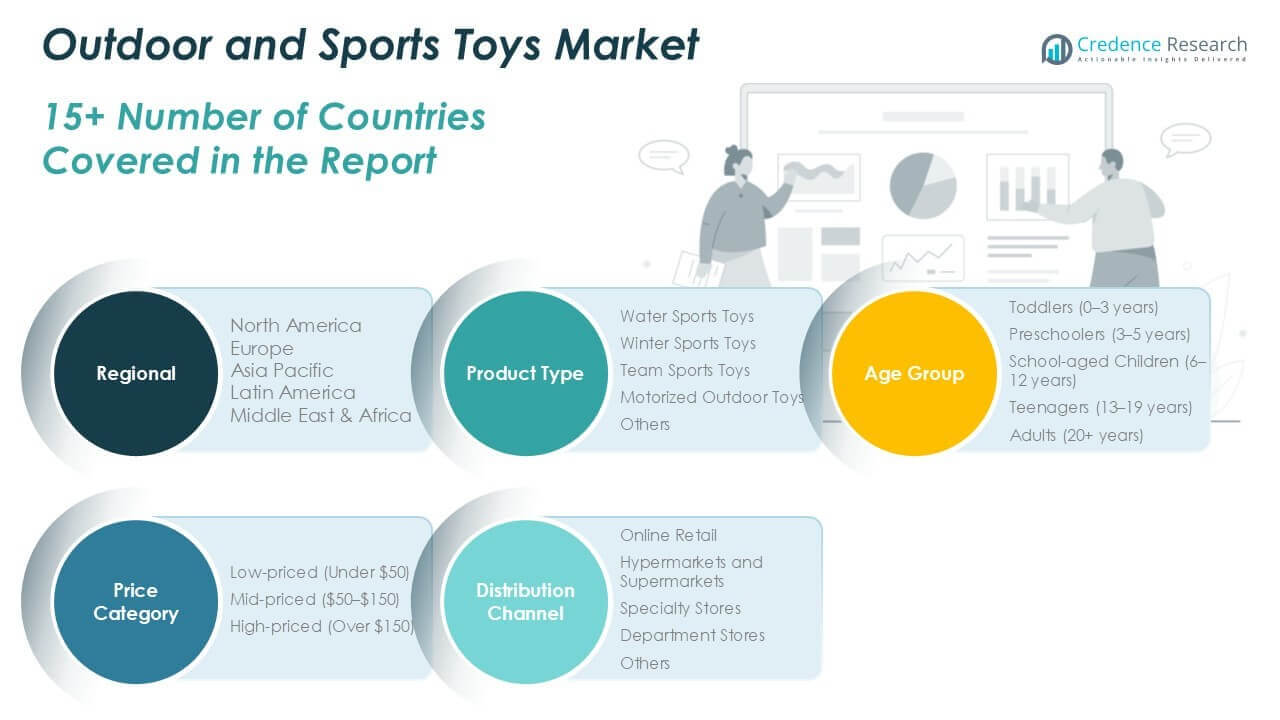
It features water sports toys, winter sports toys, team sports toys, motorized outdoor toys, and others, each category catering to unique recreational preferences and seasonal demand. Water and winter sports toys benefit from regional climate variations and holiday-driven purchases, while team sports toys foster social interaction and skill development across age groups. Motorized outdoor toys, including electric scooters and ride-ons, appeal to older children and teenagers seeking excitement and innovation.
By Age Group:
Based on age group, the market serves toddlers (0–3 years), preschoolers (3–5 years), school-aged children (6–12 years), teenagers (13–19 years), and adults (20+ years), ensuring product availability for family-oriented activities and lifelong engagement in outdoor play.
By Price:
Price segmentation spans low-priced (under $50), mid-priced ($50–$150), and high-priced (over $150) categories, allowing consumers to select products that fit diverse budgets. It meets varying expectations for quality, durability, and advanced features, supporting both mass-market and premium positioning. This comprehensive segmentation allows the Outdoor and Sports Toys Market to adapt to changing consumer trends and maintain a competitive edge across global Market.
Segments:
Based on Type:
- Water Sports Toys
- Winter Sports Toys
- Team Sports Toys
- Motorized Outdoor Toys
- Others
Based on Age Group:
- Toddlers (0–3 years)
- Preschoolers (3–5 years)
- School-aged Children (6–12 years)
- Teenagers (13–19 years)
- Adults (20+ years)
Based on Price:
- Low-priced (Under $50)
- Mid-priced ($50–$150)
- High-priced (Over $150)
Based on Distribution Channel:
- Online Retail
- HyperMarket and SuperMarket
- Specialty Stores
- Department Stores
- Others
Based on the Geography:
- North America
- U.S.
- Canada
- Mexico
- Europe
- UK
- France
- Germany
- Italy
- Spain
- Russia
- Belgium
- Netherlands
- Austria
- Sweden
- Poland
- Denmark
- Switzerland
- Rest of Europe
- Asia Pacific
- China
- Japan
- South Korea
- India
- Australia
- Thailand
- Indonesia
- Vietnam
- Malaysia
- Philippines
- Taiwan
- Rest of Asia Pacific
- Latin America
- Brazil
- Argentina
- Peru
- Chile
- Colombia
- Rest of Latin America
- Middle East
- UAE
- KSA
- Israel
- Turkey
- Iran
- Rest of Middle East
- Africa
- Egypt
- Nigeria
- Algeria
- Morocco
- Rest of Africa
Regional Analysis
North America Outdoor and Sports Toys Market
North America Outdoor and Sports Toys Market grew from USD 1,045.66 million in 2018 to USD 1,333.65 million in 2024 and is projected to reach USD 1,948.45 million by 2032, reflecting a CAGR of 4.8%. North America holds about 35% of the global market share in 2024. The United States dominates the region, followed by Canada and Mexico, driven by a strong culture of outdoor play, sports engagement, and innovation in product design. Retailers and e-commerce platforms offer a wide range of outdoor and sports toys, from classic play equipment to technologically advanced products. Parental emphasis on physical activity and organized sports sustains strong demand, with leading brands frequently launching new and interactive lines. Regulatory compliance and safety standards shape product offerings, reinforcing consumer trust and regional market growth.
Europe Outdoor and Sports Toys Market
Europe Outdoor and Sports Toys Market grew from USD 440.28 million in 2018 to USD 533.60 million in 2024 and is expected to reach USD 698.93 million by 2032, at a CAGR of 3.3%. Europe accounts for about 14% market share in 2024. The UK, Germany, France, Italy, and Spain are the main contributors, supported by public investment in recreational infrastructure and high consumer awareness of the benefits of active play. European brands emphasize eco-friendly materials and adherence to strict safety guidelines. Seasonal changes influence purchasing patterns, and e-commerce platforms play a growing role in expanding product access across the continent.
Asia Pacific Outdoor and Sports Toys Market
Asia Pacific Outdoor and Sports Toys Market grew from USD 881.50 million in 2018 to USD 1,191.33 million in 2024 and is projected to reach USD 1,870.53 million by 2032, registering a CAGR of 5.7%. Asia Pacific commands the largest regional share at about 32% in 2024. China, Japan, India, South Korea, and Australia drive regional demand, benefiting from rising birth rates, expanding urban populations, and increasing household incomes. A growing focus on health and wellness among parents stimulates sales of outdoor and sports toys. Regional manufacturers innovate with affordable, durable products tailored to diverse climates and urban environments, while e-commerce expands market reach.
Latin America Outdoor and Sports Toys Market
Latin America Outdoor and Sports Toys Market grew from USD 119.07 million in 2018 to USD 151.63 million in 2024 and is projected to reach USD 194.63 million by 2032, at a CAGR of 3.1%. Latin America represents about 4% of the global market share in 2024. Brazil, Argentina, Chile, and Colombia are primary Market, where economic growth and urbanization support the expansion of organized sports and outdoor play. Retail infrastructure improvements and marketing campaigns during holiday seasons boost consumer interest. Affordability remains important for market penetration, and partnerships with local distributors help brands reach remote and underserved areas.
Middle East Outdoor and Sports Toys Market
Middle East Outdoor and Sports Toys Market grew from USD 55.88 million in 2018 to USD 64.00 million in 2024 and is expected to reach USD 73.65 million by 2032, with a CAGR of 1.7%. The Middle East holds about 1% of the global market share in 2024. Key countries such as the UAE, Saudi Arabia, and Israel drive demand, supported by rising investments in recreational facilities and family entertainment centers. Brands target urban consumers with premium products designed for high-temperature environments. E-commerce adoption is increasing, providing greater access to global and regional brands. Seasonal promotions and cultural events stimulate periodic sales spikes in the market.
Africa Outdoor and Sports Toys Market
Africa Outdoor and Sports Toys Market grew from USD 62.03 million in 2018 to USD 85.46 million in 2024 and is projected to reach USD 107.46 million by 2032, registering a CAGR of 2.8%. Africa accounts for about 1% of the global market in 2024. Nigeria, South Africa, and Egypt are the leading Market, where a young population and growing interest in organized sports contribute to rising demand. Local partnerships, community programs, and government-led health initiatives help drive adoption of outdoor and sports toys. Retail expansion and digital marketing improve access and awareness, supporting steady long-term market growth.
Key Player Analysis
- Hasbro
- Mattel
- Radio Flyer
- Little Tikes
- VTech
- KidKraft
- Schylling
- Battat
- PlayCore
- Henderson
Competitive Analysis
The competitive landscape of the Outdoor and Sports Toys Market features a mix of established global brands and innovative niche players. Leading companies such as Hasbro, Mattel, Radio Flyer, Little Tikes, VTech, KidKraft, Schylling, Battat, PlayCore, and Henderson set high industry standards with their expansive product portfolios, strong brand recognition, and robust distribution networks. These players prioritize continuous product innovation, integrating advanced features and smart technology to capture evolving consumer interests. Strategic partnerships and licensing agreements with popular entertainment franchises allow them to leverage brand loyalty and drive repeat purchases. Companies maintain a competitive edge through targeted marketing campaigns, e-commerce expansion, and investment in sustainable materials that meet growing consumer and regulatory demands for eco-friendly products. The market sees active mergers, acquisitions, and collaborations to broaden product offerings and enhance market presence across diverse regions. This dynamic and competitive environment compels leading firms to differentiate on quality, safety, and value, ensuring their ongoing relevance in a rapidly changing recreational landscape.
Recent Developments
- In May 2025,Little Tikes, under MGA Entertainment, launched a new Justice League-themed outdoor toy line, including the Batman Bow Blaster, Batman vs. The Joker Blaster 2-Pack, and Justice League Power Pods. These toys are designed for both indoor and outdoor play, focusing on safe, imaginative superhero action .
- In March 2025, Hasbro announced the NERF Loadout blasters at Toy Fair, a line that allows for extensive customization with over 1,000 possible combinations of interchangeable parts. These blasters bridge the gap between video game customization and real-world active play by offering a wide range of accessories and barrel attachments.
- In 2025, Mattel and Hasbro collaborated for the PLAY-DOH Barbie collection, combining creative arts and play, but this is more arts-focused than a traditional outdoor toy.
Market Concentration & Characteristics
The Outdoor and Sports Toys Market exhibit moderate to high market concentration, with a few major players holding significant influence due to their extensive product ranges, established brands, and global distribution networks. It features a blend of multinational corporations and regional manufacturers, creating a competitive but innovation-driven landscape. The market values quality, safety, and product durability, reflecting consumer preferences for reliable and engaging outdoor experiences. Seasonal fluctuations impact demand patterns, while regulatory standards shape manufacturing practices and material choices. Product differentiation remains a key characteristic, with companies investing in technology, eco-friendly materials, and licensed themes to maintain consumer interest. The market’s dynamic nature supports both mass-market offerings and premium products, catering to a wide spectrum of age groups and recreational preferences.
Report Coverage
The research report offers an in-depth analysis based on Type, Age Group, Price, Distribution Channel and Geography. It details leading market players, providing an overview of their business, product offerings, investments, revenue streams, and key applications. Additionally, the report includes insights into the competitive environment, SWOT analysis, current market trends, as well as the primary drivers and constraints. Furthermore, it discusses various factors that have driven market expansion in recent years. The report also explores market dynamics, regulatory scenarios, and technological advancements that are shaping the industry. It assesses the impact of external factors and global economic changes on market growth. Lastly, it provides strategic recommendations for new entrants and established companies to navigate the complexities of the market.
Future Outlook
- The market is projected to grow steadily, driven by increasing awareness of the benefits of outdoor play and physical activity among children and families.
- Technological advancements, such as the integration of artificial intelligence and interactive features, are expected to enhance the appeal of outdoor toys.
- Sustainability concerns are prompting manufacturers to develop eco-friendly toys made from biodegradable materials, aligning with consumer preferences.
- The rise of e-commerce platforms is expanding market reach, allowing consumers easier access to a diverse range of outdoor and sports toys.
- Subscription-based toy service models are gaining popularity, offering convenience and variety to consumers.
- Emerging Market in Asia-Pacific and Latin America present significant growth opportunities due to increasing disposable incomes and urbanization.
- The development of toys that combine physical activity with educational elements is expected to attract health-conscious and learning-focused consumers.
- Collaborations with popular entertainment franchises are likely to continue, boosting the popularity of themed outdoor toys.
- Manufacturers are focusing on product innovation to differentiate their offerings in a competitive market landscape.
- Regulatory standards emphasizing safety and environmental impact will influence product development and manufacturing processes.
Request a Free Sample
Fill in your details and we'll send you a free sample report.
- Sample data tables & charts
- Research methodology
Need a Custom Version of This Report?
Tailor the scope, geography, or segments to your exact requirements.
- Custom geography or segment scope
- Direct access to our analyst team
Frequently Asked Questions
What is the current size of the Outdoor and Sports Toys Market?
At what Compound Annual Growth Rate is the Global Outdoor and Sports Toys Market projected to grow between 2025 and 2032?
What factors are driving the growth of the Outdoor and Sports Toys Market?
What are the key segments within the Outdoor and Sports Toys Market?
Who are the major players in the Outdoor and Sports Toys Market?
Table of Content
Chapter 1. Report Introduction
- 1.1 Report Description & Purpose
- 1.1.1 Report Title & Market Definition
- 1.1.2 Unique Selling Propositions (USP) & Key Differentiators
- 1.1.3 Value Proposition for Stakeholders
- 1.2 Research Objectives
- 1.2.1 Market Sizing Objectives (Volume & Revenue)
- 1.2.2 Segmentation Objectives
- 1.2.3 Competitive Intelligence Objectives
- 1.2.4 Forecast & Scenario Objectives
- 1.3 Report Scope
- 1.3.1 Outdoor and Sports Toys Scope – Types & Subtypes Covered
- 1.3.2 Geographic Scope – Regions & Countries Covered
- 1.3.3 Historical Period, Base Year & Forecast Period (2024; forecast to 2032)
- 1.3.4 Inclusions & Exclusions
- 1.4 HS Code & Classification Framework
- 1.5 Currency, Units & Pricing Basis
- 1.6 Target Stakeholders
- 1.7 Limitations & Assumptions
Chapter 2. Executive Summary
- 2.1 Global Outdoor and Sports Toys Market Snapshot
- 2.1.1 Market Size – Historical (2024) & Forecast (2024-2032) (2024: USD 3,359.66 million → 2032: USD 4,893.64 million)
- 2.1.2 Volume & Revenue – Global Totals
- 2.1.3 Key Market Highlights – Top Five Facts
- 2.2 Outdoor and Sports Toys Market Segmentation Snapshot
- 2.2.1 Market Split by Region – 2024 vs. 2032
- 2.3 Competitive Snapshot
- 2.3.1 Top 10 Players by Revenue Share – 2024
- 2.3.2 Top 10 Players by Volume Share – 2024
- 2.3.3 Recent Strategic Developments (18-Month Summary)
- 2.4 Key Investment Highlights & Strategic Conclusions
Chapter 3. Outdoor and Sports Toys Market Dynamics & Industry Analysis
- 3.1 Market Overview & Context
- 3.1.1 Outdoor and Sports Toys Market Position in the Broader Automotive Value Chain
- 3.1.2 OEM vs. Replacement Market Dynamics
- 3.1.3 Market Maturity & Development Stage by Region
- 3.2 Outdoor and Sports Toys Market Drivers
- 3.3 Outdoor and Sports Toys Market Restraints & Challenges
- 3.4 Outdoor and Sports Toys Market Opportunities
- 3.5 Porter's Five Forces Analysis
- 3.5.1 Threat of New Entrants
- 3.5.2 Bargaining Power of Suppliers
- 3.5.3 Bargaining Power of Buyers
- 3.5.4 Threat of Substitutes
- 3.5.5 Competitive Rivalry – Intensity Assessment
- 3.6 Outdoor and Sports Toys Value Chain Analysis
- 3.6.1 Upstream – Raw Material/Input Suppliers
- 3.6.1.1 Raw Material/Input 1
- 3.6.1.2 Raw Material/Input 2
- 3.6.1.3 Raw Material/Input 3
- 3.6.2 Midstream – Production/Manufacturing/Service Delivery
- 3.6.2.1 Production/Process Overview
- 3.6.2.2 Key Facility Locations & Capacity by Manufacturer
- 3.6.3 Downstream – Distribution & End Consumer
- 3.6.3.1 Primary Channel – B2B/OEM
- 3.6.3.2 Secondary Channels – Dealer, Retail, Online, Direct
- 3.6.4 Value Chain Profitability Analysis
- 3.6.1 Upstream – Raw Material/Input Suppliers
- 3.7 PESTEL Analysis
- 3.7.1 Political Factors
- 3.7.2 Economic Factors
- 3.7.3 Social Factors
- 3.7.4 Technological Factors
- 3.7.5 Environmental Factors
- 3.7.6 Legal Factors
- 3.8 Outdoor and Sports Toys Supply Chain Analysis
- 3.8.1 Raw Material/Input Supply Risk Assessment
- 3.8.2 Manufacturing Concentration Risk (Geographic Exposure)
- 3.8.3 Trade Disruption Impact Analysis
- 3.9 Regulatory & Policy Landscape
Note: The regulatory and policy landscape section covers regulations based on their applicability to the market, Outdoor and Sports Toys category, geography, and scope of the study. Only regulatory frameworks with a material impact on operations, compliance, trade, sustainability, or market access are analyzed in detail.
Chapter 4. Key Investment Pockets & Opportunity Analysis
- 4.1 Outdoor and Sports Toys Market Attractiveness Analysis
- 4.1.1 By Region – Investment Attractiveness Matrix (Volume × CAGR)
- 4.2 Absolute Revenue Growth Opportunity
- 4.2.1 By Region – Absolute USD Growth Through 2032
- 4.3 Incremental Volume Opportunity
- 4.3.1 By Region – Incremental Volume Through 2032
- 4.3.2 Segment – Incremental Volume
- 4.4 Emerging Submarket Opportunity Deep Dive (Subject to Applicability)
- 4.5 Emerging Market Opportunity Scorecards
- 4.5.1 United States
- 4.5.2 Europe
- 4.5.3 Asia
- 4.5.4 Middle East & Africa
Note: Emerging Market Opportunity Scorecards will be included based on relevance and strategic importance. Regions listed are indicative and may vary depending on data availability and market dynamics.
Chapter 5. Outdoor and Sports Toys Import-Export Analysis & Trade Flows
- 5.1 Global Trade Overview
- 5.1.1 Global Export Value by Country (2024)
- 5.1.2 Global Export Volume by Country (2024)
- 5.1.3 Global Import Value by Country (2024)
- 5.1.4 Global Import Volume by Country (2024)
- 5.1.5 Net Trade Balance by Country (2024)
- 5.2 Export Analysis – Segment
- 5.2.1 Type 1 (HS Code)
- 5.2.2 Type 2 (HS Code)
- 5.2.3 Type 3 (HS Code)
- 5.2.4 Type 4 (HS Code)
- 5.2.5 Type 5 (HS Code)
- 5.3 Import Analysis – Segment
- 5.3.1 Type 1 (HS Code)
- 5.3.2 Type 2 (HS Code)
- 5.3.3 Type 3 (HS Code)
- 5.3.4 Type 4 (HS Code)
- 5.3.5 Type 5 (HS Code)
- 5.4 Average Unit Trade Prices
- 5.4.1 Average Export Price – Segment & Country
- 5.4.2 Average Import Price – Segment & Source Country
- 5.4.3 Price Trends (2024)
- 5.5 Key Trade Route Analysis
- 5.5.1 Trade Route 1
- 5.5.2 Trade Route 2
- 5.5.3 Trade Route 3
- 5.5.4 Trade Route 4
- 5.5.5 Trade Route 5
- 5.6 Trade Policy Impact Assessment
- 5.6.1 US Anti-Dumping & Section 301 Tariffs
- 5.6.2 EU Customs Union Impact
- 5.6.3 Major Free Trade Agreements
- 5.6.4 USMCA Rules of Origin
Note: Trade policy analysis will be included only where relevant to the Outdoor and Sports Toys market.
Chapter 6. Competitive Landscape & Company Benchmarking
- 6.1 Outdoor and Sports Toys Market Concentration & Structure
- 6.1.1 Herfindahl-Hirschman Index (HHI) – vs. 2024
- 6.1.2 Tier 1, Tier 2 & Tier 3 Market Structure
- 6.1.3 Global, Regional & Local Player Dynamics
- 6.2 Outdoor and Sports Toys Market Share Analysis – 2024
- 6.2.1 Global Revenue Share by Company
- 6.2.2 Global Volume Share by Company
- 6.2.3 Regional Revenue Share
- 6.2.4 Market Share Evolution ( vs. 2024)
- 6.2.5 OEM Segment Share by Company
- 6.2.6 Replacement Segment Share by Company
- 6.3 Production/Delivery Capacity & Facility Analysis
- 6.3.1 Global Installed Capacity
- 6.3.2 Capacity Utilization Rates
- 6.3.3 Production/Output Volume
- 6.3.4 Facility Locations & Capacity Map
- 6.3.5 Planned Capacity Additions
- 6.4 Outdoor and Sports Toys Competitive Benchmarking Matrix
- 6.4.1 Revenue, Volume, CAGR & Profitability Comparison
- 6.4.2 Channel Revenue Mix
- 6.4.3 Geographic Revenue Exposure
- 6.4.4 R&D Intensity
- 6.4.5 Sustainability Maturity
- 6.5 Strategic Developments in Outdoor and Sports Toys (Last 24 Months)
- 6.5.1 Mergers, Acquisitions & Divestments
- 6.5.2 New Outdoor and Sports Toys Launches
- 6.5.3 Facility Expansions
- 6.5.4 Strategic Alliances, Joint Ventures & Partnerships
- 6.5.5 Distribution Expansion & Market Entry
- 6.5.6 Sustainability & ESG Initiatives
- 6.6 Competitive Strategy Mapping
- 6.6.1 Leader, Challenger, Follower & Niche Classification
- 6.6.2 Pricing Strategy Comparison
- 6.6.3 Channel Strategy Matrix
Note: Strategic developments are included based on their materiality and the availability of reliable information.
Chapter 7. Global Outdoor and Sports Toys Market – By Distribution Channel
- 7.1 Segment Overview
- 7.1.1 Volume & Revenue Split by Channel (2024 & 2032)
- 7.1.2 Channel Mix Evolution (2024-2032)
Chapter 8. Regional Market Analysis – Global Overview
- 8.1 Global Regional Overview
- 8.1.1 Regional Volume Share
- 8.1.2 Regional Revenue Share
- 8.1.3 Regional Volume by Region
- 8.1.4 Regional Revenue by Region
- 8.1.5 Regional Forecast Through 2032
- 8.2 Cross-Regional Segment Analysis
- 8.2.1 By Distribution Channel
- 8.2.2 By Brand/Price Tier
Chapter 9. North America Outdoor and Sports Toys Market
- 9.1 United States
- 9.2 Canada
- 9.3 Mexico
Chapter 10. Europe Outdoor and Sports Toys Market
- 10.1 Germany
- 10.2 France
- 10.3 Italy
- 10.4 United Kingdom
- 10.5 Spain
- 10.6 Poland
- 10.7 Russia
- 10.8 Netherlands
- 10.9 Belgium
- 10.10 Sweden
- 10.11 Denmark
- 10.12 Norway
- 10.13 Rest of Europe
Chapter 11. Asia Pacific Outdoor and Sports Toys Market
- 11.1 China
- 11.2 India
- 11.3 Japan
- 11.4 South Korea
- 11.5 Thailand
- 11.6 Indonesia
- 11.7 Vietnam
- 11.8 Malaysia
- 11.9 Australia
- 11.10 Rest of Asia Pacific
Chapter 12. Latin America Outdoor and Sports Toys Market
- 12.1 Brazil
- 12.2 Argentina
- 12.3 Colombia
- 12.4 Chile
- 12.5 Rest of Latin America
Chapter 13. Middle East Outdoor and Sports Toys Market
- 13.1 Saudi Arabia
- 13.2 United Arab Emirates
- 13.3 Turkey
- 13.4 Israel
- 13.5 Iran
- 13.6 Rest of the Middle East
Chapter 14. Africa Outdoor and Sports Toys Market
- 14.1 South Africa
- 14.2 Egypt
- 14.3 Nigeria
- 14.4 Morocco
- 14.5 Rest of Africa
Chapter 15. Outdoor and Sports Toys Company Profiles
- 15.1 [Company 01]
- 15.1.1 Company Overview
- 15.1.2 Key Management Personnel
- 15.1.3 Products & Services Portfolio
- 15.1.4 Financial Performance
- 15.1.5 Key Market Focus & Geographic Presence
- 15.1.6 Recent Developments & Strategic Initiatives
Note: The company profile list is preliminary and may change based on research findings, market developments, data availability, and client requirements.
Chapter 16. Appendices
- Appendix A – List of Abbreviations & Acronyms
- Appendix B – Industry Classification Code Reference – Full Series
- Appendix C – Production & Capacity Data Tables
- Appendix D – End-Use & Demand Base Tables
- Appendix E – Consumption & Replacement Rate Assumptions
- Appendix F – ASP Reference Tables
- Appendix G – Manufacturing & Facility Database
- Appendix H – Import-Export Data Tables
- Appendix I – Regulatory Summary Tables
- Appendix J – Primary Research Participant List (Anonymized)
- Appendix K – Primary Research Questionnaire Framework
- Appendix L – Data Sources & Bibliography
- Appendix M – Market Size Divergence & Source Comparison
Chapter 17. Research Methodology
- 17.1 Research Framework & Philosophy
- 17.2 Secondary Research – Sources, Hierarchy & Data Extraction
- 17.3 Data Modeling – Bottom-Up & Top-Down Market Sizing
- 17.4 Primary Research – Stakeholder Framework, LOI & Sample Sizes
- 17.5 Forecast Methodology – Regression, Scenario & Sensitivity Analysis
- 17.6 Quality Control – Four-Layer Validation Framework
- 17.7 Limitations & Standard Assumptions
- 17.8 Disclaimer
