
Market Overview:
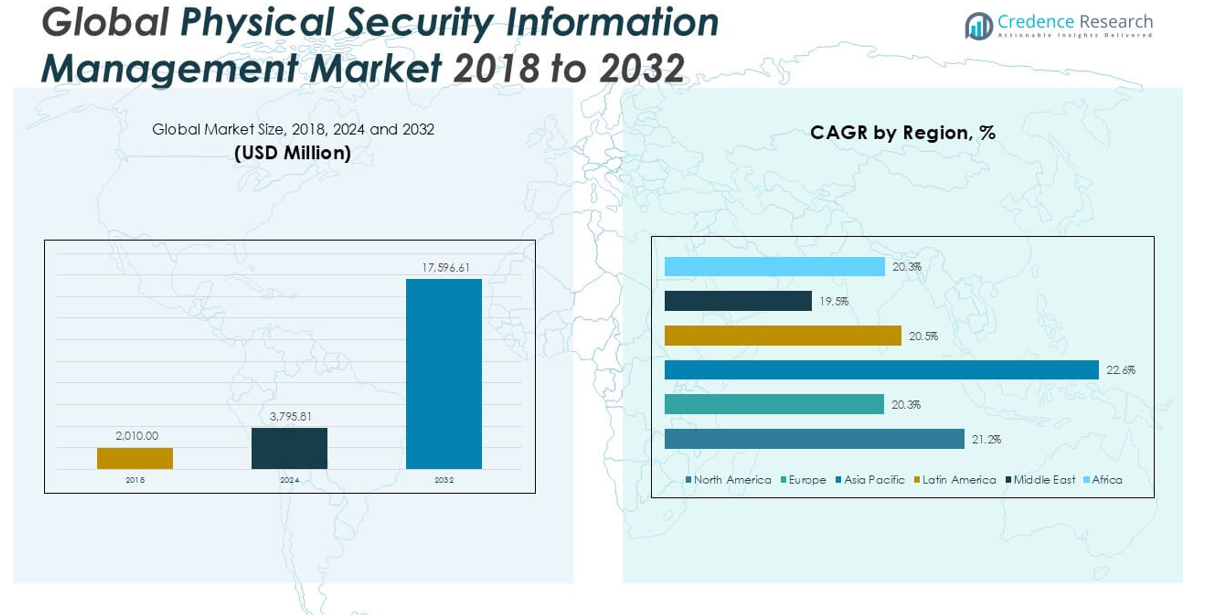
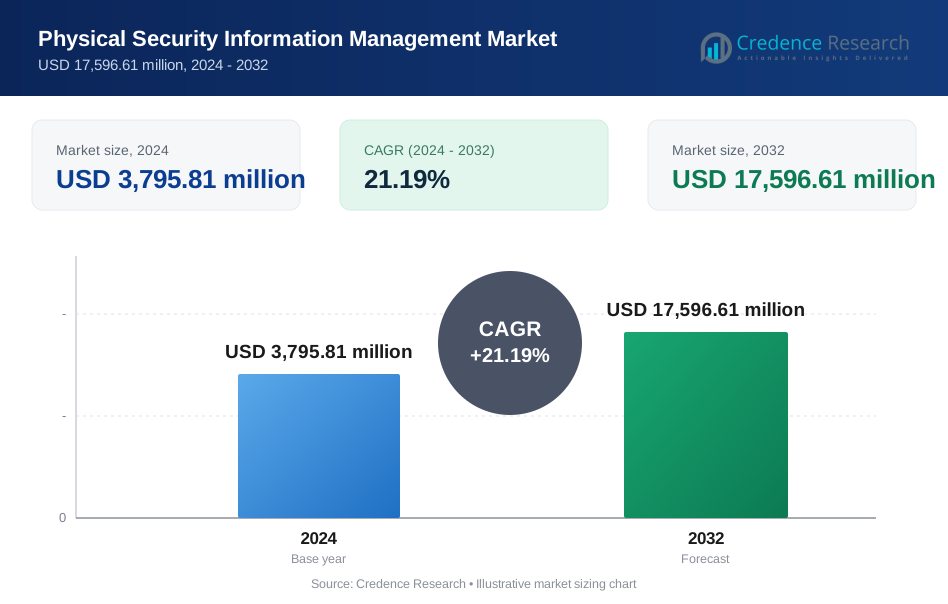
The Physical Security Information Management market size was valued at USD 2,010.00 million in 2018, increased to USD 3,795.81 million in 2024, and is anticipated to reach USD 17,596.61 million by 2032, growing at a CAGR of 21.19% during the forecast period.
| REPORT ATTRIBUTE | DETAILS |
|---|---|
| Historical Period | 2020-2023 |
| Base Year | 2024 |
| Forecast Period | 2025-2032 |
| Physical Security Information Management Market Size 2024 | USD 3,795.81 million |
| Physical Security Information Management Market, CAGR | 21.19% |
| Physical Security Information Management Market Size 2032 | USD 17,596.61 million |
The Physical Security Information Management (PSIM) market is led by prominent players such as Genetec Inc., Milestone Systems, Johnson Controls International plc, Honeywell International Inc., Cisco Systems, Inc., Avigilon (a Motorola Solutions company), Axis Communications, Bosch Security Systems, NEC Corp, and Seoul Semiconductor Co., Ltd. These companies maintain strong market positions through advanced software platforms, integrated security solutions, and strategic collaborations. North America emerged as the leading region in 2024, capturing approximately 35.4% of the global market share, driven by widespread adoption of PSIM technologies across government, transportation, and commercial sectors. The region’s emphasis on public safety, regulatory compliance, and critical infrastructure protection continues to support strong demand for PSIM solutions.
Market Insights
- The Physical Security Information Management (PSIM) market was valued at USD 3,795.81 million in 2024 and is projected to reach USD 17,596.61 million by 2032, growing at a CAGR of 21.19% during the forecast period.
- Rising demand for centralized security management systems across critical infrastructure, smart cities, and government facilities is a key driver fueling market growth globally.
- A significant trend is the growing integration of AI, video analytics, and cloud-based deployments, enabling real-time threat detection and smarter decision-making across organizations.
- The market is highly competitive, with major players including Genetec Inc., Honeywell, Cisco Systems, and Johnson Controls focusing on innovation, partnerships, and scalable platform offerings; however, high implementation costs and integration complexities remain key restraints.
- North America leads with a 35.4% share in 2024, followed by Europe at 24.6% and Asia Pacific at 24.7%; the software segment dominates by component, holding over 45% of the market share.
Market Segmentation Analysis:
By Component:
The software segment held the dominant share in the Physical Security Information Management (PSIM) market in 2024, accounting for over 45% of the total revenue. This growth is driven by increasing demand for integrated platforms that centralize control of multiple security systems and provide real-time situational awareness. Software solutions enable seamless data integration, analysis, and reporting across access control, video surveillance, and alarm systems. The rise of intelligent automation and AI-based analytics within PSIM platforms is further accelerating adoption. Hardware and services segments also show steady growth, supported by ongoing infrastructure upgrades and the need for maintenance and technical support.
- For instance, Genetec’s Security Center software unified over 5,000 security devices in a single deployment at the Port of Montreal, enabling consolidated monitoring and incident response.
By Application:
Among the application segments, the video management system emerged as the largest contributor, capturing more than 35% market share in 2024. This dominance is attributed to the widespread deployment of surveillance cameras and the growing need for centralized video monitoring and analytics. Organizations are prioritizing real-time threat detection and incident response, driving the integration of PSIM platforms with video systems. Access control systems and intrusion detection systems also exhibit strong growth, fueled by heightened security concerns in sensitive environments. Fire alarm and video analytics systems are gaining momentum, particularly in smart city and critical infrastructure projects that require proactive risk management.
- For instance, Milestone Systems’ XProtect VMS supported over 10,000 concurrent video streams at the Singapore Changi Airport, enabling high-availability monitoring and rapid forensic search capabilities.
By End-Use:
The government & public sector segment led the PSIM market in 2024, contributing approximately 30% to the overall market share. The segment’s growth is driven by increasing public safety initiatives, urban surveillance programs, and national security mandates. Governments are actively deploying PSIM solutions to enhance interoperability across multiple security infrastructures. Transportation and BFSI sectors are also major contributors, adopting PSIM systems for threat mitigation, compliance, and asset protection. Healthcare, education, and retail sectors are increasingly adopting these systems to improve operational safety, manage visitor access, and ensure regulatory adherence, contributing to a more diversified end-user landscape.
Market Overview
Rising Demand for Centralized Security Management
Organizations across sectors are increasingly adopting centralized platforms to manage dispersed security systems, fueling demand for Physical Security Information Management (PSIM) solutions. These systems integrate access control, surveillance, alarms, and analytics into a unified interface, offering real-time situational awareness and faster incident response. The growing complexity of security infrastructure, particularly in critical facilities and urban areas, necessitates consolidated management tools. As businesses aim to reduce operational silos and improve coordination among security teams, the preference for centralized PSIM platforms continues to grow steadily.
- For instance, Honeywell’s Pro-Watch Integrated Security Suite was deployed across 120 facilities for a global logistics provider, connecting over 15,000 sensors and cameras into a single management dashboard.
Expansion of Smart Cities and Critical Infrastructure Projects
The global focus on smart city development and the modernization of critical infrastructure is significantly boosting the PSIM market. Governments and urban planners are investing in integrated security technologies to ensure public safety, traffic regulation, and emergency response. PSIM systems provide the foundation for such integration, enabling interoperability across surveillance, communication, and control systems. Their ability to streamline command and control operations makes them ideal for transportation hubs, utilities, and public service infrastructure, thus creating robust demand in both developed and emerging economies.
- For instance, NEC Corporation’s PSIM platform was deployed in New Delhi’s Intelligent Traffic Management System project, integrating over 6,000 IP cameras and sensors across 25 high-traffic corridors.
Increased Security Threats and Regulatory Pressures
Escalating physical threats, terrorism risks, and unauthorized intrusions have driven organizations to adopt proactive security strategies. PSIM platforms enable preemptive identification and mitigation of such threats through real-time monitoring and automated alerts. In addition, stringent regulatory requirements related to safety compliance, especially in sectors like BFSI, healthcare, and government, are compelling enterprises to adopt integrated physical security frameworks. Compliance mandates are pushing businesses to enhance transparency, auditability, and resilience-capabilities that PSIM systems are designed to deliver efficiently.
Key Trends & Opportunities
Integration with AI and Advanced Analytics
A significant trend shaping the PSIM market is the integration of artificial intelligence and data analytics. AI-powered PSIM solutions offer predictive capabilities, facial recognition, behavior analysis, and anomaly detection, enhancing situational intelligence and decision-making. These technologies are transforming conventional PSIM platforms into intelligent ecosystems capable of autonomous incident response. As demand grows for smarter, faster, and more accurate threat detection, vendors are investing heavily in AI-driven features, creating opportunities for innovation and differentiation in the competitive landscape.
- For instance, Cisco integrated AI-based anomaly detection into its PSIM solution to analyze over 50 terabytes of video data per day for a Fortune 100 retail chain, enabling proactive loss prevention and fraud detection.
Shift Toward Cloud-Based Deployments
The shift from traditional on-premise models to cloud-based deployments is gaining traction in the PSIM market. Cloud-based PSIM solutions offer improved scalability, reduced infrastructure costs, and easier updates, making them attractive to both SMEs and large enterprises. The flexibility of remote access and centralized data management supports hybrid work environments and geographically dispersed operations. As cybersecurity measures become more robust, concerns about cloud security are diminishing, opening up new opportunities for cloud-native PSIM offerings across various industries.
- For instance, Johnson Controls’ OpenBlue platform managed cloud-based PSIM deployments across 800 educational institutions in the U.S., supporting over 22,000 users with real-time threat intelligence and remote access control.
Key Challenges
High Implementation and Integration Costs
One of the most significant challenges in the PSIM market is the high cost associated with implementation and integration. Deploying PSIM systems requires considerable investment in software, compatible hardware, and skilled personnel. For many mid-sized organizations, especially in price-sensitive markets, these upfront costs act as a major barrier. Additionally, integrating PSIM platforms with existing legacy systems often demands customization and consulting services, further increasing the total cost of ownership and delaying ROI realization.
Complexity in System Integration and Interoperability
Achieving seamless interoperability among diverse security systems remains a critical hurdle for PSIM deployment. Organizations often operate multiple devices and subsystems from different vendors, leading to integration challenges. Lack of standardized protocols and limited API support can hinder the creation of a unified platform. These complexities can result in inefficiencies, data silos, and increased vulnerability. Addressing this challenge requires strong collaboration between solution providers and end-users, along with the development of flexible, vendor-agnostic architectures.
Concerns Around Data Privacy and Cybersecurity
As PSIM systems collect and process sensitive security data, concerns around data privacy and cybersecurity have intensified. Breaches in centralized platforms could expose organizations to operational risks, legal liabilities, and reputational damage. Moreover, regulatory frameworks such as GDPR and industry-specific mandates require stringent data protection mechanisms. Vendors must invest in robust encryption, access controls, and compliance tools to address these concerns. Failure to ensure data security can hamper adoption and erode trust in PSIM technologies.
Regional Analysis
North America:
North America led the global Physical Security Information Management (PSIM) market in 2024, accounting for a dominant market share of approximately 35.4%, with a market size rising from USD 720.99 million in 2018 to USD 1,344.83 million. The region is projected to reach USD 6,213.19 million by 2032, growing at a CAGR of 21.2%. This growth is driven by high adoption of advanced security technologies, strong presence of PSIM vendors, and significant investment in smart city and critical infrastructure projects. The U.S. plays a leading role, with high regulatory emphasis on integrated security systems and public safety enhancement.
Europe:
Europe held a substantial market share of 24.6% in 2024, with the PSIM market expanding from USD 512.15 million in 2018 to USD 928.35 million. By 2032, the region is expected to reach USD 4,056.94 million, advancing at a CAGR of 20.3%. Market growth in Europe is supported by stringent security regulations, increased focus on surveillance infrastructure, and adoption of PSIM in transportation and public sector operations. Countries like Germany, the UK, and France are at the forefront, with investments in unified platforms to improve threat detection, response coordination, and compliance across industries.
Asia Pacific:
Asia Pacific is the fastest-growing region in the PSIM market, with a CAGR of 22.6% and a market share of approximately 24.7% in 2024. The regional market surged from USD 474.36 million in 2018 to USD 936.98 million, and is forecast to reach USD 4,767.25 million by 2032. Rapid urbanization, infrastructure development, and rising security concerns in countries like China, India, and Japan are driving demand. The expansion of smart cities, increasing cyber-physical integration, and government-backed public safety programs are encouraging widespread PSIM deployment across commercial, transportation, and public domains.
Latin America:
Latin America represented around 9.8% of the global PSIM market in 2024, with its size growing from USD 198.39 million in 2018 to USD 372.33 million. The market is projected to reach USD 1,646.51 million by 2032, registering a robust CAGR of 20.5%. Regional demand is influenced by increased investment in city surveillance, transportation safety, and crime prevention technologies. Countries such as Brazil and Mexico are actively embracing PSIM platforms to consolidate fragmented security systems and improve real-time monitoring and decision-making, particularly in urban hubs facing security and infrastructural challenges.
Middle East:
The Middle East accounted for 3.3% of the global PSIM market in 2024, with revenues increasing from USD 71.96 million in 2018 to USD 126.76 million. Expected to grow to USD 526.24 million by 2032, the market is progressing at a CAGR of 19.5%. Regional growth is fueled by large-scale infrastructure development, smart city initiatives (particularly in the UAE and Saudi Arabia), and a heightened focus on critical asset protection. Government efforts to enhance public security and integrate advanced surveillance with command-and-control centers are key drivers for PSIM system deployment across sectors.
Africa:
Africa held a market share of 2.3% in 2024, with the PSIM market expanding from USD 32.16 million in 2018 to USD 86.56 million. It is projected to grow to USD 386.48 million by 2032, recording a CAGR of 20.3%. Though currently a smaller market, Africa is witnessing gradual adoption of PSIM systems driven by increased urban development, investments in public safety infrastructure, and growing awareness of integrated security benefits. Countries like South Africa and Kenya are emerging as key markets, focusing on improving transportation security and critical infrastructure monitoring to combat rising crime rates and security threats.
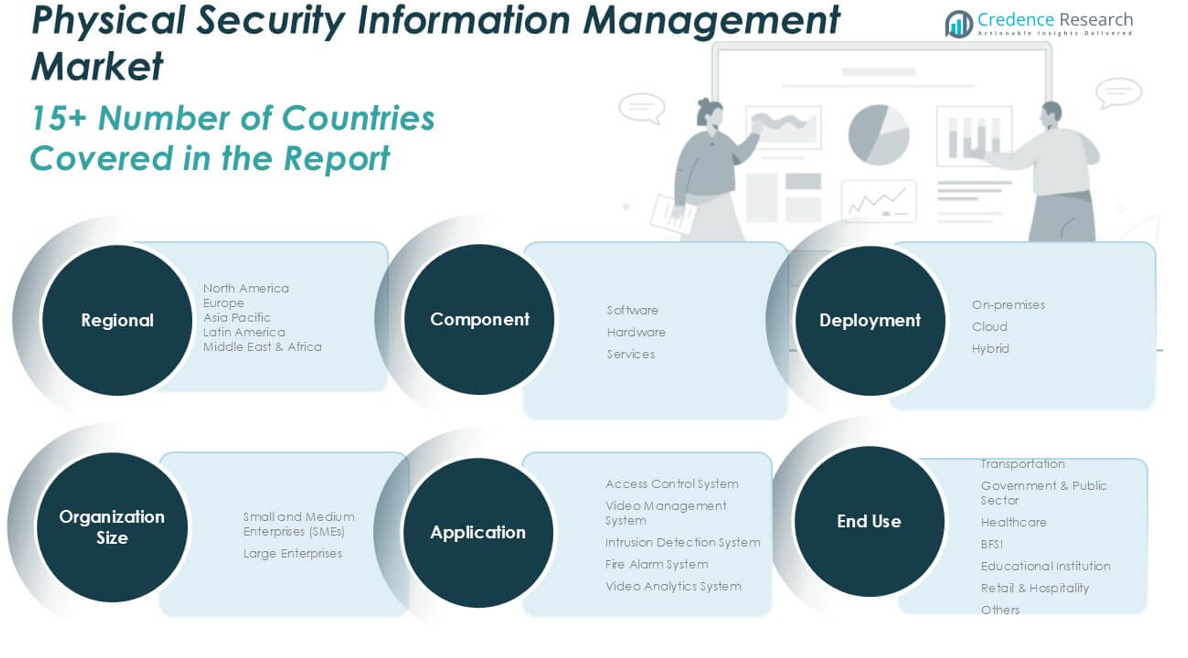
Market Segmentations:
By Component
- Software
- Hardware
- Services
By Application
- Access Control System
- Video Management System
- Intrusion Detection System
- Fire Alarm System
- Video Analytics System
By End-Use
- Transportation
- Government & Public Sector
- Healthcare
- BFSI (Banking, Financial Services, and Insurance)
- Educational Institution
- Retail & Hospitality
- Others
By Deployment
- On-premises
- Cloud
- Hybrid
By Organization Size
- Small and Medium Enterprises (SMEs)
- Large Enterprises
By Geography
- North America
- U.S.
- Canada
- Mexico
- Europe
- Germany
- France
- U.K.
- Italy
- Spain
- Rest of Europe
- Asia Pacific
- China
- Japan
- India
- South Korea
- South-east Asia
- Rest of Asia Pacific
- Latin America
- Brazil
- Argentina
- Rest of Latin America
- Middle East & Africa
- GCC Countries
- South Africa
- Rest of the Middle East and Africa
Competitive Landscape
The Physical Security Information Management (PSIM) market is highly competitive, characterized by the presence of both global technology giants and specialized security solution providers. Leading companies such as Genetec Inc., Milestone Systems, Honeywell International Inc., Johnson Controls International plc, and Cisco Systems, Inc. dominate the market with comprehensive portfolios offering integrated PSIM platforms, advanced analytics, and scalable deployments. These players focus on continuous innovation, strategic partnerships, and acquisitions to enhance their market position and expand geographic reach. Avigilon (a Motorola Solutions company), Axis Communications, and Bosch Security Systems are also notable contributors, leveraging their expertise in surveillance hardware and video analytics to offer end-to-end solutions. Additionally, companies like NEC Corp and Seoul Semiconductor Co., Ltd. are making inroads with technology integration and customized offerings for public and enterprise sectors. The market competition is driven by increasing demand for centralized security management, smart city projects, and the adoption of AI-powered, cloud-based PSIM solutions.
Key Player Analysis
- Genetec Inc.
- Milestone Systems
- Johnson Controls International plc
- Honeywell International Inc.
- Cisco Systems, Inc.
- Avigilon (a Motorola Solutions Company)
- Axis Communications
- Seoul Semiconductor Co., Ltd.
- Bosch Security Systems
- NEC Corp
Recent Developments
- In January 2025, Milestone, a major PSIM vendor, is expected to continue integrating AI and IoT capabilities into its video management and PSIM solutions. This includes enhancing real-time data analysis, centralized management, and cloud compatibility. Their focus aligns with industry trends towards greater interoperability and AI-driven automation, though no specific product announcements are mentioned in current public releases.
- In December 2024, Genetec reported a significant trend: growing demand for hybrid-cloud solutions in physical security. Organizations are increasingly seeking adaptable, open-architecture systems to avoid vendor lock-in and better manage evolving regulatory and operational requirements. This hybrid approach allows for a mix of on-premises and cloud-based solutions, providing flexibility and control over data and applications.
- In March 2024, Access Information Management, the world's largest privately held provider of integrated information management services, announced its acquisition of Triyam, a fast-growing software company specializing in data management solutions for healthcare organizations. This acquisition enables Access to rapidly expand its presence in the archival digital records management and electronic health records (EHR) markets, complementing its strong existing capabilities in records archiving and compliance management.
- In December 2023, Genetec announced a new version of its flagship unified security platform, Security Center, embracing a continuous delivery model for rapid innovation. Enhancements included new mapping features for smoother operator experiences in large deployments and simplified authentication setup, setting the stage for advanced workflow capabilities to streamline system management.
- In November 2023, Hikvision introduced HikCentral Professional 2.5, an upgraded integrated security management software. This release offers versatile add-on applications through the App Market, expanding functionalities for diverse business needs. The software enhances operational efficiency with simplified operations, user-friendly interfaces, and strong integration capabilities using OpenAPIs for seamless system integration and third-party device management.
- In March 2023, Advancis introduced WinGuard X5, a vendor-neutral PSIM software featuring a new core and advanced capabilities. Built on the Advancis Open Platform (AOP), it supports third-party development for customized interfaces and functions. This release empowered users to scale deployments flexibly and extend functionalities with modern APIs.
Market Concentration & Characteristics
The Physical Security Information Management Market exhibits moderate to high market concentration, with a few dominant players controlling a significant share of global revenues. Companies such as Genetec Inc., Honeywell International Inc., Cisco Systems, and Johnson Controls International plc lead through integrated platforms, advanced analytics, and strong global presence. It remains technology-driven, with vendors continuously improving interoperability, automation, and AI-based features to stay competitive. The market shows strong demand from sectors like government, transportation, and BFSI, where centralized control and real-time threat response are essential. Entry barriers remain high due to the complexity of system integration and the substantial initial investment required. Vendors focus on expanding cloud capabilities and enhancing cybersecurity features to meet evolving customer needs. The market also features regional variation in adoption, with North America and Asia Pacific showing faster growth due to smart city development and public safety initiatives. Price sensitivity in developing regions affects vendor strategies and deployment scale.
Report Coverage
The research report offers an in-depth analysis based on Component, Application, End-Use, Deployment, Organization Size and Geography. It details leading market players, providing an overview of their business, product offerings, investments, revenue streams, and key applications. Additionally, the report includes insights into the competitive environment, SWOT analysis, current market trends, as well as the primary drivers and constraints. Furthermore, it discusses various factors that have driven market expansion in recent years. The report also explores market dynamics, regulatory scenarios, and technological advancements that are shaping the industry. It assesses the impact of external factors and global economic changes on market growth. Lastly, it provides strategic recommendations for new entrants and established companies to navigate the complexities of the market.
Future Outlook
- The market will continue to expand rapidly due to increasing demand for centralized and integrated security management solutions.
- Cloud-based PSIM platforms will gain strong traction for their scalability, remote accessibility, and lower infrastructure costs.
- AI-powered analytics will play a larger role in enhancing incident detection, threat prediction, and response automation.
- Government and public sector investment in smart cities and critical infrastructure will remain a major growth driver.
- Interoperability between various security subsystems will become a key focus for vendors and end-users.
- Small and medium enterprises will adopt PSIM solutions as cloud and subscription-based models reduce entry barriers.
- Cybersecurity integration will grow in importance to protect centralized platforms from potential digital threats.
- Regions such as Asia Pacific and Latin America will experience accelerated adoption due to urban development and security modernization.
- Vendor competition will intensify, pushing innovation in user interface design, analytics, and mobile control features.
- Regulatory compliance and auditability will shape solution development, particularly in finance, healthcare, and public safety sectors.
Request a Free Sample
Fill in your details and we'll send you a free sample report.
- Sample data tables & charts
- Research methodology
Need a Custom Version of This Report?
Tailor the scope, geography, or segments to your exact requirements.
- Custom geography or segment scope
- Direct access to our analyst team
Frequently Asked Questions
What is the current size of the Physical Security Information Management market?
What factors are driving the growth of the Physical Security Information Management market?
What are the key segments within the Physical Security Information Management market?
What are some challenges faced by the Physical Security Information Management market?
Who are the major players in the Physical Security Information Management market?
Table of Content
Chapter 1. Report Introduction
- 1.1 Report Description & Purpose
- 1.1.1 Report Title & Market Definition
- 1.1.2 Unique Selling Propositions (USP) & Key Differentiators
- 1.1.3 Value Proposition for Stakeholders
- 1.2 Research Objectives
- 1.2.1 Market Sizing Objectives (Volume & Revenue) (Volume Where Applicable)
- 1.2.2 Segmentation Objectives
- 1.2.3 Competitive Intelligence Objectives
- 1.2.4 Forecast & Scenario Objectives
- 1.3 Report Scope
- 1.3.1 Physical Security Information Management Scope – Segments & Subsegments Covered
- 1.3.2 Geographic Scope – Regions & Countries Covered
- 1.3.3 Historical Period, Base Year & Forecast Period (2024; forecast to 2032)
- 1.3.4 Inclusions & Exclusions
- 1.4 Industry Classification & Applicable Codes
- 1.5 Currency, Measurement Units & Valuation Basis
- 1.6 Target Stakeholders
- 1.7 Limitations & Assumptions
Chapter 2. Executive Summary
- 2.1 Global Physical Security Information Management Market Snapshot
- 2.1.1 Market Size – Historical (2024) & Forecast (2024-2032) (2024: USD 3,795.81 million → 2032: USD 17,596.61 million)
- 2.1.2 Volume & Revenue – Global Totals (Volume Where Applicable)
- 2.1.3 Key Market Highlights – Top Five Facts
- 2.2 Physical Security Information Management Market Segmentation Snapshot
- 2.2.1 Market Split by Region – 2024 vs. 2032
- 2.3 Competitive Snapshot
- 2.3.1 Top 10 Players by Revenue Share – 2024
- 2.3.2 Top 10 Players by Volume Share – 2024 (Volume Where Applicable)
- 2.3.3 Recent Strategic Developments (18-Month Summary)
- 2.4 Key Investment Highlights & Strategic Conclusions
Chapter 3. Physical Security Information Management Market Dynamics & Industry Analysis
- 3.1 Market Overview & Context
- 3.1.1 Physical Security Information Management Market Position in the Broader Industry Value Chain
- 3.1.2 Demand Structure & Purchasing Dynamics
- 3.1.3 Market Maturity & Development Stage by Region
- 3.2 Physical Security Information Management Market Drivers
- 3.3 Physical Security Information Management Market Restraints & Challenges
- 3.4 Physical Security Information Management Market Opportunities
- 3.5 Porter's Five Forces Analysis
- 3.5.1 Threat of New Entrants
- 3.5.2 Bargaining Power of Suppliers
- 3.5.3 Bargaining Power of Buyers
- 3.5.4 Threat of Substitutes
- 3.5.5 Competitive Rivalry – Intensity Assessment
- 3.6 Physical Security Information Management Value Chain Analysis
- 3.6.1 Upstream – Key Inputs, Resources & Suppliers
- 3.6.1.1 Key Input/Resource 1
- 3.6.1.2 Key Input/Resource 2
- 3.6.1.3 Key Input/Resource 3
- 3.6.2 Midstream – Core Operations & Value Creation
- 3.6.2.1 Operating Model & Process Overview
- 3.6.2.2 Key Operating Locations & Capabilities by Company
- 3.6.3 Downstream – Market Channels & End Users
- 3.6.3.1 Direct Sales & Customer Engagement Channels
- 3.6.3.2 Indirect Sales, Intermediaries & Partner Channels
- 3.6.4 Value Chain Profitability Analysis
- 3.6.1 Upstream – Key Inputs, Resources & Suppliers
- 3.7 PESTEL Analysis
- 3.7.1 Political Factors
- 3.7.2 Economic Factors
- 3.7.3 Social Factors
- 3.7.4 Technological Factors
- 3.7.5 Environmental Factors
- 3.7.6 Legal Factors
- 3.8 Physical Security Information Management Supply Chain Analysis
- 3.8.1 Critical Input & Resource Availability Risk Assessment
- 3.8.2 Supplier & Operational Concentration Risk (Geographic Exposure)
- 3.8.3 Supply & Service Disruption Impact Analysis
- 3.9 Regulatory & Policy Landscape
Note: The regulatory and policy landscape section covers regulations based on their applicability to the market, Physical Security Information Management category, geography, and scope of the study. Only regulatory frameworks with a material impact on operations, compliance, trade, sustainability, or market access are analyzed in detail.
Chapter 4. Key Investment Pockets & Opportunity Analysis
- 4.1 Physical Security Information Management Market Attractiveness Analysis
- 4.1.1 By Region – Investment Attractiveness Matrix (Market Size × CAGR)
- 4.2 Absolute Revenue Growth Opportunity
- 4.2.1 By Region – Absolute Revenue Growth Through 2032
- 4.3 Incremental Demand Opportunity
- 4.3.1 By Region – Incremental Demand Through 2032
- 4.3.2 Segment – Incremental Demand
- 4.4 Emerging Submarket Opportunity Deep Dive (Subject to Applicability)
- 4.5 Priority Market Opportunity Scorecards
- 4.5.1 United States
- 4.5.2 Europe
- 4.5.3 Asia
- 4.5.4 Middle East & Africa
Note: Priority market opportunity scorecards reflect the geographic scope and strategic relevance of the study. Listed markets are indicative and may be adapted to the industry.
Chapter 5. Physical Security Information Management Cross-Border Trade & Market Access Analysis
- 5.1 International Trade & Cross-Border Activity Overview
- 5.1.1 Global Export Value by Country (2024)
- 5.1.2 Global Export Volume by Country (2024) (Volume Where Applicable)
- 5.1.3 Global Import Value by Country (2024)
- 5.1.4 Global Import Volume by Country (2024) (Volume Where Applicable)
- 5.1.5 Net Trade Balance by Country (2024)
- 5.2 Export Analysis – Segment
- 5.2.1 Category 1 (Applicable Classification Code)
- 5.2.2 Category 2 (Applicable Classification Code)
- 5.2.3 Category 3 (Applicable Classification Code)
- 5.2.4 Category 4 (Applicable Classification Code)
- 5.2.5 Category 5 (Applicable Classification Code)
- 5.3 Import Analysis – Segment
- 5.3.1 Category 1 (Applicable Classification Code)
- 5.3.2 Category 2 (Applicable Classification Code)
- 5.3.3 Category 3 (Applicable Classification Code)
- 5.3.4 Category 4 (Applicable Classification Code)
- 5.3.5 Category 5 (Applicable Classification Code)
- 5.4 Cross-Border Pricing & Transaction Benchmarks
- 5.4.1 Export Pricing – Segment & Country
- 5.4.2 Import Pricing – Segment & Source Country
- 5.4.3 Price Trends (2024)
- 5.5 Key Cross-Border Trade & Delivery Routes
- 5.5.1 Cross-Border Trade/Delivery Route 1
- 5.5.2 Cross-Border Trade/Delivery Route 2
- 5.5.3 Cross-Border Trade/Delivery Route 3
- 5.5.4 Cross-Border Trade/Delivery Route 4
- 5.5.5 Cross-Border Trade/Delivery Route 5
- 5.6 Trade Policy & Market Access Impact Assessment
- 5.6.1 Tariff & Non-Tariff Barriers
- 5.6.2 Regional Trade & Economic Integration Frameworks
- 5.6.3 Bilateral & Multilateral Trade Agreements
- 5.6.4 Cross-Border Operating, Licensing & Localization Requirements
Note: This chapter applies where cross-border trade or delivery is relevant to Physical Security Information Management. Goods, services, and digital offerings are assessed using applicable classifications and transaction measures. Import-export volumes, trade balances, and route analyses are included only where meaningful to the market.
Chapter 6. Competitive Landscape & Company Benchmarking
- 6.1 Physical Security Information Management Market Concentration & Structure
- 6.1.1 Herfindahl-Hirschman Index (HHI) – vs. 2024
- 6.1.2 Leading, Mid-Sized & Emerging Player Structure
- 6.1.3 Global, Regional & Local Player Dynamics
- 6.2 Physical Security Information Management Market Share Analysis – 2024
- 6.2.1 Global Revenue Share by Company
- 6.2.2 Global Volume Share by Company (Volume Where Applicable)
- 6.2.3 Regional Revenue Share
- 6.2.4 Market Share Evolution ( vs. 2024)
- 6.2.5 Company Market Share by Key Segment
- 6.2.6 Company Market Share by Customer Group
- 6.3 Operating Scale, Capacity & Infrastructure Analysis
- 6.3.1 Global Operating Scale & Supply Capacity
- 6.3.2 Resource Utilization & Operating Efficiency
- 6.3.3 Output, Service Delivery & Activity Metrics
- 6.3.4 Operating Footprint & Infrastructure Map
- 6.3.5 Planned Operational & Capacity Expansion
- 6.4 Physical Security Information Management Competitive Benchmarking Matrix
- 6.4.1 Revenue, Growth, Profitability & Operating Metric Comparison
- 6.4.2 Channel Revenue Mix
- 6.4.3 Geographic Revenue Exposure
- 6.4.4 R&D Intensity
- 6.4.5 Sustainability Maturity
- 6.5 Strategic Developments in Physical Security Information Management (Last 24 Months)
- 6.5.1 Mergers, Acquisitions & Divestments
- 6.5.2 New Products, Services & Solutions in Physical Security Information Management
- 6.5.3 Operational & Infrastructure Expansions
- 6.5.4 Strategic Alliances, Joint Ventures & Partnerships
- 6.5.5 Distribution Expansion & Market Entry
- 6.5.6 Sustainability & ESG Initiatives
- 6.6 Competitive Strategy Mapping
- 6.6.1 Leader, Challenger, Follower & Niche Classification
- 6.6.2 Pricing Strategy Comparison
- 6.6.3 Channel Strategy Matrix
Note: Strategic developments are included based on their materiality and the availability of reliable information.
Chapter 7. Global Physical Security Information Management Market – By Sales & Delivery Channel
- 7.1 Segment Overview
- 7.1.1 Volume & Revenue Split by Channel (2024 & 2032) (Volume Where Applicable)
- 7.1.2 Channel Mix Evolution (2024-2032)
Chapter 8. Regional Market Analysis – Global Overview
- 8.1 Global Regional Overview
- 8.1.1 Regional Volume Share (Volume Where Applicable)
- 8.1.2 Regional Revenue Share
- 8.1.3 Regional Volume by Region (Volume Where Applicable)
- 8.1.4 Regional Revenue by Region
- 8.1.5 Regional Forecast Through 2032
- 8.2 Cross-Regional Segment Analysis
- 8.2.1 By Sales & Delivery Channel
- 8.2.2 By Competitive Positioning & Price Tier
Chapter 9. North America Physical Security Information Management Market
- 9.1 United States
- 9.2 Canada
- 9.3 Mexico
Chapter 10. Europe Physical Security Information Management Market
- 10.1 Germany
- 10.2 France
- 10.3 Italy
- 10.4 United Kingdom
- 10.5 Spain
- 10.6 Poland
- 10.7 Russia
- 10.8 Netherlands
- 10.9 Belgium
- 10.10 Sweden
- 10.11 Denmark
- 10.12 Norway
- 10.13 Rest of Europe
Chapter 11. Asia Pacific Physical Security Information Management Market
- 11.1 China
- 11.2 India
- 11.3 Japan
- 11.4 South Korea
- 11.5 Thailand
- 11.6 Indonesia
- 11.7 Vietnam
- 11.8 Malaysia
- 11.9 Australia
- 11.10 Rest of Asia Pacific
Chapter 12. Latin America Physical Security Information Management Market
- 12.1 Brazil
- 12.2 Argentina
- 12.3 Colombia
- 12.4 Chile
- 12.5 Rest of Latin America
Chapter 13. Middle East Physical Security Information Management Market
- 13.1 Saudi Arabia
- 13.2 United Arab Emirates
- 13.3 Turkey
- 13.4 Israel
- 13.5 Iran
- 13.6 Rest of the Middle East
Chapter 14. Africa Physical Security Information Management Market
- 14.1 South Africa
- 14.2 Egypt
- 14.3 Nigeria
- 14.4 Morocco
- 14.5 Rest of Africa
Chapter 15. Physical Security Information Management Company Profiles
- 15.1 [Company 01]
- 15.1.1 Company Overview
- 15.1.2 Key Management Personnel
- 15.1.3 Products & Services Portfolio
- 15.1.4 Financial Performance
- 15.1.5 Key Market Focus & Geographic Presence
- 15.1.6 Recent Developments & Strategic Initiatives
Note: The company profile list is preliminary and may change based on research findings, market developments, data availability, and client requirements.
Chapter 16. Appendices
- Appendix A – List of Abbreviations & Acronyms
- Appendix B – Industry Classification Code Reference – Full Series
- Appendix C – Supply, Output & Operating Capacity Data Tables
- Appendix D – End-Use & Demand Base Tables
- Appendix E – Demand, Adoption & Usage Assumptions
- Appendix F – Pricing & Revenue Metric Reference Tables
- Appendix G – Company Operations & Infrastructure Database
- Appendix H – Cross-Border Trade & Activity Data Tables (Where Applicable)
- Appendix I – Regulatory Summary Tables
- Appendix J – Primary Research Participant List (Anonymized)
- Appendix K – Primary Research Questionnaire Framework
- Appendix L – Data Sources & Bibliography
- Appendix M – Market Size Divergence & Source Comparison
Chapter 17. Research Methodology
- 17.1 Research Framework & Philosophy
- 17.2 Secondary Research – Sources, Hierarchy & Data Extraction
- 17.3 Data Modeling – Bottom-Up & Top-Down Market Sizing
- 17.4 Primary Research – Stakeholder Framework, LOI & Sample Sizes
- 17.5 Forecast Methodology – Regression, Scenario & Sensitivity Analysis
- 17.6 Quality Control – Four-Layer Validation Framework
- 17.7 Limitations & Standard Assumptions
- 17.8 Disclaimer
