
Market Overview:
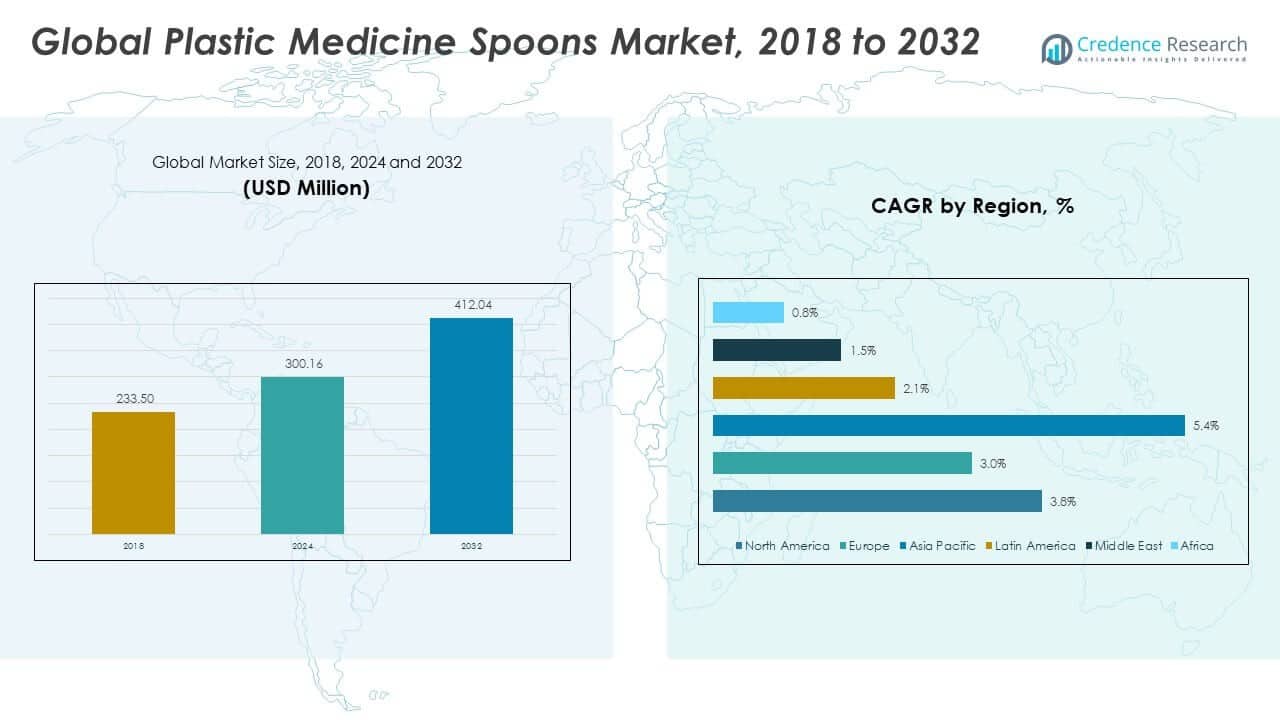
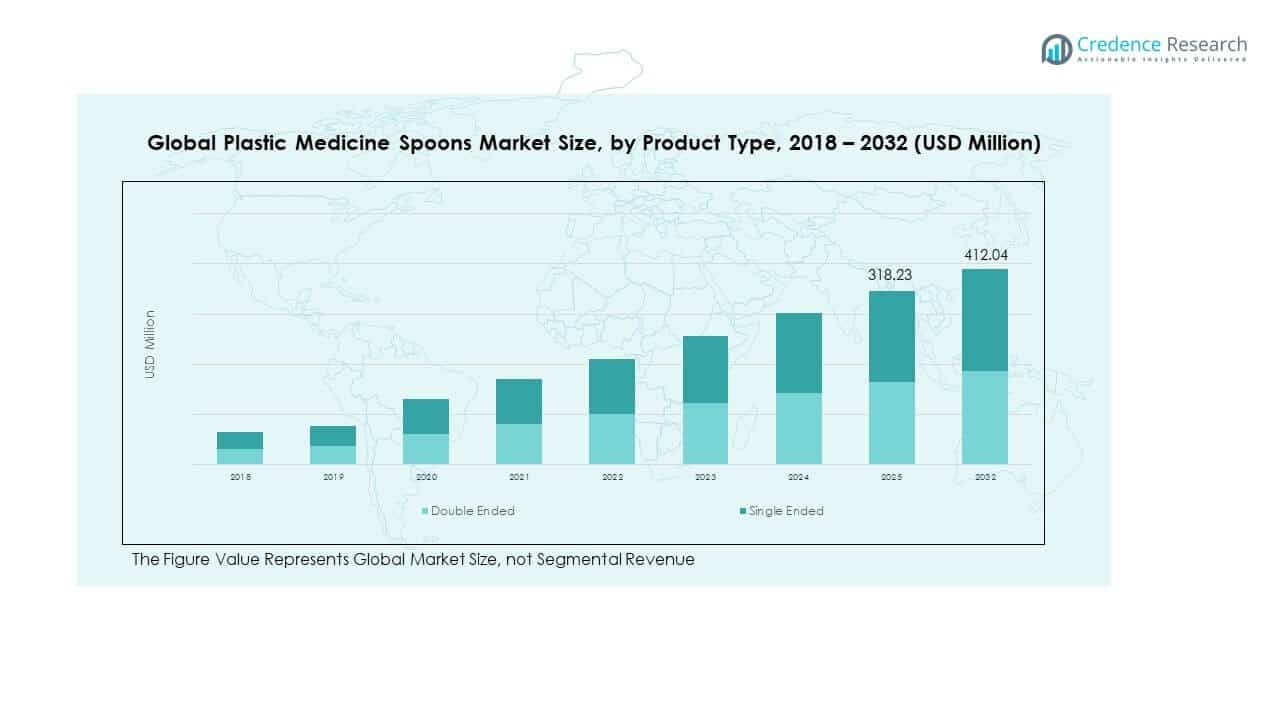
The Global Plastic Medicine Spoons Market size was valued at USD 233.50 million in 2018 to USD 300.16 million in 2024 and is anticipated to reach USD 412.04 million by 2032, at a CAGR of 3.76% during the forecast period.
| REPORT ATTRIBUTE | DETAILS |
|---|---|
| Historical Period | 2020-2023 |
| Base Year | 2024 |
| Forecast Period | 2025-2032 |
| Plastic Medicine Spoons Market Size 2024 | USD 300.16 Million |
| Plastic Medicine Spoons Market, CAGR | 3.76% |
| Plastic Medicine Spoons Market Size 2032 | USD 412.04 Million |
The market growth is driven by the expanding pharmaceutical and healthcare industries that require accurate liquid medication measurement tools. Rising use of liquid formulations, particularly in pediatric and geriatric care, strengthens demand for calibrated plastic spoons. Manufacturers focus on product precision, durability, and regulatory compliance to ensure safe dosing. Increasing awareness of hygiene and single-use packaging further supports adoption. Continuous innovation in injection molding and eco-friendly materials enhances product quality and sustainability.
Regionally, North America leads the Global Plastic Medicine Spoons Market due to strong pharmaceutical manufacturing and advanced packaging standards. Europe follows with a well-regulated healthcare ecosystem and emphasis on safety compliance. Asia Pacific shows the fastest growth, supported by rising medicine consumption, expanding retail pharmacy networks, and cost-effective local production. Latin America, the Middle East, and Africa show steady adoption as healthcare infrastructure develops and awareness of precise dosing practices grows.
Market Insights:
- The Global Plastic Medicine Spoons Market was valued at USD 233.50 million in 2018, reached USD 300.16 million in 2024, and is projected to hit USD 412.04 million by 2032, growing at a CAGR of 3.76%.
- North America leads with around 37% share, supported by strong pharmaceutical production, advanced packaging systems, and strict regulatory standards ensuring dosing accuracy.
- Europe and Asia Pacific follow with 23% and 26% shares respectively; Europe benefits from robust healthcare infrastructure, while Asia Pacific’s fast growth stems from large-scale drug manufacturing and affordable local production.
- Asia Pacific is the fastest-growing region, driven by rising demand for affordable healthcare solutions, expanding retail pharmacy presence, and low-cost manufacturing efficiency.
- By product type, Double Ended spoons account for nearly 58%, while Single Ended spoons hold around 42%, reflecting user preference for multifunctional and cost-effective dosing solutions.
Market Drivers
Rising Demand for Accurate Dosage Tools Across Healthcare and Home Settings
The Global Plastic Medicine Spoons Market grows due to the need for precision in liquid medication measurement. Hospitals, pharmacies, and home users prefer spoons with accurate calibration to ensure safe dosing. Increasing cases of chronic and pediatric diseases push demand for standardized measuring tools. Pharmaceutical firms use these spoons for syrup and suspension packaging to ensure user safety. It supports medication adherence, particularly in children and elderly patients. Growth in over-the-counter liquid formulations enhances their use. Manufacturers invest in ergonomic and durable designs to meet clinical standards. Awareness campaigns by health authorities strengthen adoption rates worldwide.
- For example, Splice‑Cast Ltd offers CE-marked plastic medicine spoons for dosing liquids and powders, and its website confirms manufacturing under ISO 13485 accreditation.
Expansion of Pharmaceutical Manufacturing and Packaging Activities
Rising pharmaceutical output drives large-scale adoption of plastic measuring spoons in packaging lines. Global producers of cough syrups, antibiotics, and supplements use spoons to meet labeling compliance. The expansion of contract manufacturing firms supports continuous production cycles that include dosing aids. It allows drug manufacturers to maintain standard volume accuracy across units. Increased government focus on dosage transparency improves packaging practices. Pharmaceutical packaging firms integrate sustainable polymers to align with global recycling goals. Growth in personalized medicines also increases demand for precise measuring accessories. The rising availability of low-cost production units strengthens competitive supply chains.
- For example, Origin Pharma Packaging lists single-ended and double‐ended plastic medicine spoons (5 ml and 2.5/5 ml) for hospital and packaging use.
Growing Emphasis on Patient Safety and Dosing Compliance
Healthcare systems promote the use of calibrated spoons to reduce medication errors. Accurate measurement reduces under- or overdosing, improving treatment outcomes. The Global Plastic Medicine Spoons Market benefits from regulations that encourage dose-specific packaging. It aligns with pediatric and geriatric care programs emphasizing self-administration safety. Training initiatives in hospitals and retail pharmacies support correct usage habits. Packaging manufacturers incorporate easy-read markings for better user experience. Technological improvements in injection molding ensure consistent calibration accuracy. The integration of patient-centric designs helps increase compliance across all demographics.
Rising Adoption in Emerging Economies and Expansion of Retail Distribution Channels
Emerging economies adopt plastic medicine spoons with expanding healthcare access and drug availability. Retail pharmacies and e-commerce platforms distribute affordable dosing tools to rural users. It supports liquid drug consumption in growing generic medicine markets. Increasing awareness of hygiene and dosing safety encourages disposable spoon use. Low production cost and flexible design customization enhance product appeal. Manufacturers introduce color-coded options for distinct dose levels. Domestic producers in India, China, and Southeast Asia strengthen global supply networks. Expanding retail and healthcare infrastructure accelerates overall market penetration.
Market Trends
Shift Toward Eco-Friendly and Recyclable Plastic Materials
Sustainability trends influence the Global Plastic Medicine Spoons Market, encouraging producers to use biodegradable polymers. Companies adopt polypropylene and PET variants with lower environmental impact. It aligns with international packaging directives favoring eco-safe materials. Brand owners promote spoons with minimal plastic content to reduce waste. Research on compostable resins drives innovation in design and lifecycle management. Some firms introduce hybrid materials combining renewable fillers with plastics. Manufacturers explore closed-loop recycling systems to reuse production waste. Consumer demand for sustainable healthcare packaging strengthens green product adoption.
Integration of Advanced Manufacturing and Quality Control Technologies
Automation and precision molding redefine the production of plastic medicine spoons. Advanced injection systems improve accuracy and consistency in scale markings. The Global Plastic Medicine Spoons Market benefits from automated quality inspection tools. It enhances manufacturing throughput while minimizing defects. Artificial intelligence-based monitoring systems detect weight and calibration variance. 3D-printing technology assists prototype development for new designs. Manufacturers adopt laser-etching for permanent dose markings resistant to wear. Integration of robotics streamlines packaging and inspection across production facilities.
- For instance, ENGEL, a leader in injection molding technology, integrates AI-driven process optimization that enables precision molding with part dimensional tolerances below 0.01 mm, while automated inspection solutions from companies like Cognex improve defect detection rates by over 20% in healthcare manufacturing lines, enhancing consistency and throughput.
Rise in Private-Label and Customized Spoon Designs by Pharmaceutical Brands
Pharmaceutical companies introduce branded spoons with distinct markings and shapes for identity and trust. Custom designs help improve user engagement and patient recall. It supports compliance programs where specific dose visuals improve user understanding. Contract manufacturers offer color and shape customization to meet branding goals. The Global Plastic Medicine Spoons Market witnesses growing partnerships between drug firms and packaging suppliers. Innovative printing techniques allow multi-color scales for easy dosage tracking. Brand differentiation through packaging accessories drives long-term loyalty. Flexible molds enable varied capacity production aligned with formulation needs.
Growth of Online Retail Channels and Direct-to-Consumer Distribution
E-commerce platforms boost accessibility for dosing tools across consumer segments. It helps small clinics and households source low-volume packs at competitive prices. Online marketplaces enable manufacturers to promote product variety globally. The Global Plastic Medicine Spoons Market gains traction through bulk e-retail supply programs. Digital catalogs highlight product specifications and certifications, raising transparency. Online feedback loops guide improvements in durability and marking visibility. Increasing internet penetration supports broader adoption in developing regions. Expanding distribution partnerships enhance supply reliability and visibility across markets.
- For instance, Medline Industries expanded its direct-to-consumer e-commerce platform in 2024, reporting a 35% increase in online sales of medical accessories, including dosing spoons, while platforms such as Amazon Business improved healthcare product traceability via enhanced certification display and verified supplier ratings, facilitating transparent, global online procurement.
Market Challenges Analysis
Environmental Concerns and Rising Regulations on Plastic Waste
Stringent environmental policies create hurdles for producers in managing waste and recycling compliance. Single-use plastic bans in multiple regions challenge manufacturers to find alternatives. The Global Plastic Medicine Spoons Market faces scrutiny over polymer type and recyclability. It pushes firms to invest in R&D for biodegradable materials, raising production cost. Transition toward eco-friendly resins slows supply availability in cost-sensitive regions. Disposal issues from medical waste collection intensify sustainability pressures. Small manufacturers struggle to align with global packaging standards. Regulatory differences across countries complicate uniform compliance and supply management.
Supply Chain Volatility and Pricing Pressure from Raw Materials
Fluctuation in resin prices directly impacts production margins and pricing strategies. It challenges consistent cost control among small-scale producers and exporters. The Global Plastic Medicine Spoons Market witnesses delays from logistic constraints and import duties. It affects timely order fulfillment for pharmaceutical clients. Rising competition increases pressure on profit margins, limiting innovation budgets. Supply chain disruptions from regional trade issues hinder raw material access. Manufacturers must maintain consistent quality under tight cost frameworks. Dependence on limited polymer suppliers heightens vulnerability during demand surges.
Market Opportunities
Expansion of Biodegradable Product Lines and Sustainable Partnerships
Growing focus on environmental sustainability opens new growth avenues for market players. Firms exploring plant-based or biodegradable plastics can secure long-term supply contracts. The Global Plastic Medicine Spoons Market benefits from collaborations with eco-packaging innovators. It creates space for differentiation through certified green labeling. Governments support projects promoting recyclable materials in healthcare packaging. Emerging startups develop reusable measuring tools suitable for clinical environments. Increased funding in sustainable material R&D encourages product diversification.
Rising Pharmaceutical Output and Expansion in Developing Economies
Rapid expansion of pharmaceutical industries in Asia-Pacific, Latin America, and Africa creates strong prospects. Manufacturers offering affordable yet compliant dosing tools gain contracts with global drug suppliers. The Global Plastic Medicine Spoons Market benefits from infrastructure development supporting medicine accessibility. It aligns with government programs emphasizing safe and standardized drug dispensing. Growth in pediatric and geriatric patient populations sustains recurring demand. Partnerships with public health organizations enhance visibility and export potential. Emerging producers gain access to wider export routes through digital trade channels.
Market Segmentation Analysis:
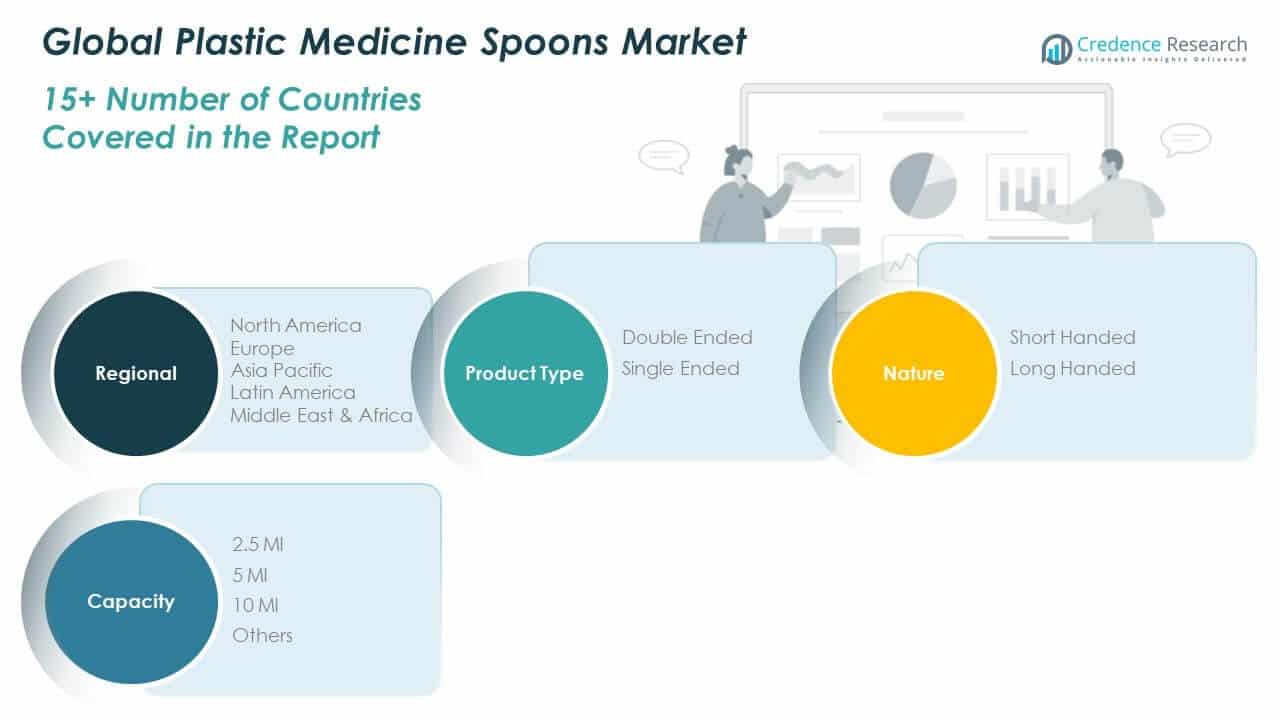
The Global Plastic Medicine Spoons Market is segmented by product type, nature, and capacity to understand demand patterns across user groups.
By product type, double-ended spoons hold a larger share due to their versatility in measuring multiple doses with a single unit. Single-ended spoons remain widely used in household and retail applications where simplicity and cost efficiency are preferred. Manufacturers focus on accurate calibration and sturdy design to meet pharmaceutical packaging standards. It continues to attract packaging firms aiming for precision and consumer convenience.
By nature, short-handed spoons dominate due to their compact form suitable for bottles and travel-size medicine containers. Long-handed spoons gain traction in hospital and pediatric applications that require deeper reach and easy grip. The balance between functionality and comfort drives steady adoption in both categories. Product differentiation through ergonomic design and material quality supports brand competitiveness.
- For example, Shako Plastick offers two-sided (double-ended) flat measuring spoons in 2.5 ml and 5 ml capacities oriented toward pharmaceutical application.
By capacity, 5 ml spoons remain the most used format aligned with standard prescription dosages. The 2.5 ml variant finds application in pediatric and micro-dose formulations. The 10 ml and other customized sizes cater to syrups and nutraceuticals with varied concentration levels. It helps packaging companies offer complete dosage solutions to pharmaceutical clients. Growing demand for multi-capacity packaging strengthens market opportunities for global manufacturers.
- For example, Neelkanth Polymer Industries manufactures 5 ml and 10 ml measuring spoons with capacity markings such as 2.5 ml/5.0 ml/10.0 ml for pharma packaging.
Segmentation:
By Product Type
- Double Ended
- Single Ended
By Nature
- Short Handed
- Long Handed
By Capacity
- 2.5 ml
- 5 ml
- 10 ml
- Others
By Region
- North America
- U.S.
- Canada
- Mexico
- Europe
- Germany
- France
- U.K.
- Italy
- Spain
- Rest of Europe
- Asia Pacific
- China
- Japan
- India
- South Korea
- South-east Asia
- Rest of Asia Pacific
- Latin America
- Brazil
- Argentina
- Rest of Latin America
- Middle East & Africa
- GCC Countries
- South Africa
- Rest of the Middle East and Africa
Regional Analysis:
North America
The North America Global Plastic Medicine Spoons Market size was valued at USD 103.26 million in 2018 to USD 131.38 million in 2024 and is anticipated to reach USD 180.85 million by 2032, at a CAGR of 3.8% during the forecast period. North America accounts for around 37% of the global share, supported by strong pharmaceutical packaging infrastructure and advanced healthcare systems. The region maintains steady demand from hospitals, retail pharmacies, and contract packaging firms. It benefits from strict regulatory standards promoting accurate dosing tools for liquid medicines. The U.S. leads due to large drug production volumes and wide access to over-the-counter medications. Canada and Mexico contribute through expanding generic drug markets. Leading packaging companies invest in precision molding and eco-friendly polymers to comply with sustainability goals. It maintains dominance through continuous technological innovation and product diversification.
Europe
The Europe Global Plastic Medicine Spoons Market size was valued at USD 66.84 million in 2018 to USD 82.85 million in 2024 and is anticipated to reach USD 107.13 million by 2032, at a CAGR of 3.0% during the forecast period. Europe holds nearly 23% of the total market share, driven by strong pharmaceutical exports and stringent drug packaging standards. Countries such as Germany, the U.K., and France emphasize precision in dosage tools for patient safety. It benefits from advanced manufacturing facilities and consistent investment in polymer research. European producers focus on recyclable plastic spoons to align with regional green packaging laws. Demand from hospital pharmacies and clinical facilities remains consistent. The presence of global pharmaceutical packaging leaders enhances competitiveness. Product standardization across EU nations strengthens cross-border trade of medical packaging accessories.
Asia Pacific
The Asia Pacific Global Plastic Medicine Spoons Market size was valued at USD 42.86 million in 2018 to USD 59.94 million in 2024 and is anticipated to reach USD 93.67 million by 2032, at a CAGR of 5.4% during the forecast period. Asia Pacific represents about 26% of the global market share, making it the fastest-growing region. Rising pharmaceutical production in China and India fuels large-scale use of dosing spoons. It benefits from a growing population base and increasing access to affordable medicines. Expanding retail pharmacy networks and healthcare reforms promote liquid dosage packaging. Japan and South Korea support growth through precision manufacturing and export-oriented supply chains. Domestic manufacturers produce cost-effective spoons that meet global quality benchmarks. Continuous investment in molding automation strengthens regional supply capacity.
Latin America
The Latin America Global Plastic Medicine Spoons Market size was valued at USD 10.56 million in 2018 to USD 13.40 million in 2024 and is anticipated to reach USD 16.19 million by 2032, at a CAGR of 2.1% during the forecast period. Latin America contributes around 5% of the total market share. Demand is supported by pharmaceutical expansion in Brazil, Argentina, and Chile. It benefits from improving access to healthcare and the rise of over-the-counter liquid drugs. Local packaging manufacturers increase output to meet hospital and retail supply needs. Import partnerships with U.S. and European producers support quality compliance. Growing consumer awareness of accurate dosing methods encourages the use of calibrated spoons. Government initiatives promoting safe pediatric formulations sustain market growth. It continues to gain traction in secondary packaging contracts for liquid pharmaceuticals.
Middle East
The Middle East Global Plastic Medicine Spoons Market size was valued at USD 6.36 million in 2018 to USD 7.45 million in 2024 and is anticipated to reach USD 8.58 million by 2032, at a CAGR of 1.5% during the forecast period. The region holds about 4% of global revenue share, driven by expanding hospital infrastructure and pharmaceutical imports. Gulf countries invest in healthcare modernization that supports improved drug dispensing tools. It benefits from growing awareness of dose precision among clinicians. Packaging distributors focus on importing standardized spoons for hospital and retail use. Domestic manufacturing remains limited, though interest in local molding facilities is increasing. Regulatory reforms encourage the adoption of safer packaging components. Partnerships with European suppliers strengthen product availability across GCC nations.
Africa
The Africa Global Plastic Medicine Spoons Market size was valued at USD 3.62 million in 2018 to USD 5.14 million in 2024 and is anticipated to reach USD 5.62 million by 2032, at a CAGR of 0.8% during the forecast period. Africa accounts for nearly 2% of the global share, reflecting gradual adoption of modern dosing tools. The market benefits from ongoing healthcare development programs and pharmaceutical import growth. South Africa leads in local packaging integration due to established manufacturing capacity. It faces challenges in raw material costs and limited automation infrastructure. Government healthcare initiatives improve accessibility of safe dosing equipment. International aid programs and NGO-driven health campaigns promote proper medication measurement practices. Increased focus on quality packaging supports future growth in the region.
Key Player Analysis:
- Origin Pharma Packaging
- Lab Pro Inc.
- Modern Plasmold
- Falit Plastics Private Limited
- Shako Plastick
- Splice-Cast Ltd
- D. Mould & Industries
Competitive Analysis:
The market displays a moderately consolidated structure, where a handful of established firms hold a significant share and many regional players compete on cost and customization. Top-tier companies focus investments in high-precision plastic molds, pharmaceutical-grade materials, and supply-chain extensions to maintain their lead. It drives strategic partnerships with drug manufacturers seeking branded dosing tools and regulatory compliance. Mid-tier players differentiate through regional cost advantage, niche designs (such as biodegradable spoons), and packaging line flexibility. Smaller or local producers compete by offering rapid lead-time, region-specific formats, and competitive pricing. Competitive pressure forces all participants to enhance calibration accuracy, quality certifications, and sustainability credentials. Strategic developments such as product launches, regional manufacturing expansions and acquisitions mark the competitive dynamics. It creates an environment where scalability, technology adoption and regulatory alignment determine winners.
Recent Developments:
- In November 2025, Zydus Lifesciences and SIG signed an agreement to launch India’s first single-serve spouted pouches for liquid cough and cold medications. The packaging solution integrates SIG’s StrawCap 30 Linked tethered spout and Motion Servo 3.2 filling machine, delivering precise 5 ml and 10 ml doses.
Report Coverage:
The research report offers an in-depth analysis based on product type, nature, and capacity. It details leading market players, providing an overview of their business, product offerings, investments, revenue streams, and key applications. Additionally, the report includes insights into the competitive environment, SWOT analysis, current market trends, as well as the primary drivers and constraints. Furthermore, it discusses various factors that have driven market expansion in recent years. The report also explores market dynamics, regulatory scenarios, and technological advancements that are shaping the industry. It assesses the impact of external factors and global economic changes on market growth. Lastly, it provides strategic recommendations for new entrants and established companies to navigate the complexities of the market.
Future Outlook:
- Demand for accurate dosing tools will continue rising with expanding pharmaceutical and healthcare sectors.
- Manufacturers will invest in sustainable polymer alternatives to address environmental regulations and waste management.
- Automation in injection molding and quality inspection will enhance output efficiency and product precision.
- Pharmaceutical packaging integration will expand as firms prefer pre-calibrated spoons for liquid formulations.
- Growth in pediatric and geriatric medication consumption will strengthen long-term market stability.
- Regional manufacturing expansion in Asia Pacific will lower production costs and improve global supply reliability.
- Strategic partnerships between packaging companies and drug producers will accelerate innovation in spoon design.
- Increased healthcare spending and improved access to over-the-counter medicines will sustain retail demand.
- Digital distribution platforms and e-commerce channels will support higher consumer reach for dosing tools.
- Standardization of dosage compliance rules across regions will create new opportunities for certified manufacturers.

Request a Free Sample
Fill in your details and we'll send you a free sample report.
- Sample data tables & charts
- Research methodology
Market Dynamics
Expansion of Pharmaceutical and Healthcare Sectors
The growing pharmaceutical and healthcare industries require accurate liquid medication measurement tools, driving demand for plastic medicine spoons in both clinical and home settings.
Rising Use of Liquid Formulations in Pediatric and Geriatric Care
Increasing prevalence of chronic and pediatric diseases, along with a shift toward liquid medications for children and elderly patients, boosts the need for calibrated dosing spoons to ensure safe and precise administration.
Focus on Product Precision, Durability, and Regulatory Compliance
Manufacturers are investing in advanced molding technologies and quality control to meet strict regulatory standards, ensuring dosing accuracy and patient safety, which in turn increases adoption among pharmaceutical companies.
Growth of Retail Pharmacy Networks and E-commerce Channels
Expanding retail pharmacy presence and the rise of online distribution platforms make plastic medicine spoons more accessible to consumers, supporting market penetration in both developed and emerging economies.
Shift Toward Eco-Friendly and Single-Use Packaging
Increasing awareness of hygiene and environmental sustainability is driving innovation in biodegradable and recyclable plastic spoons, aligning with global packaging trends and regulatory requirements.
Need a Custom Version of This Report?
Tailor the scope, geography, or segments to your exact requirements.
- Custom geography or segment scope
- Direct access to our analyst team
Frequently Asked Questions
What is the current market size for Global Plastic Medicine Spoons Market, and what is its projected size in 2032?
At what Compound Annual Growth Rate is the Global Plastic Medicine Spoons Market projected to grow between 2024 and 2032?
Which Global Plastic Medicine Spoons Market segment held the largest share in 2024?
What are the primary factors fueling the growth of the Global Plastic Medicine Spoons Market?
Who are the leading companies in the Global Plastic Medicine Spoons Market?
Which region commanded the largest share of the Global Plastic Medicine Spoons Market in 2024?
Table of Content
Chapter 1 Market Segmentation
- 1.1 Segmentation Framework
- 1.1.1 Product and Service Classification
- 1.1.2 Application and End-Use Classification
- 1.1.3 Technology and Solution Classification
- 1.1.4 Customer and Distribution Channel Classification
- 1.1.5 Geographic Segmentation
- 1.1.6 Market Segment Definitions and Boundaries
- 1.2 By Nature
- 1.2.1 Short Handed
- 1.2.2 Long Handed
- 1.3 By Capacity
- 1.3.1 2.5 ml
- 1.3.2 5 ml
- 1.3.3 10 ml
- 1.3.4 Others
- 1.4 By Product Type
- 1.4.1 Double Ended
- 1.4.2 Single Ended
Chapter 2 Introduction
- 2.1 Report Objectives and Scope
- 2.2 Product Definition and Industry Terminology
- 2.3 Market Inclusions and Exclusions
- 2.4 Research Process
- 2.4.1 Primary Research and Expert Interviews
- 2.4.2 Secondary Research and Source Review
- 2.4.3 Top-Down and Bottom-Up Estimation
- 2.4.4 Data Triangulation and Verification
- 2.5 Market Size Measurement Basis
- 2.5.1 2024: USD 300.16 million → 2032: USD 412.04 million
- 2.6 Historical and Forecast Reference Periods
- 2.6.1 Base Year: 2024
- 2.6.2 Forecast Period: 2024-2032
- 2.7 Research Assumptions and Limitations
Chapter 3 Executive Summary
- 3.1 Market Snapshot and Key Findings
- 3.2 Base-Year Market Size, 2024
- 3.3 Forecast Market Size, 2032
- 3.4 Revenue and Volume Growth Outlook
- 3.5 Key Demand and Supply Indicators
- 3.6 Leading Market Segments
- 3.7 Fastest-Growing Market Opportunities
- 3.8 Regional Performance Highlights
- 3.9 Technology and Industry Transformation
- 3.10 Competitive Landscape Summary
- 3.11 Analyst View and Strategic Implications
Chapter 4 Global Plastic Medicine Spoons Market Trends and Developments
- 4.1 Historical Industry Development
- 4.2 Recent Market Trends and Developments
- 4.3 Demand and Customer Behavior Trends
- 4.4 Technology and Product Innovation
- 4.5 Artificial Intelligence, Automation and Digitalization
- 4.6 Local Manufacturing and Supply Chain Realignment
- 4.7 Industry Partnerships, Mergers and Acquisitions
- 4.8 Sustainability and Circular Economy Developments
- 4.9 Government and Private Sector Investment Trends
- 4.10 Emerging Business Models and Commercialization
- 4.11 Industry Developments and Announcements
Chapter 5 Global Plastic Medicine Spoons Market Production, Supply and Demand Analysis
- 5.1 Demand Trend and Consumption Analysis
- 5.2 Demand Forecast, 2024-2032
- 5.3 Production and Output Trend
- 5.4 Production and Output Forecast, 2024-2032
- 5.5 Installed Capacity and Capacity Utilization
- 5.6 Company-Wise Production Plants and Statistics
- 5.6.1 Installed Production Capacity
- 5.6.2 Actual Production
- 5.6.3 Planned Capacity and Expansion Targets
- 5.7 Supply Chain Structure and Procurement Trends
- 5.8 Supply-Demand Gap and Bottlenecks
- 5.9 Import Dependence and Sourcing Structure
- 5.10 Contract Manufacturing and Outsourcing
- 5.11 Regional Supply and Demand Concentration
Chapter 6 Global Plastic Medicine Spoons Market Pricing Analysis
- 6.1 Pricing Structure and Measurement
- 6.2 Historical Pricing Trends
- 6.3 Pricing Outlook, 2024-2032
- 6.4 Average Selling Price and Unit Economics
- 6.5 Pricing by Product and Market Segment
- 6.6 Geographic Pricing Differences
- 6.7 Key Input, Energy, Labor and Logistics Costs
- 6.8 Contract Pricing and Purchasing Models
- 6.9 Pricing Sensitivity and Competitive Positioning
- 6.10 Price, Margin and Profitability Implications
Chapter 7 Global Plastic Medicine Spoons Market Dynamics
- 7.1 Market Growth Drivers
- 7.1.1 Demand-Side Drivers
- 7.1.2 Technology and Innovation Drivers
- 7.1.3 Infrastructure and Investment Drivers
- 7.1.4 Regulatory and Policy Drivers
- 7.2 Market Restraints
- 7.2.1 Cost and Affordability Constraints
- 7.2.2 Technology and Adoption Barriers
- 7.2.3 Supply Chain and Operational Constraints
- 7.3 Market Challenges
- 7.3.1 Competitive Pressure and Margin Erosion
- 7.3.2 Skills, Infrastructure and Implementation Gaps
- 7.4 Emerging Market Opportunities
- 7.5 Market Dynamics Impact and Time-Horizon Assessment
Chapter 8 Global Plastic Medicine Spoons Value Chain Analysis
- 8.1 Industry Value Chain Overview
- 8.2 Upstream Suppliers and Critical Inputs
- 8.3 Technology and Component Providers
- 8.4 Manufacturing or Service Delivery
- 8.5 Distribution, Channel Partners and Integrators
- 8.6 Downstream Applications and End Users
- 8.7 Value Addition and Profit Pools
- 8.8 Vertical Integration and Outsourcing
- 8.9 Supplier Concentration and Risk
- 8.10 Supply Chain Localization and Resilience
Chapter 9 Global Plastic Medicine Spoons Market Regulations and Policies
- 9.1 Relevant Laws, Standards and Compliance Frameworks
- 9.2 Product, Service, Safety and Quality Requirements
- 9.3 Government Policies, Incentives and Subsidies
- 9.4 Imports, Exports and Trade Barriers
- 9.5 Public Procurement and Local Content Requirements
- 9.6 Environmental and Sustainability Compliance
- 9.7 Upcoming Policy Changes and Market Implications
Chapter 10 Global Plastic Medicine Spoons Market Hotspots and Opportunities
- 10.1 Market Opportunity Mapping and Growth Hotspots
- 10.2 High-Growth Applications and Customer Groups
- 10.3 Underserved Markets and White-Space Opportunities
- 10.4 Emerging Technology and Product Opportunities
- 10.5 New Capacity and Investment Hotspots
- 10.6 Market Entry and Expansion Opportunities
- 10.7 Distribution and Partnership Opportunities
- 10.8 Near-Term and Long-Term Commercial Potential
- 10.9 Opportunity Attractiveness and Execution Risks
Chapter 11 Global Plastic Medicine Spoons Market Outlook, 2024-2032
- 11.1 Market Size and Analysis
- 11.1.1 Revenue (Market Measurement: 2024: USD 300.16 million → 2032: USD 412.04 million)
- 11.1.2 Market Volume and Quantity Sold
- 11.1.3 Historical Market Size
- 11.1.4 Base-Year Market Size, 2024
- 11.2 Market Forecast, 2024-2032
- 11.2.1 Revenue Forecast to 2032
- 11.2.2 Volume Forecast to 2032
- 11.2.3 CAGR and Year-on-Year Growth
- 11.2.4 Incremental Revenue Opportunity
- 11.3 Forecast Assumptions and Scenario Analysis
- 11.3.1 Base-Case Forecast
- 11.3.2 Optimistic and Conservative Scenarios
- 11.3.3 Technology, Pricing and Policy Sensitivities
- 11.4 Market Attractiveness and Growth Outlook
Chapter 12 Global Plastic Medicine Spoons Market Segmentation and Outlook
- 12.1 Segmentation Summary and Market Shares, 2024
- 12.2 Largest and Fastest-Growing Segments
- 12.3 By Nature - Market Size and Forecast, 2024-2032
- 12.3.1 Segment Definition and Scope
- 12.3.2 Historical Market Size
- 12.3.3 Revenue Forecast, 2024-2032
- 12.3.4 Volume Forecast, 2024-2032
- 12.3.5 Base-Year Market Share, 2024
- 12.3.6 Segment CAGR and Growth Drivers
- 12.3.7 Subsegment Market Size and Forecast
- 12.3.7.1 Short Handed
- 12.3.7.2 Long Handed
- 12.3.8 Subsegment Pricing and Adoption Trends
- 12.3.9 Leading Suppliers and Competition
- 12.3.10 Regional Demand and Opportunities
- 12.4 By Capacity - Market Size and Forecast, 2024-2032
- 12.4.1 Segment Definition and Scope
- 12.4.2 Historical Market Size
- 12.4.3 Revenue Forecast, 2024-2032
- 12.4.4 Volume Forecast, 2024-2032
- 12.4.5 Base-Year Market Share, 2024
- 12.4.6 Segment CAGR and Growth Drivers
- 12.4.7 Subsegment Market Size and Forecast
- 12.4.7.1 2.5 ml
- 12.4.7.2 5 ml
- 12.4.7.3 10 ml
- 12.4.7.4 Others
- 12.4.8 Subsegment Pricing and Adoption Trends
- 12.4.9 Leading Suppliers and Competition
- 12.4.10 Regional Demand and Opportunities
- 12.5 By Product Type - Market Size and Forecast, 2024-2032
- 12.5.1 Segment Definition and Scope
- 12.5.2 Historical Market Size
- 12.5.3 Revenue Forecast, 2024-2032
- 12.5.4 Volume Forecast, 2024-2032
- 12.5.5 Base-Year Market Share, 2024
- 12.5.6 Segment CAGR and Growth Drivers
- 12.5.7 Subsegment Market Size and Forecast
- 12.5.7.1 Double Ended
- 12.5.7.2 Single Ended
- 12.5.8 Subsegment Pricing and Adoption Trends
- 12.5.9 Leading Suppliers and Competition
- 12.5.10 Regional Demand and Opportunities
- 12.6 Segment Growth Comparison
- 12.7 Segment Attractiveness and Priority Matrix
Chapter 13 Global Plastic Medicine Spoons Geographic Market Outlook, 2024-2032
- 13.1 Regional Market Size and Share, 2024
- 13.2 Regional Market Forecast, 2024-2032
- 13.3 Regional Pricing, Production and Demand Differences
- 13.4 North America
- 13.4.1 United States
- 13.4.2 Canada
- 13.4.3 Mexico
- 13.5 Europe
- 13.5.1 Germany
- 13.5.2 France
- 13.5.3 Italy
- 13.5.4 United Kingdom
- 13.5.5 Spain
- 13.5.6 Poland
- 13.5.7 Russia
- 13.5.8 Netherlands
- 13.5.9 Belgium
- 13.5.10 Sweden
- 13.5.11 Denmark
- 13.5.12 Norway
- 13.5.13 Rest of Europe
- 13.6 Asia Pacific
- 13.6.1 China
- 13.6.2 India
- 13.6.3 Japan
- 13.6.4 South Korea
- 13.6.5 Thailand
- 13.6.6 Indonesia
- 13.6.7 Vietnam
- 13.6.8 Malaysia
- 13.6.9 Australia
- 13.6.10 Rest of Asia Pacific
- 13.7 Latin America
- 13.7.1 Brazil
- 13.7.2 Argentina
- 13.7.3 Colombia
- 13.7.4 Chile
- 13.7.5 Rest of Latin America
- 13.8 Middle East
- 13.8.1 Saudi Arabia
- 13.8.2 United Arab Emirates
- 13.8.3 Turkey
- 13.8.4 Israel
- 13.8.5 Iran
- 13.8.6 Rest of the Middle East
- 13.9 Africa
- 13.9.1 South Africa
- 13.9.2 Egypt
- 13.9.3 Nigeria
- 13.9.4 Morocco
- 13.9.5 Rest of Africa
- 13.10 Regional Investment, Policy and Supply Chain Differences
- 13.11 Regional Competitive Landscape
- 13.12 Geographic Growth Hotspots
Chapter 14 Global Plastic Medicine Spoons Technology, Innovation and Sustainability Outlook
- 14.1 Technology Landscape and Maturity
- 14.2 Product, Process and Service Innovation
- 14.3 AI, Automation and Digital Tools in the Industry
- 14.4 Technology Adoption and Performance Benchmarking
- 14.5 Innovation Pipeline and R&D Investment
- 14.6 Patent and Intellectual Property Trends
- 14.7 Energy Efficiency and Resource Management
- 14.8 Sustainability, Recycling and Circularity
- 14.9 Technology Roadmap, 2024-2032
- 14.10 Risks of Obsolescence and Technology Substitution
Chapter 15 Global Plastic Medicine Spoons Market Key Strategic Imperatives
- 15.1 Growth and Market Entry Priorities
- 15.2 High-Return Products and Segments
- 15.3 Pricing, Profitability and Cost Optimization
- 15.4 Technology Investment and Product Differentiation
- 15.5 Supply Chain Localization and Resilience
- 15.6 Distribution and Customer Acquisition
- 15.7 Partnership, Acquisition and Capacity Strategy
- 15.8 Regional Expansion Priorities
- 15.9 Short-, Medium- and Long-Term Actions
Chapter 16 Competition Outlook
- 16.1 Industry Competition Characteristics
- 16.2 Market Structure and Concentration
- 16.3 Market Share and Competitive Positioning, 2024
- 16.4 Company-Wise Revenue and Product Benchmarking
- 16.5 Production and Service Capacity Benchmarking
- 16.6 Technology, Pricing and Differentiation
- 16.7 Regional Footprint and Distribution Strength
- 16.8 Mergers, Acquisitions and Strategic Alliances
- 16.9 New Entrants and Competitive Threats
- 16.10 Porter's Five Forces and Industry Attractiveness
- 16.11 Competitive Outlook, 2024-2032
Chapter 17 Company Profiles
- 17.1 Company Coverage and Selection Criteria
- 17.2 Origin Pharma Packaging
- 17.2.1 Business Description
- 17.2.2 Company Ownership and Geographic Presence
- 17.2.3 Product and Service Portfolio
- 17.2.4 Manufacturing and Operating Footprint
- 17.2.5 Production Capacity and Expansion Plans
- 17.2.6 Financial Performance and Investment
- 17.2.7 Market Share and Competitive Position
- 17.2.8 Technology and Innovation Capabilities
- 17.2.9 Strategic Alliances or Partnerships
- 17.2.10 Recent Developments
- 17.2.11 Growth Strategy and Outlook
- 17.3 Lab Pro Inc.
- 17.4 Modern Plasmold
- 17.5 Falit Plastics Private Limited
- 17.6 Shako Plastick
- 17.7 Splice-Cast Ltd
- 17.8 D. Mould & Industries
- 17.9 Medline Industries
- 17.10 Neelkanth Polymer Industries
- 17.11 ENGEL
- 17.12 Other Relevant Market Participants
Note: Every listed company is profiled on the structure shown under the first company. The company list is preliminary and may change based on research findings, market developments, data availability and client requirements.
Chapter 18 Disclaimer
- 18.1 Research and Forecast Disclaimer
- 18.2 Data Source and Estimation Limitations
Note: The depth of individual sections depends on data availability for this market. Volume, capacity, trade and other unit-based metrics are included where applicable.

