
| REPORT ATTRIBUTE | DETAILS |
|---|---|
| Historical Period | 2020-2023 |
| Base Year | 2024 |
| Forecast Period | 2025-2032 |
| Plus Size and Big & Tall Clothing Market Size 2024 | USD 119348.6 Million |
| Plus Size and Big & Tall Clothing Market, CAGR | 4.6% |
| Plus Size and Big & Tall Clothing Market Size 2032 | USD 171029.4 Million |
Market Overview:
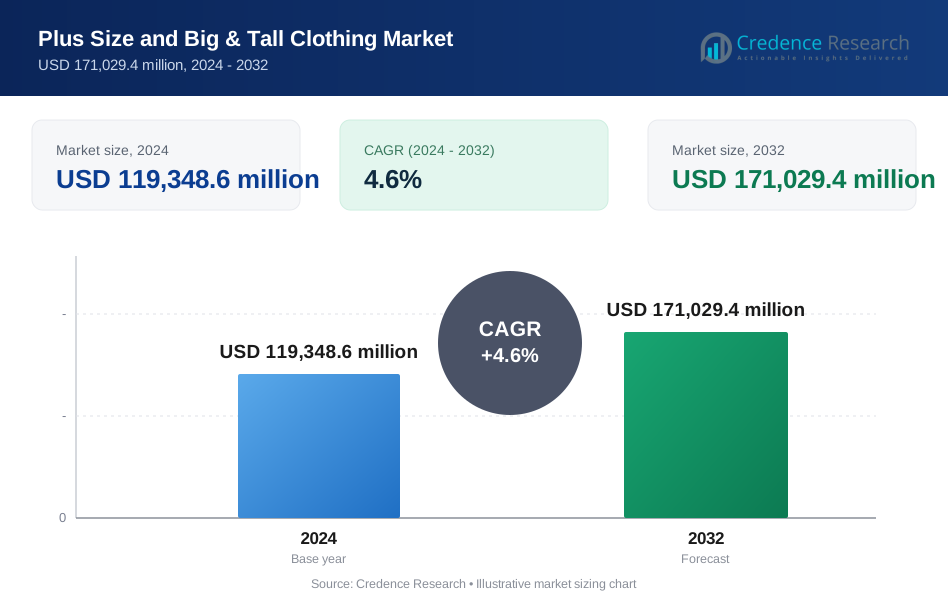
Plus Size and Big & Tall Clothing Market size was valued at USD 119348.6 million in 2024 and is anticipated to reach USD 171029.4 million by 2032, at a CAGR of 4.6% during the forecast period (2024-2032).
Several factors are propelling the market's growth. The global rise in obesity rates and greater health awareness are creating sustained demand for larger-sized clothing. Consumers are increasingly seeking fashion-forward collections that reflect mainstream trends rather than traditional, less dynamic offerings. Moreover, technological advancements in fabric innovation and online size recommendation tools are improving shopping experiences and boosting consumer confidence. In addition, changing societal attitudes toward body image are encouraging more consumers to seek fashionable options that offer both comfort and style. Retailers and fashion labels are expanding their offerings to serve this growing demographic, integrating better design, improved sizing standards, and premium quality fabrics. Furthermore, the influence of social media, celebrity endorsements, and growing representation of diverse body types in mainstream fashion campaigns is accelerating the acceptance and popularity of plus-size and big & tall apparel.
Regionally, North America dominates the Plus Size and Big & Tall Clothing Market, supported by high consumer spending power, strong retail infrastructure, and widespread acceptance of size-inclusive fashion. The presence of major brands actively promoting inclusive collections, such as Nike, Levi’s, and ASOS, further strengthens the regional market leadership. In addition, the increasing popularity of dedicated plus-size fashion events and shows is driving cultural shifts toward normalizing size diversity. Europe follows, driven by evolving fashion standards and heightened awareness of inclusive apparel lines. The Asia-Pacific region is poised for the fastest growth over the coming years, fueled by urbanization, increasing disposable incomes, and a growing focus on body positivity among younger consumers. Regional e-commerce giants are increasingly investing in size-inclusive product lines to cater to rising demand across emerging cities. Meanwhile, Latin America and the Middle East & Africa are gradually expanding their market presence through emerging e-commerce platforms and greater brand outreach, supported by growing investment from international retailers targeting underserved markets.
Market Insights:
- The Plus Size and Big & Tall Clothing Market was valued at USD 119,348.6 million in 2024 and is expected to reach USD 171,029.4 million by 2032, growing at a CAGR of 4.6% during the forecast period.
- Rising global obesity rates and heightened health awareness are creating sustained demand for larger-sized, stylish clothing options.
- Societal shifts toward body positivity and inclusivity are encouraging brands to offer fashionable collections that cater to diverse body types.
- Major fashion brands are expanding size-inclusive lines, incorporating premium fabrics, better cuts, and trend-driven designs to appeal to wider demographics.
- Digital platforms, influencer-led campaigns, and AI-powered sizing innovations are significantly improving the consumer shopping experience and boosting confidence.
- North America holds 44% of the global market share, leading due to strong consumer spending, widespread inclusivity initiatives, and a well-established retail sector.
- Asia-Pacific is poised for the fastest growth, fueled by urbanization, increasing disposable incomes, expanding e-commerce platforms, and changing beauty standards among younger consumers.
Market Drivers:
Rising Global Obesity Rates and Health Awareness
The growing prevalence of obesity worldwide is a primary driver behind the increasing demand for plus size and big & tall clothing. According to global health organizations, obesity rates have nearly tripled over the past few decades, leading to a larger consumer base requiring extended sizing options. As awareness around health and wellness rises, individuals are seeking clothing that not only fits well but also promotes confidence and self-expression. This trend is encouraging fashion brands to design apparel that accommodates larger body types without compromising style, functionality, or quality.
Changing Societal Attitudes Toward Body Image
Societal perceptions of body image are undergoing a major transformation, further boosting the plus size and big & tall clothing market. The traditional emphasis on thinness is gradually being replaced by a broader acceptance of diverse body types. For instance, Aerie has been widely recognized for its authentic body positivity campaigns, featuring models of various ethnicities, sizes, disabilities, and illnesses, and promoting acceptance of all body types through its “We Are REAL” campaign. Campaigns promoting body positivity, inclusivity, and mental well-being are reshaping consumer expectations, leading to greater demand for stylish clothing options in larger sizes. Brands that embrace inclusive marketing and offer varied sizing are witnessing stronger customer loyalty and higher brand engagement, thus creating a positive cycle of demand and innovation in the sector.
Expansion of Size-Inclusive Fashion Lines
Leading fashion brands and retailers are increasingly investing in expanding their size ranges, recognizing the commercial potential of the underserved plus-size market. Companies are developing size-inclusive lines that mirror the latest fashion trends, ensuring that style is accessible to all customers regardless of body type. For instance, ASOS Curve and Universal Standard have introduced extensive collections specifically designed for plus-size customers, showcasing the latest fashion trends. Improved sizing standards, better cuts, and premium materials are being integrated into product lines to cater to this demographic. This strategic shift is not only driving market growth but also enhancing brand reputation and expanding customer reach across diverse market segments.
Influence of Digital Platforms and Social Media Trends
The rise of digital platforms and social media influencers advocating body positivity has significantly accelerated market demand. Social media channels have given plus size and big & tall consumers greater visibility, inspiring brands to develop more authentic and relatable campaigns. E-commerce platforms are also offering personalized shopping experiences with detailed size guides, virtual try-ons, and customer reviews, simplifying the buying process for consumers. These advancements are making plus size and big & tall clothing more accessible and attractive, reinforcing market expansion across all regions.
Market Trends:
Emphasis on Size Inclusivity in Mainstream Fashion
Mainstream fashion brands are increasingly embracing size inclusivity by extending their collections to accommodate plus size and big & tall customers. For instance, Versace has embraced curvy models on the runway, signaling a shift toward greater inclusivity in high fashion. This shift is not limited to specialized retailers but includes leading global labels that are actively promoting diverse sizing options. As inclusivity becomes a core component of brand identity, companies are introducing full product ranges in larger sizes rather than offering limited selections, enabling consumers to access the latest styles without compromise.
Focus on Customization and Personalization
Customization and personalization have emerged as strong trends in the plus size and big & tall clothing market. Brands are offering tailored fits, adjustable features, and made-to-measure options to meet the specific needs of consumers seeking better comfort and style alignment. Technology-driven innovations, such as AI-based sizing recommendations and virtual fitting rooms, are further enhancing the customer experience. These advancements are helping brands improve satisfaction rates and reduce returns, thereby boosting profitability.
Rise of Sustainable and Ethical Fashion
Sustainability is gaining traction in the plus size and big & tall segment, with consumers increasingly prioritizing eco-friendly fabrics and ethical production practices. Brands are responding by integrating organic materials, recycled fibers, and transparent sourcing into their collections. For instance, Girlfriend Collective uses recycled materials like fishing nets and plastic bottles to create stylish activewear in extended sizes, promoting environmental responsibility. The move toward slow fashion principles, combined with the growing demand for durable and long-lasting apparel, is influencing design and manufacturing strategies across the industry.
Expansion of Online Retail and Digital Marketing
E-commerce is playing a crucial role in reshaping the market, offering greater accessibility and variety to plus size and big & tall consumers. Online platforms are leveraging targeted digital marketing, inclusive branding, and influencer partnerships to reach a wider audience. Virtual fashion shows, size-inclusive advertisements, and social media campaigns are driving consumer engagement and strengthening brand loyalty, reinforcing the market’s steady upward trajectory.
Market Challenges Analysis:
Sizing Standardization and Fit Issues One of the primary challenges facing the plus size and big & tall clothing market is the lack of standardized sizing across brands and regions. Many consumers continue to experience inconsistencies in fit, making online and in-store shopping difficult and often frustrating. For instance, research conducted on top 100 U.S. retailers by Dunn found significant dissimilarities in size labeling from brand to brand, and international comparisons revealed haphazard dimensional variations among countries like Spain, UK, Sweden, and Poland. Although brands are expanding their size ranges, variations in measurement charts, fabric elasticity, and design cuts frequently result in ill-fitting garments. This inconsistency not only leads to high return rates but also undermines customer trust and loyalty. Developing universally accepted sizing guidelines remains a critical need for improving consumer confidence and enhancing brand credibility in this market segment. Without accurate sizing, brands risk losing competitive advantage, especially as consumers increasingly favor retailers offering consistent, well-fitting options. Investment in better sizing technology and enhanced virtual try-on tools could offer meaningful solutions to mitigate these concerns.
Limited Fashion Diversity and Premium Options Despite the progress toward inclusivity, the range of fashion-forward and premium options available to plus size and big & tall consumers remains limited compared to standard sizing markets. Many brands still offer basic or less trend-driven collections for larger sizes, which often fail to meet the evolving fashion expectations of modern consumers. Additionally, luxury and high-end fashion labels have been slow to fully embrace size inclusivity, creating a gap in the market for stylish, high-quality apparel in extended sizes. This limitation restricts the purchasing choices for discerning consumers and highlights an opportunity for brands willing to invest in creative design, better material selection, and broader trend adoption to meet growing demand. Bridging this gap could unlock significant revenue opportunities for companies able to blend innovation with inclusivity. Expanding premium plus-size collections would also strengthen brand equity and foster deeper consumer loyalty across a wider demographic.
Market Opportunities:
The Plus Size and Big & Tall Clothing Market presents significant growth opportunities as consumer demand for size-inclusive fashion continues to rise globally. Expanding product lines beyond basic apparel into categories such as activewear, formalwear, luxury fashion, and seasonal collections can help brands capture new segments of this growing market. There is also a strong opportunity for companies to invest in technology-driven solutions, such as AI-based sizing recommendations and personalized shopping experiences, to address longstanding fit issues. Collaborations with influencers and celebrities who advocate body positivity can further strengthen brand loyalty and expand customer bases. Brands that prioritize inclusive marketing strategies and showcase diverse body types in their advertising campaigns are better positioned to resonate with modern consumers seeking representation and authenticity.
In addition, emerging markets across Asia-Pacific, Latin America, and the Middle East & Africa offer untapped potential for plus size and big & tall clothing brands. As disposable incomes rise and awareness of fashion inclusivity spreads, consumers in these regions are increasingly seeking stylish, well-fitting apparel in extended sizes. E-commerce expansion, coupled with targeted digital marketing efforts, provides an efficient platform to reach these underserved demographics. Furthermore, the growing consumer preference for sustainable and ethically produced fashion opens additional opportunities for brands to differentiate themselves by offering eco-friendly plus-size collections. Companies that successfully combine inclusive sizing, fashion-forward design, and responsible production practices are likely to capture long-term loyalty and gain a competitive advantage in the evolving global apparel landscape.
Market Segmentation Analysis:
By Type
The Plus Size and Big & Tall Clothing Market is segmented into casual wear, formal wear, sportswear, and others. Casual wear holds a major share due to increasing demand for comfortable daily outfits that align with modern fashion trends. Formal wear and sportswear segments are witnessing steady growth as brands introduce diverse styles catering to professional and active lifestyles.
By Material
Segmentation by material includes cotton, polyester, rayon, and blends. Cotton dominates the market because of its breathability and comfort, making it ideal for larger sizes. However, blends incorporating polyester and spandex are gaining popularity as they offer stretchability, enhanced durability, and better fit, addressing the specific needs of plus size and big & tall consumers.
By Application
By application, the market serves men, women, and unisex categories. Women’s plus size clothing commands a significant portion of the market, fueled by growing body positivity movements and expanded brand offerings. Meanwhile, the men’s segment is experiencing strong growth as retailers recognize the underserved demand for stylish, big & tall fashion solutions.
Segmentations:
By Type
- Casual Wear
- Formal Wear
- Sportswear
- Swimwear
- Innerwear
- Others
By Material
- Cotton
- Polyester
- Nylon
- Spandex
- Rayon
- Blended Fabrics
By Application
- Men
- Women
- Unisex
By Standard Size
- 1XL
- 2XL
- 3XL
- 4XL and Above
By Price Range
- Economy
- Mid-Range
- Premium
By Distribution Channel
- Online Retail
- Supermarkets and Hypermarkets
- Specialty Stores
- Department Stores
- Others
By Region
- North America
- U.S.
- Canada
- Mexico
- Europe
- UK
- France
- Germany
- Italy
- Spain
- Russia
- Belgium
- Netherlands
- Austria
- Sweden
- Poland
- Denmark
- Switzerland
- Rest of Europe
- Asia Pacific
- China
- Japan
- South Korea
- India
- Australia
- Thailand
- Indonesia
- Vietnam
- Malaysia
- Philippines
- Taiwan
- Rest of Asia Pacific
- Latin America
- Brazil
- Argentina
- Peru
- Chile
- Colombia
- Rest of Latin America
- Middle East
- UAE
- KSA
- Israel
- Turkey
- Iran
- Rest of Middle East
- Africa
- Egypt
- Nigeria
- Algeria
- Morocco
- Rest of Africa
Regional Analysis:
North America
North America holds the largest share of the plus size and big & tall clothing market, commanding 44% of the global market. This strong position is driven by the high prevalence of larger body types and a well-developed retail sector offering size-inclusive fashion lines. Growing consumer focus on body positivity and inclusivity has significantly influenced purchasing patterns across the United States and Canada. In addition, major brands have invested heavily in expanding their plus-size collections, further enhancing regional market growth. Rising online sales and the adoption of AI-driven sizing technologies continue to reinforce North America's market dominance. Leading retailers in the region are also implementing sustainability initiatives, catering to consumer demand for eco-friendly plus-size apparel.
Europe
Europe accounts for 29% of the global plus size and big & tall clothing market. The region benefits from increasing consumer acceptance of diverse body types and a growing demand for stylish, size-inclusive clothing options. Key markets such as the United Kingdom, Germany, and France are at the forefront, driven by trends in sustainable fashion and ethical production practices. The rising influence of online platforms offering specialized plus-size fashion is boosting market accessibility. Efforts by European retailers to improve sizing standards and expand product lines have strengthened the region’s competitive position in the global landscape. Collaborations between designers and plus-size fashion influencers are further enhancing brand visibility and customer engagement across Europe.
Asia-Pacific
Asia-Pacific represents 18% of the global plus size and big & tall clothing market. Rising disposable income levels, rapid urbanization, and changing perceptions of body image are driving demand across countries like China, India, and Japan. Although traditionally underserved, this demographic is gaining attention from both international and regional brands seeking to tap into its growth potential. The expansion of e-commerce platforms, coupled with the influence of global fashion trends, is accelerating market penetration. Strategic initiatives to promote inclusivity and offer culturally resonant designs are expected to further enhance the market’s trajectory in Asia-Pacific. Local brands are increasingly introducing extended size ranges to capitalize on the unmet demand in emerging economies.
Key Player Analysis:
- Billoomi Fashion Pvt. Ltd.
- Casual Male
- Jones Ney York
- Kellwood Apparel
- Kita Ku
- Charming Shoppes, Inc
- Destination XL Group, Inc.
- H & M Hennes & Mauritz AB.
- Lane Bryant
- MGOO Fashion Apparel Co., Ltd
- Oberlo
- ON THE PLUS SIDE
Competitive Analysis:
The Plus Size and Big & Tall Clothing Market is highly competitive, characterized by the presence of established brands and emerging players striving to capture a growing consumer base. Companies are focusing on expanding their size ranges, improving fit accuracy, and adopting inclusive marketing strategies to strengthen brand loyalty. Innovation in design, sustainable sourcing, and the integration of advanced sizing technologies are becoming critical differentiators. Retailers are also enhancing their online presence to meet the rising demand for convenient shopping experiences. Strategic collaborations with influencers and fashion designers are helping brands connect with broader audiences and boost visibility. Furthermore, investment in AI-driven personalization tools and virtual fitting rooms is reshaping the competitive landscape. The market’s dynamic nature demands continuous product innovation, customer engagement, and adaptability to evolving consumer expectations to maintain a strong position.
Recent Developments:
- In March 2025, DXL Group plans to open eight new DXL stores and convert two more Casual Male XL stores to the DXL format, while pausing new store openings in 2026 until market conditions improve.
- In March 2025, DXL Group launched an upgraded e-commerce platform and an improved rewards program to enhance customer engagement and drive direct sales, which accounted for over 30% of retail segment sales.
Market Concentration & Characteristics:
The Plus Size and Big & Tall Clothing Market is moderately fragmented, with a mix of well-established brands and emerging players competing across global and regional levels. Leading companies dominate significant portions of the market by offering wide product ranges, investing in sustainable materials, and adopting inclusive marketing approaches. Smaller and niche brands are gaining traction by addressing specific consumer needs, such as customized fits and eco-conscious designs. The market is characterized by rapid innovation in sizing technology, high consumer expectations for comfort and style, and a growing emphasis on ethical production practices. Online retail channels play a crucial role, allowing brands to reach diverse demographics and offer personalized shopping experiences. As consumer awareness of body positivity and inclusivity increases, market players must continuously adapt by expanding size offerings, enhancing product quality, and maintaining authenticity to succeed in this evolving competitive environment.
Report Coverage:
The research report offers an in-depth analysis based on type, material, application, standard size, price range, distribution channel and region. It details leading market players, providing an overview of their business, product offerings, investments, revenue streams, and key applications. Additionally, the report includes insights into the competitive environment, SWOT analysis, current market trends, as well as the primary drivers and constraints. Furthermore, it discusses various factors that have driven market expansion in recent years. The report also explores market dynamics, regulatory scenarios, and technological advancements that are shaping the industry. It assesses the impact of external factors and global economic changes on market growth. Lastly, it provides strategic recommendations for new entrants and established companies to navigate the complexities of the market.
Future Outlook:
- Brands will continue to expand size ranges to promote greater inclusivity and reach wider demographics.
- Investment in AI-driven sizing technology and virtual fitting solutions will enhance the online shopping experience.
- Sustainable materials and ethical production practices will become central to brand differentiation and consumer loyalty.
- Customized and made-to-measure clothing offerings will gain traction, catering to individual preferences and comfort needs.
- Collaborations between plus-size influencers and major fashion labels will drive new product lines and marketing strategies.
- Demand for fashionable plus-size activewear and athleisure will increase as health and wellness trends grow globally.
- Emerging markets, particularly in Asia-Pacific and Latin America, will present significant growth opportunities for industry players.
- Omni-channel retail strategies will strengthen, blending in-store experiences with personalized digital services.
- Consumers will place greater emphasis on quality, durability, and style, prompting brands to innovate in design and fabric technology.
- Regulatory pressures and social responsibility movements will encourage transparency in sourcing, manufacturing, and labor practices.
Request a Free Sample
Fill in your details and we'll send you a free sample report.
- Sample data tables & charts
- Research methodology
Market Dynamics
Rising Global Obesity Rates and Health Awareness
The increasing prevalence of obesity worldwide is expanding the consumer base for plus size and big & tall clothing, as more individuals require extended sizing options. Heightened health awareness is also prompting consumers to seek comfortable, well-fitting apparel that supports confidence and self-expression.
Changing Societal Attitudes Toward Body Image
Societal shifts toward body positivity and inclusivity are encouraging brands to offer fashionable collections for diverse body types. This cultural change is driving demand for stylish, size-inclusive clothing and fostering greater brand loyalty.
Expansion of Size-Inclusive Fashion Lines
Major fashion brands and retailers are investing in broader size ranges and trend-driven designs, making fashionable options accessible to all body types. This expansion is not only meeting unmet demand but also enhancing brand reputation and market reach.
Influence of Digital Platforms and Social Media
Digital platforms and influencer-led campaigns are increasing visibility for plus size and big & tall consumers, inspiring brands to develop more authentic and relatable marketing. E-commerce innovations like AI-powered sizing tools are improving the shopping experience and boosting consumer confidence.
Growth of E-Commerce and Technological Advancements
The rise of online retail and advancements in virtual fitting rooms and personalized size recommendations are making it easier for consumers to find well-fitting plus size and big & tall clothing, driving market growth across all regions.
Need a Custom Version of This Report?
Tailor the scope, geography, or segments to your exact requirements.
- Custom geography or segment scope
- Direct access to our analyst team
Frequently Asked Questions
What is the current and projected size of the Plus Size and Big & Tall Clothing Market?
What factors are driving the growth of the Plus Size and Big & Tall Clothing Market?
Which region leads the Plus Size and Big & Tall Clothing Market?
How are fashion brands responding to the demand for plus-size clothing?
What regional trends are shaping the market’s future growth?
Table of Content
Chapter 1 Market Segmentation
- 1.1 Segmentation Framework
- 1.1.1 Product and Service Classification
- 1.1.2 Application and End-Use Classification
- 1.1.3 Technology and Solution Classification
- 1.1.4 Customer and Distribution Channel Classification
- 1.1.5 Geographic Segmentation
- 1.1.6 Market Segment Definitions and Boundaries
- 1.2 By Type
- 1.2.1 Casual Wear
- 1.2.2 Formal Wear
- 1.2.3 Sportswear
- 1.2.4 Swimwear
- 1.2.5 Innerwear
- 1.2.6 Others
- 1.3 By Material
- 1.3.1 Cotton
- 1.3.2 Polyester
- 1.3.3 Nylon
- 1.3.4 Spandex
- 1.3.5 Rayon
- 1.3.6 Blended Fabrics
- 1.4 By Application
- 1.4.1 Men
- 1.4.2 Women
- 1.4.3 Unisex
Chapter 2 Introduction
- 2.1 Report Objectives and Scope
- 2.2 Product Definition and Industry Terminology
- 2.3 Market Inclusions and Exclusions
- 2.4 Research Process
- 2.4.1 Primary Research and Expert Interviews
- 2.4.2 Secondary Research and Source Review
- 2.4.3 Top-Down and Bottom-Up Estimation
- 2.4.4 Data Triangulation and Verification
- 2.5 Market Size Measurement Basis
- 2.5.1 2024: USD 119,348.6 million → 2032: USD 171,029.4 million
- 2.6 Historical and Forecast Reference Periods
- 2.6.1 Base Year: 2024
- 2.6.2 Forecast Period: 2024-2032
- 2.7 Research Assumptions and Limitations
Chapter 3 Executive Summary
- 3.1 Market Snapshot and Key Findings
- 3.2 Base-Year Market Size, 2024
- 3.3 Forecast Market Size, 2032
- 3.4 Revenue and Volume Growth Outlook
- 3.5 Key Demand and Supply Indicators
- 3.6 Leading Market Segments
- 3.7 Fastest-Growing Market Opportunities
- 3.8 Regional Performance Highlights
- 3.9 Technology and Industry Transformation
- 3.10 Competitive Landscape Summary
- 3.11 Analyst View and Strategic Implications
Chapter 4 Global Plus Size and Big & Tall Clothing Market Trends and Developments
- 4.1 Historical Industry Development
- 4.2 Recent Market Trends and Developments
- 4.3 Demand and Customer Behavior Trends
- 4.4 Technology and Product Innovation
- 4.5 Artificial Intelligence, Automation and Digitalization
- 4.6 Local Manufacturing and Supply Chain Realignment
- 4.7 Industry Partnerships, Mergers and Acquisitions
- 4.8 Sustainability and Circular Economy Developments
- 4.9 Government and Private Sector Investment Trends
- 4.10 Emerging Business Models and Commercialization
- 4.11 Industry Developments and Announcements
Chapter 5 Global Plus Size and Big & Tall Clothing Market Production, Supply and Demand Analysis
- 5.1 Demand Trend and Consumption Analysis
- 5.2 Demand Forecast, 2024-2032
- 5.3 Production and Output Trend
- 5.4 Production and Output Forecast, 2024-2032
- 5.5 Installed Capacity and Capacity Utilization
- 5.6 Company-Wise Production Plants and Statistics
- 5.6.1 Installed Production Capacity
- 5.6.2 Actual Production
- 5.6.3 Planned Capacity and Expansion Targets
- 5.7 Supply Chain Structure and Procurement Trends
- 5.8 Supply-Demand Gap and Bottlenecks
- 5.9 Import Dependence and Sourcing Structure
- 5.10 Contract Manufacturing and Outsourcing
- 5.11 Regional Supply and Demand Concentration
Chapter 6 Global Plus Size and Big & Tall Clothing Market Pricing Analysis
- 6.1 Pricing Structure and Measurement
- 6.2 Historical Pricing Trends
- 6.3 Pricing Outlook, 2024-2032
- 6.4 Average Selling Price and Unit Economics
- 6.5 Pricing by Product and Market Segment
- 6.6 Geographic Pricing Differences
- 6.7 Key Input, Energy, Labor and Logistics Costs
- 6.8 Contract Pricing and Purchasing Models
- 6.9 Pricing Sensitivity and Competitive Positioning
- 6.10 Price, Margin and Profitability Implications
Chapter 7 Global Plus Size and Big & Tall Clothing Market Dynamics
- 7.1 Market Growth Drivers
- 7.1.1 Demand-Side Drivers
- 7.1.2 Technology and Innovation Drivers
- 7.1.3 Infrastructure and Investment Drivers
- 7.1.4 Regulatory and Policy Drivers
- 7.2 Market Restraints
- 7.2.1 Cost and Affordability Constraints
- 7.2.2 Technology and Adoption Barriers
- 7.2.3 Supply Chain and Operational Constraints
- 7.3 Market Challenges
- 7.3.1 Competitive Pressure and Margin Erosion
- 7.3.2 Skills, Infrastructure and Implementation Gaps
- 7.4 Emerging Market Opportunities
- 7.5 Market Dynamics Impact and Time-Horizon Assessment
Chapter 8 Global Plus Size and Big & Tall Clothing Value Chain Analysis
- 8.1 Industry Value Chain Overview
- 8.2 Upstream Suppliers and Critical Inputs
- 8.3 Technology and Component Providers
- 8.4 Manufacturing or Service Delivery
- 8.5 Distribution, Channel Partners and Integrators
- 8.6 Downstream Applications and End Users
- 8.7 Value Addition and Profit Pools
- 8.8 Vertical Integration and Outsourcing
- 8.9 Supplier Concentration and Risk
- 8.10 Supply Chain Localization and Resilience
Chapter 9 Global Plus Size and Big & Tall Clothing Market Regulations and Policies
- 9.1 Relevant Laws, Standards and Compliance Frameworks
- 9.2 Product, Service, Safety and Quality Requirements
- 9.3 Government Policies, Incentives and Subsidies
- 9.4 Imports, Exports and Trade Barriers
- 9.5 Public Procurement and Local Content Requirements
- 9.6 Environmental and Sustainability Compliance
- 9.7 Upcoming Policy Changes and Market Implications
Chapter 10 Global Plus Size and Big & Tall Clothing Market Hotspots and Opportunities
- 10.1 Market Opportunity Mapping and Growth Hotspots
- 10.2 High-Growth Applications and Customer Groups
- 10.3 Underserved Markets and White-Space Opportunities
- 10.4 Emerging Technology and Product Opportunities
- 10.5 New Capacity and Investment Hotspots
- 10.6 Market Entry and Expansion Opportunities
- 10.7 Distribution and Partnership Opportunities
- 10.8 Near-Term and Long-Term Commercial Potential
- 10.9 Opportunity Attractiveness and Execution Risks
Chapter 11 Global Plus Size and Big & Tall Clothing Market Outlook, 2024-2032
- 11.1 Market Size and Analysis
- 11.1.1 Revenue (Market Measurement: 2024: USD 119,348.6 million → 2032: USD 171,029.4 million)
- 11.1.2 Market Volume and Quantity Sold
- 11.1.3 Historical Market Size
- 11.1.4 Base-Year Market Size, 2024
- 11.2 Market Forecast, 2024-2032
- 11.2.1 Revenue Forecast to 2032
- 11.2.2 Volume Forecast to 2032
- 11.2.3 CAGR and Year-on-Year Growth
- 11.2.4 Incremental Revenue Opportunity
- 11.3 Forecast Assumptions and Scenario Analysis
- 11.3.1 Base-Case Forecast
- 11.3.2 Optimistic and Conservative Scenarios
- 11.3.3 Technology, Pricing and Policy Sensitivities
- 11.4 Market Attractiveness and Growth Outlook
Chapter 12 Global Plus Size and Big & Tall Clothing Market Segmentation and Outlook
- 12.1 Segmentation Summary and Market Shares, 2024
- 12.2 Largest and Fastest-Growing Segments
- 12.3 By Type - Market Size and Forecast, 2024-2032
- 12.3.1 Segment Definition and Scope
- 12.3.2 Historical Market Size
- 12.3.3 Revenue Forecast, 2024-2032
- 12.3.4 Volume Forecast, 2024-2032
- 12.3.5 Base-Year Market Share, 2024
- 12.3.6 Segment CAGR and Growth Drivers
- 12.3.7 Subsegment Market Size and Forecast
- 12.3.7.1 Casual Wear
- 12.3.7.2 Formal Wear
- 12.3.7.3 Sportswear
- 12.3.7.4 Swimwear
- 12.3.7.5 Innerwear
- 12.3.7.6 Others
- 12.3.8 Subsegment Pricing and Adoption Trends
- 12.3.9 Leading Suppliers and Competition
- 12.3.10 Regional Demand and Opportunities
- 12.4 By Material - Market Size and Forecast, 2024-2032
- 12.4.1 Segment Definition and Scope
- 12.4.2 Historical Market Size
- 12.4.3 Revenue Forecast, 2024-2032
- 12.4.4 Volume Forecast, 2024-2032
- 12.4.5 Base-Year Market Share, 2024
- 12.4.6 Segment CAGR and Growth Drivers
- 12.4.7 Subsegment Market Size and Forecast
- 12.4.7.1 Cotton
- 12.4.7.2 Polyester
- 12.4.7.3 Nylon
- 12.4.7.4 Spandex
- 12.4.7.5 Rayon
- 12.4.7.6 Blended Fabrics
- 12.4.8 Subsegment Pricing and Adoption Trends
- 12.4.9 Leading Suppliers and Competition
- 12.4.10 Regional Demand and Opportunities
- 12.5 By Application - Market Size and Forecast, 2024-2032
- 12.5.1 Segment Definition and Scope
- 12.5.2 Historical Market Size
- 12.5.3 Revenue Forecast, 2024-2032
- 12.5.4 Volume Forecast, 2024-2032
- 12.5.5 Base-Year Market Share, 2024
- 12.5.6 Segment CAGR and Growth Drivers
- 12.5.7 Subsegment Market Size and Forecast
- 12.5.7.1 Men
- 12.5.7.2 Women
- 12.5.7.3 Unisex
- 12.5.8 Subsegment Pricing and Adoption Trends
- 12.5.9 Leading Suppliers and Competition
- 12.5.10 Regional Demand and Opportunities
- 12.6 Segment Growth Comparison
- 12.7 Segment Attractiveness and Priority Matrix
Chapter 13 Global Plus Size and Big & Tall Clothing End-Use and Application Market Outlook
- 13.1 End-Use Industry and Customer Demand Structure
- 13.2 Leading Applications and Customer Groups
- 13.3 End-Use Market Size, Share and Forecast
- 13.4 Major End-Use Industry Deep Dives
- 13.4.1 Customer Requirements and Use Cases
- 13.4.2 Demand and Replacement Cycles
- 13.4.3 Technical and Regulatory Considerations
- 13.4.4 Purchasing and Procurement Models
- 13.4.5 Leading Vendors and Distribution Channels
- 13.4.6 Forecast and Commercial Opportunities
- 13.5 Emerging Applications and Cross-Segment Demand
- 13.6 End-Use Industry Investment Priorities
Chapter 14 Global Plus Size and Big & Tall Clothing Geographic Market Outlook, 2024-2032
- 14.1 Regional Market Size and Share, 2024
- 14.2 Regional Market Forecast, 2024-2032
- 14.3 Regional Pricing, Production and Demand Differences
- 14.4 North America
- 14.4.1 United States
- 14.4.2 Canada
- 14.4.3 Mexico
- 14.5 Europe
- 14.5.1 Germany
- 14.5.2 France
- 14.5.3 Italy
- 14.5.4 United Kingdom
- 14.5.5 Spain
- 14.5.6 Poland
- 14.5.7 Russia
- 14.5.8 Netherlands
- 14.5.9 Belgium
- 14.5.10 Sweden
- 14.5.11 Denmark
- 14.5.12 Norway
- 14.5.13 Rest of Europe
- 14.6 Asia Pacific
- 14.6.1 China
- 14.6.2 India
- 14.6.3 Japan
- 14.6.4 South Korea
- 14.6.5 Thailand
- 14.6.6 Indonesia
- 14.6.7 Vietnam
- 14.6.8 Malaysia
- 14.6.9 Australia
- 14.6.10 Rest of Asia Pacific
- 14.7 Latin America
- 14.7.1 Brazil
- 14.7.2 Argentina
- 14.7.3 Colombia
- 14.7.4 Chile
- 14.7.5 Rest of Latin America
- 14.8 Middle East
- 14.8.1 Saudi Arabia
- 14.8.2 United Arab Emirates
- 14.8.3 Turkey
- 14.8.4 Israel
- 14.8.5 Iran
- 14.8.6 Rest of the Middle East
- 14.9 Africa
- 14.9.1 South Africa
- 14.9.2 Egypt
- 14.9.3 Nigeria
- 14.9.4 Morocco
- 14.9.5 Rest of Africa
- 14.10 Regional Investment, Policy and Supply Chain Differences
- 14.11 Regional Competitive Landscape
- 14.12 Geographic Growth Hotspots
Chapter 15 Global Plus Size and Big & Tall Clothing Technology, Innovation and Sustainability Outlook
- 15.1 Technology Landscape and Maturity
- 15.2 Product, Process and Service Innovation
- 15.3 AI, Automation and Digital Tools in the Industry
- 15.4 Technology Adoption and Performance Benchmarking
- 15.5 Innovation Pipeline and R&D Investment
- 15.6 Patent and Intellectual Property Trends
- 15.7 Energy Efficiency and Resource Management
- 15.8 Sustainability, Recycling and Circularity
- 15.9 Technology Roadmap, 2024-2032
- 15.10 Risks of Obsolescence and Technology Substitution
Chapter 16 Global Plus Size and Big & Tall Clothing Market Key Strategic Imperatives
- 16.1 Growth and Market Entry Priorities
- 16.2 High-Return Products and Segments
- 16.3 Pricing, Profitability and Cost Optimization
- 16.4 Technology Investment and Product Differentiation
- 16.5 Supply Chain Localization and Resilience
- 16.6 Distribution and Customer Acquisition
- 16.7 Partnership, Acquisition and Capacity Strategy
- 16.8 Regional Expansion Priorities
- 16.9 Short-, Medium- and Long-Term Actions
Chapter 17 Competition Outlook
- 17.1 Industry Competition Characteristics
- 17.2 Market Structure and Concentration
- 17.3 Market Share and Competitive Positioning, 2024
- 17.4 Company-Wise Revenue and Product Benchmarking
- 17.5 Production and Service Capacity Benchmarking
- 17.6 Technology, Pricing and Differentiation
- 17.7 Regional Footprint and Distribution Strength
- 17.8 Mergers, Acquisitions and Strategic Alliances
- 17.9 New Entrants and Competitive Threats
- 17.10 Porter's Five Forces and Industry Attractiveness
- 17.11 Competitive Outlook, 2024-2032
Chapter 18 Company Profiles
- 18.1 Company Coverage and Selection Criteria
- 18.2 Lane Bryant
- 18.2.1 Business Description
- 18.2.2 Company Ownership and Geographic Presence
- 18.2.3 Product and Service Portfolio
- 18.2.4 Manufacturing and Operating Footprint
- 18.2.5 Production Capacity and Expansion Plans
- 18.2.6 Financial Performance and Investment
- 18.2.7 Market Share and Competitive Position
- 18.2.8 Technology and Innovation Capabilities
- 18.2.9 Strategic Alliances or Partnerships
- 18.2.10 Recent Developments
- 18.2.11 Growth Strategy and Outlook
- 18.3 Destination XL Group, Inc.
- 18.4 H&M Hennes & Mauritz AB
- 18.5 ASOS
- 18.6 Nike
- 18.7 Levi Strauss & Co.
- 18.8 Charming Shoppes, Inc.
- 18.9 Universal Standard
- 18.10 Kellwood Apparel
- 18.11 Billoomi Fashion Pvt. Ltd.
- 18.12 Other Relevant Market Participants
Note: Every listed company is profiled on the structure shown under the first company. The company list is preliminary and may change based on research findings, market developments, data availability and client requirements.
Chapter 19 Disclaimer
- 19.1 Research and Forecast Disclaimer
- 19.2 Data Source and Estimation Limitations
Note: The depth of individual sections depends on data availability for this market. Volume, capacity, trade and other unit-based metrics are included where applicable.

