
Market Overviews
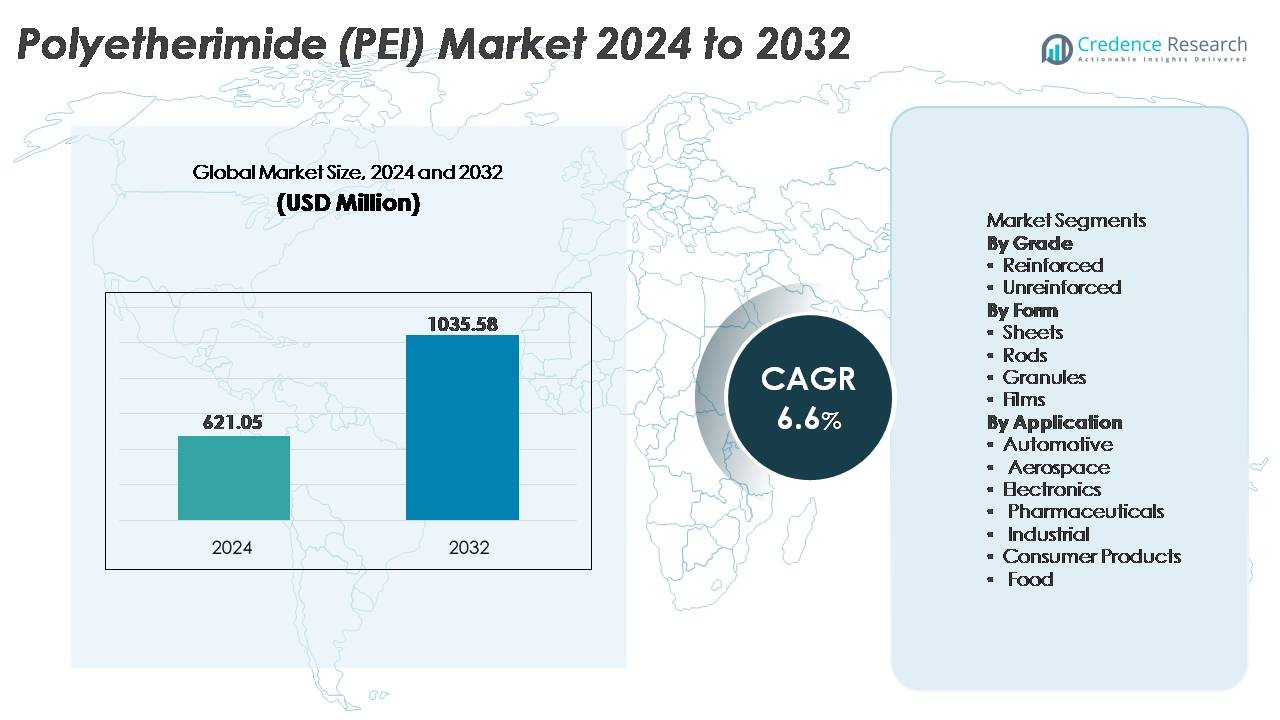
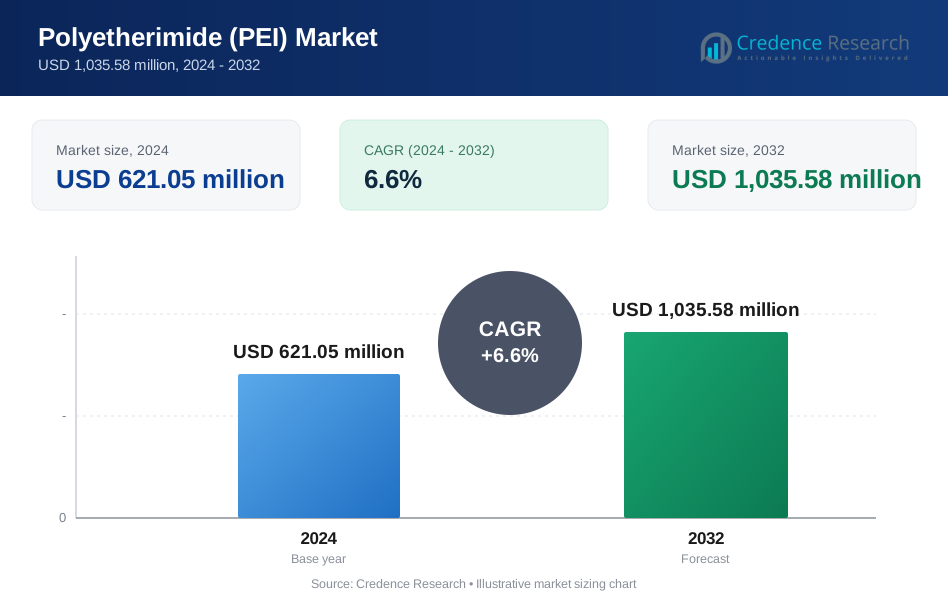
Polyetherimide (PEI) market size was valued at USD 621.05 million in 2024 and is anticipated to reach USD 1,035.58 million by 2032, at a CAGR of 6.6% during the forecast period.
| REPORT ATTRIBUTE | DETAILS |
|---|---|
| Historical Period | 2020-2023 |
| Base Year | 2024 |
| Forecast Period | 2025-2032 |
| Polyetherimide (PEI) Market Size 2024 | USD 621.05 Million |
| Polyetherimide (PEI) Market, CAGR | 6.6% |
| Polyetherimide (PEI) Market Size 2032 | USD 1,035.58 Million |
The Polyetherimide (PEI) market features strong participation from global polymer suppliers, engineered plastics processors, and integrated chemical manufacturers. Key players include Mitsubishi Chemical Advanced Materials, Centroplast Engineering Plastics GmbH, PolyOne Corporation, Aetna Plastics, Ensinger, SABIC, Lehmann & Voss & Co., Westlake Plastics Company, RTP Company, and Röchling SE & Co. KG. These companies compete by offering high-heat, flame-retardant grades, precision-molding capabilities, and application-specific PEI solutions for aerospace, automotive electrification, and medical equipment. Asia Pacific leads the PEI market with approximately 34% share, supported by large-scale electronics manufacturing, industrial automation growth, and cost-efficient processing clusters that accelerate regional adoption.
Market Insights
- The Polyetherimide (PEI) market was valued at USD 621.05 million in 2024 and is projected to reach USD 1,035.58 million by 2032, expanding at a CAGR of 6.6% during the forecast period.
- Strong demand for lightweight, high-performance polymers in aerospace, automotive electrification, and industrial automation continues to drive market expansion as OEMs prioritize thermal-resistant and flame-retardant materials.
- Emerging trends include the growing integration of PEI in 3D printing filaments, semiconductor components, and medical sterilization-safe devices, supported by material innovation and recyclable engineering-grade polymers.
- Competitive dynamics remain shaped by specialty compounders and global resin producers offering application-specific grades, with cost sensitivity and processing complexity restraining wider adoption across general-purpose industries.
- Asia Pacific holds the largest regional share at 34%, followed by North America at 32% and Europe at 29%, while the reinforced grade segment leads consumption, supported by its dominance in high-strength aerospace and automotive components.
Market Segmentation Analysis:
By Grade
The reinforced PEI grade captures the dominant market share, driven by its superior tensile strength, dimensional stability, and flame-resistant characteristics that meet rigorous industrial and aerospace standards. Its ability to retain mechanical strength above 200°C positions it competitively against metals in high-stress applications. Unreinforced PEI gains traction where flexibility, insulation, and lightweight design are critical, particularly in electronics and medical components. However, reinforced PEI remains the preferred choice due to its enhanced modulus and durability, supporting advanced manufacturing in automotive structural parts and aircraft seating systems.
- For instance, SABIC’s ULTEM™ 2200, a 20% glass fiber reinforced PEI, delivers a tensile strength of approximately 140 MPa (ISO 527) and a heat deflection temperature of 210°C at 1.8 MPa load, enabling replacement of aluminum in structural housings.
By Form
Granules hold the leading position within the PEI form segment, primarily fueled by their applicability in injection molding and extrusion for mass-scale component production. Their ease of processing, recyclability, and compatibility with complex geometries make them an essential feedstock for automotive housings, connectors, and medical device casings. Sheets and rods support structural fabrication and prototyping, while PEI films cater to insulation and membrane applications in electronics. Despite the growing utility of films, granules maintain dominance due to cost-efficient downstream fabrication and alignment with high-volume OEM manufacturing lines.
- For instance, SABIC produces ULTEM™ PEI granules supporting melt flow rates ranging from 3 to 24 g/10 min (at 337°C/6.6 kg) enabling precision molding for medical and aerospace components with wall thicknesses below 0.75 mm.
By Application
The aerospace sector represents the dominant application segment, propelled by its demand for lightweight, flame-retardant materials with minimal outgassing and compliance with stringent safety standards. PEI’s high strength-to-weight ratio and resistance to jet fuels and chemicals enable its adoption in seat frames, ducting, and avionics housings. Automotive applications continue expanding through electric vehicle components requiring thermal stability. Electronics leverage PEI for connectors and semiconductors due to its dielectric properties. Pharmaceuticals, food processing, and consumer products increasingly adopt PEI for sterilizable, chemically inert, and regulatory-compliant functional designs.
Key Growth Drivers
Expanding Demand for High-Performance Engineering Thermoplastics
The market benefits from industries increasingly shifting from metals and conventional polymers to high-performance engineering thermoplastics. Polyetherimide’s exceptional mechanical strength, dimensional stability, and thermal resistance support its adoption in aerospace components, electric vehicle systems, rail interiors, and industrial automation solutions. Its high dielectric strength and flame-retardant properties make PEI a preferred material for circuit protection, connectors, and semiconductor packaging. Rapid industrial automation accelerates the need for materials that sustain exposure to heat, chemicals, and vibration without deformation. With regulatory bodies emphasizing reduced emissions and energy efficiency, manufacturers prefer strong lightweight substitutes that optimize operational economies. PEI therefore positions itself as a future-proof industrial material aligned with global engineering transformation.
- "For instance, SABIC’s ULTEM™ 1010 resin provides high tensile strength (up to approximately 110 MPa for injection-molded parts) and a glass transition temperature near 217°C, allowing its use as a lightweight, high-performance alternative to machined aluminum in structural aerospace brackets and interior cabin components."
Growing Integration in EV Platforms and Electrification Systems
The polyetherimide market experiences substantial growth through its integration in electric vehicle platforms and advanced electrification systems. Its high temperature tolerance, resistance to battery electrolytes, and low smoke toxicity enable the design of EV connectors, charging sockets, busbar insulation, and power electronics housings. As EV manufacturers aim to minimize vehicle weight and enhance passenger safety, PEI competes directly with traditional alloys and offers cost-efficient processing through injection molding and additive manufacturing. The expanding charging infrastructure ecosystem further strengthens demand for durable thermoplastics that operate under variable loads and outdoor conditions. PEI’s compatibility with precision molding supports its incorporation into compact high-voltage device architectures.
- For instance, Stratasys 3D prints ULTEM™ 9085 PEI-based parts for electric mobility platforms, producing flame-resistant lightweight brackets and ducts with tensile strengths around 70 MPa.
Regulatory Alignment and Suitability for Sterilization-Critical Applications
Stringent food safety, medical-grade manufacturing, and cleanroom regulations stimulate the use of PEI in pharmaceutical and healthcare environments. Its intrinsic biocompatibility, resistance to repeated steam autoclaving cycles, and chemical stability support applications such as dental tools, diagnostic cartridges, device handles, and pump housings. The material’s low extractables and compliance with quality standards enable safe interaction with consumables and sterile liquids. In food processing, PEI withstands high-temperature continuous-service conditions without degradation. The increasing global emphasis on infection prevention, reusable instruments, and waste-reduction policies further solidifies its value proposition as a long-life polymer for hygienic infrastructure.
Key Trends & Opportunities
Adoption of PEI in Additive Manufacturing and Lightweight Component Design
Additive manufacturing opens new opportunities for PEI as a material optimized for prototyping and low-volume precision production. The increasing adoption of 3D printing in aerospace tooling, EV assemblies, and customized medical implants favors PEI powders and filaments known for heat deflection and rigidity. Manufacturers seek engineering polymers compatible with fused filament fabrication and selective laser sintering to build complex shapes previously limited by machining constraints. This trend accelerates design flexibility, reduces lead time, and enables localized production. Lightweight structures that maintain performance under mechanical stress represent a significant commercial opportunity, particularly in defense systems and satellite components.
- For instance, Stratasys offers ULTEM™ 9085 and ULTEM™ 1010 PEI filaments certified for aerospace applications, with the 9085 grade achieving a tensile strength of approximately 70 MPa and a heat deflection temperature near 153°C under load.
Emergence of Recyclable and Sustainable PEI Solutions
Sustainability drives material innovation, leading to emerging opportunities for recyclable and partly bio-based PEI formulations. Circular manufacturing models encourage the use of thermoplastics that can be recovered without losing performance characteristics. With global directives targeting reduced industrial waste and low-carbon material selection, PEI aligns with efforts to replace thermoset components that cannot be reprocessed. Technological advancements in mechanical reclamation and polymer chain preservation enable industries to repurpose scrap and end-of-life components. This presents new revenue channels for resin compounders and OEMs prioritizing compliance with environmental, social, and governance frameworks.
- For instance, SABIC has demonstrated closed-loop recovery of ULTEM™ PEI, enabling mechanical recycling of scrap materials while retaining tensile strength values above 100 MPa after multiple reprocessing cycles.
Key Challenges
High Material Cost and Price Sensitivity Among End Users
Despite its advantages, PEI faces adoption challenges in cost-sensitive markets where metal replacements or conventional polymers remain viable. Pricing reflects the complexity of synthesis, reliance on specialty feedstock, and high-precision processing requirements. Small and mid-tier manufacturers hesitate to transition when lifecycle benefits are long-term rather than immediate. Competitive engineering plastics such as PEEK and PPS also create pricing pressure, shifting buyers toward materials optimized for specific rather than broad functionality. This cost barrier limits application penetration in consumer products and general-purpose equipment where alternative blends meet basic specifications.
Processing Complexity and Requirement for Specialized Manufacturing Infrastructure
PEI’s high glass transition temperature and melt processing characteristics require specialized molding equipment capable of maintaining elevated temperatures and strict dimensional tolerances. Manufacturers without dedicated tooling infrastructures incur higher processing costs and longer setup times, discouraging rapid scaling. The risk of defects such as voids or warpage demands skilled operators and stringent quality control systems. These factors restrain adoption among regions with limited polymer engineering capability. Furthermore, integrating PEI into hybrid assemblies may require new bonding and finishing techniques, increasing overall production complexity.
Regional Analysis
North America
North America accounts for approximately 32% of the global Polyetherimide (PEI) market, driven by aerospace, defense, medical devices, and electric vehicle components manufacturing. The United States dominates regional demand with strong OEM activity and long-term adoption of PEI in wire insulation, compact electronic housings, and structural aircraft parts. Increasing FDA-compliant material usage in sterilization-resistant surgical tools and laboratory consumables reinforces market expansion. Partnerships between resin compounders and 3D printing technology providers further stimulate advanced manufacturing adoption. Growing environmental compliance and lightweighting initiatives encourage material shift from metals toward high-performance polymers such as PEI across engineering industries.
Europe
Europe represents nearly 29% of the Polyetherimide (PEI) market, supported by stringent regulatory standards in transportation, pharmaceuticals, and industrial safety. Germany, France, and the U.K. accelerate usage of PEI due to aerospace Tier-1 supplier networks, expanding renewable energy infrastructure, and automation-intensive industrial operations. PEI’s fire-retardant classification and chemical resistance align with EU regulations emphasizing passenger safety and sustainable manufacturing. Rising investments in electric mobility and lightweight composite materials also support its integration into electronic connectors, motor insulation, and charging components. European research institutions continue leveraging PEI in additive manufacturing for prototyping and precision tooling.
Asia Pacific
Asia Pacific captures the largest share at approximately 34%, fueled by rapid industrialization, cost-efficient manufacturing ecosystems, and expanding electronics and automotive production hubs in China, Japan, South Korea, and India. PEI adoption advances through high-speed connectors, semiconductor parts, and heat-resistant components molded for EV platforms. The region’s strong presence in industrial automation technology supports the use of PEI in pump components, robotics systems, and high-voltage insulation assemblies. Favorable government policies and foreign investments in aerospace and healthcare manufacturing further elevate demand. Cost competitiveness and scaling capacity position Asia Pacific as a global production and consumption center for PEI.
Latin America
Latin America accounts for approximately 3% of global PEI consumption, with growth emerging in automotive aftermarket components, food processing equipment, and industrial maintenance applications. Brazil and Mexico drive demand through expanding manufacturing bases and greater interest in flame-resistant and corrosion-resistant polymers that replace metal parts in machinery. Adoption remains slower than in developed markets due to cost considerations and limited high-performance polymer processing capacity. However, the growing pharmaceutical packaging industry, combined with regional investment in industrial automation and export-driven electronics assembly, provides opportunities for increased PEI penetration over the forecast horizon.
Middle East & Africa
The Middle East & Africa region holds around 2% of market share, primarily driven by demand from oil and gas, medical device distribution, and food processing sectors that require high-temperature, chemically resilient materials. PEI tubing, valve components, and sensor housings find application in corrosive or sterilized operating environments. The UAE and Saudi Arabia support technologically advanced manufacturing clusters, while South Africa represents emerging industrial usage. Higher costs and limited polymer engineering capacity restrain faster adoption. Nevertheless, infrastructure diversification programs and foreign investments in healthcare and industrial equipment manufacturing gradually expand regional market potential.
Market Segmentations:
By Grade
- Reinforced
- Unreinforced
By Form
- Sheets
- Rods
- Granules
- Films
By Application
- Automotive
- Aerospace
- Electronics
- Pharmaceuticals
- Industrial
- Consumer Products
- Food
By Geography
- North America
- U.S.
- Canada
- Mexico
- Europe
- Germany
- France
- U.K.
- Italy
- Spain
- Rest of Europe
- Asia Pacific
- China
- Japan
- India
- South Korea
- South-east Asia
- Rest of Asia Pacific
- Latin America
- Brazil
- Argentina
- Rest of Latin America
- Middle East & Africa
- GCC Countries
- South Africa
- Rest of the Middle East and Africa
Competitive Landscape
The competitive landscape of the Polyetherimide (PEI) market is characterized by the presence of global resin manufacturers, specialty polymer suppliers, and value-added compounders that focus on high-performance materials for critical end-use industries. Market participants compete through product purity, heat and chemical resistance, process optimization for injection molding and 3D printing, and customized grades for aerospace, electronics, and medical applications. Companies emphasize lightweight innovation, sustainability-driven formulations, and regulatory-compliant materials to meet stringent industry standards. Strategic initiatives include capacity expansions, R&D partnerships, and downstream integration to strengthen supply chain security and serve niche precision-engineered applications. Competitive differentiation increasingly derives from technical advisory services, application-specific testing capabilities, and alignment with OEM specifications. Additionally, growing EV production, increased industrial automation, and additive manufacturing adoption provide further avenues for competitive positioning, enabling leading manufacturers to enhance market penetration through performance enhancements and tailored engineering support.
Key Player Analysis
- Mitsubishi Chemical Advanced Materials
- Centroplast Engineering Plastics GmbH
- PolyOne Corporation
- Aetna Plastics
- Ensinger
- SABIC
- Lehmann & Voss & Co.
- Westlake Plastics Company
- RTP Company
- Rochling SE & Co. KG
Recent Developments
- In July 2025 the company refreshed its product specification for “CENTRO HPM / PEI,” indicating ongoing material maintenance and supply readiness.
- In July 2024, SABIC officially commissioned a new manufacturing facility in Singapore to produce its ULTEM™ PEI resin, boosting global resin capacity.
- In July 2023, Mitsubishi Chemical Advanced Materials The firm updated datasheets (e.g., for its “Duratron U1000 PEI” line) reflecting revised technical data and reaffirmed availability of PEI shapes and parts.
Report Coverage
The research report offers an in-depth analysis based on Grade, Form, Application and Geography. It details leading market players, providing an overview of their business, product offerings, investments, revenue streams, and key applications. Additionally, the report includes insights into the competitive environment, SWOT analysis, current market trends, as well as the primary drivers and constraints. Furthermore, it discusses various factors that have driven market expansion in recent years. The report also explores market dynamics, regulatory scenarios, and technological advancements that are shaping the industry. It assesses the impact of external factors and global economic changes on market growth. Lastly, it provides strategic recommendations for new entrants and established companies to navigate the complexities of the market.
Future Outlook
- Demand for PEI is expected to increase as more industries replace metals with high-strength engineering polymers.
- Electric vehicle platforms will expand opportunities for PEI in high-voltage insulation, connectors, and battery-adjacent components.
- Aerospace applications will continue driving material innovation focused on lightweight, heat-resistant, and flame-retardant structures.
- Adoption of PEI in additive manufacturing will accelerate low-volume production and design-flexible industrial tooling.
- Medical and pharmaceutical industries will increase usage of sterilization-resistant PEI components.
- Recyclable and sustainable PEI formulations will gain prominence as environmental standards tighten.
- Integration into semiconductor and 5G infrastructure parts will advance due to its dielectric performance.
- Material customization and compound blending will expand niche applications in industrial automation.
- Strategic collaborations between polymer suppliers and OEMs will shape customized product development.
- Asia Pacific will strengthen its role as a manufacturing and consumption hub for PEI materials.
Request a Free Sample
Fill in your details and we'll send you a free sample report.
- Sample data tables & charts
- Research methodology
Need a Custom Version of This Report?
Tailor the scope, geography, or segments to your exact requirements.
- Custom geography or segment scope
- Direct access to our analyst team
Frequently Asked Questions
What is the current market size for Polyetherimide (PEI), and what is its projected size in 2032?
At what Compound Annual Growth Rate is the Polyetherimide (PEI) market projected to grow between 2024 and 2032?
Which Polyetherimide (PEI) segment held the largest share in 2024?
What are the primary factors fueling the growth of the Polyetherimide (PEI) market?
Who are the leading companies in the Polyetherimide (PEI) market?
Which region commanded the largest share of the Polyetherimide (PEI) market in 2024?
Table of Content
Chapter 1. Report Introduction
- 1.1 Report Description & Purpose
- 1.1.1 Report Title & Market Definition
- 1.1.2 Unique Selling Propositions (USP) & Key Differentiators
- 1.1.3 Value Proposition for Stakeholders
- 1.2 Research Objectives
- 1.2.1 Market Sizing Objectives (Volume & Revenue)
- 1.2.2 Segmentation Objectives
- 1.2.3 Competitive Intelligence Objectives
- 1.2.4 Forecast & Scenario Objectives
- 1.3 Report Scope
- 1.3.1 Polyetherimide (PEI) Scope – Types & Subtypes Covered
- 1.3.2 Geographic Scope – Regions & Countries Covered
- 1.3.3 Historical Period, Base Year & Forecast Period (2024; forecast to 2032)
- 1.3.4 Inclusions & Exclusions
- 1.4 HS Code & Classification Framework
- 1.5 Currency, Units & Pricing Basis
- 1.6 Target Stakeholders
- 1.7 Limitations & Assumptions
Chapter 2. Executive Summary
- 2.1 Global Polyetherimide (PEI) Market Snapshot
- 2.1.1 Market Size – Historical (2024) & Forecast (2024-2032) (2024: USD 621.05 million → 2032: USD 1,035.58 million)
- 2.1.2 Volume & Revenue – Global Totals
- 2.1.3 Key Market Highlights – Top Five Facts
- 2.2 Polyetherimide (PEI) Market Segmentation Snapshot
- 2.2.1 Market Split by Region – 2024 vs. 2032
- 2.3 Competitive Snapshot
- 2.3.1 Top 10 Players by Revenue Share – 2024
- 2.3.2 Top 10 Players by Volume Share – 2024
- 2.3.3 Recent Strategic Developments (18-Month Summary)
- 2.4 Key Investment Highlights & Strategic Conclusions
Chapter 3. Polyetherimide (PEI) Market Dynamics & Industry Analysis
- 3.1 Market Overview & Context
- 3.1.1 Polyetherimide (PEI) Market Position in the Broader Automotive Value Chain
- 3.1.2 OEM vs. Replacement Market Dynamics
- 3.1.3 Market Maturity & Development Stage by Region
- 3.2 Polyetherimide (PEI) Market Drivers
- 3.3 Polyetherimide (PEI) Market Restraints & Challenges
- 3.4 Polyetherimide (PEI) Market Opportunities
- 3.5 Porter's Five Forces Analysis
- 3.5.1 Threat of New Entrants
- 3.5.2 Bargaining Power of Suppliers
- 3.5.3 Bargaining Power of Buyers
- 3.5.4 Threat of Substitutes
- 3.5.5 Competitive Rivalry – Intensity Assessment
- 3.6 Polyetherimide (PEI) Value Chain Analysis
- 3.6.1 Upstream – Raw Material/Input Suppliers
- 3.6.1.1 Raw Material/Input 1
- 3.6.1.2 Raw Material/Input 2
- 3.6.1.3 Raw Material/Input 3
- 3.6.2 Midstream – Production/Manufacturing/Service Delivery
- 3.6.2.1 Production/Process Overview
- 3.6.2.2 Key Facility Locations & Capacity by Manufacturer
- 3.6.3 Downstream – Distribution & End Consumer
- 3.6.3.1 Primary Channel – B2B/OEM
- 3.6.3.2 Secondary Channels – Dealer, Retail, Online, Direct
- 3.6.4 Value Chain Profitability Analysis
- 3.6.1 Upstream – Raw Material/Input Suppliers
- 3.7 PESTEL Analysis
- 3.7.1 Political Factors
- 3.7.2 Economic Factors
- 3.7.3 Social Factors
- 3.7.4 Technological Factors
- 3.7.5 Environmental Factors
- 3.7.6 Legal Factors
- 3.8 Polyetherimide (PEI) Supply Chain Analysis
- 3.8.1 Raw Material/Input Supply Risk Assessment
- 3.8.2 Manufacturing Concentration Risk (Geographic Exposure)
- 3.8.3 Trade Disruption Impact Analysis
- 3.9 Regulatory & Policy Landscape
Note: The regulatory and policy landscape section covers regulations based on their applicability to the market, Polyetherimide (PEI) category, geography, and scope of the study. Only regulatory frameworks with a material impact on operations, compliance, trade, sustainability, or market access are analyzed in detail.
Chapter 4. Key Investment Pockets & Opportunity Analysis
- 4.1 Polyetherimide (PEI) Market Attractiveness Analysis
- 4.1.1 By Region – Investment Attractiveness Matrix (Volume × CAGR)
- 4.2 Absolute Revenue Growth Opportunity
- 4.2.1 By Region – Absolute USD Growth Through 2032
- 4.3 Incremental Volume Opportunity
- 4.3.1 By Region – Incremental Volume Through 2032
- 4.3.2 Segment – Incremental Volume
- 4.4 Emerging Submarket Opportunity Deep Dive (Subject to Applicability)
- 4.5 Emerging Market Opportunity Scorecards
- 4.5.1 United States
- 4.5.2 Europe
- 4.5.3 Asia
- 4.5.4 Middle East & Africa
Note: Emerging Market Opportunity Scorecards will be included based on relevance and strategic importance. Regions listed are indicative and may vary depending on data availability and market dynamics.
Chapter 5. Polyetherimide (PEI) Import-Export Analysis & Trade Flows
- 5.1 Global Trade Overview
- 5.1.1 Global Export Value by Country (2024)
- 5.1.2 Global Export Volume by Country (2024)
- 5.1.3 Global Import Value by Country (2024)
- 5.1.4 Global Import Volume by Country (2024)
- 5.1.5 Net Trade Balance by Country (2024)
- 5.2 Export Analysis – Segment
- 5.2.1 Type 1 (HS Code)
- 5.2.2 Type 2 (HS Code)
- 5.2.3 Type 3 (HS Code)
- 5.2.4 Type 4 (HS Code)
- 5.2.5 Type 5 (HS Code)
- 5.3 Import Analysis – Segment
- 5.3.1 Type 1 (HS Code)
- 5.3.2 Type 2 (HS Code)
- 5.3.3 Type 3 (HS Code)
- 5.3.4 Type 4 (HS Code)
- 5.3.5 Type 5 (HS Code)
- 5.4 Average Unit Trade Prices
- 5.4.1 Average Export Price – Segment & Country
- 5.4.2 Average Import Price – Segment & Source Country
- 5.4.3 Price Trends (2024)
- 5.5 Key Trade Route Analysis
- 5.5.1 Trade Route 1
- 5.5.2 Trade Route 2
- 5.5.3 Trade Route 3
- 5.5.4 Trade Route 4
- 5.5.5 Trade Route 5
- 5.6 Trade Policy Impact Assessment
- 5.6.1 US Anti-Dumping & Section 301 Tariffs
- 5.6.2 EU Customs Union Impact
- 5.6.3 Major Free Trade Agreements
- 5.6.4 USMCA Rules of Origin
Note: Trade policy analysis will be included only where relevant to the Polyetherimide (PEI) market.
Chapter 6. Competitive Landscape & Company Benchmarking
- 6.1 Polyetherimide (PEI) Market Concentration & Structure
- 6.1.1 Herfindahl-Hirschman Index (HHI) – vs. 2024
- 6.1.2 Tier 1, Tier 2 & Tier 3 Market Structure
- 6.1.3 Global, Regional & Local Player Dynamics
- 6.2 Polyetherimide (PEI) Market Share Analysis – 2024
- 6.2.1 Global Revenue Share by Company
- 6.2.2 Global Volume Share by Company
- 6.2.3 Regional Revenue Share
- 6.2.4 Market Share Evolution ( vs. 2024)
- 6.2.5 OEM Segment Share by Company
- 6.2.6 Replacement Segment Share by Company
- 6.3 Production/Delivery Capacity & Facility Analysis
- 6.3.1 Global Installed Capacity
- 6.3.2 Capacity Utilization Rates
- 6.3.3 Production/Output Volume
- 6.3.4 Facility Locations & Capacity Map
- 6.3.5 Planned Capacity Additions
- 6.4 Polyetherimide (PEI) Competitive Benchmarking Matrix
- 6.4.1 Revenue, Volume, CAGR & Profitability Comparison
- 6.4.2 Channel Revenue Mix
- 6.4.3 Geographic Revenue Exposure
- 6.4.4 R&D Intensity
- 6.4.5 Sustainability Maturity
- 6.5 Strategic Developments in Polyetherimide (PEI) (Last 24 Months)
- 6.5.1 Mergers, Acquisitions & Divestments
- 6.5.2 New Polyetherimide (PEI) Launches
- 6.5.3 Facility Expansions
- 6.5.4 Strategic Alliances, Joint Ventures & Partnerships
- 6.5.5 Distribution Expansion & Market Entry
- 6.5.6 Sustainability & ESG Initiatives
- 6.6 Competitive Strategy Mapping
- 6.6.1 Leader, Challenger, Follower & Niche Classification
- 6.6.2 Pricing Strategy Comparison
- 6.6.3 Channel Strategy Matrix
Note: Strategic developments are included based on their materiality and the availability of reliable information.
Chapter 7. Global Polyetherimide (PEI) Market – By Distribution Channel
- 7.1 Segment Overview
- 7.1.1 Volume & Revenue Split by Channel (2024 & 2032)
- 7.1.2 Channel Mix Evolution (2024-2032)
Chapter 8. Regional Market Analysis – Global Overview
- 8.1 Global Regional Overview
- 8.1.1 Regional Volume Share
- 8.1.2 Regional Revenue Share
- 8.1.3 Regional Volume by Region
- 8.1.4 Regional Revenue by Region
- 8.1.5 Regional Forecast Through 2032
- 8.2 Cross-Regional Segment Analysis
- 8.2.1 By Distribution Channel
- 8.2.2 By Brand/Price Tier
Chapter 9. North America Polyetherimide (PEI) Market
- 9.1 United States
- 9.2 Canada
- 9.3 Mexico
Chapter 10. Europe Polyetherimide (PEI) Market
- 10.1 Germany
- 10.2 France
- 10.3 Italy
- 10.4 United Kingdom
- 10.5 Spain
- 10.6 Poland
- 10.7 Russia
- 10.8 Netherlands
- 10.9 Belgium
- 10.10 Sweden
- 10.11 Denmark
- 10.12 Norway
- 10.13 Rest of Europe
Chapter 11. Asia Pacific Polyetherimide (PEI) Market
- 11.1 China
- 11.2 India
- 11.3 Japan
- 11.4 South Korea
- 11.5 Thailand
- 11.6 Indonesia
- 11.7 Vietnam
- 11.8 Malaysia
- 11.9 Australia
- 11.10 Rest of Asia Pacific
Chapter 12. Latin America Polyetherimide (PEI) Market
- 12.1 Brazil
- 12.2 Argentina
- 12.3 Colombia
- 12.4 Chile
- 12.5 Rest of Latin America
Chapter 13. Middle East Polyetherimide (PEI) Market
- 13.1 Saudi Arabia
- 13.2 United Arab Emirates
- 13.3 Turkey
- 13.4 Israel
- 13.5 Iran
- 13.6 Rest of the Middle East
Chapter 14. Africa Polyetherimide (PEI) Market
- 14.1 South Africa
- 14.2 Egypt
- 14.3 Nigeria
- 14.4 Morocco
- 14.5 Rest of Africa
Chapter 15. Polyetherimide (PEI) Company Profiles
- 15.1 [Company 01]
- 15.1.1 Company Overview
- 15.1.2 Key Management Personnel
- 15.1.3 Products & Services Portfolio
- 15.1.4 Financial Performance
- 15.1.5 Key Market Focus & Geographic Presence
- 15.1.6 Recent Developments & Strategic Initiatives
Note: The company profile list is preliminary and may change based on research findings, market developments, data availability, and client requirements.
Chapter 16. Appendices
- Appendix A – List of Abbreviations & Acronyms
- Appendix B – Industry Classification Code Reference – Full Series
- Appendix C – Production & Capacity Data Tables
- Appendix D – End-Use & Demand Base Tables
- Appendix E – Consumption & Replacement Rate Assumptions
- Appendix F – ASP Reference Tables
- Appendix G – Manufacturing & Facility Database
- Appendix H – Import-Export Data Tables
- Appendix I – Regulatory Summary Tables
- Appendix J – Primary Research Participant List (Anonymized)
- Appendix K – Primary Research Questionnaire Framework
- Appendix L – Data Sources & Bibliography
- Appendix M – Market Size Divergence & Source Comparison
Chapter 17. Research Methodology
- 17.1 Research Framework & Philosophy
- 17.2 Secondary Research – Sources, Hierarchy & Data Extraction
- 17.3 Data Modeling – Bottom-Up & Top-Down Market Sizing
- 17.4 Primary Research – Stakeholder Framework, LOI & Sample Sizes
- 17.5 Forecast Methodology – Regression, Scenario & Sensitivity Analysis
- 17.6 Quality Control – Four-Layer Validation Framework
- 17.7 Limitations & Standard Assumptions
- 17.8 Disclaimer
