
Market Overview:
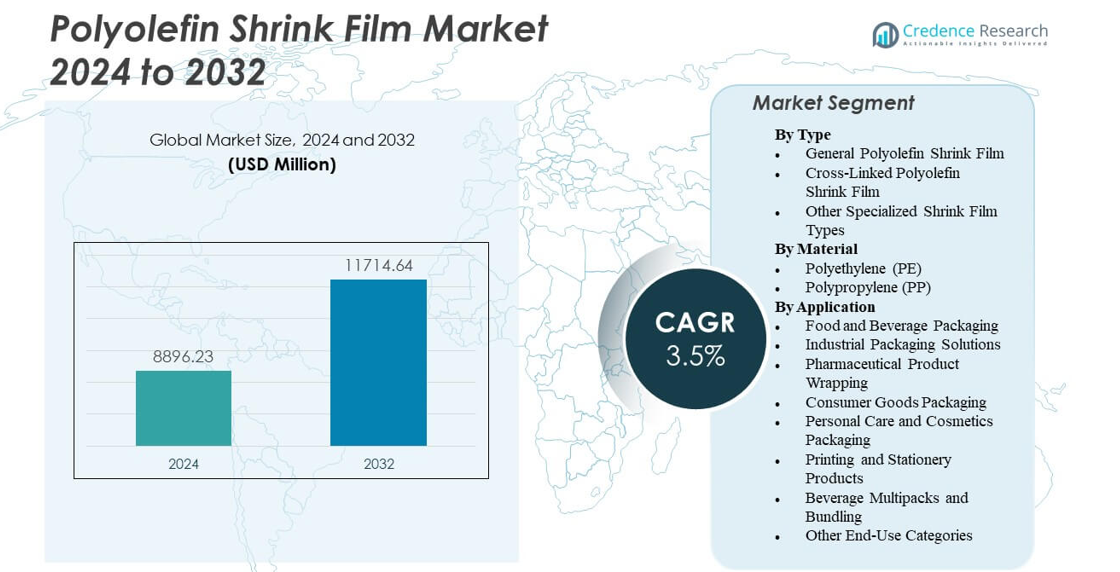
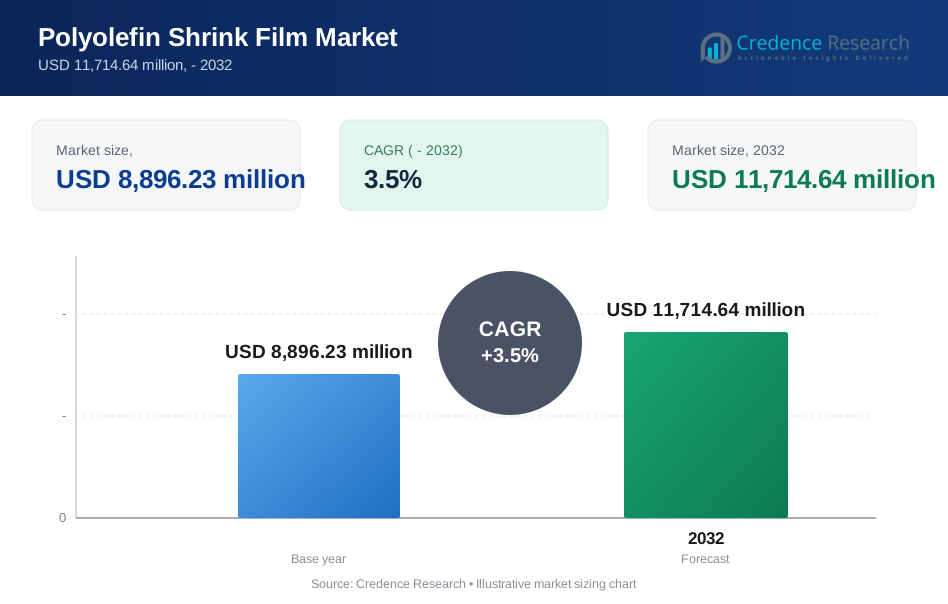
The Polyolefin Shrink Film Market is projected to grow from USD 8,896.23 million in 2024 to an estimated USD 11,714.64 million by 2032, with a compound annual growth rate (CAGR) of 3.5% from 2024 to 2032.
| REPORT ATTRIBUTE | DETAILS |
|---|---|
| Historical Period | 2020-2023 |
| Base Year | 2024 |
| Forecast Period | 2025-2032 |
| Polyolefin Shrink Film Market Size 2024 | USD 8,896.23 million |
| Polyolefin Shrink Film Market, CAGR | 3.5% |
| Polyolefin Shrink Film Market Size 2032 | USD 11,714.64 million |
Market drivers focus on improved packaging efficiency, strong consumer preference for visually appealing goods and the shift toward recyclable materials. Many manufacturers upgrade extrusion systems to achieve thinner gauges while maintaining strength. The film’s flexibility helps brands handle diverse product shapes and sizes. Steady growth in e-commerce increases the need for secure wrapping across distribution networks. Companies use shrink films to reduce damage, improve safety and support branding. Adoption grows as packaged food demand rises across global markets. These factors reinforce long-term market expansion.
North America leads due to mature packaging infrastructure and strong FMCG production. Europe follows with high emphasis on standardized packaging quality and sustainability-driven material innovation. Asia Pacific emerges as the fastest-growing region supported by expanding manufacturing hubs and rising packaged food consumption. China and India display strong growth due to large retail networks and increasing automation. Latin America shows moderate expansion as companies upgrade packaging operations. The Middle East & Africa gain traction through rising consumer goods demand and growing retail distribution.
Market Insights:
- The Polyolefin Shrink Film Market will rise from USD 8,896.23 million in 2024 to USD 11,714.64 million by 2032, supported by a 3.5% CAGR driven by strong usage across food, retail and consumer goods sectors.
- Market drivers highlight demand for clear, durable and lightweight packaging that supports branding, automation efficiency and reduced material load.
- Market restraints involve sustainability pressures, raw material volatility and rising expectations for recyclable structures that challenge production stability.
- Regional analysis shows North America leading due to advanced packaging systems, Europe following with strong regulatory influence and Asia Pacific emerging rapidly through expanding manufacturing and packaged food demand.
- Long-term momentum will strengthen through technology upgrades, thinner gauge development and broader adoption across e-commerce, FMCG and industrial sectors.
Market Drivers
Growing Shift Toward Flexible and Lightweight Packaging Solutions Across Consumer and Industrial Sectors
The Polyolefin Shrink Film Market gains strength through rising demand for flexible packaging across retail and industrial supply chains. Brand owners choose shrink films to improve product visibility and shelf appeal. Packaging teams adopt these films to reduce material weight and improve transport efficiency. Many processors invest in upgraded extrusion systems that support high-clarity output. Food and beverage producers rely on safe sealing features to protect sensitive goods. E-commerce players use shrink formats to reduce damage during transit. Sustainability goals push firms toward recyclable polyolefin structures. Many factors support continued market acceptance.
- For instance, Dow collaborated with RKW Group in June 2024 to launch REVOLOOP™ recycled-plastics resin grades with up to 100% post-consumer recycled content for shrink-film applications.
Increasing Emphasis on High-Speed Packaging Line Efficiency and Cost Optimization Across Production Hubs
High-speed packaging lines drive wider usage due to strong compatibility with automated systems. The Polyolefin Shrink Film Market benefits from stronger demand for clean sealing at rapid cycle rates. Machine operators prefer films that reduce breakage on wrapping units. It helps packaging plants maintain predictable throughput during peak loads. Cost pressure encourages manufacturers to adopt thinner gauges without losing durability. Film converters develop new blends that improve puncture resistance. Retailers rely on consistent wrapping to maintain brand image across stores. Efficiency-driven purchasing supports long-term uptake.
Rising Adoption Across Food, Beverage, and FMCG Brands Seeking Safer and More Attractive Pack Formats
Food and FMCG brands use shrink films to maintain hygiene and support tamper-evident wrapping. The Polyolefin Shrink Film Market gains momentum through increased processed food consumption. Producers need materials that handle variable temperatures during storage and shipping. It supports stable protection against moisture and dust across retail chains. Clear film structures help brands display labels and graphics with stronger impact. Busy lifestyles push consumers toward packaged goods with clean presentation. Packaging experts adopt shrink films to extend shelf presence. Demand continues to rise across large brand portfolios.
- for instance, Innovia Films introduced a next-generation floatable polyolefin shrink film in February 2025 tailored for light-sensitive goods using recycling-friendly material.
Strong Push Toward Reducing Damage Rates and Improving Product Handling Across Expanded Distribution Networks
Distribution networks use shrink films to protect mixed product loads across long routes. The Polyolefin Shrink Film Market grows through strong logistics modernization. Packaged goods move across diverse climates that require steady performance from wrapping films. It helps reduce breakage during stacking and pallet movement. Many firms adopt multipack formats to improve promotional planning. Shrink films support safer handling for fragile goods. Retailers gain better control over inventory with clear outer wraps. Transport-heavy sectors drive continuous adoption.
Market Trends
Expansion of Multilayer Film Structures Supporting Higher Strength, Clarity, and Performance Across Packaging Lines
Multilayer structures gain wide use due to improved toughness and better sealing response. The Polyolefin Shrink Film Market sees rising interest in engineered blends. Film producers upgrade resin combinations to meet strict clarity rules from brand owners. It supports efficient wrapping across high-speed units. New structures help deliver stronger shrink force for irregular items. Companies pursue balanced film properties that lower waste. Packaging teams shift from single-layer formats to multilayer grades. Innovation guides the design of next-generation films.
- For instance, ExxonMobil's Exceed S 9243ML performance polyethylene delivers high dart drop impact alongside stiffness in blown film lines, reducing the need for HDPE blending while maintaining toughness in functional layers.
Increasing Use of Recyclable and Eco-Focused Film Grades Driven by Strong Sustainability Commitments
Sustainability rules shape demand for recyclable polyolefin options across multiple regions. The Polyolefin Shrink Film Market gains value through greener material development. Many producers test low-impact additives to meet circular economy goals. It supports reduced environmental load without affecting film strength. Packaging buyers choose solutions aligned with corporate responsibility plans. Recycle-ready films gain traction across consumer goods. Brands highlight improved environmental performance in new launches. Green-focused innovation continues to expand.
Growing Integration of Advanced Extrusion and Automation Technologies Across High-Volume Plants
Producers invest in advanced extrusion systems to improve consistency and reduce downtime. The Polyolefin Shrink Film Market benefits from better process control. Automated tools help maintain stable thickness and performance. It drives higher reliability for converters that serve global supply chains. Plants use improved cooling and flow management tools to raise output. Data-driven monitoring strengthens quality across large batches. Faster roll changes improve operational speed. Technology upgrades shape long-term production planning.
Wider Use of Shrink Films in Multipacks, Promotional Bundles, and E-Commerce Packaging Formats
Multipack formats grow due to rising retail promotions and bulk buying patterns. The Polyolefin Shrink Film Market rises through wider use in bundling needs. E-commerce sellers prefer shrink films for compact packaging that reduces void space. It helps improve delivery safety for mixed goods. Many brands adopt shrink formats to simplify display-ready packaging. Multipacks offer flexibility for seasonal campaigns. Retail teams depend on clean wraps for faster shelving. Demand grows across high-volume categories.
- For instance, ExxonMobil's Exceed XP 7021ML in 1 mil films shows puncture force of 66 N and puncture energy of 5.1 J on blown film lines with 2.5:1 blow-up ratio.
Market Challenges Analysis
Rising Pressure from Sustainability Rules and Shifts Toward Alternative Packaging Formats
The Polyolefin Shrink Film Market faces strict rules tied to plastic reduction goals. Governments push firms to improve waste collection and recycling readiness. It forces producers to redesign structures that meet compliance needs. Some buyers explore paper or compostable formats that compete with shrink films. Public concern over single-use plastic affects purchase decisions. Film converters must upgrade resins to meet clarity and strength targets while staying compliant. Brands need clearer sustainability claims to support customer trust. Regulatory pressure shapes long-term adoption.
Operational Constraints Linked to Raw Material Volatility and High Investment Needs for Technology Upgrades
Producers face fluctuating resin prices that affect planning across large operations. The Polyolefin Shrink Film Market manages cost swings through careful sourcing. It requires stable access to high-quality polyolefin grades. Plants need major capital for new extrusion and automation tools. Small converters struggle to match quality from larger players. Machine downtime affects supply reliability for retail and FMCG clients. Variability in feedstock supply adds further stress. Cost control remains a recurring challenge.
Market Opportunities
Rising Scope for Recycle-Ready Film Structures and High-Performance Grades Across Modern Packaging Chains
The Polyolefin Shrink Film Market gains new opportunities through next-generation recyclable structures. Brands seek materials that support corporate sustainability programs across global markets. It allows converters to design films with fewer additives. High-performance blends open room for advanced sealing and improved clarity. FMCG groups explore thinner gauges that maintain strength. Recycle-ready solutions support stronger acceptance across regulated regions. Innovation in clean formulations expands value. Interest continues to rise among major producers.
Growing Demand Across E-Commerce, Retail Multipacks, and Automated Warehousing Systems Worldwide
E-commerce expansion creates strong openings for compact and protective packaging. The Polyolefin Shrink Film Market benefits from rising shipment frequency across many categories. It helps brands secure goods during long transport cycles. Automated warehouses need wrap formats that run smoothly on robotics and conveyor units. Multipack packaging supports retail promotions across large stores. New product launches strengthen adoption across consumer goods. Emerging economies grow fast due to rising packaged product output. Many sectors drive broad new opportunities.
Market Segmentation Analysis:
By Type
General polyolefin shrink film holds strong usage across high-volume packaging due to its clarity and balanced shrink performance. The Polyolefin Shrink Film Market benefits from steady demand in food, retail, and consumer goods. It supports efficient sealing on automated lines and provides reliable protection during transport. Cross-linked grades gain traction for products that need higher strength and puncture resistance. These films perform well in multipacks and heavy-item wrapping. Specialized shrink films address niche needs tied to label visibility or custom shrink ratios. Each type supports different performance goals across supply chains.
- For instance, Dow's AFFINITY™ PL 1888G polyolefin plastomer for shrink film achieves 600% tensile elongation at break in the machine direction and 570% in the transverse direction.
By Material
Polyethylene grades lead due to their flexibility, durability, and broad machine compatibility across global packaging plants. The Polyolefin Shrink Film Market sees growing preference for PE due to improved toughness and stable shrink response. It maintains strong adoption in food and industrial wrapping. Polypropylene films offer better stiffness and clarity, making them suitable for high-visibility retail goods. PP supports sharper print presentation and lower haze in display packaging. Many converters use PP for premium consumer products. Material choice depends on needed strength, clarity, and print performance.
- For instance, Jiuteng's JT01 film exhibits elongation of 138% in machine direction and 135% in transverse direction at 30 microns.
By Application
Food and beverage packaging holds major demand due to strict hygiene needs and high turnover rates across retail channels. The Polyolefin Shrink Film Market expands through growing use in industrial packaging solutions where durability matters. It supports wrapping for tools, hardware, and machine parts. Pharmaceuticals adopt shrink films for tamper-evident protection. Consumer goods use shrink formats to improve display appeal and shelf stability. Personal care and cosmetics brands rely on clear wraps for premium presentation. Printing and stationery benefit from protection against dust and handling damage. Beverage multipacks depend on shrink bundling for stable transport across long routes. Other end-use categories adopt shrink films for safety, visibility, and easy handling.
Segmentation:
By Type
- General Polyolefin Shrink Film
- Cross-Linked Polyolefin Shrink Film
- Other Specialized Shrink Film Types
By Material
- Polyethylene (PE)
- Polypropylene (PP)
By Application
- Food and Beverage Packaging
- Industrial Packaging Solutions
- Pharmaceutical Product Wrapping
- Consumer Goods Packaging
- Personal Care and Cosmetics Packaging
- Printing and Stationery Products
- Beverage Multipacks and Bundling
- Other End-Use Categories
By Region
- North America
- U.S.
- Canada
- Mexico
- Europe
- Germany
- France
- U.K.
- Italy
- Spain
- Rest of Europe
- Asia Pacific
- China
- Japan
- India
- South Korea
- South-east Asia
- Rest of Asia Pacific
- Latin America
- Brazil
- Argentina
- Rest of Latin America
- Middle East & Africa
- GCC Countries
- South Africa
- Rest of the Middle East and Africa
Regional Analysis:
North America holds the leading share of the Polyolefin Shrink Film Market with about 34%, driven by strong packaged food demand and high automation across distribution networks. The region benefits from advanced extrusion capabilities that support stable supply. It sees steady growth from e-commerce and retail multipacks. It maintains wide acceptance across FMCG brands that require clarity and durability. Strong quality rules push producers to upgrade material structures. Market players strengthen capacity to meet rising sustainability targets.
Europe follows with roughly 28% share, supported by strict packaging standards and strong FMCG production strength. The Polyolefin Shrink Film Market in this region benefits from high focus on recyclable structures. It gains traction across food, cosmetics, and specialty consumer goods. Western Europe leads demand due to dense retail networks. Eastern Europe shows firm adoption through growing investment in automated packaging lines. Sustainability rules shape material innovation across converters.
Asia Pacific holds about 30% share and stands as the fastest-growing region due to rising manufacturing output and strong export activity. It gains momentum through expanding packaged food consumption in China, India, and Southeast Asia. It supports high-volume wrapping needs across industrial products. Local producers invest in advanced machinery to meet global quality standards. Many brands shift output to APAC to gain cost advantages. Strong demographic growth supports long-term expansion.
Key Player Analysis:
- Amcor Plc
- Berry Global Inc.
- Sealed Air Corporation
- Intertape Polymer Group Inc. (IPG, Exlfilm)
- Sigma Plastics Group
- Syfan
- Clysar
- Coveris Holdings SA
Competitive Analysis:
The Polyolefin Shrink Film Market features strong competition driven by material innovation, gauge reduction programs, and sustainability commitments. Global producers invest in multilayer structures that improve clarity and toughness across automated lines. It encourages firms to expand extrusion capacity and strengthen regional distribution. Leading companies compete through resin optimization, recyclable material development, and improved shrink performance for irregular goods. Mid-size converters focus on contract packaging, short-run production, and niche blends for premium segments. Partnerships across FMCG, food, and logistics firms help suppliers align film features with brand needs. Competitive pressure remains high due to pricing sensitivity across major applications. Market players pursue technology upgrades to secure stronger positioning across global supply chains.
Recent Developments:
- In November 2025, Amcor plc announced a major expansion of printing, lamination, and converting capabilities at its North American facilities to support growing demand in protein packaging an investment that will run through the first half of 2026.
- In April 2025, Amcor Plc completed its combination with Berry Global Inc., enhancing its position as a global leader in consumer and healthcare packaging solutions through advanced material science and innovation capabilities.
- In October 2024, Innovia Films expanded its floatable polyolefin shrink range by introducing a 45 µm grade to improve material efficiency and a high-shrink variant tailored for contoured bottles.
Report Coverage:
The research report offers an in-depth analysis based on Type, Material and Application. It details leading market players, providing an overview of their business, product offerings, investments, revenue streams, and key applications. Additionally, the report includes insights into the competitive environment, SWOT analysis, current market trends, as well as the primary drivers and constraints. Furthermore, it discusses various factors that have driven market expansion in recent years. The report also explores market dynamics, regulatory scenarios, and technological advancements that are shaping the industry. It assesses the impact of external factors and global economic changes on market growth. Lastly, it provides strategic recommendations for new entrants and established companies to navigate the complexities of the market.
Future Outlook:
- The Polyolefin Shrink Film Market will gain strength through wider use across food, retail, and consumer goods.
- Demand will rise as brands adopt high-clarity films that support stronger visual appeal.
- Growth will improve through thin-gauge structures that lower material load without reducing performance.
- Adoption of recyclable blends will increase due to rising sustainability rules across key regions.
- Automated packaging lines will drive interest in films that maintain stable sealing at higher speeds.
- E-commerce expansion will support consistent uptake for protective and lightweight wrapping formats.
- Industrial sectors will prefer reinforced shrink films designed for heavy-load applications.
- Investments in multilayer extrusion technology will improve durability and shrink consistency.
- Emerging regions will expand output due to rising packaged product consumption.
- Partnerships between resin suppliers and converters will shape next-generation shrink film innovation.
Request a Free Sample
Fill in your details and we'll send you a free sample report.
- Sample data tables & charts
- Research methodology
Need a Custom Version of This Report?
Tailor the scope, geography, or segments to your exact requirements.
- Custom geography or segment scope
- Direct access to our analyst team
Frequently Asked Questions
What is the current market size for the Polyolefin Shrink Film Market, and what is its projected size in 2032?
At what Compound Annual Growth Rate is the Polyolefin Shrink Film Market projected to grow between 2024 and 2032?
Which Polyolefin Shrink Film Market segment held the largest share in 2024?
What are the primary factors fueling the growth of the Polyolefin Shrink Film Market?
Who are the leading companies in the Polyolefin Shrink Film Market?
Table of Content
Chapter 1. Report Introduction
- 1.1 Report Description & Purpose
- 1.1.1 Report Title & Market Definition
- 1.1.2 Unique Selling Propositions (USP) & Key Differentiators
- 1.1.3 Value Proposition for Stakeholders
- 1.2 Research Objectives
- 1.2.1 Market Sizing Objectives (Volume & Revenue)
- 1.2.2 Segmentation Objectives
- 1.2.3 Competitive Intelligence Objectives
- 1.2.4 Forecast & Scenario Objectives
- 1.3 Report Scope
- 1.3.1 Polyolefin Shrink Film Scope – Types & Subtypes Covered
- 1.3.2 Geographic Scope – Regions & Countries Covered
- 1.3.3 Historical Period, Base Year & Forecast Period (the historical period; forecast to 2032)
- 1.3.4 Inclusions & Exclusions
- 1.4 HS Code & Classification Framework
- 1.5 Currency, Units & Pricing Basis
- 1.6 Target Stakeholders
- 1.7 Limitations & Assumptions
Chapter 2. Executive Summary
- 2.1 Global Polyolefin Shrink Film Market Snapshot
- 2.1.1 Market Size – Historical (the historical period) & Forecast (2032) (base year: USD 8,896.23 million → 2032: USD 11,714.64 million)
- 2.1.2 Volume & Revenue – Global Totals
- 2.1.3 Key Market Highlights – Top Five Facts
- 2.2 Polyolefin Shrink Film Market Segmentation Snapshot
- 2.2.1 Market Split by Region – vs. 2032
- 2.3 Competitive Snapshot
- 2.3.1 Top 10 Players by Revenue Share –
- 2.3.2 Top 10 Players by Volume Share –
- 2.3.3 Recent Strategic Developments (18-Month Summary)
- 2.4 Key Investment Highlights & Strategic Conclusions
Chapter 3. Polyolefin Shrink Film Market Dynamics & Industry Analysis
- 3.1 Market Overview & Context
- 3.1.1 Polyolefin Shrink Film Market Position in the Broader Automotive Value Chain
- 3.1.2 OEM vs. Replacement Market Dynamics
- 3.1.3 Market Maturity & Development Stage by Region
- 3.2 Polyolefin Shrink Film Market Drivers
- 3.3 Polyolefin Shrink Film Market Restraints & Challenges
- 3.4 Polyolefin Shrink Film Market Opportunities
- 3.5 Porter's Five Forces Analysis
- 3.5.1 Threat of New Entrants
- 3.5.2 Bargaining Power of Suppliers
- 3.5.3 Bargaining Power of Buyers
- 3.5.4 Threat of Substitutes
- 3.5.5 Competitive Rivalry – Intensity Assessment
- 3.6 Polyolefin Shrink Film Value Chain Analysis
- 3.6.1 Upstream – Raw Material/Input Suppliers
- 3.6.1.1 Raw Material/Input 1
- 3.6.1.2 Raw Material/Input 2
- 3.6.1.3 Raw Material/Input 3
- 3.6.2 Midstream – Production/Manufacturing/Service Delivery
- 3.6.2.1 Production/Process Overview
- 3.6.2.2 Key Facility Locations & Capacity by Manufacturer
- 3.6.3 Downstream – Distribution & End Consumer
- 3.6.3.1 Primary Channel – B2B/OEM
- 3.6.3.2 Secondary Channels – Dealer, Retail, Online, Direct
- 3.6.4 Value Chain Profitability Analysis
- 3.6.1 Upstream – Raw Material/Input Suppliers
- 3.7 PESTEL Analysis
- 3.7.1 Political Factors
- 3.7.2 Economic Factors
- 3.7.3 Social Factors
- 3.7.4 Technological Factors
- 3.7.5 Environmental Factors
- 3.7.6 Legal Factors
- 3.8 Polyolefin Shrink Film Supply Chain Analysis
- 3.8.1 Raw Material/Input Supply Risk Assessment
- 3.8.2 Manufacturing Concentration Risk (Geographic Exposure)
- 3.8.3 Trade Disruption Impact Analysis
- 3.9 Regulatory & Policy Landscape
Note: The regulatory and policy landscape section covers regulations based on their applicability to the market, Polyolefin Shrink Film category, geography, and scope of the study. Only regulatory frameworks with a material impact on operations, compliance, trade, sustainability, or market access are analyzed in detail.
Chapter 4. Key Investment Pockets & Opportunity Analysis
- 4.1 Polyolefin Shrink Film Market Attractiveness Analysis
- 4.1.1 By Region – Investment Attractiveness Matrix (Volume × CAGR)
- 4.2 Absolute Revenue Growth Opportunity
- 4.2.1 By Region – Absolute USD Growth Through 2032
- 4.3 Incremental Volume Opportunity
- 4.3.1 By Region – Incremental Volume Through 2032
- 4.3.2 Segment – Incremental Volume
- 4.4 Emerging Submarket Opportunity Deep Dive (Subject to Applicability)
- 4.5 Emerging Market Opportunity Scorecards
- 4.5.1 United States
- 4.5.2 Europe
- 4.5.3 Asia
- 4.5.4 Middle East & Africa
Note: Emerging Market Opportunity Scorecards will be included based on relevance and strategic importance. Regions listed are indicative and may vary depending on data availability and market dynamics.
Chapter 5. Polyolefin Shrink Film Import-Export Analysis & Trade Flows
- 5.1 Global Trade Overview
- 5.1.1 Global Export Value by Country (the historical period)
- 5.1.2 Global Export Volume by Country (the historical period)
- 5.1.3 Global Import Value by Country (the historical period)
- 5.1.4 Global Import Volume by Country (the historical period)
- 5.1.5 Net Trade Balance by Country (the historical period)
- 5.2 Export Analysis – Segment
- 5.2.1 Type 1 (HS Code)
- 5.2.2 Type 2 (HS Code)
- 5.2.3 Type 3 (HS Code)
- 5.2.4 Type 4 (HS Code)
- 5.2.5 Type 5 (HS Code)
- 5.3 Import Analysis – Segment
- 5.3.1 Type 1 (HS Code)
- 5.3.2 Type 2 (HS Code)
- 5.3.3 Type 3 (HS Code)
- 5.3.4 Type 4 (HS Code)
- 5.3.5 Type 5 (HS Code)
- 5.4 Average Unit Trade Prices
- 5.4.1 Average Export Price – Segment & Country
- 5.4.2 Average Import Price – Segment & Source Country
- 5.4.3 Price Trends (the historical period)
- 5.5 Key Trade Route Analysis
- 5.5.1 Trade Route 1
- 5.5.2 Trade Route 2
- 5.5.3 Trade Route 3
- 5.5.4 Trade Route 4
- 5.5.5 Trade Route 5
- 5.6 Trade Policy Impact Assessment
- 5.6.1 US Anti-Dumping & Section 301 Tariffs
- 5.6.2 EU Customs Union Impact
- 5.6.3 Major Free Trade Agreements
- 5.6.4 USMCA Rules of Origin
Note: Trade policy analysis will be included only where relevant to the Polyolefin Shrink Film market.
Chapter 6. Competitive Landscape & Company Benchmarking
- 6.1 Polyolefin Shrink Film Market Concentration & Structure
- 6.1.1 Herfindahl-Hirschman Index (HHI) – vs.
- 6.1.2 Tier 1, Tier 2 & Tier 3 Market Structure
- 6.1.3 Global, Regional & Local Player Dynamics
- 6.2 Polyolefin Shrink Film Market Share Analysis –
- 6.2.1 Global Revenue Share by Company
- 6.2.2 Global Volume Share by Company
- 6.2.3 Regional Revenue Share
- 6.2.4 Market Share Evolution ( vs. )
- 6.2.5 OEM Segment Share by Company
- 6.2.6 Replacement Segment Share by Company
- 6.3 Production/Delivery Capacity & Facility Analysis
- 6.3.1 Global Installed Capacity
- 6.3.2 Capacity Utilization Rates
- 6.3.3 Production/Output Volume
- 6.3.4 Facility Locations & Capacity Map
- 6.3.5 Planned Capacity Additions
- 6.4 Polyolefin Shrink Film Competitive Benchmarking Matrix
- 6.4.1 Revenue, Volume, CAGR & Profitability Comparison
- 6.4.2 Channel Revenue Mix
- 6.4.3 Geographic Revenue Exposure
- 6.4.4 R&D Intensity
- 6.4.5 Sustainability Maturity
- 6.5 Strategic Developments in Polyolefin Shrink Film (Last 24 Months)
- 6.5.1 Mergers, Acquisitions & Divestments
- 6.5.2 New Polyolefin Shrink Film Launches
- 6.5.3 Facility Expansions
- 6.5.4 Strategic Alliances, Joint Ventures & Partnerships
- 6.5.5 Distribution Expansion & Market Entry
- 6.5.6 Sustainability & ESG Initiatives
- 6.6 Competitive Strategy Mapping
- 6.6.1 Leader, Challenger, Follower & Niche Classification
- 6.6.2 Pricing Strategy Comparison
- 6.6.3 Channel Strategy Matrix
Note: Strategic developments are included based on their materiality and the availability of reliable information.
Chapter 7. Global Polyolefin Shrink Film Market – By Distribution Channel
- 7.1 Segment Overview
- 7.1.1 Volume & Revenue Split by Channel ( & 2032)
- 7.1.2 Channel Mix Evolution (2032)
Chapter 8. Regional Market Analysis – Global Overview
- 8.1 Global Regional Overview
- 8.1.1 Regional Volume Share
- 8.1.2 Regional Revenue Share
- 8.1.3 Regional Volume by Region
- 8.1.4 Regional Revenue by Region
- 8.1.5 Regional Forecast Through 2032
- 8.2 Cross-Regional Segment Analysis
- 8.2.1 By Distribution Channel
- 8.2.2 By Brand/Price Tier
Chapter 9. North America Polyolefin Shrink Film Market
- 9.1 United States
- 9.2 Canada
- 9.3 Mexico
Chapter 10. Europe Polyolefin Shrink Film Market
- 10.1 Germany
- 10.2 France
- 10.3 Italy
- 10.4 United Kingdom
- 10.5 Spain
- 10.6 Poland
- 10.7 Russia
- 10.8 Netherlands
- 10.9 Belgium
- 10.10 Sweden
- 10.11 Denmark
- 10.12 Norway
- 10.13 Rest of Europe
Chapter 11. Asia Pacific Polyolefin Shrink Film Market
- 11.1 China
- 11.2 India
- 11.3 Japan
- 11.4 South Korea
- 11.5 Thailand
- 11.6 Indonesia
- 11.7 Vietnam
- 11.8 Malaysia
- 11.9 Australia
- 11.10 Rest of Asia Pacific
Chapter 12. Latin America Polyolefin Shrink Film Market
- 12.1 Brazil
- 12.2 Argentina
- 12.3 Colombia
- 12.4 Chile
- 12.5 Rest of Latin America
Chapter 13. Middle East Polyolefin Shrink Film Market
- 13.1 Saudi Arabia
- 13.2 United Arab Emirates
- 13.3 Turkey
- 13.4 Israel
- 13.5 Iran
- 13.6 Rest of the Middle East
Chapter 14. Africa Polyolefin Shrink Film Market
- 14.1 South Africa
- 14.2 Egypt
- 14.3 Nigeria
- 14.4 Morocco
- 14.5 Rest of Africa
Chapter 15. Polyolefin Shrink Film Company Profiles
- 15.1 [Company 01]
- 15.1.1 Company Overview
- 15.1.2 Key Management Personnel
- 15.1.3 Products & Services Portfolio
- 15.1.4 Financial Performance
- 15.1.5 Key Market Focus & Geographic Presence
- 15.1.6 Recent Developments & Strategic Initiatives
Note: The company profile list is preliminary and may change based on research findings, market developments, data availability, and client requirements.
Chapter 16. Appendices
- Appendix A – List of Abbreviations & Acronyms
- Appendix B – Industry Classification Code Reference – Full Series
- Appendix C – Production & Capacity Data Tables
- Appendix D – End-Use & Demand Base Tables
- Appendix E – Consumption & Replacement Rate Assumptions
- Appendix F – ASP Reference Tables
- Appendix G – Manufacturing & Facility Database
- Appendix H – Import-Export Data Tables
- Appendix I – Regulatory Summary Tables
- Appendix J – Primary Research Participant List (Anonymized)
- Appendix K – Primary Research Questionnaire Framework
- Appendix L – Data Sources & Bibliography
- Appendix M – Market Size Divergence & Source Comparison
Chapter 17. Research Methodology
- 17.1 Research Framework & Philosophy
- 17.2 Secondary Research – Sources, Hierarchy & Data Extraction
- 17.3 Data Modeling – Bottom-Up & Top-Down Market Sizing
- 17.4 Primary Research – Stakeholder Framework, LOI & Sample Sizes
- 17.5 Forecast Methodology – Regression, Scenario & Sensitivity Analysis
- 17.6 Quality Control – Four-Layer Validation Framework
- 17.7 Limitations & Standard Assumptions
- 17.8 Disclaimer
