Market Overview
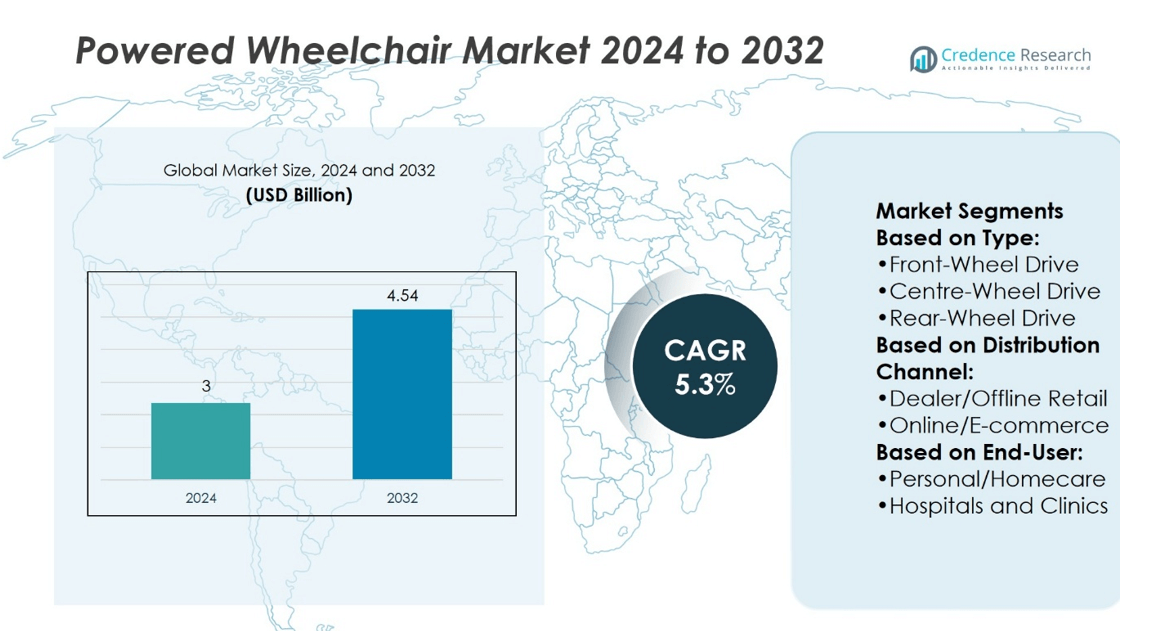
Powered Wheelchair Market size was valued at USD 3 billion in 2024 and is anticipated to reach USD 4.54 billion by 2032, at a CAGR of 5.3% during the forecast period.
| REPORT ATTRIBUTE |
DETAILS |
| Historical Period |
2020-2023 |
| Base Year |
2024 |
| Forecast Period |
2025-2032 |
| Powered Wheelchair Market Size 2024 |
USD 3 billion |
| Powered Wheelchair Market, CAGR |
5.3% |
| Powered Wheelchair Market Size 2032 |
USD 4.54 billion |
The Powered Wheelchair Market grows steadily, driven by rising mobility impairments, expanding elderly populations, and increasing demand for advanced assistive technologies. It benefits from supportive healthcare policies, reimbursement programs, and greater awareness of accessibility needs across developed and developing regions. Technological progress, including smart navigation, lightweight materials, and energy-efficient batteries, strengthens product adoption and enhances user independence. Consumers favor ergonomic and customizable designs that improve comfort and daily usability. Growing investments in healthcare infrastructure and the expansion of digital sales platforms further accelerate market growth. It reflects a clear trend toward innovation, personalization, and sustainable mobility solutions.
The Powered Wheelchair Market shows strong presence across North America, Europe, Asia-Pacific, Latin America, and the Middle East & Africa, with North America holding the largest share due to advanced healthcare systems and supportive reimbursement policies. Europe maintains stable growth with rising elderly populations, while Asia-Pacific emerges as the fastest-growing region supported by healthcare investments and local manufacturing. Key players such as Invacare Corporation, Permobil, Pride Mobility, Ottobock, and Numotion strengthen the market through innovation, global expansion, and patient-focused solutions.
Market Insights
- Powered Wheelchair Market size was valued at USD 3 billion in 2024 and is expected to reach USD 4.54 billion by 2032, at a CAGR of 5.3%.
- Rising mobility impairments and aging populations drive steady demand for advanced powered mobility solutions.
- Smart navigation, lightweight frames, and energy-efficient batteries reflect key technological trends shaping product innovation.
- Competitive landscape remains strong with global leaders focusing on product portfolios, partnerships, and user-centric designs.
- High costs and limited reimbursement in some regions act as restraints, restricting wider adoption.
- North America holds the largest share supported by healthcare policies, while Europe maintains stability and Asia-Pacific leads growth.
- Market outlook highlights innovation, customization, and sustainability as core elements for long-term expansion.
Access crucial information at unmatched prices!
Request your sample report today & start making informed decisions powered by Credence Research Inc.!
Download Sample
Market Drivers
Growing Prevalence of Mobility Impairments Driving Demand
The Powered Wheelchair Market expands steadily due to the rising prevalence of mobility impairments worldwide. It benefits from a growing elderly population, with many individuals experiencing limited mobility due to age-related conditions such as arthritis and stroke. Rising rates of spinal cord injuries and multiple sclerosis further reinforce the demand for advanced mobility solutions. Governments and healthcare providers actively support accessibility programs, fueling adoption in both developed and developing regions. The market responds with enhanced features that address specific patient needs. It positions powered wheelchairs as a critical solution for improving independence and quality of life.
- For instance, Permobil, a leading powered wheelchair manufacturer, reported in 2021 that it had delivered more than 100,000 powered wheelchairs globally, supporting patients with mobility impairments across healthcare and rehabilitation settings.
Advancements in Technology Enhancing Product Appeal
Technological progress significantly strengthens the Powered Wheelchair Market. It introduces intelligent navigation systems, lightweight materials, and improved battery performance that enhance user convenience. Manufacturers integrate IoT-based monitoring and smart controls to provide safety and comfort. Compact and foldable designs make wheelchairs more travel-friendly, increasing their appeal among active users. Enhanced durability and energy-efficient motors ensure reliable performance in diverse environments. It reinforces trust among patients and caregivers while promoting broader acceptance.
- For instance, Sunrise Medical reported that its QUICKIE and Zippie wheelchair product lines feature more than 2,000 configuration options across seating, positioning, and drive controls, enabling highly personalized solutions for diverse patient requirements worldwide.
Rising Healthcare Infrastructure and Insurance Coverage Supporting Accessibility
The Powered Wheelchair Market gains momentum through improved healthcare infrastructure and favorable insurance policies. It becomes easier for patients to access high-quality equipment through government subsidies and private insurance reimbursement. Hospitals, rehabilitation centers, and homecare providers expand their offerings, strengthening market penetration. Improved distribution networks make advanced wheelchairs more available in urban and rural areas alike. Financial assistance programs reduce cost burdens, enabling more individuals to secure powered mobility solutions. It reflects a shift toward inclusive healthcare systems that prioritize mobility support.
Increasing Focus on Personalization and User Comfort
Customization and comfort remain vital drivers in the Powered Wheelchair Market. It addresses patient-specific needs by offering adjustable seating, ergonomic designs, and modular components. Demand rises for solutions tailored to different age groups, body structures, and lifestyle requirements. Growing awareness among users encourages manufacturers to prioritize designs that improve posture, reduce strain, and prevent complications. Integration of aesthetic choices, such as varied colors and sleek builds, also influences consumer preferences. It establishes powered wheelchairs as not just medical devices but lifestyle enablers.
Market Trends
Integration of Smart Technologies Transforming User Experience
The Powered Wheelchair Market witnesses a strong trend toward the adoption of smart technologies. It incorporates features such as voice control, joystick precision, and AI-based navigation to enhance mobility. GPS tracking and connectivity options increase safety for both users and caregivers. Manufacturers explore integration with mobile applications, enabling real-time monitoring and adjustments. Smart sensors improve obstacle detection, reducing the risk of accidents in daily use. It positions powered wheelchairs as intelligent devices rather than traditional mobility aids.
- For instance, Meyra GmbH, a leading German mobility solutions manufacturer, offers more than 130 wheelchair and rehabilitation aid models, including lightweight powered wheelchairs engineered with aluminum frames to enhance portability and user convenience.
Rising Demand for Lightweight and Portable Designs
The Powered Wheelchair Market experiences growth in demand for lightweight and compact models. It addresses the need for portability by using advanced materials such as aluminum alloys and carbon fiber. Foldable designs appeal to users who travel frequently and require easy storage. Reduced weight increases maneuverability in urban settings and public transport systems. Manufacturers focus on ergonomics and user-friendly adjustments to make devices more accessible. It supports broader adoption by improving convenience and independence.
- For instance, Pride Mobility Products Ltd, one of the largest powered wheelchair manufacturers, distributes its mobility solutions in more than 80 countries worldwide, with thousands of units specifically designed for homecare environments equipped with compact turning radii and remote service support features.
Increasing Focus on Sustainable and Energy-Efficient Solutions
The Powered Wheelchair Market aligns with global trends toward sustainability and energy efficiency. It integrates rechargeable lithium-ion batteries that offer longer usage times with shorter charging cycles. Energy-efficient motors enhance performance while reducing power consumption. Eco-friendly materials in construction support environmental goals and appeal to conscious consumers. Manufacturers develop recyclable components and modular designs to extend product lifecycles. It establishes powered wheelchairs as part of sustainable healthcare innovations.
Expansion of Homecare and Remote Healthcare Applications
The Powered Wheelchair Market benefits from the expansion of homecare and remote healthcare solutions. It aligns with the growing preference for in-home treatment and rehabilitation services. Integration with telehealth platforms allows caregivers to monitor mobility progress and usage remotely. Home-based customization options make wheelchairs adaptable to different living environments. Increased demand for independence among elderly populations strengthens this trend. It highlights powered wheelchairs as essential tools within evolving homecare ecosystems.
Market Challenges Analysis
High Costs and Limited Affordability Restricting Adoption
The Powered Wheelchair Market faces significant challenges due to high product costs and limited affordability for many patients. It often requires advanced technology, durable materials, and specialized components, which drive up prices. Many individuals in low- and middle-income regions struggle to access powered mobility solutions without substantial financial assistance. Insurance coverage and reimbursement policies remain inconsistent across countries, leaving a gap in accessibility. Maintenance expenses, including battery replacement and technical servicing, add to the long-term financial burden. It creates barriers for wider adoption despite strong demand from aging populations and individuals with mobility impairments.
Infrastructure Limitations and Technical Constraints Hindering Growth
The Powered Wheelchair Market encounters obstacles from inadequate infrastructure and technical limitations. It becomes difficult for users to navigate areas lacking wheelchair-friendly facilities such as ramps, elevators, and smooth pathways. Limited availability of charging stations restricts outdoor usage, especially for long-distance travel. Power limitations, weight restrictions, and difficulties in maneuvering across uneven terrain reduce overall performance in real-world conditions. Complex repair requirements and lack of skilled service providers further complicate adoption in underserved regions. It highlights the need for comprehensive infrastructure improvements and technical support systems to fully realize the potential of powered mobility solutions.
Market Opportunities
Growing Scope in Emerging Economies and Untapped Markets
The Powered Wheelchair Market presents strong opportunities in emerging economies with rising healthcare investments and expanding accessibility initiatives. It gains momentum as governments in Asia-Pacific, Latin America, and the Middle East prioritize inclusive mobility solutions. Rising disposable incomes and expanding private healthcare facilities create favorable conditions for adoption. Local manufacturing partnerships can reduce costs and improve availability in underserved regions. International aid programs and non-governmental organizations further support distribution, particularly for disabled populations in rural areas. It opens pathways for long-term growth by addressing large and underserved demographics.
Advancements in Customization and Integration with Digital Health
The Powered Wheelchair Market benefits from growing opportunities in customization and integration with digital health platforms. It allows manufacturers to deliver tailored solutions with modular seating, posture support, and adaptive controls. Collaboration with telehealth providers creates scope for remote monitoring of usage patterns and maintenance needs. Integration with wearable devices and AI-driven analytics improves safety and enhances rehabilitation outcomes. Demand for personalized healthcare equipment strengthens the appeal of powered wheelchairs as lifestyle-oriented products. It positions the market to expand through innovation, patient-centric design, and cross-industry collaborations.
Market Segmentation Analysis:
By Type
The Powered Wheelchair Market shows a diverse product segmentation led by front-wheel drive, center-wheel drive, and rear-wheel drive models. Front-wheel drive wheelchairs offer strong maneuverability on uneven terrain, making them suitable for outdoor use. Center-wheel drive models dominate urban and indoor applications due to their tighter turning radius and smoother navigation in confined spaces. Rear-wheel drive wheelchairs provide stability at higher speeds, appealing to users who require greater power for long-distance travel. Each type addresses unique mobility challenges, allowing patients to select based on lifestyle and environment. It strengthens the market by delivering versatile options that improve accessibility.
- For instance, Levo AG, a Swiss manufacturer known for its standing powered wheelchairs, distributes its products through a network of dealers in more than 35 countries worldwide, ensuring availability and after-sales service through established offline retail and clinical partnerships.
By Distribution Channel
The Powered Wheelchair Market reaches customers through both dealer/offline retail and online/e-commerce platforms. Dealer and retail networks maintain strong influence by offering personalized consultations, product trials, and servicing support. Hospitals and rehabilitation centers often partner with offline distributors to ensure reliable product supply for patients. Online channels grow rapidly, driven by wider internet access and rising consumer confidence in digital purchases. E-commerce platforms enhance visibility for a broad range of models while offering competitive pricing. It enables manufacturers to expand reach and appeal to tech-savvy consumers seeking convenience and variety.
- For instance, Invacare serves over 25,000 medical equipment providers across 80 countries, reflecting its extensive reach into both homecare and institutional channels through hospitals, clinics, and long-term care partners.
By End User
The Powered Wheelchair Market serves personal/homecare users, hospitals, clinics, and institutional buyers. Homecare adoption rises significantly with aging populations seeking independence and comfort within domestic settings. Hospitals and clinics remain vital end users, incorporating powered wheelchairs into rehabilitation programs and long-term patient support. Institutions such as assisted living facilities also contribute to demand by investing in mobility solutions for residents. Growing awareness of accessibility rights encourages more facilities to adopt advanced wheelchairs as part of their service standards. It ensures strong demand across both individual and institutional user segments, supporting broad-based market growth.
Segments:
Based on Type:
- Front-Wheel Drive
- Centre-Wheel Drive
- Rear-Wheel Drive
Based on Distribution Channel:
- Dealer/Offline Retail
- Online/E-commerce
Based on End-User:
- Personal/Homecare
- Hospitals and Clinics
Based on the Geography:
- North America
- Europe
- UK
- France
- Germany
- Italy
- Spain
- Russia
- Belgium
- Netherlands
- Austria
- Sweden
- Poland
- Denmark
- Switzerland
- Rest of Europe
- Asia Pacific
- China
- Japan
- South Korea
- India
- Australia
- Thailand
- Indonesia
- Vietnam
- Malaysia
- Philippines
- Taiwan
- Rest of Asia Pacific
- Latin America
- Brazil
- Argentina
- Peru
- Chile
- Colombia
- Rest of Latin America
- Middle East
- UAE
- KSA
- Israel
- Turkey
- Iran
- Rest of Middle East
- Africa
- Egypt
- Nigeria
- Algeria
- Morocco
- Rest of Africa
Regional Analysis
North America
North America leads the Powered Wheelchair Market with an estimated 38.3% share in 2025. The region benefits from advanced healthcare infrastructure, strong reimbursement frameworks, and high awareness of mobility solutions. The United States accounts for the largest portion, supported by Medicare and Medicaid coverage and continuous innovation in product design. Canada contributes steadily with its universal healthcare programs and policies promoting accessibility for disabled populations. Increasing adoption of smart technologies such as joystick control and AI navigation strengthens the market position. It ensures North America remains the most mature and dominant powered wheelchair market globally.
Europe
Europe holds a substantial market share, estimated near 27% in 2025, making it the second-largest region. Countries such as Germany, the UK, and France drive demand through structured healthcare systems and widespread adoption of advanced medical equipment. Aging demographics play a key role, with a rising elderly population requiring long-term mobility support. National health services and public subsidies ease affordability, enabling broader adoption across hospitals and homecare. Technological integration and sustainable product design trends further shape the European market. It maintains steady growth through both institutional and personal usage.
Asia-Pacific
Asia-Pacific accounts for approximately 24.5% of the Powered Wheelchair Market in 2025 and represents the fastest-growing region. Rising healthcare investments, expanding elderly populations, and government initiatives on inclusive mobility drive demand. China and Japan remain the leading contributors, with India showing high potential due to its large disabled population base. Domestic manufacturing and cost-effective models support wider penetration in developing economies. Online sales channels grow rapidly in urban centers, boosting accessibility for end users. It positions Asia-Pacific as a region of high growth and strong long-term potential.
Latin America
Latin America holds an estimated 6% market share in 2025, reflecting its status as an emerging market. Brazil and Mexico lead adoption, driven by gradual healthcare reforms and improving distribution networks. Limited reimbursement systems and higher product costs restrict faster growth. However, growing private healthcare facilities and partnerships with global manufacturers improve availability. Awareness campaigns and NGO initiatives also help expand access in underserved areas. It shows potential for steady expansion as infrastructure and policies improve.
Middle East & Africa
The Middle East & Africa collectively represent about 4% of the Powered Wheelchair Market in 2025. Demand is rising in countries such as Saudi Arabia, the UAE, and South Africa, where investments in healthcare modernization are accelerating. Limited infrastructure and affordability challenges still restrain broader adoption. However, government programs and collaborations with international suppliers gradually enhance accessibility. Institutions such as hospitals and rehabilitation centers remain primary buyers, with homecare adoption beginning to grow. It signals future opportunities once cost barriers and infrastructure gaps are addressed.
Shape Your Report to Specific Countries or Regions & Enjoy 30% Off!
Key Player Analysis
- Ostrich Mobility
- Permobil
- Airwheel
- Pride Mobility Products Ltd
- Karman Healthcare
- Invacare Corporation
- Meyra GmbH
- Levo AG
- Ottobock
- Numotion
Competitive Analysis
The Powered Wheelchair Market players such as Ostrich Mobility, Permobil, Airwheel, Pride Mobility Products Ltd, Karman Healthcare, Invacare Corporation, Meyra GmbH, Levo AG, Ottobock, and Numotion. The Powered Wheelchair Market reflects an environment of intense competition driven by continuous innovation, expanding distribution networks, and rising demand for advanced mobility solutions. Companies focus on integrating smart navigation, ergonomic designs, and energy-efficient systems to meet the needs of diverse user groups. The market shows clear emphasis on personalization, with modular features and adjustable seating enhancing user comfort and independence. Strategic collaborations with healthcare providers and insurance programs improve accessibility, while e-commerce platforms expand consumer reach. Regional players strengthen their presence through cost-effective models and targeted marketing in emerging economies. The competitive landscape continues to evolve around technology leadership, service excellence, and long-term customer trust.
Recent Developments
- In November 2024, Pride Mobility Products Corp. launched the Jazzy Ultra-Light power wheelchair, made of an all-carbon-fiber frame. The launch is aimed at strengthening the company’s power wheelchair product portfolio.
- In 2024, Drive Devilbiss International acquired Mobility Designed, Inc.’s full products portfolio. The acquisition is aimed at strengthening the company’s position in the mobility device industry.
- In January 2024, Sunrise Medical announced the launch of the Switch-It Vigo head control, a proportional head control that allows drivers to control their wheelchairs and other devices with gentle and intuitive head movements.
Report Coverage
The research report offers an in-depth analysis based on Type, Distribution Channel, End-User and Geography. It details leading market players, providing an overview of their business, product offerings, investments, revenue streams, and key applications. Additionally, the report includes insights into the competitive environment, SWOT analysis, current market trends, as well as the primary drivers and constraints. Furthermore, it discusses various factors that have driven market expansion in recent years. The report also explores market dynamics, regulatory scenarios, and technological advancements that are shaping the industry. It assesses the impact of external factors and global economic changes on market growth. Lastly, it provides strategic recommendations for new entrants and established companies to navigate the complexities of the market.
Future Outlook
- The Powered Wheelchair Market will expand steadily with growing elderly populations and rising mobility impairments.
- It will see higher adoption of smart technologies such as AI-based navigation and IoT connectivity.
- Lightweight and foldable designs will gain preference among urban and travel-friendly users.
- Demand for sustainable and energy-efficient models with advanced batteries will increase.
- E-commerce and online platforms will become stronger sales channels for wider accessibility.
- Healthcare policies and reimbursement programs will play a major role in driving adoption.
- Personalization and ergonomic designs will enhance user comfort and long-term usage.
- Emerging economies will create significant growth opportunities through local manufacturing.
- Integration with telehealth and digital health platforms will expand clinical applications.
- Competition will intensify as global players and regional manufacturers invest in innovation.



