Market Overview
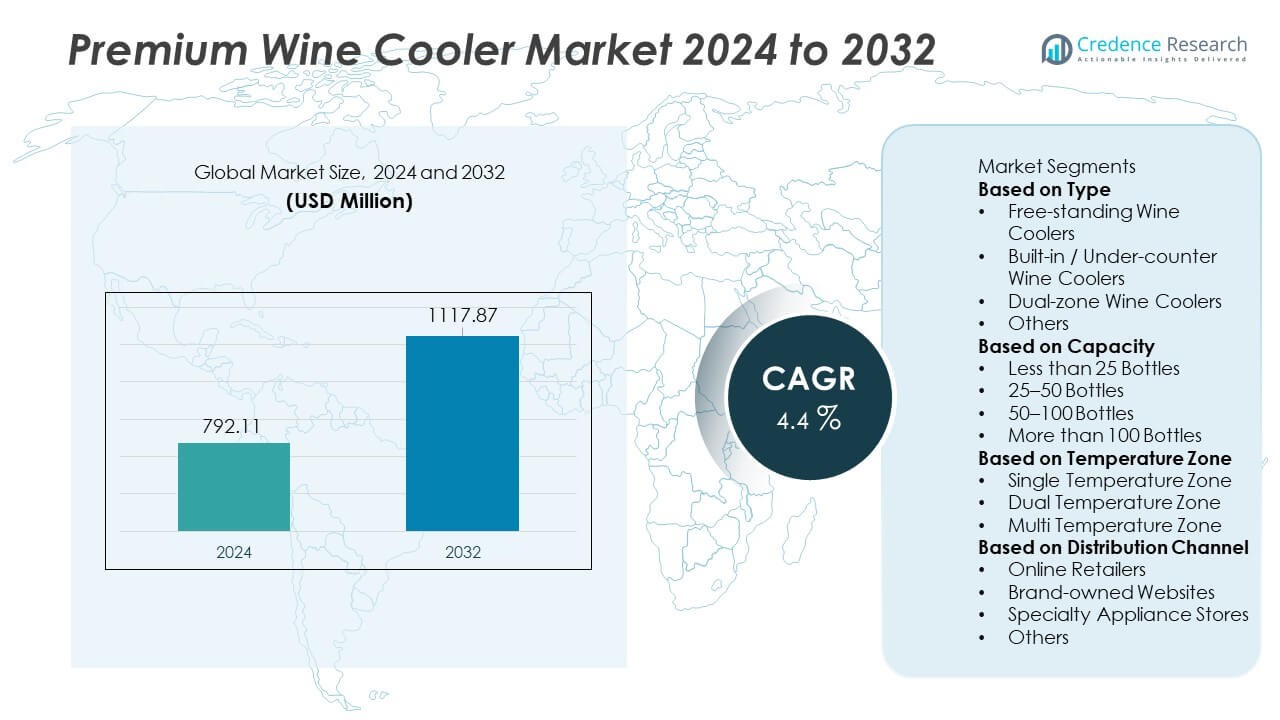
The Premium Wine Cooler Market size reached USD 792.11 million in 2024 and is expected to rise to USD 1117.87 million by 2032, registering a CAGR of 4.4% during the forecast period.
| REPORT ATTRIBUTE | DETAILS |
|---|---|
| Historical Period | 2020-2023 |
| Base Year | 2024 |
| Forecast Period | 2025-2032 |
| Premium Wine Cooler Market Size 2024 | USD 792.11 Million |
| Premium Wine Cooler Market, CAGR | 4.4% |
| Premium Wine Cooler Market Size 2032 | USD 1117.87 Million |
The Premium Wine Cooler market is shaped by leading players such as Haier Group, LG Electronics, Whirlpool Corporation, Electrolux AB, Bosch, Samsung Electronics, Avanti Products, NewAir, EuroCave, and Danby Appliances. These companies compete through advanced cooling technologies, multi-zone designs, and smart connectivity features that appeal to both residential and commercial users. North America stands as the leading region with a market share of 37%, driven by strong wine consumption trends, high disposable incomes, and rapid adoption of luxury kitchen appliances. Europe follows closely with significant demand supported by its long-established wine culture and preference for premium preservation systems.
Market Insights
- The Premium Wine Cooler market reached USD 792.11 million in 2024 and will grow to USD 1117.87 million by 2032 at a CAGR of 4.4%, supported by rising adoption of luxury home appliances.
- Demand grows due to rising wine consumption and the need for precise storage, with free-standing units leading the type segment at 46% share and the 25–50 bottle capacity range holding a 39% share.
- Key trends include rising preference for dual-zone systems, which dominate the temperature zone segment with a 52% share, and growing upgrades toward smart, connected cooling solutions.
- The competitive landscape includes major players such as Haier, LG, Whirlpool, Electrolux, Bosch, Samsung, NewAir, EuroCave, Avanti, and Danby focusing on energy-efficient builds and premium designs.
- North America leads the global market with a 37% share, followed by Europe at 32%, while Asia Pacific expands rapidly with a 20% share driven by urbanization and premium lifestyle adoption.
Market Segmentation Analysis:
By Type
Free-standing wine coolers lead this segment with a 46% market share, supported by strong demand for flexible placement and easy installation. These units appeal to homeowners seeking premium storage without structural changes. Built-in and under-counter models gain traction in luxury kitchens but grow at a slower pace due to higher installation costs. Dual-zone coolers attract collectors who store different wine types together, improving segment momentum. Rising home remodeling and interest in smart cooling features support overall market expansion, while makers enhance efficiency and noise control to improve adoption.
- For instance, Haier upgraded its Dual-Zone Series with an inverter compressor, which helps in cutting noise levels and improving energy use through precise load adjustment. The model also incorporates Wi-Fi monitoring linked to internal smart sensors that maintain temperature stability within optimal ranges.
By Capacity
The 25–50 bottles sub-segment dominates with a 39% market share, driven by strong adoption in urban homes and compact commercial spaces. This capacity range offers the right balance between storage space and footprint, making it ideal for modern kitchens. Units under 25 bottles attract beginners but face limitations for long-term storage. Larger options, including 50–100 bottles and above 100 bottles, gain interest among collectors and hospitality venues seeking wider assortments. Growing consumer interest in wine curation and vibration-free cooling supports demand across all tiers.
- For instance, NewAir introduced a 46-bottle built-in wine cooler using a compressor-based cooling system drawing approximately 90W to 100W of power. The system utilizes a digital sensor to maintain temperatures with controls for specific ranges (e.g., 40-55°F in the upper zone and 50–66°F in the lower zone).
By Temperature Zone
Dual-temperature zone wine coolers hold the leading position with a 52% market share, as buyers prefer precise climate settings for red and white wines. This flexibility makes dual-zone units popular among premium households, bars, and tasting rooms. Single-zone models remain relevant for basic storage but grow slowly due to limited versatility. Multi-zone designs attract high-end users seeking advanced preservation for varied collections. Rising awareness of proper wine aging and the integration of smart thermostatic controls continue to strengthen demand for dual-zone cooling systems.
Key Growth Drivers
Growing Demand for Home Luxury Appliances
Rising consumer interest in premium home appliances drives strong demand for high-end wine coolers. Households invest in advanced cooling systems as disposable incomes rise and home entertainment gains importance. Luxury kitchen upgrades and modular interiors further boost adoption across urban regions. Consumers also prioritize design aesthetics, quieter operation, and enhanced storage stability. These factors push manufacturers to introduce sophisticated models with sleek finishes, multi-zone cooling, and energy-efficient compressors, strengthening market growth.
- For instance, Bosch (BSH Home Appliances) offers wine storage lines featuring two precise temperature zones (5-20°C) and exceptionally quiet operation, with some models keeping noise levels as low as 38 dB.
Expansion of Wine Consumption and Collecting Culture
A growing wine-drinking population accelerates demand for reliable and stylish storage solutions. More consumers now maintain personal wine collections at home, requiring ideal temperature and humidity control. Restaurants, boutique bars, and tasting rooms also upgrade storage infrastructure to preserve wine quality. Rising awareness of proper storage conditions encourages adoption of premium coolers that protect aroma, flavor, and shelf life. These preferences support steady market expansion across residential and commercial segments.
- For instance, EuroCave developed a collector-grade unit (specifically the Royale line) equipped with a variable-speed compressor for reduced vibration, resulting in an extremely low noise level of 34 dB(A).
Advancement in Cooling and Smart Control Technologies
Improvements in thermoelectric systems, inverter compressors, and digital sensors enhance cooling precision and energy performance. Smart features such as app-based monitoring, temperature alerts, and automated climate adjustments attract tech-focused buyers. Manufacturers integrate UV-resistant glass, vibration-control motors, and humidity management to preserve wine integrity. These innovations boost efficiency while offering superior user experience. Increased interest in smart kitchens creates long-term opportunities for advanced, connected wine storage systems.
Key Trends & Opportunities
Rising Interest in Multi-Zone and Custom Storage Designs
Consumers increasingly seek wine coolers that support varied storage needs, boosting demand for dual-zone and multi-zone models. These units appeal to users who store diverse wine types with different aging conditions. Custom wood racks, LED lighting, and modular shelving enhance aesthetic appeal and usability. The trend aligns with premium kitchen design, where built-in coolers complement modern interiors. Ongoing innovation in layout flexibility and temperature zoning strengthens product adoption.
- For instance, Vinotemp introduced a multi-zone unit featuring three independent cooling chambers, each regulated by precision sensors that maintain temperature within a ±0.5°C range. The system uses a 140W compressor with vibration measured below 6 m/s², and includes customizable wooden shelves supporting loads up to 18 kilograms per shelf.
Growth of Online Sales and Premium E-Commerce Retail
E-commerce platforms expand visibility for premium wine coolers, offering wide model comparisons, customer reviews, and doorstep delivery. Digital channels help brands reach urban and semi-urban markets with minimal physical presence. Online exclusive models, virtual demos, and extended warranties encourage faster purchase decisions. Rising trust in online appliance purchases creates strong opportunities for manufacturers to scale distribution and promote high-value, feature-rich product lines.
- For instance, LG Electronics offers various wine coolers and refrigerators, including models with a Smart Inverter Compressor which is known for efficient, quiet, and durable operation.
Key Challenges
High Initial Cost Limiting Broader Adoption
Premium wine coolers often carry high purchase and installation costs, restricting adoption among price-sensitive consumers. Units with multi-zone cooling, smart connectivity, and advanced compressors require significant investment. Commercial users also face higher maintenance expenses, reducing appeal for small-scale establishments. These cost barriers slow adoption in emerging markets, where consumers still prefer basic storage solutions. Manufacturers must balance premium features with affordability to expand reach.
Energy Consumption and Performance Variability
Wine coolers rely on compressors or thermoelectric systems, both of which face performance challenges in high-temperature environments. Energy usage increases when units operate in warmer rooms, raising operating costs. Thermoelectric models offer quieter operation but struggle with temperature stability. Compressor-based systems provide stronger cooling but generate more noise and vibration. Addressing these performance trade-offs remains essential for long-term customer satisfaction and wider market penetration.
Regional Analysis
North America
North America leads the Premium Wine Cooler market with a market share of 37%, supported by strong consumer interest in luxury kitchen appliances and rising wine consumption across the U.S. and Canada. High disposable incomes encourage purchases of multi-zone and built-in units for modern homes. Restaurants, tasting rooms, and boutique bars expand premium storage installations to maintain quality standards. Growing adoption of smart home ecosystems also increases demand for connected cooling technologies. Well-established appliance brands and strong retail networks further strengthen market penetration across residential and commercial segments.
Europe
Europe holds a market share of 32%, driven by a well-established wine culture and strong demand for high-quality preservation systems. Consumers in France, Italy, Germany, and the U.K. invest in advanced coolers to support personal collections and premium kitchen upgrades. Built-in models see higher popularity due to widespread integration of modular kitchen designs. Commercial wine storage needs also rise across hotels, wineries, and fine-dining venues. Growing focus on energy-efficient cooling and noise-reduction features continues to support adoption, making Europe one of the most mature regional markets.
Asia Pacific
Asia Pacific accounts for a market share of 20%, fueled by rising urbanization, growing premium hospitality infrastructure, and increasing wine consumption in China, Japan, South Korea, and Australia. Expanding high-income groups adopt dual-zone and smart coolers to support luxury lifestyle preferences. Hotels, premium bars, and modern retail stores invest in advanced storage systems to maintain wine quality. Rapid growth of e-commerce enhances access to global brands. The region shows strong potential for future expansion as consumers shift toward high-end appliances and organized storage solutions.
Latin America
Latin America holds a market share of 7%, supported by expanding wine consumption and gradual adoption of premium household appliances across Brazil, Argentina, Chile, and Mexico. Urban households invest in compact and mid-capacity coolers to support growing interest in organized wine storage. Tourism and hospitality sectors adopt advanced cooling systems to maintain service standards in premium restaurants and boutique hotels. Rising exposure to international brands through online channels also enhances awareness. Although price sensitivity remains high, demand for premium units grows steadily among affluent customer groups.
Middle East & Africa
The Middle East & Africa region captures a market share of 4%, driven by rising luxury hospitality projects and premium residential developments in the UAE, Saudi Arabia, and South Africa. High-income consumers adopt built-in and multi-zone coolers to support upscale home designs. Premium hotels, restaurants, and resorts expand wine storage installations to cater to global travelers. Hot climates increase reliance on advanced cooling technologies to maintain temperature stability. While adoption remains concentrated in affluent segments, ongoing construction of luxury real estate continues to drive gradual market expansion.
Market Segmentations:
By Type
- Free-standing Wine Coolers
- Built-in / Under-counter Wine Coolers
- Dual-zone Wine Coolers
- Others
By Capacity
- Less than 25 Bottles
- 25–50 Bottles
- 50–100 Bottles
- More than 100 Bottles
By Temperature Zone
- Single Temperature Zone
- Dual Temperature Zone
- Multi Temperature Zone
By Distribution Channel
- Online Retailers
- Brand-owned Websites
- Specialty Appliance Stores
- Others
By Geography
- North America
- U.S.
- Canada
- Mexico
- Europe
- Germany
- France
- U.K.
- Italy
- Spain
- Rest of Europe
- Asia Pacific
- China
- Japan
- India
- South Korea
- South-east Asia
- Rest of Asia Pacific
- Latin America
- Brazil
- Argentina
- Rest of Latin America
- Middle East & Africa
- GCC Countries
- South Africa
- Rest of the Middle East and Africa
Competitive Landscape
The competitive landscape features key players such as Haier Group, LG Electronics, Whirlpool Corporation, Electrolux AB, Bosch, Samsung Electronics, Avanti Products, NewAir, EuroCave, and Danby Appliances. These companies focus on expanding product lines with advanced cooling technologies, smart connectivity, and energy-efficient components to strengthen market presence. Premium brands emphasize vibration-control systems, multi-zone temperature management, and UV-shielded glass to enhance wine preservation standards. Manufacturers also invest in sleek design upgrades to align with modern kitchen aesthetics and built-in installation trends. Partnerships with specialty retailers, expansion of e-commerce channels, and regional distribution enhancements support wider accessibility. Innovation in inverter compressors, humidity stabilization, and app-based monitoring continues to differentiate high-end offerings. As competition intensifies, companies prioritize reliability, noise reduction, and premium materials to target both residential buyers and luxury hospitality segments.
Key Player Analysis
- Haier Group
- LG Electronics
- Whirlpool Corporation
- Electrolux AB
- Bosch (BSH Home Appliances)
- Samsung Electronics
- Avanti Products
- NewAir
- EuroCave
- Danby Appliances
Recent Developments
- In April 2024, Samsung showcased a new built-in kitchen appliance lineup at events like EuroCucina 2024 and the "Welcome to BESPOKE AI" global launch, confirming their push into the premium built-in segment in the European and global markets.
- In 2023, Avanti Products expanded its built-in wine cooler range. The new models offered better energy efficiency and touch controls, targeting consumers looking for sleek, integrated wine storage.
Report Coverage
The research report offers an in-depth analysis based on Type, Capacity, Temperature Zone, Distribution Channel and Geography. It details leading market players, providing an overview of their business, product offerings, investments, revenue streams, and key applications. Additionally, the report includes insights into the competitive environment, SWOT analysis, current market trends, as well as the primary drivers and constraints. Furthermore, it discusses various factors that have driven market expansion in recent years. The report also explores market dynamics, regulatory scenarios, and technological advancements that are shaping the industry. It assesses the impact of external factors and global economic changes on market growth. Lastly, it provides strategic recommendations for new entrants and established companies to navigate the complexities of the market.
Future Outlook
- Demand for dual-zone and multi-zone coolers will rise as consumers store varied wine types.
- Smart connectivity features will expand with wider use of app-based monitoring and alerts.
- Energy-efficient compressor and inverter technologies will gain stronger adoption across regions.
- Built-in and under-counter models will see higher demand due to modern kitchen designs.
- Commercial adoption will increase as hotels, bars, and tasting rooms upgrade premium storage.
- E-commerce sales will grow as more buyers prefer online model comparison and digital warranties.
- High-end materials and noise-reduction technologies will become key differentiators for brands.
- Compact and mid-capacity coolers will remain popular among urban households with limited space.
- Manufacturers will expand regional distribution to capture rising demand in Asia Pacific and Latin America.
- Sustainability-focused buyers will drive interest in low-vibration, energy-efficient, and long-life cooling systems.

Request a Free Sample
Fill in your details and we'll send you a free sample report.
- Sample data tables & charts
- Research methodology
Market Dynamics
Growing Demand for Home Luxury Appliances
Rising disposable incomes and a focus on premium home entertainment have led consumers to invest in high-end wine coolers with advanced features, supporting market growth in urban and affluent regions.
Expansion of Wine Consumption and Collecting Culture
Increasing wine consumption and the trend of personal wine collecting are driving demand for precise, reliable, and stylish storage solutions, both in residential and commercial settings.
Advancement in Cooling and Smart Control Technologies
Innovations such as inverter compressors, digital sensors, and app-based monitoring are enhancing cooling precision, energy efficiency, and user convenience, making premium wine coolers more attractive to tech-savvy buyers.
Rising Interest in Multi-Zone and Custom Storage Designs
Consumers are seeking wine coolers with dual or multi-zone capabilities and customizable interiors to accommodate diverse wine collections, aligning with modern kitchen aesthetics and premium lifestyle trends.
Growth of Online Sales and Premium E-Commerce Retail
The expansion of e-commerce platforms enables broader access to premium wine coolers, allowing consumers to compare models, read reviews, and purchase high-value appliances with greater convenience.
Need a Custom Version of This Report?
Tailor the scope, geography, or segments to your exact requirements.
- Custom geography or segment scope
- Direct access to our analyst team
Frequently Asked Questions
What is the current market size for the Premium Wine Cooler market, and what is its projected size in 2032?
At what Compound Annual Growth Rate is the Premium Wine Cooler market projected to grow between 2025 and 2032?
Which Premium Wine Cooler market segment held the largest share in 2024?
What are the primary factors fueling the growth of the Premium Wine Cooler market?
Who are the leading companies in the Premium Wine Cooler market?
Which region commanded the largest share of the Premium Wine Cooler market in 2024?
Table of Content
Chapter 1 Market Segmentation
- 1.1 Segmentation Framework
- 1.1.1 Product and Service Classification
- 1.1.2 Application and End-Use Classification
- 1.1.3 Technology and Solution Classification
- 1.1.4 Customer and Distribution Channel Classification
- 1.1.5 Geographic Segmentation
- 1.1.6 Market Segment Definitions and Boundaries
- 1.2 By Type
- 1.2.1 Free-standing Wine Coolers
- 1.2.2 Built-in / Under-counter Wine Coolers
- 1.2.3 Dual-zone Wine Coolers
- 1.2.4 Others
- 1.3 By Capacity
- 1.3.1 Less than 25 Bottles
- 1.3.2 25–50 Bottles
- 1.3.3 50–100 Bottles
- 1.3.4 More than 100 Bottles
- 1.4 By Temperature Zone
- 1.4.1 Single Temperature Zone
- 1.4.2 Dual Temperature Zone
- 1.4.3 Multi Temperature Zone
Chapter 2 Introduction
- 2.1 Report Objectives and Scope
- 2.2 Product Definition and Industry Terminology
- 2.3 Market Inclusions and Exclusions
- 2.4 Research Process
- 2.4.1 Primary Research and Expert Interviews
- 2.4.2 Secondary Research and Source Review
- 2.4.3 Top-Down and Bottom-Up Estimation
- 2.4.4 Data Triangulation and Verification
- 2.5 Market Size Measurement Basis
- 2.5.1 2024: USD 792.11 million → 2032: USD 1,117.87 million
- 2.6 Historical and Forecast Reference Periods
- 2.6.1 Base Year: 2024
- 2.6.2 Forecast Period: 2024-2032
- 2.7 Research Assumptions and Limitations
Chapter 3 Executive Summary
- 3.1 Market Snapshot and Key Findings
- 3.2 Base-Year Market Size, 2024
- 3.3 Forecast Market Size, 2032
- 3.4 Revenue and Volume Growth Outlook
- 3.5 Key Demand and Supply Indicators
- 3.6 Leading Market Segments
- 3.7 Fastest-Growing Market Opportunities
- 3.8 Regional Performance Highlights
- 3.9 Technology and Industry Transformation
- 3.10 Competitive Landscape Summary
- 3.11 Analyst View and Strategic Implications
Chapter 4 Global Premium Wine Cooler Market Trends and Developments
- 4.1 Historical Industry Development
- 4.2 Recent Market Trends and Developments
- 4.3 Demand and Customer Behavior Trends
- 4.4 Technology and Product Innovation
- 4.5 Artificial Intelligence, Automation and Digitalization
- 4.6 Local Manufacturing and Supply Chain Realignment
- 4.7 Industry Partnerships, Mergers and Acquisitions
- 4.8 Sustainability and Circular Economy Developments
- 4.9 Government and Private Sector Investment Trends
- 4.10 Emerging Business Models and Commercialization
- 4.11 Industry Developments and Announcements
Chapter 5 Global Premium Wine Cooler Market Production, Supply and Demand Analysis
- 5.1 Demand Trend and Consumption Analysis
- 5.2 Demand Forecast, 2024-2032
- 5.3 Production and Output Trend
- 5.4 Production and Output Forecast, 2024-2032
- 5.5 Installed Capacity and Capacity Utilization
- 5.6 Company-Wise Production Plants and Statistics
- 5.6.1 Installed Production Capacity
- 5.6.2 Actual Production
- 5.6.3 Planned Capacity and Expansion Targets
- 5.7 Supply Chain Structure and Procurement Trends
- 5.8 Supply-Demand Gap and Bottlenecks
- 5.9 Import Dependence and Sourcing Structure
- 5.10 Contract Manufacturing and Outsourcing
- 5.11 Regional Supply and Demand Concentration
Chapter 6 Global Premium Wine Cooler Market Pricing Analysis
- 6.1 Pricing Structure and Measurement
- 6.2 Historical Pricing Trends
- 6.3 Pricing Outlook, 2024-2032
- 6.4 Average Selling Price and Unit Economics
- 6.5 Pricing by Product and Market Segment
- 6.6 Geographic Pricing Differences
- 6.7 Key Input, Energy, Labor and Logistics Costs
- 6.8 Contract Pricing and Purchasing Models
- 6.9 Pricing Sensitivity and Competitive Positioning
- 6.10 Price, Margin and Profitability Implications
Chapter 7 Global Premium Wine Cooler Market Dynamics
- 7.1 Market Growth Drivers
- 7.1.1 Demand-Side Drivers
- 7.1.2 Technology and Innovation Drivers
- 7.1.3 Infrastructure and Investment Drivers
- 7.1.4 Regulatory and Policy Drivers
- 7.2 Market Restraints
- 7.2.1 Cost and Affordability Constraints
- 7.2.2 Technology and Adoption Barriers
- 7.2.3 Supply Chain and Operational Constraints
- 7.3 Market Challenges
- 7.3.1 Competitive Pressure and Margin Erosion
- 7.3.2 Skills, Infrastructure and Implementation Gaps
- 7.4 Emerging Market Opportunities
- 7.5 Market Dynamics Impact and Time-Horizon Assessment
Chapter 8 Global Premium Wine Cooler Value Chain Analysis
- 8.1 Industry Value Chain Overview
- 8.2 Upstream Suppliers and Critical Inputs
- 8.3 Technology and Component Providers
- 8.4 Manufacturing or Service Delivery
- 8.5 Distribution, Channel Partners and Integrators
- 8.6 Downstream Applications and End Users
- 8.7 Value Addition and Profit Pools
- 8.8 Vertical Integration and Outsourcing
- 8.9 Supplier Concentration and Risk
- 8.10 Supply Chain Localization and Resilience
Chapter 9 Global Premium Wine Cooler Market Regulations and Policies
- 9.1 Relevant Laws, Standards and Compliance Frameworks
- 9.2 Product, Service, Safety and Quality Requirements
- 9.3 Government Policies, Incentives and Subsidies
- 9.4 Imports, Exports and Trade Barriers
- 9.5 Public Procurement and Local Content Requirements
- 9.6 Environmental and Sustainability Compliance
- 9.7 Upcoming Policy Changes and Market Implications
Chapter 10 Global Premium Wine Cooler Market Hotspots and Opportunities
- 10.1 Market Opportunity Mapping and Growth Hotspots
- 10.2 High-Growth Applications and Customer Groups
- 10.3 Underserved Markets and White-Space Opportunities
- 10.4 Emerging Technology and Product Opportunities
- 10.5 New Capacity and Investment Hotspots
- 10.6 Market Entry and Expansion Opportunities
- 10.7 Distribution and Partnership Opportunities
- 10.8 Near-Term and Long-Term Commercial Potential
- 10.9 Opportunity Attractiveness and Execution Risks
Chapter 11 Global Premium Wine Cooler Market Outlook, 2024-2032
- 11.1 Market Size and Analysis
- 11.1.1 Revenue (Market Measurement: 2024: USD 792.11 million → 2032: USD 1,117.87 million)
- 11.1.2 Market Volume and Quantity Sold
- 11.1.3 Historical Market Size
- 11.1.4 Base-Year Market Size, 2024
- 11.2 Market Forecast, 2024-2032
- 11.2.1 Revenue Forecast to 2032
- 11.2.2 Volume Forecast to 2032
- 11.2.3 CAGR and Year-on-Year Growth
- 11.2.4 Incremental Revenue Opportunity
- 11.3 Forecast Assumptions and Scenario Analysis
- 11.3.1 Base-Case Forecast
- 11.3.2 Optimistic and Conservative Scenarios
- 11.3.3 Technology, Pricing and Policy Sensitivities
- 11.4 Market Attractiveness and Growth Outlook
Chapter 12 Global Premium Wine Cooler Market Segmentation and Outlook
- 12.1 Segmentation Summary and Market Shares, 2024
- 12.2 Largest and Fastest-Growing Segments
- 12.3 By Type - Market Size and Forecast, 2024-2032
- 12.3.1 Segment Definition and Scope
- 12.3.2 Historical Market Size
- 12.3.3 Revenue Forecast, 2024-2032
- 12.3.4 Volume Forecast, 2024-2032
- 12.3.5 Base-Year Market Share, 2024
- 12.3.6 Segment CAGR and Growth Drivers
- 12.3.7 Subsegment Market Size and Forecast
- 12.3.7.1 Free-standing Wine Coolers
- 12.3.7.2 Built-in / Under-counter Wine Coolers
- 12.3.7.3 Dual-zone Wine Coolers
- 12.3.7.4 Others
- 12.3.8 Subsegment Pricing and Adoption Trends
- 12.3.9 Leading Suppliers and Competition
- 12.3.10 Regional Demand and Opportunities
- 12.4 By Capacity - Market Size and Forecast, 2024-2032
- 12.4.1 Segment Definition and Scope
- 12.4.2 Historical Market Size
- 12.4.3 Revenue Forecast, 2024-2032
- 12.4.4 Volume Forecast, 2024-2032
- 12.4.5 Base-Year Market Share, 2024
- 12.4.6 Segment CAGR and Growth Drivers
- 12.4.7 Subsegment Market Size and Forecast
- 12.4.7.1 Less than 25 Bottles
- 12.4.7.2 25–50 Bottles
- 12.4.7.3 50–100 Bottles
- 12.4.7.4 More than 100 Bottles
- 12.4.8 Subsegment Pricing and Adoption Trends
- 12.4.9 Leading Suppliers and Competition
- 12.4.10 Regional Demand and Opportunities
- 12.5 By Temperature Zone - Market Size and Forecast, 2024-2032
- 12.5.1 Segment Definition and Scope
- 12.5.2 Historical Market Size
- 12.5.3 Revenue Forecast, 2024-2032
- 12.5.4 Volume Forecast, 2024-2032
- 12.5.5 Base-Year Market Share, 2024
- 12.5.6 Segment CAGR and Growth Drivers
- 12.5.7 Subsegment Market Size and Forecast
- 12.5.7.1 Single Temperature Zone
- 12.5.7.2 Dual Temperature Zone
- 12.5.7.3 Multi Temperature Zone
- 12.5.8 Subsegment Pricing and Adoption Trends
- 12.5.9 Leading Suppliers and Competition
- 12.5.10 Regional Demand and Opportunities
- 12.6 Segment Growth Comparison
- 12.7 Segment Attractiveness and Priority Matrix
Chapter 13 Global Premium Wine Cooler Geographic Market Outlook, 2024-2032
- 13.1 Regional Market Size and Share, 2024
- 13.2 Regional Market Forecast, 2024-2032
- 13.3 Regional Pricing, Production and Demand Differences
- 13.4 North America
- 13.4.1 United States
- 13.4.2 Canada
- 13.4.3 Mexico
- 13.5 Europe
- 13.5.1 Germany
- 13.5.2 France
- 13.5.3 Italy
- 13.5.4 United Kingdom
- 13.5.5 Spain
- 13.5.6 Poland
- 13.5.7 Russia
- 13.5.8 Netherlands
- 13.5.9 Belgium
- 13.5.10 Sweden
- 13.5.11 Denmark
- 13.5.12 Norway
- 13.5.13 Rest of Europe
- 13.6 Asia Pacific
- 13.6.1 China
- 13.6.2 India
- 13.6.3 Japan
- 13.6.4 South Korea
- 13.6.5 Thailand
- 13.6.6 Indonesia
- 13.6.7 Vietnam
- 13.6.8 Malaysia
- 13.6.9 Australia
- 13.6.10 Rest of Asia Pacific
- 13.7 Latin America
- 13.7.1 Brazil
- 13.7.2 Argentina
- 13.7.3 Colombia
- 13.7.4 Chile
- 13.7.5 Rest of Latin America
- 13.8 Middle East
- 13.8.1 Saudi Arabia
- 13.8.2 United Arab Emirates
- 13.8.3 Turkey
- 13.8.4 Israel
- 13.8.5 Iran
- 13.8.6 Rest of the Middle East
- 13.9 Africa
- 13.9.1 South Africa
- 13.9.2 Egypt
- 13.9.3 Nigeria
- 13.9.4 Morocco
- 13.9.5 Rest of Africa
- 13.10 Regional Investment, Policy and Supply Chain Differences
- 13.11 Regional Competitive Landscape
- 13.12 Geographic Growth Hotspots
Chapter 14 Global Premium Wine Cooler Technology, Innovation and Sustainability Outlook
- 14.1 Technology Landscape and Maturity
- 14.2 Product, Process and Service Innovation
- 14.3 AI, Automation and Digital Tools in the Industry
- 14.4 Technology Adoption and Performance Benchmarking
- 14.5 Innovation Pipeline and R&D Investment
- 14.6 Patent and Intellectual Property Trends
- 14.7 Energy Efficiency and Resource Management
- 14.8 Sustainability, Recycling and Circularity
- 14.9 Technology Roadmap, 2024-2032
- 14.10 Risks of Obsolescence and Technology Substitution
Chapter 15 Global Premium Wine Cooler Market Key Strategic Imperatives
- 15.1 Growth and Market Entry Priorities
- 15.2 High-Return Products and Segments
- 15.3 Pricing, Profitability and Cost Optimization
- 15.4 Technology Investment and Product Differentiation
- 15.5 Supply Chain Localization and Resilience
- 15.6 Distribution and Customer Acquisition
- 15.7 Partnership, Acquisition and Capacity Strategy
- 15.8 Regional Expansion Priorities
- 15.9 Short-, Medium- and Long-Term Actions
Chapter 16 Competition Outlook
- 16.1 Industry Competition Characteristics
- 16.2 Market Structure and Concentration
- 16.3 Market Share and Competitive Positioning, 2024
- 16.4 Company-Wise Revenue and Product Benchmarking
- 16.5 Production and Service Capacity Benchmarking
- 16.6 Technology, Pricing and Differentiation
- 16.7 Regional Footprint and Distribution Strength
- 16.8 Mergers, Acquisitions and Strategic Alliances
- 16.9 New Entrants and Competitive Threats
- 16.10 Porter's Five Forces and Industry Attractiveness
- 16.11 Competitive Outlook, 2024-2032
Chapter 17 Company Profiles
- 17.1 Company Coverage and Selection Criteria
- 17.2 Haier Group
- 17.2.1 Business Description
- 17.2.2 Company Ownership and Geographic Presence
- 17.2.3 Product and Service Portfolio
- 17.2.4 Manufacturing and Operating Footprint
- 17.2.5 Production Capacity and Expansion Plans
- 17.2.6 Financial Performance and Investment
- 17.2.7 Market Share and Competitive Position
- 17.2.8 Technology and Innovation Capabilities
- 17.2.9 Strategic Alliances or Partnerships
- 17.2.10 Recent Developments
- 17.2.11 Growth Strategy and Outlook
- 17.3 LG Electronics
- 17.4 Whirlpool Corporation
- 17.5 Electrolux AB
- 17.6 Bosch
- 17.7 Samsung Electronics
- 17.8 Avanti Products
- 17.9 NewAir
- 17.10 EuroCave
- 17.11 Danby Appliances
- 17.12 Other Relevant Market Participants
Note: Every listed company is profiled on the structure shown under the first company. The company list is preliminary and may change based on research findings, market developments, data availability and client requirements.
Chapter 18 Disclaimer
- 18.1 Research and Forecast Disclaimer
- 18.2 Data Source and Estimation Limitations
Note: The depth of individual sections depends on data availability for this market. Volume, capacity, trade and other unit-based metrics are included where applicable.