
Market Overview
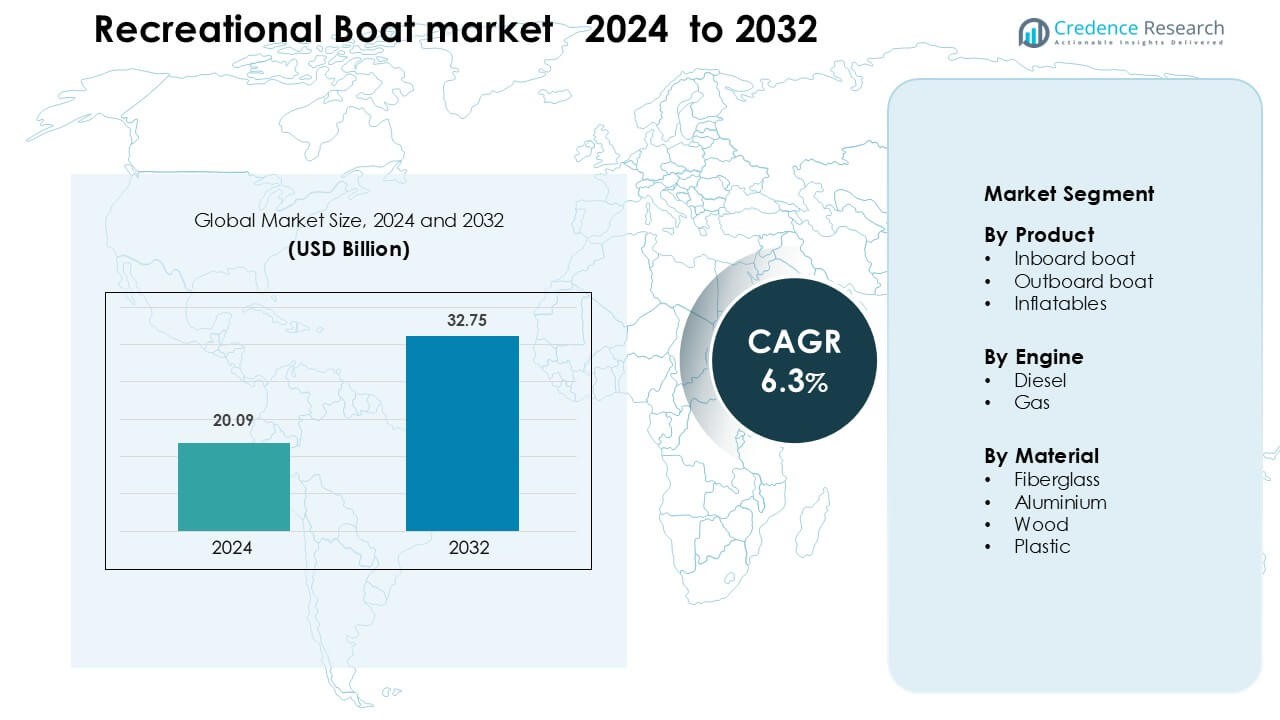
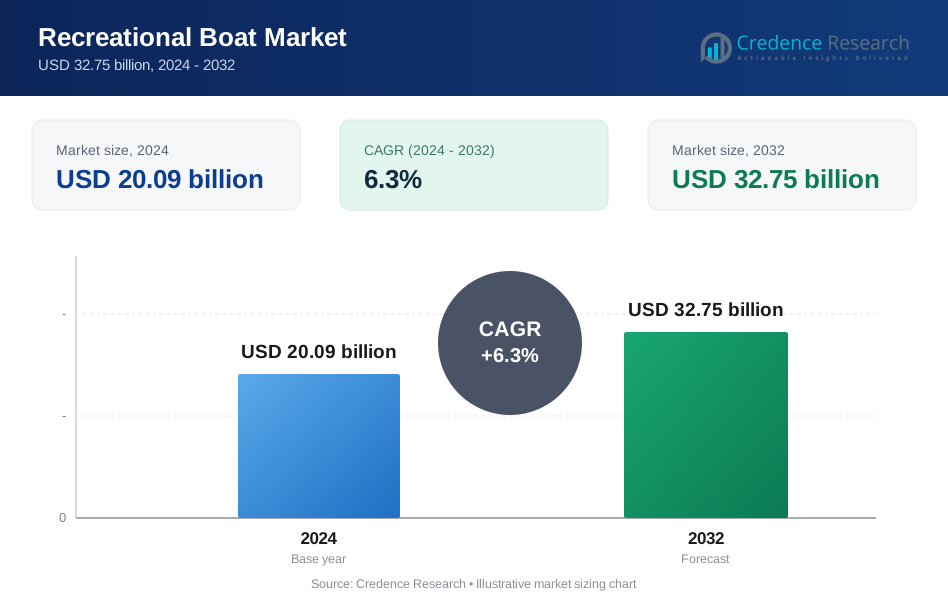
Recreational Boat market was valued at USD 20.09 billion in 2024 and is anticipated to reach USD 32.75 billion by 2032, growing at a CAGR of 6.3 % during the forecast period.
| REPORT ATTRIBUTE | DETAILS |
|---|---|
| Historical Period | 2020-2023 |
| Base Year | 2024 |
| Forecast Period | 2025-2032 |
| Recreational Boat Market Size 2024 | USD 20.09 Billion |
| Recreational Boat Market, CAGR | 6.3 % |
| Recreational Boat Market Size 2032 | USD 32.75 Billion |
The recreational boat market is shaped by leading companies such as Fountain Powerboats, Inc., Bavaria Yachtbau GmbH, Ferretti S.P.A., Bombardier Recreational Products (BRP) Inc., Chaparral Boats, Inc., Avon Marine, Azimut Benetti Group, Baja Marine, Farr Yacht Design, Ltd., and Brunswick Corporation. These manufacturers compete through advanced hull designs, high-performance engines, and expanding product portfolios across outboard, inboard, and luxury yacht categories. North America remained the leading region in 2024 with about 46% share, supported by strong consumer spending, mature marina networks, and high participation in boating activities. This regional dominance continues to drive global demand and technological innovation in recreational boats.
Market Insights
- Recreational Boat market was valued at USD 20.09 billion in 2024 and is anticipated to reach USD 32.75 billion by 2032, growing at a CAGR of 6.3 % during the forecast period.
- Rising demand for leisure boating, strong interest in outboard boats holding 58% share, and higher spending on premium watercraft drive steady sales.
- Key trends include rapid adoption of electric propulsion, smart navigation systems, and lightweight composite materials that improve efficiency and reduce operating costs.
- Competitive activity strengthens as major players expand portfolios, upgrade engine technology, and introduce customizable models to meet varied buyer preferences across global markets.
- North America led the market with 46% share, followed by Europe at 28%, while fiberglass remained the dominant material with 64% share, reinforcing strong regional and segment-level momentum worldwide.
Market Segmentation Analysis:
By Product
In 2024, outboard boats held the dominant share at about 58% due to strong demand for versatile designs, easier maintenance, and better fuel efficiency. Buyers in fishing, leisure cruising, and water sports favored outboard models because manufacturers offered compact engines, higher horsepower options, and improved noise reduction. Inboard boats kept steady use in luxury cruising and wake sports, while inflatables grew in portable recreation and rental fleets. Rising interest in accessible marine recreation continued to push outboard units as the preferred product choice.
- For instance, Suzuki DF350 outboard delivers 350 hp (257.4 k) from a 4.39 L V6 engine, using a contra-rotating dual-propeller system to reduce vibration and improve thrust efficiency.
By Engine
Gas engines led this segment in 2024 with nearly 71% share due to lower upfront cost, simple maintenance needs, and broad availability across recreational boat categories. Many users selected gas-powered systems for day cruising and watersports where quick acceleration and lighter weight offered clear benefits. Diesel engines held a smaller but stable base in larger boats needing longer range and stronger torque. Growth in high-performance gas engines with cleaner combustion supported wider adoption across mid-sized recreational craft.
- For instance, Mercury Racing 450R gasoline outboard delivers 450 hp from a 4.6-liter V8 platform and weighs 689 lb, achieving a wide operating range of 5800–6400 rpm., which supports high-performance acceleration for mid-sized recreational boats.
By Material
Fiberglass dominated the material segment in 2024 with around 64% share because the material provides strong durability, corrosion resistance, and flexible molding for complex hull shapes. Boat manufacturers relied on fiberglass to reduce maintenance demands and improve long-term performance for family cruisers, sport boats, and fishing craft. Aluminum gained traction in rugged utility and coastal models, while wood and plastic served niche designs or entry-level buyers. The shift toward lightweight and low-maintenance construction continued to reinforce fiberglass as the preferred material in the recreational boat market.
Key Growth Drivers
Growing Demand for Leisure Marine Activities
Rising participation in water-based recreation remains a key growth driver for the recreational boat market. Families, hobbyists, and adventure travelers continue to increase spending on boating, fishing, water sports, and coastal tourism. Higher disposable incomes in North America and Europe support strong purchases of mid-range and premium vessels, while emerging markets witness rising interest in entry-level models. Consumer preference for outdoor leisure after the pandemic has sustained demand across marinas and rental fleets. Tourism operators also expand boating services, which boosts fleet renewals. The growth of marina infrastructure, along with wider access to boating clubs and shared ownership programs, encourages new users to enter the market. Together, these factors strengthen long-term demand for recreational boats.
- For instance, Freedom Boat Club, one of the world’s largest boat-sharing networks, recorded over 600,000member boating trips in 2024 across more than 400 locations.
Technological Advancements in Boat Design and Engines
Technical improvements in hull design, propulsion systems, and onboard electronics significantly enhance market growth. Manufacturers adopt advanced composite materials to improve durability, reduce weight, and increase fuel efficiency. The rise of digital dashboards, smart navigation systems, and integrated telematics boosts user experience and safety. Hybrid and electric propulsion gain attention as buyers seek low-noise, low-maintenance alternatives that support eco-friendly boating. High-performance outboard engines with better torque and optimized fuel burn drive upgrades across popular segments. Automated docking, joystick controls, and predictive maintenance tools further strengthen the appeal of modern boats. These innovations attract both new and experienced buyers and support the shift toward technologically advanced recreational vessels.
- For instance, Resin infusion is an advanced composite manufacturing method that uses a vacuum to pull resin into a dry-fiber mold, which creates a lighter, stronger, and more consistent part compared to older hand-layup methods.
Expansion of Boat Sharing, Rentals, and Marine Tourism
The growth of rental platforms, peer-to-peer boat sharing, and guided marine tours accelerates demand for recreational boats. Many users now prefer flexible access models instead of full ownership, reducing cost barriers for beginners. Rental fleets expand in coastal regions, lakeside destinations, and tourism hubs where demand for short-duration boating rises. Operators regularly replace older boats with newer, more efficient models, supporting consistent sales. Government programs promoting water recreation and tourism development further strengthen infrastructure around marinas and waterways. Smooth booking apps, subscription plans, and club memberships attract younger demographics. This shift toward shared and rental-based boating creates sustained opportunities for manufacturers and service providers.
Key Trend & Opportunity
Shift Toward Electric and Hybrid Propulsion
The recreational boat market observes a strong shift toward cleaner propulsion systems as users and regulators emphasize lower emissions and quieter operation. Electric and hybrid systems gain wider adoption in small and mid-sized boats where short-range coastal travel is common. Manufacturers develop high-density battery packs, efficient power trains, and regenerative technologies that extend range and reduce operating costs. Charging infrastructure expands in marinas, supported by government incentives. Growing awareness of environmental impacts strengthens interest in sustainable boating. This trend also supports innovation in lightweight materials, hull optimization, and smart energy management systems.
- For instance, Vision Marine’s E-Motion 180E electric outboard delivers 180 hp with a 650-V powertrain and dual lithium-ion battery packs rated at 60 kWh, enabling cruising ranges of up to 70–90 km depending on speed.
Rising Demand for Smart, Connected Boats
Connected technologies create major opportunities in the recreational boat market. Boaters increasingly prefer vessels equipped with digital displays, GPS-linked systems, remote diagnostics, and onboard sensors for safety and convenience. Telematics allow real-time engine monitoring, route optimization, and maintenance alerts, reducing downtime for owners and rental operators. Integration of entertainment systems, wireless controls, and advanced navigation enhances the boating experience. Smart features help differentiate premium models and improve resale value. As digital adoption rises, manufacturers collaborate with software firms to offer advanced connectivity suites, positioning smart boats as a key growth opportunity.
- For instance, Garmin’s OneHelm integration ecosystem supports coordination of over 20 onboard systems including lighting, stabilization, and HVAC through a single digital interface.
Growth in Luxury and Customized Recreational Boats
Demand for premium vessels grows as high-income buyers seek personalized designs, larger cabins, and comfort-focused features. Luxury cruising, yacht tourism, and high-end fishing expeditions push builders to offer bespoke interiors, advanced stabilization systems, and superior safety enhancements. Customization extends to upholstery, electronics, deck layout, and performance upgrades. This segment attracts strong interest in regions with wealthy coastal communities and expanding marine tourism. The shift toward tailored experiences enhances innovation in materials, design, and craftsmanship, creating long-term opportunities in the high-value segment of the recreational boat market.
Key Challenge
High Ownership and Maintenance Costs
The recreational boat market faces a major barrier in the form of high purchase, storage, and maintenance expenses. Buyers often need to invest in docking fees, insurance, winterization, and regular servicing, increasing long-term costs. These financial burdens limit adoption among middle-income groups and reduce repeat purchases. Fuel price volatility adds further pressure, especially for larger or high-performance models. Cost concerns also affect rental operators and tourism firms, who must manage high fleet upkeep expenses. This challenge slows market penetration and encourages many potential users to choose rental or shared options instead of ownership.
Environmental Regulations and Emission Compliance (Challenge)
Strict regulations on marine emissions and environmental protection create hurdles for manufacturers and users. Authorities in major boating regions enforce limits on exhaust pollutants, noise levels, and fuel spills, requiring companies to redesign hulls, engines, and fuel systems. Compliance increases production costs and slows the launch of new models. Older boats face restrictions in sensitive waterways, reducing resale value and usage. Users also face higher costs for eco-friendly fuels and compliant equipment. While regulations improve sustainability, they create significant operational and financial challenges for the recreational boat market.
Regional Analysis
North America
North America held the largest share of about 46% in the recreational boat market in 2024, supported by strong demand in the U.S. and Canada. High participation in leisure boating, advanced marina infrastructure, and widespread ownership of outboard and inboard boats drive regional dominance. Buyers favor technologically equipped models with high-performance engines, contributing to steady product upgrades. Boat clubs, rental platforms, and tourism operators further boost sales. Government focus on water recreation safety and environmental standards strengthens industry stability. Overall, strong consumer spending and mature marine culture keep North America the leading regional market.
Europe
Europe accounted for nearly 28% share in 2024 due to established boating traditions across Italy, France, Germany, the U.K., and Nordic countries. Demand rises for sailing boats, luxury cruisers, and eco-friendly electric vessels driven by strict emission norms. Marinas along the Mediterranean and Baltic coasts continue to attract high boating traffic. Growth in charter services and coastal tourism supports consistent fleet renewal. Buyers prefer fiberglass and aluminum builds due to durability and low maintenance. Advancements in engine efficiency and connected features reinforce Europe’s strong position in global recreational boating.
Asia Pacific
Asia Pacific captured roughly 18% share in 2024, with rapid growth supported by rising disposable incomes and expanding marine tourism in China, Japan, South Korea, Australia, and Southeast Asia. Coastal destinations promote boating activities, driving higher demand for outboard boats and inflatables. Governments invest in marina development, coastal safety, and tourism infrastructure, encouraging broader adoption. Increasing interest in water sports and family cruising accelerates market expansion. Manufacturers also focus on affordable models suited for first-time buyers. Asia Pacific remains the fastest-growing region due to its expanding recreational boating culture.
Latin America
Latin America held around 5% share in 2024, influenced by boating activities in Brazil, Mexico, Argentina, and Caribbean coastal markets. Growing tourism, fishing, and leisure boating support moderate demand for outboard and fiberglass models. Rising interest in rental fleets at beach resorts also boosts sales. Economic fluctuations and import costs restrict broader ownership, but stable tourism zones maintain steady consumption. Manufacturers target mid-range and compact designs suited for warm coastal waters. Continued investment in marinas and waterfront recreation spaces helps strengthen the regional market outlook.
Middle East & Africa
The Middle East & Africa region represented nearly 3% share in 2024, supported by luxury boating culture in the UAE, Saudi Arabia, and South Africa. High-income buyers show strong interest in premium inboard boats and yachts, while rental and charter services expand along major waterfronts. Tourism development in Dubai, Cape Town, and Red Sea resorts drives additional demand. Limited marina coverage and high ownership costs slow mass adoption, but niche luxury segments remain strong. Rising coastal recreation projects and waterfront infrastructure continue to create selective growth opportunities.
Market Segmentations
By Product
- Inboard boat
- Outboard boat
- Inflatables
By Engine
- Diesel
- Gas
By Material
- Fiberglass
- Aluminium
- Wood
- Plastic
By Geography
- North America
- U.S.
- Canada
- Mexico
- Europe
- Germany
- France
- U.K.
- Italy
- Spain
- Rest of Europe
- Asia Pacific
- China
- Japan
- India
- South Korea
- South-east Asia
- Rest of Asia Pacific
- Latin America
- Brazil
- Argentina
- Rest of Latin America
- Middle East & Africa
- GCC Countries
- South Africa
- Rest of the Middle East and Africa
Competitive Landscape
The recreational boat market features a competitive landscape shaped by global manufacturers offering diverse product portfolios across outboard boats, inboard cruisers, sailboats, inflatables, and luxury yachts. Key players such as Fountain Powerboats, Inc., Bavaria Yachtbau GmbH, Ferretti S.P.A., Bombardier Recreational Products (BRP) Inc., Chaparral Boats, Inc., Avon Marine, Azimut Benetti Group, Baja Marine, Farr Yacht Design, Ltd., and Brunswick Corporation focus on product innovation, advanced propulsion systems, and enhanced onboard technologies to strengthen market presence. Companies invest heavily in lightweight materials, connected navigation systems, and fuel-efficient engines to differentiate offerings. Many leading brands expand production facilities, upgrade dealer networks, and engage in strategic partnerships to improve regional reach. The shift toward electric and hybrid propulsion encourages established players to broaden sustainable product lines. Customization, premium finishes, and performance upgrades remain important competitive factors as buyers seek tailored and high-value boating experiences.
Key Player Analysis
- Fountain Powerboats, Inc.
- Bavaria Yachtbau GmbH
- Ferretti S.P.A.
- Bombardier Recreational Products (BRP) Inc.
- Chaparral Boats, Inc.
- Avon Marine
- Azimut Benetti Group
- Baja Marine
- Farr Yacht Design, Ltd.
- Brunswick Corporation
Recent Developments
- In September 2025, Ferretti Group launched a new official dealer partnership: MennYacht GG Poland (with Gazda Group) to serve the Polish market for Ferretti Yachts, Pershing and Itama brands.
- In February 2024, Fountain Powerboats, Inc. introduced its 43 SCX center-console model (19,500-lb, quad Mercury Racing 500R outboards) at the Miami International Boat Show.
Report Coverage
The research report offers an in-depth analysis based on Product, Engine, Material and Geography. It details leading market players, providing an overview of their business, product offerings, investments, revenue streams, and key applications. Additionally, the report includes insights into the competitive environment, SWOT analysis, current market trends, as well as the primary drivers and constraints. Furthermore, it discusses various factors that have driven market expansion in recent years. The report also explores market dynamics, regulatory scenarios, and technological advancements that are shaping the industry. It assesses the impact of external factors and global economic changes on market growth. Lastly, it provides strategic recommendations for new entrants and established companies to navigate the complexities of the market.
Future Outlook
- Demand for leisure boating will rise as outdoor recreational activities gain wider interest.
- Electric and hybrid propulsion systems will see strong adoption across small and mid-sized boats.
- Smart dashboards and connected navigation tools will become standard in new models.
- Manufacturers will expand the use of lightweight composite materials to improve efficiency.
- Rental fleets and boat-sharing platforms will grow as users prefer flexible access over ownership.
- Premium and customized yachts will attract high-income buyers seeking tailored experiences.
- Marina infrastructure development will accelerate in emerging coastal regions.
- Environmental regulations will push companies toward cleaner engines and low-emission designs.
- Digital service platforms will enhance maintenance, route planning, and safety management.
- Global competition will intensify as brands innovate to capture expanding recreational boating demand.
Request a Free Sample
Fill in your details and we'll send you a free sample report.
- Sample data tables & charts
- Research methodology
Need a Custom Version of This Report?
Tailor the scope, geography, or segments to your exact requirements.
- Custom geography or segment scope
- Direct access to our analyst team
Frequently Asked Questions
What is the current market size for Recreational Boat market, and what is its projected size in 2032?
At what Compound Annual Growth Rate is Recreational Boat market projected to grow between 2025 and 2032?
Which Recreational Boat market segment held the largest share in 2024?
What are the primary factors fueling the growth of Recreational Boat market?
Who are the leading companies in Recreational Boat market?
Which region commanded the largest share of Recreational Boat market?
Table of Content
Chapter 1. Report Introduction
- 1.1 Report Description & Purpose
- 1.1.1 Report Title & Market Definition
- 1.1.2 Unique Selling Propositions (USP) & Key Differentiators
- 1.1.3 Value Proposition for Stakeholders
- 1.2 Research Objectives
- 1.2.1 Market Sizing Objectives (Volume & Revenue)
- 1.2.2 Segmentation Objectives
- 1.2.3 Competitive Intelligence Objectives
- 1.2.4 Forecast & Scenario Objectives
- 1.3 Report Scope
- 1.3.1 Recreational Boat Scope – Types & Subtypes Covered
- 1.3.2 Geographic Scope – Regions & Countries Covered
- 1.3.3 Historical Period, Base Year & Forecast Period (2024; forecast to 2032)
- 1.3.4 Inclusions & Exclusions
- 1.4 HS Code & Classification Framework
- 1.5 Currency, Units & Pricing Basis
- 1.6 Target Stakeholders
- 1.7 Limitations & Assumptions
Chapter 2. Executive Summary
- 2.1 Global Recreational Boat Market Snapshot
- 2.1.1 Market Size – Historical (2024) & Forecast (2024-2032) (2024: USD 20.09 billion → 2032: USD 32.75 billion)
- 2.1.2 Volume & Revenue – Global Totals
- 2.1.3 Key Market Highlights – Top Five Facts
- 2.2 Recreational Boat Market Segmentation Snapshot
- 2.2.1 Market Split by Region – 2024 vs. 2032
- 2.3 Competitive Snapshot
- 2.3.1 Top 10 Players by Revenue Share – 2024
- 2.3.2 Top 10 Players by Volume Share – 2024
- 2.3.3 Recent Strategic Developments (18-Month Summary)
- 2.4 Key Investment Highlights & Strategic Conclusions
Chapter 3. Recreational Boat Market Dynamics & Industry Analysis
- 3.1 Market Overview & Context
- 3.1.1 Recreational Boat Market Position in the Broader Automotive Value Chain
- 3.1.2 OEM vs. Replacement Market Dynamics
- 3.1.3 Market Maturity & Development Stage by Region
- 3.2 Recreational Boat Market Drivers
- 3.3 Recreational Boat Market Restraints & Challenges
- 3.4 Recreational Boat Market Opportunities
- 3.5 Porter's Five Forces Analysis
- 3.5.1 Threat of New Entrants
- 3.5.2 Bargaining Power of Suppliers
- 3.5.3 Bargaining Power of Buyers
- 3.5.4 Threat of Substitutes
- 3.5.5 Competitive Rivalry – Intensity Assessment
- 3.6 Recreational Boat Value Chain Analysis
- 3.6.1 Upstream – Raw Material/Input Suppliers
- 3.6.1.1 Raw Material/Input 1
- 3.6.1.2 Raw Material/Input 2
- 3.6.1.3 Raw Material/Input 3
- 3.6.2 Midstream – Production/Manufacturing/Service Delivery
- 3.6.2.1 Production/Process Overview
- 3.6.2.2 Key Facility Locations & Capacity by Manufacturer
- 3.6.3 Downstream – Distribution & End Consumer
- 3.6.3.1 Primary Channel – B2B/OEM
- 3.6.3.2 Secondary Channels – Dealer, Retail, Online, Direct
- 3.6.4 Value Chain Profitability Analysis
- 3.6.1 Upstream – Raw Material/Input Suppliers
- 3.7 PESTEL Analysis
- 3.7.1 Political Factors
- 3.7.2 Economic Factors
- 3.7.3 Social Factors
- 3.7.4 Technological Factors
- 3.7.5 Environmental Factors
- 3.7.6 Legal Factors
- 3.8 Recreational Boat Supply Chain Analysis
- 3.8.1 Raw Material/Input Supply Risk Assessment
- 3.8.2 Manufacturing Concentration Risk (Geographic Exposure)
- 3.8.3 Trade Disruption Impact Analysis
- 3.9 Regulatory & Policy Landscape
Note: The regulatory and policy landscape section covers regulations based on their applicability to the market, Recreational Boat category, geography, and scope of the study. Only regulatory frameworks with a material impact on operations, compliance, trade, sustainability, or market access are analyzed in detail.
Chapter 4. Key Investment Pockets & Opportunity Analysis
- 4.1 Recreational Boat Market Attractiveness Analysis
- 4.1.1 By Region – Investment Attractiveness Matrix (Volume × CAGR)
- 4.2 Absolute Revenue Growth Opportunity
- 4.2.1 By Region – Absolute USD Growth Through 2032
- 4.3 Incremental Volume Opportunity
- 4.3.1 By Region – Incremental Volume Through 2032
- 4.3.2 Segment – Incremental Volume
- 4.4 Emerging Submarket Opportunity Deep Dive (Subject to Applicability)
- 4.5 Emerging Market Opportunity Scorecards
- 4.5.1 United States
- 4.5.2 Europe
- 4.5.3 Asia
- 4.5.4 Middle East & Africa
Note: Emerging Market Opportunity Scorecards will be included based on relevance and strategic importance. Regions listed are indicative and may vary depending on data availability and market dynamics.
Chapter 5. Recreational Boat Import-Export Analysis & Trade Flows
- 5.1 Global Trade Overview
- 5.1.1 Global Export Value by Country (2024)
- 5.1.2 Global Export Volume by Country (2024)
- 5.1.3 Global Import Value by Country (2024)
- 5.1.4 Global Import Volume by Country (2024)
- 5.1.5 Net Trade Balance by Country (2024)
- 5.2 Export Analysis – Segment
- 5.2.1 Type 1 (HS Code)
- 5.2.2 Type 2 (HS Code)
- 5.2.3 Type 3 (HS Code)
- 5.2.4 Type 4 (HS Code)
- 5.2.5 Type 5 (HS Code)
- 5.3 Import Analysis – Segment
- 5.3.1 Type 1 (HS Code)
- 5.3.2 Type 2 (HS Code)
- 5.3.3 Type 3 (HS Code)
- 5.3.4 Type 4 (HS Code)
- 5.3.5 Type 5 (HS Code)
- 5.4 Average Unit Trade Prices
- 5.4.1 Average Export Price – Segment & Country
- 5.4.2 Average Import Price – Segment & Source Country
- 5.4.3 Price Trends (2024)
- 5.5 Key Trade Route Analysis
- 5.5.1 Trade Route 1
- 5.5.2 Trade Route 2
- 5.5.3 Trade Route 3
- 5.5.4 Trade Route 4
- 5.5.5 Trade Route 5
- 5.6 Trade Policy Impact Assessment
- 5.6.1 US Anti-Dumping & Section 301 Tariffs
- 5.6.2 EU Customs Union Impact
- 5.6.3 Major Free Trade Agreements
- 5.6.4 USMCA Rules of Origin
Note: Trade policy analysis will be included only where relevant to the Recreational Boat market.
Chapter 6. Competitive Landscape & Company Benchmarking
- 6.1 Recreational Boat Market Concentration & Structure
- 6.1.1 Herfindahl-Hirschman Index (HHI) – vs. 2024
- 6.1.2 Tier 1, Tier 2 & Tier 3 Market Structure
- 6.1.3 Global, Regional & Local Player Dynamics
- 6.2 Recreational Boat Market Share Analysis – 2024
- 6.2.1 Global Revenue Share by Company
- 6.2.2 Global Volume Share by Company
- 6.2.3 Regional Revenue Share
- 6.2.4 Market Share Evolution ( vs. 2024)
- 6.2.5 OEM Segment Share by Company
- 6.2.6 Replacement Segment Share by Company
- 6.3 Production/Delivery Capacity & Facility Analysis
- 6.3.1 Global Installed Capacity
- 6.3.2 Capacity Utilization Rates
- 6.3.3 Production/Output Volume
- 6.3.4 Facility Locations & Capacity Map
- 6.3.5 Planned Capacity Additions
- 6.4 Recreational Boat Competitive Benchmarking Matrix
- 6.4.1 Revenue, Volume, CAGR & Profitability Comparison
- 6.4.2 Channel Revenue Mix
- 6.4.3 Geographic Revenue Exposure
- 6.4.4 R&D Intensity
- 6.4.5 Sustainability Maturity
- 6.5 Strategic Developments in Recreational Boat (Last 24 Months)
- 6.5.1 Mergers, Acquisitions & Divestments
- 6.5.2 New Recreational Boat Launches
- 6.5.3 Facility Expansions
- 6.5.4 Strategic Alliances, Joint Ventures & Partnerships
- 6.5.5 Distribution Expansion & Market Entry
- 6.5.6 Sustainability & ESG Initiatives
- 6.6 Competitive Strategy Mapping
- 6.6.1 Leader, Challenger, Follower & Niche Classification
- 6.6.2 Pricing Strategy Comparison
- 6.6.3 Channel Strategy Matrix
Note: Strategic developments are included based on their materiality and the availability of reliable information.
Chapter 7. Global Recreational Boat Market – By Distribution Channel
- 7.1 Segment Overview
- 7.1.1 Volume & Revenue Split by Channel (2024 & 2032)
- 7.1.2 Channel Mix Evolution (2024-2032)
Chapter 8. Regional Market Analysis – Global Overview
- 8.1 Global Regional Overview
- 8.1.1 Regional Volume Share
- 8.1.2 Regional Revenue Share
- 8.1.3 Regional Volume by Region
- 8.1.4 Regional Revenue by Region
- 8.1.5 Regional Forecast Through 2032
- 8.2 Cross-Regional Segment Analysis
- 8.2.1 By Distribution Channel
- 8.2.2 By Brand/Price Tier
Chapter 9. North America Recreational Boat Market
- 9.1 United States
- 9.2 Canada
- 9.3 Mexico
Chapter 10. Europe Recreational Boat Market
- 10.1 Germany
- 10.2 France
- 10.3 Italy
- 10.4 United Kingdom
- 10.5 Spain
- 10.6 Poland
- 10.7 Russia
- 10.8 Netherlands
- 10.9 Belgium
- 10.10 Sweden
- 10.11 Denmark
- 10.12 Norway
- 10.13 Rest of Europe
Chapter 11. Asia Pacific Recreational Boat Market
- 11.1 China
- 11.2 India
- 11.3 Japan
- 11.4 South Korea
- 11.5 Thailand
- 11.6 Indonesia
- 11.7 Vietnam
- 11.8 Malaysia
- 11.9 Australia
- 11.10 Rest of Asia Pacific
Chapter 12. Latin America Recreational Boat Market
- 12.1 Brazil
- 12.2 Argentina
- 12.3 Colombia
- 12.4 Chile
- 12.5 Rest of Latin America
Chapter 13. Middle East Recreational Boat Market
- 13.1 Saudi Arabia
- 13.2 United Arab Emirates
- 13.3 Turkey
- 13.4 Israel
- 13.5 Iran
- 13.6 Rest of the Middle East
Chapter 14. Africa Recreational Boat Market
- 14.1 South Africa
- 14.2 Egypt
- 14.3 Nigeria
- 14.4 Morocco
- 14.5 Rest of Africa
Chapter 15. Recreational Boat Company Profiles
- 15.1 [Company 01]
- 15.1.1 Company Overview
- 15.1.2 Key Management Personnel
- 15.1.3 Products & Services Portfolio
- 15.1.4 Financial Performance
- 15.1.5 Key Market Focus & Geographic Presence
- 15.1.6 Recent Developments & Strategic Initiatives
Note: The company profile list is preliminary and may change based on research findings, market developments, data availability, and client requirements.
Chapter 16. Appendices
- Appendix A – List of Abbreviations & Acronyms
- Appendix B – Industry Classification Code Reference – Full Series
- Appendix C – Production & Capacity Data Tables
- Appendix D – End-Use & Demand Base Tables
- Appendix E – Consumption & Replacement Rate Assumptions
- Appendix F – ASP Reference Tables
- Appendix G – Manufacturing & Facility Database
- Appendix H – Import-Export Data Tables
- Appendix I – Regulatory Summary Tables
- Appendix J – Primary Research Participant List (Anonymized)
- Appendix K – Primary Research Questionnaire Framework
- Appendix L – Data Sources & Bibliography
- Appendix M – Market Size Divergence & Source Comparison
Chapter 17. Research Methodology
- 17.1 Research Framework & Philosophy
- 17.2 Secondary Research – Sources, Hierarchy & Data Extraction
- 17.3 Data Modeling – Bottom-Up & Top-Down Market Sizing
- 17.4 Primary Research – Stakeholder Framework, LOI & Sample Sizes
- 17.5 Forecast Methodology – Regression, Scenario & Sensitivity Analysis
- 17.6 Quality Control – Four-Layer Validation Framework
- 17.7 Limitations & Standard Assumptions
- 17.8 Disclaimer
