
Market Overview
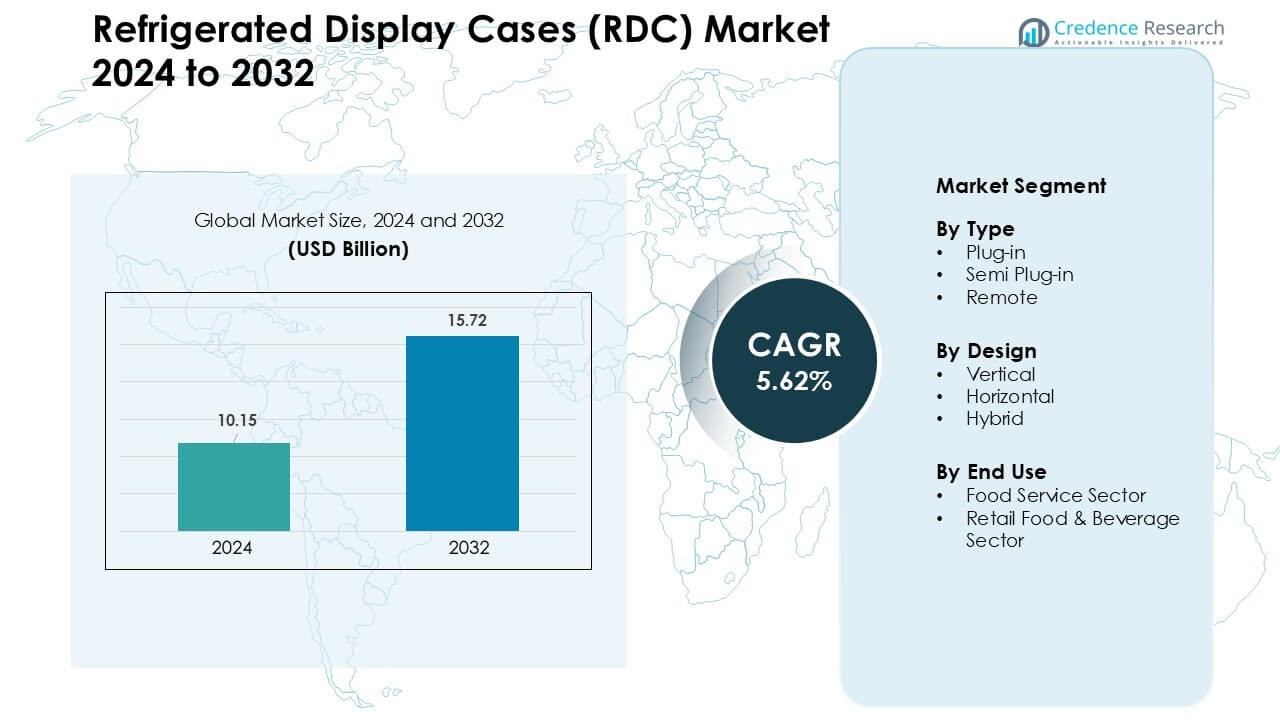
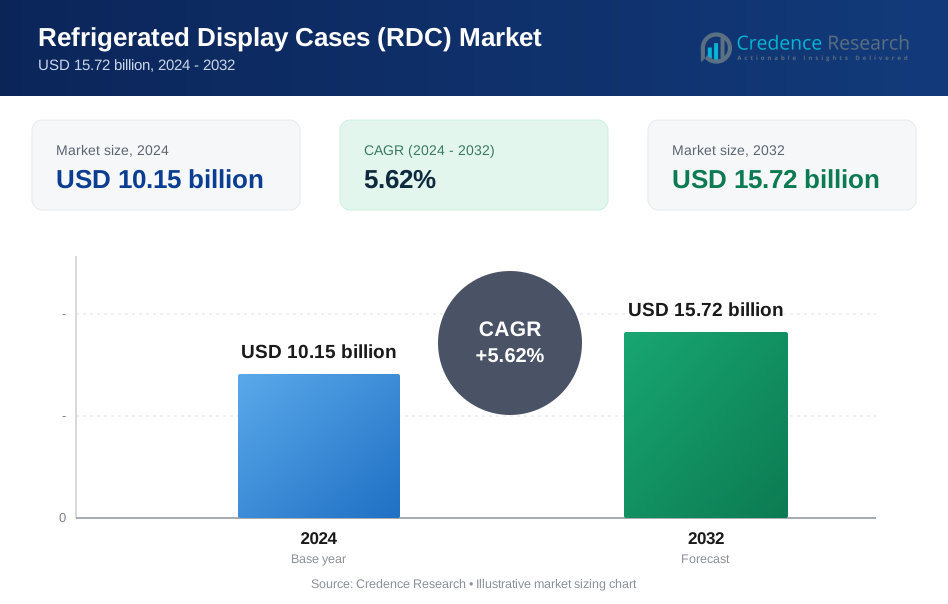
Refrigerated Display Cases (RDC) Market was valued at USD 10.15 billion in 2024 and is anticipated to reach USD 15.72 billion by 2032, growing at a CAGR of 5.62 % during the forecast period.| REPORT ATTRIBUTE | DETAILS |
|---|---|
| Historical Period | 2020-2023 |
| Base Year | 2024 |
| Forecast Period | 2025-2032 |
| Refrigerated Display Cases (RDC) Market Size 2024 | USD 10.15 Billion |
| Refrigerated Display Cases (RDC) Market, CAGR | 5.62 % |
| Refrigerated Display Cases (RDC) Market Size 2032 | USD 15.72 Billion |
Market Insights
- The Refrigerated Display Cases (RDC) Market reached USD 10.15 billion in 2024 and is projected to hit USD 15.72 billion by 2032, growing at a CAGR of 5.62%.
- Demand grew as retailers expanded chilled food, ready-to-eat meals, and beverage assortments, supporting strong adoption of plug-in units, which held about 48% share in 2024.
- Trends focused on energy-efficient systems, low-GWP refrigerants, and IoT-enabled monitoring as supermarkets upgraded fleets to cut operating costs and improve temperature stability.
- Competition remained strong among AHT Cooling Systems, Lennox International, Liebherr, Haier, Carrier, Dover, Hussmann, Metalfrio, Danfoss, and Epta, each expanding through efficient designs, modular layouts, and smart controls.
- North America led the market with about 34% share in 2024, supported by strict food safety rules and strong retail modernization, while the retail food & beverage sector dominated end use with nearly 61% share.
Market Segmentation Analysis:
By Type Plug-in units dominated the type segment in 2024 with about 48% share due to easy installation, low upfront setup needs, and strong demand from small retailers and cafés. These systems gained traction because buyers preferred flexible placement and reduced installation downtime. Semi plug-in formats expanded as energy-efficient heat-exchange designs lowered operating loads in compact stores. Remote systems grew in large supermarkets that needed stable temperature control and centralized refrigeration. Growth across all types reflected rising cold-chain standards and wider use of ready-to-eat and fresh food categories.- For instance, AHT Cooling Systems a major global manufacturer of supermarket freezers continues to supply plug‑in refrigeration and freezer systems for small‑format stores, reflecting strong plug-in demand among retailers with limited floor space.
- For instance, Carrier Commercial Refrigeration has emphasized vertical‑design cases in recent installations because their compact upright footprint supports better space utilization in convenience‑store formats and even smaller supermarkets, which often operate within constrained retail floor areas.
Key Growth Drivers
Growing Demand for Fresh and Chilled Food Products Rising consumption of fresh, ready-to-eat, and convenience food has become a major driver for the Refrigerated Display Cases (RDC) Market. Supermarkets, convenience stores, and cafés expanded chilled assortments as consumers shifted toward healthier meals, grab-and-go snacks, fresh bakery items, and premium beverages. This shift increased placement of vertical and plug-in systems that support high turnover and strong product visibility. Urban lifestyles boosted demand for packaged salads, fresh meat, dairy, and cut fruits, which require stable cooling throughout the day. Retailers also expanded chilled zones to reduce spoilage and maintain quality standards. Growth in quick-service restaurants further accelerated adoption as chains needed compact RDCs for fast-moving menu items. These preferences pushed brands to invest in energy-efficient and modular systems that maintain temperature consistency.- For instance, a trend report on chilled and deli foods globally indicates that a significant share of consumer demand comes from categories such as meat, dairy, snacks, and ready meals, reinforcing the need for reliable chilled display infrastructure in retail outlets to cater to diverse perishable categories.
- For instance, a 2024 market study reported that supermarkets held about 52% share of the global refrigerated display‑case market application segment, reflecting how expansion of modern retail networks underpins RDC demand worldwide.
Key Trends & Opportunities
Rise of Smart, Connected, and IoT-Enabled Refrigeration Digital transformation created strong opportunities in the RDC market as operators adopted IoT-based monitoring, predictive maintenance, and cloud-connected temperature tracking. Smart RDCs helped retailers reduce energy waste, avoid spoilage, and detect equipment failures before they occur. Sensors enabled real-time visibility of compressor loads and product temperatures, improving compliance and lowering operational risk. These upgrades strengthened appeal among supermarkets that manage large fleets across multiple outlets. Remote monitoring also supported labor efficiency as staff relied on automated alerts rather than manual checks. Manufacturers responded with advanced controllers, adaptive defrost logic, and algorithms that adjust cooling cycles based on load. These innovations positioned smart RDCs as a high-value investment for modern retail.- For instance, a multinational cold‑chain solutions provider Axino Solutions (in collaboration with Semtech’s LoRa® connectivity) offered a vendor‑agnostic temperature‑monitoring platform that claims the ability to detect the core temperature of food items within one degree Celsius using sensors placed inside coolers enabling precise, continuous monitoring of perishable goods, regardless of the original cooling‑equipment manufacturer.
- For instance, Embraco a global refrigeration‑technology brand in 2024 delivered variable‑speed condensing units using hydrocarbon refrigerant R290 for refrigerated food displays. Their case studies showed up to 53% energy savings compared with older fixed‑speed, HFO‑based systems a dramatic reduction in power consumption for display‑case operations.
Key Challenges
High Energy Consumption and Operating Cost Burden Despite efficiency improvements, RDCs still account for a major share of energy use in retail stores, making operating cost a key challenge. Large supermarkets run multiple units continuously, creating high electricity loads that strain budgets. Smaller retailers struggle to justify investments in advanced RDCs due to limited capital and rising power tariffs. High energy use also increases carbon emissions, pushing operators to balance cost, compliance, and sustainability. Maintenance costs add pressure as compressors, fans, and temperature-control components demand regular service. For many operators, retrofitting or replacing outdated RDC fleets remains financially challenging. Complexity of Installation, Maintenance, and Technical Integration RDC systems require specialized handling, which creates challenges for operators with limited technical expertise. Remote refrigeration setups need complex pipework, precise refrigerant charging, and professional installation teams. Maintenance demands increase when integrating IoT sensors, smart controllers, and energy-management systems. Lack of skilled technicians in emerging markets slows adoption of advanced RDC technologies. Downtime caused by technical issues can lead to product loss, reduced sales, and high repair bills. Manufacturers face challenges standardizing components across diverse store formats, which complicates scalability and increases long-term servicing needs.Regional Analysis
North America North America led the Refrigerated Display Cases (RDC) Market in 2024 with about 34% share, supported by strong supermarket networks, high adoption of energy-efficient refrigeration, and strict food safety regulations. Retailers upgraded fleets to hydrocarbon and CO₂-based systems as sustainability targets tightened. Growth in convenience stores and grab-and-go dining boosted demand for plug-in and vertical cases. Quick-service restaurant expansion also increased adoption of compact RDCs. Investments in smart, IoT-enabled refrigeration further strengthened regional leadership, with operators focusing on predictive maintenance, temperature monitoring, and lower operating costs across supermarkets, hypermarkets, and specialty food retail formats. Europe Europe held around 29% share in 2024, driven by advanced cold-chain standards, strong regulatory pressure on refrigerants, and early adoption of CO₂-based systems. Supermarkets across Germany, France, Italy, and the UK invested in low-GWP RDCs to comply with F-Gas rules. High disposable incomes supported growth in premium food formats that rely on modern chillers for fresh bakery, dairy, and specialty beverages. Retailers prioritized energy savings, prompting upgrades to LED lighting, variable-speed compressors, and closed-door designs. The rise of convenience and discount chains further accelerated demand for flexible and efficient vertical and hybrid display cases. Asia-Pacific Asia-Pacific accounted for the largest regional growth momentum with roughly 28% share in 2024, fueled by rapid urbanization, supermarket expansion, and rising consumption of chilled and ready-to-eat food. China, India, Japan, and Southeast Asia saw strong investment in plug-in and semi plug-in cases due to flexible installation needs. Retail modernization increased demand for energy-efficient RDCs as chains focused on lowering long-term electricity costs. Growth in QSRs, bakery chains, and specialty beverage outlets further supported adoption. Government regulations on food hygiene and cold storage strengthened market penetration across developing economies. Latin America Latin America captured nearly 6% share in 2024, supported by supermarket expansion in Brazil, Mexico, and Chile, along with rising demand for chilled bakery, dairy, and beverage products. Retailers invested in affordable plug-in units that support flexible placement and low installation costs. Growth of convenience chains and QSR brands boosted adoption of compact vertical models. Economic fluctuations limited large-scale RDC upgrades, but sustainability programs encouraged gradual adoption of energy-efficient units. Rising urban consumption and modernization of food retail formats continued to push demand across key countries. Middle East & Africa The Middle East & Africa region accounted for about 3% share in 2024, with growth driven by rising hospitality projects, expanding hypermarket chains, and increasing interest in chilled bakery and beverage products. GCC countries adopted advanced RDCs to support premium food retail and strict temperature control in high-heat environments. Remote and hybrid systems gained traction in large supermarkets, while plug-in models dominated small urban stores. Energy-efficiency initiatives encouraged operators to shift toward LED-lit and low-emission systems. Market adoption across Africa grew steadily as food retail formalized and cold-chain infrastructure improved.Market Segmentations:
By Type- Plug-in
- Semi Plug-in
- Remote
- Vertical
- Horizontal
- Hybrid
- Food Service Sector
- Retail Food & Beverage Sector
- North America
- U.S.
- Canada
- Mexico
- Europe
- Germany
- France
- U.K.
- Italy
- Spain
- Rest of Europe
- Asia Pacific
- China
- Japan
- India
- South Korea
- South-east Asia
- Rest of Asia Pacific
- Latin America
- Brazil
- Argentina
- Rest of Latin America
- Middle East & Africa
- GCC Countries
- South Africa
- Rest of the Middle East and Africa
Competitive Landscape
The competitive landscape of the Refrigerated Display Cases (RDC) Market features major players such as AHT Cooling Systems GmbH, Lennox International Inc., Liebherr Group, Haier Group, Carrier Commercial Refrigeration, Dover Corporation, Hussmann Corporation, Metalfrio Solutions S.A., Danfoss A/S, and Epta S.p.A. Refrigeration. These companies compete through advanced energy-efficient designs, low-GWP refrigerant adoption, and strong portfolios of plug-in, semi plug-in, and remote systems. Manufacturers focus on LED lighting, variable-speed compressors, and connected controls that enhance temperature stability and reduce operating costs. Many players expand through partnerships with supermarkets and convenience chains to support fleet upgrades and sustainability programs. Strong investments in IoT-enabled monitoring, modular layouts, and customized merchandising features help brands differentiate in a market driven by regulatory compliance, food safety, and retail modernization.Key Player Analysis
- AHT Cooling Systems GmbH
- Lennox International Inc.
- Liebherr Group
- Haier Group
- Carrier Commercial Refrigeration
- Dover Corporation
- Hussmann Corporation
- Metalfrio Solutions S.A.
- Danfoss A/S
- Epta S.p.A. Refrigeration
Recent Developments
- In August 2025, Lennox International Inc. Expanded its HVAC / parts & supplies footprint by signing an agreement to acquire the HVAC division of NSI Industries (Duro Dyne, Supco brands) a deal that strengthens Lennox’s channel/parts capabilities which can influence service/support for commercial refrigeration and RDC customers.
- In June 2025, Epta S.p.A. Refrigeration launched UNIT, an Iarp-branded refrigerated display case designed around circular-economy principles, using modular design for disassembly, recyclable materials, and natural refrigerant R600a to cut lifecycle impacts while improving serviceability and energy efficiency for food and beverage retail.
- In April 2025, Lennox’s EMEA commercial/refrigeration operations were restructured / rebranded following earlier transactions (Lennox EMEA activity and rebranding to LFB Group noted in industry press), affecting the regional footprint of its Heatcraft/related refrigeration businesses.
Report Coverage
The research report offers an in-depth analysis based on Type, Design, End-Use and Geography. It details leading market players, providing an overview of their business, product offerings, investments, revenue streams, and key applications. Additionally, the report includes insights into the competitive environment, SWOT analysis, current market trends, as well as the primary drivers and constraints. Furthermore, it discusses various factors that have driven market expansion in recent years. The report also explores market dynamics, regulatory scenarios, and technological advancements that are shaping the industry. It assesses the impact of external factors and global economic changes on market growth. Lastly, it provides strategic recommendations for new entrants and established companies to navigate the complexities of the market.Future Outlook
- The market will see faster adoption of energy-efficient RDCs as retailers cut power use.
- Low-GWP and natural refrigerants will gain wider acceptance due to strict environmental rules.
- IoT-enabled monitoring and predictive maintenance will become standard features across new installations.
- Remote and semi plug-in systems will expand as supermarkets optimize cooling loads and store comfort.
- Compact plug-in units will grow in convenience stores and QSR chains seeking flexible placement.
- Advanced insulation, LED lighting, and variable-speed compressors will shape next-generation designs.
- Premium food merchandising will drive demand for sleek, frameless, and customizable RDC models.
- Retailers will invest more in temperature stability to reduce spoilage and meet safety norms.
- Emerging markets will accelerate purchases as modern retail formats expand.
- Replacement demand will rise as aging fleets are phased out for greener and smarter solutions.
Request a Free Sample
Fill in your details and we'll send you a free sample report.
- Sample data tables & charts
- Research methodology
Need a Custom Version of This Report?
Tailor the scope, geography, or segments to your exact requirements.
- Custom geography or segment scope
- Direct access to our analyst team
Frequently Asked Questions
What is the current market size for Refrigerated Display Cases (RDC) Market, and what is its projected size in 2032?
At what Compound Annual Growth Rate is Refrigerated Display Cases (RDC) Market projected to grow between 2024 and 2032?
Which Refrigerated Display Cases (RDC) Market segment held the largest share in 2024?
What are the primary factors fueling the growth of Refrigerated Display Cases (RDC) Market?
Who are the leading companies in Refrigerated Display Cases (RDC) Market?
Which region commanded the largest share of Refrigerated Display Cases (RDC) Market?
Table of Content
Chapter 1. Report Introduction
- 1.1 Report Description & Purpose
- 1.1.1 Report Title & Market Definition
- 1.1.2 Unique Selling Propositions (USP) & Key Differentiators
- 1.1.3 Value Proposition for Stakeholders
- 1.2 Research Objectives
- 1.2.1 Market Sizing Objectives (Volume & Revenue)
- 1.2.2 Segmentation Objectives
- 1.2.3 Competitive Intelligence Objectives
- 1.2.4 Forecast & Scenario Objectives
- 1.3 Report Scope
- 1.3.1 Refrigerated Display Cases (RDC) Scope – Types & Subtypes Covered
- 1.3.2 Geographic Scope – Regions & Countries Covered
- 1.3.3 Historical Period, Base Year & Forecast Period (2024; forecast to 2032)
- 1.3.4 Inclusions & Exclusions
- 1.4 HS Code & Classification Framework
- 1.5 Currency, Units & Pricing Basis
- 1.6 Target Stakeholders
- 1.7 Limitations & Assumptions
Chapter 2. Executive Summary
- 2.1 Global Refrigerated Display Cases (RDC) Market Snapshot
- 2.1.1 Market Size – Historical (2024) & Forecast (2024-2032) (2024: USD 10.15 billion → 2032: USD 15.72 billion)
- 2.1.2 Volume & Revenue – Global Totals
- 2.1.3 Key Market Highlights – Top Five Facts
- 2.2 Refrigerated Display Cases (RDC) Market Segmentation Snapshot
- 2.2.1 Market Split by Region – 2024 vs. 2032
- 2.3 Competitive Snapshot
- 2.3.1 Top 10 Players by Revenue Share – 2024
- 2.3.2 Top 10 Players by Volume Share – 2024
- 2.3.3 Recent Strategic Developments (18-Month Summary)
- 2.4 Key Investment Highlights & Strategic Conclusions
Chapter 3. Refrigerated Display Cases (RDC) Market Dynamics & Industry Analysis
- 3.1 Market Overview & Context
- 3.1.1 Refrigerated Display Cases (RDC) Market Position in the Broader Automotive Value Chain
- 3.1.2 OEM vs. Replacement Market Dynamics
- 3.1.3 Market Maturity & Development Stage by Region
- 3.2 Refrigerated Display Cases (RDC) Market Drivers
- 3.3 Refrigerated Display Cases (RDC) Market Restraints & Challenges
- 3.4 Refrigerated Display Cases (RDC) Market Opportunities
- 3.5 Porter's Five Forces Analysis
- 3.5.1 Threat of New Entrants
- 3.5.2 Bargaining Power of Suppliers
- 3.5.3 Bargaining Power of Buyers
- 3.5.4 Threat of Substitutes
- 3.5.5 Competitive Rivalry – Intensity Assessment
- 3.6 Refrigerated Display Cases (RDC) Value Chain Analysis
- 3.6.1 Upstream – Raw Material/Input Suppliers
- 3.6.1.1 Raw Material/Input 1
- 3.6.1.2 Raw Material/Input 2
- 3.6.1.3 Raw Material/Input 3
- 3.6.2 Midstream – Production/Manufacturing/Service Delivery
- 3.6.2.1 Production/Process Overview
- 3.6.2.2 Key Facility Locations & Capacity by Manufacturer
- 3.6.3 Downstream – Distribution & End Consumer
- 3.6.3.1 Primary Channel – B2B/OEM
- 3.6.3.2 Secondary Channels – Dealer, Retail, Online, Direct
- 3.6.4 Value Chain Profitability Analysis
- 3.6.1 Upstream – Raw Material/Input Suppliers
- 3.7 PESTEL Analysis
- 3.7.1 Political Factors
- 3.7.2 Economic Factors
- 3.7.3 Social Factors
- 3.7.4 Technological Factors
- 3.7.5 Environmental Factors
- 3.7.6 Legal Factors
- 3.8 Refrigerated Display Cases (RDC) Supply Chain Analysis
- 3.8.1 Raw Material/Input Supply Risk Assessment
- 3.8.2 Manufacturing Concentration Risk (Geographic Exposure)
- 3.8.3 Trade Disruption Impact Analysis
- 3.9 Regulatory & Policy Landscape
Note: The regulatory and policy landscape section covers regulations based on their applicability to the market, Refrigerated Display Cases (RDC) category, geography, and scope of the study. Only regulatory frameworks with a material impact on operations, compliance, trade, sustainability, or market access are analyzed in detail.
Chapter 4. Key Investment Pockets & Opportunity Analysis
- 4.1 Refrigerated Display Cases (RDC) Market Attractiveness Analysis
- 4.1.1 By Region – Investment Attractiveness Matrix (Volume × CAGR)
- 4.2 Absolute Revenue Growth Opportunity
- 4.2.1 By Region – Absolute USD Growth Through 2032
- 4.3 Incremental Volume Opportunity
- 4.3.1 By Region – Incremental Volume Through 2032
- 4.3.2 Segment – Incremental Volume
- 4.4 Emerging Submarket Opportunity Deep Dive (Subject to Applicability)
- 4.5 Emerging Market Opportunity Scorecards
- 4.5.1 United States
- 4.5.2 Europe
- 4.5.3 Asia
- 4.5.4 Middle East & Africa
Note: Emerging Market Opportunity Scorecards will be included based on relevance and strategic importance. Regions listed are indicative and may vary depending on data availability and market dynamics.
Chapter 5. Refrigerated Display Cases (RDC) Import-Export Analysis & Trade Flows
- 5.1 Global Trade Overview
- 5.1.1 Global Export Value by Country (2024)
- 5.1.2 Global Export Volume by Country (2024)
- 5.1.3 Global Import Value by Country (2024)
- 5.1.4 Global Import Volume by Country (2024)
- 5.1.5 Net Trade Balance by Country (2024)
- 5.2 Export Analysis – Segment
- 5.2.1 Type 1 (HS Code)
- 5.2.2 Type 2 (HS Code)
- 5.2.3 Type 3 (HS Code)
- 5.2.4 Type 4 (HS Code)
- 5.2.5 Type 5 (HS Code)
- 5.3 Import Analysis – Segment
- 5.3.1 Type 1 (HS Code)
- 5.3.2 Type 2 (HS Code)
- 5.3.3 Type 3 (HS Code)
- 5.3.4 Type 4 (HS Code)
- 5.3.5 Type 5 (HS Code)
- 5.4 Average Unit Trade Prices
- 5.4.1 Average Export Price – Segment & Country
- 5.4.2 Average Import Price – Segment & Source Country
- 5.4.3 Price Trends (2024)
- 5.5 Key Trade Route Analysis
- 5.5.1 Trade Route 1
- 5.5.2 Trade Route 2
- 5.5.3 Trade Route 3
- 5.5.4 Trade Route 4
- 5.5.5 Trade Route 5
- 5.6 Trade Policy Impact Assessment
- 5.6.1 US Anti-Dumping & Section 301 Tariffs
- 5.6.2 EU Customs Union Impact
- 5.6.3 Major Free Trade Agreements
- 5.6.4 USMCA Rules of Origin
Note: Trade policy analysis will be included only where relevant to the Refrigerated Display Cases (RDC) market.
Chapter 6. Competitive Landscape & Company Benchmarking
- 6.1 Refrigerated Display Cases (RDC) Market Concentration & Structure
- 6.1.1 Herfindahl-Hirschman Index (HHI) – vs. 2024
- 6.1.2 Tier 1, Tier 2 & Tier 3 Market Structure
- 6.1.3 Global, Regional & Local Player Dynamics
- 6.2 Refrigerated Display Cases (RDC) Market Share Analysis – 2024
- 6.2.1 Global Revenue Share by Company
- 6.2.2 Global Volume Share by Company
- 6.2.3 Regional Revenue Share
- 6.2.4 Market Share Evolution ( vs. 2024)
- 6.2.5 OEM Segment Share by Company
- 6.2.6 Replacement Segment Share by Company
- 6.3 Production/Delivery Capacity & Facility Analysis
- 6.3.1 Global Installed Capacity
- 6.3.2 Capacity Utilization Rates
- 6.3.3 Production/Output Volume
- 6.3.4 Facility Locations & Capacity Map
- 6.3.5 Planned Capacity Additions
- 6.4 Refrigerated Display Cases (RDC) Competitive Benchmarking Matrix
- 6.4.1 Revenue, Volume, CAGR & Profitability Comparison
- 6.4.2 Channel Revenue Mix
- 6.4.3 Geographic Revenue Exposure
- 6.4.4 R&D Intensity
- 6.4.5 Sustainability Maturity
- 6.5 Strategic Developments in Refrigerated Display Cases (RDC) (Last 24 Months)
- 6.5.1 Mergers, Acquisitions & Divestments
- 6.5.2 New Refrigerated Display Cases (RDC) Launches
- 6.5.3 Facility Expansions
- 6.5.4 Strategic Alliances, Joint Ventures & Partnerships
- 6.5.5 Distribution Expansion & Market Entry
- 6.5.6 Sustainability & ESG Initiatives
- 6.6 Competitive Strategy Mapping
- 6.6.1 Leader, Challenger, Follower & Niche Classification
- 6.6.2 Pricing Strategy Comparison
- 6.6.3 Channel Strategy Matrix
Note: Strategic developments are included based on their materiality and the availability of reliable information.
Chapter 7. Global Refrigerated Display Cases (RDC) Market – By Distribution Channel
- 7.1 Segment Overview
- 7.1.1 Volume & Revenue Split by Channel (2024 & 2032)
- 7.1.2 Channel Mix Evolution (2024-2032)
Chapter 8. Regional Market Analysis – Global Overview
- 8.1 Global Regional Overview
- 8.1.1 Regional Volume Share
- 8.1.2 Regional Revenue Share
- 8.1.3 Regional Volume by Region
- 8.1.4 Regional Revenue by Region
- 8.1.5 Regional Forecast Through 2032
- 8.2 Cross-Regional Segment Analysis
- 8.2.1 By Distribution Channel
- 8.2.2 By Brand/Price Tier
Chapter 9. North America Refrigerated Display Cases (RDC) Market
- 9.1 United States
- 9.2 Canada
- 9.3 Mexico
Chapter 10. Europe Refrigerated Display Cases (RDC) Market
- 10.1 Germany
- 10.2 France
- 10.3 Italy
- 10.4 United Kingdom
- 10.5 Spain
- 10.6 Poland
- 10.7 Russia
- 10.8 Netherlands
- 10.9 Belgium
- 10.10 Sweden
- 10.11 Denmark
- 10.12 Norway
- 10.13 Rest of Europe
Chapter 11. Asia Pacific Refrigerated Display Cases (RDC) Market
- 11.1 China
- 11.2 India
- 11.3 Japan
- 11.4 South Korea
- 11.5 Thailand
- 11.6 Indonesia
- 11.7 Vietnam
- 11.8 Malaysia
- 11.9 Australia
- 11.10 Rest of Asia Pacific
Chapter 12. Latin America Refrigerated Display Cases (RDC) Market
- 12.1 Brazil
- 12.2 Argentina
- 12.3 Colombia
- 12.4 Chile
- 12.5 Rest of Latin America
Chapter 13. Middle East Refrigerated Display Cases (RDC) Market
- 13.1 Saudi Arabia
- 13.2 United Arab Emirates
- 13.3 Turkey
- 13.4 Israel
- 13.5 Iran
- 13.6 Rest of the Middle East
Chapter 14. Africa Refrigerated Display Cases (RDC) Market
- 14.1 South Africa
- 14.2 Egypt
- 14.3 Nigeria
- 14.4 Morocco
- 14.5 Rest of Africa
Chapter 15. Refrigerated Display Cases (RDC) Company Profiles
- 15.1 [Company 01]
- 15.1.1 Company Overview
- 15.1.2 Key Management Personnel
- 15.1.3 Products & Services Portfolio
- 15.1.4 Financial Performance
- 15.1.5 Key Market Focus & Geographic Presence
- 15.1.6 Recent Developments & Strategic Initiatives
Note: The company profile list is preliminary and may change based on research findings, market developments, data availability, and client requirements.
Chapter 16. Appendices
- Appendix A – List of Abbreviations & Acronyms
- Appendix B – Industry Classification Code Reference – Full Series
- Appendix C – Production & Capacity Data Tables
- Appendix D – End-Use & Demand Base Tables
- Appendix E – Consumption & Replacement Rate Assumptions
- Appendix F – ASP Reference Tables
- Appendix G – Manufacturing & Facility Database
- Appendix H – Import-Export Data Tables
- Appendix I – Regulatory Summary Tables
- Appendix J – Primary Research Participant List (Anonymized)
- Appendix K – Primary Research Questionnaire Framework
- Appendix L – Data Sources & Bibliography
- Appendix M – Market Size Divergence & Source Comparison
Chapter 17. Research Methodology
- 17.1 Research Framework & Philosophy
- 17.2 Secondary Research – Sources, Hierarchy & Data Extraction
- 17.3 Data Modeling – Bottom-Up & Top-Down Market Sizing
- 17.4 Primary Research – Stakeholder Framework, LOI & Sample Sizes
- 17.5 Forecast Methodology – Regression, Scenario & Sensitivity Analysis
- 17.6 Quality Control – Four-Layer Validation Framework
- 17.7 Limitations & Standard Assumptions
- 17.8 Disclaimer
