
Market Overview:
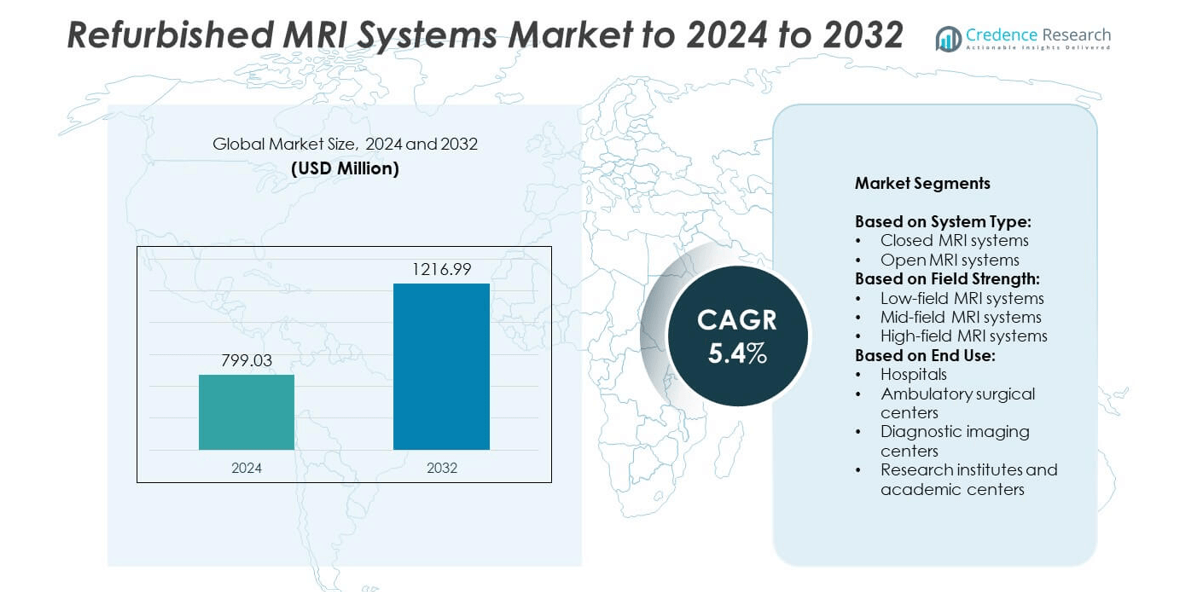
Refurbished MRI Systems Market size was valued at USD 799.03 million in 2024 and is anticipated to reach USD 1216.99 million by 2032, at a CAGR of 5.4% during the forecast period.
| REPORT ATTRIBUTE | DETAILS |
|---|---|
| Historical Period | 2020-2023 |
| Base Year | 2024 |
| Forecast Period | 2025-2032 |
| Refurbished MRI Systems Market Size 2024 | USD 799.03 million |
| Refurbished MRI Systems Market, CAGR | 5.4% |
| Refurbished MRI Systems Market Size 2032 | USD 1216.99 million |
The refurbished MRI systems market is driven by leading players such as GE HealthCare, Siemens Healthineers, Koninklijke Philips, Fujifilm Healthcare, Canon Medical Systems, Avante Health Solutions, Block Imaging, and SOMA Technology. These companies focus on certified refurbishment processes, service expansion, and sustainability initiatives to provide cost-effective imaging solutions. Their competitive strategies emphasize enhancing diagnostic reliability while supporting healthcare providers in managing budget constraints. Regionally, North America led the market in 2024 with a 37% share, supported by strong healthcare infrastructure and high imaging demand, followed by Europe with 29% and Asia Pacific with 23%, reflecting expanding adoption in emerging economies.
Market Insights
- The refurbished MRI systems market was valued at USD 799.03 million in 2024 and is projected to reach USD 1216.99 million by 2032, growing at a CAGR of 5.4%.
- Rising demand for affordable diagnostic imaging and cost-effective solutions is driving the adoption of refurbished MRI systems across hospitals and diagnostic centers.
- Key trends include sustainability initiatives, advanced refurbishment technologies, and growing adoption in emerging economies where budget constraints limit access to new systems.
- The market is competitive, with major players focusing on certified refurbishment, service network expansion, and partnerships to strengthen their global presence.
- North America led with 37% share in 2024, followed by Europe with 29% and Asia Pacific with 23%, while Latin America accounted for 7% and the Middle East & Africa 4%; closed MRI systems and high-field systems dominated segment-wise due to advanced imaging capabilities and higher diagnostic reliability.
Market Segmentation Analysis:
By System Type
Closed MRI systems dominated the refurbished MRI systems market in 2024, accounting for the largest share due to their superior image resolution and broad clinical applications. These systems are widely preferred in diagnostic imaging for neurological, musculoskeletal, and cardiovascular examinations. Their strong demand stems from the ability to provide detailed scans essential for accurate diagnosis, especially in critical cases. Refurbished closed MRI systems are cost-effective alternatives for hospitals and diagnostic centers, making advanced imaging accessible without high capital investment. Open MRI systems, though growing, remain niche due to lower resolution capabilities.
- For instance, GE HealthCare’s SIGNA Explorer 1.5T has a 60 cm bore, 33 mT/m gradients, and 120 T/m/s slew rate, matching high-volume diagnostic needs.
By Field Strength
High-field MRI systems held the largest share in 2024, driven by their capability to deliver faster scans and higher image quality, which is vital for complex clinical applications such as oncology and neurology. Their adoption is particularly high in large hospitals and research centers seeking advanced diagnostic precision. Refurbished high-field MRI systems offer an affordable option for facilities aiming to upgrade diagnostic capabilities without incurring the full cost of new equipment. Mid-field and low-field systems continue to serve smaller healthcare providers where budget and operational needs differ.
- For instance, United Imaging’s uMR 790 (3.0 T) offers 100 mT/m gradient strength and 200 T/m/s slew rate; the uMR Omega (3.0 T) uses a 75 cm bore cleared by the FDA.
By End Use
Hospitals emerged as the leading end-use segment, commanding the largest market share in 2024 due to the high patient volume and broad demand for advanced imaging services. Hospitals often invest in refurbished MRI systems to expand imaging capacity while managing budget constraints, particularly in developing regions. These systems help hospitals balance cost efficiency with the need for advanced diagnostic accuracy. While diagnostic imaging centers and ambulatory surgical centers are expanding adoption, hospitals remain dominant as they handle diverse cases requiring reliable imaging solutions. Research institutes also contribute steadily, focusing on clinical studies and training applications.
Market Overview
Cost-Effectiveness and Accessibility
One of the primary growth drivers for the refurbished MRI systems market is the cost-effectiveness of refurbished units, which makes advanced imaging technology accessible to smaller hospitals and diagnostic centers. With rising healthcare costs, many facilities are unable to afford new MRI systems, driving demand for refurbished alternatives. These systems provide comparable performance at reduced prices, allowing healthcare providers to expand diagnostic services. Growing adoption in emerging economies, where budget constraints are significant, further strengthens market penetration and contributes to the steady growth trajectory.
- For instance, Canon Medical Systems USA announced the commercial release of the Vantage Galan 3T / Supreme Edition MRI system on November 26, 2024.
Rising Demand for Diagnostic Imaging
The increasing burden of chronic diseases, such as cancer, neurological disorders, and musculoskeletal conditions, has boosted demand for advanced imaging solutions. MRI scans play a crucial role in early disease detection and treatment planning, creating consistent market demand. Refurbished MRI systems enable healthcare providers to meet growing patient volumes without large investments in new machines. As imaging volumes rise globally, particularly in developing nations, refurbished systems offer an effective solution to improve diagnostic capacity while supporting healthcare infrastructure expansion.
- For instance, DirectMed's acquisition of LBN Medical was announced in February 2022. At the time of the acquisition, DirectMed already had over 60,000 parts in its inventory.
Sustainability and Equipment Lifecycle Extension
Sustainability in healthcare is a growing priority, and refurbished MRI systems support this trend by extending the lifecycle of high-value medical equipment. Facilities benefit from reduced electronic waste and lower carbon footprints, aligning with global environmental goals. Manufacturers and refurbishing companies ensure compliance with safety and performance standards, providing reliable systems at lower costs. This focus on sustainable practices, combined with strong demand for eco-friendly solutions, positions refurbished MRI systems as an attractive choice for healthcare institutions committed to green initiatives and responsible technology use.
Key Trends and Opportunities
Technological Advancements in Refurbishment
A key trend shaping the market is the integration of advanced refurbishment techniques that enhance system reliability and performance. Modern refurbishing processes now include upgrading software, coils, and imaging components, allowing refurbished MRI systems to meet clinical standards closer to new machines. This innovation expands the appeal of refurbished units, making them more attractive to hospitals seeking advanced diagnostics at lower costs. Enhanced quality assurance practices also improve trust and adoption among healthcare providers, creating long-term growth opportunities in the market.
- For instance, Philips reclaimed more than 11,500 systems or pieces of equipment in 2023, according to its Annual Report 2023.
Expanding Adoption in Emerging Economies
An important opportunity lies in the growing adoption of refurbished MRI systems in emerging economies where budgetary constraints limit access to new machines. Healthcare facilities in regions such as Asia-Pacific, Latin America, and parts of Africa are increasingly investing in refurbished imaging solutions to expand diagnostic capacity. The rising prevalence of chronic diseases, coupled with government initiatives to improve healthcare access, supports this growth. This opportunity is strengthened by the cost savings and sustainability benefits that refurbished systems bring to resource-constrained settings.
- For instance, according to the Canadian Medical Imaging Inventory, the number of MRI units in Canada rose from 378 in 2019–2020 to 432 in 2022–2023. In the fiscal year 2022–2023, Canada recorded an average of 55.6 publicly funded MRI exams per 1,000 people, which was lower than the OECD average of 83.6 exams per 1,000 population.
Increasing Private Sector Investment
Another notable trend is the increasing investment from private healthcare providers in refurbished MRI systems to enhance service offerings. With rising competition in the healthcare industry, diagnostic centers and private hospitals are adopting refurbished machines to provide advanced imaging at affordable costs. This trend also reflects the growing importance of outpatient diagnostic services, where refurbished MRI units play a critical role in delivering timely and efficient care. Such investments accelerate market growth while diversifying the customer base across regions.
Key Challenges
Concerns Over Quality and Reliability
A major challenge in the refurbished MRI systems market is lingering concerns over the quality and reliability of refurbished equipment. Some healthcare providers hesitate to invest in pre-owned systems due to doubts about performance consistency and longevity. Although certified refurbishment processes address many of these issues, the perception gap remains a barrier to adoption. Overcoming this challenge requires stronger awareness, standardized certification practices, and transparent warranties to build confidence among buyers in both developed and developing markets.
Regulatory and Compliance Barriers
Strict regulations governing refurbished medical devices present another challenge for market growth. Different countries impose varying safety, quality, and certification standards, making it difficult for refurbishing companies to maintain compliance across global markets. These regulatory complexities can delay market entry and increase costs for suppliers. Smaller refurbishing firms often struggle to meet such requirements, limiting their reach. Addressing these challenges will require harmonized international standards and stronger collaboration between regulators and industry players to ensure safe and compliant equipment supply.
Regional Analysis
North America North America held the largest share of the refurbished MRI systems market in 2024, accounting for 37%. The region’s dominance is driven by advanced healthcare infrastructure, high adoption of diagnostic imaging, and strong presence of refurbishing companies. Hospitals and diagnostic centers in the United States and Canada increasingly opt for refurbished MRI systems to manage costs while meeting rising imaging demand. Favorable regulatory frameworks supporting certified refurbished equipment further encourage adoption. The growing patient pool with chronic diseases and technological improvements in refurbishment processes are expected to sustain North America’s leadership throughout the forecast period.
Europe
Europe captured 29% of the refurbished MRI systems market in 2024, driven by increasing demand for affordable imaging solutions across both public and private healthcare facilities. Countries such as Germany, the UK, and France are leading adopters, supported by government healthcare budgets and sustainability initiatives. Refurbished MRI systems align with Europe’s strong focus on reducing electronic waste and promoting eco-friendly healthcare solutions. The presence of established refurbishing companies ensures reliable supply and compliance with safety standards. Rising diagnostic imaging demand, particularly in oncology and neurology, further contributes to Europe’s significant market share and continued growth.
Asia Pacific
Asia Pacific accounted for 23% of the refurbished MRI systems market in 2024, reflecting growing investments in healthcare infrastructure and increasing adoption of cost-effective imaging solutions. Emerging economies such as China, India, and Southeast Asian countries are key growth engines, driven by rising chronic disease prevalence and government efforts to improve diagnostic access. Limited budgets in many hospitals make refurbished MRI systems attractive, particularly for expanding rural and semi-urban healthcare facilities. Increasing collaborations with international refurbishing companies and rising private healthcare investments are expected to accelerate Asia Pacific’s market growth during the forecast period.
Latin America
Latin America represented 7% of the refurbished MRI systems market in 2024, with demand driven by cost-conscious healthcare systems in countries such as Brazil, Mexico, and Argentina. Budget limitations and uneven access to advanced medical equipment make refurbished MRI systems a practical choice for expanding diagnostic imaging capacity. Growing prevalence of chronic diseases and rising adoption in private healthcare facilities support regional growth. However, regulatory complexities and economic instability limit wider penetration. Efforts by global refurbishing companies to strengthen distribution and service networks in Latin America are expected to boost adoption in the coming years.
Middle East and Africa
The Middle East and Africa held a 4% share of the refurbished MRI systems market in 2024, reflecting gradual adoption in developing healthcare systems. High costs of new imaging equipment and limited healthcare budgets make refurbished systems appealing, particularly in African nations. Gulf countries such as Saudi Arabia and the UAE show stronger adoption due to ongoing healthcare modernization initiatives. However, infrastructural limitations and weak distribution networks remain challenges. Increasing partnerships with refurbishing firms and international aid programs aimed at improving diagnostic capabilities are likely to drive steady but moderate growth in the region.
Market Segmentations:
By System Type:
- Closed MRI systems
- Open MRI systems
By Field Strength:
- Low-field MRI systems
- Mid-field MRI systems
- High-field MRI systems
By End Use:
- Hospitals
- Ambulatory surgical centers
- Diagnostic imaging centers
- Research institutes and academic centers
By Geography:
- North America
- U.S.
- Canada
- Mexico
- Europe
- UK
- France
- Germany
- Italy
- Spain
- Russia
- Belgium
- Netherlands
- Austria
- Sweden
- Poland
- Denmark
- Switzerland
- Rest of Europe
- Asia Pacific
- China
- Japan
- South Korea
- India
- Australia
- Thailand
- Indonesia
- Vietnam
- Malaysia
- Philippines
- Taiwan
- Rest of Asia Pacific
- Latin America
- Brazil
- Argentina
- Peru
- Chile
- Colombia
- Rest of Latin America
- Middle East
- UAE
- KSA
- Israel
- Turkey
- Iran
- Rest of Middle East
- Africa
- Egypt
- Nigeria
- Algeria
- Morocco
- Rest of Africa
Competitive Landscape
The refurbished MRI systems market is shaped by prominent players such as MedScanner, GE HealthCare, Avante Health Solutions, SOMA Technology, Radon Medical Imaging (Radon), Block Imaging, Amber Diagnostics, LBN Medical, Integrity Medical Systems, Canon Medical Systems, Fujifilm Healthcare, Aegys, Siemens Healthineers, Providian Medical, and Koninklijke Philips. These companies collectively focus on extending the lifecycle of imaging equipment through certified refurbishment processes while ensuring compliance with safety and performance standards. Their strategies emphasize offering cost-effective diagnostic solutions to healthcare facilities across developed and emerging markets. Competitive dynamics are marked by investments in advanced refurbishment technologies, expansion of service networks, and partnerships with hospitals and diagnostic centers to strengthen market reach. Sustainability initiatives and the growing need for affordable imaging solutions further enhance competition, with companies increasingly aligning portfolios to meet global healthcare demands. The market is expected to remain competitive as players continue to innovate and expand their presence worldwide.
Key Player Analysis
- MedScanner
- GE HealthCare
- Avante Health Solutions
- SOMA Technology
- Radon Medical Imaging (Radon)
- Block Imaging
- Amber Diagnostics
- LBN Medical
- Integrity Medical Systems
- Canon Medical Systems
- Fujifilm Healthcare
- Aegys
- Siemens Healthineers
- Providian Medical
- Koninklijke Philips
Recent Developments
- In 2024, General Electric (GE Healthcare) expanded its refurbished imaging equipment portfolio, including newer MRI models with software upgrades. This enabled the company to offer refurbished equipment with advanced functionalities at a lower cost compared to new systems.
- In 2023, Siemens Healthineers collaborated with CommonSpirit Health to acquire Block Imaging. Block Imaging provides refurbished medical equipment, servicing, and parts. The acquisition aimed to encourage efforts to repair and reuse equipment, provide greater value to consumers and their patients, and reduce waste.
- In 2023, Radon Medical Imaging (Radon) acquired Premier Imaging Medical Systems (Premier), a company specializing in the sale and maintenance of new, used, and refurbished imaging and biomedical equipment.
Report Coverage
The research report offers an in-depth analysis based on System Type, Field Strength, End-Use and Geography. It details leading market players, providing an overview of their business, product offerings, investments, revenue streams, and key applications. Additionally, the report includes insights into the competitive environment, SWOT analysis, current market trends, as well as the primary drivers and constraints. Furthermore, it discusses various factors that have driven market expansion in recent years. The report also explores market dynamics, regulatory scenarios, and technological advancements that are shaping the industry. It assesses the impact of external factors and global economic changes on market growth. Lastly, it provides strategic recommendations for new entrants and established companies to navigate the complexities of the market.
Future Outlook
- The market will continue to expand steadily, driven by rising demand for cost-effective imaging solutions.
- Hospitals will remain the dominant end users due to high patient volumes and diverse diagnostic needs.
- Closed MRI systems will sustain their lead because of superior imaging capabilities and wider adoption.
- High-field refurbished MRI systems will see growing demand for complex diagnostic and research applications.
- Emerging economies will drive significant growth as healthcare infrastructure investments increase.
- Sustainability initiatives will strengthen adoption by extending equipment lifecycle and reducing electronic waste.
- Technological advancements in refurbishment will enhance system performance and reliability.
- Private diagnostic centers will increasingly invest in refurbished MRI systems to stay competitive.
- Regulatory clarity and certification improvements will build greater trust among healthcare providers.
- The market will evolve with stronger collaborations between refurbishing companies and global healthcare institutions.

Request a Free Sample
Fill in your details and we'll send you a free sample report.
- Sample data tables & charts
- Research methodology
Market Dynamics
Cost-Effectiveness and Accessibility
Refurbished MRI systems offer advanced imaging capabilities at significantly lower costs compared to new equipment, making them accessible to smaller hospitals and diagnostic centers, especially in emerging economies with budget constraints.
Sustainability and Lifecycle Extension
The refurbishment of MRI systems extends the useful life of high-value medical equipment, reducing electronic waste and supporting healthcare providers' sustainability initiatives, which is increasingly important for both regulatory compliance and public image.
Technological Advancements in Refurbishment
Modern refurbishment processes now include upgrades to software, coils, and imaging components, allowing refurbished MRI systems to approach the performance and reliability of new machines, thereby increasing their attractiveness to healthcare providers.
Expanding Adoption in Emerging Economies
Emerging markets in Asia Pacific, Latin America, and Africa are investing in refurbished MRI systems to expand diagnostic capacity, driven by rising chronic disease prevalence and government efforts to improve healthcare access despite limited budgets.
Increasing Private Sector Investment
Private hospitals and diagnostic centers are increasingly purchasing refurbished MRI systems to enhance their service offerings and remain competitive, particularly as outpatient diagnostic services grow and cost pressures intensify.
Need a Custom Version of This Report?
Tailor the scope, geography, or segments to your exact requirements.
- Custom geography or segment scope
- Direct access to our analyst team
Frequently Asked Questions
What is the current market size for Refurbished MRI Systems Market, and what is its projected size in 2032?
At what Compound Annual Growth Rate is the Refurbished MRI Systems Market projected to grow between 2025 and 2032?
Which Refurbished MRI Systems Market segment held the largest share in 2024?
What are the primary factors fueling the growth of the Refurbished MRI Systems Market?
Who are the leading companies in the Refurbished MRI Systems Market?
Table of Content
Chapter 1 Market Segmentation
- 1.1 Segmentation Framework
- 1.1.1 Product and Service Classification
- 1.1.2 Application and End-Use Classification
- 1.1.3 Technology and Solution Classification
- 1.1.4 Customer and Distribution Channel Classification
- 1.1.5 Geographic Segmentation
- 1.1.6 Market Segment Definitions and Boundaries
- 1.2 By End Use
- 1.2.1 Hospitals
- 1.2.2 Ambulatory surgical centers
- 1.2.3 Diagnostic imaging centers
- 1.2.4 Research institutes and academic centers
- 1.3 By System Type
- 1.3.1 Closed MRI systems
- 1.3.2 Open MRI systems
- 1.4 By Field Strength
- 1.4.1 Low-field MRI systems
- 1.4.2 Mid-field MRI systems
- 1.4.3 High-field MRI systems
Chapter 2 Introduction
- 2.1 Report Objectives and Scope
- 2.2 Product Definition and Industry Terminology
- 2.3 Market Inclusions and Exclusions
- 2.4 Research Process
- 2.4.1 Primary Research and Expert Interviews
- 2.4.2 Secondary Research and Source Review
- 2.4.3 Top-Down and Bottom-Up Estimation
- 2.4.4 Data Triangulation and Verification
- 2.5 Market Size Measurement Basis
- 2.5.1 2024: USD 799.03 million → 2032: USD 1216.99 million
- 2.6 Historical and Forecast Reference Periods
- 2.6.1 Base Year: 2024
- 2.6.2 Forecast Period: 2024-2032
- 2.7 Research Assumptions and Limitations
Chapter 3 Executive Summary
- 3.1 Market Snapshot and Key Findings
- 3.2 Base-Year Market Size, 2024
- 3.3 Forecast Market Size, 2032
- 3.4 Revenue and Volume Growth Outlook
- 3.5 Key Demand and Supply Indicators
- 3.6 Leading Market Segments
- 3.7 Fastest-Growing Market Opportunities
- 3.8 Regional Performance Highlights
- 3.9 Technology and Industry Transformation
- 3.10 Competitive Landscape Summary
- 3.11 Analyst View and Strategic Implications
Chapter 4 Global Refurbished MRI Systems Market Trends and Developments
- 4.1 Historical Industry Development
- 4.2 Recent Market Trends and Developments
- 4.3 Demand and Customer Behavior Trends
- 4.4 Technology and Product Innovation
- 4.5 Artificial Intelligence, Automation and Digitalization
- 4.6 Local Manufacturing and Supply Chain Realignment
- 4.7 Industry Partnerships, Mergers and Acquisitions
- 4.8 Sustainability and Circular Economy Developments
- 4.9 Government and Private Sector Investment Trends
- 4.10 Emerging Business Models and Commercialization
- 4.11 Industry Developments and Announcements
Chapter 5 Global Refurbished MRI Systems Market Production, Supply and Demand Analysis
- 5.1 Demand Trend and Consumption Analysis
- 5.2 Demand Forecast, 2024-2032
- 5.3 Production and Output Trend
- 5.4 Production and Output Forecast, 2024-2032
- 5.5 Installed Capacity and Capacity Utilization
- 5.6 Company-Wise Production Plants and Statistics
- 5.6.1 Installed Production Capacity
- 5.6.2 Actual Production
- 5.6.3 Planned Capacity and Expansion Targets
- 5.7 Supply Chain Structure and Procurement Trends
- 5.8 Supply-Demand Gap and Bottlenecks
- 5.9 Import Dependence and Sourcing Structure
- 5.10 Contract Manufacturing and Outsourcing
- 5.11 Regional Supply and Demand Concentration
Chapter 6 Global Refurbished MRI Systems Market Pricing Analysis
- 6.1 Pricing Structure and Measurement
- 6.2 Historical Pricing Trends
- 6.3 Pricing Outlook, 2024-2032
- 6.4 Average Selling Price and Unit Economics
- 6.5 Pricing by Product and Market Segment
- 6.6 Geographic Pricing Differences
- 6.7 Key Input, Energy, Labor and Logistics Costs
- 6.8 Contract Pricing and Purchasing Models
- 6.9 Pricing Sensitivity and Competitive Positioning
- 6.10 Price, Margin and Profitability Implications
Chapter 7 Global Refurbished MRI Systems Market Dynamics
- 7.1 Market Growth Drivers
- 7.1.1 Demand-Side Drivers
- 7.1.2 Technology and Innovation Drivers
- 7.1.3 Infrastructure and Investment Drivers
- 7.1.4 Regulatory and Policy Drivers
- 7.2 Market Restraints
- 7.2.1 Cost and Affordability Constraints
- 7.2.2 Technology and Adoption Barriers
- 7.2.3 Supply Chain and Operational Constraints
- 7.3 Market Challenges
- 7.3.1 Competitive Pressure and Margin Erosion
- 7.3.2 Skills, Infrastructure and Implementation Gaps
- 7.4 Emerging Market Opportunities
- 7.5 Market Dynamics Impact and Time-Horizon Assessment
Chapter 8 Global Refurbished MRI Systems Value Chain Analysis
- 8.1 Industry Value Chain Overview
- 8.2 Upstream Suppliers and Critical Inputs
- 8.3 Technology and Component Providers
- 8.4 Manufacturing or Service Delivery
- 8.5 Distribution, Channel Partners and Integrators
- 8.6 Downstream Applications and End Users
- 8.7 Value Addition and Profit Pools
- 8.8 Vertical Integration and Outsourcing
- 8.9 Supplier Concentration and Risk
- 8.10 Supply Chain Localization and Resilience
Chapter 9 Global Refurbished MRI Systems Market Regulations and Policies
- 9.1 Relevant Laws, Standards and Compliance Frameworks
- 9.2 Product, Service, Safety and Quality Requirements
- 9.3 Government Policies, Incentives and Subsidies
- 9.4 Imports, Exports and Trade Barriers
- 9.5 Public Procurement and Local Content Requirements
- 9.6 Environmental and Sustainability Compliance
- 9.7 Upcoming Policy Changes and Market Implications
Chapter 10 Global Refurbished MRI Systems Market Hotspots and Opportunities
- 10.1 Market Opportunity Mapping and Growth Hotspots
- 10.2 High-Growth Applications and Customer Groups
- 10.3 Underserved Markets and White-Space Opportunities
- 10.4 Emerging Technology and Product Opportunities
- 10.5 New Capacity and Investment Hotspots
- 10.6 Market Entry and Expansion Opportunities
- 10.7 Distribution and Partnership Opportunities
- 10.8 Near-Term and Long-Term Commercial Potential
- 10.9 Opportunity Attractiveness and Execution Risks
Chapter 11 Global Refurbished MRI Systems Market Outlook, 2024-2032
- 11.1 Market Size and Analysis
- 11.1.1 Revenue (Market Measurement: 2024: USD 799.03 million → 2032: USD 1216.99 million)
- 11.1.2 Market Volume and Quantity Sold
- 11.1.3 Historical Market Size
- 11.1.4 Base-Year Market Size, 2024
- 11.2 Market Forecast, 2024-2032
- 11.2.1 Revenue Forecast to 2032
- 11.2.2 Volume Forecast to 2032
- 11.2.3 CAGR and Year-on-Year Growth
- 11.2.4 Incremental Revenue Opportunity
- 11.3 Forecast Assumptions and Scenario Analysis
- 11.3.1 Base-Case Forecast
- 11.3.2 Optimistic and Conservative Scenarios
- 11.3.3 Technology, Pricing and Policy Sensitivities
- 11.4 Market Attractiveness and Growth Outlook
Chapter 12 Global Refurbished MRI Systems Market Segmentation and Outlook
- 12.1 Segmentation Summary and Market Shares, 2024
- 12.2 Largest and Fastest-Growing Segments
- 12.3 By End Use - Market Size and Forecast, 2024-2032
- 12.3.1 Segment Definition and Scope
- 12.3.2 Historical Market Size
- 12.3.3 Revenue Forecast, 2024-2032
- 12.3.4 Volume Forecast, 2024-2032
- 12.3.5 Base-Year Market Share, 2024
- 12.3.6 Segment CAGR and Growth Drivers
- 12.3.7 Subsegment Market Size and Forecast
- 12.3.7.1 Hospitals
- 12.3.7.2 Ambulatory surgical centers
- 12.3.7.3 Diagnostic imaging centers
- 12.3.7.4 Research institutes and academic centers
- 12.3.8 Subsegment Pricing and Adoption Trends
- 12.3.9 Leading Suppliers and Competition
- 12.3.10 Regional Demand and Opportunities
- 12.4 By System Type - Market Size and Forecast, 2024-2032
- 12.4.1 Segment Definition and Scope
- 12.4.2 Historical Market Size
- 12.4.3 Revenue Forecast, 2024-2032
- 12.4.4 Volume Forecast, 2024-2032
- 12.4.5 Base-Year Market Share, 2024
- 12.4.6 Segment CAGR and Growth Drivers
- 12.4.7 Subsegment Market Size and Forecast
- 12.4.7.1 Closed MRI systems
- 12.4.7.2 Open MRI systems
- 12.4.8 Subsegment Pricing and Adoption Trends
- 12.4.9 Leading Suppliers and Competition
- 12.4.10 Regional Demand and Opportunities
- 12.5 By Field Strength - Market Size and Forecast, 2024-2032
- 12.5.1 Segment Definition and Scope
- 12.5.2 Historical Market Size
- 12.5.3 Revenue Forecast, 2024-2032
- 12.5.4 Volume Forecast, 2024-2032
- 12.5.5 Base-Year Market Share, 2024
- 12.5.6 Segment CAGR and Growth Drivers
- 12.5.7 Subsegment Market Size and Forecast
- 12.5.7.1 Low-field MRI systems
- 12.5.7.2 Mid-field MRI systems
- 12.5.7.3 High-field MRI systems
- 12.5.8 Subsegment Pricing and Adoption Trends
- 12.5.9 Leading Suppliers and Competition
- 12.5.10 Regional Demand and Opportunities
- 12.6 Segment Growth Comparison
- 12.7 Segment Attractiveness and Priority Matrix
Chapter 13 Global Refurbished MRI Systems End-Use and Application Market Outlook
- 13.1 End-Use Industry and Customer Demand Structure
- 13.2 Leading Applications and Customer Groups
- 13.3 End-Use Market Size, Share and Forecast
- 13.4 Major End-Use Industry Deep Dives
- 13.4.1 Customer Requirements and Use Cases
- 13.4.2 Demand and Replacement Cycles
- 13.4.3 Technical and Regulatory Considerations
- 13.4.4 Purchasing and Procurement Models
- 13.4.5 Leading Vendors and Distribution Channels
- 13.4.6 Forecast and Commercial Opportunities
- 13.5 Emerging Applications and Cross-Segment Demand
- 13.6 End-Use Industry Investment Priorities
Chapter 14 Global Refurbished MRI Systems Geographic Market Outlook, 2024-2032
- 14.1 Regional Market Size and Share, 2024
- 14.2 Regional Market Forecast, 2024-2032
- 14.3 Regional Pricing, Production and Demand Differences
- 14.4 North America
- 14.4.1 United States
- 14.4.2 Canada
- 14.4.3 Mexico
- 14.5 Europe
- 14.5.1 Germany
- 14.5.2 France
- 14.5.3 Italy
- 14.5.4 United Kingdom
- 14.5.5 Spain
- 14.5.6 Poland
- 14.5.7 Russia
- 14.5.8 Netherlands
- 14.5.9 Belgium
- 14.5.10 Sweden
- 14.5.11 Denmark
- 14.5.12 Norway
- 14.5.13 Rest of Europe
- 14.6 Asia Pacific
- 14.6.1 China
- 14.6.2 India
- 14.6.3 Japan
- 14.6.4 South Korea
- 14.6.5 Thailand
- 14.6.6 Indonesia
- 14.6.7 Vietnam
- 14.6.8 Malaysia
- 14.6.9 Australia
- 14.6.10 Rest of Asia Pacific
- 14.7 Latin America
- 14.7.1 Brazil
- 14.7.2 Argentina
- 14.7.3 Colombia
- 14.7.4 Chile
- 14.7.5 Rest of Latin America
- 14.8 Middle East
- 14.8.1 Saudi Arabia
- 14.8.2 United Arab Emirates
- 14.8.3 Turkey
- 14.8.4 Israel
- 14.8.5 Iran
- 14.8.6 Rest of the Middle East
- 14.9 Africa
- 14.9.1 South Africa
- 14.9.2 Egypt
- 14.9.3 Nigeria
- 14.9.4 Morocco
- 14.9.5 Rest of Africa
- 14.10 Regional Investment, Policy and Supply Chain Differences
- 14.11 Regional Competitive Landscape
- 14.12 Geographic Growth Hotspots
Chapter 15 Global Refurbished MRI Systems Technology, Innovation and Sustainability Outlook
- 15.1 Technology Landscape and Maturity
- 15.2 Product, Process and Service Innovation
- 15.3 AI, Automation and Digital Tools in the Industry
- 15.4 Technology Adoption and Performance Benchmarking
- 15.5 Innovation Pipeline and R&D Investment
- 15.6 Patent and Intellectual Property Trends
- 15.7 Energy Efficiency and Resource Management
- 15.8 Sustainability, Recycling and Circularity
- 15.9 Technology Roadmap, 2024-2032
- 15.10 Risks of Obsolescence and Technology Substitution
Chapter 16 Global Refurbished MRI Systems Market Key Strategic Imperatives
- 16.1 Growth and Market Entry Priorities
- 16.2 High-Return Products and Segments
- 16.3 Pricing, Profitability and Cost Optimization
- 16.4 Technology Investment and Product Differentiation
- 16.5 Supply Chain Localization and Resilience
- 16.6 Distribution and Customer Acquisition
- 16.7 Partnership, Acquisition and Capacity Strategy
- 16.8 Regional Expansion Priorities
- 16.9 Short-, Medium- and Long-Term Actions
Chapter 17 Competition Outlook
- 17.1 Industry Competition Characteristics
- 17.2 Market Structure and Concentration
- 17.3 Market Share and Competitive Positioning, 2024
- 17.4 Company-Wise Revenue and Product Benchmarking
- 17.5 Production and Service Capacity Benchmarking
- 17.6 Technology, Pricing and Differentiation
- 17.7 Regional Footprint and Distribution Strength
- 17.8 Mergers, Acquisitions and Strategic Alliances
- 17.9 New Entrants and Competitive Threats
- 17.10 Porter's Five Forces and Industry Attractiveness
- 17.11 Competitive Outlook, 2024-2032
Chapter 18 Company Profiles
- 18.1 Company Coverage and Selection Criteria
- 18.2 GE HealthCare
- 18.2.1 Business Description
- 18.2.2 Company Ownership and Geographic Presence
- 18.2.3 Product and Service Portfolio
- 18.2.4 Manufacturing and Operating Footprint
- 18.2.5 Production Capacity and Expansion Plans
- 18.2.6 Financial Performance and Investment
- 18.2.7 Market Share and Competitive Position
- 18.2.8 Technology and Innovation Capabilities
- 18.2.9 Strategic Alliances or Partnerships
- 18.2.10 Recent Developments
- 18.2.11 Growth Strategy and Outlook
- 18.3 Siemens Healthineers
- 18.4 Koninklijke Philips
- 18.5 Canon Medical Systems
- 18.6 Fujifilm Healthcare
- 18.7 Avante Health Solutions
- 18.8 Block Imaging
- 18.9 SOMA Technology
- 18.10 LBN Medical
- 18.11 Amber Diagnostics
- 18.12 Other Relevant Market Participants
Note: Every listed company is profiled on the structure shown under the first company. The company list is preliminary and may change based on research findings, market developments, data availability and client requirements.
Chapter 19 Disclaimer
- 19.1 Research and Forecast Disclaimer
- 19.2 Data Source and Estimation Limitations
Note: The depth of individual sections depends on data availability for this market. Volume, capacity, trade and other unit-based metrics are included where applicable.

