Market Overview
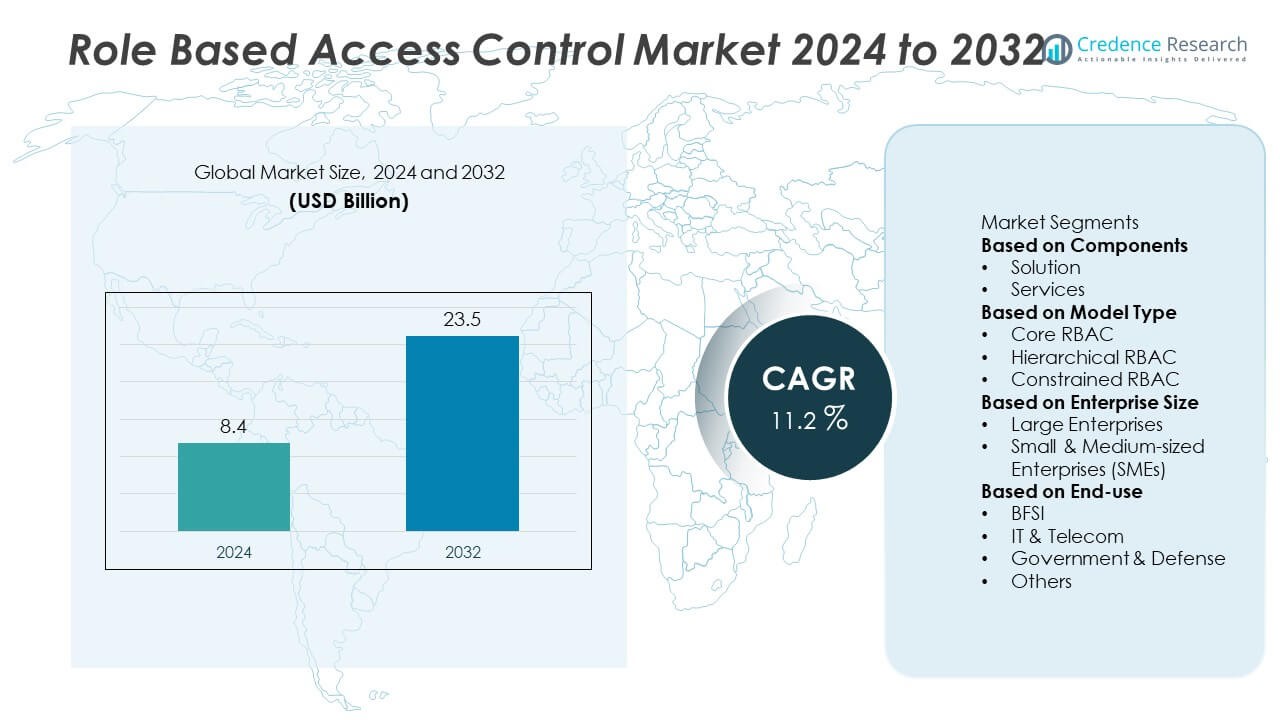
The Role Based Access Control (RBAC) Market was valued at USD 8.4 billion in 2024 and is projected to reach USD 23.5 billion by 2032, growing at a CAGR of 11.2% during the forecast period.
| REPORT ATTRIBUTE | DETAILS |
|---|---|
| Historical Period | 2020-2023 |
| Base Year | 2024 |
| Forecast Period | 2025-2032 |
| Role Based Access Control (RBAC) Market Size 2024 | USD 8.4 Billion |
| Role Based Access Control (RBAC) Market, CAGR | 11.2% |
| Role Based Access Control (RBAC) Market Size 2032 | USD 23.5 Billion |
The role-based access control market is led by major players such as Oracle Corporation, Microsoft Corporation, IBM Corporation, Amazon Web Services, Inc., CyberArk Software Ltd., Broadcom Inc., Dell EMC, Okta, Inc., JumpCloud Inc., and Micro Focus International plc. These companies dominate the market through advanced IAM integrations, AI-driven policy automation, and scalable cloud-based RBAC solutions. Their focus on enhancing compliance, identity security, and zero-trust frameworks supports enterprise-wide adoption. North America led the global market in 2024 with a 41% share, supported by strong regulatory enforcement and high enterprise digitalization, followed by Europe with 27% and Asia-Pacific with 23%, driven by rapid cloud adoption and expanding cybersecurity investments.
Market Insights
- The role-based access control market was valued at USD 8.4 billion in 2024 and is projected to reach USD 23.5 billion by 2032, growing at a CAGR of 11.2% during the forecast period.
- Increasing regulatory compliance requirements and rising concerns over data breaches are driving demand for RBAC solutions across enterprises globally.
- Cloud-based and AI-integrated RBAC systems are emerging as key trends, enabling automated policy enforcement and real-time access monitoring.
- Leading companies such as Oracle, Microsoft, IBM, and CyberArk are focusing on innovation in zero-trust architectures, cloud security, and identity management platforms to strengthen market competitiveness.
- North America led with a 41% share in 2024, followed by Europe (27%) and Asia-Pacific (23%), while by component, the solution segment held a 67% share, driven by large-scale enterprise deployment for access governance and compliance management.
Market Segmentation Analysis:
By Components
The solution segment dominated the role-based access control market in 2024 with a 67% share, driven by increasing adoption of identity and access management platforms across enterprises. RBAC solutions enable centralized control over user permissions, reducing the risk of unauthorized access and data breaches. The growing complexity of IT infrastructures, coupled with rising compliance requirements, fuels demand for automated access control systems. Organizations in sectors such as BFSI, healthcare, and government are deploying RBAC solutions to enhance operational security, ensure regulatory compliance, and streamline user authentication processes across hybrid and cloud environments.
- For instance, Oracle Corporation’s Identity Governance Suite, which provides granular RBAC controls, manages user provisioning and entitlement access for numerous enterprise clients. The software is highly scalable and can handle millions of identities, roles, and entitlements for a single organization.
By Model Type
The core RBAC segment held the largest share of 46% in 2024, owing to its simplicity, scalability, and cost-effectiveness for managing access rights. It provides a structured framework for assigning permissions based on roles rather than individuals, improving efficiency and minimizing administrative overhead. Enterprises favor this model for its ease of integration with existing IT systems and ability to enforce consistent access policies. The rising implementation of digital identity governance and zero-trust architectures further strengthens the adoption of core RBAC frameworks in both on-premises and cloud-based applications.
- For instance, CyberArk Software Ltd. secures millions of privileged accounts globally through its Privilege Cloud platform, which is designed to reduce unauthorized privilege escalations and improve audit readiness for regulated industries.
By Enterprise Size
The large enterprises segment accounted for a 59% share in 2024, driven by the need to manage complex user hierarchies and secure sensitive data across global operations. These organizations rely on RBAC solutions to handle high volumes of access requests and maintain compliance with industry-specific standards. The increasing adoption of multi-cloud strategies and remote working models necessitates advanced role management capabilities. Large corporations in finance, manufacturing, and IT services are leading adopters, investing heavily in scalable and automated RBAC systems to ensure seamless user access while maintaining strict security governance.
Key Growth Drivers
Rising Focus on Data Security and Regulatory Compliance
The growing number of cyberattacks and data breaches is pushing organizations to adopt RBAC systems for improved access governance. Companies must comply with global data protection regulations such as GDPR, HIPAA, and ISO 27001, driving demand for structured access control solutions. RBAC enables enterprises to enforce role-based permissions, ensuring that employees access only necessary resources. The increasing need for secure user authentication across cloud platforms and enterprise applications continues to strengthen the adoption of RBAC systems across industries.
- For instance, IBM Security Verify integrates with identity and access management (IAM) tools to help manage compliance-driven RBAC policies across hybrid cloud workloads, and the overall platform is certified for ISO 27001.
Growing Adoption of Cloud and Hybrid Infrastructures
The rapid migration toward cloud-based ecosystems has significantly increased access control complexities. RBAC solutions offer seamless integration across multi-cloud and hybrid environments, enabling centralized control of user roles and privileges. Enterprises are prioritizing cloud-native RBAC frameworks to manage access to SaaS and IaaS resources. The rise of digital transformation initiatives and remote workforce expansion further amplifies the need for scalable, automated access management tools that enhance visibility and reduce security vulnerabilities in distributed environments.
- For instance, AWS Identity Center enables RBAC configuration through permission sets, which are centrally managed and used to grant access to a user or group across multiple AWS accounts within an organization.
Expanding Use of Identity and Access Management (IAM) Systems
Integration of RBAC into IAM platforms is emerging as a key growth catalyst. Modern IAM systems incorporate RBAC capabilities to streamline user provisioning, authentication, and authorization. This integration enhances accountability and supports compliance through automated audit trails. Enterprises are deploying RBAC-enabled IAM systems to improve operational efficiency while minimizing insider risks. The growing emphasis on zero-trust security models and identity-centric cybersecurity strategies continues to drive the adoption of RBAC solutions across sectors such as BFSI, IT, and healthcare.
Key Trends & Opportunities
Emergence of AI-Driven and Automated Access Management
Artificial intelligence and machine learning are revolutionizing RBAC solutions by enabling predictive access control and anomaly detection. AI-driven systems can dynamically adjust user permissions based on behavioral analytics, improving security and reducing manual workload. Automation also ensures real-time compliance monitoring and faster onboarding processes. As organizations embrace digital transformation, integrating AI into RBAC frameworks presents opportunities for enhanced scalability, accuracy, and proactive threat mitigation in enterprise security management.
- For instance, Microsoft uses machine learning algorithms, trained on trillions of signals processed across its security products daily, to provide intelligent recommendations for least-privilege role adjustments during access reviews. This capability assists administrators in ensuring that users retain the right level of access, strengthening security.
Increasing Adoption of Zero-Trust Architecture
The shift toward zero-trust security principles is driving RBAC implementation in modern enterprises. RBAC aligns with zero-trust frameworks by enforcing least-privilege access and continuous authentication. Companies are integrating RBAC with network segmentation, multi-factor authentication, and privileged access management systems to strengthen defenses. The growing focus on securing remote work, IoT devices, and cloud-native applications is expected to fuel demand for RBAC solutions that provide dynamic and contextual access control capabilities.
- For instance, Broadcom’s Symantec Identity Security enables zero-trust principles for identity and access management, ensuring RBAC-driven access verification for distributed workforce environments.
Key Challenges
Complex Implementation and Role Management
Deploying RBAC in large enterprises often involves complex configurations due to extensive role hierarchies and overlapping permissions. Managing thousands of user roles across departments can lead to administrative inefficiencies and potential access conflicts. Frequent organizational changes require continuous role updates, increasing operational burden. Enterprises need automated role-mining tools and governance policies to simplify implementation. Without proper planning, role explosion and misconfiguration can compromise both security and compliance objectives.
Integration with Legacy Systems and Multi-Cloud Environments
Many organizations struggle to integrate RBAC frameworks with legacy IT systems and diverse cloud platforms. Older infrastructures often lack compatibility with modern access control protocols, creating visibility and security gaps. The coexistence of on-premises and cloud applications further complicates role synchronization and policy enforcement. Enterprises must invest in flexible, API-driven RBAC solutions to enable interoperability. Overcoming these integration challenges is critical for achieving unified access governance across heterogeneous IT ecosystems.
Regional Analysis
North America
North America dominated the role-based access control market in 2024 with a 41% share, driven by stringent data security regulations and rapid adoption of digital identity management systems. The United States leads due to early implementation of advanced IAM and zero-trust security frameworks across sectors such as BFSI, healthcare, and government. The region’s mature cloud ecosystem and high cybersecurity spending further strengthen RBAC adoption. Growing concerns over insider threats and regulatory mandates like HIPAA and CCPA are prompting enterprises to integrate RBAC into hybrid and multi-cloud security strategies.
Europe
Europe accounted for a 27% share in 2024, supported by strict data protection regulations such as GDPR and increasing digitalization across enterprises. The United Kingdom, Germany, and France lead market demand with strong emphasis on compliance-driven access management. Organizations are implementing RBAC solutions to improve accountability and streamline permission management across distributed teams. The rise of remote work and cloud-based collaboration tools has accelerated adoption of secure access control systems. Ongoing investments in cybersecurity infrastructure and identity governance solutions continue to drive market expansion across the region.
Asia-Pacific
Asia-Pacific held a 23% share in 2024, driven by rapid digital transformation and expansion of IT infrastructure in countries such as China, India, and Japan. Increasing adoption of cloud computing, e-governance platforms, and fintech applications is boosting RBAC implementation. Enterprises across the region are integrating RBAC into IAM and network security systems to mitigate growing cyber threats. Government initiatives promoting data protection frameworks and rising demand for compliance automation solutions support market growth. The region’s expanding enterprise ecosystem and focus on securing digital identities are positioning it as a major growth hub.
Latin America
Latin America represented a 5% share in 2024, fueled by growing awareness of data privacy and cybersecurity risks among enterprises. Brazil and Mexico lead regional adoption due to rising demand for secure access management in finance, telecom, and government sectors. Increasing adoption of cloud-based enterprise platforms and compliance with evolving data protection laws support market expansion. However, limited cybersecurity infrastructure and budget constraints among small enterprises remain challenges. Strategic partnerships with global security vendors and cloud service providers are expected to accelerate RBAC adoption across the region.
Middle East & Africa
The Middle East & Africa accounted for a 4% share in 2024, supported by growing investments in digital security and identity management infrastructure. The UAE and Saudi Arabia are leading adopters, driven by national cybersecurity initiatives such as Vision 2030 and the Dubai Cyber Security Strategy. Rising digital transformation across government, energy, and banking sectors is driving RBAC deployment. In Africa, South Africa and Kenya are emerging markets as organizations strengthen data access governance. Increasing awareness of insider threats and expanding cloud penetration are expected to enhance RBAC adoption across the region.
Market Segmentations:
By Components
- Solution
- Services
By Model Type
- Core RBAC
- Hierarchical RBAC
- Constrained RBAC
By Enterprise Size
- Large Enterprises
- Small & Medium-sized Enterprises (SMEs)
By End-use
- BFSI
- IT & Telecom
- Government & Defense
- Others
By Geography
- North America
- U.S.
- Canada
- Mexico
- Europe
- Germany
- France
- U.K.
- Italy
- Spain
- Rest of Europe
- Asia Pacific
- China
- Japan
- India
- South Korea
- South-east Asia
- Rest of Asia Pacific
- Latin America
- Brazil
- Argentina
- Rest of Latin America
- Middle East & Africa
- GCC Countries
- South Africa
- Rest of the Middle East and Africa
Competitive Landscape
The competitive landscape of the role-based access control market includes key players such as Oracle Corporation, CyberArk Software Ltd., JumpCloud Inc., Dell EMC, Amazon Web Services, Inc., Micro Focus International plc, Microsoft Corporation, Broadcom Inc., IBM Corporation, and Okta, Inc. These companies are driving market growth through advancements in identity and access management (IAM) technologies, zero-trust frameworks, and AI-powered access governance platforms. Leading vendors are focusing on cloud-native RBAC solutions that integrate seamlessly across hybrid infrastructures. Strategic collaborations, product launches, and acquisitions are strengthening their positions in the cybersecurity ecosystem. Companies are also prioritizing automation and compliance-driven access control to meet evolving regulatory requirements. Continuous investments in analytics-based monitoring, multi-factor authentication, and machine learning are enabling enterprises to enhance security, minimize insider threats, and improve operational efficiency in access governance systems globally.
Key Player Analysis
- Oracle Corporation
- CyberArk Software Ltd.
- JumpCloud Inc.
- Dell EMC
- Amazon Web Services, Inc.
- Micro Focus International plc
- Microsoft Corporation
- Broadcom Inc.
- IBM Corporation
- Okta, Inc.
Recent Developments
- In October 2025, Oracle also updated its Fusion Applications AI Agent to strictly enforce role-based access control across named data objects and user tasks.
- In June 2025, Oracle Corporation introduced ACLs (Access Control Lists) for OCI Cache clusters, enabling fine-grained role-based access control for Redis instances.
- In May 2025, Microsoft added the “Microsoft Graph Data Connect Administrator” role within its built-in RBAC role set, enabling organizations to delegate data-connect management separately from full admin privileges.
- In February 2025, Okta, Inc. made its Workflows Role-Based Access Control feature generally available in production, enabling granular role-based definitions in its automation platform.
Report Coverage
The research report offers an in-depth analysis based on Components, Model Type, Enterprise Size, End-use and Geography. It details leading market players, providing an overview of their business, product offerings, investments, revenue streams, and key applications. Additionally, the report includes insights into the competitive environment, SWOT analysis, current market trends, as well as the primary drivers and constraints. Furthermore, it discusses various factors that have driven market expansion in recent years. The report also explores market dynamics, regulatory scenarios, and technological advancements that are shaping the industry. It assesses the impact of external factors and global economic changes on market growth. Lastly, it provides strategic recommendations for new entrants and established companies to navigate the complexities of the market.
Future Outlook
- Demand for RBAC solutions will rise as organizations strengthen data security frameworks.
- Integration with zero-trust architectures will become a standard practice across enterprises.
- Cloud-based RBAC systems will dominate due to scalability and centralized control.
- AI and automation will enhance policy management and access decision-making efficiency.
- Enterprises will adopt RBAC to meet stricter global compliance and privacy regulations.
- SMEs will increasingly deploy RBAC through affordable SaaS-based security platforms.
- Hybrid and multi-cloud environments will drive innovation in unified access governance.
- Vendors will focus on interoperability with IAM and privileged access management systems.
- Cybersecurity investments will expand in critical sectors such as BFSI and healthcare.
- North America and Asia-Pacific will continue leading market growth through digital transformation initiatives.

Request a Free Sample
Fill in your details and we'll send you a free sample report.
- Sample data tables & charts
- Research methodology
Need a Custom Version of This Report?
Tailor the scope, geography, or segments to your exact requirements.
- Custom geography or segment scope
- Direct access to our analyst team
Frequently Asked Questions
What is the current market size for Role Based Access Control market, and what is its projected size in 2032?
At what Compound Annual Growth Rate is the Role Based Access Control market projected to grow between 2025 and 2032?
Which Role Based Access Control market segment held the largest share in 2024?
What are the primary factors fueling the growth of the Role Based Access Control market?
Who are the leading companies in the Role Based Access Control market?
Which region commanded the largest share of the Role Based Access Control market in 2024?
Table of Content
Chapter 1 Market Segmentation
- 1.1 Segmentation Framework
- 1.1.1 Product and Service Classification
- 1.1.2 Application and End-Use Classification
- 1.1.3 Technology and Solution Classification
- 1.1.4 Customer and Distribution Channel Classification
- 1.1.5 Geographic Segmentation
- 1.1.6 Market Segment Definitions and Boundaries
Chapter 2 Introduction
- 2.1 Report Objectives and Scope
- 2.2 Product Definition and Industry Terminology
- 2.3 Market Inclusions and Exclusions
- 2.4 Research Process
- 2.4.1 Primary Research and Expert Interviews
- 2.4.2 Secondary Research and Source Review
- 2.4.3 Top-Down and Bottom-Up Estimation
- 2.4.4 Data Triangulation and Verification
- 2.5 Market Size Measurement Basis
- 2.5.1 2024: USD 8.4 billion → 2032: USD 23.5 billion
- 2.6 Historical and Forecast Reference Periods
- 2.6.1 Base Year: 2024
- 2.6.2 Forecast Period: 2024-2032
- 2.7 Research Assumptions and Limitations
Chapter 3 Executive Summary
- 3.1 Market Snapshot and Key Findings
- 3.2 Base-Year Market Size, 2024
- 3.3 Forecast Market Size, 2032
- 3.4 Revenue and Volume Growth Outlook
- 3.5 Key Demand and Supply Indicators
- 3.6 Leading Market Segments
- 3.7 Fastest-Growing Market Opportunities
- 3.8 Regional Performance Highlights
- 3.9 Technology and Industry Transformation
- 3.10 Competitive Landscape Summary
- 3.11 Analyst View and Strategic Implications
Chapter 4 Global Role Based Access Control Market Trends and Developments
- 4.1 Historical Industry Development
- 4.2 Recent Market Trends and Developments
- 4.3 Demand and Customer Behavior Trends
- 4.4 Technology and Product Innovation
- 4.5 Artificial Intelligence, Automation and Digitalization
- 4.6 Local Manufacturing and Supply Chain Realignment
- 4.7 Industry Partnerships, Mergers and Acquisitions
- 4.8 Sustainability and Circular Economy Developments
- 4.9 Government and Private Sector Investment Trends
- 4.10 Emerging Business Models and Commercialization
- 4.11 Industry Developments and Announcements
Chapter 5 Global Role Based Access Control Market Production, Supply and Demand Analysis
- 5.1 Demand Trend and Consumption Analysis
- 5.2 Demand Forecast, 2024-2032
- 5.3 Production and Output Trend
- 5.4 Production and Output Forecast, 2024-2032
- 5.5 Installed Capacity and Capacity Utilization
- 5.6 Company-Wise Production Plants and Statistics
- 5.6.1 Installed Production Capacity
- 5.6.2 Actual Production
- 5.6.3 Planned Capacity and Expansion Targets
- 5.7 Supply Chain Structure and Procurement Trends
- 5.8 Supply-Demand Gap and Bottlenecks
- 5.9 Import Dependence and Sourcing Structure
- 5.10 Contract Manufacturing and Outsourcing
- 5.11 Regional Supply and Demand Concentration
Chapter 6 Global Role Based Access Control Market Pricing Analysis
- 6.1 Pricing Structure and Measurement
- 6.2 Historical Pricing Trends
- 6.3 Pricing Outlook, 2024-2032
- 6.4 Average Selling Price and Unit Economics
- 6.5 Pricing by Product and Market Segment
- 6.6 Geographic Pricing Differences
- 6.7 Key Input, Energy, Labor and Logistics Costs
- 6.8 Contract Pricing and Purchasing Models
- 6.9 Pricing Sensitivity and Competitive Positioning
- 6.10 Price, Margin and Profitability Implications
Chapter 7 Global Role Based Access Control Market Dynamics
- 7.1 Market Growth Drivers
- 7.1.1 Demand-Side Drivers
- 7.1.2 Technology and Innovation Drivers
- 7.1.3 Infrastructure and Investment Drivers
- 7.1.4 Regulatory and Policy Drivers
- 7.2 Market Restraints
- 7.2.1 Cost and Affordability Constraints
- 7.2.2 Technology and Adoption Barriers
- 7.2.3 Supply Chain and Operational Constraints
- 7.3 Market Challenges
- 7.3.1 Competitive Pressure and Margin Erosion
- 7.3.2 Skills, Infrastructure and Implementation Gaps
- 7.4 Emerging Market Opportunities
- 7.5 Market Dynamics Impact and Time-Horizon Assessment
Chapter 8 Global Role Based Access Control Value Chain Analysis
- 8.1 Industry Value Chain Overview
- 8.2 Upstream Suppliers and Critical Inputs
- 8.3 Technology and Component Providers
- 8.4 Manufacturing or Service Delivery
- 8.5 Distribution, Channel Partners and Integrators
- 8.6 Downstream Applications and End Users
- 8.7 Value Addition and Profit Pools
- 8.8 Vertical Integration and Outsourcing
- 8.9 Supplier Concentration and Risk
- 8.10 Supply Chain Localization and Resilience
Chapter 9 Global Role Based Access Control Market Regulations and Policies
- 9.1 Relevant Laws, Standards and Compliance Frameworks
- 9.2 Product, Service, Safety and Quality Requirements
- 9.3 Government Policies, Incentives and Subsidies
- 9.4 Imports, Exports and Trade Barriers
- 9.5 Public Procurement and Local Content Requirements
- 9.6 Environmental and Sustainability Compliance
- 9.7 Data Protection, AI and Cybersecurity Compliance
- 9.8 Upcoming Policy Changes and Market Implications
Chapter 10 Global Role Based Access Control Market Hotspots and Opportunities
- 10.1 Market Opportunity Mapping and Growth Hotspots
- 10.2 High-Growth Applications and Customer Groups
- 10.3 Underserved Markets and White-Space Opportunities
- 10.4 Emerging Technology and Product Opportunities
- 10.5 New Capacity and Investment Hotspots
- 10.6 Market Entry and Expansion Opportunities
- 10.7 Distribution and Partnership Opportunities
- 10.8 Near-Term and Long-Term Commercial Potential
- 10.9 Opportunity Attractiveness and Execution Risks
Chapter 11 Global Role Based Access Control Market Outlook, 2024-2032
- 11.1 Market Size and Analysis
- 11.1.1 Revenue (Market Measurement: 2024: USD 8.4 billion → 2032: USD 23.5 billion)
- 11.1.2 Market Volume and Quantity Sold
- 11.1.3 Historical Market Size
- 11.1.4 Base-Year Market Size, 2024
- 11.2 Market Forecast, 2024-2032
- 11.2.1 Revenue Forecast to 2032
- 11.2.2 Volume Forecast to 2032
- 11.2.3 CAGR and Year-on-Year Growth
- 11.2.4 Incremental Revenue Opportunity
- 11.3 Forecast Assumptions and Scenario Analysis
- 11.3.1 Base-Case Forecast
- 11.3.2 Optimistic and Conservative Scenarios
- 11.3.3 Technology, Pricing and Policy Sensitivities
- 11.4 Market Attractiveness and Growth Outlook
Chapter 12 Global Role Based Access Control Market Segmentation and Outlook
- 12.1 Segmentation Summary and Market Shares, 2024
- 12.2 Largest and Fastest-Growing Segments
- 12.3 Segment Growth Comparison
- 12.4 Segment Attractiveness and Priority Matrix
Chapter 13 Global Role Based Access Control Geographic Market Outlook, 2024-2032
- 13.1 Regional Market Size and Share, 2024
- 13.2 Regional Market Forecast, 2024-2032
- 13.3 Regional Pricing, Production and Demand Differences
- 13.4 North America
- 13.4.1 United States
- 13.4.2 Canada
- 13.4.3 Mexico
- 13.5 Europe
- 13.5.1 Germany
- 13.5.2 France
- 13.5.3 Italy
- 13.5.4 United Kingdom
- 13.5.5 Spain
- 13.5.6 Poland
- 13.5.7 Russia
- 13.5.8 Netherlands
- 13.5.9 Belgium
- 13.5.10 Sweden
- 13.5.11 Denmark
- 13.5.12 Norway
- 13.5.13 Rest of Europe
- 13.6 Asia Pacific
- 13.6.1 China
- 13.6.2 India
- 13.6.3 Japan
- 13.6.4 South Korea
- 13.6.5 Thailand
- 13.6.6 Indonesia
- 13.6.7 Vietnam
- 13.6.8 Malaysia
- 13.6.9 Australia
- 13.6.10 Rest of Asia Pacific
- 13.7 Latin America
- 13.7.1 Brazil
- 13.7.2 Argentina
- 13.7.3 Colombia
- 13.7.4 Chile
- 13.7.5 Rest of Latin America
- 13.8 Middle East
- 13.8.1 Saudi Arabia
- 13.8.2 United Arab Emirates
- 13.8.3 Turkey
- 13.8.4 Israel
- 13.8.5 Iran
- 13.8.6 Rest of the Middle East
- 13.9 Africa
- 13.9.1 South Africa
- 13.9.2 Egypt
- 13.9.3 Nigeria
- 13.9.4 Morocco
- 13.9.5 Rest of Africa
- 13.10 Regional Investment, Policy and Supply Chain Differences
- 13.11 Regional Competitive Landscape
- 13.12 Geographic Growth Hotspots
Chapter 14 Global Role Based Access Control Technology, Innovation and Sustainability Outlook
- 14.1 Technology Landscape and Maturity
- 14.2 Product, Process and Service Innovation
- 14.3 AI, Automation and Digital Tools in the Industry
- 14.4 Technology Adoption and Performance Benchmarking
- 14.5 Innovation Pipeline and R&D Investment
- 14.6 Patent and Intellectual Property Trends
- 14.7 Energy Efficiency and Resource Management
- 14.8 Sustainability, Recycling and Circularity
- 14.9 Technology Roadmap, 2024-2032
- 14.10 Risks of Obsolescence and Technology Substitution
Chapter 15 Global Role Based Access Control Market Key Strategic Imperatives
- 15.1 Growth and Market Entry Priorities
- 15.2 High-Return Products and Segments
- 15.3 Pricing, Profitability and Cost Optimization
- 15.4 Technology Investment and Product Differentiation
- 15.5 Supply Chain Localization and Resilience
- 15.6 Distribution and Customer Acquisition
- 15.7 Partnership, Acquisition and Capacity Strategy
- 15.8 Regional Expansion Priorities
- 15.9 Short-, Medium- and Long-Term Actions
Chapter 16 Competition Outlook
- 16.1 Industry Competition Characteristics
- 16.2 Market Structure and Concentration
- 16.3 Market Share and Competitive Positioning, 2024
- 16.4 Company-Wise Revenue and Product Benchmarking
- 16.5 Production and Service Capacity Benchmarking
- 16.6 Technology, Pricing and Differentiation
- 16.7 Regional Footprint and Distribution Strength
- 16.8 Mergers, Acquisitions and Strategic Alliances
- 16.9 New Entrants and Competitive Threats
- 16.10 Porter's Five Forces and Industry Attractiveness
- 16.11 Competitive Outlook, 2024-2032
Chapter 17 Company Profiles
- 17.1 Company Coverage and Selection Criteria
- 17.2 Leading Market Participants – Standard Profile Structure
- 17.2.1 Business Description
- 17.2.2 Company Ownership and Geographic Presence
- 17.2.3 Product and Service Portfolio
- 17.2.4 Manufacturing and Operating Footprint
- 17.2.5 Production Capacity and Expansion Plans
- 17.2.6 Financial Performance and Investment
- 17.2.7 Market Share and Competitive Position
- 17.2.8 Technology and Innovation Capabilities
- 17.2.9 Strategic Alliances or Partnerships
- 17.2.10 Recent Developments
- 17.2.11 Growth Strategy and Outlook
- 17.3 Other Relevant Market Participants
Note: Every listed company is profiled on the structure shown under the first company. The company list is preliminary and may change based on research findings, market developments, data availability and client requirements.
Chapter 18 Disclaimer
- 18.1 Research and Forecast Disclaimer
- 18.2 Data Source and Estimation Limitations
Note: The depth of individual sections depends on data availability for this market. Volume, capacity, trade and other unit-based metrics are included where applicable.