
| REPORT ATTRIBUTE | DETAILS |
|---|---|
| Historical Period | 2020-2023 |
| Base Year | 2024 |
| Forecast Period | 2025-2032 |
| Russia Writing Instruments Market Size 2023 | USD 391.98 million |
| IRussia Writing Instruments Market, CAGR | 8.49% |
| Russia Writing Instruments Market Size 2032 | USD 817.08 million |
Market Overview
Russia Writing Instruments market size was valued at USD 391.98 million in 2023 and is anticipated to reach USD 817.08 million by 2032, at a CAGR of 8.49% during the forecast period (2023-2032).
The Russia Writing Instruments market is driven by several factors, including the growing demand for quality writing tools in educational and corporate sectors. As education continues to be a priority in the region, the need for pens, pencils, and other writing instruments remains robust. Additionally, the rise of online and offline retail channels is facilitating wider product availability. Technological advancements, such as the integration of ergonomic designs and eco-friendly materials, are also influencing consumer preferences. The increasing popularity of personalized and premium writing instruments, especially in corporate gifting, further supports market growth. Furthermore, the rising trend of remote working and learning is contributing to the demand for stationery products, as consumers seek reliable tools for everyday tasks. These drivers, coupled with a growing focus on sustainability, are expected to sustain the market's upward trajectory throughout the forecast period.
The geographical landscape of the Russia Writing Instruments market reflects varied demand patterns across Central Russia, Siberian Russia, Southern Russia, and the Far East. Central Russia, with major cities like Moscow and Saint Petersburg, serves as the primary hub due to its dense population, advanced retail infrastructure, and strong educational and corporate presence. In contrast, Siberian and Southern Russia show growing demand, driven by expanding educational institutions and increased consumer interest in creative tools. The Far East region, though less developed, is gradually emerging with the help of improved accessibility and regional development initiatives. Key players operating in the market include international and domestic brands such as Lamy, Montblanc, Waterman, Faber-Castell, Montegrappa, Pelikan, Kaweco, Diplomat, Aurora, Sheaffer, Cello Pens, and Benu Pen. These companies compete on factors such as quality, design, innovation, and pricing, catering to a wide spectrum of consumers ranging from students to professionals and luxury product enthusiasts.
Market Insights
- The Russia Writing Instruments market was valued at USD 391.98 million in 2023 and is expected to reach USD 817.08 million by 2032, growing at a CAGR of 8.49% during the forecast period.
- The Global Writing Instruments market was valued at USD 22,000.00 million in 2023 and is expected to reach USD 57,196.01 million by 2032, growing at a CAGR of 11.20% during the forecast period.
- The market is primarily driven by growing demand from educational institutions and increased student enrollment across Russia.
- A rising preference for premium and luxury writing tools among professionals and collectors is shaping product innovation and brand positioning.
- Digitalization and the shift toward paperless communication pose significant challenges to the growth of traditional writing instruments.
- Key players such as Lamy, Montblanc, Faber-Castell, and Cello Pens are focusing on product design, sustainability, and direct-to-consumer strategies to strengthen market presence.
- Central Russia leads the market due to its urban density and developed retail infrastructure, while regions like Siberia and the Far East are showing steady growth.
- Eco-friendly and refillable writing instruments are emerging trends aligned with rising environmental awareness among consumers.
Report Scope
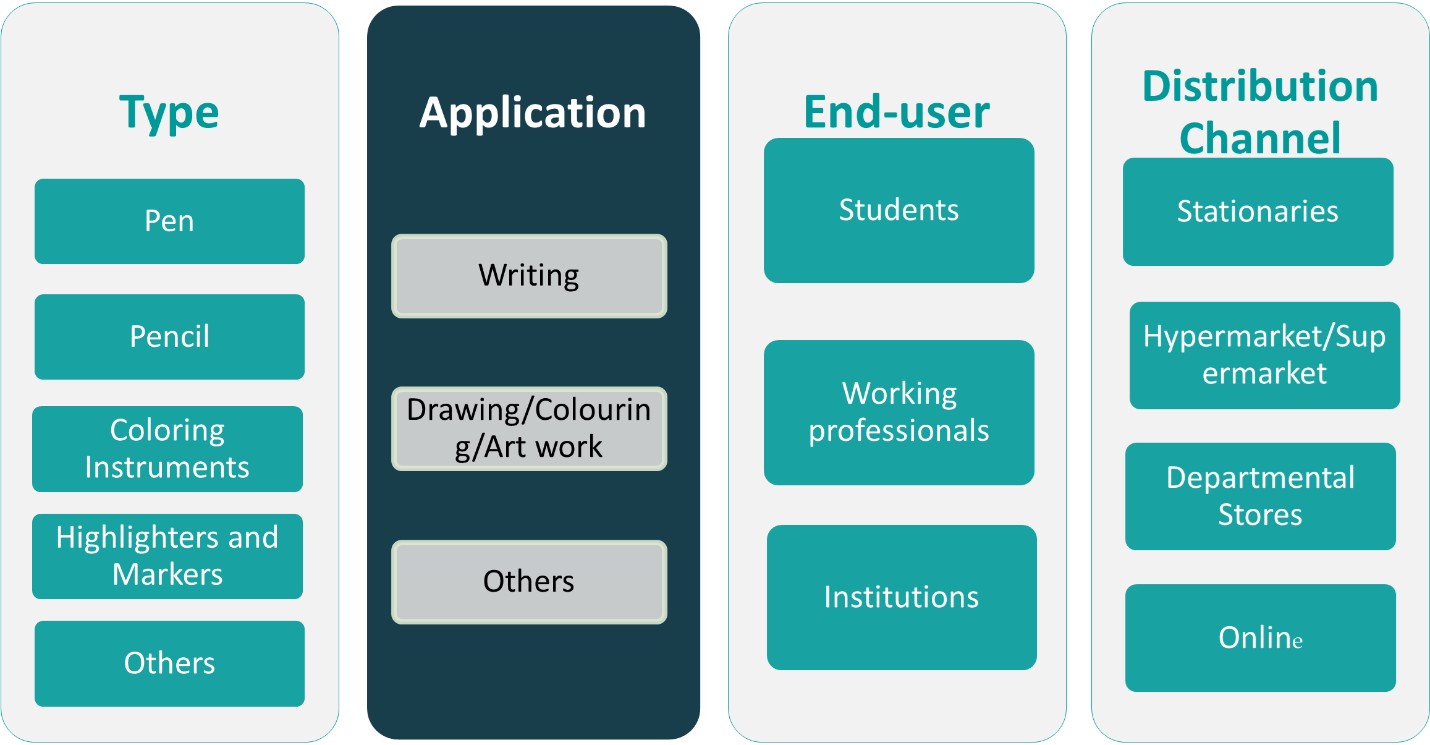
This report segments the Russia Writing Instruments Market as follows:
Market Drivers
Growing Demand in the Education Sector
The demand for writing instruments in Russia is significantly driven by the education sector. For instance, surveys conducted by the Russian Ministry of Education highlight the consistent need for pens, pencils, and markers in schools and universities to support academic activities. With a large student population, the need for basic writing tools like pens, pencils, and markers remains consistently high. Educational institutions at all levels require a wide variety of stationery supplies for their academic activities. The increasing emphasis on quality education and the expansion of both primary and secondary educational institutions further fuels this demand. Moreover, the adoption of digital learning platforms has not completely eliminated the need for traditional writing instruments, particularly for note-taking and creative exercises. As a result, writing instruments continue to be integral to the educational process, contributing to the market’s growth.
Expansion of the Corporate Sector
The growing corporate sector in Russia also plays a significant role in driving the market for writing instruments. For instance, studies conducted by the Russian Chamber of Commerce reveal that businesses frequently purchase branded and personalized stationery for corporate gifting and promotional campaigns. Businesses across various industries require high-quality writing tools for daily operations, meetings, and presentations. From employees needing pens for note-taking to businesses gifting premium writing instruments to clients or employees, the demand for these products is consistently strong. In particular, the trend of using branded and personalized stationery in corporate gifting and promotions has gained traction, creating a new demand segment. The expansion of the corporate sector, alongside rising office supply needs, continues to be a key market driver.
Rising Popularity of Eco-Friendly Products
Consumer preferences are shifting towards sustainability, leading to a surge in the demand for eco-friendly writing instruments in Russia. Brands offering pens, pencils, and markers made from recycled materials or biodegradable components are gaining traction, as Russian consumers become more environmentally conscious. The growing focus on reducing plastic waste and adopting sustainable practices across industries aligns with this trend. Furthermore, eco-conscious companies are increasingly prioritizing sustainable products in their office supply choices. This shift towards environmentally friendly writing tools is expected to be a key driver in the market’s evolution, as it caters to both consumer demand and broader environmental goals.
Retail and E-commerce Growth
The rise of both online and offline retail channels is a significant factor contributing to the growth of the Russia Writing Instruments market. Traditional brick-and-mortar stores continue to be a reliable source of writing instruments, but the increasing penetration of e-commerce platforms is revolutionizing how consumers purchase these products. Online platforms provide consumers with a wider range of options, easy access to premium and niche products, and competitive pricing. E-commerce growth, driven by rising internet usage and digital literacy, enables consumers to compare products, read reviews, and have them delivered directly to their doorsteps. The convenience and variety offered by online retailers have made it a preferred channel for purchasing writing instruments, thus boosting overall market demand. This shift towards digital shopping is expected to continue to support the market’s expansion during the forecast period.
Market Trends
Technological Innovations in Writing Instruments
Technological advancements are driving significant trends in the Russia Writing Instruments market. For instance, reports from the Russian Ministry of Industry and Trade highlight the integration of multifunctional pens with stylus capabilities, catering to the growing demand for versatile products that bridge traditional and digital mediums. Manufacturers are incorporating innovative features such as ergonomic designs, enhanced grip materials, and smooth ink flow technologies to improve the user experience. Additionally, the integration of multifunctional pens that combine writing with stylus capabilities for digital devices is gaining popularity. These innovations cater to the growing demand for versatile products that can bridge the gap between traditional and digital mediums. The market is also witnessing an increase in smart writing instruments, such as digital pens that allow users to capture handwritten notes and convert them into digital format, meeting the needs of both professionals and students. These technological advancements are expected to continue shaping the market as consumers seek more efficient and user-friendly writing tools.
Customization and Personalization Trends
Customization and personalization are becoming significant trends in the Russian writing instruments market. Consumers are increasingly seeking personalized pens and pencils, particularly for corporate gifting, promotional events, and special occasions. Writing instruments branded with company logos or customized with names are in high demand, particularly among businesses looking to enhance brand visibility or engage customers. The ability to personalize products with unique designs, colors, and engravings is gaining popularity, driving both consumer and business interest. This trend is particularly strong in the premium segment of the market, where consumers are willing to pay a premium for bespoke, high-quality products. The growing popularity of personalized writing instruments is expected to fuel continued market growth, as they provide added value and a sense of uniqueness to consumers.
Shift Towards Eco-Friendly and Sustainable Products
Sustainability is becoming a defining trend in the Russia Writing Instruments market. With growing environmental awareness, Russian consumers are increasingly demanding eco-friendly writing tools made from recycled or biodegradable materials. For instance, environmental campaigns led by Russian green organizations have encouraged manufacturers to adopt recycled and biodegradable materials in their products. Companies are responding by developing pens, pencils, and markers that minimize their environmental impact, such as pens made from recycled plastic or wood. Additionally, the use of non-toxic and water-based inks is rising in response to consumer demand for safer, greener products. Sustainability is not only influencing consumer preferences but also impacting corporate purchasing decisions, with businesses prioritizing eco-friendly office supplies. This trend is reshaping the market, with an increasing number of brands incorporating environmental considerations into their product offerings to appeal to the eco-conscious consumer.
Premiumization and Luxury Writing Instruments
The premium and luxury segments of the Russia Writing Instruments market are experiencing notable growth. Consumers are increasingly interested in high-end writing tools that offer superior craftsmanship, unique designs, and prestigious brand associations. Luxury brands such as Montblanc, Parker, and Cross are gaining popularity among Russian consumers, particularly for corporate gifting, professional use, and personal indulgence. This trend towards premiumization reflects a broader consumer shift towards valuing quality and exclusivity over price. Additionally, the increasing availability of high-quality materials, such as precious metals and fine wood, is contributing to the rise of luxury writing instruments in the market. As disposable income rises and consumer tastes evolve, the demand for premium and luxury writing instruments is expected to continue growing, driving the market's diversification.
Market Challenges Analysis
Rising Digitalization and Declining Paper-Based Communication
One of the primary challenges facing the Russia Writing Instruments market is the increasing shift toward digitalization, which is reducing reliance on traditional writing tools. For instance, reports from the Russian Ministry of Education highlight the widespread adoption of e-learning platforms in schools and universities, reducing the frequency of manual writing tasks. With the widespread adoption of smartphones, tablets, and laptops, both students and professionals are increasingly using digital devices for communication, note-taking, and documentation. Educational institutions are incorporating e-learning platforms, and businesses are streamlining operations through paperless workflows. This digital transformation is gradually diminishing the role of pens, pencils, and markers in everyday tasks, particularly in urban and tech-savvy regions. As more consumers embrace digital alternatives, the demand for conventional writing instruments may face stagnation or decline, posing a significant hurdle for market players seeking long-term growth in a rapidly evolving technological landscape.
Intense Market Competition and Price Sensitivity
The Russia Writing Instruments market also faces challenges from intense competition and heightened price sensitivity among consumers. The market is flooded with a wide range of local and international brands, offering products at varying price points. While premium brands strive to differentiate through quality and innovation, many consumers continue to favor cost-effective alternatives, especially in price-sensitive segments such as school supplies. This competitive environment exerts pressure on manufacturers to balance affordability with quality, often leading to compressed profit margins. Additionally, counterfeit and low-quality products further saturate the market, undermining brand trust and affecting sales of established players. To navigate these challenges, companies must focus on brand positioning, innovation, and distribution efficiency while maintaining competitive pricing strategies to capture and retain market share.
Market Opportunities
The Russia Writing Instruments market presents substantial opportunities driven by evolving consumer preferences and emerging niche segments. One promising area lies in the growing demand for premium and luxury writing instruments, particularly among professionals, collectors, and corporate clients. As disposable income levels rise and gifting culture strengthens in Russia, high-end pens and writing tools are increasingly being viewed as symbols of status, taste, and professionalism. Brands that focus on craftsmanship, personalization, and limited-edition collections can effectively tap into this demand. Additionally, the expanding use of writing instruments in corporate branding and promotional campaigns provides opportunities for manufacturers to offer customized products that enhance brand visibility and client engagement.
Another key opportunity stems from the rising awareness and demand for sustainable and eco-friendly products. With environmental concerns gaining prominence among Russian consumers, writing instrument manufacturers have the chance to differentiate themselves by introducing biodegradable, recyclable, and refillable product lines. Innovations in materials-such as recycled plastics, bamboo, and biodegradable polymers-are gaining traction, particularly among environmentally conscious buyers and organizations seeking green office supplies. Moreover, the continued growth of online retail and e-commerce platforms in Russia offers an expanded distribution channel for both mainstream and niche brands to reach wider audiences. Companies that leverage digital marketing, social media outreach, and direct-to-consumer sales models can capitalize on this shift and enhance customer engagement. Together, these trends present a favorable landscape for manufacturers and suppliers to innovate and grow within the dynamic Russian writing instruments market.
Market Segmentation Analysis:
By Type:
The Russia Writing Instruments market is segmented by type into pens, pencils, coloring instruments, highlighters and markers, and others. Among these, pens hold the largest market share due to their widespread usage across educational, professional, and personal settings. The demand for various pen types, including ballpoint, gel, and fountain pens, remains consistently high, particularly with the rise in academic and corporate activities. Pencils, both wooden and mechanical, are also popular, especially among students and artists for their versatility and cost-effectiveness. Coloring instruments, such as crayons and color pencils, are gaining traction among children and hobbyists, supported by a growing interest in creative and recreational activities. Highlighters and markers are extensively used in both office and academic environments for organizing and emphasizing information. The "others" category, which includes specialty and multifunctional writing tools, also contributes to market expansion, especially as consumers seek novelty and innovation. This segmentation reflects the diverse needs of end-users and supports tailored product development and marketing strategies.
By Application:
Based on application, the Russia Writing Instruments market is segmented into writing, drawing/colouring/art work, and others. The writing segment dominates the market, driven by its essential role in education, office work, and daily personal use. Despite the digital shift, writing instruments remain fundamental tools, particularly in schools, universities, and professional environments. The drawing/colouring/art work segment is experiencing notable growth, supported by increasing interest in art education, recreational drawing, and creative hobbies across all age groups. This trend is particularly strong among children and young adults, encouraging sales of colored pencils, markers, and sketch pens. The “others” segment includes specialized uses such as calligraphy, technical drawing, and niche artistic applications, offering opportunities for premium and targeted products. As consumer preferences evolve and creative expression gains prominence, manufacturers are focusing on enhancing product quality and expanding portfolios to meet the unique needs of each application segment. This segmentation allows companies to strategically cater to varied customer demands and strengthen their market presence.
Segments:
Based on Type:
- Pen
- Pencil
- Coloring Instruments
- Highlighters and Markers
- Others
Based on Application:
- Writing
- Drawing/Colouring/Art Work
- Others
Based on End- User:
- Students
- Working Professionals
- Institutions
Based on Distribution Channel:
- Stationaries
- Hypermarket/Supermarket
- Departmental Stores
- Online
Based on the Geography:
- Central Russia
- Siberian Russia
- Far East
- Southern Russia
Regional Analysis
Central Russia
Central Russia holds the largest share in the Russia Writing Instruments market, accounting for approximately 43% of the total market revenue in 2023. As the most urbanized and economically developed region, it includes major cities such as Moscow and Saint Petersburg, which serve as commercial, educational, and administrative hubs. The high population density, concentration of educational institutions, and a thriving corporate sector drive strong demand for writing instruments in both personal and professional contexts. Additionally, Central Russia benefits from well-established retail networks and e-commerce infrastructure, ensuring easy access to a wide variety of writing tools. The presence of premium stationery stores, office supply chains, and growing online platforms further enhances product availability, contributing to this region’s dominant market position.
Siberian Russia
Siberian Russia captures an estimated 24% share of the national writing instruments market. Despite its vast geographical area and lower population density compared to Central Russia, the region has a well-organized education system and growing urban centers such as Novosibirsk, Omsk, and Krasnoyarsk that contribute to demand. Schools and universities remain key end-users of basic stationery items, including pens and pencils. Additionally, there is a growing appreciation for art and creative activities, boosting sales of coloring instruments and markers. Regional government investments in education and infrastructure, alongside the expansion of retail networks and digital platforms, are gradually improving accessibility to a diverse range of writing tools. As these developments continue, Siberian Russia is expected to show steady market growth throughout the forecast period.
Southern Russia
Southern Russia accounts for around 18% of the total market share, driven largely by educational demand and the steady growth of mid-sized cities such as Rostov-on-Don, Krasnodar, and Volgograd. The region is witnessing a gradual rise in economic activity and urbanization, which in turn boosts demand for writing instruments across schools, universities, and offices. Moreover, cultural and artistic activities in the region contribute to increased consumption of coloring and art-based writing tools. Retail stores and local distributors cater to the growing need for affordable and reliable writing products, particularly in the mid- and low-price segments. With continued investments in the education sector and rising consumer awareness, Southern Russia offers a favorable landscape for market expansion.
Far East Russia
Far East Russia holds the smallest market share, contributing approximately 15% of the national revenue. Despite being geographically remote and less densely populated, the region includes important cities like Vladivostok and Khabarovsk, where demand is gradually rising due to improvements in education and infrastructure. The regional government’s efforts to enhance connectivity and public services are opening up opportunities for consumer goods, including writing instruments. However, limited access to premium brands and supply chain challenges hinder rapid market development. Local suppliers and online platforms are playing a crucial role in addressing accessibility issues, offering cost-effective options for students and professionals. As digital literacy improves and e-commerce expands, the Far East region is expected to see moderate but consistent growth in the writing instruments market.
Key Player Analysis
- Lamy
- Montblanc
- Waterman
- Faber-Castell
- Montegrappa
- Pelikan
- Kaweco
- Diplomat
- Aurora
- Sheaffer
- Cello Pens
- Benu Pen
Competitive Analysis
The Russia Writing Instruments market features a competitive landscape marked by the presence of both international and domestic players offering a wide range of products across price points. Leading companies such as Lamy, Montblanc, Waterman, Faber-Castell, Montegrappa, Pelikan, Kaweco, Diplomat, Aurora, Sheaffer, Cello Pens, and Benu Pen are actively competing through product differentiation, quality craftsmanship, and brand positioning. The players focus on innovation, with an emphasis on ergonomic design, ink quality, and sustainable materials to attract diverse consumer segments including students, professionals, and collectors. Companies focus on offering a diverse range of writing tools, including basic and premium pens, pencils, and coloring instruments, to meet the needs of students, professionals, and creative users. Product innovation, such as ergonomic designs, smooth ink flow, and eco-friendly materials, plays a critical role in gaining a competitive edge. Many brands are investing in sustainability by launching refillable and biodegradable writing instruments to appeal to environmentally conscious consumers. Digital marketing, influencer partnerships, and e-commerce expansion are also becoming key strategies for enhancing visibility and customer engagement. Additionally, personalized and limited-edition collections are gaining popularity, especially among gifting and collector segments. Strong retail distribution networks, combined with growing online sales platforms, allow market participants to reach a broader audience and strengthen their presence in urban and emerging regional markets.
Recent Developments
- In February 2023, Zebra Pen Corp., a prominent player in the industry, announced its partnership with Liqui-Mark. This collaboration aims to enhance distribution aspects in the market, bringing about a new era of possibilities.
- In July 2023, Montblanc launched its exclusive "Meisterstück 146 LeGrand" fountain pen, featuring a handcrafted design with intricate detailing, addressing the rising demand for personalized, high-end writing tools in luxury segments.
- In April 2022, Zebra Pen Corp. announced the launch of its official website. This step was taken by the company to enhance user experience, increase e-commerce functionality, and improve brand communication, among other objectives.
Market Concentration & Characteristics
The Russia Writing Instruments market demonstrates a moderately concentrated structure, characterized by the presence of a few established players alongside numerous regional and niche manufacturers. Larger companies dominate in terms of brand recognition, product variety, and distribution networks, particularly in urban areas with high purchasing power. However, regional manufacturers contribute significantly by offering cost-effective alternatives tailored to local preferences. The market is marked by a diverse consumer base, ranging from students and office professionals to artists and collectors, driving demand across various product categories such as pens, pencils, markers, and coloring tools. Key characteristics of the market include a growing inclination toward environmentally sustainable and refillable products, rising interest in premium and aesthetically designed writing instruments, and increasing influence of online retail platforms. While brand loyalty remains strong among certain consumer segments, price sensitivity continues to shape purchasing behavior, especially in lower-income and educational sectors, making affordability a vital factor in market competition.
Report Coverage
The research report offers an in-depth analysis based on Type, Application, End-User, Distribution Channel and Geography. It details leading market players, providing an overview of their business, product offerings, investments, revenue streams, and key applications. Additionally, the report includes insights into the competitive environment, SWOT analysis, current market trends, as well as the primary drivers and constraints. Furthermore, it discusses various factors that have driven market expansion in recent years. The report also explores market dynamics, regulatory scenarios, and technological advancements that are shaping the industry. It assesses the impact of external factors and global economic changes on market growth. Lastly, it provides strategic recommendations for new entrants and established companies to navigate the complexities of the market.
Future Outlook
- The demand for writing instruments in Russia is expected to grow with increasing consumer preference for premium and eco-friendly products.
- Technological advancements in writing tools, such as smart pens and digital writing pads, will likely drive innovation in the market.
- The rise in educational and corporate activities is anticipated to boost the consumption of writing instruments in the coming years.
- With the growing trend of customization and personalization, there will be more demand for bespoke writing tools.
- Russian consumers are increasingly seeking sustainable and biodegradable writing products, contributing to a shift in production trends.
- Increased focus on quality and design in writing instruments will lead to higher product value and growth in the premium segment.
- The expansion of e-commerce platforms will facilitate wider distribution and availability of writing products across the country.
- Russia's growing middle class and improving living standards are expected to influence greater purchasing power for writing instruments.
- The popularity of gifting and corporate branding will continue to drive the sales of high-quality pens and related products.
- Rising interest in stationery and creative hobbies will fuel demand for a diverse range of writing instruments across different demographics.

Request a Free Sample
Fill in your details and we'll send you a free sample report.
- Sample data tables & charts
- Research methodology
Market Dynamics
Growing Demand in the Education Sector
Russia's large student population and ongoing expansion of educational institutions drive consistent demand for pens, pencils, and other writing instruments, as these remain essential for academic activities despite digitalization.
Expansion of the Corporate Sector
The increasing number of businesses and corporate activities in Russia fuels demand for high-quality and personalized writing instruments, especially for daily office use and corporate gifting, supporting market growth.
Rising Popularity of Eco-Friendly Products
Consumer preferences are shifting toward sustainable and biodegradable writing tools, prompting manufacturers to innovate with recycled materials and eco-friendly designs, which aligns with broader environmental goals and increases market appeal.
Retail and E-commerce Growth
The proliferation of both traditional retail and e-commerce platforms in Russia has made writing instruments more accessible, offering consumers a wider product selection and convenient purchasing options, thus boosting overall market demand.
Premiumization and Customization Trends
There is a growing appetite for premium, luxury, and personalized writing instruments among professionals and collectors, driven by gifting culture and a desire for unique, high-quality products, which is expanding the market's value segment.
Need a Custom Version of This Report?
Tailor the scope, geography, or segments to your exact requirements.
- Custom geography or segment scope
- Direct access to our analyst team
Frequently Asked Questions
What is the current size of the Russia Writing Instruments?
What factors are driving the growth of the Russia Writing Instruments?
What are the key segments within the Russia Writing Instruments?
Who are the major players in the Russia Writing Instruments?
Table of Content
Chapter 1 Market Segmentation
- 1.1 Segmentation Framework
- 1.1.1 Product and Service Classification
- 1.1.2 Application and End-Use Classification
- 1.1.3 Technology and Solution Classification
- 1.1.4 Customer and Distribution Channel Classification
- 1.1.5 Geographic Segmentation
- 1.1.6 Market Segment Definitions and Boundaries
- 1.2 By Type
- 1.2.1 Pen
- 1.2.2 Pencil
- 1.2.3 Coloring Instruments
- 1.2.4 Highlighters and Markers
- 1.2.5 Others
- 1.3 By End-User
- 1.3.1 Students
- 1.3.2 Working Professionals
- 1.3.3 Institutions
- 1.4 By Application
- 1.4.1 Writing
- 1.4.2 Drawing/Colouring/Art Work
- 1.4.3 Others
Chapter 2 Introduction
- 2.1 Report Objectives and Scope
- 2.2 Product Definition and Industry Terminology
- 2.3 Market Inclusions and Exclusions
- 2.4 Research Process
- 2.4.1 Primary Research and Expert Interviews
- 2.4.2 Secondary Research and Source Review
- 2.4.3 Top-Down and Bottom-Up Estimation
- 2.4.4 Data Triangulation and Verification
- 2.5 Market Size Measurement Basis
- 2.5.1 2023: USD 391.98 million → 2032: USD 817.08 million
- 2.6 Historical and Forecast Reference Periods
- 2.6.1 Base Year: 2023
- 2.6.2 Forecast Period: 2023-2032
- 2.7 Research Assumptions and Limitations
Chapter 3 Executive Summary
- 3.1 Market Snapshot and Key Findings
- 3.2 Base-Year Market Size, 2023
- 3.3 Forecast Market Size, 2032
- 3.4 Revenue and Volume Growth Outlook
- 3.5 Key Demand and Supply Indicators
- 3.6 Leading Market Segments
- 3.7 Fastest-Growing Market Opportunities
- 3.8 Regional Performance Highlights
- 3.9 Technology and Industry Transformation
- 3.10 Competitive Landscape Summary
- 3.11 Analyst View and Strategic Implications
Chapter 4 Russia Writing Instruments Market Trends and Developments
- 4.1 Historical Industry Development
- 4.2 Recent Market Trends and Developments
- 4.3 Demand and Customer Behavior Trends
- 4.4 Technology and Product Innovation
- 4.5 Artificial Intelligence, Automation and Digitalization
- 4.6 Local Manufacturing and Supply Chain Realignment
- 4.7 Industry Partnerships, Mergers and Acquisitions
- 4.8 Sustainability and Circular Economy Developments
- 4.9 Government and Private Sector Investment Trends
- 4.10 Emerging Business Models and Commercialization
- 4.11 Industry Developments and Announcements
Chapter 5 Russia Writing Instruments Market Production, Supply and Demand Analysis
- 5.1 Demand Trend and Consumption Analysis
- 5.2 Demand Forecast, 2023-2032
- 5.3 Production and Output Trend
- 5.4 Production and Output Forecast, 2023-2032
- 5.5 Installed Capacity and Capacity Utilization
- 5.6 Company-Wise Production Plants and Statistics
- 5.6.1 Installed Production Capacity
- 5.6.2 Actual Production
- 5.6.3 Planned Capacity and Expansion Targets
- 5.7 Supply Chain Structure and Procurement Trends
- 5.8 Supply-Demand Gap and Bottlenecks
- 5.9 Import Dependence and Sourcing Structure
- 5.10 Contract Manufacturing and Outsourcing
- 5.11 Regional Supply and Demand Concentration
Chapter 6 Russia Writing Instruments Market Pricing Analysis
- 6.1 Pricing Structure and Measurement
- 6.2 Historical Pricing Trends
- 6.3 Pricing Outlook, 2023-2032
- 6.4 Average Selling Price and Unit Economics
- 6.5 Pricing by Product and Market Segment
- 6.6 Geographic Pricing Differences
- 6.7 Key Input, Energy, Labor and Logistics Costs
- 6.8 Contract Pricing and Purchasing Models
- 6.9 Pricing Sensitivity and Competitive Positioning
- 6.10 Price, Margin and Profitability Implications
Chapter 7 Russia Writing Instruments Market Dynamics
- 7.1 Market Growth Drivers
- 7.1.1 Demand-Side Drivers
- 7.1.2 Technology and Innovation Drivers
- 7.1.3 Infrastructure and Investment Drivers
- 7.1.4 Regulatory and Policy Drivers
- 7.2 Market Restraints
- 7.2.1 Cost and Affordability Constraints
- 7.2.2 Technology and Adoption Barriers
- 7.2.3 Supply Chain and Operational Constraints
- 7.3 Market Challenges
- 7.3.1 Competitive Pressure and Margin Erosion
- 7.3.2 Skills, Infrastructure and Implementation Gaps
- 7.4 Emerging Market Opportunities
- 7.5 Market Dynamics Impact and Time-Horizon Assessment
Chapter 8 Russia Writing Instruments Value Chain Analysis
- 8.1 Industry Value Chain Overview
- 8.2 Upstream Suppliers and Critical Inputs
- 8.3 Technology and Component Providers
- 8.4 Manufacturing or Service Delivery
- 8.5 Distribution, Channel Partners and Integrators
- 8.6 Downstream Applications and End Users
- 8.7 Value Addition and Profit Pools
- 8.8 Vertical Integration and Outsourcing
- 8.9 Supplier Concentration and Risk
- 8.10 Supply Chain Localization and Resilience
Chapter 9 Russia Writing Instruments Market Regulations and Policies
- 9.1 Relevant Laws, Standards and Compliance Frameworks
- 9.2 Product, Service, Safety and Quality Requirements
- 9.3 Government Policies, Incentives and Subsidies
- 9.4 Imports, Exports and Trade Barriers
- 9.5 Public Procurement and Local Content Requirements
- 9.6 Environmental and Sustainability Compliance
- 9.7 Upcoming Policy Changes and Market Implications
Chapter 10 Russia Writing Instruments Market Hotspots and Opportunities
- 10.1 Market Opportunity Mapping and Growth Hotspots
- 10.2 High-Growth Applications and Customer Groups
- 10.3 Underserved Markets and White-Space Opportunities
- 10.4 Emerging Technology and Product Opportunities
- 10.5 New Capacity and Investment Hotspots
- 10.6 Market Entry and Expansion Opportunities
- 10.7 Distribution and Partnership Opportunities
- 10.8 Near-Term and Long-Term Commercial Potential
- 10.9 Opportunity Attractiveness and Execution Risks
Chapter 11 Russia Writing Instruments Market Outlook, 2023-2032
- 11.1 Market Size and Analysis
- 11.1.1 Revenue (Market Measurement: 2023: USD 391.98 million → 2032: USD 817.08 million)
- 11.1.2 Market Volume and Quantity Sold
- 11.1.3 Historical Market Size
- 11.1.4 Base-Year Market Size, 2023
- 11.2 Market Forecast, 2023-2032
- 11.2.1 Revenue Forecast to 2032
- 11.2.2 Volume Forecast to 2032
- 11.2.3 CAGR and Year-on-Year Growth
- 11.2.4 Incremental Revenue Opportunity
- 11.3 Forecast Assumptions and Scenario Analysis
- 11.3.1 Base-Case Forecast
- 11.3.2 Optimistic and Conservative Scenarios
- 11.3.3 Technology, Pricing and Policy Sensitivities
- 11.4 Market Attractiveness and Growth Outlook
Chapter 12 Russia Writing Instruments Market Segmentation and Outlook
- 12.1 Segmentation Summary and Market Shares, 2023
- 12.2 Largest and Fastest-Growing Segments
- 12.3 By Type - Market Size and Forecast, 2023-2032
- 12.3.1 Segment Definition and Scope
- 12.3.2 Historical Market Size
- 12.3.3 Revenue Forecast, 2023-2032
- 12.3.4 Volume Forecast, 2023-2032
- 12.3.5 Base-Year Market Share, 2023
- 12.3.6 Segment CAGR and Growth Drivers
- 12.3.7 Subsegment Market Size and Forecast
- 12.3.7.1 Pen
- 12.3.7.2 Pencil
- 12.3.7.3 Coloring Instruments
- 12.3.7.4 Highlighters and Markers
- 12.3.7.5 Others
- 12.3.8 Subsegment Pricing and Adoption Trends
- 12.3.9 Leading Suppliers and Competition
- 12.3.10 Regional Demand and Opportunities
- 12.4 By End-User - Market Size and Forecast, 2023-2032
- 12.4.1 Segment Definition and Scope
- 12.4.2 Historical Market Size
- 12.4.3 Revenue Forecast, 2023-2032
- 12.4.4 Volume Forecast, 2023-2032
- 12.4.5 Base-Year Market Share, 2023
- 12.4.6 Segment CAGR and Growth Drivers
- 12.4.7 Subsegment Market Size and Forecast
- 12.4.7.1 Students
- 12.4.7.2 Working Professionals
- 12.4.7.3 Institutions
- 12.4.8 Subsegment Pricing and Adoption Trends
- 12.4.9 Leading Suppliers and Competition
- 12.4.10 Regional Demand and Opportunities
- 12.5 By Application - Market Size and Forecast, 2023-2032
- 12.5.1 Segment Definition and Scope
- 12.5.2 Historical Market Size
- 12.5.3 Revenue Forecast, 2023-2032
- 12.5.4 Volume Forecast, 2023-2032
- 12.5.5 Base-Year Market Share, 2023
- 12.5.6 Segment CAGR and Growth Drivers
- 12.5.7 Subsegment Market Size and Forecast
- 12.5.7.1 Writing
- 12.5.7.2 Drawing/Colouring/Art Work
- 12.5.7.3 Others
- 12.5.8 Subsegment Pricing and Adoption Trends
- 12.5.9 Leading Suppliers and Competition
- 12.5.10 Regional Demand and Opportunities
- 12.6 Segment Growth Comparison
- 12.7 Segment Attractiveness and Priority Matrix
Chapter 13 Russia Writing Instruments End-Use and Application Market Outlook
- 13.1 End-Use Industry and Customer Demand Structure
- 13.2 Leading Applications and Customer Groups
- 13.3 End-Use Market Size, Share and Forecast
- 13.4 Major End-Use Industry Deep Dives
- 13.4.1 Customer Requirements and Use Cases
- 13.4.2 Demand and Replacement Cycles
- 13.4.3 Technical and Regulatory Considerations
- 13.4.4 Purchasing and Procurement Models
- 13.4.5 Leading Vendors and Distribution Channels
- 13.4.6 Forecast and Commercial Opportunities
- 13.5 Emerging Applications and Cross-Segment Demand
- 13.6 End-Use Industry Investment Priorities
Chapter 14 Russia Writing Instruments Geographic Market Outlook, 2023-2032
- 14.1 Domestic Market Distribution and Demand Clusters
- 14.2 State- or Province-Wise Market Size and Forecast, 2023-2032
- 14.3 City and Metropolitan Market Outlook
- 14.4 Industrial, Manufacturing and Commercial Clusters
- 14.5 Geographic Concentration of Key End Users
- 14.6 Local Pricing and Purchasing Differences
- 14.7 Domestic Production Facilities and Capacity Map
- 14.8 Local Infrastructure and Project Pipeline
- 14.9 State-Level Policy and Incentive Differences
- 14.10 Subnational Investment Hotspots and Opportunities
- 14.11 Distribution and Logistics Networks
- 14.12 Domestic Competitive Footprint
Chapter 15 Russia Writing Instruments Technology, Innovation and Sustainability Outlook
- 15.1 Technology Landscape and Maturity
- 15.2 Product, Process and Service Innovation
- 15.3 AI, Automation and Digital Tools in the Industry
- 15.4 Technology Adoption and Performance Benchmarking
- 15.5 Innovation Pipeline and R&D Investment
- 15.6 Patent and Intellectual Property Trends
- 15.7 Energy Efficiency and Resource Management
- 15.8 Sustainability, Recycling and Circularity
- 15.9 Technology Roadmap, 2023-2032
- 15.10 Risks of Obsolescence and Technology Substitution
Chapter 16 Russia Writing Instruments Market Key Strategic Imperatives
- 16.1 Growth and Market Entry Priorities
- 16.2 High-Return Products and Segments
- 16.3 Pricing, Profitability and Cost Optimization
- 16.4 Technology Investment and Product Differentiation
- 16.5 Supply Chain Localization and Resilience
- 16.6 Distribution and Customer Acquisition
- 16.7 Partnership, Acquisition and Capacity Strategy
- 16.8 Regional Expansion Priorities
- 16.9 Short-, Medium- and Long-Term Actions
Chapter 17 Competition Outlook
- 17.1 Industry Competition Characteristics
- 17.2 Market Structure and Concentration
- 17.3 Market Share and Competitive Positioning, 2023
- 17.4 Company-Wise Revenue and Product Benchmarking
- 17.5 Production and Service Capacity Benchmarking
- 17.6 Technology, Pricing and Differentiation
- 17.7 Regional Footprint and Distribution Strength
- 17.8 Mergers, Acquisitions and Strategic Alliances
- 17.9 New Entrants and Competitive Threats
- 17.10 Porter's Five Forces and Industry Attractiveness
- 17.11 Competitive Outlook, 2023-2032
Chapter 18 Company Profiles
- 18.1 Company Coverage and Selection Criteria
- 18.2 Lamy
- 18.2.1 Business Description
- 18.2.2 Company Ownership and Geographic Presence
- 18.2.3 Product and Service Portfolio
- 18.2.4 Manufacturing and Operating Footprint
- 18.2.5 Production Capacity and Expansion Plans
- 18.2.6 Financial Performance and Investment
- 18.2.7 Market Share and Competitive Position
- 18.2.8 Technology and Innovation Capabilities
- 18.2.9 Strategic Alliances or Partnerships
- 18.2.10 Recent Developments
- 18.2.11 Growth Strategy and Outlook
- 18.3 Montblanc
- 18.4 Faber-Castell
- 18.5 Cello Pens
- 18.6 Waterman
- 18.7 Pelikan
- 18.8 Montegrappa
- 18.9 Kaweco
- 18.10 Diplomat
- 18.11 Benu Pen
- 18.12 Other Relevant Market Participants
Note: Every listed company is profiled on the structure shown under the first company. The company list is preliminary and may change based on research findings, market developments, data availability and client requirements.
Chapter 19 Disclaimer
- 19.1 Research and Forecast Disclaimer
- 19.2 Data Source and Estimation Limitations
Note: The depth of individual sections depends on data availability for this market. Volume, capacity, trade and other unit-based metrics are included where applicable.

