
Market Overview
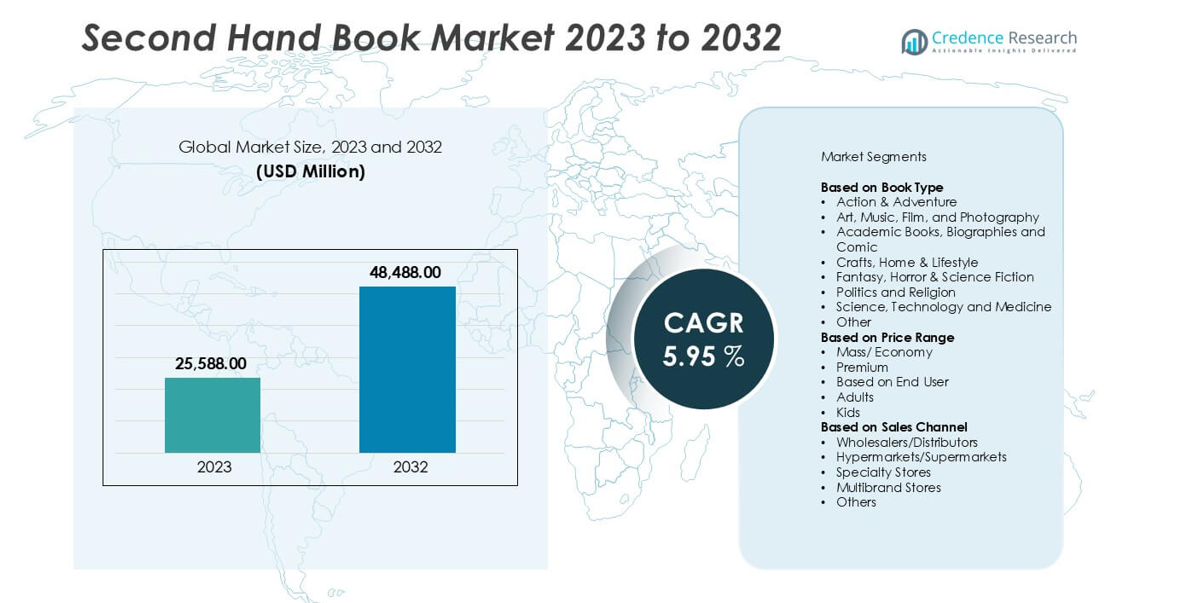
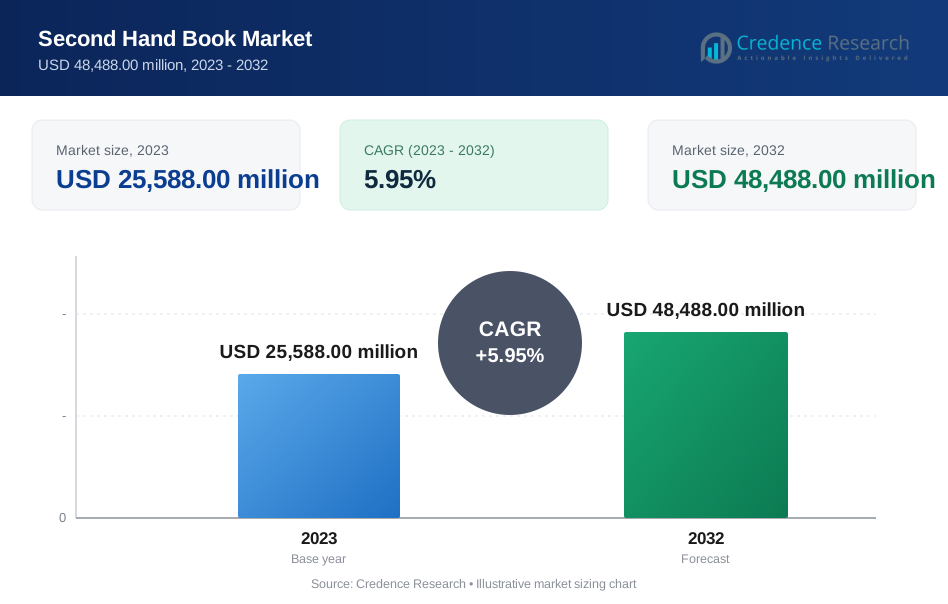
The Second-Hand Book Market was valued at USD 25,588.00 million in 2023 and is projected to reach USD 25,588.00 millionby 2032, growing at a compound annual growth rate (CAGR) of 5.95% during the forecast period.
| REPORT ATTRIBUTE | DETAILS |
|---|---|
| Historical Period | 2020-2023 |
| Base Year | 2024 |
| Forecast Period | 2025-2032 |
| Second Hand Book Market Size 2023 | USD 25,588.00 million |
| Second Hand Book Market, CAGR | 5.95% |
| Second Hand Book Market Size 2032 | USD 25,588.00 million |
The Second-Hand Book Market is led by key players such as Thrift Books, AbeBooks Inc., eBay Inc., Better World Books, BookChor Literary Solutions Pvt. Ltd., and BookMooch, which collectively dominate the global landscape. These companies leverage strong e-commerce platforms, vast inventories, and sustainability-driven initiatives to attract a wide reader base. North America emerged as the leading region in 2024, holding nearly 34% of the global market share, driven by the presence of major online resellers and high literacy levels. Europe followed with 29%, supported by established second-hand bookstore networks and circular economy initiatives promoting book reuse and resale.
Market Insights
- The Second-Hand Book Market was valued at USD 25,588.00 million in 2023 and is projected to reach USD 48,488.00 million by 2032, growing at a CAGR of 5.95%.
- Growing demand for affordable academic and leisure reading drives market expansion, supported by online resale platforms offering wide book selections.
- Digital transformation and AI-based cataloging streamline inventory management, while sustainability initiatives promote circular reading culture.
- The market is fragmented, with key players such as Thrift Books, AbeBooks, eBay, and BookChor competing through pricing, accessibility, and digital reach.
- North America leads with 34% market share, followed by Europe (29%) and Asia-Pacific (27%), while the Academic Books, Biographies, and Comics segment dominates with around 36% of total global sales.
Market Segmentation Analysis:
By Book Type
The Academic Books, Biographies, and Comic segment dominated the Second-Hand Book Market in 2024, accounting for over 36% of the total share. This dominance stems from the strong demand for affordable academic resources and collectible comics. College students and book enthusiasts drive purchases to save costs and access out-of-print editions. The segment also benefits from digital marketplaces and campus resale programs that streamline book exchanges. Expanding literacy initiatives and sustainability-focused reading habits further support growth in this category across major regions.
- For instance, Chegg, which transitioned from its physical textbook rental business starting in 2014, has since focused on subscription-based learning services. As part of that shift, Chegg Study was integrated with an affiliate partner, Valore, to manage textbook resales and rentals for students in North America.
By Price Range
The Mass/Economy segment held the largest share of around 68% in 2024. Affordable pricing makes used books accessible to wider audiences, especially students and budget-conscious readers. Online resale platforms and thrift stores promote high-volume, low-cost trade. The rise of e-commerce channels such as ThriftBooks and eBay Books has simplified global distribution. Growing interest in sustainable consumption and circular economy models continues to strengthen this segment’s leadership in both developed and emerging markets.
- For instance, ThriftBooksis one of the largest independent online used book retailers globally, selling millions of second-hand titles annually.
By End User
The Adult segment accounted for nearly 72% of the market share in 2024. Adults dominate due to high engagement in academic, professional, and leisure reading categories. Second-hand fiction, biographies, and business books are popular among urban readers seeking cost-effective options. Increased awareness of environmental sustainability and nostalgia for physical books also drive repeat purchases. Meanwhile, the kids’ segment shows steady growth supported by parental focus on early learning and affordable education materials.
Key Growth Drivers
Rising Demand for Affordable Reading Options
Growing awareness of cost-effective reading habits has driven demand for second-hand books worldwide. Students, young professionals, and avid readers prefer used copies to save money while accessing a broad range of titles. The availability of online resale platforms such as ThriftBooks, Better World Books, and Amazon Renewed enhances accessibility and transparency. As inflation pressures persist, affordability becomes a stronger purchase motivator. Educational institutions and libraries are also encouraging book reuse to promote sustainability. This combination of economic and environmental benefits continues to position pre-owned books as an appealing alternative to new ones.
- For instance, Better World Books has resold, reused, or recycled over 475 million books globally, diverting them from landfills through its reuse, recycling, and donation programs. The company has also donated over 38 million books and raised more than $35 million for literacy and libraries.
Expansion of Online Resale Platforms and E-Commerce
E-commerce platforms have revolutionized the used book market by offering vast collections and seamless global access. Companies such as eBay, BookScouter, and AbeBooks provide digital marketplaces where buyers and sellers connect instantly. Advanced algorithms help match supply with demand, ensuring better visibility for rare and academic books. Mobile apps with integrated payment systems and doorstep delivery make the buying process effortless. The digital shift has expanded consumer reach beyond local stores and flea markets. This convenience, combined with fast logistics, is a key factor fueling market expansion across all regions.
- For instance, AbeBooks listed over 110 million used and rare book titles in 2024, expanding its catalog through global independent bookseller partnerships.
Growing Awareness of Environmental Sustainability
Environmental consciousness has become a strong growth driver in the second-hand book industry. Consumers are increasingly aware that purchasing pre-owned books reduces paper waste and carbon emissions from printing and logistics. Circular economy principles encourage reusing and recycling goods, including books, to minimize landfill waste. Book donation drives and sustainability campaigns by retailers reinforce this eco-friendly image. Universities and community libraries are partnering with online platforms to promote green reading initiatives. As sustainability becomes part of mainstream consumer behavior, the second-hand book market is positioned as a responsible and low-impact alternative to new publishing.
Key Trends & Opportunities
Integration of Digital Catalogs and AI-Based Inventory Management
Digital transformation is reshaping how used books are sourced, listed, and sold. AI-powered systems now categorize millions of book titles, enabling faster search and accurate price comparison. Automated cataloging and condition grading improve buyer trust and reduce manual sorting time. Online sellers integrate barcode scanning and predictive algorithms to identify trending titles. This efficiency not only enhances customer satisfaction but also reduces operational costs. As more sellers adopt AI and cloud-based systems, the industry’s scalability and inventory accuracy are expected to improve significantly.
- For instance, ThriftBooks uses machine learning to help manage its inventory, which consists of millions of titles. This includes automating title recognition and dynamically pricing books based on market analysis.
Growing Popularity of Rare and Collectible Editions
Collectors and enthusiasts are fueling a rising demand for vintage and first-edition books. Rare titles, author-signed copies, and out-of-print academic works are increasingly viewed as valuable assets. Auction sites and specialty marketplaces such as Alibris and Biblio are capitalizing on this niche. This trend attracts investors and bibliophiles who value authenticity and long-term appreciation. Moreover, publishers and resellers are organizing limited-edition resale events to target premium buyers. The growing intersection of nostalgia, culture, and investment is creating a new profit stream within the used book ecosystem.
Key Challenges
Quality and Condition Standardization Issues
One of the major challenges in the second-hand book market is the lack of standardized quality grading. Buyers often face uncertainty regarding book condition, edition accuracy, or missing pages. This inconsistency can reduce consumer trust and limit repeat purchases. Platforms are introducing condition tags such as “like new,” “good,” or “acceptable,” but variations still exist across sellers. Returns and disputes due to poor condition increase operational costs. Establishing global condition assessment standards and transparent seller ratings can address this challenge effectively.
Competition from Digital and Audiobook Platforms
The rapid growth of digital reading alternatives such as Kindle, Scribd, and Audible poses a significant threat to second-hand book sales. Younger readers increasingly prefer e-books and audiobooks due to their portability and accessibility. Subscription models offering unlimited content reduce the need for physical copies. Additionally, publishers are expanding digital libraries, limiting the availability of printed editions. This shift challenges resale volumes and long-term profitability for second-hand vendors. To remain competitive, traditional resellers must combine digital integration with sustainability-focused marketing strategies.
Regional Analysis
North America
North America held the largest share of around 34% of the Second-Hand Book Market in 2024. The region benefits from a strong network of online marketplaces such as eBay, Amazon, and ThriftBooks. College textbook reselling and growing sustainability awareness also support steady growth. The U.S. dominates due to its large base of students and readers seeking affordable options. Book donation and library resale programs have expanded, strengthening the circular book economy. Canada’s demand for used academic and fiction books is also rising through platforms like Kijiji and BookOutlet, reinforcing North America’s overall leadership.
Europe
Europe accounted for nearly 29% of the Second-Hand Book Market share in 2024. The market thrives due to established reuse culture and environmental awareness. The U.K., Germany, and France are major contributors, supported by online platforms like World of Books and Momox. High literacy rates and strong reading habits drive sales in both print and digital used formats. Government initiatives promoting sustainability and recycling enhance adoption. The shift toward eco-friendly consumption patterns, along with student demand for affordable educational books, continues to sustain market expansion across Western and Northern Europe.
Asia-Pacific
Asia-Pacific captured approximately 27% of the Second-Hand Book Market in 2024. The region’s rapid digital transformation and growing e-commerce base have strengthened used book sales. Countries like India, Japan, and China lead the market, supported by large student populations and online resale platforms such as BookChor and Mercari. Affordable pricing and rising literacy rates drive steady adoption. Urbanization and digital payment growth further expand accessibility for younger readers. Academic institutions increasingly encourage textbook reuse, reinforcing sustainable reading practices and positioning Asia-Pacific as a major growth hub for pre-owned books.
Latin America
Latin America represented around 6% of the Second-Hand Book Market share in 2024. Brazil, Mexico, and Argentina dominate regional activity, supported by online and street-level resale channels. Growing internet access and economic constraints have boosted second-hand purchasing behavior. Local marketplaces like Estante Virtual and OLX play key roles in expanding access. Educational institutions increasingly support reused textbooks to reduce costs. Cultural reading events and book fairs across major cities continue to promote book recycling. Despite logistical challenges, the region’s gradual digital adoption is expected to strengthen its long-term growth potential.
Middle East & Africa
The Middle East and Africa accounted for about 4% of the Second-Hand Book Market share in 2024. The market remains small but is gradually expanding with digital access improvements. South Africa, the UAE, and Egypt are leading contributors due to rising literacy rates and growing urban readership. Online resale through platforms like Dubizzle and Facebook Marketplace is expanding availability. Economic factors and sustainability awareness are also promoting affordable reading alternatives. Educational institutions in Africa are fostering book exchange programs, supporting literacy growth and improving access to low-cost academic materials across the region.
Market Segmentations:
By Book Type
- Action & Adventure
- Art, Music, Film, and Photography
- Academic Books, Biographies and Comic
- Crafts, Home & Lifestyle
- Fantasy, Horror & Science Fiction
- Politics and Religion
- Science, Technology and Medicine
- Other
By Price Range
- Mass/ Economy
- Premium
By End User
- Adults
- Kids
By Sales Channel
- Wholesalers/Distributors
- Hypermarkets/Supermarkets
- Specialty Stores
- Multibrand Stores
- Others
By Geography
- North America
- U.S.
- Canada
- Mexico
- Europe
- UK
- France
- Germany
- Italy
- Spain
- Russia
- Rest of Europe
- Asia Pacific
- China
- Japan
- South Korea
- India
- Australia
- Southeast Asia
- Rest of Asia Pacific
- Latin America
- Brazil
- Argentina
- Rest of Latin America
- Middle East
- GCC Countries
- Israel
- Turkey
- Rest of Middle East
- Africa
- South Africa
- Egypt
- Rest of Africa
Competitive Landscape
The Second-Hand Book Market is highly fragmented, featuring a mix of global e-commerce leaders, regional online resellers, and independent bookstores. Key players include BookMooch, BookChor Literary Solutions Private Limited, Crossword Bookstores Ltd., eBay Inc., Powells Book, Skyo, BookMafiya Study Solutions Pvt. Ltd., The Strand, PaperBack Swap, AbeBooks Inc., Thrift Books, and Better World Books. These companies compete on pricing, inventory variety, and platform accessibility. Online marketplaces such as eBay, Thrift Books, and AbeBooks dominate due to large-scale logistics and AI-driven inventory management. Local platforms like BookChor and BookMafiya cater to regional demand for academic and affordable reading materials. Sustainability-focused initiatives and digital cataloging systems have further strengthened brand loyalty. Strategic collaborations, resale partnerships, and improved user interfaces continue to define competition, enabling leading players to expand customer reach while promoting circular economy models across major book markets worldwide.
Key Player Analysis
- BookMooch
- BookChor Literary Solutions Private Limited
- Crossword Bookstores Ltd.
- eBay Inc.
- Powells Book
- Skyo
- BookMafiya Study Solutions Pvt. Ltd.
- The Strand
- PaperBack Swap
- AbeBooks Inc.
- Thrift Books
- Better World Books
Recent Developments
- In March 2025, BookChor remains a prominent online platform for buying and selling second-hand books in India, offering a wide range of genres at affordable prices.
- In March 2025, Thrift Books offers various promotions, including up to 35% off purchases and free shipping.
- In February 2025, Crossword targets expanding to 300 stores in five years, focusing on tier-2 and tier-3 cities in India. They also plan to enter international markets like the Middle East and Southeast Asia.
- In January 2025, BookMafiya hosted its Dream Book Fair in Jodhpur, featuring over 700,000 books across multiple genres.
- In 2025, Powell’s continues to operate as a major independent bookstore in Portland, Oregon, offering a vast collection of new, used, and rare books.
- In November 2024, eBay UK sellers noted challenges in selling used books due to low demand except for rare editions.
Report Coverage
The research report offers an in-depth analysis based on Book Type, Price Range, End User, Sales Channel and Geography. It details leading market players, providing an overview of their business, product offerings, investments, revenue streams, and key applications. Additionally, the report includes insights into the competitive environment, SWOT analysis, current market trends, as well as the primary drivers and constraints. Furthermore, it discusses various factors that have driven market expansion in recent years. The report also explores market dynamics, regulatory scenarios, and technological advancements that are shaping the industry. It assesses the impact of external factors and global economic changes on market growth. Lastly, it provides strategic recommendations for new entrants and established companies to navigate the complexities of the market.
Future Outlook
- The market will expand steadily with growing adoption of online resale platforms.
- Increasing environmental awareness will boost demand for sustainable reading choices.
- Academic institutions will continue promoting book reuse through campus exchange programs.
- AI-driven cataloging and price tracking will enhance digital marketplace efficiency.
- Demand for rare and collectible editions will create new premium opportunities.
- Partnerships between bookstores and e-commerce platforms will strengthen global reach.
- Mobile-based resale apps will attract younger, tech-savvy readers across regions.
- Community libraries and NGOs will play a larger role in book circulation.
- Improved logistics and delivery systems will enhance accessibility in emerging markets.
- Integration of blockchain for book authentication will increase buyer trust and transparency.
Request a Free Sample
Fill in your details and we'll send you a free sample report.
- Sample data tables & charts
- Research methodology
Need a Custom Version of This Report?
Tailor the scope, geography, or segments to your exact requirements.
- Custom geography or segment scope
- Direct access to our analyst team
Frequently Asked Questions
What is the market size of the global second-hand book market in 2023 and 2032?
What are the main factors driving the growth of the second-hand book market?
How has digitalization impacted the second-hand book market?
Which regions are leading the global second-hand book market?
Who are the key players in the second-hand book market?
Table of Content
Chapter 1. Report Introduction
- 1.1 Report Description & Purpose
- 1.1.1 Report Title & Market Definition
- 1.1.2 Unique Selling Propositions (USP) & Key Differentiators
- 1.1.3 Value Proposition for Stakeholders
- 1.2 Research Objectives
- 1.2.1 Market Sizing Objectives (Volume & Revenue) (Volume Where Applicable)
- 1.2.2 Segmentation Objectives
- 1.2.3 Competitive Intelligence Objectives
- 1.2.4 Forecast & Scenario Objectives
- 1.3 Report Scope
- 1.3.1 Second Hand Book Scope – Segments & Subsegments Covered
- 1.3.2 Geographic Scope – Regions & Countries Covered
- 1.3.3 Historical Period, Base Year & Forecast Period (2023; forecast to 2032)
- 1.3.4 Inclusions & Exclusions
- 1.4 Industry Classification & Applicable Codes
- 1.5 Currency, Measurement Units & Valuation Basis
- 1.6 Target Stakeholders
- 1.7 Limitations & Assumptions
Chapter 2. Executive Summary
- 2.1 Global Second Hand Book Market Snapshot
- 2.1.1 Market Size – Historical (2023) & Forecast (2023-2032) (2023: USD 25,588.00 million → 2032: USD 48,488.00 million)
- 2.1.2 Volume & Revenue – Global Totals (Volume Where Applicable)
- 2.1.3 Key Market Highlights – Top Five Facts
- 2.2 Second Hand Book Market Segmentation Snapshot
- 2.2.1 Market Split by Region – 2023 vs. 2032
- 2.3 Competitive Snapshot
- 2.3.1 Top 10 Players by Revenue Share – 2023
- 2.3.2 Top 10 Players by Volume Share – 2023 (Volume Where Applicable)
- 2.3.3 Recent Strategic Developments (18-Month Summary)
- 2.4 Key Investment Highlights & Strategic Conclusions
Chapter 3. Second Hand Book Market Dynamics & Industry Analysis
- 3.1 Market Overview & Context
- 3.1.1 Second Hand Book Market Position in the Broader Industry Value Chain
- 3.1.2 Demand Structure & Purchasing Dynamics
- 3.1.3 Market Maturity & Development Stage by Region
- 3.2 Second Hand Book Market Drivers
- 3.3 Second Hand Book Market Restraints & Challenges
- 3.4 Second Hand Book Market Opportunities
- 3.5 Porter's Five Forces Analysis
- 3.5.1 Threat of New Entrants
- 3.5.2 Bargaining Power of Suppliers
- 3.5.3 Bargaining Power of Buyers
- 3.5.4 Threat of Substitutes
- 3.5.5 Competitive Rivalry – Intensity Assessment
- 3.6 Second Hand Book Value Chain Analysis
- 3.6.1 Upstream – Key Inputs, Resources & Suppliers
- 3.6.1.1 Key Input/Resource 1
- 3.6.1.2 Key Input/Resource 2
- 3.6.1.3 Key Input/Resource 3
- 3.6.2 Midstream – Core Operations & Value Creation
- 3.6.2.1 Operating Model & Process Overview
- 3.6.2.2 Key Operating Locations & Capabilities by Company
- 3.6.3 Downstream – Market Channels & End Users
- 3.6.3.1 Direct Sales & Customer Engagement Channels
- 3.6.3.2 Indirect Sales, Intermediaries & Partner Channels
- 3.6.4 Value Chain Profitability Analysis
- 3.6.1 Upstream – Key Inputs, Resources & Suppliers
- 3.7 PESTEL Analysis
- 3.7.1 Political Factors
- 3.7.2 Economic Factors
- 3.7.3 Social Factors
- 3.7.4 Technological Factors
- 3.7.5 Environmental Factors
- 3.7.6 Legal Factors
- 3.8 Second Hand Book Supply Chain Analysis
- 3.8.1 Critical Input & Resource Availability Risk Assessment
- 3.8.2 Supplier & Operational Concentration Risk (Geographic Exposure)
- 3.8.3 Supply & Service Disruption Impact Analysis
- 3.9 Regulatory & Policy Landscape
Note: The regulatory and policy landscape section covers regulations based on their applicability to the market, Second Hand Book category, geography, and scope of the study. Only regulatory frameworks with a material impact on operations, compliance, trade, sustainability, or market access are analyzed in detail.
Chapter 4. Key Investment Pockets & Opportunity Analysis
- 4.1 Second Hand Book Market Attractiveness Analysis
- 4.1.1 By Region – Investment Attractiveness Matrix (Market Size × CAGR)
- 4.2 Absolute Revenue Growth Opportunity
- 4.2.1 By Region – Absolute Revenue Growth Through 2032
- 4.3 Incremental Demand Opportunity
- 4.3.1 By Region – Incremental Demand Through 2032
- 4.3.2 Segment – Incremental Demand
- 4.4 Emerging Submarket Opportunity Deep Dive (Subject to Applicability)
- 4.5 Priority Market Opportunity Scorecards
- 4.5.1 United States
- 4.5.2 Europe
- 4.5.3 Asia
- 4.5.4 Middle East & Africa
Note: Priority market opportunity scorecards reflect the geographic scope and strategic relevance of the study. Listed markets are indicative and may be adapted to the industry.
Chapter 5. Second Hand Book Cross-Border Trade & Market Access Analysis
- 5.1 International Trade & Cross-Border Activity Overview
- 5.1.1 Global Export Value by Country (2023)
- 5.1.2 Global Export Volume by Country (2023) (Volume Where Applicable)
- 5.1.3 Global Import Value by Country (2023)
- 5.1.4 Global Import Volume by Country (2023) (Volume Where Applicable)
- 5.1.5 Net Trade Balance by Country (2023)
- 5.2 Export Analysis – Segment
- 5.2.1 Category 1 (Applicable Classification Code)
- 5.2.2 Category 2 (Applicable Classification Code)
- 5.2.3 Category 3 (Applicable Classification Code)
- 5.2.4 Category 4 (Applicable Classification Code)
- 5.2.5 Category 5 (Applicable Classification Code)
- 5.3 Import Analysis – Segment
- 5.3.1 Category 1 (Applicable Classification Code)
- 5.3.2 Category 2 (Applicable Classification Code)
- 5.3.3 Category 3 (Applicable Classification Code)
- 5.3.4 Category 4 (Applicable Classification Code)
- 5.3.5 Category 5 (Applicable Classification Code)
- 5.4 Cross-Border Pricing & Transaction Benchmarks
- 5.4.1 Export Pricing – Segment & Country
- 5.4.2 Import Pricing – Segment & Source Country
- 5.4.3 Price Trends (2023)
- 5.5 Key Cross-Border Trade & Delivery Routes
- 5.5.1 Cross-Border Trade/Delivery Route 1
- 5.5.2 Cross-Border Trade/Delivery Route 2
- 5.5.3 Cross-Border Trade/Delivery Route 3
- 5.5.4 Cross-Border Trade/Delivery Route 4
- 5.5.5 Cross-Border Trade/Delivery Route 5
- 5.6 Trade Policy & Market Access Impact Assessment
- 5.6.1 Tariff & Non-Tariff Barriers
- 5.6.2 Regional Trade & Economic Integration Frameworks
- 5.6.3 Bilateral & Multilateral Trade Agreements
- 5.6.4 Cross-Border Operating, Licensing & Localization Requirements
Note: This chapter applies where cross-border trade or delivery is relevant to Second Hand Book. Goods, services, and digital offerings are assessed using applicable classifications and transaction measures. Import-export volumes, trade balances, and route analyses are included only where meaningful to the market.
Chapter 6. Competitive Landscape & Company Benchmarking
- 6.1 Second Hand Book Market Concentration & Structure
- 6.1.1 Herfindahl-Hirschman Index (HHI) – vs. 2023
- 6.1.2 Leading, Mid-Sized & Emerging Player Structure
- 6.1.3 Global, Regional & Local Player Dynamics
- 6.2 Second Hand Book Market Share Analysis – 2023
- 6.2.1 Global Revenue Share by Company
- 6.2.2 Global Volume Share by Company (Volume Where Applicable)
- 6.2.3 Regional Revenue Share
- 6.2.4 Market Share Evolution ( vs. 2023)
- 6.2.5 Company Market Share by Key Segment
- 6.2.6 Company Market Share by Customer Group
- 6.3 Operating Scale, Capacity & Infrastructure Analysis
- 6.3.1 Global Operating Scale & Supply Capacity
- 6.3.2 Resource Utilization & Operating Efficiency
- 6.3.3 Output, Service Delivery & Activity Metrics
- 6.3.4 Operating Footprint & Infrastructure Map
- 6.3.5 Planned Operational & Capacity Expansion
- 6.4 Second Hand Book Competitive Benchmarking Matrix
- 6.4.1 Revenue, Growth, Profitability & Operating Metric Comparison
- 6.4.2 Channel Revenue Mix
- 6.4.3 Geographic Revenue Exposure
- 6.4.4 R&D Intensity
- 6.4.5 Sustainability Maturity
- 6.5 Strategic Developments in Second Hand Book (Last 24 Months)
- 6.5.1 Mergers, Acquisitions & Divestments
- 6.5.2 New Products, Services & Solutions in Second Hand Book
- 6.5.3 Operational & Infrastructure Expansions
- 6.5.4 Strategic Alliances, Joint Ventures & Partnerships
- 6.5.5 Distribution Expansion & Market Entry
- 6.5.6 Sustainability & ESG Initiatives
- 6.6 Competitive Strategy Mapping
- 6.6.1 Leader, Challenger, Follower & Niche Classification
- 6.6.2 Pricing Strategy Comparison
- 6.6.3 Channel Strategy Matrix
Note: Strategic developments are included based on their materiality and the availability of reliable information.
Chapter 7. Global Second Hand Book Market – By Sales & Delivery Channel
- 7.1 Segment Overview
- 7.1.1 Volume & Revenue Split by Channel (2023 & 2032) (Volume Where Applicable)
- 7.1.2 Channel Mix Evolution (2023-2032)
Chapter 8. Regional Market Analysis – Global Overview
- 8.1 Global Regional Overview
- 8.1.1 Regional Volume Share (Volume Where Applicable)
- 8.1.2 Regional Revenue Share
- 8.1.3 Regional Volume by Region (Volume Where Applicable)
- 8.1.4 Regional Revenue by Region
- 8.1.5 Regional Forecast Through 2032
- 8.2 Cross-Regional Segment Analysis
- 8.2.1 By Sales & Delivery Channel
- 8.2.2 By Competitive Positioning & Price Tier
Chapter 9. North America Second Hand Book Market
- 9.1 United States
- 9.2 Canada
- 9.3 Mexico
Chapter 10. Europe Second Hand Book Market
- 10.1 Germany
- 10.2 France
- 10.3 Italy
- 10.4 United Kingdom
- 10.5 Spain
- 10.6 Poland
- 10.7 Russia
- 10.8 Netherlands
- 10.9 Belgium
- 10.10 Sweden
- 10.11 Denmark
- 10.12 Norway
- 10.13 Rest of Europe
Chapter 11. Asia Pacific Second Hand Book Market
- 11.1 China
- 11.2 India
- 11.3 Japan
- 11.4 South Korea
- 11.5 Thailand
- 11.6 Indonesia
- 11.7 Vietnam
- 11.8 Malaysia
- 11.9 Australia
- 11.10 Rest of Asia Pacific
Chapter 12. Latin America Second Hand Book Market
- 12.1 Brazil
- 12.2 Argentina
- 12.3 Colombia
- 12.4 Chile
- 12.5 Rest of Latin America
Chapter 13. Middle East Second Hand Book Market
- 13.1 Saudi Arabia
- 13.2 United Arab Emirates
- 13.3 Turkey
- 13.4 Israel
- 13.5 Iran
- 13.6 Rest of the Middle East
Chapter 14. Africa Second Hand Book Market
- 14.1 South Africa
- 14.2 Egypt
- 14.3 Nigeria
- 14.4 Morocco
- 14.5 Rest of Africa
Chapter 15. Second Hand Book Company Profiles
- 15.1 [Company 01]
- 15.1.1 Company Overview
- 15.1.2 Key Management Personnel
- 15.1.3 Products & Services Portfolio
- 15.1.4 Financial Performance
- 15.1.5 Key Market Focus & Geographic Presence
- 15.1.6 Recent Developments & Strategic Initiatives
Note: The company profile list is preliminary and may change based on research findings, market developments, data availability, and client requirements.
Chapter 16. Appendices
- Appendix A – List of Abbreviations & Acronyms
- Appendix B – Industry Classification Code Reference – Full Series
- Appendix C – Supply, Output & Operating Capacity Data Tables
- Appendix D – End-Use & Demand Base Tables
- Appendix E – Demand, Adoption & Usage Assumptions
- Appendix F – Pricing & Revenue Metric Reference Tables
- Appendix G – Company Operations & Infrastructure Database
- Appendix H – Cross-Border Trade & Activity Data Tables (Where Applicable)
- Appendix I – Regulatory Summary Tables
- Appendix J – Primary Research Participant List (Anonymized)
- Appendix K – Primary Research Questionnaire Framework
- Appendix L – Data Sources & Bibliography
- Appendix M – Market Size Divergence & Source Comparison
Chapter 17. Research Methodology
- 17.1 Research Framework & Philosophy
- 17.2 Secondary Research – Sources, Hierarchy & Data Extraction
- 17.3 Data Modeling – Bottom-Up & Top-Down Market Sizing
- 17.4 Primary Research – Stakeholder Framework, LOI & Sample Sizes
- 17.5 Forecast Methodology – Regression, Scenario & Sensitivity Analysis
- 17.6 Quality Control – Four-Layer Validation Framework
- 17.7 Limitations & Standard Assumptions
- 17.8 Disclaimer
