
Market Overview:
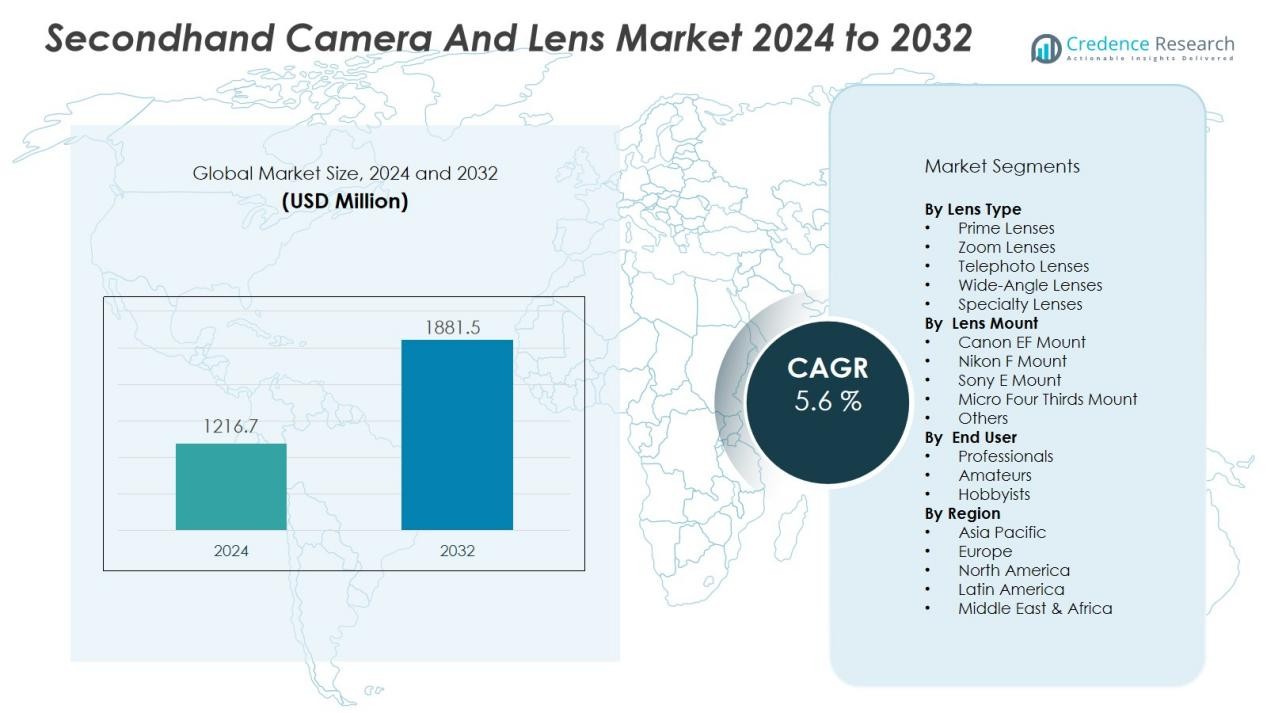
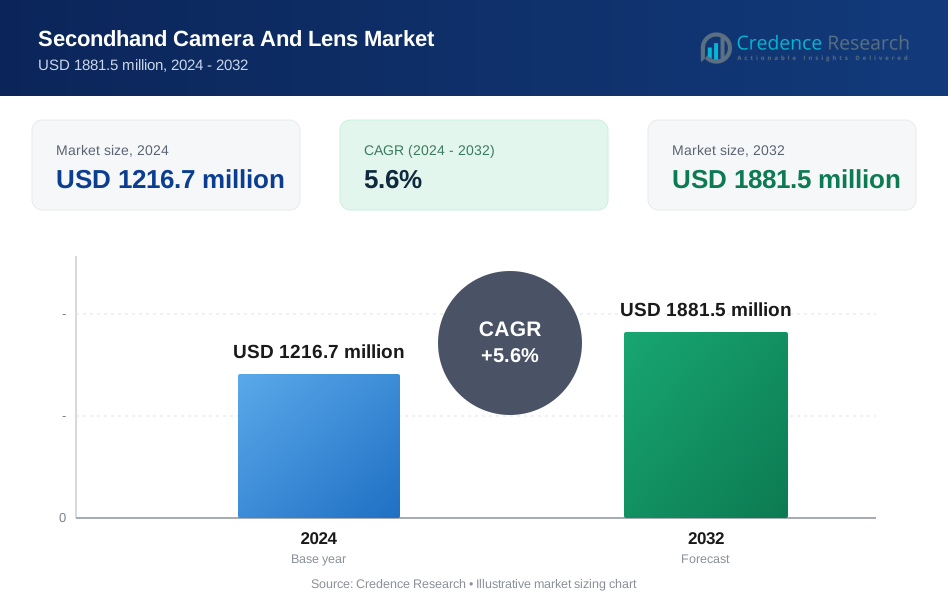
The secondhand camera and lens market size was valued at USD 1216.7 million in 2024 and is anticipated to reach USD 1881.5 million by 2032, at a CAGR of 5.6 % during the forecast period (2024-2032).
| REPORT ATTRIBUTE | DETAILS |
|---|---|
| Historical Period | 2020-2024 |
| Base Year | 2024 |
| Forecast Period | 2025-2032 |
| Secondhand Camera and Lens Market Size 2024 | USD 1216.7 Million |
| Secondhand Camera and Lens Market, CAGR | 5.6 % |
| Secondhand Camera and Lens Market Size 2032 | USD 1881.5 Million |
Key drivers include the rising popularity of photography as both a hobby and profession, alongside growing interest in sustainable consumption. Many consumers and professionals prefer pre-owned equipment due to lower cost, reliable performance, and access to discontinued or rare models. Circular economy practices and environmental awareness are also boosting the resale value of cameras and lenses. Furthermore, platforms offering product authentication, warranties, and flexible financing are increasing consumer confidence in pre-owned purchases.
Regionally, North America and Europe dominate the market due to mature photography cultures, well-established resale platforms, and strong professional demand. Asia-Pacific is projected to register the fastest growth, driven by expanding middle-class populations, increasing disposable income, and rising interest in content creation across countries such as China, India, and Japan. Emerging markets in Latin America and the Middle East & Africa are also showing steady adoption, supported by growing digital penetration and e-commerce infrastructure.
Market Insights:
- The secondhand camera and lens market was valued at USD 1216.7 million in 2024 and is expected to reach USD 1881.5 million by 2032, growing at a CAGR of 5.6% during 2024–2032.
- Rising demand for affordable photography gear among hobbyists, students, and professionals drives steady growth.
- Increasing popularity of social media, vlogging, and digital content creation boosts pre-owned equipment adoption.
- Sustainability and circular economy practices support wider acceptance, with buyers seeking eco-friendly alternatives.
- Expansion of online platforms offering warranties, authentication, and secure payments improves buyer confidence.
- Quality concerns and lack of standardized pricing remain key challenges for market credibility and growth.
- North America leads with 36% market share, followed by Europe at 28%, while Asia-Pacific records the fastest growth at 24%, and Latin America and Middle East & Africa account for 12% combined.
Market Drivers:
Growing Demand for Affordable Photography Equipment:
The secondhand camera and lens market benefits from rising demand for affordable gear among hobbyists, students, and professionals. Many buyers seek cost-effective alternatives to new equipment, especially high-end lenses and full-frame cameras. Lower pricing enables wider access to advanced photography tools without compromising quality. This affordability factor strongly influences purchase decisions, expanding the customer base.
- For instance, Sony’s Alpha a7 III full-frame mirrorless camera, launched in 2018, features a 24.2-megapixel sensor delivering high image quality and has sold over 1.8 million units globally, providing used-market buyers access to professional-grade features at reduced prices.
Rising Popularity of Content Creation and Digital Platforms:
It gains momentum from the increasing influence of social media, vlogging, and digital content creation. Creators require reliable equipment but often face budget constraints, which makes pre-owned options attractive. Access to secondhand gear helps them start or upgrade without significant financial pressure. This trend expands market reach, especially among younger demographics.
- For instance, GoPro achieved a milestone by shipping over 30 million Hero cameras worldwide by the end of 2023, notable for their rugged design favored by vloggers and adventurers looking for durable, affordable recording gear.
Strengthening Role of Sustainability and Circular Economy:
Environmental awareness supports the growth of this market by encouraging reuse and extending product lifecycles. Consumers are increasingly inclined to purchase pre-owned equipment to reduce electronic waste. Brands and platforms that promote resale contribute to circular economy practices, making sustainability a key driver. It aligns with broader consumer values around responsible consumption.
Expansion of Online Marketplaces and Resale Platforms:
The secondhand camera and lens market is expanding through specialized online platforms and e-commerce channels. Secure payment systems, authentication services, and warranties have increased buyer confidence in pre-owned purchases. Online platforms also provide access to rare or discontinued models, further boosting demand. This digital expansion ensures convenience and global reach for both buyers and sellers.
Market Trends:
Growing Integration of Authentication and Warranty Services:
The secondhand camera and lens market is witnessing a strong trend toward professional authentication and warranty-backed services. Buyers now expect assurance of product quality, leading platforms to invest in verification systems. Certified pre-owned programs are gaining traction, offering guarantees that reduce risks tied to pre-owned purchases. Retailers and online platforms highlight transparency by sharing detailed product histories and condition grading. This structured approach builds buyer confidence and accelerates market adoption. It also strengthens trust between sellers and new customers, shaping resale behavior toward premium and verified platforms.
- For instance, KEH Camera’s Atlanta headquarters inspects and grades 275,000 pieces of pre-owned gear annually through its team of expert technicians, providing detailed condition reports and serial-number authentication before listing each item.
Rising Influence of Digital Channels and Global Reach:
- commerce platforms and specialized resale marketplaces are becoming dominant channels for secondhand camera and lens transactions. Online communities and peer-to-peer platforms allow buyers to access rare and discontinued models across global markets. The increasing role of mobile applications further improves convenience, expanding consumer engagement. Sellers benefit from wider visibility, while buyers gain price transparency and secure payment solutions. The market is shifting from traditional in-store transactions to digital-first sales models, driven by growing trust in online platforms. It reflects a broader trend of digital transformation in consumer electronics resale, supported by strong growth in cross-border trade.
- For example, the Depop app has seen over 30 million registered users globally, offering streamlined peer-to-peer sales through mobile-first design. Sellers benefit from wider visibility, while buyers gain price transparency and secure payment solutions.
Market Challenges Analysis:
Concerns Over Product Quality and Counterfeit Risks:
The secondhand camera and lens market faces challenges linked to product authenticity and reliability. Buyers often worry about hidden defects, tampering, or counterfeit products that may not deliver promised performance. Limited inspection and grading standards across platforms create uncertainty during transactions. This concern discourages potential buyers, especially first-time customers seeking professional gear. It also impacts resale platforms, which must invest in verification systems to maintain credibility. Ensuring consistent quality remains a critical barrier for market expansion.
Price Volatility and Lack of Standardized Valuation:
Fluctuating demand and inconsistent pricing create barriers for both sellers and buyers in the secondhand camera and lens market. Product value often depends on subjective factors such as condition, age, and brand reputation. The absence of standardized valuation systems complicates negotiations and reduces market transparency. Buyers may overpay for worn products, while sellers risk undervaluing high-quality gear. This pricing imbalance undermines trust and slows repeat transactions. It highlights the need for structured pricing frameworks and transparent resale practices to ensure sustainable growth.
Market Opportunities:
Expansion Through Certified Pre-Owned Programs and Value-Added Services:
The secondhand camera and lens market presents strong opportunities through certified pre-owned initiatives supported by warranties and quality checks. Professional authentication builds trust, making buyers more confident in purchasing higher-value gear. Platforms that combine grading systems, repair services, and extended warranties can capture loyal customers seeking reliability. Retailers and brands entering the resale space can strengthen customer retention while tapping into new revenue streams. It also allows companies to reinforce sustainability commitments by extending product lifecycles. The adoption of value-added services positions resale as a mainstream alternative to new equipment.
Rising Demand from Emerging Markets and Digital Creators:
Expanding digital penetration in emerging economies creates significant opportunities for the secondhand camera and lens market. Growing middle-class populations in Asia, Latin America, and Africa are seeking affordable photography tools. Content creators, vloggers, and influencers increasingly prefer pre-owned equipment to balance cost and performance. Online platforms offering localized support and flexible financing can accelerate adoption in these regions. It benefits from the rising influence of social media culture, where demand for visual content drives camera purchases. Access to rare or discontinued models also appeals to niche segments, opening profitable growth avenues.
Market Segmentation Analysis:
By Lens Type:
The secondhand camera and lens market features strong demand across prime, zoom, telephoto, and wide-angle lenses. Zoom lenses dominate due to their versatility for both professionals and hobbyists. Prime lenses attract photographers seeking sharper image quality and better low-light performance. Telephoto lenses gain traction among wildlife and sports enthusiasts, while wide-angle lenses remain popular for landscape and architectural photography. It benefits from users seeking specialized lenses at affordable prices, often unavailable or costly in the new equipment segment.
- For instance, the Nikon AF-S Nikkor 50mm f/1.8G Prime lens is renowned for its sharpness and delivers excellent bokeh with its 7-blade diaphragm, contributing to clearer imagery in low-light conditions.
By Lens Mount:
Lens mount segments include Canon EF, Nikon F, Sony E, Micro Four Thirds, and others. Canon EF and Nikon F mounts hold significant demand due to a large installed base of compatible cameras. Sony E-mount is expanding rapidly, driven by mirrorless adoption among professionals and creators. Micro Four Thirds attracts videographers and travel photographers who value portability and cost efficiency. The market benefits from cross-brand adapters, which allow users to pair lenses with different camera systems. It strengthens opportunities for resale platforms offering a wide inventory.
- For instance, Sony expanded its E-mount lens lineup to 70 native E-mount lenses by June 2022, covering both APS-C and full-frame formats with prime, zoom, and specialty optics.
By End User:
End-user segments include professionals, amateurs, and hobbyists. Professionals drive recurring demand for high-end lenses and discontinued models. Amateurs seek affordable upgrades to improve their skills, while hobbyists focus on niche lenses for creative projects. The secondhand camera and lens market benefits from this diverse base, as each group values affordability, access, and product variety differently. It ensures steady demand across user categories, supporting long-term market growth.
Segmentations:
By Lens Type:
- Prime Lenses
- Zoom Lenses
- Telephoto Lenses
- Wide-Angle Lenses
- Specialty Lenses
By Lens Mount:
- Canon EF Mount
- Nikon F Mount
- Sony E Mount
- Micro Four Thirds Mount
- Others
By End User:
- Professionals
- Amateurs
- Hobbyists
By Region:
- North America
- U.S.
- Canada
- Mexico
- Europe
- Germany
- France
- U.K.
- Italy
- Spain
- Rest of Europe
- Asia Pacific
- China
- Japan
- India
- South Korea
- South-east Asia
- Rest of Asia Pacific
- Latin America
- Brazil
- Argentina
- Rest of Latin America
- Middle East & Africa
- GCC Countries
- South Africa
- Rest of the Middle East and Africa
Regional Analysis:
North America and Europe:
North America holds 36% market share, while Europe accounts for 28% market share in the secondhand camera and lens market. These regions benefit from mature photography cultures, high disposable incomes, and established resale platforms. Buyers in these markets actively seek certified pre-owned programs that ensure quality and authenticity. Strong professional demand from photographers, media houses, and hobbyists further fuels steady growth. Strict consumer protection regulations also drive platforms to maintain transparency and reliability. It benefits from advanced logistics networks that support efficient resale and returns across both regions.
Asia-Pacific:
Asia-Pacific commands 24% market share, driven by rising middle-class populations and expanding e-commerce ecosystems. Countries such as China, India, and Japan show strong adoption due to high interest in photography and content creation. Young consumers view pre-owned cameras and lenses as affordable entry points into digital imaging. The increasing influence of social media platforms fuels steady demand from vloggers, influencers, and online creators. Localized platforms offering financing and warranties build stronger trust among buyers. It continues to benefit from the region’s fast-growing digital economy and rising consumer purchasing power.
Latin America and Middle East & Africa:
Latin America holds 7% market share, while the Middle East & Africa represent 5% market share in this industry. Growth in these regions is supported by expanding internet penetration and growing access to global e-commerce channels. Buyers show increasing interest in affordable gear for photography and small-scale content creation. Rising urbanization and smartphone-driven digital awareness encourage demand for professional cameras and lenses. Local platforms supported by international partnerships are gradually improving trust and accessibility. It shows potential for steady adoption as more consumers explore sustainable and cost-effective purchasing options.
Key Player Analysis:
- Adorama
- Campkins Cameras
- B&H Photo
- Canon
- FUJIFILM Corporation
- eBay
- Harrison Cameras
- Kerrisdale Cameras
- KEH
- MPB
- National Camera Exchange
Competitive Analysis:
The secondhand camera and lens market is characterized by strong competition among global and regional players. Key companies include Adorama, Campkins Cameras, B&H Photo, Canon, FUJIFILM Corporation, eBay, Harrison Cameras, and Kerrisdale Cameras. These players compete by offering wide product ranges, authentication services, and warranty-backed resale programs. Platforms such as eBay focus on global reach and diverse inventory, while retailers like Adorama and B&H Photo emphasize certified pre-owned models with quality assurance. Manufacturers such as Canon and FUJIFILM Corporation are also entering resale through trade-in programs that support circular economy initiatives. Regional retailers like Harrison Cameras and Kerrisdale Cameras strengthen customer trust with personalized services and local expertise. It drives innovation in pricing models, after-sales support, and digital platforms to attract a growing customer base. The market remains highly dynamic, with competition centered on quality assurance, customer engagement, and access to rare or discontinued equipment.
Recent Developments:
- In March 2025, Adorama hosted major events and presented new products, brands, and live demos at WPPI 2025, the leading photography convention in Las Vegas.
- In June 2025, B&H Photo organized the Bild Expo 2025, an immersive imaging industry event with workshops, photo walks, and technology demonstrations in New York City.
Report Coverage:
The research report offers an in-depth analysis based on Lens Type, Lens Mount, End User and Region. It details leading Market players, providing an overview of their business, product offerings, investments, revenue streams, and key applications. Additionally, the report includes insights into the competitive environment, SWOT analysis, current Market trends, as well as the primary drivers and constraints. Furthermore, it discusses various factors that have driven Market expansion in recent years. The report also explores Market dynamics, regulatory scenarios, and technological advancements that are shaping the industry. It assesses the impact of external factors and global economic changes on Market growth. Lastly, it provides strategic recommendations for new entrants and established companies to navigate the complexities of the Market.
Future Outlook:
- The secondhand camera and lens market will gain traction through growing demand for affordable photography gear.
- Sustainability initiatives will support wider adoption as consumers choose pre-owned products to reduce waste.
- E-commerce platforms will expand their influence by offering secure payments, warranties, and quality checks.
- Certified pre-owned programs will become a standard practice, strengthening buyer trust and resale value.
- Digital creators, vloggers, and influencers will continue driving demand for pre-owned equipment worldwide.
- Access to discontinued and rare models will remain a strong motivator for professional and hobbyist buyers.
- Emerging markets in Asia, Latin America, and Africa will fuel significant growth through expanding middle-class populations.
- Partnerships between manufacturers and resale platforms will increase to integrate circular economy models.
- Technology-enabled grading systems and AI-based authentication will enhance transparency in product condition evaluation.
- Cross-border trade will rise as global resale networks connect buyers and sellers across regions.
Request a Free Sample
Fill in your details and we'll send you a free sample report.
- Sample data tables & charts
- Research methodology
Need a Custom Version of This Report?
Tailor the scope, geography, or segments to your exact requirements.
- Custom geography or segment scope
- Direct access to our analyst team
Frequently Asked Questions
What is the current market size for the secondhand camera and lens market, and what is its projected size in 2032?
At what Compound Annual Growth Rate is the secondhand camera and lens market projected to grow between 2024 and 2032?
Which segment held the largest share in the secondhand camera and lens market in 2024?
What are the primary factors fueling the growth of the secondhand camera and lens market?
Who are the leading companies in the secondhand camera and lens market?
Which region commanded the largest share of the secondhand camera and lens market in 2024?
Table of Content
Chapter 1 Market Segmentation
- 1.1 Segmentation Framework
- 1.1.1 Product and Service Classification
- 1.1.2 Application and End-Use Classification
- 1.1.3 Technology and Solution Classification
- 1.1.4 Customer and Distribution Channel Classification
- 1.1.5 Geographic Segmentation
- 1.1.6 Market Segment Definitions and Boundaries
Chapter 2 Introduction
- 2.1 Report Objectives and Scope
- 2.2 Product Definition and Industry Terminology
- 2.3 Market Inclusions and Exclusions
- 2.4 Research Process
- 2.4.1 Primary Research and Expert Interviews
- 2.4.2 Secondary Research and Source Review
- 2.4.3 Top-Down and Bottom-Up Estimation
- 2.4.4 Data Triangulation and Verification
- 2.5 Market Size Measurement Basis
- 2.5.1 2024: USD 1216.7 million → 2032: USD 1881.5 million
- 2.6 Historical and Forecast Reference Periods
- 2.6.1 Base Year: 2024
- 2.6.2 Forecast Period: 2024-2032
- 2.7 Research Assumptions and Limitations
Chapter 3 Executive Summary
- 3.1 Market Snapshot and Key Findings
- 3.2 Base-Year Market Size, 2024
- 3.3 Forecast Market Size, 2032
- 3.4 Revenue and Volume Growth Outlook
- 3.5 Key Demand and Supply Indicators
- 3.6 Leading Market Segments
- 3.7 Fastest-Growing Market Opportunities
- 3.8 Regional Performance Highlights
- 3.9 Technology and Industry Transformation
- 3.10 Competitive Landscape Summary
- 3.11 Analyst View and Strategic Implications
Chapter 4 Global Secondhand Camera And Lens Market Trends and Developments
- 4.1 Historical Industry Development
- 4.2 Recent Market Trends and Developments
- 4.3 Demand and Customer Behavior Trends
- 4.4 Technology and Product Innovation
- 4.5 Artificial Intelligence, Automation and Digitalization
- 4.6 Local Manufacturing and Supply Chain Realignment
- 4.7 Industry Partnerships, Mergers and Acquisitions
- 4.8 Sustainability and Circular Economy Developments
- 4.9 Government and Private Sector Investment Trends
- 4.10 Emerging Business Models and Commercialization
- 4.11 Industry Developments and Announcements
Chapter 5 Global Secondhand Camera And Lens Market Production, Supply and Demand Analysis
- 5.1 Demand Trend and Consumption Analysis
- 5.2 Demand Forecast, 2024-2032
- 5.3 Production and Output Trend
- 5.4 Production and Output Forecast, 2024-2032
- 5.5 Installed Capacity and Capacity Utilization
- 5.6 Company-Wise Production Plants and Statistics
- 5.6.1 Installed Production Capacity
- 5.6.2 Actual Production
- 5.6.3 Planned Capacity and Expansion Targets
- 5.7 Supply Chain Structure and Procurement Trends
- 5.8 Supply-Demand Gap and Bottlenecks
- 5.9 Import Dependence and Sourcing Structure
- 5.10 Contract Manufacturing and Outsourcing
- 5.11 Regional Supply and Demand Concentration
Chapter 6 Global Secondhand Camera And Lens Market Pricing Analysis
- 6.1 Pricing Structure and Measurement
- 6.2 Historical Pricing Trends
- 6.3 Pricing Outlook, 2024-2032
- 6.4 Average Selling Price and Unit Economics
- 6.5 Pricing by Product and Market Segment
- 6.6 Geographic Pricing Differences
- 6.7 Key Input, Energy, Labor and Logistics Costs
- 6.8 Contract Pricing and Purchasing Models
- 6.9 Pricing Sensitivity and Competitive Positioning
- 6.10 Price, Margin and Profitability Implications
Chapter 7 Global Secondhand Camera And Lens Market Dynamics
- 7.1 Market Growth Drivers
- 7.1.1 Demand-Side Drivers
- 7.1.2 Technology and Innovation Drivers
- 7.1.3 Infrastructure and Investment Drivers
- 7.1.4 Regulatory and Policy Drivers
- 7.2 Market Restraints
- 7.2.1 Cost and Affordability Constraints
- 7.2.2 Technology and Adoption Barriers
- 7.2.3 Supply Chain and Operational Constraints
- 7.3 Market Challenges
- 7.3.1 Competitive Pressure and Margin Erosion
- 7.3.2 Skills, Infrastructure and Implementation Gaps
- 7.4 Emerging Market Opportunities
- 7.5 Market Dynamics Impact and Time-Horizon Assessment
Chapter 8 Global Secondhand Camera And Lens Value Chain Analysis
- 8.1 Industry Value Chain Overview
- 8.2 Upstream Suppliers and Critical Inputs
- 8.3 Technology and Component Providers
- 8.4 Manufacturing or Service Delivery
- 8.5 Distribution, Channel Partners and Integrators
- 8.6 Downstream Applications and End Users
- 8.7 Value Addition and Profit Pools
- 8.8 Vertical Integration and Outsourcing
- 8.9 Supplier Concentration and Risk
- 8.10 Supply Chain Localization and Resilience
Chapter 9 Global Secondhand Camera And Lens Market Regulations and Policies
- 9.1 Relevant Laws, Standards and Compliance Frameworks
- 9.2 Product, Service, Safety and Quality Requirements
- 9.3 Government Policies, Incentives and Subsidies
- 9.4 Imports, Exports and Trade Barriers
- 9.5 Public Procurement and Local Content Requirements
- 9.6 Environmental and Sustainability Compliance
- 9.7 Upcoming Policy Changes and Market Implications
Chapter 10 Global Secondhand Camera And Lens Market Hotspots and Opportunities
- 10.1 Market Opportunity Mapping and Growth Hotspots
- 10.2 High-Growth Applications and Customer Groups
- 10.3 Underserved Markets and White-Space Opportunities
- 10.4 Emerging Technology and Product Opportunities
- 10.5 New Capacity and Investment Hotspots
- 10.6 Market Entry and Expansion Opportunities
- 10.7 Distribution and Partnership Opportunities
- 10.8 Near-Term and Long-Term Commercial Potential
- 10.9 Opportunity Attractiveness and Execution Risks
Chapter 11 Global Secondhand Camera And Lens Market Outlook, 2024-2032
- 11.1 Market Size and Analysis
- 11.1.1 Revenue (Market Measurement: 2024: USD 1216.7 million → 2032: USD 1881.5 million)
- 11.1.2 Market Volume and Quantity Sold
- 11.1.3 Historical Market Size
- 11.1.4 Base-Year Market Size, 2024
- 11.2 Market Forecast, 2024-2032
- 11.2.1 Revenue Forecast to 2032
- 11.2.2 Volume Forecast to 2032
- 11.2.3 CAGR and Year-on-Year Growth
- 11.2.4 Incremental Revenue Opportunity
- 11.3 Forecast Assumptions and Scenario Analysis
- 11.3.1 Base-Case Forecast
- 11.3.2 Optimistic and Conservative Scenarios
- 11.3.3 Technology, Pricing and Policy Sensitivities
- 11.4 Market Attractiveness and Growth Outlook
Chapter 12 Global Secondhand Camera And Lens Market Segmentation and Outlook
- 12.1 Segmentation Summary and Market Shares, 2024
- 12.2 Largest and Fastest-Growing Segments
- 12.3 Segment Growth Comparison
- 12.4 Segment Attractiveness and Priority Matrix
Chapter 13 Global Secondhand Camera And Lens Geographic Market Outlook, 2024-2032
- 13.1 Regional Market Size and Share, 2024
- 13.2 Regional Market Forecast, 2024-2032
- 13.3 Regional Pricing, Production and Demand Differences
- 13.4 North America
- 13.4.1 United States
- 13.4.2 Canada
- 13.4.3 Mexico
- 13.5 Europe
- 13.5.1 Germany
- 13.5.2 France
- 13.5.3 Italy
- 13.5.4 United Kingdom
- 13.5.5 Spain
- 13.5.6 Poland
- 13.5.7 Russia
- 13.5.8 Netherlands
- 13.5.9 Belgium
- 13.5.10 Sweden
- 13.5.11 Denmark
- 13.5.12 Norway
- 13.5.13 Rest of Europe
- 13.6 Asia Pacific
- 13.6.1 China
- 13.6.2 India
- 13.6.3 Japan
- 13.6.4 South Korea
- 13.6.5 Thailand
- 13.6.6 Indonesia
- 13.6.7 Vietnam
- 13.6.8 Malaysia
- 13.6.9 Australia
- 13.6.10 Rest of Asia Pacific
- 13.7 Latin America
- 13.7.1 Brazil
- 13.7.2 Argentina
- 13.7.3 Colombia
- 13.7.4 Chile
- 13.7.5 Rest of Latin America
- 13.8 Middle East
- 13.8.1 Saudi Arabia
- 13.8.2 United Arab Emirates
- 13.8.3 Turkey
- 13.8.4 Israel
- 13.8.5 Iran
- 13.8.6 Rest of the Middle East
- 13.9 Africa
- 13.9.1 South Africa
- 13.9.2 Egypt
- 13.9.3 Nigeria
- 13.9.4 Morocco
- 13.9.5 Rest of Africa
- 13.10 Regional Investment, Policy and Supply Chain Differences
- 13.11 Regional Competitive Landscape
- 13.12 Geographic Growth Hotspots
Chapter 14 Global Secondhand Camera And Lens Technology, Innovation and Sustainability Outlook
- 14.1 Technology Landscape and Maturity
- 14.2 Product, Process and Service Innovation
- 14.3 AI, Automation and Digital Tools in the Industry
- 14.4 Technology Adoption and Performance Benchmarking
- 14.5 Innovation Pipeline and R&D Investment
- 14.6 Patent and Intellectual Property Trends
- 14.7 Energy Efficiency and Resource Management
- 14.8 Sustainability, Recycling and Circularity
- 14.9 Technology Roadmap, 2024-2032
- 14.10 Risks of Obsolescence and Technology Substitution
Chapter 15 Global Secondhand Camera And Lens Market Key Strategic Imperatives
- 15.1 Growth and Market Entry Priorities
- 15.2 High-Return Products and Segments
- 15.3 Pricing, Profitability and Cost Optimization
- 15.4 Technology Investment and Product Differentiation
- 15.5 Supply Chain Localization and Resilience
- 15.6 Distribution and Customer Acquisition
- 15.7 Partnership, Acquisition and Capacity Strategy
- 15.8 Regional Expansion Priorities
- 15.9 Short-, Medium- and Long-Term Actions
Chapter 16 Competition Outlook
- 16.1 Industry Competition Characteristics
- 16.2 Market Structure and Concentration
- 16.3 Market Share and Competitive Positioning, 2024
- 16.4 Company-Wise Revenue and Product Benchmarking
- 16.5 Production and Service Capacity Benchmarking
- 16.6 Technology, Pricing and Differentiation
- 16.7 Regional Footprint and Distribution Strength
- 16.8 Mergers, Acquisitions and Strategic Alliances
- 16.9 New Entrants and Competitive Threats
- 16.10 Porter's Five Forces and Industry Attractiveness
- 16.11 Competitive Outlook, 2024-2032
Chapter 17 Company Profiles
- 17.1 Company Coverage and Selection Criteria
- 17.2 Leading Market Participants – Standard Profile Structure
- 17.2.1 Business Description
- 17.2.2 Company Ownership and Geographic Presence
- 17.2.3 Product and Service Portfolio
- 17.2.4 Manufacturing and Operating Footprint
- 17.2.5 Production Capacity and Expansion Plans
- 17.2.6 Financial Performance and Investment
- 17.2.7 Market Share and Competitive Position
- 17.2.8 Technology and Innovation Capabilities
- 17.2.9 Strategic Alliances or Partnerships
- 17.2.10 Recent Developments
- 17.2.11 Growth Strategy and Outlook
- 17.3 Other Relevant Market Participants
Note: Every listed company is profiled on the structure shown under the first company. The company list is preliminary and may change based on research findings, market developments, data availability and client requirements.
Chapter 18 Disclaimer
- 18.1 Research and Forecast Disclaimer
- 18.2 Data Source and Estimation Limitations
Note: The depth of individual sections depends on data availability for this market. Volume, capacity, trade and other unit-based metrics are included where applicable.
