
| REPORT ATTRIBUTE | DETAILS |
|---|---|
| Historical Period | 2019-2022 |
| Base Year | 2023 |
| Forecast Period | 2024-2032 |
| Security Cameras Market Size 2023 | USD 11581.20 Million |
| Security Cameras Market , CAGR | 18.00% |
| Security Cameras Market Size 2032 | USD 51367.88 Million |
Market Insights
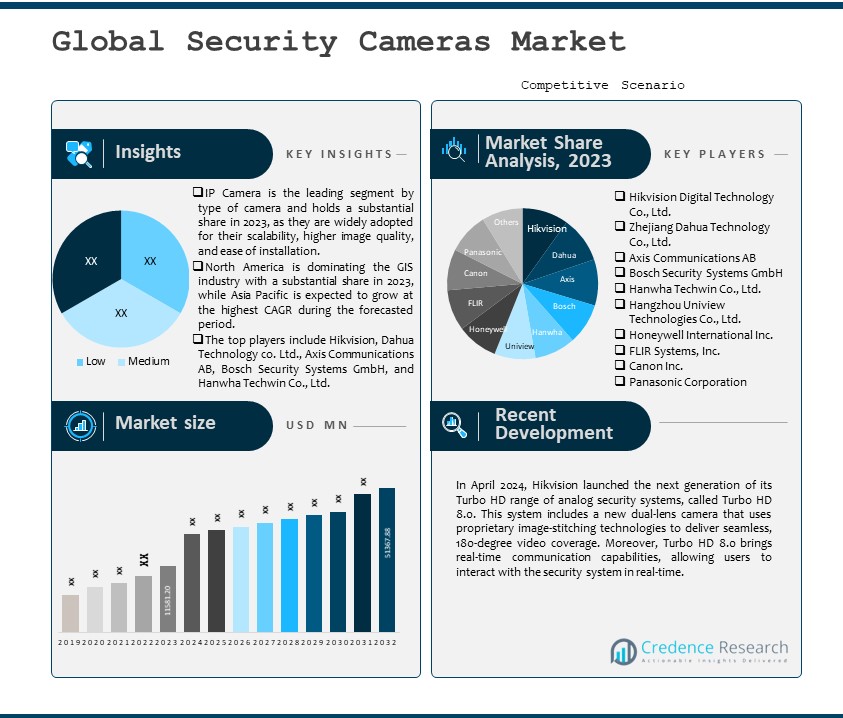
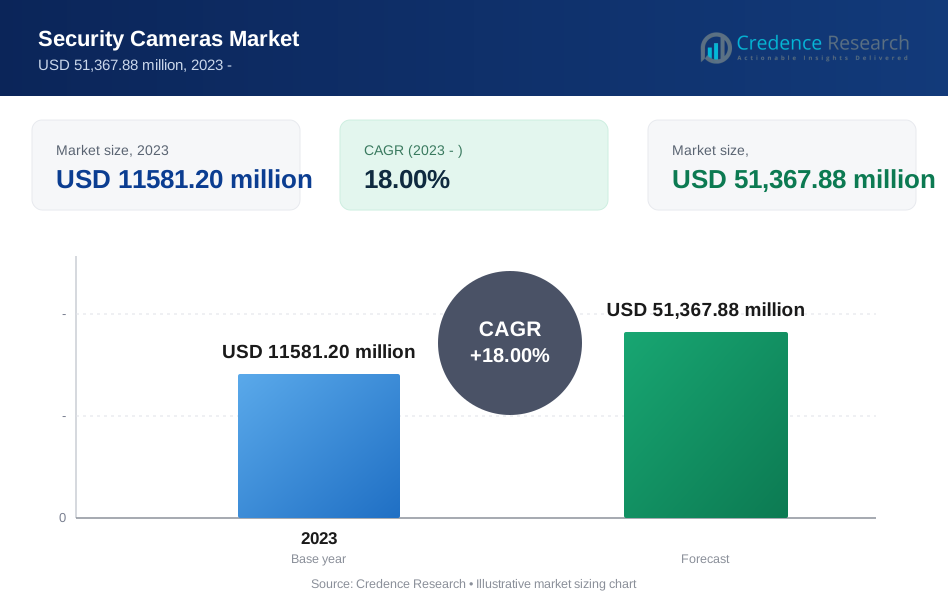
- The global demand for security cameras was valued at USD 11581.20 million in 2023 and is expected to reach USD 51367.88 million in 2032, growing at a CAGR of 18.00% between 2024 and 2032.
- In 2023, the IP camera (network cameras) segment was the market leader by type of camera, accounting for the highest share in value 2023, while the wireless camera segment is expected to grow rapidly throughout the forecast period.
- The HD & Ultra HD (4K) Camera segment is predicted to grow fastest over the projection period, while IP surveillance had the largest technology market share in 2023.
- Over the projection period, residential applications are expected to expand at the fastest rate, and the government & public sector segment will dominate the market share in 2023.
- In terms of specialized features, the night vision segment accounted for the highest share, while the facial recognition segment is anticipated to showcase the highest growth rate.
- The integrated systems segment dominates the security cameras market in terms of integration, accounting for a significant share in 2023, and is predicted to expand at a moderate CAGR.
- North America is dominating the security cameras industry, with over one-third of the market in 2023.
- The market's primary possibilities include significant growth potential driven by several factors, including Advancements such as ultra-high-definition (UHD) cameras, night vision capabilities, motion sensors, and artificial intelligence (AI)-powered analytics are making security cameras more effective and driving market expansion.
Executive Summary
Market Definition
Security Cameras are devices designed to capture and record video footage of specific areas for monitoring, surveillance, and ensuring safety. These cameras can be used in various settings, including residential, commercial, industrial, and public spaces, to deter criminal activity, monitor real-time events, and provide evidence in case of incidents. Security cameras come in different types, such as analog, digital, IP (Internet Protocol), and wireless cameras. They may feature technologies like high-definition imaging, night vision, motion detection, and remote viewing capabilities. They play a crucial role in modern security systems by helping to protect property, assets, and individuals.
Market Overview
The global security cameras market has witnessed steady growth in recent years and is expected to grow at a CAGR of 18.00% between 2024 and 2032. The market was valued at USD 11581.20 million in 2023 and is expected to reach USD 51367.88 million in 2032.
The rising incidences of theft, vandalism, terrorism, and other security-related incidents have heightened the need for effective surveillance systems. This escalating demand for robust security measures has led to the widespread adoption of security cameras to monitor and deter potential threats. Additionally, the rapid pace of urbanization and the expansion of smart cities globally are fueling the deployment of surveillance systems. As urban areas grow, there is a pressing need to monitor infrastructure, ensure public safety, and manage traffic effectively, all of which are facilitated by comprehensive surveillance systems.
Moreover, Innovations such as high-definition (HD) and ultra-high-definition (UHD) cameras, night vision capabilities, motion sensors, and artificial intelligence (AI)-powered analytics have significantly enhanced the efficacy and functionality of security cameras. These technological improvements have made surveillance systems more reliable and efficient, thereby driving their market expansion.
Furthermore, government initiatives and regulations further contribute to the growing use of security camera systems. Governments worldwide are mandating increased surveillance in critical infrastructure facilities, public areas, and transit hubs to ensure safety and security. These regulatory requirements and initiatives are boosting the deployment of security cameras across various sectors. In addition, the increase in residential and commercial construction, particularly in emerging nations, is driving the installation of security cameras. The construction boom has led to a surge in new commercial buildings, which often incorporate advanced security systems, including cameras, to protect assets and ensure safety. This factor is contributing to the sustained growth of the Security Cameras market.
Segmentation by Type of Camera
- IP cameras (network cameras) are the leading segment by type of camera and held the dominant share in value in 2023. IP cameras offer advanced features such as high-resolution video, remote access, and easier integration with other security systems, making them highly popular across various applications. These cameras are particularly favored for their scalability, higher image quality, and ease of installation and maintenance compared to traditional analog systems.
- The wireless camera segment is expected to exhibit the highest CAGR during the forecast period. This growth is driven by the increasing demand for flexible, easy-to-install security solutions without the need for complex wiring. Wireless cameras are particularly appealing for residential and small business applications due to their affordability and convenience. Advances in wireless technology, including improved battery life and enhanced connectivity, further propel the adoption of wireless security cameras.
- Analog Cameras, PTZ Cameras (Pan-Tilt-Zoom Cameras), and the 360-degree Camera segment are anticipated to have a moderate growth rate compared to the wireless camera segment during the forecasted period.
Segmentation by Technology
- IP surveillance held the largest market share within the technology segment in terms of value in 2023. This is due to its advantages over analog systems, such as higher resolution, scalability, and flexibility in installation. It offers enhanced features like remote access, advanced analytics, and integration with other security systems, making it a preferred choice for various applications across commercial, industrial, and residential sectors. The increasing adoption of IoT and smart city projects also drives the demand for IP surveillance systems.
- HD & Ultra HD (4K) cameras are expected to be the fastest-growing segment. This is largely due to the rising demand for high-resolution video quality, which provides better clarity and detail for monitoring and surveillance purposes. These cameras are becoming more affordable, and their ability to deliver superior image quality makes them ideal for critical security applications. The advancements in camera technology, coupled with increasing security concerns, are propelling the rapid adoption of HD and 4K cameras.
- The analog CCTV segment is projected to grow at a moderate CAGR and hold a lower share compared to the HD and Ultra HD (4K) camera segment.
Segmentation by Applications
- The government & public sector segment held the largest market share in terms of value in 2023. This dominance is driven by the extensive use of security cameras for surveillance and monitoring in public spaces, government buildings, and critical infrastructure. Governments globally are investing heavily in surveillance systems to enhance public safety, monitor traffic, and prevent criminal activities. The need for robust security measures in public spaces has led to the widespread adoption of security cameras in this sector.
- The residential segment is anticipated to be the fastest-growing segment in terms of application. The surge in demand for home security solutions is propelled by increasing awareness about personal safety, rising crime rates, and the growing popularity of smart home technologies. Modern residential security cameras come equipped with advanced features like remote monitoring, motion detection, and integration with smart home devices, which appeal to homeowners seeking comprehensive and convenient security solutions.
- The commercial and industrial, education and healthcare, and critical infrastructure segments are anticipated to significantly contribute to the market growth rates during the forecasted period.
Segmentation by Specialized Features
- Night vision held the largest value share in 2023. The demand for night vision cameras is driven by their ability to provide surveillance in low-light conditions, making them highly suitable for both residential and commercial applications. These cameras are essential for 24/7 surveillance, which is crucial for security in various settings, including commercial, government, and public sectors.
- The facial recognition segment is anticipated to register the highest CAGR during the projection period. The rapid adoption of facial recognition technology is due to its advanced security capabilities, which include identifying and verifying individuals based on their facial features. This technology is increasingly being used in government buildings, airports, and other high-security areas to enhance safety and streamline security processes.
- The motion detection and weatherproof & vandal-resistant segment is anticipated to grow at a moderate CAGR and hold a lower share compared to the night vision segments
Segmentation by Integration
- The Integrated Systems held the largest value share in 2023. This is due to their ability to combine various security devices into a single cohesive system, providing enhanced control and comprehensive monitoring solutions. These systems are widely adopted by commercial enterprises, industrial facilities, and government institutions that require robust, all-in-one security solutions to cover extensive areas and complex infrastructures.
- The cloud-based surveillance segment is anticipated to register the highest CAGR during the projection period. The increasing demand for remote access, scalability, and cost-effectiveness drives this growth. Cloud-based solutions allow for easy storage and retrieval of large amounts of video data, along with the flexibility to access footage from anywhere with an internet connection. Additionally, advancements in cloud technology, improved data security, and the convenience of managing and scaling video surveillance systems without significant on-premise infrastructure investments contribute to the rapid growth of this segment.
Segmentation by Region
- North America drove the growth of the security cameras industry in 2023, fueled by the rapid integration of IoT technology within smart homes. Also, the increasing adoption of home automation systems in North America plays a pivotal role in driving the demand for smart home security cameras.
- Asia Pacific is anticipated to showcase the highest growth rate during the forecasted period due to the increasing adoption of digital technologies and the implementation of smart city initiatives.
- The rest of the world, including Latin America, the Middle East, and Africa, supplies the remaining demand for security cameras.
North America is poised to lead the Security camera market over the forecast period, primarily due to the rapid integration of IoT technology within smart homes. This technological shift is steering consumers away from conventional mountable Wi-Fi cameras towards more sophisticated smart home security cameras, aligning with the region's penchant for technological innovation and adoption.
Moreover, the increasing focus on home remodeling projects across North America, coupled with a growing enthusiasm for smart home devices, is creating lucrative prospects in the market. As homeowners in the region invest heavily in upgrading their residences, the demand for technologically advanced security solutions, such as smart home security cameras, is on the rise. Furthermore, the increasing adoption of home automation systems in North America plays a pivotal role in driving the demand for smart home security cameras. Integrated with other smart devices and platforms, these cameras allow for seamless control and monitoring, adding value to the overall smart home experience that is increasingly sought after in the region.
Additionally, the presence of key players in the region contributes significantly to market growth. These companies continually innovate and launch new products and services tailored to the needs of North American consumers. For instance, in April 2021, Ring announced the launch of the Ring Floodlight Cam Wired Pro, its most advanced outdoor security camera equipped with 3D Motion Detection with radar and Bird' s-eye View. This reimagined floodlight builds upon the features of the popular Ring Floodlight Cam, offering homeowners more insight into what’s happening around their property.
On the other hand, the growth of the Security Cameras market in the Asia Pacific region is being driven by the increasing adoption of digital technologies and the implementation of smart city initiatives. These initiatives, exemplified by India’s 100 Smart Cities Mission launched by the government, serve as significant drivers of this growth. As of 7 July 2023, substantial progress has been made, with work orders issued for 7,978 projects across 100 smart cities, 74% of which have been completed. With approximately USD 9000 million invested by the government, representing 90% utilization of funds, this initiative underscores the critical role of sophisticated VSaaS solutions in ensuring efficient urban management and enhanced security.
Additionally, the adoption of advanced technologies such as AI-powered analytics and IoT integration is bolstering the expansion of the video surveillance market in the Asia Pacific region. For instance, in May 2022, Tenda introduced the CP3, an AI-driven smart security camera with advanced features tailored to the needs of the region. This innovation, coupled with the increasing prevalence of cybercrimes, has fostered demand for advanced surveillance systems, encouraging the adoption of cutting-edge technologies like facial recognition and video analytics.
Moreover, the region's robust manufacturing capabilities and the presence of key market players have facilitated the development of innovative solutions, further boosting revenue growth in the Security Cameras market in the Asia Pacific. For instance, in July 2022, Xiaomi launched its new home security camera in India, providing the Indian population with cutting-edge 360° solutions. The Xiaomi 360 Home Security Camera 1080 2i, available online and offline, offers an affordable yet feature-packed option for creating a 24-hour home security system.
Key Highlights of the Report
The global Security Cameras Market is segmented by type of camera, technology, application, specialized features, integration, and region. IP Cameras (Network Cameras) will dominate the market in 2023, holding the largest value share. However, HD & Ultra HD (4K) cameras are expected to see the fastest growth, and the Government & Public Sector remains the primary application, with North America leading the market growth.
The global Security Cameras market is growing rapidly, driven by rapid urbanization and the development of smart cities that necessitate extensive monitoring of infrastructure and public safety. Moreover, increasing security concerns, with rising incidents of theft, vandalism, and terrorism, heighten the need for effective surveillance. Government initiatives and regulations mandating surveillance in critical areas also boost demand. Additionally, the construction boom, particularly in emerging nations, integrates advanced security systems into new commercial buildings, further fueling market growth.
Nonetheless, While North America is expected to hold the largest market share due to the rapid integration of IoT technology within smart homes, Asia Pacific is anticipated to see the fastest growth driven by the increasing adoption of digital technologies and the implementation of smart city initiatives.
What Are The Main Drivers Of The Global Security Cameras Market?
The growth of the Security Cameras market is driven by increasing security concerns, as rising incidents of theft, vandalism, and terrorism heighten the need for surveillance. Additionally, rapid urbanization and the development of smart cities necessitate extensive monitoring of infrastructure and public safety, further increasing the demand for security cameras. Moreover, government initiatives and regulations mandating surveillance in critical areas further boost market growth. Furthermore, the construction boom, especially in emerging nations, fuels market growth by integrating advanced security systems into new commercial buildings.
What are The Major Challenges Faced By The Global Security Cameras Market?
Data privacy and security concerns present formidable obstacles to the expansion of the Security Cameras market. As surveillance systems become more widespread, there is a heightened awareness of the potential risks inherent in the collection, storage, and utilization of video data. Moreover, the substantial implementation and maintenance expenses associated with security cameras serve as additional deterrents to market growth.
What Are The Growth Opportunities In The Global Security Cameras Market?
The integration of edge computing presents a significant opportunity for the Security Cameras market. Processing data closer to cameras reduces latency, enabling real-time analysis for quicker security responses. It optimizes bandwidth by filtering video data locally before transmitting it to the cloud, reducing costs and network strain. Edge computing also enhances data privacy and security by minimizing data transmission, appealing to industries with stringent regulations.
Market Drivers
Several factors drive the global Security Cameras Market. The following are the key drivers of the global Security Cameras Market:
Increasing Urbanization and Development of Smart Cities
As urban areas expand rapidly, there is an increasing need for extensive monitoring of infrastructure and public safety. The influx of people into cities necessitates enhanced surveillance to manage the higher density of population and activities, ensuring the safety and security of both public and private spaces. According to the United Nations, 70% of the world’s population is expected to reside in cities and urban areas by 2050. This demographic shift demands robust security measures to address the challenges of higher population density, increased traffic, and more complex urban infrastructure.
Moreover, smart city initiatives, which integrate advanced technologies to improve city management and quality of life, are particularly influential in this market. These initiatives rely heavily on comprehensive surveillance systems to monitor traffic, manage public services, and enhance emergency response capabilities. Security cameras are crucial in providing real-time data and analytics, which help in making informed decisions for urban planning and management. The deployment of these cameras in smart cities supports various applications such as crime prevention, traffic management, and disaster response, making them indispensable for modern urban environments.
Significant investments by the Chinese government in safe city projects, which focus on city surveillance and traffic monitoring, are anticipated to drive market growth. Since the establishment of the China Smart City Industry Alliance in 2010, China has developed 500 smart cities, leveraging technologies such as artificial intelligence and IoT to enhance urban planning and development. By the end of 2020, the Chinese government developed 100 more smart cities, leading to advanced security infrastructure. These projects highlight the essential role of security cameras in ensuring the safety and efficiency of smart cities.
Market Restraints
The global Security Cameras Market faces some challenges that may hinder its growth. These include the following:
Concerns Associated with Data Privacy and Security
Data privacy and security concerns pose significant challenges to the growth of the Security Cameras market. With the increasing prevalence of surveillance systems, there is a growing awareness of the potential risks associated with the collection, storage, and use of video data. As a result, governments around the world are enacting stricter regulations to protect individuals' privacy rights and ensure the secure handling of sensitive information.
The shift towards remote or cloud-based video storage introduces additional concerns. Unauthorized access to cloud storage servers or data breaches can result in the exposure of sensitive information, leading to legal and reputational consequences for businesses. Moreover, the introduction of privacy protection laws, such as GDPR in Europe and FISMA in the US, underscores the global trend towards stricter data governance. These regulations impose stringent requirements on organizations handling personal data, including video footage captured by security cameras. Non-compliance with these laws can result in hefty fines and penalties, further incentivizing businesses to prioritize data security and privacy. This heightened scrutiny and emphasis on data privacy are projected to restrain the growth of the Security Cameras market as businesses navigate the complex landscape of regulatory compliance and privacy protection.
Opportunities
The global Security Cameras Market offers significant growth opportunities. These include the following:
Integration of Edge Computing
The integration of edge computing presents a significant opportunity for the growth of the Security Cameras market in the future. This approach involves processing data closer to the source, such as cameras, rather than relying solely on centralized cloud servers. By adopting edge computing, security camera systems can capitalize on several advantages that enhance their effectiveness and appeal.
Edge computing reduces latency, enabling real-time processing and analysis of video footage. This is crucial for security applications requiring immediate responses, such as detecting security breaches or unusual activities. By processing data at the edge, surveillance systems can provide faster alerts and enable quicker decision-making, ultimately improving overall security outcomes.
Moreover, edge computing helps optimize bandwidth usage. With the increasing volume of high-definition video data generated by security cameras, transmitting all this data to the cloud can be costly and bandwidth-intensive. Edge computing allows for preliminary processing and filtering of video data locally, ensuring that only relevant information is sent to the cloud for further analysis and storage. This reduces the burden on network infrastructure and lowers associated costs for Security Cameras systems.
Furthermore, edge computing enhances data privacy and security by keeping sensitive data closer to its source. By minimizing the amount of data transmitted over the internet, the risk of interception and unauthorized access is reduced. This is particularly beneficial for industries with stringent data protection requirements, such as healthcare, finance, and government sectors, making Security Cameras solutions more attractive to these markets.
Competitive Landscape
Key Players
The global Security Cameras Market is highly competitive, with several key players. Some of the major players in the market and their market share are as follows:
- Hikvision Digital Technology Co., Ltd.
- Zhejiang Dahua Technology Co., Ltd.
- Axis Communications AB
- Bosch Security Systems GmbH
- Hanwha Techwin Co., Ltd.
- Hangzhou Uniview Technologies Co., Ltd.
- Honeywell International Inc.
- FLIR Systems, Inc.
- Canon Inc.
- Panasonic Corporation
These organizations prioritize product innovation, distribution channel expansion, and mergers and acquisitions to stay competitive.
The global Security Cameras Market's key players continually seek to stay ahead by launching new products.
In April 2024, Hikvision launched the next generation of its Turbo HD range of analog security systems, called Turbo HD 8.0. This system includes a new dual-lens camera that uses proprietary image-stitching technologies to deliver seamless, 180-degree video coverage. Moreover, Turbo HD 8.0 brings real-time communication capabilities, allowing users to interact with the security system in real-time.
In March 2023, Dahua revitalized its low-light product line by launching the first Enhanced Night Color 180° panoramic camera series. These new 4MP dual-sensor cameras utilize Dahua's improved Night Color technology for exceptional low-light performance across the entire product line. Additionally, they boast a unique Electronic Pan Tilt Zoom (EPTZ) capability that can automatically track targets within subsections of the image while still displaying the full 180° field-of-view in the same video stream.
How are Companies Performing in the Security Cameras Market?
The global Security Cameras Market is highly competitive, with several key players.
In the security cameras industry, significant advancements have been made by startups such as Ambient.ai and Deep Sentinel, driving the market with innovative solutions. Ambient.ai has developed a computer vision intelligence platform that transforms enterprise security operations by applying AI and computer vision to existing camera and sensor infrastructure. This platform provides continuous physical security monitoring and automates human resource dispatch, achieving near-human perception and situational context to prevent security incidents proactively. This innovation has attracted substantial investment, reflecting the critical need for advanced physical security solutions in large enterprises and schools.
Similarly, Deep Sentinel offers an AI-driven security camera system for home security, combining AI with human intervention. Their system uses smart cameras to detect unusual activities and alert live security guards who can immediately address potential threats. This hybrid model enhances reliability and effectiveness in crime prevention, offering a proactive and comprehensive home security solution . These innovations are pushing the boundaries of traditional security systems, offering enhanced capabilities and addressing crucial security gaps in both enterprise and residential settings.
Summary of Key Findings
- The global security cameras market is experiencing rapid growth, propelled by rapid urbanization and the development of smart cities, which demand extensive monitoring of infrastructure and public safety. Furthermore, increasing security concerns, with rising incidents of theft, vandalism, and terrorism, amplify the need for effective surveillance. Additionally, the construction boom, particularly in emerging nations, incorporates advanced security systems into new commercial buildings, further fueling market expansion.
- Market segmented type of camera, technology, application, specialized features, integration, and region.
- IP Cameras (Network Cameras) are the most popular, with the government & public sector remaining the primary application segment.
- North America is leading market growth; the market is highly competitive, with key players including Hikvision Digital Technology Co., Ltd., Zhejiang Dahua Technology Co., Ltd., Axis Communications AB, Bosch Security Systems GmbH, Hanwha Techwin Co., Ltd., Hangzhou Uniview Technologies Co., Ltd., Honeywell International Inc., FLIR Systems, Inc., Canon Inc., and Panasonic Corporation.
Future Outlook
- Positive outlook for the global security cameras market with significant growth potential in the North American region.
- The key drivers accelerating the growth of the Security Cameras Market include rapid urbanization and the development of smart cities, the growth of the construction industry, and government initiatives and regulations requiring surveillance in critical areas.
- During the forecast period, the concerns associated with data privacy and security are expected to significantly restrain the growth of the Security Cameras Market.
- Key firms must focus on product innovation, growing market reach, and maintaining competitive pricing to keep ahead of the competition.
How CXOs Can Benefit from the Credence Research Security Cameras Market Report
The Credence Research Security Cameras Market Report provides CXOs with a comprehensive overview of the market, including:
- Market size and growth forecast: The report provides detailed estimates of the global security cameras market size, segmented by type of camera, technology, application, specialized features, integration, and region. It also includes forecasts for the market through 2032 based on key trends and drivers.
- Market segmentation: The report segments the security cameras market by type of camera, technology, application, specialized features, integration, and region. This segmentation provides CXOs with a granular understanding of the market and the opportunities in each segment.
- Competitive Landscape: The report profiles the key players in the security cameras market and provides insights into their strategies, product offerings, and financial performance. This information can help CXOs to identify and assess their competition.
- Key trends and drivers: The report identifies and analyzes the key trends and drivers shaping the security cameras market. This information can help CXOs make informed decisions about their investments and strategies.
CXOs can use the insights from the Credence Research Security Cameras Market Report to:
- Identify growth opportunities: The report can help CXOs identify new growth opportunities in the security cameras market. For example, it identifies the growing demand for security cameras integrated with artificial intelligence (AI) and video analytics. This trend is being driven by the increasing need for more intelligent and automated security systems that can not only deter crime but also provide real-time actionable insights.
- Make informed investment decisions: The report can help CXOs make informed investment decisions about security cameras. For example, it provides insights into the key factors to consider when evaluating security camera providers.
- Develop competitive strategies: The report can help CXOs develop competitive strategies for their security camera businesses. For example, it identifies the key strategies that security camera providers are using to differentiate themselves from their competitors.
- Track market developments: The report can help CXOs monitor market developments and stay ahead of the curve. For example, it provides insights into the latest trends and innovations in the Security Cameras Market.
Overall, the Credence Research Security Cameras Market Report is a valuable resource for CXOs who are looking to gain a deeper understanding of the market and identify opportunities for growth.
Segmentation
- By Type of Camera
- Analog Cameras
- IP Cameras (Network Cameras)
- Wireless Cameras
- PTZ Cameras (Pan-Tilt-Zoom Cameras)
- 360-Degree Cameras
- By Technology
- Analog CCTV
- IP Surveillance
- HD & Ultra HD (4K) Cameras
- By Application
- Commercial & Industrial
- Residential
- Government & Public Sector
- Education & Healthcare
- Critical Infrastructure
- By Specialized Features
- Night Vision
- Motion Detection
- Facial Recognition
- Weatherproof & Vandal-Resistant
- By Integration
- Integrated Systems
- Cloud-Based Surveillance
- By Region
- North America
- The U.S.
- Canada
- Mexico
- Europe
- Germany
- France
- The U.K.
- Italy
- Spain
- Rest of Europe
- Asia Pacific
- China
- Japan
- India
- South Korea
- South-east Asia
- Rest of Asia Pacific
- Latin America
- Brazil
- Argentina
- Rest of Latin America
- Middle East & Africa
- GCC Countries
- South Africa
- Rest of the Middle East and Africa
- North America
Adjacent Markets
In the Security Cameras Market, several adjacent markets have high revenue growth opportunities. The key adjacent markets for security cameras market-
Adjacent Markets |
||
| Video Management Systems (VMS) Market | Video Analytics Software Market | Access Control Systems Market |
| Intruder Detection Systems Market | Fire Alarm Systems Market | Smart Home Security Systems Market |
| Cloud-Based Security Solutions Market | Physical Security Services Market | Body Worn Cameras Market |
Request a Free Sample
Fill in your details and we'll send you a free sample report.
- Sample data tables & charts
- Research methodology
Need a Custom Version of This Report?
Tailor the scope, geography, or segments to your exact requirements.
- Custom geography or segment scope
- Direct access to our analyst team
Frequently Asked Questions
What is the current size of the global security cameras market?
What is the expected growth rate of the security cameras market between 2024 and 2032?
Which segment is leading the market share in terms of Type of Camera?
Which technology governs the demand for security cameras globally?
Which Application is expected to post the highest CAGR during the forecast period?
Which region is fueling the growth of the security cameras industry?
Who are the major players in the global Security Cameras Market?
What are the major market drivers of the security cameras industry?
What are the major market restraints of the security cameras industry?
What are the major market opportunities of the security cameras industry?
Table of Content
Chapter 1. Report Introduction
- 1.1 Report Description & Purpose
- 1.1.1 Report Title & Market Definition
- 1.1.2 Unique Selling Propositions (USP) & Key Differentiators
- 1.1.3 Value Proposition for Stakeholders
- 1.2 Research Objectives
- 1.2.1 Market Sizing Objectives (Volume & Revenue)
- 1.2.2 Segmentation Objectives
- 1.2.3 Competitive Intelligence Objectives
- 1.2.4 Forecast & Scenario Objectives
- 1.3 Report Scope
- 1.3.1 Security Cameras Scope – Types & Subtypes Covered
- 1.3.2 Geographic Scope – Regions & Countries Covered
- 1.3.3 Historical Period, Base Year & Forecast Period (2023; forecast to the forecast period)
- 1.3.4 Inclusions & Exclusions
- 1.4 HS Code & Classification Framework
- 1.5 Currency, Units & Pricing Basis
- 1.6 Target Stakeholders
- 1.7 Limitations & Assumptions
Chapter 2. Executive Summary
- 2.1 Global Security Cameras Market Snapshot
- 2.1.1 Market Size – Historical (2023) & Forecast (the forecast period) (2023: USD 11581.20 million → forecast year: USD 51,367.88 million)
- 2.1.2 Volume & Revenue – Global Totals
- 2.1.3 Key Market Highlights – Top Five Facts
- 2.2 Security Cameras Market Segmentation Snapshot
- 2.2.1 Market Split by Region – 2023 vs.
- 2.3 Competitive Snapshot
- 2.3.1 Top 10 Players by Revenue Share – 2023
- 2.3.2 Top 10 Players by Volume Share – 2023
- 2.3.3 Recent Strategic Developments (18-Month Summary)
- 2.4 Key Investment Highlights & Strategic Conclusions
Chapter 3. Security Cameras Market Dynamics & Industry Analysis
- 3.1 Market Overview & Context
- 3.1.1 Security Cameras Market Position in the Broader Automotive Value Chain
- 3.1.2 OEM vs. Replacement Market Dynamics
- 3.1.3 Market Maturity & Development Stage by Region
- 3.2 Security Cameras Market Drivers
- 3.3 Security Cameras Market Restraints & Challenges
- 3.4 Security Cameras Market Opportunities
- 3.5 Porter's Five Forces Analysis
- 3.5.1 Threat of New Entrants
- 3.5.2 Bargaining Power of Suppliers
- 3.5.3 Bargaining Power of Buyers
- 3.5.4 Threat of Substitutes
- 3.5.5 Competitive Rivalry – Intensity Assessment
- 3.6 Security Cameras Value Chain Analysis
- 3.6.1 Upstream – Raw Material/Input Suppliers
- 3.6.1.1 Raw Material/Input 1
- 3.6.1.2 Raw Material/Input 2
- 3.6.1.3 Raw Material/Input 3
- 3.6.2 Midstream – Production/Manufacturing/Service Delivery
- 3.6.2.1 Production/Process Overview
- 3.6.2.2 Key Facility Locations & Capacity by Manufacturer
- 3.6.3 Downstream – Distribution & End Consumer
- 3.6.3.1 Primary Channel – B2B/OEM
- 3.6.3.2 Secondary Channels – Dealer, Retail, Online, Direct
- 3.6.4 Value Chain Profitability Analysis
- 3.6.1 Upstream – Raw Material/Input Suppliers
- 3.7 PESTEL Analysis
- 3.7.1 Political Factors
- 3.7.2 Economic Factors
- 3.7.3 Social Factors
- 3.7.4 Technological Factors
- 3.7.5 Environmental Factors
- 3.7.6 Legal Factors
- 3.8 Security Cameras Supply Chain Analysis
- 3.8.1 Raw Material/Input Supply Risk Assessment
- 3.8.2 Manufacturing Concentration Risk (Geographic Exposure)
- 3.8.3 Trade Disruption Impact Analysis
- 3.9 Regulatory & Policy Landscape
Note: The regulatory and policy landscape section covers regulations based on their applicability to the market, Security Cameras category, geography, and scope of the study. Only regulatory frameworks with a material impact on operations, compliance, trade, sustainability, or market access are analyzed in detail.
Chapter 4. Key Investment Pockets & Opportunity Analysis
- 4.1 Security Cameras Market Attractiveness Analysis
- 4.1.1 By Region – Investment Attractiveness Matrix (Volume × CAGR)
- 4.2 Absolute Revenue Growth Opportunity
- 4.2.1 By Region – Absolute USD Growth Through the forecast period
- 4.3 Incremental Volume Opportunity
- 4.3.1 By Region – Incremental Volume Through the forecast period
- 4.3.2 Segment – Incremental Volume
- 4.4 Emerging Submarket Opportunity Deep Dive (Subject to Applicability)
- 4.5 Emerging Market Opportunity Scorecards
- 4.5.1 United States
- 4.5.2 Europe
- 4.5.3 Asia
- 4.5.4 Middle East & Africa
Note: Emerging Market Opportunity Scorecards will be included based on relevance and strategic importance. Regions listed are indicative and may vary depending on data availability and market dynamics.
Chapter 5. Security Cameras Import-Export Analysis & Trade Flows
- 5.1 Global Trade Overview
- 5.1.1 Global Export Value by Country (2023)
- 5.1.2 Global Export Volume by Country (2023)
- 5.1.3 Global Import Value by Country (2023)
- 5.1.4 Global Import Volume by Country (2023)
- 5.1.5 Net Trade Balance by Country (2023)
- 5.2 Export Analysis – Segment
- 5.2.1 Type 1 (HS Code)
- 5.2.2 Type 2 (HS Code)
- 5.2.3 Type 3 (HS Code)
- 5.2.4 Type 4 (HS Code)
- 5.2.5 Type 5 (HS Code)
- 5.3 Import Analysis – Segment
- 5.3.1 Type 1 (HS Code)
- 5.3.2 Type 2 (HS Code)
- 5.3.3 Type 3 (HS Code)
- 5.3.4 Type 4 (HS Code)
- 5.3.5 Type 5 (HS Code)
- 5.4 Average Unit Trade Prices
- 5.4.1 Average Export Price – Segment & Country
- 5.4.2 Average Import Price – Segment & Source Country
- 5.4.3 Price Trends (2023)
- 5.5 Key Trade Route Analysis
- 5.5.1 Trade Route 1
- 5.5.2 Trade Route 2
- 5.5.3 Trade Route 3
- 5.5.4 Trade Route 4
- 5.5.5 Trade Route 5
- 5.6 Trade Policy Impact Assessment
- 5.6.1 US Anti-Dumping & Section 301 Tariffs
- 5.6.2 EU Customs Union Impact
- 5.6.3 Major Free Trade Agreements
- 5.6.4 USMCA Rules of Origin
Note: Trade policy analysis will be included only where relevant to the Security Cameras market.
Chapter 6. Competitive Landscape & Company Benchmarking
- 6.1 Security Cameras Market Concentration & Structure
- 6.1.1 Herfindahl-Hirschman Index (HHI) – vs. 2023
- 6.1.2 Tier 1, Tier 2 & Tier 3 Market Structure
- 6.1.3 Global, Regional & Local Player Dynamics
- 6.2 Security Cameras Market Share Analysis – 2023
- 6.2.1 Global Revenue Share by Company
- 6.2.2 Global Volume Share by Company
- 6.2.3 Regional Revenue Share
- 6.2.4 Market Share Evolution ( vs. 2023)
- 6.2.5 OEM Segment Share by Company
- 6.2.6 Replacement Segment Share by Company
- 6.3 Production/Delivery Capacity & Facility Analysis
- 6.3.1 Global Installed Capacity
- 6.3.2 Capacity Utilization Rates
- 6.3.3 Production/Output Volume
- 6.3.4 Facility Locations & Capacity Map
- 6.3.5 Planned Capacity Additions
- 6.4 Security Cameras Competitive Benchmarking Matrix
- 6.4.1 Revenue, Volume, CAGR & Profitability Comparison
- 6.4.2 Channel Revenue Mix
- 6.4.3 Geographic Revenue Exposure
- 6.4.4 R&D Intensity
- 6.4.5 Sustainability Maturity
- 6.5 Strategic Developments in Security Cameras (Last 24 Months)
- 6.5.1 Mergers, Acquisitions & Divestments
- 6.5.2 New Security Cameras Launches
- 6.5.3 Facility Expansions
- 6.5.4 Strategic Alliances, Joint Ventures & Partnerships
- 6.5.5 Distribution Expansion & Market Entry
- 6.5.6 Sustainability & ESG Initiatives
- 6.6 Competitive Strategy Mapping
- 6.6.1 Leader, Challenger, Follower & Niche Classification
- 6.6.2 Pricing Strategy Comparison
- 6.6.3 Channel Strategy Matrix
Note: Strategic developments are included based on their materiality and the availability of reliable information.
Chapter 7. Global Security Cameras Market – By Distribution Channel
- 7.1 Segment Overview
- 7.1.1 Volume & Revenue Split by Channel (2023 & )
- 7.1.2 Channel Mix Evolution (the forecast period)
Chapter 8. Regional Market Analysis – Global Overview
- 8.1 Global Regional Overview
- 8.1.1 Regional Volume Share
- 8.1.2 Regional Revenue Share
- 8.1.3 Regional Volume by Region
- 8.1.4 Regional Revenue by Region
- 8.1.5 Regional Forecast Through the forecast period
- 8.2 Cross-Regional Segment Analysis
- 8.2.1 By Distribution Channel
- 8.2.2 By Brand/Price Tier
Chapter 9. North America Security Cameras Market
- 9.1 United States
- 9.2 Canada
- 9.3 Mexico
Chapter 10. Europe Security Cameras Market
- 10.1 Germany
- 10.2 France
- 10.3 Italy
- 10.4 United Kingdom
- 10.5 Spain
- 10.6 Poland
- 10.7 Russia
- 10.8 Netherlands
- 10.9 Belgium
- 10.10 Sweden
- 10.11 Denmark
- 10.12 Norway
- 10.13 Rest of Europe
Chapter 11. Asia Pacific Security Cameras Market
- 11.1 China
- 11.2 India
- 11.3 Japan
- 11.4 South Korea
- 11.5 Thailand
- 11.6 Indonesia
- 11.7 Vietnam
- 11.8 Malaysia
- 11.9 Australia
- 11.10 Rest of Asia Pacific
Chapter 12. Latin America Security Cameras Market
- 12.1 Brazil
- 12.2 Argentina
- 12.3 Colombia
- 12.4 Chile
- 12.5 Rest of Latin America
Chapter 13. Middle East Security Cameras Market
- 13.1 Saudi Arabia
- 13.2 United Arab Emirates
- 13.3 Turkey
- 13.4 Israel
- 13.5 Iran
- 13.6 Rest of the Middle East
Chapter 14. Africa Security Cameras Market
- 14.1 South Africa
- 14.2 Egypt
- 14.3 Nigeria
- 14.4 Morocco
- 14.5 Rest of Africa
Chapter 15. Security Cameras Company Profiles
- 15.1 [Company 01]
- 15.1.1 Company Overview
- 15.1.2 Key Management Personnel
- 15.1.3 Products & Services Portfolio
- 15.1.4 Financial Performance
- 15.1.5 Key Market Focus & Geographic Presence
- 15.1.6 Recent Developments & Strategic Initiatives
Note: The company profile list is preliminary and may change based on research findings, market developments, data availability, and client requirements.
Chapter 16. Appendices
- Appendix A – List of Abbreviations & Acronyms
- Appendix B – Industry Classification Code Reference – Full Series
- Appendix C – Production & Capacity Data Tables
- Appendix D – End-Use & Demand Base Tables
- Appendix E – Consumption & Replacement Rate Assumptions
- Appendix F – ASP Reference Tables
- Appendix G – Manufacturing & Facility Database
- Appendix H – Import-Export Data Tables
- Appendix I – Regulatory Summary Tables
- Appendix J – Primary Research Participant List (Anonymized)
- Appendix K – Primary Research Questionnaire Framework
- Appendix L – Data Sources & Bibliography
- Appendix M – Market Size Divergence & Source Comparison
Chapter 17. Research Methodology
- 17.1 Research Framework & Philosophy
- 17.2 Secondary Research – Sources, Hierarchy & Data Extraction
- 17.3 Data Modeling – Bottom-Up & Top-Down Market Sizing
- 17.4 Primary Research – Stakeholder Framework, LOI & Sample Sizes
- 17.5 Forecast Methodology – Regression, Scenario & Sensitivity Analysis
- 17.6 Quality Control – Four-Layer Validation Framework
- 17.7 Limitations & Standard Assumptions
- 17.8 Disclaimer
