
Market Overview
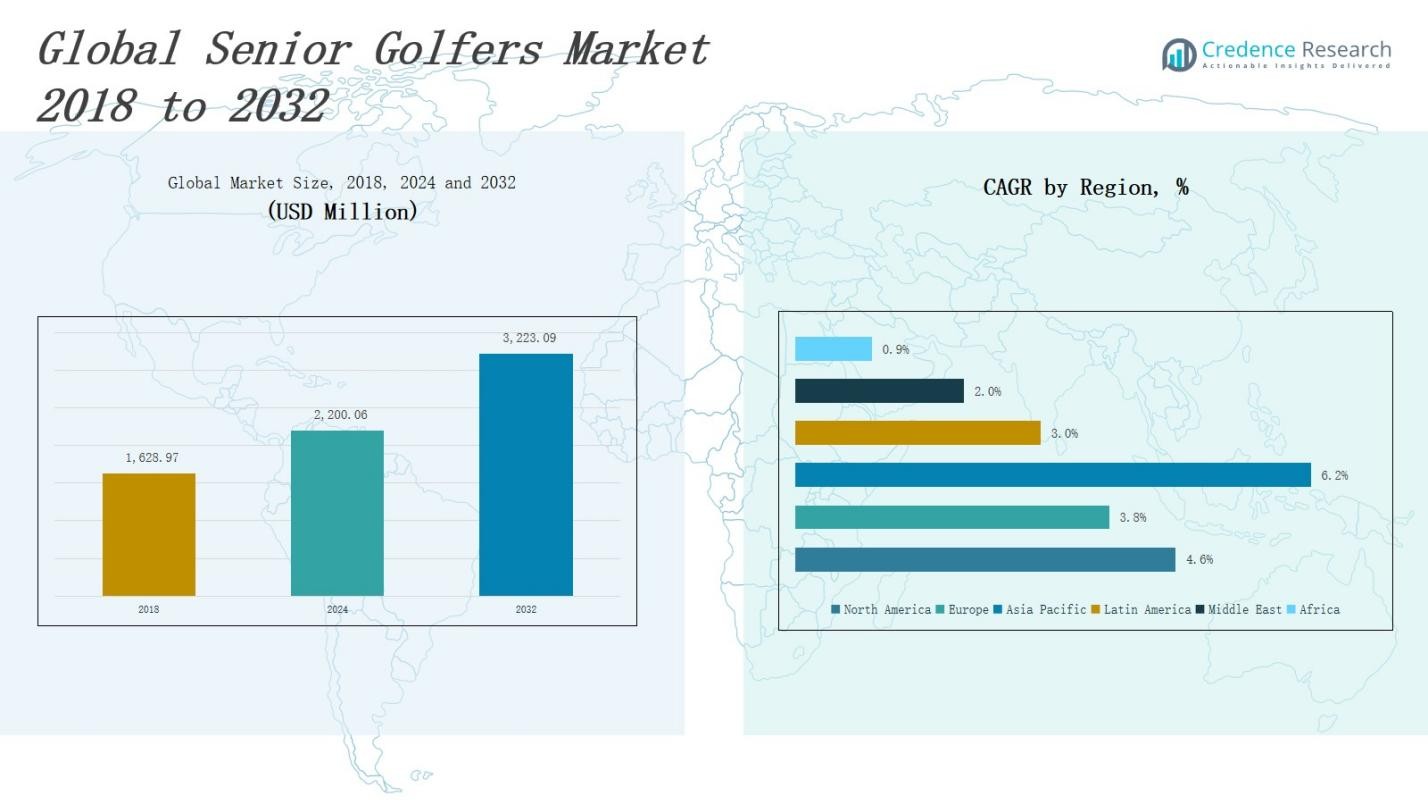
The Senior Golfers Market was valued at USD 1,628.97 million in 2018 and grew to USD 2,200.06 million in 2024. It is projected to reach USD 3,223.09 million by 2032, registering a compound annual growth rate (CAGR) of 4.55% during the forecast period.
| REPORT ATTRIBUTE | DETAILS |
|---|---|
| Historical Period | 2020-2024 |
| Base Year | 2024 |
| Forecast Period | 2025-2032 |
| Senior Golfers Market Size 2024 | USD 2,200.06 Million |
| Senior Golfers Market, CAGR | 4.55% |
| Senior Golfers Market Size 2032 | USD 3,223.09 Million |
The Senior Golfers Market features key players such as Callaway Golf Company, TaylorMade Golf Company, Acushnet Holdings Corp., PING, and Cobra Golf, which dominate product innovation and brand loyalty in this segment. These companies focus on designing equipment and apparel tailored to the specific needs of senior golfers, including lightweight clubs and ergonomic designs. North America leads the market, commanding a 42.7% share due to its large aging population, well-established golf culture, and extensive network of senior-focused golf facilities and tournaments. The region’s strong consumer spending power and growing health awareness further reinforce its dominant position.
Market Insights
- The Senior Golfers Market grew from USD 1,628.97 million in 2018 to USD 2,200.06 million in 2024 and is projected to reach USD 3,223.09 million by 2032, registering a CAGR of 4.55% during the forecast period.
- Leading players such as Callaway Golf Company, TaylorMade Golf Company, Acushnet Holdings Corp., PING, and Cobra Golf drive innovation by designing lightweight clubs and ergonomic apparel tailored for senior golfers. North America holds a 42.7% market share, supported by its large aging population and well-established golf culture.
- The aging population and rising health awareness fuel market growth, as more seniors adopt golf for physical activity and social engagement, increasing demand for comfort-focused equipment and apparel. Technological advancements and senior-specific golf programs further enhance participation and product adoption.
- E-commerce growth and digital marketing create opportunities by expanding access and engagement among seniors, while rising demand for customized and personalized golf equipment and apparel strengthens brand loyalty and repeat purchases.
- Challenges include the high cost of premium equipment limiting affordability, physical limitations among seniors affecting participation, and seasonal and regional variability impacting consistent demand across markets.
Market Segmentation Analysis:
By Product Type:
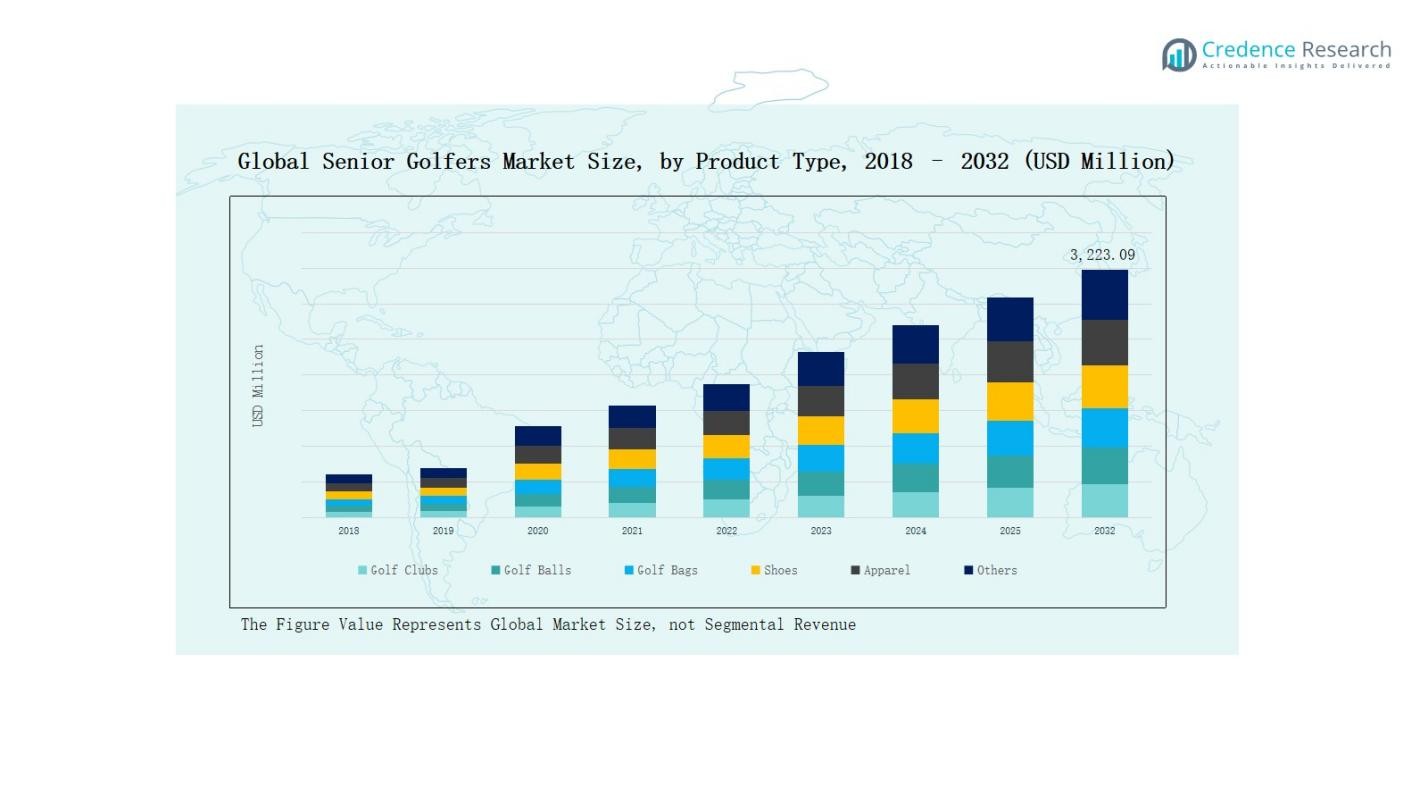
Golf clubs dominate the Senior Golfers Market by product type, accounting for the largest share due to their critical role in game performance and the increasing demand for senior-friendly, lightweight, and technologically advanced club designs. Golf balls follow closely, driven by innovations targeting enhanced control and distance tailored to seniors’ swing speeds. Golf bags, shoes, and apparel hold smaller but growing shares as seniors seek comfort, functionality, and style. The rise in senior participation and focus on customized equipment support growth across all product categories.
- For instance, FootJoy’s Quantum shoe integrates Ortholite Impression FitBed and SofFoam heel technology, earning praise for exceptional “cloud-like” comfort and customized fit during extended rounds-qualities especially appreciated by seniors.
By Age Group:
The 60-69 years age group leads the market with the highest share, reflecting this cohort’s active lifestyle and disposable income to invest in golf-related products. The 50-59 years group shows steady growth, fueled by early retirees and health-conscious individuals adopting golf for leisure and fitness. The 70+ segment, while smaller, is expanding due to improved healthcare and longer life expectancy, encouraging ongoing engagement in golf activities. Tailored products and services targeting these age brackets drive segment growth.
- For instance, the Callaway Strata 14-piece golf set, which comes equipped with lightweight graphite shafts and forgiving club heads, is recommended for senior golfers-particularly those 70 and above-looking for easy launch and improved control to stay engaged in the game as they age.
By Distribution Channel:
Sports retail stores hold the dominant share in the distribution channel segment, benefiting from wide product assortments, expert staff, and hands-on purchase experiences preferred by senior golfers. Online stores are rapidly growing, propelled by convenience, competitive pricing, and expanded product variety. Golf academies and pro shops contribute niche value by offering specialized products and personalized fittings. Specialty stores and other channels maintain modest shares but provide targeted options, supporting overall market accessibility and growth.
Key Growth Drivers
Aging Population and Rising Health Awareness
The expanding global aging population significantly drives the Senior Golfers Market, as more individuals aged 50 and above adopt golf for physical activity and social engagement. Growing health awareness encourages seniors to pursue low-impact sports that improve fitness and mental well-being. This demographic shift creates increased demand for senior-specific golf equipment and apparel designed for comfort and ease of use. Market players capitalize on these trends by developing tailored products that meet the unique needs of aging golfers, fueling sustained market growth.
- For instance, PING released its G Le3 range in 2023, featuring clubs designed with lighter shafts and softer grips to enhance comfort and ease of use for older golfers, addressing common needs like reduced hand strength and slower swing speeds.
Technological Advancements in Golf Equipment
Technological innovations in golf clubs, balls, and accessories enhance performance and accessibility for senior golfers. Lightweight materials, improved club designs, and customized fittings help accommodate seniors’ reduced swing speeds and physical limitations. Smart devices and performance tracking technologies integrate seamlessly with traditional equipment, attracting tech-savvy seniors. These advancements increase product appeal, driving adoption and encouraging repeat purchases. Manufacturers focusing on R&D to innovate senior-friendly equipment reinforce market expansion.
- For instance, the Cleveland Launcher XL Lite driver incorporates high-launch technology and super-light construction, specifically addressing the needs of golfers with joint sensitivities and decreasing strength, making it easier to regain distance and control as physical abilities change with age.
Expansion of Golf Facilities and Senior Programs
The rise in golf facilities offering senior-specific programs and memberships supports market growth by increasing participation rates. Golf courses and clubs invest in tailored coaching, tournaments, and social events targeting senior players, fostering community engagement. This environment motivates seniors to purchase specialized equipment and apparel, boosting market demand. Collaboration between golf facility operators and manufacturers further stimulates product development and targeted marketing efforts, reinforcing market momentum.
Key Trends & Opportunities
Growth of E-Commerce and Digital Marketing
The increasing shift toward online shopping offers significant opportunities for the Senior Golfers Market. E-commerce platforms provide seniors with easy access to a wide range of products, competitive pricing, and home delivery. Digital marketing strategies, including social media and influencer partnerships, enhance brand visibility and engagement with senior consumers. Personalized online experiences and virtual fitting tools further encourage sales. Market players leveraging digital channels can expand reach, increase customer loyalty, and capture emerging consumer segments.
- For instance, TCS’s digital solutions, such as the TCS Omnistore™, have helped companies like Kingfisher streamline and enhance the online shopping and checkout experience, making it more efficient and user-friendly for diverse customer segments, including seniors.
Rising Demand for Customization and Personalization
Senior golfers increasingly seek customized equipment and apparel that match their physical abilities and style preferences. Personalization options, including custom club fitting, tailored shoe sizing, and bespoke apparel, improve comfort and performance. This trend presents growth opportunities for manufacturers and retailers who offer bespoke services and product lines. Enhanced customer satisfaction from personalized solutions drives repeat purchases and brand differentiation, strengthening competitive advantage within the market.
- For instance, CaddieWheel.com has developed an electric power-assist wheel that can be attached to existing push carts, enabling senior golfers to conserve energy by reducing physical strain on hilly courses, thus maintaining endurance and focus throughout their game.
Key Challenges
High Cost of Premium Senior Golf Equipment
The relatively high prices of technologically advanced and customized senior golf products pose a challenge for market growth, particularly in price-sensitive regions. Many seniors operate on fixed incomes, limiting their purchasing power for premium equipment and accessories. This cost barrier restricts broader market penetration and may lead some consumers to opt for lower-priced or second-hand products. Companies must balance innovation with affordability to expand their customer base while maintaining profitability.
Physical Limitations and Health Issues Among Seniors
Despite growing interest, some seniors face physical challenges such as arthritis, reduced mobility, and chronic conditions that limit golf participation. These health issues reduce the frequency and intensity of play, constraining demand for golf-related products. Manufacturers and service providers must innovate to create equipment and programs accommodating diverse health conditions. Failure to address these limitations may restrict market growth and exclude a significant portion of the senior demographic.
Seasonal and Regional Variability in Golf Participation
Golf participation among seniors fluctuates based on seasonal weather conditions and regional preferences, impacting consistent demand for products. Markets in colder climates experience lower year-round activity, limiting sales opportunities. Additionally, cultural differences influence golf’s popularity and accessibility across regions. Manufacturers and retailers must adapt strategies to address these variabilities, including offering seasonal promotions, indoor training solutions, or targeting emerging markets with favorable climates. Managing these factors is crucial to sustaining growth.
Regional Analysis
North America
North America holds the largest market share in the Senior Golfers Market, supported by a valuation of USD 949.76 million in 2024 and a projected growth to USD 1,395.27 million by 2032. The region’s CAGR stands at 4.6%, reflecting steady expansion driven by a large aging population, high disposable incomes, and well-established golf infrastructure. Extensive golf facilities and senior-focused programs contribute to sustained demand for specialized equipment and apparel. The region’s strong health awareness and active lifestyle culture among seniors reinforce its leadership position in the market.
Europe
Europe ranks as the second-largest market for senior golfers, with market value reaching USD 618.23 million in 2024 and expected to grow to USD 854.14 million by 2032 at a CAGR of 3.8%. The region benefits from a mature golf ecosystem and increasing participation among the aging population. Rising investments in golf course modernization and senior-targeted events stimulate demand for tailored golf products. Economic stability and growing health consciousness among seniors support gradual market growth, while variations in golf popularity across countries present opportunities for targeted regional strategies.
Asia Pacific
Asia Pacific exhibits the highest growth rate in the Senior Golfers Market, with a CAGR of 6.2%. The market value is projected to increase from USD 447.42 million in 2024 to USD 744.56 million by 2032. Rapid urbanization, expanding middle-class populations, and increasing health awareness among seniors drive market expansion. Growing golf infrastructure and rising disposable incomes in countries like China and India boost participation. The region presents significant opportunities for market players to introduce affordable and customized senior golf products to capture this emerging demand.
Latin America
Latin America’s Senior Golfers Market demonstrates moderate growth, with a CAGR of 3.0%, reaching USD 102.86 million in 2024 and forecasted to rise to USD 133.41 million by 2032. Market expansion is supported by increasing golf awareness and growing senior populations in key countries such as Brazil and Mexico. However, limited golf infrastructure and economic challenges constrain rapid growth. Efforts to develop golf facilities and promote senior participation could accelerate demand for specialized golf equipment and apparel, creating new growth avenues in the region.
Middle East
The Middle East holds a smaller share of the Senior Golfers Market, valued at USD 50.22 million in 2024 and expected to reach USD 60.68 million by 2032, with a CAGR of 2.0%. Growth is restrained by limited senior golf culture and lower participation rates. Nevertheless, rising investments in luxury golf resorts and increasing interest in sports tourism offer opportunities to boost market demand. Focused marketing and development of senior-friendly golf programs can help capture emerging opportunities in this region.
Africa
Africa represents the smallest share in the Senior Golfers Market, with a market size of USD 31.56 million in 2024 and projected growth to USD 35.02 million by 2032 at a CAGR of 0.9%. The market remains nascent due to limited golf infrastructure, economic constraints, and low senior population engagement in golf activities. However, growing urbanization and investment in recreational facilities may gradually improve participation. Expanding awareness and accessibility of senior golf products could stimulate market development over the long term.
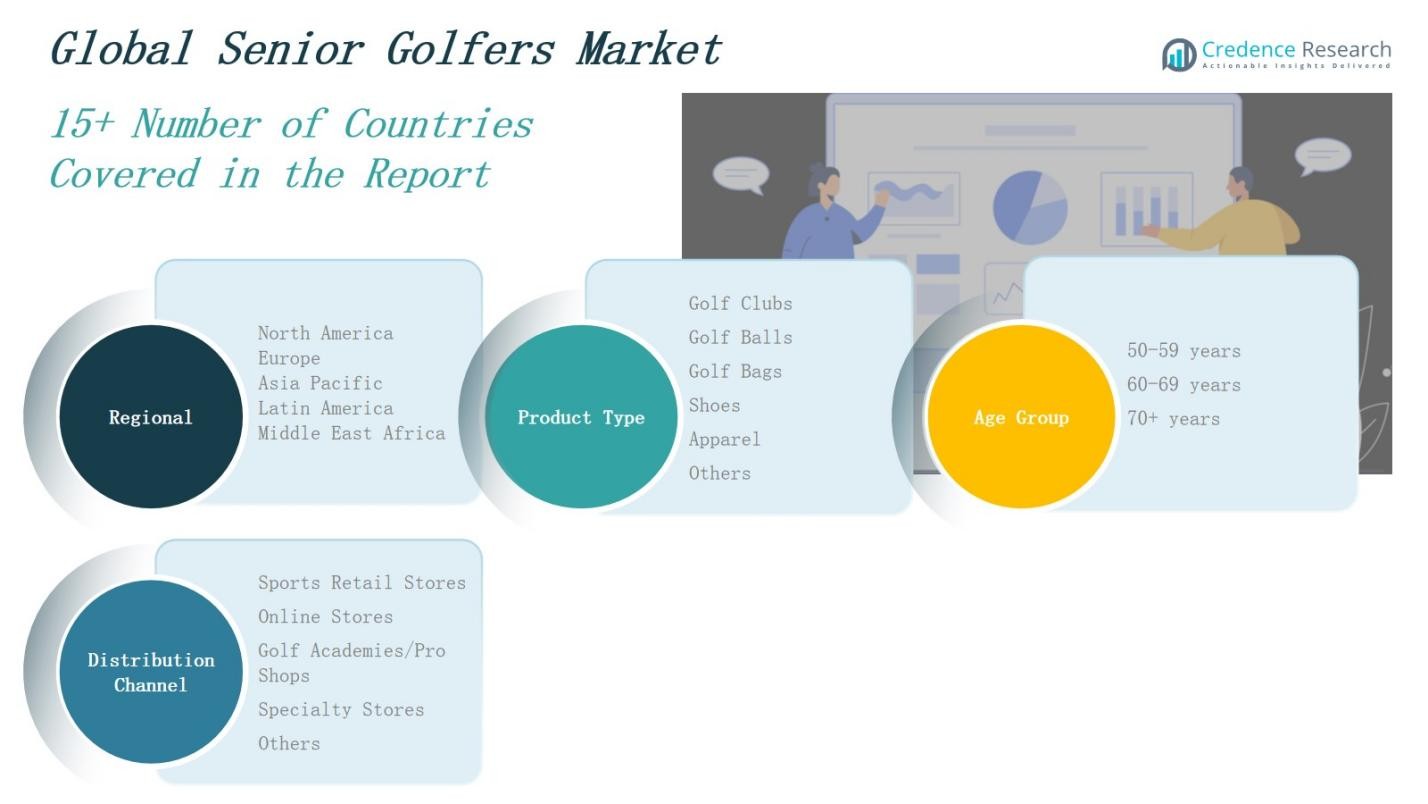
Market Segmentations
By Product Type:
- Golf Clubs
- Golf Balls
- Golf Bags
- Shoes
- Apparel
- Others
By Age Group:
- 50-59 years
- 60-69 years
- 70+ years
By Distribution Channel:
- Sports Retail Stores
- Online Stores
- Golf Academies/Pro Shops
- Specialty Stores
- Others
By Region:
- North America
- U.S.
- Canada
- Mexico
- Europe
- Germany
- France
- U.K.
- Italy
- Spain
- Rest of Europe
- Asia Pacific
- China
- Japan
- India
- South Korea
- South-east Asia
- Rest of Asia Pacific
- Latin America
- Brazil
- Argentina
- Rest of Latin America
- Middle East & Africa
- GCC Countries
- South Africa
- Rest of the Middle East and Africa
Competitive Landscape
The Senior Golfers Market features a competitive landscape dominated by established global brands such as Callaway Golf Company, TaylorMade Golf Company, Acushnet Holdings Corp., PING, and Cobra Golf. These companies invest heavily in research and development to create senior-specific golf equipment and apparel that address the unique needs of aging golfers, including lightweight clubs, ergonomic designs, and performance-enhancing technologies. Strategic collaborations with golf courses and senior-focused events strengthen brand visibility and consumer loyalty. Additionally, the rise of niche players offering customized and personalized products intensifies competition by catering to specific senior preferences. Market entrants emphasize digital marketing and e-commerce expansion to capture the growing online senior consumer base. Price competitiveness, innovation, and after-sales services remain critical factors shaping market dynamics. Overall, the competitive environment encourages continuous product improvements and diversified offerings, driving the market’s growth and enabling companies to capture a larger share of the expanding senior golfer demographic.
Key Player Analysis
- Callaway Golf
- TaylorMade Golf
- PING
- Titleist
- Wilson Sporting Goods
- Cobra Puma Golf
- Srixon
- S. Kids Golf
- Bridgestone Golf
- Cleveland Golf
Recent Developments
- In January 2025, Callaway Golf introduced the Elyte Irons, featuring Speed Frame construction that enhances forgiveness and distance, specifically designed for senior golfers.
- In January 2025, TaylorMade Golf launched the Qi35 Driver Series, including models like Qi35 Max and Qi35 LS, aimed at senior players seeking improved distance and forgiveness.
- In January 2025, PING released the G440 Driver Family with lightweight designs and a low center of gravity to support seniors with slower swing speeds.
- In March 2025, Cobra Golf unveiled the Fly-XL Senior Flex Complete Set, offering a full package optimized for senior players.
- In February 2025, IndusInd Bank partnered with the Professional Golf Tour of India as its official banking partner, supporting professional golf in India, which indirectly supports senior and all golfers by enhancing the sport’s reach.
Market Concentration & Characteristics
The Senior Golfers Market exhibits a moderately concentrated structure dominated by a few key players such as Callaway Golf, TaylorMade Golf, and PING, which control a significant share through strong brand recognition and continuous innovation. It features intense competition centered on product differentiation, focusing on senior-specific equipment that enhances comfort and performance. Companies invest heavily in research and development to introduce lightweight clubs, ergonomic designs, and technology-integrated accessories tailored to senior users. The market also experiences growing participation from niche players offering customization and personalized services, increasing competitive dynamics. Distribution channels diversify, with sports retail stores and online platforms playing crucial roles in reaching the expanding senior consumer base. The market’s characteristics reflect a balance between established multinational corporations and agile specialized firms, driving innovation while catering to evolving senior golfer preferences. This competitive landscape encourages constant product evolution and strategic marketing to maintain and grow market share.
Report Coverage
The research report offers an in-depth analysis based on Product Type, Age Group, Distribution Channel and Region. It details leading market players, providing an overview of their business, product offerings, investments, revenue streams, and key applications. Additionally, the report includes insights into the competitive environment, SWOT analysis, current market trends, as well as the primary drivers and constraints. Furthermore, it discusses various factors that have driven market expansion in recent years. The report also explores market dynamics, regulatory scenarios, and technological advancements that are shaping the industry. It assesses the impact of external factors and global economic changes on market growth. Lastly, it provides strategic recommendations for new entrants and established companies to navigate the complexities of the market.
Future Outlook
- The Senior Golfers Market will expand due to increasing global aging populations embracing active lifestyles.
- Manufacturers will focus on developing more ergonomic and lightweight golf equipment tailored to seniors’ needs.
- Technological integration, such as smart tracking and performance analytics, will become standard in senior golf products.
- Growth in senior-focused golf facilities and membership programs will drive higher participation rates.
- Customization and personalization of golf gear will gain importance, enhancing user experience and brand loyalty.
- Online sales and digital marketing will play a critical role in reaching senior consumers efficiently.
- Emerging markets will see accelerated growth due to rising disposable incomes and expanding middle-aged populations.
- Collaboration between equipment manufacturers and golf clubs will increase to promote senior engagement.
- Affordable product lines will emerge to address price sensitivity among fixed-income senior golfers.
- Health and wellness trends will continue to encourage golf participation among seniors, supporting sustained market demand.

Request a Free Sample
Fill in your details and we'll send you a free sample report.
- Sample data tables & charts
- Research methodology
Market Dynamics
Aging Population and Health Awareness
The expanding global aging population is increasingly adopting golf as a low-impact sport for physical activity and social engagement, driving demand for senior-specific golf equipment and apparel. Rising health consciousness among seniors further encourages participation, supporting sustained market growth.
Technological Advancements in Equipment
Innovations such as lightweight materials, ergonomic club designs, and performance-tracking technologies make golf more accessible and enjoyable for seniors with reduced strength or mobility. These advancements increase product appeal and adoption among senior golfers.
Growth of Senior-Focused Golf Facilities and Programs
The proliferation of golf courses and clubs offering senior-specific programs, coaching, and tournaments boosts participation rates and stimulates demand for specialized products. These tailored environments foster community engagement and encourage ongoing investment in golf gear.
Expansion of E-Commerce and Digital Marketing
Online platforms and digital marketing strategies have made it easier for seniors to access a wide range of golf products, compare prices, and benefit from home delivery. This shift expands market reach and enhances engagement with the senior demographic.
Rising Demand for Customization and Personalization
Senior golfers increasingly seek customized equipment and apparel that match their physical needs and style preferences. Personalization options, such as custom club fitting and tailored shoes, improve comfort and performance, driving repeat purchases and brand loyalty.
Need a Custom Version of This Report?
Tailor the scope, geography, or segments to your exact requirements.
- Custom geography or segment scope
- Direct access to our analyst team
Frequently Asked Questions
What is the current market size for Senior Golfers Market, and what is its projected size in 2032?
At what Compound Annual Growth Rate is the Senior Golfers Market projected to grow between 2025 and 2032?
Which Senior Golfers Market segment held the largest share in 2024?
What are the primary factors fueling the growth of the Senior Golfers Market?
Who are the leading companies in the Senior Golfers Market?
Which region commanded the largest share of the Senior Golfers Market in 2024?
Table of Content
Chapter 1 Market Segmentation
- 1.1 Segmentation Framework
- 1.1.1 Product and Service Classification
- 1.1.2 Application and End-Use Classification
- 1.1.3 Technology and Solution Classification
- 1.1.4 Customer and Distribution Channel Classification
- 1.1.5 Geographic Segmentation
- 1.1.6 Market Segment Definitions and Boundaries
- 1.2 By Age Group
- 1.2.1 50-59 years
- 1.2.2 60-69 years
- 1.2.3 70+ years
- 1.3 By Product Type
- 1.3.1 Golf Clubs
- 1.3.2 Golf Balls
- 1.3.3 Golf Bags
- 1.3.4 Shoes
- 1.3.5 Apparel
- 1.3.6 Others
Chapter 2 Introduction
- 2.1 Report Objectives and Scope
- 2.2 Product Definition and Industry Terminology
- 2.3 Market Inclusions and Exclusions
- 2.4 Research Process
- 2.4.1 Primary Research and Expert Interviews
- 2.4.2 Secondary Research and Source Review
- 2.4.3 Top-Down and Bottom-Up Estimation
- 2.4.4 Data Triangulation and Verification
- 2.5 Market Size Measurement Basis
- 2.5.1 2024: USD 2,200.06 million → 2032: USD 3,223.09 million
- 2.6 Historical and Forecast Reference Periods
- 2.6.1 Base Year: 2024
- 2.6.2 Forecast Period: 2024-2032
- 2.7 Research Assumptions and Limitations
Chapter 3 Executive Summary
- 3.1 Market Snapshot and Key Findings
- 3.2 Base-Year Market Size, 2024
- 3.3 Forecast Market Size, 2032
- 3.4 Revenue and Volume Growth Outlook
- 3.5 Key Demand and Supply Indicators
- 3.6 Leading Market Segments
- 3.7 Fastest-Growing Market Opportunities
- 3.8 Regional Performance Highlights
- 3.9 Technology and Industry Transformation
- 3.10 Competitive Landscape Summary
- 3.11 Analyst View and Strategic Implications
Chapter 4 Global Senior Golfers Market Trends and Developments
- 4.1 Historical Industry Development
- 4.2 Recent Market Trends and Developments
- 4.3 Demand and Customer Behavior Trends
- 4.4 Technology and Product Innovation
- 4.5 Artificial Intelligence, Automation and Digitalization
- 4.6 Local Manufacturing and Supply Chain Realignment
- 4.7 Industry Partnerships, Mergers and Acquisitions
- 4.8 Sustainability and Circular Economy Developments
- 4.9 Government and Private Sector Investment Trends
- 4.10 Emerging Business Models and Commercialization
- 4.11 Industry Developments and Announcements
Chapter 5 Global Senior Golfers Market Production, Supply and Demand Analysis
- 5.1 Demand Trend and Consumption Analysis
- 5.2 Demand Forecast, 2024-2032
- 5.3 Production and Output Trend
- 5.4 Production and Output Forecast, 2024-2032
- 5.5 Installed Capacity and Capacity Utilization
- 5.6 Company-Wise Production Plants and Statistics
- 5.6.1 Installed Production Capacity
- 5.6.2 Actual Production
- 5.6.3 Planned Capacity and Expansion Targets
- 5.7 Supply Chain Structure and Procurement Trends
- 5.8 Supply-Demand Gap and Bottlenecks
- 5.9 Import Dependence and Sourcing Structure
- 5.10 Contract Manufacturing and Outsourcing
- 5.11 Regional Supply and Demand Concentration
Chapter 6 Global Senior Golfers Market Pricing Analysis
- 6.1 Pricing Structure and Measurement
- 6.2 Historical Pricing Trends
- 6.3 Pricing Outlook, 2024-2032
- 6.4 Average Selling Price and Unit Economics
- 6.5 Pricing by Product and Market Segment
- 6.6 Geographic Pricing Differences
- 6.7 Key Input, Energy, Labor and Logistics Costs
- 6.8 Contract Pricing and Purchasing Models
- 6.9 Pricing Sensitivity and Competitive Positioning
- 6.10 Price, Margin and Profitability Implications
Chapter 7 Global Senior Golfers Market Dynamics
- 7.1 Market Growth Drivers
- 7.1.1 Demand-Side Drivers
- 7.1.2 Technology and Innovation Drivers
- 7.1.3 Infrastructure and Investment Drivers
- 7.1.4 Regulatory and Policy Drivers
- 7.2 Market Restraints
- 7.2.1 Cost and Affordability Constraints
- 7.2.2 Technology and Adoption Barriers
- 7.2.3 Supply Chain and Operational Constraints
- 7.3 Market Challenges
- 7.3.1 Competitive Pressure and Margin Erosion
- 7.3.2 Skills, Infrastructure and Implementation Gaps
- 7.4 Emerging Market Opportunities
- 7.5 Market Dynamics Impact and Time-Horizon Assessment
Chapter 8 Global Senior Golfers Value Chain Analysis
- 8.1 Industry Value Chain Overview
- 8.2 Upstream Suppliers and Critical Inputs
- 8.3 Technology and Component Providers
- 8.4 Manufacturing or Service Delivery
- 8.5 Distribution, Channel Partners and Integrators
- 8.6 Downstream Applications and End Users
- 8.7 Value Addition and Profit Pools
- 8.8 Vertical Integration and Outsourcing
- 8.9 Supplier Concentration and Risk
- 8.10 Supply Chain Localization and Resilience
Chapter 9 Global Senior Golfers Market Regulations and Policies
- 9.1 Relevant Laws, Standards and Compliance Frameworks
- 9.2 Product, Service, Safety and Quality Requirements
- 9.3 Government Policies, Incentives and Subsidies
- 9.4 Imports, Exports and Trade Barriers
- 9.5 Public Procurement and Local Content Requirements
- 9.6 Environmental and Sustainability Compliance
- 9.7 Upcoming Policy Changes and Market Implications
Chapter 10 Global Senior Golfers Market Hotspots and Opportunities
- 10.1 Market Opportunity Mapping and Growth Hotspots
- 10.2 High-Growth Applications and Customer Groups
- 10.3 Underserved Markets and White-Space Opportunities
- 10.4 Emerging Technology and Product Opportunities
- 10.5 New Capacity and Investment Hotspots
- 10.6 Market Entry and Expansion Opportunities
- 10.7 Distribution and Partnership Opportunities
- 10.8 Near-Term and Long-Term Commercial Potential
- 10.9 Opportunity Attractiveness and Execution Risks
Chapter 11 Global Senior Golfers Market Outlook, 2024-2032
- 11.1 Market Size and Analysis
- 11.1.1 Revenue (Market Measurement: 2024: USD 2,200.06 million → 2032: USD 3,223.09 million)
- 11.1.2 Market Volume and Quantity Sold
- 11.1.3 Historical Market Size
- 11.1.4 Base-Year Market Size, 2024
- 11.2 Market Forecast, 2024-2032
- 11.2.1 Revenue Forecast to 2032
- 11.2.2 Volume Forecast to 2032
- 11.2.3 CAGR and Year-on-Year Growth
- 11.2.4 Incremental Revenue Opportunity
- 11.3 Forecast Assumptions and Scenario Analysis
- 11.3.1 Base-Case Forecast
- 11.3.2 Optimistic and Conservative Scenarios
- 11.3.3 Technology, Pricing and Policy Sensitivities
- 11.4 Market Attractiveness and Growth Outlook
Chapter 12 Global Senior Golfers Market Segmentation and Outlook
- 12.1 Segmentation Summary and Market Shares, 2024
- 12.2 Largest and Fastest-Growing Segments
- 12.3 By Age Group - Market Size and Forecast, 2024-2032
- 12.3.1 Segment Definition and Scope
- 12.3.2 Historical Market Size
- 12.3.3 Revenue Forecast, 2024-2032
- 12.3.4 Volume Forecast, 2024-2032
- 12.3.5 Base-Year Market Share, 2024
- 12.3.6 Segment CAGR and Growth Drivers
- 12.3.7 Subsegment Market Size and Forecast
- 12.3.7.1 50-59 years
- 12.3.7.2 60-69 years
- 12.3.7.3 70+ years
- 12.3.8 Subsegment Pricing and Adoption Trends
- 12.3.9 Leading Suppliers and Competition
- 12.3.10 Regional Demand and Opportunities
- 12.4 By Product Type - Market Size and Forecast, 2024-2032
- 12.4.1 Segment Definition and Scope
- 12.4.2 Historical Market Size
- 12.4.3 Revenue Forecast, 2024-2032
- 12.4.4 Volume Forecast, 2024-2032
- 12.4.5 Base-Year Market Share, 2024
- 12.4.6 Segment CAGR and Growth Drivers
- 12.4.7 Subsegment Market Size and Forecast
- 12.4.7.1 Golf Clubs
- 12.4.7.2 Golf Balls
- 12.4.7.3 Golf Bags
- 12.4.7.4 Shoes
- 12.4.7.5 Apparel
- 12.4.7.6 Others
- 12.4.8 Subsegment Pricing and Adoption Trends
- 12.4.9 Leading Suppliers and Competition
- 12.4.10 Regional Demand and Opportunities
- 12.5 Segment Growth Comparison
- 12.6 Segment Attractiveness and Priority Matrix
Chapter 13 Global Senior Golfers Geographic Market Outlook, 2024-2032
- 13.1 Regional Market Size and Share, 2024
- 13.2 Regional Market Forecast, 2024-2032
- 13.3 Regional Pricing, Production and Demand Differences
- 13.4 North America
- 13.4.1 United States
- 13.4.2 Canada
- 13.4.3 Mexico
- 13.5 Europe
- 13.5.1 Germany
- 13.5.2 France
- 13.5.3 Italy
- 13.5.4 United Kingdom
- 13.5.5 Spain
- 13.5.6 Poland
- 13.5.7 Russia
- 13.5.8 Netherlands
- 13.5.9 Belgium
- 13.5.10 Sweden
- 13.5.11 Denmark
- 13.5.12 Norway
- 13.5.13 Rest of Europe
- 13.6 Asia Pacific
- 13.6.1 China
- 13.6.2 India
- 13.6.3 Japan
- 13.6.4 South Korea
- 13.6.5 Thailand
- 13.6.6 Indonesia
- 13.6.7 Vietnam
- 13.6.8 Malaysia
- 13.6.9 Australia
- 13.6.10 Rest of Asia Pacific
- 13.7 Latin America
- 13.7.1 Brazil
- 13.7.2 Argentina
- 13.7.3 Colombia
- 13.7.4 Chile
- 13.7.5 Rest of Latin America
- 13.8 Middle East
- 13.8.1 Saudi Arabia
- 13.8.2 United Arab Emirates
- 13.8.3 Turkey
- 13.8.4 Israel
- 13.8.5 Iran
- 13.8.6 Rest of the Middle East
- 13.9 Africa
- 13.9.1 South Africa
- 13.9.2 Egypt
- 13.9.3 Nigeria
- 13.9.4 Morocco
- 13.9.5 Rest of Africa
- 13.10 Regional Investment, Policy and Supply Chain Differences
- 13.11 Regional Competitive Landscape
- 13.12 Geographic Growth Hotspots
Chapter 14 Global Senior Golfers Technology, Innovation and Sustainability Outlook
- 14.1 Technology Landscape and Maturity
- 14.2 Product, Process and Service Innovation
- 14.3 AI, Automation and Digital Tools in the Industry
- 14.4 Technology Adoption and Performance Benchmarking
- 14.5 Innovation Pipeline and R&D Investment
- 14.6 Patent and Intellectual Property Trends
- 14.7 Energy Efficiency and Resource Management
- 14.8 Sustainability, Recycling and Circularity
- 14.9 Technology Roadmap, 2024-2032
- 14.10 Risks of Obsolescence and Technology Substitution
Chapter 15 Global Senior Golfers Market Key Strategic Imperatives
- 15.1 Growth and Market Entry Priorities
- 15.2 High-Return Products and Segments
- 15.3 Pricing, Profitability and Cost Optimization
- 15.4 Technology Investment and Product Differentiation
- 15.5 Supply Chain Localization and Resilience
- 15.6 Distribution and Customer Acquisition
- 15.7 Partnership, Acquisition and Capacity Strategy
- 15.8 Regional Expansion Priorities
- 15.9 Short-, Medium- and Long-Term Actions
Chapter 16 Competition Outlook
- 16.1 Industry Competition Characteristics
- 16.2 Market Structure and Concentration
- 16.3 Market Share and Competitive Positioning, 2024
- 16.4 Company-Wise Revenue and Product Benchmarking
- 16.5 Production and Service Capacity Benchmarking
- 16.6 Technology, Pricing and Differentiation
- 16.7 Regional Footprint and Distribution Strength
- 16.8 Mergers, Acquisitions and Strategic Alliances
- 16.9 New Entrants and Competitive Threats
- 16.10 Porter's Five Forces and Industry Attractiveness
- 16.11 Competitive Outlook, 2024-2032
Chapter 17 Company Profiles
- 17.1 Company Coverage and Selection Criteria
- 17.2 Callaway Golf Company
- 17.2.1 Business Description
- 17.2.2 Company Ownership and Geographic Presence
- 17.2.3 Product and Service Portfolio
- 17.2.4 Manufacturing and Operating Footprint
- 17.2.5 Production Capacity and Expansion Plans
- 17.2.6 Financial Performance and Investment
- 17.2.7 Market Share and Competitive Position
- 17.2.8 Technology and Innovation Capabilities
- 17.2.9 Strategic Alliances or Partnerships
- 17.2.10 Recent Developments
- 17.2.11 Growth Strategy and Outlook
- 17.3 TaylorMade Golf Company
- 17.4 Acushnet Holdings Corp.
- 17.5 PING
- 17.6 Cobra Golf
- 17.7 Wilson Sporting Goods
- 17.8 Srixon
- 17.9 Bridgestone Golf
- 17.10 Cleveland Golf
- 17.11 Titleist
- 17.12 Other Relevant Market Participants
Note: Every listed company is profiled on the structure shown under the first company. The company list is preliminary and may change based on research findings, market developments, data availability and client requirements.
Chapter 18 Disclaimer
- 18.1 Research and Forecast Disclaimer
- 18.2 Data Source and Estimation Limitations
Note: The depth of individual sections depends on data availability for this market. Volume, capacity, trade and other unit-based metrics are included where applicable.

