
Market Overview
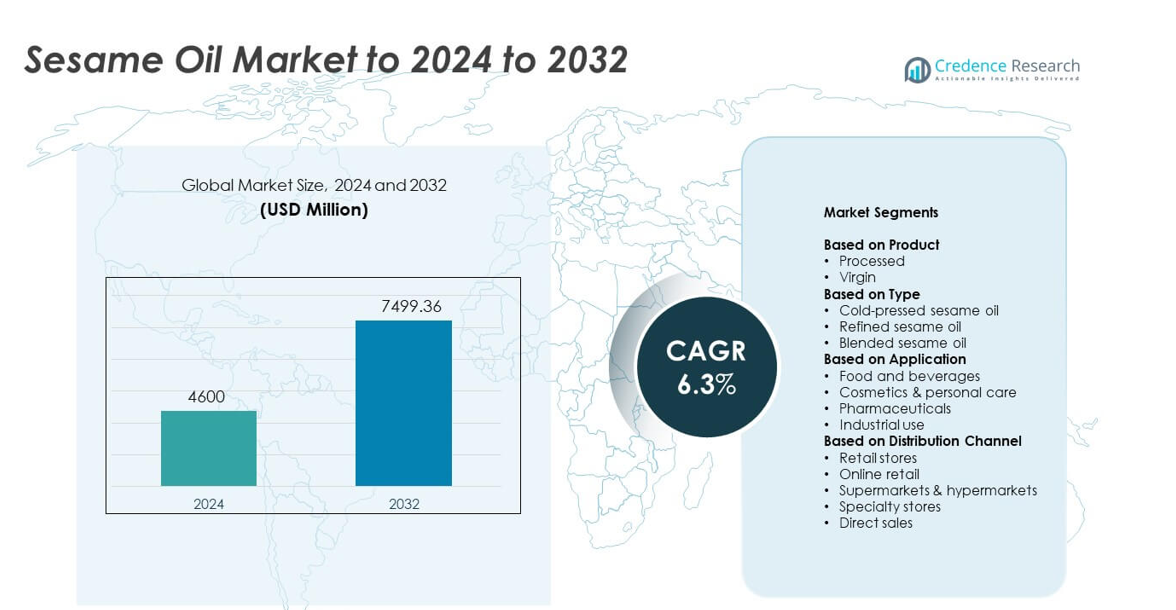
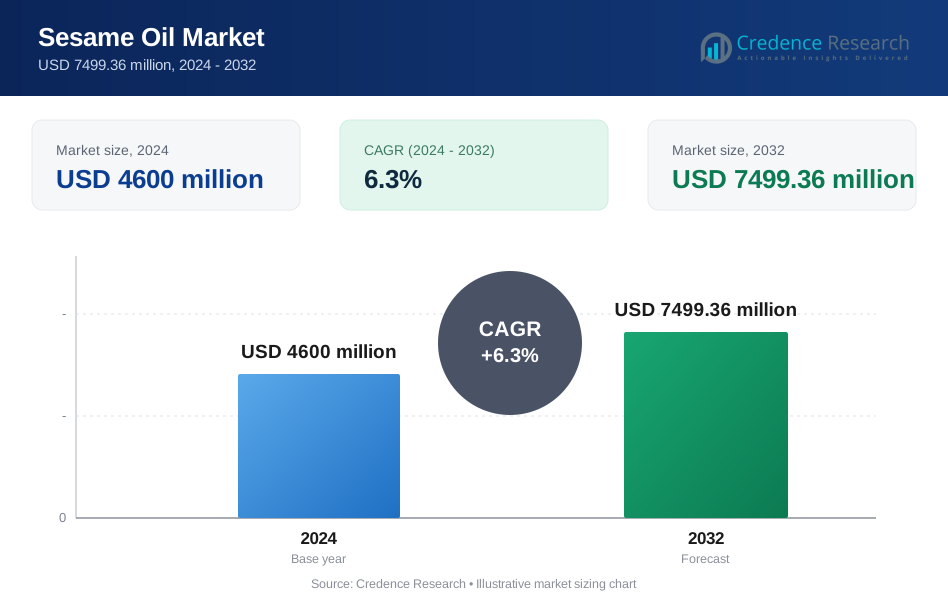
Sesame Oil Market size was valued USD 4600 million in 2024 and is anticipated to reach USD 7499.36 million by 2032, at a CAGR of 6.3% during the forecast period.
| REPORT ATTRIBUTE | DETAILS |
|---|---|
| Historical Period | 2020-2023 |
| Base Year | 2024 |
| Forecast Period | 2025-2032 |
| Sesame Oil Market Size 2024 | USD 4600 million |
| Sesame Oil Market, CAGR | 6.3% |
| Sesame Oil Market Size 2032 | USD 7499.36 million |
The Sesame Oil Market is driven by major players including Archer Daniels Midland Company, Bunge Limited, Cargill Inc., Borges International Group S.L.U., ConAgra Foods, Adams Group Inc., American Vegetable Oils Inc., Tradin Organic, Anhui Yanzhuang, and Takemoto Oil & Fat. These companies expand their portfolios through improved extraction methods, wider sourcing networks, and stronger presence in premium cold-pressed and organic categories. Asia Pacific remained the leading region in 2024 with about 38% share, supported by strong culinary use and large processing capacity. North America followed with nearly 29% share, driven by rising demand for natural and clean-label oils.
Market Insights
- The Sesame Oil Market reached USD 4600 million in 2024 and is projected to hit USD 7499.36 million by 2032 at a CAGR of 6.3%.
- Market growth is driven by rising use in food and beverages, which held about 72% share due to strong demand in processed foods, sauces, and restaurant cooking.
- Cold-pressed and organic variants are gaining traction as consumers shift toward natural, clean-label, and nutrient-rich oils across retail and online channels.
- Competition intensifies as major producers invest in better extraction efficiency, sustainable sourcing, and expanded premium product lines to strengthen market presence.
- Asia Pacific led the market with about 38% share, followed by North America at 29% and Europe at 24%, while processed sesame oil continued to dominate the product segment with roughly 68% share.
Market Segmentation Analysis:
By Product
Processed sesame oil held the largest share in 2024 with about 68% share. Strong demand came from packaged food makers that rely on stable flavor, longer shelf life, and uniform quality. Processed variants support large-scale frying, seasoning blends, and ready-meal production, which keeps industrial use high. Virgin sesame oil grew at a steady pace due to rising clean-label demand and higher consumption in premium culinary products. Growth in home cooking and ethnic cuisine also supported interest in minimally processed options.
- For instance, Kadoya Sesame Mills Inc. reported an annual sesame seed processing capacity of over 48,000 tons in its 2023 operational disclosure, supporting rising demand for processed sesame oil globally.
By Type
Refined sesame oil dominated the market in 2024 with nearly 57% share. Food manufacturers prefer refined grades because they offer neutral taste, high smoke point, and consistent performance in large-batch cooking. Cold-pressed oil gained traction in health-focused segments, supported by higher nutrient retention and premium positioning. Blended sesame oil expanded slowly as brands promoted cost-effective combinations for mass retail. The shift toward stable frying oils and scalable processing methods kept refined grades in the lead.
- For instance, Flavor Full Co., Ltd. (also known as Flavor Full Foods Inc.) publicly documents its annual sesame oil production capacity as exceeding 7,000 metric tons.
By Application
Food and beverages accounted for the largest share in 2024 with about 72% share. Strong use in edible oils, snacks, instant foods, marinades, and Asian cuisine supported wide adoption. Growing retail demand for flavored and specialty oils also boosted this segment. Cosmetics and personal care expanded with rising use in moisturizers and hair oils due to natural emollient benefits. Pharmaceuticals and industrial use saw steady but smaller uptake driven by niche applications in topical formulations and lubricants.
Key Growth Drivers
Rising demand from food and beverage industries
Global consumption of packaged foods, sauces, dressings, and ready meals continues to expand, which boosts the use of sesame oil as a flavoring and cooking medium. Strong demand in Asian cuisines and growing adoption in Western households supports wider usage. Packaged snack producers also prefer sesame oil due to its stability and rich aroma. This steady rise in large-scale food processing strengthens long-term demand and positions the food and beverage sector as a major growth catalyst.
- For instance, Sesajal S.A. de C.V. in Mexico reports a daily sesame seed processing capacity of about 40 tons, supporting sesame oil production that feeds both domestic food manufacturers and export markets across Latin America and beyond.
Growing preference for natural and clean-label products
Consumers increasingly seek natural oils that offer health benefits and minimal processing. Sesame oil matches this need due to its antioxidant content and traditional wellness positioning. Cold-pressed variants gain strong traction in premium retail shelves as buyers move away from synthetic additives. The clean-label trend influences purchases across supermarkets and online channels. This shift supports steady market expansion and helps manufacturers promote higher-value natural and organic sesame oil products.
- For instance, Chee Seng Oil Factory in Singapore, a renowned household brand that is the top-selling sesame oil locally, distributes its sesame oil to more than 35 countries and operates FSSC 22000-certified facilities, aligning with strict clean-label and food-safety expectations in global retail
Expanding use in cosmetics and personal care
Beauty and personal care brands use sesame oil in moisturizers, hair oils, and skin treatments due to its emollient and antioxidant qualities. Rising interest in plant-based formulations strengthens demand in premium beauty categories. Growth in aromatherapy and natural spa products further supports market momentum. Many consumers prefer oils with traditional wellness roots, which enhances sesame oil's appeal. This diversification into high-margin personal care applications acts as a strong growth driver.
Key Trends and Opportunities
Growth of cold-pressed and organic sesame oil
Premium buyers show strong interest in cold-pressed and organic variants due to their higher nutrient retention and chemical-free processing. Retailers expand shelf space for such oils, especially across urban markets and online platforms. This shift creates opportunities for producers to launch clean, high-quality formulations targeting health-conscious consumers. Branding focused on purity, origin, and traditional extraction methods gains traction. This trend supports value-driven growth and improves the market reach of artisanal and specialty sesame oils.
- For instance, Olivado sells extra virgin sesame oil in 250 ml bottles and promotes it as the only cold-pressed sesame oil on the New Zealand market, highlighting minimal processing and retention of natural sesamin and sesaminol.
Rising expansion in functional food and nutraceuticals
Sesame oil's antioxidant properties support its adoption in functional foods, fortified blends, and nutraceutical formulations. Manufacturers explore new applications in immunity-focused products and wellness foods. Growth in preventive health habits encourages consumers to choose oils with natural bioactive compounds. This creates opportunities for brands to diversify into dietary supplements and herbal formulations using sesame extracts. The expansion of wellness-focused innovations accelerates long-term market potential across global markets.
- For instance, The Hain Celestial Group’s Spectrum brand offers organic sesame oil in 8 fl oz and 16 fl oz bottles, with each tablespoon providing 14 grams of fat and 120 calories, positioning the product for nutrient-dense, health-oriented cooking and functional diets.
Increasing penetration in pharmaceutical and topical applications
Pharmaceutical firms use sesame oil in ointments, emulsions, and topical therapies due to its soothing and anti-inflammatory effects. Rising investment in herbal and traditional medicine systems expands the opportunity base. Its compatibility with active ingredients supports wider formulation use. Growth in dermatology and pain-relief products further strengthens demand. These developments create strong prospects for manufacturers looking to enter specialized medical and therapeutic product categories.
Key Challenges
Price fluctuations due to unstable sesame seed supply
Sesame seed prices often rise due to climate variability, inconsistent harvests, and disruptions in key producing regions. This volatility increases production costs and reduces margin stability for processors. Many countries rely on imports, which exposes buyers to trade restrictions and freight fluctuations. These supply risks limit predictable pricing for manufacturers and end users. Long-term instability in raw material availability remains a major challenge for sustaining steady output.
Strong competition from alternative edible oils
Sesame oil competes with soybean, sunflower, mustard, and olive oils, many of which offer lower prices or broader global availability. Food manufacturers sometimes choose cheaper substitutes for mass-market products, which limits sesame oil penetration. Marketing differentiation becomes difficult in regions where sesame oil is less familiar. Price-sensitive consumers may also shift to alternative oils during cost spikes. This competitive pressure restricts widespread adoption across mainstream cooking and industrial applications.
Regional Analysis
North America
North America accounted for about 29% share in 2024, supported by rising demand for ethnic cuisines, premium edible oils, and clean-label products. Growth in Asian restaurants and wider retail penetration of cold-pressed oils boosted sales across the United States and Canada. Increasing consumer focus on natural ingredients strengthened adoption in both home cooking and packaged food categories. Expanding use in personal care items such as moisturizers and hair oils also contributed to steady demand. The region continues to advance due to strong distribution networks and growing awareness of the health benefits linked to sesame oil.
Europe
Europe held nearly 24% share in 2024, driven by rising interest in natural oils and plant-based diets. Strong culinary influence from Mediterranean and Middle Eastern cuisines supported consistent consumption across major countries such as Germany, France, and the United Kingdom. Premium retail channels expanded shelf space for organic and cold-pressed variants. Growth in clean beauty trends increased demand for sesame oil in skincare and haircare formulations. The region benefits from strong regulatory support for natural ingredients, which encourages manufacturers to introduce high-quality and sustainably sourced sesame oil products.
Asia Pacific
Asia Pacific dominated the Sesame Oil Market in 2024 with about 38% share, supported by strong consumption in China, India, South Korea, Japan, and Southeast Asia. Long-standing culinary traditions, high household use, and strong presence of sesame-based foods fuel demand. Expanding packaged food production also boosts uptake in processed forms. Growing interest in premium cold-pressed oils among urban consumers strengthens market expansion. The region benefits from its position as a major sesame seed producer and processor, which ensures strong supply availability and competitive pricing advantages across global markets.
Latin America
Latin America accounted for around 5% share in 2024, reflecting emerging but steady adoption across food and personal care sectors. Growing popularity of Asian cuisine and rising interest in natural cooking oils expanded demand in countries such as Brazil and Mexico. Local cosmetics brands increasingly use sesame oil in skin and hair formulations due to its emollient properties. Limited production capacity in the region leads to greater dependence on imports, yet expanding retail distribution supports market visibility. Rising wellness trends provide opportunities for higher-value cold-pressed and organic variants.
Middle East and Africa
Middle East and Africa captured nearly 4% share in 2024, supported by traditional culinary uses and rising processed food production. Countries in the Gulf region show increasing demand for premium oils due to higher disposable incomes and expanding modern retail outlets. Africa’s sesame seed production base, particularly in Ethiopia, Sudan, and Nigeria, supports strong export activity. Local consumption grows steadily as awareness of natural oils increases. Adoption in cosmetics and topical applications offers additional opportunities. However, uneven distribution networks and price volatility remain constraints to faster market expansion across the region.
Market Segmentations:
By Product
- Processed
- Virgin
By Type
- Cold-pressed sesame oil
- Refined sesame oil
- Blended sesame oil
By Application
- Food and beverages
- Cosmetics & personal care
- Pharmaceuticals
- Industrial use
By Distribution Channel
- Retail stores
- Online retail
- Supermarkets & hypermarkets
- Specialty stores
- Direct sales
By Geography
- North America
- U.S.
- Canada
- Mexico
- Europe
- Germany
- France
- U.K.
- Italy
- Spain
- Rest of Europe
- Asia Pacific
- China
- Japan
- India
- South Korea
- South-east Asia
- Rest of Asia Pacific
- Latin America
- Brazil
- Argentina
- Rest of Latin America
- Middle East & Africa
- GCC Countries
- South Africa
- Rest of the Middle East and Africa
Competitive Landscape
The Sesame Oil Market is shaped by leading companies such as Archer Daniels Midland Company, Bunge Limited, Cargill Inc., Borges International Group S.L.U., ConAgra Foods (Agrotech Foods Ltd.), Adams Group Inc., American Vegetable Oils Inc., Tradin Organic, Anhui Yanzhuang, and Takemoto Oil & Fat. The competitive environment reflects strong focus on quality enhancement, advanced refining, and expansion of cold-pressed and organic product lines. Producers invest in modern extraction technologies to improve yield consistency and reduce processing losses. Many firms strengthen global sourcing networks to mitigate seed price volatility and ensure reliable supply. Strategic partnerships with food manufacturers, cosmetic brands, and nutraceutical producers help expand end-use penetration. Companies also focus on sustainability certifications, cleaner production, and traceability to meet rising consumer expectations. Increased emphasis on premium oils and online distribution supports wider market reach, while continuous product innovation enhances brand positioning in both mature and emerging markets.
Key Player Analysis
- Archer Daniels Midland Company
- Bunge Limited
- Cargill Inc.
- Borges International Group S.L.U.
- ConAgra Foods (Agrotech Foods Ltd.)
- Adams Group Inc.
- American Vegetable Oils Inc.
- Tradin Organic
- Anhui Yanzhuang
- Takemoto Oil & Fat
Recent Developments
- In 2024, Tradin Organic partnered with the ESG (Environmental, Social, and Governance) solutions company Osapiens to ensure compliance with the European Union Deforestation Regulation (EUDR), emphasizing sustainability in sesame oil production.
- In 2024, Anhui Yanzhuang, a major Chinese producer, invested in modern cold-pressing and refining technologies to achieve higher yield and consistent quality of sesame oil, catering to both domestic and export markets.
- In 2024, Takemoto Oil & Fat continued expanding its production capacities to meet the global demand for premium, cold-pressed sesame oil variants.
Report Coverage
The research report offers an in-depth analysis based on Product, Type, Application, Distribution Channel and Geography. It details leading market players, providing an overview of their business, product offerings, investments, revenue streams, and key applications. Additionally, the report includes insights into the competitive environment, SWOT analysis, current market trends, as well as the primary drivers and constraints. Furthermore, it discusses various factors that have driven market expansion in recent years. The report also explores market dynamics, regulatory scenarios, and technological advancements that are shaping the industry. It assesses the impact of external factors and global economic changes on market growth. Lastly, it provides strategic recommendations for new entrants and established companies to navigate the complexities of the market.
Future Outlook
- The market will grow as demand rises for natural and clean-label edible oils.
- Cold-pressed and organic sesame oil will gain stronger traction in premium retail.
- Food processing companies will expand use due to stable flavor and heat performance.
- Personal care brands will increase adoption in skincare and haircare formulations.
- Pharmaceutical applications will grow with higher focus on plant-based ingredients.
- Online retail channels will boost global accessibility and consumer reach.
- Producers will invest in improved extraction and filtration technologies.
- Supply chain optimization will become essential due to raw material fluctuations.
- Blended formulations will rise as brands target cost-sensitive buyers.
- Strong consumption in Asia Pacific will continue to drive global market expansion.
Request a Free Sample
Fill in your details and we'll send you a free sample report.
- Sample data tables & charts
- Research methodology
Need a Custom Version of This Report?
Tailor the scope, geography, or segments to your exact requirements.
- Custom geography or segment scope
- Direct access to our analyst team
Frequently Asked Questions
What is the current market size for Sesame Oil Market, and what is its projected size in 2032?
At what Compound Annual Growth Rate is the Sesame Oil Market projected to grow between 2024 and 2032?
Which Sesame Oil Market segment held the largest share in 2024?
What are the primary factors fueling the growth of the Sesame Oil Market?
5Who are the leading companies in the Sesame Oil Market?
Table of Content
Chapter 1. Report Introduction
- 1.1 Report Description & Purpose
- 1.1.1 Report Title & Market Definition
- 1.1.2 Unique Selling Propositions (USP) & Key Differentiators
- 1.1.3 Value Proposition for Stakeholders
- 1.2 Research Objectives
- 1.2.1 Market Sizing Objectives (Volume & Revenue)
- 1.2.2 Segmentation Objectives
- 1.2.3 Competitive Intelligence Objectives
- 1.2.4 Forecast & Scenario Objectives
- 1.3 Report Scope
- 1.3.1 Sesame Oil Scope – Types & Subtypes Covered
- 1.3.2 Geographic Scope – Regions & Countries Covered
- 1.3.3 Historical Period, Base Year & Forecast Period (2024; forecast to 2032)
- 1.3.4 Inclusions & Exclusions
- 1.4 HS Code & Classification Framework
- 1.5 Currency, Units & Pricing Basis
- 1.6 Target Stakeholders
- 1.7 Limitations & Assumptions
Chapter 2. Executive Summary
- 2.1 Global Sesame Oil Market Snapshot
- 2.1.1 Market Size – Historical (2024) & Forecast (2024-2032) (2024: USD 4600 million → 2032: USD 7499.36 million)
- 2.1.2 Volume & Revenue – Global Totals
- 2.1.3 Key Market Highlights – Top Five Facts
- 2.2 Sesame Oil Market Segmentation Snapshot
- 2.2.1 Market Split by Region – 2024 vs. 2032
- 2.3 Competitive Snapshot
- 2.3.1 Top 10 Players by Revenue Share – 2024
- 2.3.2 Top 10 Players by Volume Share – 2024
- 2.3.3 Recent Strategic Developments (18-Month Summary)
- 2.4 Key Investment Highlights & Strategic Conclusions
Chapter 3. Sesame Oil Market Dynamics & Industry Analysis
- 3.1 Market Overview & Context
- 3.1.1 Sesame Oil Market Position in the Broader Automotive Value Chain
- 3.1.2 OEM vs. Replacement Market Dynamics
- 3.1.3 Market Maturity & Development Stage by Region
- 3.2 Sesame Oil Market Drivers
- 3.3 Sesame Oil Market Restraints & Challenges
- 3.4 Sesame Oil Market Opportunities
- 3.5 Porter's Five Forces Analysis
- 3.5.1 Threat of New Entrants
- 3.5.2 Bargaining Power of Suppliers
- 3.5.3 Bargaining Power of Buyers
- 3.5.4 Threat of Substitutes
- 3.5.5 Competitive Rivalry – Intensity Assessment
- 3.6 Sesame Oil Value Chain Analysis
- 3.6.1 Upstream – Raw Material/Input Suppliers
- 3.6.1.1 Raw Material/Input 1
- 3.6.1.2 Raw Material/Input 2
- 3.6.1.3 Raw Material/Input 3
- 3.6.2 Midstream – Production/Manufacturing/Service Delivery
- 3.6.2.1 Production/Process Overview
- 3.6.2.2 Key Facility Locations & Capacity by Manufacturer
- 3.6.3 Downstream – Distribution & End Consumer
- 3.6.3.1 Primary Channel – B2B/OEM
- 3.6.3.2 Secondary Channels – Dealer, Retail, Online, Direct
- 3.6.4 Value Chain Profitability Analysis
- 3.6.1 Upstream – Raw Material/Input Suppliers
- 3.7 PESTEL Analysis
- 3.7.1 Political Factors
- 3.7.2 Economic Factors
- 3.7.3 Social Factors
- 3.7.4 Technological Factors
- 3.7.5 Environmental Factors
- 3.7.6 Legal Factors
- 3.8 Sesame Oil Supply Chain Analysis
- 3.8.1 Raw Material/Input Supply Risk Assessment
- 3.8.2 Manufacturing Concentration Risk (Geographic Exposure)
- 3.8.3 Trade Disruption Impact Analysis
- 3.9 Regulatory & Policy Landscape
Note: The regulatory and policy landscape section covers regulations based on their applicability to the market, Sesame Oil category, geography, and scope of the study. Only regulatory frameworks with a material impact on operations, compliance, trade, sustainability, or market access are analyzed in detail.
Chapter 4. Key Investment Pockets & Opportunity Analysis
- 4.1 Sesame Oil Market Attractiveness Analysis
- 4.1.1 By Region – Investment Attractiveness Matrix (Volume × CAGR)
- 4.2 Absolute Revenue Growth Opportunity
- 4.2.1 By Region – Absolute USD Growth Through 2032
- 4.3 Incremental Volume Opportunity
- 4.3.1 By Region – Incremental Volume Through 2032
- 4.3.2 Segment – Incremental Volume
- 4.4 Emerging Submarket Opportunity Deep Dive (Subject to Applicability)
- 4.5 Emerging Market Opportunity Scorecards
- 4.5.1 United States
- 4.5.2 Europe
- 4.5.3 Asia
- 4.5.4 Middle East & Africa
Note: Emerging Market Opportunity Scorecards will be included based on relevance and strategic importance. Regions listed are indicative and may vary depending on data availability and market dynamics.
Chapter 5. Sesame Oil Import-Export Analysis & Trade Flows
- 5.1 Global Trade Overview
- 5.1.1 Global Export Value by Country (2024)
- 5.1.2 Global Export Volume by Country (2024)
- 5.1.3 Global Import Value by Country (2024)
- 5.1.4 Global Import Volume by Country (2024)
- 5.1.5 Net Trade Balance by Country (2024)
- 5.2 Export Analysis – Segment
- 5.2.1 Type 1 (HS Code)
- 5.2.2 Type 2 (HS Code)
- 5.2.3 Type 3 (HS Code)
- 5.2.4 Type 4 (HS Code)
- 5.2.5 Type 5 (HS Code)
- 5.3 Import Analysis – Segment
- 5.3.1 Type 1 (HS Code)
- 5.3.2 Type 2 (HS Code)
- 5.3.3 Type 3 (HS Code)
- 5.3.4 Type 4 (HS Code)
- 5.3.5 Type 5 (HS Code)
- 5.4 Average Unit Trade Prices
- 5.4.1 Average Export Price – Segment & Country
- 5.4.2 Average Import Price – Segment & Source Country
- 5.4.3 Price Trends (2024)
- 5.5 Key Trade Route Analysis
- 5.5.1 Trade Route 1
- 5.5.2 Trade Route 2
- 5.5.3 Trade Route 3
- 5.5.4 Trade Route 4
- 5.5.5 Trade Route 5
- 5.6 Trade Policy Impact Assessment
- 5.6.1 US Anti-Dumping & Section 301 Tariffs
- 5.6.2 EU Customs Union Impact
- 5.6.3 Major Free Trade Agreements
- 5.6.4 USMCA Rules of Origin
Note: Trade policy analysis will be included only where relevant to the Sesame Oil market.
Chapter 6. Competitive Landscape & Company Benchmarking
- 6.1 Sesame Oil Market Concentration & Structure
- 6.1.1 Herfindahl-Hirschman Index (HHI) – vs. 2024
- 6.1.2 Tier 1, Tier 2 & Tier 3 Market Structure
- 6.1.3 Global, Regional & Local Player Dynamics
- 6.2 Sesame Oil Market Share Analysis – 2024
- 6.2.1 Global Revenue Share by Company
- 6.2.2 Global Volume Share by Company
- 6.2.3 Regional Revenue Share
- 6.2.4 Market Share Evolution ( vs. 2024)
- 6.2.5 OEM Segment Share by Company
- 6.2.6 Replacement Segment Share by Company
- 6.3 Production/Delivery Capacity & Facility Analysis
- 6.3.1 Global Installed Capacity
- 6.3.2 Capacity Utilization Rates
- 6.3.3 Production/Output Volume
- 6.3.4 Facility Locations & Capacity Map
- 6.3.5 Planned Capacity Additions
- 6.4 Sesame Oil Competitive Benchmarking Matrix
- 6.4.1 Revenue, Volume, CAGR & Profitability Comparison
- 6.4.2 Channel Revenue Mix
- 6.4.3 Geographic Revenue Exposure
- 6.4.4 R&D Intensity
- 6.4.5 Sustainability Maturity
- 6.5 Strategic Developments in Sesame Oil (Last 24 Months)
- 6.5.1 Mergers, Acquisitions & Divestments
- 6.5.2 New Sesame Oil Launches
- 6.5.3 Facility Expansions
- 6.5.4 Strategic Alliances, Joint Ventures & Partnerships
- 6.5.5 Distribution Expansion & Market Entry
- 6.5.6 Sustainability & ESG Initiatives
- 6.6 Competitive Strategy Mapping
- 6.6.1 Leader, Challenger, Follower & Niche Classification
- 6.6.2 Pricing Strategy Comparison
- 6.6.3 Channel Strategy Matrix
Note: Strategic developments are included based on their materiality and the availability of reliable information.
Chapter 7. Global Sesame Oil Market – By Distribution Channel
- 7.1 Segment Overview
- 7.1.1 Volume & Revenue Split by Channel (2024 & 2032)
- 7.1.2 Channel Mix Evolution (2024-2032)
Chapter 8. Regional Market Analysis – Global Overview
- 8.1 Global Regional Overview
- 8.1.1 Regional Volume Share
- 8.1.2 Regional Revenue Share
- 8.1.3 Regional Volume by Region
- 8.1.4 Regional Revenue by Region
- 8.1.5 Regional Forecast Through 2032
- 8.2 Cross-Regional Segment Analysis
- 8.2.1 By Distribution Channel
- 8.2.2 By Brand/Price Tier
Chapter 9. North America Sesame Oil Market
- 9.1 United States
- 9.2 Canada
- 9.3 Mexico
Chapter 10. Europe Sesame Oil Market
- 10.1 Germany
- 10.2 France
- 10.3 Italy
- 10.4 United Kingdom
- 10.5 Spain
- 10.6 Poland
- 10.7 Russia
- 10.8 Netherlands
- 10.9 Belgium
- 10.10 Sweden
- 10.11 Denmark
- 10.12 Norway
- 10.13 Rest of Europe
Chapter 11. Asia Pacific Sesame Oil Market
- 11.1 China
- 11.2 India
- 11.3 Japan
- 11.4 South Korea
- 11.5 Thailand
- 11.6 Indonesia
- 11.7 Vietnam
- 11.8 Malaysia
- 11.9 Australia
- 11.10 Rest of Asia Pacific
Chapter 12. Latin America Sesame Oil Market
- 12.1 Brazil
- 12.2 Argentina
- 12.3 Colombia
- 12.4 Chile
- 12.5 Rest of Latin America
Chapter 13. Middle East Sesame Oil Market
- 13.1 Saudi Arabia
- 13.2 United Arab Emirates
- 13.3 Turkey
- 13.4 Israel
- 13.5 Iran
- 13.6 Rest of the Middle East
Chapter 14. Africa Sesame Oil Market
- 14.1 South Africa
- 14.2 Egypt
- 14.3 Nigeria
- 14.4 Morocco
- 14.5 Rest of Africa
Chapter 15. Sesame Oil Company Profiles
- 15.1 [Company 01]
- 15.1.1 Company Overview
- 15.1.2 Key Management Personnel
- 15.1.3 Products & Services Portfolio
- 15.1.4 Financial Performance
- 15.1.5 Key Market Focus & Geographic Presence
- 15.1.6 Recent Developments & Strategic Initiatives
Note: The company profile list is preliminary and may change based on research findings, market developments, data availability, and client requirements.
Chapter 16. Appendices
- Appendix A – List of Abbreviations & Acronyms
- Appendix B – Industry Classification Code Reference – Full Series
- Appendix C – Production & Capacity Data Tables
- Appendix D – End-Use & Demand Base Tables
- Appendix E – Consumption & Replacement Rate Assumptions
- Appendix F – ASP Reference Tables
- Appendix G – Manufacturing & Facility Database
- Appendix H – Import-Export Data Tables
- Appendix I – Regulatory Summary Tables
- Appendix J – Primary Research Participant List (Anonymized)
- Appendix K – Primary Research Questionnaire Framework
- Appendix L – Data Sources & Bibliography
- Appendix M – Market Size Divergence & Source Comparison
Chapter 17. Research Methodology
- 17.1 Research Framework & Philosophy
- 17.2 Secondary Research – Sources, Hierarchy & Data Extraction
- 17.3 Data Modeling – Bottom-Up & Top-Down Market Sizing
- 17.4 Primary Research – Stakeholder Framework, LOI & Sample Sizes
- 17.5 Forecast Methodology – Regression, Scenario & Sensitivity Analysis
- 17.6 Quality Control – Four-Layer Validation Framework
- 17.7 Limitations & Standard Assumptions
- 17.8 Disclaimer
