
Market Overview
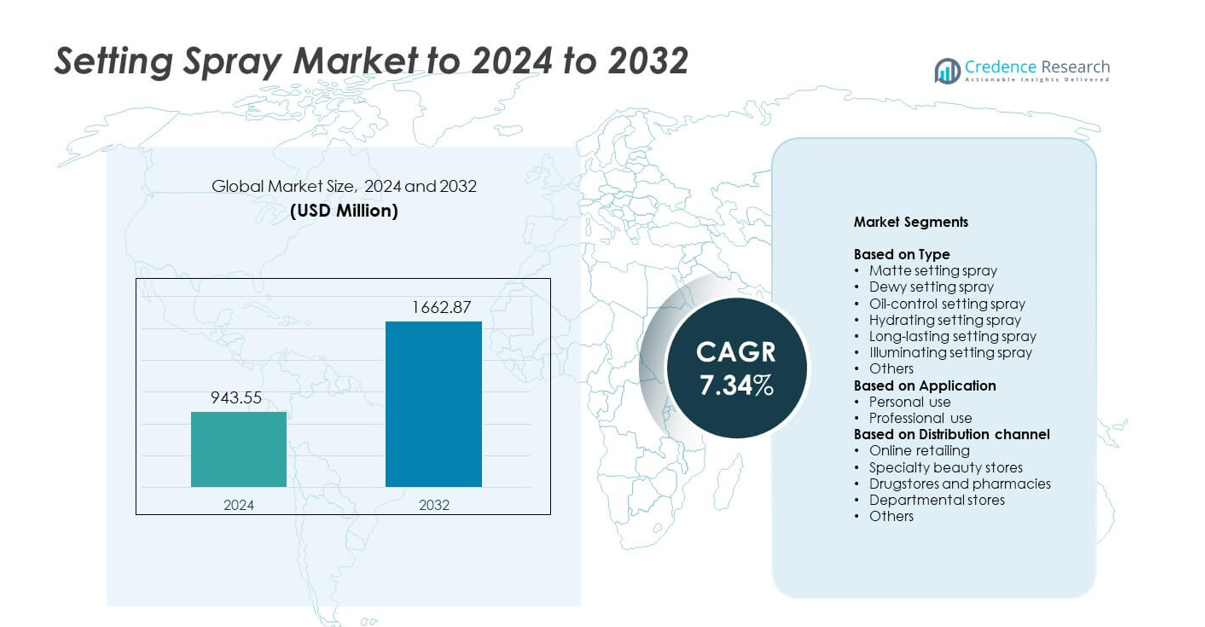
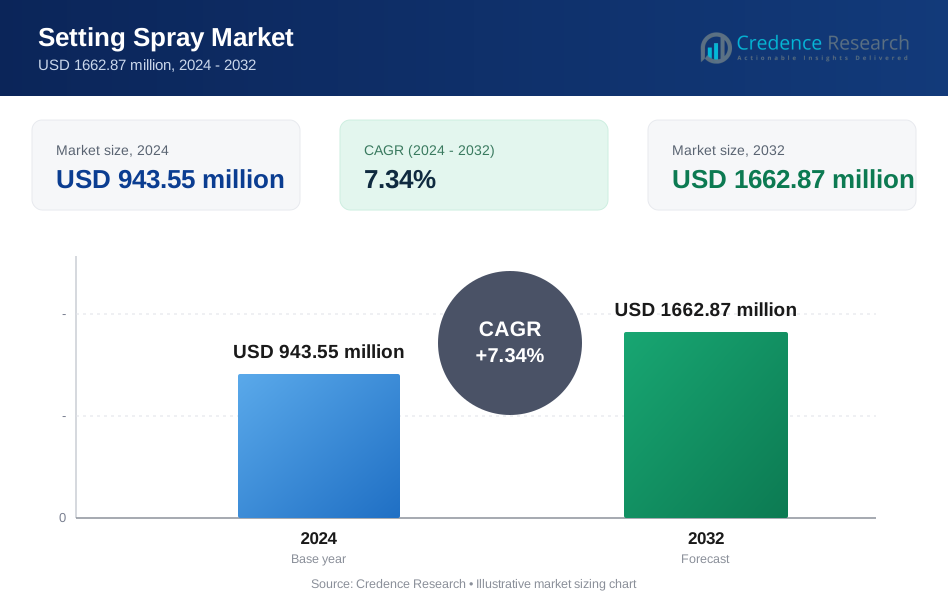
Setting Spray Market size was valued at USD 943.55 million in 2024 and is anticipated to reach USD 1662.87 million by 2032, at a CAGR of 7.34% during the forecast period.
| REPORT ATTRIBUTE | DETAILS |
|---|---|
| Historical Period | 2020-2023 |
| Base Year | 2024 |
| Forecast Period | 2025-2032 |
| Setting Spray Market Size 2024 | USD 943.55 million |
| Setting Spray Market, CAGR | 7.34% |
| Setting Spray Market Size 2032 | USD 1662.87 million |
The Setting Spray Market is driven by major players such as LVMH, Anastasia Beverly Hills, Milani Cosmetics, Coty Inc, Huda Beauty, Ben Nye Inc, L'Oréal Group, AS Beauty, Pat McGrath, Kose Corporation, e.l.f. Beauty Inc, and Cover FX. These companies expand the market through advanced long-wear formulas, diverse finish options, and strong digital promotion. North America led the market in 2024 with about 36% share due to high makeup adoption and strong retail networks. Europe followed with nearly 27% share, supported by premium beauty demand, while Asia Pacific held around 24% and recorded the fastest growth.
Market Insights
- The Setting Spray Market reached USD 943.55 million in 2024 and is projected to hit USD 1662.87 million by 2032, growing at a CAGR of 7.34%. • Rising daily makeup use and demand for long-wear performance drive adoption, with matte sprays holding the largest share at about 32%. • Clean-label, skin-benefit, and climate-adapted sprays shape key trends as brands innovate with lightweight and multifunctional formulas. • Strong competition comes from global beauty companies expanding digital marketing, premium lines, and micro-fine mist technologies while facing challenges related to ingredient sensitivity. • North America led with 36% share in 2024, followed by Europe at 27% and Asia Pacific at 24%, while online retailing held the dominant distribution share at about 46%
Market Segmentation Analysis:
By Type
Matte setting spray held the leading position in 2024 with about 32% share. Strong demand came from consumers who prefer shine-free makeup that lasts through long hours, warm climates, and daily use. Matte formulas gained wider reach due to rising social media trends that highlight smooth, oil-free finishes. Oil-control and long-lasting sprays also grew as brands improved transfer resistance and humidity performance. Hydrating and illuminating sprays advanced within premium lines, but their reach stayed smaller due to niche usage needs and higher price points.
- For instance, NYX Professional Makeup’s Matte Finish Setting Spray is documented on its official product page as keeping makeup in place for up to 16 hours, with a breathable matte formula designed for all-day shine control, reinforcing the dominance of long-wear matte formats in daily use.
By Application
Personal use dominated the Setting Spray Market in 2024 with nearly 71% share. Growth came from rising daily makeup adoption, broader access to affordable products, and higher demand among young users. Personal routines shifted toward longer wear, which pushed consumers to adopt setting sprays as a core step. Professional use grew in salons, studios, and events, driven by makeup artists who require high-performance finishes. However, the segment stayed smaller as most volume sales continued to come from mass-market personal use purchases.
- For instance, Urban Decay’s All Nighter Waterproof Makeup Setting Spray is advertised by the brand as delivering up to 24 hours of makeup wear, which makes it a staple among both everyday consumers and professional artists who need reliable long-duration performance for events and long shifts.
By Distribution Channel
Online retailing led the market in 2024 with around 46% share. Strong growth came from influencer-driven marketing, fast product discovery, and easy comparison of new launches. E-commerce platforms expanded global reach for both premium and mass brands, boosting repeat purchases. Specialty beauty stores maintained a key role for experiential testing and in-store guidance, while drugstores supported budget shoppers. Departmental stores and other outlets held smaller shares as buyers shifted toward faster online buying and broader digital assortments.
Key Growth Drivers
Rising daily makeup adoption
Daily makeup use grew across young and working consumers, which increased demand for products that improve wear time and finish. Setting sprays gained traction as buyers sought long-lasting looks in warm and humid regions. Social media tutorials expanded awareness and pushed users to add setting sprays to routine steps. Brands also promoted lightweight and skin-friendly formulas, which further supported steady uptake in global markets.
- For instance, Benefit Cosmetics’ The POREfessional: Super Setter is positioned on Sephora as a multitasking mist that locks makeup for up to 16 hours, and its wide availability in both travel and full sizes supports frequent, everyday use among consumers who wear base makeup for extended workdays.
Expansion of premium and multifunctional formulas
Premium brands introduced innovative textures that combine hydration, oil control, and long-wear benefits in one spray. This shift boosted consumer interest in higher-performance options. Multifunctional products appealed to users seeking simple routines with reliable results, raising engagement across online platforms. The premium segment grew faster as shoppers favored high-quality ingredients and advanced claims supported by strong marketing campaigns.
- For instance, Charlotte Tilbury’s Airbrush Flawless Setting Spray is described on the brand’s site as priming and setting makeup for up to 16 hours while providing a hydrating, waterproof veil and an anti-pollution shield, illustrating how premium sprays now combine base extension, skincare-style benefits, and environmental protection in a single SKU.
Growth of e-commerce beauty channels
Digital platforms strengthened demand as buyers compared finishes, reviews, and shade effects with ease. Influencer content raised visibility across global regions, helping both new and established brands scale faster. Online stores expanded assortment depth and made limited-edition products widely accessible. Faster delivery and frequent discounts encouraged repeat purchases, placing e-commerce at the center of market growth.
Key Trends and Opportunities
Clean-label and skin-benefit formulations
Consumers shifted toward setting sprays with gentle, safer, and dermatologically tested ingredients. Brands developed sprays that provide skincare benefits such as hydration, soothing, and pollution defense. Hybrid formulas grew as buyers sought makeup that supports skin health while improving wear time. This trend opened opportunities for brands to expand product lines focused on sensitive and wellness-driven users.
- For instance, Clarins’ Fix’ Make-Up setting spray is marketed with a clinical study on 30 women showing 24-hour makeup hold
Rise of long-wear and climate-adapted sprays
Demand increased for sprays that withstand heat, sweat, and long hours, especially in warm climates and high-activity lifestyles. Brands invested in polymers that boost transfer resistance and durability. Climate-adapted sprays gained visibility in regions with humidity challenges, creating space for innovation in texture and hold. This trend allowed companies to differentiate through advanced performance claims.
- For instance, MAC Cosmetics’ Fix+ Stay Over Alcohol-Free 16Hr Setting Spray is described by the brand as keeping makeup in place for 16 hours and cites consumer testing on 122 women
Customization and shade-enhancing finishes
More consumers looked for setting sprays that enhance glow, soften matte effects, or refine overall tone. Brands launched illuminating, blurring, and micro-fine mist formats to meet diverse finish preferences. This created opportunities for targeted lines that match specific skin types and makeup styles. Personalization through varied finishes increased market depth across both mass and premium categories.
Key Challenges
Growing competition and brand saturation
The market saw rapid entry of new labels, which increased pressure on pricing and differentiation. Many products offer similar wear-long and finish claims, making it harder for brands to stand out. Marketing costs continued to rise as companies competed for visibility across social platforms. This saturation forced firms to focus on innovation and stronger brand positioning.
Concerns over ingredient sensitivity
Consumers became more aware of potential irritation from alcohol-heavy or fragrance-rich sprays. Regulatory scrutiny increased around certain preservatives used in long-wear formulas. These concerns drove buyers to check ingredient lists more closely, challenging brands that rely on older formulations. Companies faced pressure to reformulate without compromising performance, raising development costs and extending launch cycles.
Regional Analysis
North America
North America led the Setting Spray Market in 2024 with about 36% share. Strong demand came from high daily makeup usage, wide product availability, and frequent new launches from both premium and mass brands. The region’s strong e-commerce penetration and influencer-driven marketing also supported adoption. Consumers preferred long-wear and oil-control sprays due to diverse climate conditions and active lifestyles. Growth continued as brands expanded clean-label and skin-benefit formulas tailored to sensitive skin. The United States generated most sales, while Canada showed faster adoption in hydration-focused variants.
Europe
Europe accounted for nearly 27% share in 2024, supported by strong interest in premium beauty and clean cosmetic formulations. Demand grew in Western European countries where makeup users prefer lightweight, hydrating, and natural-finish sprays. Regulations encouraging safer cosmetic ingredients pushed brands to innovate within permissible limits. The region also saw growing online beauty sales that offered broad product visibility. Climate differences across northern and southern Europe supported varied preferences, from hydrating sprays to long-wear variants. Increased spending on skincare-driven makeup hybrids further strengthened Europe’s position.
Asia Pacific
Asia Pacific held about 24% share in 2024 and recorded the fastest expansion. High beauty engagement among young consumers and the influence of K-beauty trends boosted adoption. Users favored hydrating, dewy, and illuminating sprays due to regional preference for fresh, glowing finishes. Rising urbanization, heat, and humidity also increased demand for long-lasting and sweat-resistant variants. E-commerce growth and social media platforms accelerated product discovery across large markets such as China, Japan, and South Korea. Expanding middle-income groups and strong local brand innovation helped Asia Pacific gain momentum.
Latin America
Latin America captured around 8% share in 2024, supported by rising makeup culture across Brazil, Mexico, and Argentina. Consumers preferred setting sprays that offer durability in warm climates and support day-long wear. Growth in local beauty brands and increasing online retail penetration improved access to affordable options. Social media beauty trends encouraged wider trial of matte and long-wear sprays among young buyers. Economic fluctuations remained a restraint, but steady demand in mass-market ranges supported market stability. Expanding distribution in supermarkets and drugstores continued to widen reach.
Middle East and Africa
Middle East and Africa accounted for roughly 5% share in 2024 and showed steady growth. High temperatures and long outdoor hours increased preference for strong-hold and humidity-resistant sprays. Demand rose in urban centers such as the UAE, Saudi Arabia, and South Africa as consumers embraced global beauty trends. Premium and long-wear variants gained traction with rising disposable income and wider access to international brands. Online retailing supported product discovery across younger users. Despite lower penetration than other regions, adoption increased as beauty awareness and retail expansion improved.
Market Segmentations:
By Type
- Matte setting spray
- Dewy setting spray
- Oil-control setting spray
- Hydrating setting spray
- Long-lasting setting spray
- Illuminating setting spray
- Others
By Application
- Personal use
- Professional use
By Distribution channel
- Online retailing
- Specialty beauty stores
- Drugstores and pharmacies
- Departmental stores
- Others
By Geography
- North America
- U.S.
- Canada
- Mexico
- Europe
- Germany
- France
- U.K.
- Italy
- Spain
- Rest of Europe
- Asia Pacific
- China
- Japan
- India
- South Korea
- South-east Asia
- Rest of Asia Pacific
- Latin America
- Brazil
- Argentina
- Rest of Latin America
- Middle East & Africa
- GCC Countries
- South Africa
- Rest of the Middle East and Africa
Competitive Landscape
The Setting Spray Market is shaped by leading beauty companies such as LVMH, Anastasia Beverly Hills, Milani Cosmetics, Coty Inc, Huda Beauty, Ben Nye Inc, L'Oréal Group, AS Beauty, Pat McGrath, Kose Corporation, e.l.f. Beauty Inc, and Cover FX. Competition centers on innovation in long-wear performance, lightweight textures, and skin-enhancing benefits as brands target both mass and premium buyers. Product lines expand through hydrating, matte, dewy, and illuminating finishes designed for varied climate conditions and daily use. Companies strengthen visibility through influencer collaborations, social media campaigns, and seasonal product drops. Clean-label shifts drive reformulation toward alcohol-free and sensitive-skin options, while e-commerce boosts global reach through faster launches and limited-edition collections. Manufacturers also invest in micro-fine mist technologies that offer smoother dispersion and improved setting efficiency. Growing consumer demand for hybrid skincare-makeup functions encourages ongoing development of advanced formulas that support durability, comfort, and personalization across diverse user segments.
Key Player Analysis
- LVMH
- Anastasia Beverly Hills
- Milani Cosmetics, Inc
- Coty Inc
- Huda Beauty
- Ben Nye, Inc.
- L'Oréal Group
- AS Beauty
- Pat McGrath
- Kose Corporation
- e.l.f. Beauty, Inc.
- Cover FX
Recent Developments
- In 2025, Pat McGrath introduced Glass 001 Legendary Glow Setting Spray, designed to create a radiant, glass-like finish.
- In 2025, Huda Beauty launched the Easy Bake Setting Spray, transforming their popular Easy Bake Powder into a lightweight, alcohol-free mist with rice starch, mineral clay, and five types of hyaluronic acid for 16-hour wear, oil control, and pore-blurring effects
- In 2024, Milani Cosmetics promoted their Make It Last Setting Spray through a major athlete partnership campaign, featuring Team USA stars like Sabrina Ionescu and Jordan Chiles ahead of the Paris Olympics to highlight its 24-hour waterproof and sweatproof performance
Report Coverage
The research report offers an in-depth analysis based on Type, Application, Distribution Channel and Geography. It details leading market players, providing an overview of their business, product offerings, investments, revenue streams, and key applications. Additionally, the report includes insights into the competitive environment, SWOT analysis, current market trends, as well as the primary drivers and constraints. Furthermore, it discusses various factors that have driven market expansion in recent years. The report also explores market dynamics, regulatory scenarios, and technological advancements that are shaping the industry. It assesses the impact of external factors and global economic changes on market growth. Lastly, it provides strategic recommendations for new entrants and established companies to navigate the complexities of the market.
Future Outlook
- The market will grow as daily makeup use increases across young consumers.
- Brands will expand clean-label and skin-benefit setting spray portfolios.
- Demand will rise for long-wear sprays suited for heat and humidity.
- E-commerce will play a larger role in product visibility and global reach.
- Premium and multifunctional sprays will gain stronger traction.
- Innovation will focus on lightweight, alcohol-free, and sensitive-skin formulas.
- Personalization through varied finishes will strengthen brand differentiation.
- Emerging markets will adopt setting sprays faster due to social media influence.
- Regulatory pressure will encourage safer and more transparent formulations.
- Hybrid skincare-makeup sprays will shape future product development.
Request a Free Sample
Fill in your details and we'll send you a free sample report.
- Sample data tables & charts
- Research methodology
Need a Custom Version of This Report?
Tailor the scope, geography, or segments to your exact requirements.
- Custom geography or segment scope
- Direct access to our analyst team
Frequently Asked Questions
What is the current market size for Setting Spray Market, and what is its projected size in 2032?
At what Compound Annual Growth Rate is the Setting Spray Market projected to grow between 2024 and 2032?
Which Setting Spray Market segment held the largest share in 2024?
What are the primary factors fueling the growth of the Setting Spray Market?
Who are the leading companies in the Setting Spray Market?
Table of Content
Chapter 1 Market Segmentation
- 1.1 Segmentation Framework
- 1.1.1 Product and Service Classification
- 1.1.2 Application and End-Use Classification
- 1.1.3 Technology and Solution Classification
- 1.1.4 Customer and Distribution Channel Classification
- 1.1.5 Geographic Segmentation
- 1.1.6 Market Segment Definitions and Boundaries
Chapter 2 Introduction
- 2.1 Report Objectives and Scope
- 2.2 Product Definition and Industry Terminology
- 2.3 Market Inclusions and Exclusions
- 2.4 Research Process
- 2.4.1 Primary Research and Expert Interviews
- 2.4.2 Secondary Research and Source Review
- 2.4.3 Top-Down and Bottom-Up Estimation
- 2.4.4 Data Triangulation and Verification
- 2.5 Market Size Measurement Basis
- 2.5.1 2024: USD 943.55 million → 2032: USD 1662.87 million
- 2.6 Historical and Forecast Reference Periods
- 2.6.1 Base Year: 2024
- 2.6.2 Forecast Period: 2024-2032
- 2.7 Research Assumptions and Limitations
Chapter 3 Executive Summary
- 3.1 Market Snapshot and Key Findings
- 3.2 Base-Year Market Size, 2024
- 3.3 Forecast Market Size, 2032
- 3.4 Revenue and Volume Growth Outlook
- 3.5 Key Demand and Supply Indicators
- 3.6 Leading Market Segments
- 3.7 Fastest-Growing Market Opportunities
- 3.8 Regional Performance Highlights
- 3.9 Technology and Industry Transformation
- 3.10 Competitive Landscape Summary
- 3.11 Analyst View and Strategic Implications
Chapter 4 Global Setting Spray Market Trends and Developments
- 4.1 Historical Industry Development
- 4.2 Recent Market Trends and Developments
- 4.3 Demand and Customer Behavior Trends
- 4.4 Technology and Product Innovation
- 4.5 Artificial Intelligence, Automation and Digitalization
- 4.6 Local Manufacturing and Supply Chain Realignment
- 4.7 Industry Partnerships, Mergers and Acquisitions
- 4.8 Sustainability and Circular Economy Developments
- 4.9 Government and Private Sector Investment Trends
- 4.10 Emerging Business Models and Commercialization
- 4.11 Industry Developments and Announcements
Chapter 5 Global Setting Spray Market Production, Supply and Demand Analysis
- 5.1 Demand Trend and Consumption Analysis
- 5.2 Demand Forecast, 2024-2032
- 5.3 Production and Output Trend
- 5.4 Production and Output Forecast, 2024-2032
- 5.5 Installed Capacity and Capacity Utilization
- 5.6 Company-Wise Production Plants and Statistics
- 5.6.1 Installed Production Capacity
- 5.6.2 Actual Production
- 5.6.3 Planned Capacity and Expansion Targets
- 5.7 Supply Chain Structure and Procurement Trends
- 5.8 Supply-Demand Gap and Bottlenecks
- 5.9 Import Dependence and Sourcing Structure
- 5.10 Contract Manufacturing and Outsourcing
- 5.11 Regional Supply and Demand Concentration
Chapter 6 Global Setting Spray Market Pricing Analysis
- 6.1 Pricing Structure and Measurement
- 6.2 Historical Pricing Trends
- 6.3 Pricing Outlook, 2024-2032
- 6.4 Average Selling Price and Unit Economics
- 6.5 Pricing by Product and Market Segment
- 6.6 Geographic Pricing Differences
- 6.7 Key Input, Energy, Labor and Logistics Costs
- 6.8 Contract Pricing and Purchasing Models
- 6.9 Pricing Sensitivity and Competitive Positioning
- 6.10 Price, Margin and Profitability Implications
Chapter 7 Global Setting Spray Market Dynamics
- 7.1 Market Growth Drivers
- 7.1.1 Demand-Side Drivers
- 7.1.2 Technology and Innovation Drivers
- 7.1.3 Infrastructure and Investment Drivers
- 7.1.4 Regulatory and Policy Drivers
- 7.2 Market Restraints
- 7.2.1 Cost and Affordability Constraints
- 7.2.2 Technology and Adoption Barriers
- 7.2.3 Supply Chain and Operational Constraints
- 7.3 Market Challenges
- 7.3.1 Competitive Pressure and Margin Erosion
- 7.3.2 Skills, Infrastructure and Implementation Gaps
- 7.4 Emerging Market Opportunities
- 7.5 Market Dynamics Impact and Time-Horizon Assessment
Chapter 8 Global Setting Spray Value Chain Analysis
- 8.1 Industry Value Chain Overview
- 8.2 Upstream Suppliers and Critical Inputs
- 8.3 Technology and Component Providers
- 8.4 Manufacturing or Service Delivery
- 8.5 Distribution, Channel Partners and Integrators
- 8.6 Downstream Applications and End Users
- 8.7 Value Addition and Profit Pools
- 8.8 Vertical Integration and Outsourcing
- 8.9 Supplier Concentration and Risk
- 8.10 Supply Chain Localization and Resilience
Chapter 9 Global Setting Spray Market Regulations and Policies
- 9.1 Relevant Laws, Standards and Compliance Frameworks
- 9.2 Product, Service, Safety and Quality Requirements
- 9.3 Government Policies, Incentives and Subsidies
- 9.4 Imports, Exports and Trade Barriers
- 9.5 Public Procurement and Local Content Requirements
- 9.6 Environmental and Sustainability Compliance
- 9.7 Upcoming Policy Changes and Market Implications
Chapter 10 Global Setting Spray Market Hotspots and Opportunities
- 10.1 Market Opportunity Mapping and Growth Hotspots
- 10.2 High-Growth Applications and Customer Groups
- 10.3 Underserved Markets and White-Space Opportunities
- 10.4 Emerging Technology and Product Opportunities
- 10.5 New Capacity and Investment Hotspots
- 10.6 Market Entry and Expansion Opportunities
- 10.7 Distribution and Partnership Opportunities
- 10.8 Near-Term and Long-Term Commercial Potential
- 10.9 Opportunity Attractiveness and Execution Risks
Chapter 11 Global Setting Spray Market Outlook, 2024-2032
- 11.1 Market Size and Analysis
- 11.1.1 Revenue (Market Measurement: 2024: USD 943.55 million → 2032: USD 1662.87 million)
- 11.1.2 Market Volume and Quantity Sold
- 11.1.3 Historical Market Size
- 11.1.4 Base-Year Market Size, 2024
- 11.2 Market Forecast, 2024-2032
- 11.2.1 Revenue Forecast to 2032
- 11.2.2 Volume Forecast to 2032
- 11.2.3 CAGR and Year-on-Year Growth
- 11.2.4 Incremental Revenue Opportunity
- 11.3 Forecast Assumptions and Scenario Analysis
- 11.3.1 Base-Case Forecast
- 11.3.2 Optimistic and Conservative Scenarios
- 11.3.3 Technology, Pricing and Policy Sensitivities
- 11.4 Market Attractiveness and Growth Outlook
Chapter 12 Global Setting Spray Market Segmentation and Outlook
- 12.1 Segmentation Summary and Market Shares, 2024
- 12.2 Largest and Fastest-Growing Segments
- 12.3 Segment Growth Comparison
- 12.4 Segment Attractiveness and Priority Matrix
Chapter 13 Global Setting Spray Geographic Market Outlook, 2024-2032
- 13.1 Regional Market Size and Share, 2024
- 13.2 Regional Market Forecast, 2024-2032
- 13.3 Regional Pricing, Production and Demand Differences
- 13.4 North America
- 13.4.1 United States
- 13.4.2 Canada
- 13.4.3 Mexico
- 13.5 Europe
- 13.5.1 Germany
- 13.5.2 France
- 13.5.3 Italy
- 13.5.4 United Kingdom
- 13.5.5 Spain
- 13.5.6 Poland
- 13.5.7 Russia
- 13.5.8 Netherlands
- 13.5.9 Belgium
- 13.5.10 Sweden
- 13.5.11 Denmark
- 13.5.12 Norway
- 13.5.13 Rest of Europe
- 13.6 Asia Pacific
- 13.6.1 China
- 13.6.2 India
- 13.6.3 Japan
- 13.6.4 South Korea
- 13.6.5 Thailand
- 13.6.6 Indonesia
- 13.6.7 Vietnam
- 13.6.8 Malaysia
- 13.6.9 Australia
- 13.6.10 Rest of Asia Pacific
- 13.7 Latin America
- 13.7.1 Brazil
- 13.7.2 Argentina
- 13.7.3 Colombia
- 13.7.4 Chile
- 13.7.5 Rest of Latin America
- 13.8 Middle East
- 13.8.1 Saudi Arabia
- 13.8.2 United Arab Emirates
- 13.8.3 Turkey
- 13.8.4 Israel
- 13.8.5 Iran
- 13.8.6 Rest of the Middle East
- 13.9 Africa
- 13.9.1 South Africa
- 13.9.2 Egypt
- 13.9.3 Nigeria
- 13.9.4 Morocco
- 13.9.5 Rest of Africa
- 13.10 Regional Investment, Policy and Supply Chain Differences
- 13.11 Regional Competitive Landscape
- 13.12 Geographic Growth Hotspots
Chapter 14 Global Setting Spray Technology, Innovation and Sustainability Outlook
- 14.1 Technology Landscape and Maturity
- 14.2 Product, Process and Service Innovation
- 14.3 AI, Automation and Digital Tools in the Industry
- 14.4 Technology Adoption and Performance Benchmarking
- 14.5 Innovation Pipeline and R&D Investment
- 14.6 Patent and Intellectual Property Trends
- 14.7 Energy Efficiency and Resource Management
- 14.8 Sustainability, Recycling and Circularity
- 14.9 Technology Roadmap, 2024-2032
- 14.10 Risks of Obsolescence and Technology Substitution
Chapter 15 Global Setting Spray Market Key Strategic Imperatives
- 15.1 Growth and Market Entry Priorities
- 15.2 High-Return Products and Segments
- 15.3 Pricing, Profitability and Cost Optimization
- 15.4 Technology Investment and Product Differentiation
- 15.5 Supply Chain Localization and Resilience
- 15.6 Distribution and Customer Acquisition
- 15.7 Partnership, Acquisition and Capacity Strategy
- 15.8 Regional Expansion Priorities
- 15.9 Short-, Medium- and Long-Term Actions
Chapter 16 Competition Outlook
- 16.1 Industry Competition Characteristics
- 16.2 Market Structure and Concentration
- 16.3 Market Share and Competitive Positioning, 2024
- 16.4 Company-Wise Revenue and Product Benchmarking
- 16.5 Production and Service Capacity Benchmarking
- 16.6 Technology, Pricing and Differentiation
- 16.7 Regional Footprint and Distribution Strength
- 16.8 Mergers, Acquisitions and Strategic Alliances
- 16.9 New Entrants and Competitive Threats
- 16.10 Porter's Five Forces and Industry Attractiveness
- 16.11 Competitive Outlook, 2024-2032
Chapter 17 Company Profiles
- 17.1 Company Coverage and Selection Criteria
- 17.2 Leading Market Participants – Standard Profile Structure
- 17.2.1 Business Description
- 17.2.2 Company Ownership and Geographic Presence
- 17.2.3 Product and Service Portfolio
- 17.2.4 Manufacturing and Operating Footprint
- 17.2.5 Production Capacity and Expansion Plans
- 17.2.6 Financial Performance and Investment
- 17.2.7 Market Share and Competitive Position
- 17.2.8 Technology and Innovation Capabilities
- 17.2.9 Strategic Alliances or Partnerships
- 17.2.10 Recent Developments
- 17.2.11 Growth Strategy and Outlook
- 17.3 Other Relevant Market Participants
Note: Every listed company is profiled on the structure shown under the first company. The company list is preliminary and may change based on research findings, market developments, data availability and client requirements.
Chapter 18 Disclaimer
- 18.1 Research and Forecast Disclaimer
- 18.2 Data Source and Estimation Limitations
Note: The depth of individual sections depends on data availability for this market. Volume, capacity, trade and other unit-based metrics are included where applicable.

