
| REPORT ATTRIBUTE | DETAILS |
|---|---|
| Historical Period | 2020-2023 |
| Base Year | 2024 |
| Forecast Period | 2025-2032 |
| Sheet Face Masks Market Size 2024 | USD 2,346.7 million |
| Sheet Face Masks Market, CAGR | 7.90% |
| Sheet Face Masks Market Size 2032 | USD 4,305.9 million |
Market Overview:
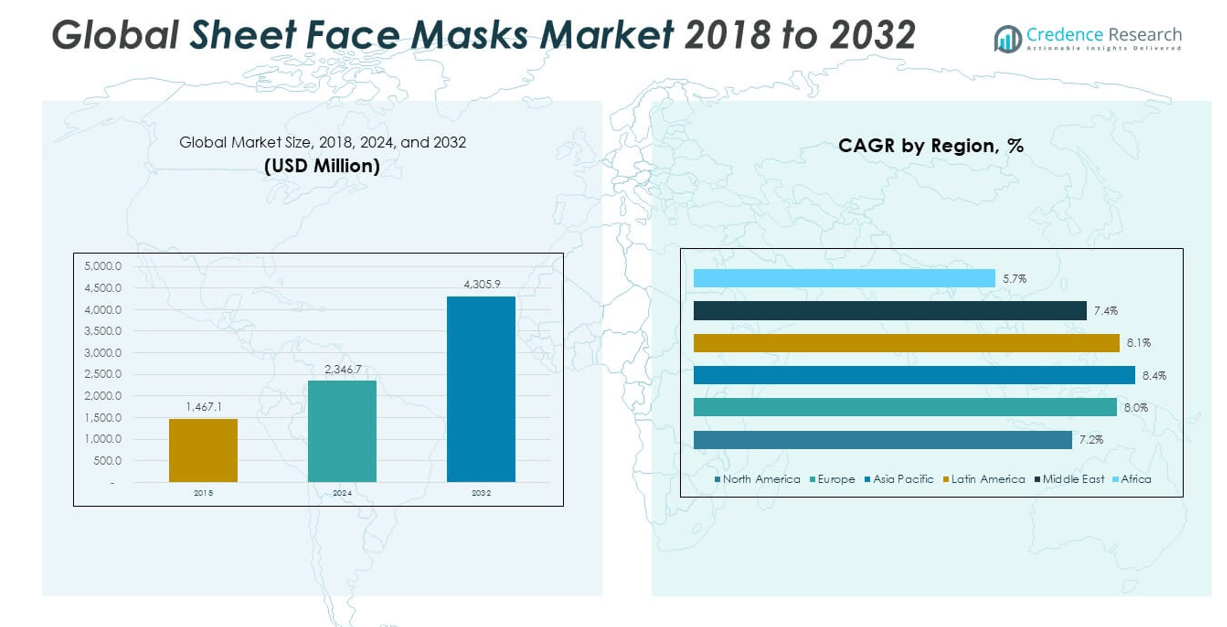
The Sheet Face Masks Market size was valued at USD 1,467.1 million in 2018 to USD 2,346.7 million in 2024 and is anticipated to reach USD 4,305.9 million by 2032, at a CAGR of 7.90% during the forecast period.
The growth of the sheet face masks market is primarily driven by rising consumer awareness regarding skincare and personal grooming. With an increasing focus on self-care routines, particularly among millennials and Gen Z, consumers are actively seeking easy-to-use skincare solutions that deliver quick and visible results. Sheet face masks, known for their hydrating, anti-aging, brightening, and soothing properties, are increasingly integrated into weekly skincare routines. The demand is further fueled by aggressive marketing campaigns and endorsements by beauty influencers, dermatologists, and social media trends. Technological innovations in mask formulation such as the infusion of active botanical ingredients, hyaluronic acid, peptides, and vitamin complexes enhance product appeal. In addition, the convenience of single-use formats, combined with expanding online and offline retail availability, has made these products accessible across urban and semi-urban areas. Eco-conscious trends are also influencing manufacturers to offer biodegradable sheet masks using sustainable fabrics like bamboo fiber, bio-cellulose, and cotton, catering to the growing preference for clean beauty products.
Asia-Pacific holds the largest share of the sheet face masks market, led by countries such as South Korea, Japan, and China, where skincare routines are deeply ingrained in daily lifestyles. The region is a global trendsetter in the beauty and cosmetics space, with K-beauty and J-beauty innovations significantly influencing product development and global demand. Asia-Pacific’s dominance is also supported by the presence of numerous manufacturers, affordable product pricing, and wide retail distribution networks. North America accounts for a substantial market share as well, driven by growing consumer interest in wellness, clean beauty, and premium skincare products. The U.S. leads this region, supported by strong e-commerce platforms and frequent product launches. Europe follows closely, with countries like Germany, France, and the U.K. embracing sustainable and natural beauty trends, aligning with strict cosmetic regulations. Emerging markets in Latin America and the Middle East & Africa are gaining traction, supported by urbanization, increasing disposable income, and the influence of global beauty brands.
Market Insights:
- The Sheet Face Masks Market was valued at USD 2,346.7 million in 2024 and is projected to reach USD 4,305.9 million by 2032, growing at a CAGR of 7.90% during the forecast period.
- Rising skincare awareness among millennials and Gen Z is driving the market, with a strong preference for convenient, effective, and easy-to-use beauty routines.
- Product innovation continues to evolve, with brands introducing masks infused with peptides, botanicals, hyaluronic acid, and vitamin complexes tailored for specific skin concerns.
- E-commerce and retail expansion have boosted accessibility across both developed and emerging regions, supporting wider adoption and brand visibility.
- Sustainability trends are influencing manufacturers to shift toward biodegradable materials, recyclable packaging, and clean-label ingredients.
- Market saturation in lower-price segments and rising environmental concerns pose challenges, urging brands to differentiate through innovation and eco-conscious practices.
- Asia-Pacific leads the global market, followed by North America and Europe, while Latin America, the Middle East, and Africa show promising growth driven by urbanization and beauty brand penetration.
Market Drivers:
Rising Consumer Awareness and Changing Skincare Habits
The global demand for skincare products is rapidly evolving, with sheet face masks gaining prominence due to their convenience and visible benefits. Consumers are increasingly prioritizing skincare over traditional cosmetics, focusing on hydration, brightening, and anti-aging outcomes. Urbanization and rising disposable incomes have expanded access to advanced skincare routines, encouraging frequent use of sheet masks. Social media platforms and influencer-driven marketing are accelerating product discovery and educating users on regular application. Brands are targeting younger demographics who actively engage with beauty content and prefer products that deliver quick results. The Sheet Face Masks Market is benefiting from these behavioral shifts, making it a recurring part of consumers’ weekly skincare rituals.
Product Innovation and Ingredient Diversification
Innovation remains a key competitive differentiator, driving consistent growth across product lines. Manufacturers are introducing sheet masks with advanced formulations that combine natural extracts, vitamins, peptides, and active botanicals to target specific skin concerns. Customized solutions catering to hydration, anti-aging, acne control, and skin brightening are enabling brands to address diverse consumer needs. It is responding to demand for cleaner, safer ingredients by incorporating vegan, cruelty-free, and paraben-free formulations. The integration of biotechnology, such as encapsulated serums and hydrogel layers, has enhanced the effectiveness and consumer appeal of new offerings. These advancements help brands differentiate in a saturated market and retain consumer interest through superior product performance.
Strong Distribution Channels and E-Commerce Penetration
Retail and e-commerce channels have become critical enablers for market expansion. The availability of sheet masks in supermarkets, beauty stores, pharmacies, and convenience outlets has increased their accessibility across urban and semi-urban regions. At the same time, online platforms provide global reach and offer customers the ability to compare ingredients, reviews, and prices with ease. The Sheet Face Masks Market benefits from this dual-channel strategy, which supports impulse purchases offline and planned buying online. Subscription models, influencer collaborations, and promotional bundles further enhance online sales performance. The rise in e-commerce during and after the pandemic has permanently shifted consumer behavior, giving digital-first brands a clear advantage.
- For example, BioRepublic introduced its Deep Hydration Organic Facial Sheet Mask (along with the Soothe & Calm Organic Facial Sheet Mask) into CVS stores starting March 3, 2023, as part of a nationwide retail rollout across thousands of locations.
Sustainability, Clean Beauty, and Ethical Consumerism
Environmental concerns and health-conscious decision-making are pushing brands to adopt sustainable practices. Biodegradable sheet materials, recyclable packaging, and low-impact manufacturing are becoming standard expectations. It is aligning with clean beauty trends by offering transparent ingredient lists and avoiding harmful chemicals. Consumers are more likely to choose products that reflect their values, including sustainability, cruelty-free testing, and ethical sourcing. Certifications such as “vegan,” “organic,” and “eco-certified” help reinforce brand trust and loyalty. Regulatory changes and retailer requirements across Europe and North America are also reinforcing the demand for cleaner, greener sheet mask options.
- For example, BioRepublic Skincare offers organic sheet masks that carry USDA Organic certification and are made from 100% biodegradable, vegan, paraben-free, sulfate-free, phthalate-free, and cruelty‑free
Market Trends:
Growing Popularity of Hybrid and Multifunctional Sheet Masks
Consumers are showing strong interest in sheet masks that offer more than one function within a single application. Hybrid sheet masks that combine skin hydration with exfoliation, brightening, or firming capabilities are gaining traction across multiple demographic segments. These all-in-one solutions align with time-conscious lifestyles, reducing the need for multi-step routines. Brands are launching dual-chamber sheet masks and masks infused with ampoules or serums that activate upon use. The Sheet Face Masks Market is responding to this trend by developing masks with innovative delivery systems and layered formulations. This multifunctionality not only enhances consumer satisfaction but also strengthens brand loyalty through perceived value and performance.
Premiumization and Rise of Luxury Sheet Mask Offerings
A growing segment of consumers is willing to pay a premium for sheet masks that offer high-efficacy ingredients, luxurious textures, and elevated experiences. Luxury skincare brands are introducing gold-infused, caviar-based, and silk sheet masks that cater to high-income consumers and spa-like routines at home. It is shifting from being seen as a low-cost, mass-market product to one that can sit in the premium skincare category. Packaging innovations such as single-use glass vials, vacuum-sealed sachets, and temperature-controlled masks also add to the luxury appeal. This premiumization trend is most visible in Asia-Pacific and North America, where skincare spending is rising. The move toward luxury is allowing brands to expand margins while offering exclusivity and enhanced perceived benefits.
- For example, Sulwhasoo’s First Care Activating Mask uses a hydrogel base infused with its signature JAUM Activator™, delivering visible hydration and soothing benefits. In consumer trials, most of users reported more radiant and comfortable skin after one use.
Personalization Through Technology and Data Integration
Technological advancements are enabling brands to personalize skincare solutions with greater precision. Mobile apps and skin diagnostic tools are now being used to recommend sheet masks tailored to individual skin types, concerns, and environmental conditions. Some companies are also exploring AI-powered skincare platforms and smart devices that scan the skin and suggest suitable sheet mask formulations. The Sheet Face Masks Market is evolving to accommodate these innovations by offering personalized subscription kits and QR code-enabled product journeys. Consumers value this hyper-personalized approach, which mimics the expertise of dermatologists and estheticians. It elevates the user experience and reinforces brand credibility through data-backed recommendations.
- For example, L’Oréal’s Perso device, for instance, uses a proprietary AI algorithm and a 6.5-inch IoT-enabled dispenser to analyze user selfies and environmental data, then formulates a single-use sheet mask with precise concentrations of actives such as hyaluronic acid, vitamin C, or niacinamide.
Inclusion of Medicinal and Dermatological Claims
There is an increasing incorporation of dermatologically tested and clinically backed ingredients in sheet masks. Products that claim to reduce inflammation, support skin barrier repair, or improve sensitivity tolerance are resonating with consumers facing chronic skin conditions. It is leveraging dermatological endorsements and clinical trial data to position sheet masks as both cosmetic and quasi-therapeutic products. This medical crossover is especially popular in Europe and South Korea, where regulatory structures support cosmeceuticals. Sheet masks infused with ceramides, peptides, niacinamide, and probiotics are gaining credibility and traction in both retail and clinical skincare spaces. These claims appeal to consumers who seek targeted results and professional-grade formulations in everyday skincare.
Market Challenges Analysis:
Environmental Concerns and Waste Management Issues
The widespread use of single-use sheet masks raises significant concerns about environmental sustainability. Most conventional sheet masks are made from synthetic fibers or non-biodegradable materials, which contribute to landfill waste and environmental degradation. The growing consumer awareness around eco-impact is prompting backlash against excessive packaging and disposability. The Sheet Face Masks Market faces pressure to adopt biodegradable substrates, recyclable materials, and low-waste manufacturing processes to retain environmentally conscious consumers. Brands that fail to address these concerns risk losing market share to competitors offering more sustainable alternatives. Regulatory bodies across Europe and North America are also tightening guidelines on packaging waste and product sustainability, creating compliance challenges for manufacturers.
Price Sensitivity and Market Saturation in Lower Segments
While affordability has driven mass-market adoption, price sensitivity remains a key constraint, particularly in emerging economies. Low production costs have encouraged an influx of generic products and private-label offerings, leading to intense competition and downward pricing pressure. It now faces saturation in the lower-price segments, where many products offer similar ingredients and benefits, making differentiation difficult. Consumers often struggle to distinguish between brands, reducing loyalty and encouraging brand switching. Profit margins in these segments are shrinking, forcing manufacturers to rethink their pricing strategies and value propositions. This saturation limits long-term growth potential unless companies invest in innovation, quality assurance, and brand-building to move up the value chain.
Market Opportunities:
Expansion into Emerging Markets and Untapped Demographics
Emerging economies across Asia, Latin America, and the Middle East present significant growth potential for the sheet face masks market. Rising disposable incomes, growing urban populations, and expanding beauty consciousness are creating favorable conditions for skincare product adoption. Consumers in these regions are increasingly receptive to global beauty trends and actively seek affordable, effective skincare solutions. The Sheet Face Masks Market can capitalize on this demand by introducing region-specific variants and establishing strategic retail partnerships. Brands that localize marketing strategies and offer culturally relevant product lines will gain a competitive edge. Penetrating Tier 2 and Tier 3 cities with cost-effective offerings can further enhance market reach.
Focus on Men’s Grooming and Professional Skincare Channels
The male grooming segment is evolving rapidly, creating new opportunities for sheet mask applications tailored to men’s skincare needs. Brands are launching masks that address concerns like oil control, post-shave hydration, and skin fatigue, backed by masculine branding and simplified usage instructions. It is also seeing traction in professional skincare channels such as spas, dermatology clinics, and wellness centers. These venues offer premium positioning and foster consumer trust through expert recommendations. Offering specialized SKUs for professional use can drive higher margins and elevate brand perception. Tapping into these alternative customer segments enables sustained growth beyond conventional beauty markets.
Market Segmentation Analysis:
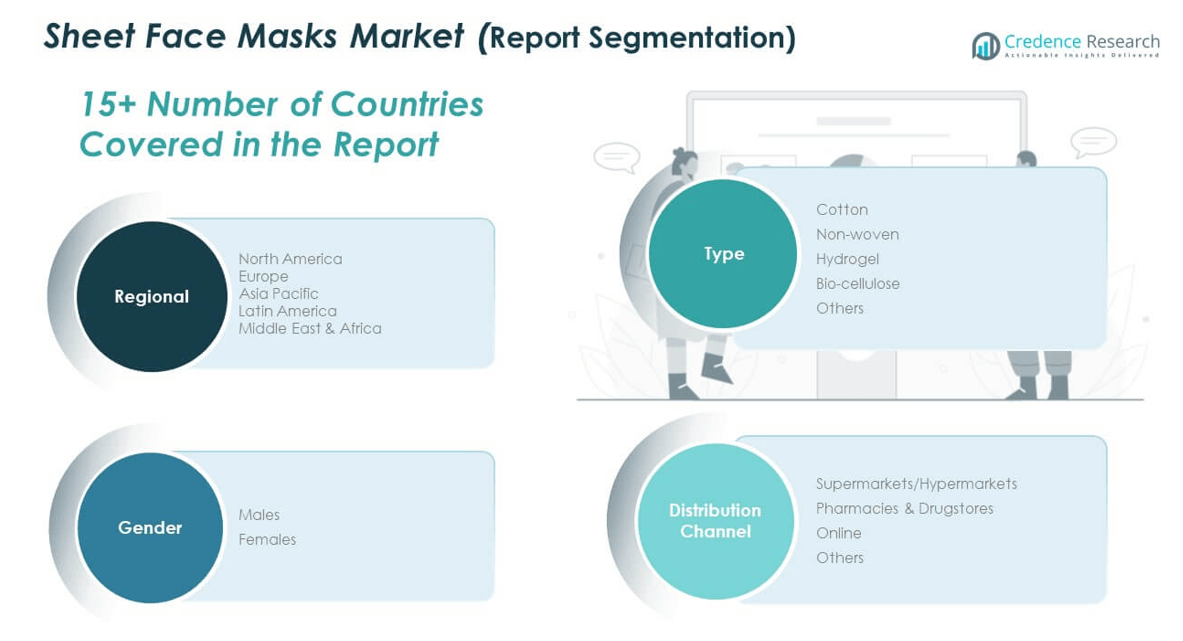
The Sheet Face Masks Market is segmented by type, gender, and distribution channel, reflecting diverse consumer needs and usage patterns.
By type, cotton and non-woven masks dominate volume sales due to their affordability and comfort, while hydrogel and bio-cellulose variants are gaining traction in the premium segment for their superior adherence and serum delivery. It is witnessing a growing shift toward bio-cellulose due to its natural composition and compatibility with biodegradable packaging trends.
- For example, Mediheal produces bio-cellulose sheet masks, which are praised for their superior adherence and natural fiber structure, often derived from plant-based sources such as fermented coconut water.
By gender segment is led by female consumers, who account for the majority of product adoption, though the male segment is expanding steadily with increased interest in grooming and skincare.
By distribution channel, supermarkets and hypermarkets hold a large market share due to widespread accessibility and in-store promotions. Pharmacies and drugstores attract consumers seeking dermatologist-recommended or clinically tested products. Online platforms are experiencing the fastest growth, driven by the convenience of home delivery, broader product selection, and influencer-led digital campaigns. The market continues to diversify across these segments.
- For example, Amazon’s U.S. skincare sales grew 21% year-over-year in 2024, with the overall Beauty & Personal Care category forecasted to reach USD 36 billion, marking a 26% YoY increase
Segmentation:
By Type:
- Cotton
- Non-woven
- Hydrogel
- Bio-cellulose
- Others
By Gender:
- Males
- Females
By Distribution Channel:
- Supermarkets/Hypermarkets
- Pharmacies & Drugstores
- Online
- Others
By Region:
- North America
- U.S.
- Canada
- Mexico
- Europe
- Germany
- France
- U.K.
- Italy
- Spain
- Rest of Europe
- Asia Pacific
- China
- Japan
- India
- South Korea
- South-east Asia
- Rest of Asia Pacific
- Latin America
- Brazil
- Argentina
- Rest of Latin America
- Middle East & Africa
- GCC Countries
- South Africa
- Rest of the Middle East and Africa
Regional Analysis:
The North America Sheet Face Masks Market size was valued at USD 273.91 million in 2018 to USD 421.34 million in 2024 and is anticipated to reach USD 732.01 million by 2032, at a CAGR of 7.2% during the forecast period. North America holds a 25% share of the global Sheet Face Masks Market, driven by high consumer spending on personal care and skincare products. The U.S. leads the region, supported by a strong presence of premium beauty brands, dermatology clinics, and wellness centers. Consumer interest in anti-aging and hydration benefits continues to boost demand for functional and clinical-grade masks. It benefits from well-established e-commerce channels and retail chains that offer diverse product selections. Increasing popularity of clean beauty and sustainable packaging is also reshaping product preferences in this market. Brands that emphasize dermatological backing and transparency are gaining consumer trust and loyalty.
The Europe Sheet Face Masks Market size was valued at USD 332.59 million in 2018 to USD 535.33 million in 2024 and is anticipated to reach USD 990.37 million by 2032, at a CAGR of 8.0% during the forecast period. Europe accounts for 31% of the global market share, making it the second-largest regional contributor. Countries such as Germany, France, and the U.K. are major markets, driven by rising demand for organic, vegan, and ethically sourced skincare products. Consumers in this region value ingredient transparency and environmental responsibility. The Sheet Face Masks Market in Europe is shaped by strict regulatory frameworks that promote quality and safety. Growth is also supported by expanding online beauty platforms and wellness-focused retail environments. Brands focusing on eco-friendly packaging and dermatologist-recommended ingredients are performing strongly in this market.
The Asia Pacific Sheet Face Masks Market size was valued at USD 552.51 million in 2018 to USD 907.32 million in 2024 and is anticipated to reach USD 1,722.37 million by 2032, at a CAGR of 8.4% during the forecast period. Asia Pacific holds the largest market share globally, accounting for 40% of total revenue. South Korea, Japan, and China dominate the region with their deeply rooted skincare cultures and innovation-driven beauty sectors. The Sheet Face Masks Market here is supported by early adoption of new product formats, celebrity endorsements, and affordable pricing. Consumers in this region regularly use sheet masks as part of daily skincare routines, creating repeat purchase behavior. It also benefits from a robust manufacturing base and strong export networks. Local brands and global entrants compete aggressively, contributing to a dynamic and fast-paced market environment.
The Latin America Sheet Face Masks Market size was valued at USD 153.31 million in 2018 to USD 247.45 million in 2024 and is anticipated to reach USD 459.44 million by 2032, at a CAGR of 8.1% during the forecast period. Latin America holds a 7% share of the global market, with Brazil and Mexico leading consumption. Rising beauty consciousness and social media influence are driving product visibility across younger consumers. The Sheet Face Masks Market in this region is expanding due to the growing availability of international brands and the emergence of local skincare manufacturers. Consumers favor brightening and hydrating masks suited to tropical climates. It is also gaining traction in pharmacies and beauty specialty stores, expanding product reach. Competitive pricing and culturally relevant marketing will play key roles in future growth.
The Middle East Sheet Face Masks Market size was valued at USD 104.31 million in 2018 to USD 162.73 million in 2024 and is anticipated to reach USD 288.50 million by 2032, at a CAGR of 7.4% during the forecast period. The Middle East contributes 5% to the global market share, with the UAE and Saudi Arabia emerging as key demand centers. The growing interest in high-end skincare and wellness is propelling the market forward, particularly in urban hubs. The Sheet Face Masks Market benefits from rising awareness of facial care routines and increasing female workforce participation. Luxury retailers and beauty clinics are actively expanding their sheet mask portfolios to meet demand. It is influenced by premium preferences, with consumers seeking products backed by international certifications. Expansion of online beauty platforms is also helping brands penetrate underserved segments.
The Africa Sheet Face Masks Market size was valued at USD 50.47 million in 2018 to USD 72.58 million in 2024 and is anticipated to reach USD 113.25 million by 2032, at a CAGR of 5.7% during the forecast period. Africa represents 2% of the global market share but offers notable potential for future expansion. South Africa, Nigeria, and Kenya are leading markets driven by rising middle-class income and urbanization. Awareness of skincare is growing, supported by social media influence and improved access to global beauty trends. The Sheet Face Masks Market is still in its early phase but gaining momentum through retail expansion and promotional campaigns. It remains price-sensitive, requiring brands to offer affordable yet effective solutions. Education on product usage and skin benefits will be essential for deeper market penetration.
Key Player Analysis:
- BioRepublic SkinCare
- ES Cosmetics
- Innisfree Corporation
- Kracie Holdings, Ltd.
- L’Oréal
- Lancôme Paris
- Sephora Inc.
- Tonymoly Co.
- DECLÉOR Paris
- Yunos Co. Ltd.
- Other Key Players
Competitive Analysis:
The Sheet Face Masks Market features intense competition with the presence of global cosmetic giants, regional manufacturers, and emerging indie brands. Leading players such as L'Oréal, Unilever, Procter & Gamble, and Shiseido continue to dominate through extensive product portfolios, strong distribution networks, and sustained marketing investments. It sees frequent product launches focusing on targeted skincare solutions, natural ingredients, and sustainable packaging to maintain consumer engagement. Regional companies from South Korea and Japan, including Innisfree, Mediheal, and SK-II, hold significant influence, especially in Asia-Pacific. Startups and niche brands are gaining traction by offering clean, vegan, and eco-friendly alternatives. The market also benefits from collaborations with influencers and dermatologists to enhance brand credibility. Private labels and retailer-exclusive brands intensify pricing competition, particularly in the mass-market segment. Innovation, product differentiation, and brand positioning remain critical success factors in capturing and retaining consumer loyalty across geographies.
Recent Developments:
- In June 2025, L’Oréal showcased its most advanced portfolio of beauty innovations at Viva Technology in Paris. The company introduced L’Oréal Longevity Integrative Science™, vertical farming technology for plant-based ingredients, and the YSL Beauty Hyper Look Studio. Additionally, L’Oréal Paris Beauty Genius, a 24/7 personal beauty assistant powered by Agentic AI, will soon be available on WhatsApp, enhancing personalized consumer engagement.
Market Concentration & Characteristics:
The Sheet Face Masks Market demonstrates moderate market concentration, with a mix of multinational corporations and regional players contributing to its competitive dynamics. It is characterized by frequent product innovation, short product life cycles, and strong influence from beauty trends and consumer preferences. The market remains highly brand-driven, with consumers often associating product quality with brand reputation. It also shows low entry barriers, allowing new entrants and niche brands to capture market share through clean-label claims and unique formulations. Seasonal demand, influencer marketing, and fast-changing packaging aesthetics further define the market’s dynamic nature. Distribution channels range from mass retail and specialty stores to direct-to-consumer platforms.
Report Coverage:
The research report offers an in-depth analysis based on Type, Gender and Distribution Channel. It details leading market players, providing an overview of their business, product offerings, investments, revenue streams, and key applications. Additionally, the report includes insights into the competitive environment, SWOT analysis, current market trends, as well as the primary drivers and constraints. Furthermore, it discusses various factors that have driven market expansion in recent years. The report also explores market dynamics, regulatory scenarios, and technological advancements that are shaping the industry. It assesses the impact of external factors and global economic changes on market growth. Lastly, it provides strategic recommendations for new entrants and established companies to navigate the complexities of the market.
Future Outlook:
- Demand for multifunctional sheet masks is expected to rise, driven by consumer preference for efficient skincare solutions.
- Biodegradable and eco-friendly materials will gain traction due to sustainability concerns and regulatory pressures.
- Personalization through AI-based skin analysis and diagnostic tools will create new product development opportunities.
- Men’s grooming segment will offer untapped potential with tailored formulations and branding strategies.
- Premium sheet masks featuring luxury ingredients will appeal to high-income consumers in mature markets.
- Emerging economies in Asia, Latin America, and Africa will drive volume growth through expanding retail access.
- Dermatologically tested and cosmeceutical sheet masks will see increased adoption in clinical skincare settings.
- E-commerce platforms will continue to dominate sales, supported by influencer-led promotions and virtual try-ons.
- Strategic collaborations between beauty tech firms and skincare brands will shape next-generation offerings.
- Brands investing in sustainable packaging and transparent labeling will gain competitive advantage and consumer trust.

Request a Free Sample
Fill in your details and we'll send you a free sample report.
- Sample data tables & charts
- Research methodology
Market Dynamics
Rising Skincare Awareness and Changing Habits
Increasing consumer focus on skincare, especially among millennials and Gen Z, is driving demand for convenient, effective sheet face masks that fit into modern self-care routines.
Product Innovation and Ingredient Diversification
Brands are launching sheet masks with advanced formulations, including botanicals, peptides, and vitamins, targeting specific skin concerns and appealing to consumers seeking tailored skincare solutions.
E-commerce and Retail Expansion
The growth of online platforms and wider retail distribution has made sheet face masks more accessible, supporting impulse purchases and planned buying across both developed and emerging markets.
Sustainability and Clean Beauty Trends
Consumer demand for eco-friendly, biodegradable materials and clean-label ingredients is pushing manufacturers to innovate with sustainable sheet masks, attracting environmentally conscious buyers.
Influencer and Social Media Marketing
Aggressive marketing campaigns, influencer endorsements, and viral social media trends are accelerating product discovery and adoption, especially among younger demographics.
Need a Custom Version of This Report?
Tailor the scope, geography, or segments to your exact requirements.
- Custom geography or segment scope
- Direct access to our analyst team
Frequently Asked Questions
What is the size of Sheet Face Masks Market?
What factors are driving the growth of the Sheet Face Masks Market?
What are some challenges faced by the Sheet Face Masks Market?
Who are the major players in this market?
Table of Content
Chapter 1 Market Segmentation
- 1.1 Segmentation Framework
- 1.1.1 Product and Service Classification
- 1.1.2 Application and End-Use Classification
- 1.1.3 Technology and Solution Classification
- 1.1.4 Customer and Distribution Channel Classification
- 1.1.5 Geographic Segmentation
- 1.1.6 Market Segment Definitions and Boundaries
- 1.2 By Type
- 1.2.1 Cotton
- 1.2.2 Non-woven
- 1.2.3 Hydrogel
- 1.2.4 Bio-cellulose
- 1.2.5 Others
- 1.3 By Gender
- 1.3.1 Males
- 1.3.2 Females
Chapter 2 Introduction
- 2.1 Report Objectives and Scope
- 2.2 Product Definition and Industry Terminology
- 2.3 Market Inclusions and Exclusions
- 2.4 Research Process
- 2.4.1 Primary Research and Expert Interviews
- 2.4.2 Secondary Research and Source Review
- 2.4.3 Top-Down and Bottom-Up Estimation
- 2.4.4 Data Triangulation and Verification
- 2.5 Market Size Measurement Basis
- 2.5.1 2024: USD 2,346.7 million → 2032: USD 4,305.9 million
- 2.6 Historical and Forecast Reference Periods
- 2.6.1 Base Year: 2024
- 2.6.2 Forecast Period: 2024-2032
- 2.7 Research Assumptions and Limitations
Chapter 3 Executive Summary
- 3.1 Market Snapshot and Key Findings
- 3.2 Base-Year Market Size, 2024
- 3.3 Forecast Market Size, 2032
- 3.4 Revenue and Volume Growth Outlook
- 3.5 Key Demand and Supply Indicators
- 3.6 Leading Market Segments
- 3.7 Fastest-Growing Market Opportunities
- 3.8 Regional Performance Highlights
- 3.9 Technology and Industry Transformation
- 3.10 Competitive Landscape Summary
- 3.11 Analyst View and Strategic Implications
Chapter 4 Global Sheet Face Masks Market Trends and Developments
- 4.1 Historical Industry Development
- 4.2 Recent Market Trends and Developments
- 4.3 Demand and Customer Behavior Trends
- 4.4 Technology and Product Innovation
- 4.5 Artificial Intelligence, Automation and Digitalization
- 4.6 Local Manufacturing and Supply Chain Realignment
- 4.7 Industry Partnerships, Mergers and Acquisitions
- 4.8 Sustainability and Circular Economy Developments
- 4.9 Government and Private Sector Investment Trends
- 4.10 Emerging Business Models and Commercialization
- 4.11 Industry Developments and Announcements
Chapter 5 Global Sheet Face Masks Market Production, Supply and Demand Analysis
- 5.1 Demand Trend and Consumption Analysis
- 5.2 Demand Forecast, 2024-2032
- 5.3 Production and Output Trend
- 5.4 Production and Output Forecast, 2024-2032
- 5.5 Installed Capacity and Capacity Utilization
- 5.6 Company-Wise Production Plants and Statistics
- 5.6.1 Installed Production Capacity
- 5.6.2 Actual Production
- 5.6.3 Planned Capacity and Expansion Targets
- 5.7 Supply Chain Structure and Procurement Trends
- 5.8 Supply-Demand Gap and Bottlenecks
- 5.9 Import Dependence and Sourcing Structure
- 5.10 Contract Manufacturing and Outsourcing
- 5.11 Regional Supply and Demand Concentration
Chapter 6 Global Sheet Face Masks Market Pricing Analysis
- 6.1 Pricing Structure and Measurement
- 6.2 Historical Pricing Trends
- 6.3 Pricing Outlook, 2024-2032
- 6.4 Average Selling Price and Unit Economics
- 6.5 Pricing by Product and Market Segment
- 6.6 Geographic Pricing Differences
- 6.7 Key Input, Energy, Labor and Logistics Costs
- 6.8 Contract Pricing and Purchasing Models
- 6.9 Pricing Sensitivity and Competitive Positioning
- 6.10 Price, Margin and Profitability Implications
Chapter 7 Global Sheet Face Masks Market Dynamics
- 7.1 Market Growth Drivers
- 7.1.1 Demand-Side Drivers
- 7.1.2 Technology and Innovation Drivers
- 7.1.3 Infrastructure and Investment Drivers
- 7.1.4 Regulatory and Policy Drivers
- 7.2 Market Restraints
- 7.2.1 Cost and Affordability Constraints
- 7.2.2 Technology and Adoption Barriers
- 7.2.3 Supply Chain and Operational Constraints
- 7.3 Market Challenges
- 7.3.1 Competitive Pressure and Margin Erosion
- 7.3.2 Skills, Infrastructure and Implementation Gaps
- 7.4 Emerging Market Opportunities
- 7.5 Market Dynamics Impact and Time-Horizon Assessment
Chapter 8 Global Sheet Face Masks Value Chain Analysis
- 8.1 Industry Value Chain Overview
- 8.2 Upstream Suppliers and Critical Inputs
- 8.3 Technology and Component Providers
- 8.4 Manufacturing or Service Delivery
- 8.5 Distribution, Channel Partners and Integrators
- 8.6 Downstream Applications and End Users
- 8.7 Value Addition and Profit Pools
- 8.8 Vertical Integration and Outsourcing
- 8.9 Supplier Concentration and Risk
- 8.10 Supply Chain Localization and Resilience
Chapter 9 Global Sheet Face Masks Market Regulations and Policies
- 9.1 Relevant Laws, Standards and Compliance Frameworks
- 9.2 Product, Service, Safety and Quality Requirements
- 9.3 Government Policies, Incentives and Subsidies
- 9.4 Imports, Exports and Trade Barriers
- 9.5 Public Procurement and Local Content Requirements
- 9.6 Environmental and Sustainability Compliance
- 9.7 Upcoming Policy Changes and Market Implications
Chapter 10 Global Sheet Face Masks Market Hotspots and Opportunities
- 10.1 Market Opportunity Mapping and Growth Hotspots
- 10.2 High-Growth Applications and Customer Groups
- 10.3 Underserved Markets and White-Space Opportunities
- 10.4 Emerging Technology and Product Opportunities
- 10.5 New Capacity and Investment Hotspots
- 10.6 Market Entry and Expansion Opportunities
- 10.7 Distribution and Partnership Opportunities
- 10.8 Near-Term and Long-Term Commercial Potential
- 10.9 Opportunity Attractiveness and Execution Risks
Chapter 11 Global Sheet Face Masks Market Outlook, 2024-2032
- 11.1 Market Size and Analysis
- 11.1.1 Revenue (Market Measurement: 2024: USD 2,346.7 million → 2032: USD 4,305.9 million)
- 11.1.2 Market Volume and Quantity Sold
- 11.1.3 Historical Market Size
- 11.1.4 Base-Year Market Size, 2024
- 11.2 Market Forecast, 2024-2032
- 11.2.1 Revenue Forecast to 2032
- 11.2.2 Volume Forecast to 2032
- 11.2.3 CAGR and Year-on-Year Growth
- 11.2.4 Incremental Revenue Opportunity
- 11.3 Forecast Assumptions and Scenario Analysis
- 11.3.1 Base-Case Forecast
- 11.3.2 Optimistic and Conservative Scenarios
- 11.3.3 Technology, Pricing and Policy Sensitivities
- 11.4 Market Attractiveness and Growth Outlook
Chapter 12 Global Sheet Face Masks Market Segmentation and Outlook
- 12.1 Segmentation Summary and Market Shares, 2024
- 12.2 Largest and Fastest-Growing Segments
- 12.3 By Type - Market Size and Forecast, 2024-2032
- 12.3.1 Segment Definition and Scope
- 12.3.2 Historical Market Size
- 12.3.3 Revenue Forecast, 2024-2032
- 12.3.4 Volume Forecast, 2024-2032
- 12.3.5 Base-Year Market Share, 2024
- 12.3.6 Segment CAGR and Growth Drivers
- 12.3.7 Subsegment Market Size and Forecast
- 12.3.7.1 Cotton
- 12.3.7.2 Non-woven
- 12.3.7.3 Hydrogel
- 12.3.7.4 Bio-cellulose
- 12.3.7.5 Others
- 12.3.8 Subsegment Pricing and Adoption Trends
- 12.3.9 Leading Suppliers and Competition
- 12.3.10 Regional Demand and Opportunities
- 12.4 By Gender - Market Size and Forecast, 2024-2032
- 12.4.1 Segment Definition and Scope
- 12.4.2 Historical Market Size
- 12.4.3 Revenue Forecast, 2024-2032
- 12.4.4 Volume Forecast, 2024-2032
- 12.4.5 Base-Year Market Share, 2024
- 12.4.6 Segment CAGR and Growth Drivers
- 12.4.7 Subsegment Market Size and Forecast
- 12.4.7.1 Males
- 12.4.7.2 Females
- 12.4.8 Subsegment Pricing and Adoption Trends
- 12.4.9 Leading Suppliers and Competition
- 12.4.10 Regional Demand and Opportunities
- 12.5 Segment Growth Comparison
- 12.6 Segment Attractiveness and Priority Matrix
Chapter 13 Global Sheet Face Masks Geographic Market Outlook, 2024-2032
- 13.1 Regional Market Size and Share, 2024
- 13.2 Regional Market Forecast, 2024-2032
- 13.3 Regional Pricing, Production and Demand Differences
- 13.4 North America
- 13.4.1 United States
- 13.4.2 Canada
- 13.4.3 Mexico
- 13.5 Europe
- 13.5.1 Germany
- 13.5.2 France
- 13.5.3 Italy
- 13.5.4 United Kingdom
- 13.5.5 Spain
- 13.5.6 Poland
- 13.5.7 Russia
- 13.5.8 Netherlands
- 13.5.9 Belgium
- 13.5.10 Sweden
- 13.5.11 Denmark
- 13.5.12 Norway
- 13.5.13 Rest of Europe
- 13.6 Asia Pacific
- 13.6.1 China
- 13.6.2 India
- 13.6.3 Japan
- 13.6.4 South Korea
- 13.6.5 Thailand
- 13.6.6 Indonesia
- 13.6.7 Vietnam
- 13.6.8 Malaysia
- 13.6.9 Australia
- 13.6.10 Rest of Asia Pacific
- 13.7 Latin America
- 13.7.1 Brazil
- 13.7.2 Argentina
- 13.7.3 Colombia
- 13.7.4 Chile
- 13.7.5 Rest of Latin America
- 13.8 Middle East
- 13.8.1 Saudi Arabia
- 13.8.2 United Arab Emirates
- 13.8.3 Turkey
- 13.8.4 Israel
- 13.8.5 Iran
- 13.8.6 Rest of the Middle East
- 13.9 Africa
- 13.9.1 South Africa
- 13.9.2 Egypt
- 13.9.3 Nigeria
- 13.9.4 Morocco
- 13.9.5 Rest of Africa
- 13.10 Regional Investment, Policy and Supply Chain Differences
- 13.11 Regional Competitive Landscape
- 13.12 Geographic Growth Hotspots
Chapter 14 Global Sheet Face Masks Technology, Innovation and Sustainability Outlook
- 14.1 Technology Landscape and Maturity
- 14.2 Product, Process and Service Innovation
- 14.3 AI, Automation and Digital Tools in the Industry
- 14.4 Technology Adoption and Performance Benchmarking
- 14.5 Innovation Pipeline and R&D Investment
- 14.6 Patent and Intellectual Property Trends
- 14.7 Energy Efficiency and Resource Management
- 14.8 Sustainability, Recycling and Circularity
- 14.9 Technology Roadmap, 2024-2032
- 14.10 Risks of Obsolescence and Technology Substitution
Chapter 15 Global Sheet Face Masks Market Key Strategic Imperatives
- 15.1 Growth and Market Entry Priorities
- 15.2 High-Return Products and Segments
- 15.3 Pricing, Profitability and Cost Optimization
- 15.4 Technology Investment and Product Differentiation
- 15.5 Supply Chain Localization and Resilience
- 15.6 Distribution and Customer Acquisition
- 15.7 Partnership, Acquisition and Capacity Strategy
- 15.8 Regional Expansion Priorities
- 15.9 Short-, Medium- and Long-Term Actions
Chapter 16 Competition Outlook
- 16.1 Industry Competition Characteristics
- 16.2 Market Structure and Concentration
- 16.3 Market Share and Competitive Positioning, 2024
- 16.4 Company-Wise Revenue and Product Benchmarking
- 16.5 Production and Service Capacity Benchmarking
- 16.6 Technology, Pricing and Differentiation
- 16.7 Regional Footprint and Distribution Strength
- 16.8 Mergers, Acquisitions and Strategic Alliances
- 16.9 New Entrants and Competitive Threats
- 16.10 Porter's Five Forces and Industry Attractiveness
- 16.11 Competitive Outlook, 2024-2032
Chapter 17 Company Profiles
- 17.1 Company Coverage and Selection Criteria
- 17.2 L'Oréal
- 17.2.1 Business Description
- 17.2.2 Company Ownership and Geographic Presence
- 17.2.3 Product and Service Portfolio
- 17.2.4 Manufacturing and Operating Footprint
- 17.2.5 Production Capacity and Expansion Plans
- 17.2.6 Financial Performance and Investment
- 17.2.7 Market Share and Competitive Position
- 17.2.8 Technology and Innovation Capabilities
- 17.2.9 Strategic Alliances or Partnerships
- 17.2.10 Recent Developments
- 17.2.11 Growth Strategy and Outlook
- 17.3 Innisfree Corporation
- 17.4 Tonymoly Co.
- 17.5 BioRepublic SkinCare
- 17.6 Kracie Holdings, Ltd.
- 17.7 Sephora Inc.
- 17.8 DECLÉOR Paris
- 17.9 Yunos Co. Ltd.
- 17.10 Unilever
- 17.11 Shiseido
- 17.12 Other Relevant Market Participants
Note: Every listed company is profiled on the structure shown under the first company. The company list is preliminary and may change based on research findings, market developments, data availability and client requirements.
Chapter 18 Disclaimer
- 18.1 Research and Forecast Disclaimer
- 18.2 Data Source and Estimation Limitations
Note: The depth of individual sections depends on data availability for this market. Volume, capacity, trade and other unit-based metrics are included where applicable.

