
Market Overview
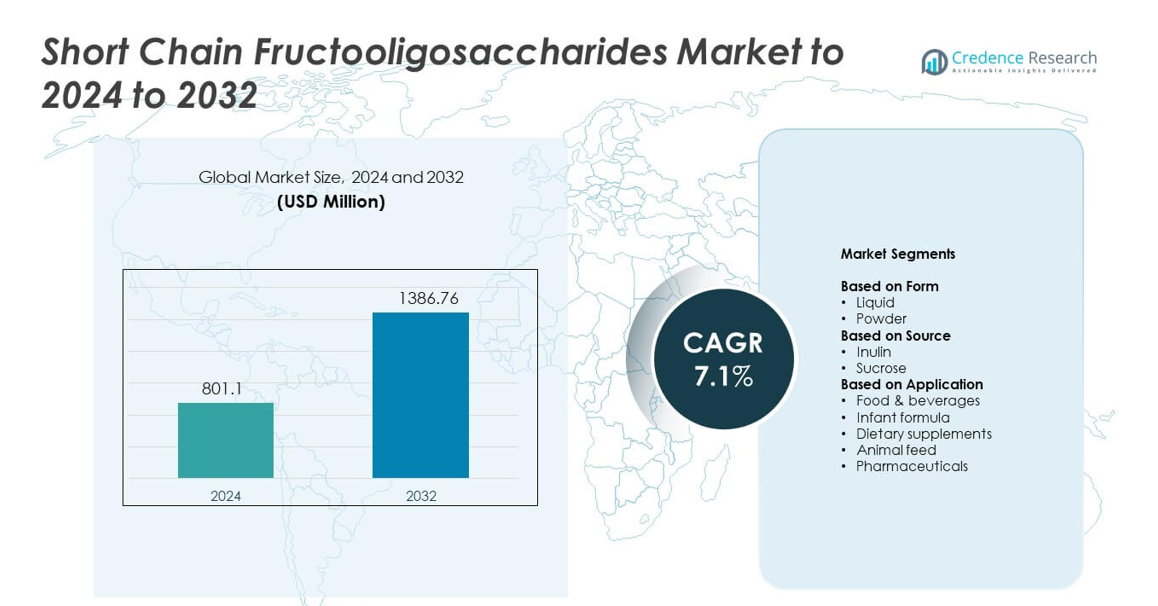
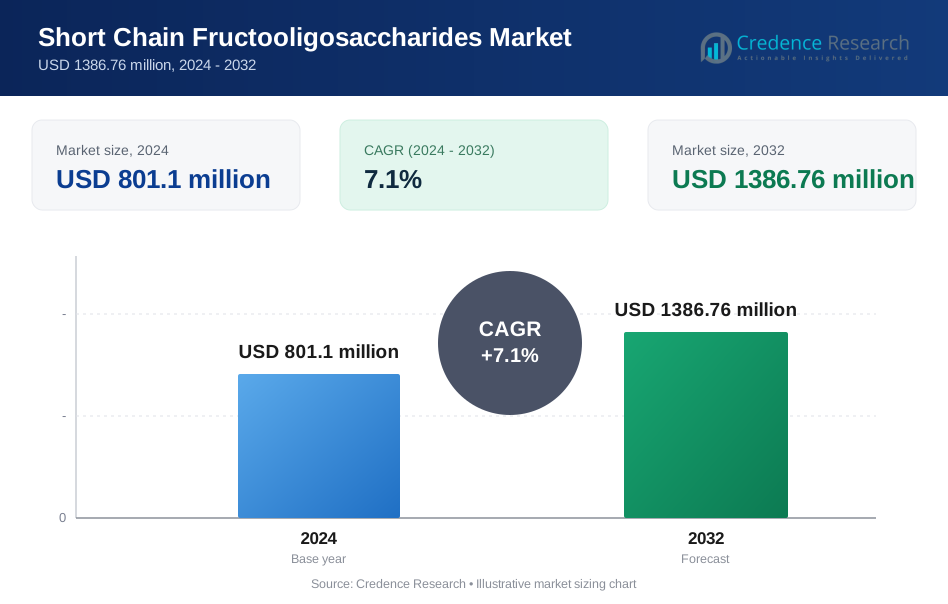
Short Chain Fructooligosaccharides Market size was valued at USD 801.1 million in 2024 and is anticipated to reach USD 1386.76 million by 2032, at a CAGR of 7.1% during the forecast period.
| REPORT ATTRIBUTE | DETAILS |
|---|---|
| Historical Period | 2020-2023 |
| Base Year | 2024 |
| Forecast Period | 2025-2032 |
| Short Chain Fructooligosaccharides Market Size 2024 | USD 801.1 million |
| Short Chain Fructooligosaccharides Market, CAGR | 7.1% |
| Short Chain Fructooligosaccharides Market Size 2032 | USD 1386.76 million |
The Short Chain Fructooligosaccharides Market includes major players such as Baolingbao Biology, Jarrow Formulas, Cargill Incorporated, Galam Ltd, Cosucra, Ingredion, Nutriagaves Group, Alkem Labs, and BENEO GmbH, each expanding capabilities to meet rising demand for prebiotic ingredients across food, infant formula, and dietary supplements. These companies strengthen their portfolios through advanced enzymatic processing, higher-purity offerings, and wider application support. Asia Pacific emerged as the leading region with about 34% share in 2024, driven by strong functional food consumption, large-scale infant formula production, and growing health awareness across major economies.
Market Insights
- Short Chain Fructooligosaccharides Market reached USD 801.1 million in 2024 and is projected to hit USD 1386.76 million by 2032 at a CAGR of 7.1%.
- Growth is driven by rising demand for digestive health products and expanding use of prebiotic fibers in food, beverages, supplements, and infant formula.
- Clean-label trends and adoption of low-sugar, fiber-rich formulations boost inclusion of FOS across bakery, dairy, plant-based, and wellness categories.
- Leading players enhance processing efficiency and product purity while expanding partnerships across nutrition and functional food sectors.
- Asia Pacific led the market with 34% share in 2024, followed by North America at 32% and Europe at 28%, while the powder form segment dominated with about 62% share.
Market Segmentation Analysis:
By Form
Powder led the Short Chain Fructooligosaccharides Market in 2024 with about 62% share. Strong demand came from its high stability, easy blending, and longer shelf life across packaged foods and dietary supplements. The powder format also supports efficient transport and bulk handling for large manufacturers. Liquid FOS grew at a steady pace due to rising use in beverages, syrups, and infant nutrition where fast dissolution is required. Growth across both forms is supported by rising clean-label demand and the shift toward prebiotic ingredients in global health and wellness products.
- For instance, Ingredion offers its NutraFlora short-chain fructooligosaccharide (scFOS) in both a highly concentrated syrup form (approximately 70% dry substance) and a powder form.
By Source
Inulin remained the dominant source in 2024 with nearly 70% share. Manufacturers preferred inulin-derived short chain FOS due to its strong availability, cost efficiency, and natural origin from chicory root. This source also supports higher purity and consistent composition, which helps formulators maintain stable taste and texture. Sucrose-derived FOS grew due to expanding production in Asia and its flexible processing advantages. Rising use of non-synthetic prebiotic fibers in functional foods continues to drive demand across both sources.
- For instance, Tata Chemicals specifies that its FOSSENCE short-chain fructooligosaccharide is manufactured by biotransformation of cane sugar and consists of molecules with a degree of polymerization between 3 and 5, confirming a sucrose-derived scFOS source profile.
By Application
Food and beverages held the leading position in 2024 with around 48% share. Growth came from increasing use of short chain FOS in bakery, dairy, beverages, and low-sugar formulations to enhance fiber intake and improve digestive support. Infant formula remained a strong contributor due to growing adoption of prebiotic blends that mimic human milk oligosaccharides. Dietary supplements expanded with rising gut-health awareness, while animal feed and pharmaceuticals added niche but stable demand. Clean-label trends and global consumer focus on digestive wellness continue to strengthen application growth.
Key Growth Drivers
Rising Demand for Digestive Health Products
Growing awareness of gut health and the role of prebiotics drives strong adoption of short chain fructooligosaccharides. Consumers now seek fiber-rich ingredients that support digestion and immunity, which boosts use in foods, beverages, and supplements. Brands expand functional product lines containing FOS due to its clean-label profile and strong safety record. This shift toward preventive health continues to raise demand across global markets.
- For instance, Tereos notes that a single teaspoon of its Actilight short-chain fructooligosaccharide provides dietary fibre equivalent to that found in 10 bananas, 700 grams of rye bread or 40 cloves of garlic, underlining how concentrated scFOS helps consumers increase fibre intake for gut health in small serving sizes.
Expansion of Infant Nutrition and Functional Formulations
Infant formula manufacturers increasingly add short chain fructooligosaccharides to mimic natural prebiotic activity found in human milk. This trend strengthens market growth as parents prefer formulas that support healthy gut flora and immunity. FOS also improves product stability and blends well with other nutrients, enhancing formulation flexibility. Rising birth rates in key regions and greater adoption of premium formula options support continued expansion.
- For instance, BENEO-Orafti documents that its Orafti oligofructose, produced from chicory root, has a degree of polymerization between 2 and 8 and is purified further to meet stringent quality requirements, explicitly including standards for infant nutrition, supporting its use in premium formula and toddler products.
Shift Toward Low-Sugar and Fiber-Enhanced Foods
Food producers adopt short chain fructooligosaccharides to reduce sugar while improving taste and texture. FOS provides mild sweetness and added fiber, which supports reformulation efforts in dairy, bakery, snacks, and beverages. Growing regulatory pressure on sugar reduction accelerates this trend. As consumers choose healthier alternatives with balanced nutrition, demand for FOS in food applications continues to grow.
Key Trends and Opportunities
Growth in Clean-Label and Plant-Based Product Development
Short chain fructooligosaccharides align well with clean-label, natural, and plant-based positioning. Brands use FOS to enhance fiber levels without altering flavor, which supports expansion in plant-based dairy, wellness beverages, and functional snacks. Consumers increasingly prefer transparent ingredient lists, creating strong opportunities for FOS suppliers to partner with manufacturers focused on natural product development. This trend expands application scope across mainstream retail categories.
- For instance, Nutriagaves de México offers a portfolio of Olifructine ingredients derived from blue agave. Their agave inulin products provide a range of fructans with a broad degree of polymerization (DP), typically from 3 up to around 42.
Advances in Prebiotic Research and Product Innovation
New studies on gut microbiome health encourage broader use of FOS in specialized nutrition. Manufacturers explore advanced blends that combine FOS with other prebiotics to deliver targeted digestive support. This research-driven innovation fuels opportunities in sports nutrition, medical foods, and immunity-boosting products. As scientific validation grows, brands gain confidence to include FOS in more value-added formulations.
- For instance, a 2024 Microbial Cell Factories study on the industrial FOS-producing fungus Aspergillus niger ATCC 20611 showed that engineered strains GOF-3 and DPOC-11 reduced glucose in the reaction mixture from 178.33 milligrams per millilitre to 89.33 milligrams per millilitre after 10 hours, demonstrating higher-purity fructooligosaccharide production through advanced bioprocess design.
Rising Demand in Animal Nutrition
Short chain fructooligosaccharides gain traction in animal feed due to their ability to support gut integrity and improve nutrient absorption. Producers focus on natural additives as alternatives to antibiotic growth promoters, boosting demand for prebiotic fibers. Growth in poultry and aquaculture production strengthens opportunities for FOS inclusion in feed blends. This expansion creates a new revenue channel for suppliers.
Key Challenges
High Production Cost and Complex Processing
Manufacturing short chain fructooligosaccharides requires advanced enzymatic processes and strict quality control. These factors raise production costs and limit access for price-sensitive markets. Smaller manufacturers face difficulties scaling operations due to equipment investment and purification requirements. Cost pressure affects competitiveness and may slow adoption in lower-margin food categories.
Regulatory Variations Across Global Markets
Different countries apply varied regulations for prebiotic claims, safety approvals, and labeling standards. These inconsistencies create barriers for manufacturers seeking global expansion. Companies must adjust product claims and formulations to meet regional rules, which increases compliance expenses. Slow approval timelines in some regions also delay market entry and affect innovation speed.
Regional Analysis
North America
North America held around 32% share of the Short Chain Fructooligosaccharides Market in 2024. Growth came from strong adoption of prebiotic fibers in functional foods, nutritional beverages, and dietary supplements. Rising consumer focus on gut health and clean-label ingredients supports steady expansion across major product categories. The United States leads regional demand due to high innovation activity and wider use in infant formula and wellness products. Increasing penetration in sports nutrition and reduced-sugar formulations continues to strengthen the market outlook.
Europe
Europe accounted for nearly 28% share in 2024, supported by mature demand for digestive health ingredients and strict nutrition standards. Manufacturers integrate short chain fructooligosaccharides into bakery, dairy, baby food, and plant-based products to meet rising fiber expectations. Regulatory encouragement toward reduced sugar and improved gut health further boosts inclusion in mainstream food categories. Countries such as Germany, the Netherlands, and the United Kingdom drive innovation in prebiotic-enriched products. Expanding applications in clinical nutrition and elderly care also enhance long-term growth.
Asia Pacific
Asia Pacific dominated the market in 2024 with about 34% share. Strong demand came from expanding infant formula production, rising functional food consumption, and increasing health awareness across China, Japan, South Korea, and India. Local manufacturers scale output of inulin- and sucrose-based FOS, improving regional supply and reducing production costs. Rapid urbanization and growing digestive health concerns drive wider use in beverages, snacks, and dietary supplements. The region continues to show the fastest growth due to large population size and rising spending on nutritional products.
Latin America
Latin America captured close to 4% share in 2024, supported by growing interest in digestive wellness and functional ingredients. Countries such as Brazil and Mexico witness rising adoption of short chain fructooligosaccharides in dairy, bakery, and beverage applications. Local food producers increasingly reformulate to meet consumer demand for higher fiber intake and reduced sugar. Awareness campaigns on gut health support market penetration, while expanding retail access to prebiotic supplements strengthens demand. Growth remains steady as manufacturers explore cost-effective FOS integration in mainstream foods.
Middle East and Africa
The Middle East and Africa held nearly 2% share in 2024. Market expansion remains gradual due to lower awareness of prebiotic benefits and limited local production capacity. However, rising demand for fortified foods, infant formula, and imported nutritional products supports incremental growth. Urban consumers show increasing interest in digestive health, which encourages food producers to add fiber-enhancing ingredients. Gulf countries lead adoption due to higher purchasing power and wider availability of functional foods. Improving healthcare access and nutrition education continues to create new opportunities for FOS inclusion.
Market Segmentations:
By Form
- Liquid
- Powder
By Source
- Inulin
- Sucrose
By Application
- Food & beverages
- Infant formula
- Dietary supplements
- Animal feed
- Pharmaceuticals
By Geography
- North America
- U.S.
- Canada
- Mexico
- Europe
- Germany
- France
- U.K.
- Italy
- Spain
- Rest of Europe
- Asia Pacific
- China
- Japan
- India
- South Korea
- South-east Asia
- Rest of Asia Pacific
- Latin America
- Brazil
- Argentina
- Rest of Latin America
- Middle East & Africa
- GCC Countries
- South Africa
- Rest of the Middle East and Africa
Competitive Landscape
The Short Chain Fructooligosaccharides Market features key players such as Baolingbao Biology, Jarrow Formulas, Cargill Incorporated, Galam Ltd, Cosucra, Ingredion, Nutriagaves Group, Alkem Labs, and BENEO GmbH. Companies in this space focus on expanding production capacity, improving enzymatic processing efficiency, and enhancing purity levels to meet rising global demand for high-quality prebiotics. Many manufacturers strengthen partnerships with food, beverage, infant nutrition, and supplement brands to support large-scale formulation needs. Firms also invest in research to validate digestive health benefits, improve product stability, and develop versatile FOS formats that blend smoothly across applications. Growing interest in clean-label and plant-based products drives innovation, while strategic distribution expansions help increase market reach. Regulatory compliance and alignment with global food safety standards remain priorities as companies work to access new regions.
Key Player Analysis
- Baolingbao Biology
- Jarrow Formulas
- Cargill Incorporated
- Galam Ltd
- Cosucra
- Ingredion
- Nutriagaves Group
- Alkem Labs
- BENEO GmbH
Recent Developments
- In 2024, Nutriagaves de México expanded its agave-derived FOS line with new organic-certified agave FOS products, targeting demand for low-glycemic, prebiotic sweeteners based on short-chain fructooligosaccharides.
- In 2023, BENEO expanded its portfolio with the launch of Beneo-scL85, a short-chain fructooligosaccharide (scFOS) ingredient in syrup form aimed at sugar reduction and fiber enrichment
Report Coverage
The research report offers an in-depth analysis based on Form, Source, Application and Geography. It details leading market players, providing an overview of their business, product offerings, investments, revenue streams, and key applications. Additionally, the report includes insights into the competitive environment, SWOT analysis, current market trends, as well as the primary drivers and constraints. Furthermore, it discusses various factors that have driven market expansion in recent years. The report also explores market dynamics, regulatory scenarios, and technological advancements that are shaping the industry. It assesses the impact of external factors and global economic changes on market growth. Lastly, it provides strategic recommendations for new entrants and established companies to navigate the complexities of the market.
Future Outlook
- Demand for digestive health products will continue to rise across major regions.
- Use of FOS in infant formula will expand due to growing focus on gut microbiome support.
- Food and beverage manufacturers will increase FOS adoption for sugar reduction and fiber enrichment.
- Prebiotic research will drive new product formulations in medical and clinical nutrition.
- Supplement brands will scale FOS-based offerings as consumers seek natural wellness solutions.
- Plant-based and clean-label trends will boost integration of FOS in dairy alternatives and snacks.
- Animal nutrition applications will grow as producers shift toward natural gut-support solutions.
- Production capacity will increase as manufacturers invest in advanced enzymatic technologies.
- Regulatory clarity on prebiotic claims will support wider global market expansion.
- Rising awareness of microbiome health will drive long-term demand across all application segments.
Request a Free Sample
Fill in your details and we'll send you a free sample report.
- Sample data tables & charts
- Research methodology
Need a Custom Version of This Report?
Tailor the scope, geography, or segments to your exact requirements.
- Custom geography or segment scope
- Direct access to our analyst team
Frequently Asked Questions
What is the current market size for Short Chain Fructooligosaccharides Market, and what is its projected size in 2032?
At what Compound Annual Growth Rate is the Short Chain Fructooligosaccharides Market projected to grow between 2024 and 2032?
Which Short Chain Fructooligosaccharides Market segment held the largest share in 2024?
What are the primary factors fueling the growth of the Short Chain Fructooligosaccharides Market?
Who are the leading companies in the Short Chain Fructooligosaccharides Market?
Table of Content
Chapter 1. Report Introduction
- 1.1 Report Description & Purpose
- 1.1.1 Report Title & Market Definition
- 1.1.2 Unique Selling Propositions (USP) & Key Differentiators
- 1.1.3 Value Proposition for Stakeholders
- 1.2 Research Objectives
- 1.2.1 Market Sizing Objectives (Volume & Revenue)
- 1.2.2 Segmentation Objectives
- 1.2.3 Competitive Intelligence Objectives
- 1.2.4 Forecast & Scenario Objectives
- 1.3 Report Scope
- 1.3.1 Short Chain Fructooligosaccharides Scope – Types & Subtypes Covered
- 1.3.2 Geographic Scope – Regions & Countries Covered
- 1.3.3 Historical Period, Base Year & Forecast Period (2024; forecast to 2032)
- 1.3.4 Inclusions & Exclusions
- 1.4 HS Code & Classification Framework
- 1.5 Currency, Units & Pricing Basis
- 1.6 Target Stakeholders
- 1.7 Limitations & Assumptions
Chapter 2. Executive Summary
- 2.1 Global Short Chain Fructooligosaccharides Market Snapshot
- 2.1.1 Market Size – Historical (2024) & Forecast (2024-2032) (2024: USD 801.1 million → 2032: USD 1386.76 million)
- 2.1.2 Volume & Revenue – Global Totals
- 2.1.3 Key Market Highlights – Top Five Facts
- 2.2 Short Chain Fructooligosaccharides Market Segmentation Snapshot
- 2.2.1 Market Split by Region – 2024 vs. 2032
- 2.3 Competitive Snapshot
- 2.3.1 Top 10 Players by Revenue Share – 2024
- 2.3.2 Top 10 Players by Volume Share – 2024
- 2.3.3 Recent Strategic Developments (18-Month Summary)
- 2.4 Key Investment Highlights & Strategic Conclusions
Chapter 3. Short Chain Fructooligosaccharides Market Dynamics & Industry Analysis
- 3.1 Market Overview & Context
- 3.1.1 Short Chain Fructooligosaccharides Market Position in the Broader Automotive Value Chain
- 3.1.2 OEM vs. Replacement Market Dynamics
- 3.1.3 Market Maturity & Development Stage by Region
- 3.2 Short Chain Fructooligosaccharides Market Drivers
- 3.3 Short Chain Fructooligosaccharides Market Restraints & Challenges
- 3.4 Short Chain Fructooligosaccharides Market Opportunities
- 3.5 Porter's Five Forces Analysis
- 3.5.1 Threat of New Entrants
- 3.5.2 Bargaining Power of Suppliers
- 3.5.3 Bargaining Power of Buyers
- 3.5.4 Threat of Substitutes
- 3.5.5 Competitive Rivalry – Intensity Assessment
- 3.6 Short Chain Fructooligosaccharides Value Chain Analysis
- 3.6.1 Upstream – Raw Material/Input Suppliers
- 3.6.1.1 Raw Material/Input 1
- 3.6.1.2 Raw Material/Input 2
- 3.6.1.3 Raw Material/Input 3
- 3.6.2 Midstream – Production/Manufacturing/Service Delivery
- 3.6.2.1 Production/Process Overview
- 3.6.2.2 Key Facility Locations & Capacity by Manufacturer
- 3.6.3 Downstream – Distribution & End Consumer
- 3.6.3.1 Primary Channel – B2B/OEM
- 3.6.3.2 Secondary Channels – Dealer, Retail, Online, Direct
- 3.6.4 Value Chain Profitability Analysis
- 3.6.1 Upstream – Raw Material/Input Suppliers
- 3.7 PESTEL Analysis
- 3.7.1 Political Factors
- 3.7.2 Economic Factors
- 3.7.3 Social Factors
- 3.7.4 Technological Factors
- 3.7.5 Environmental Factors
- 3.7.6 Legal Factors
- 3.8 Short Chain Fructooligosaccharides Supply Chain Analysis
- 3.8.1 Raw Material/Input Supply Risk Assessment
- 3.8.2 Manufacturing Concentration Risk (Geographic Exposure)
- 3.8.3 Trade Disruption Impact Analysis
- 3.9 Regulatory & Policy Landscape
Note: The regulatory and policy landscape section covers regulations based on their applicability to the market, Short Chain Fructooligosaccharides category, geography, and scope of the study. Only regulatory frameworks with a material impact on operations, compliance, trade, sustainability, or market access are analyzed in detail.
Chapter 4. Key Investment Pockets & Opportunity Analysis
- 4.1 Short Chain Fructooligosaccharides Market Attractiveness Analysis
- 4.1.1 By Region – Investment Attractiveness Matrix (Volume × CAGR)
- 4.2 Absolute Revenue Growth Opportunity
- 4.2.1 By Region – Absolute USD Growth Through 2032
- 4.3 Incremental Volume Opportunity
- 4.3.1 By Region – Incremental Volume Through 2032
- 4.3.2 Segment – Incremental Volume
- 4.4 Emerging Submarket Opportunity Deep Dive (Subject to Applicability)
- 4.5 Emerging Market Opportunity Scorecards
- 4.5.1 United States
- 4.5.2 Europe
- 4.5.3 Asia
- 4.5.4 Middle East & Africa
Note: Emerging Market Opportunity Scorecards will be included based on relevance and strategic importance. Regions listed are indicative and may vary depending on data availability and market dynamics.
Chapter 5. Short Chain Fructooligosaccharides Import-Export Analysis & Trade Flows
- 5.1 Global Trade Overview
- 5.1.1 Global Export Value by Country (2024)
- 5.1.2 Global Export Volume by Country (2024)
- 5.1.3 Global Import Value by Country (2024)
- 5.1.4 Global Import Volume by Country (2024)
- 5.1.5 Net Trade Balance by Country (2024)
- 5.2 Export Analysis – Segment
- 5.2.1 Type 1 (HS Code)
- 5.2.2 Type 2 (HS Code)
- 5.2.3 Type 3 (HS Code)
- 5.2.4 Type 4 (HS Code)
- 5.2.5 Type 5 (HS Code)
- 5.3 Import Analysis – Segment
- 5.3.1 Type 1 (HS Code)
- 5.3.2 Type 2 (HS Code)
- 5.3.3 Type 3 (HS Code)
- 5.3.4 Type 4 (HS Code)
- 5.3.5 Type 5 (HS Code)
- 5.4 Average Unit Trade Prices
- 5.4.1 Average Export Price – Segment & Country
- 5.4.2 Average Import Price – Segment & Source Country
- 5.4.3 Price Trends (2024)
- 5.5 Key Trade Route Analysis
- 5.5.1 Trade Route 1
- 5.5.2 Trade Route 2
- 5.5.3 Trade Route 3
- 5.5.4 Trade Route 4
- 5.5.5 Trade Route 5
- 5.6 Trade Policy Impact Assessment
- 5.6.1 US Anti-Dumping & Section 301 Tariffs
- 5.6.2 EU Customs Union Impact
- 5.6.3 Major Free Trade Agreements
- 5.6.4 USMCA Rules of Origin
Note: Trade policy analysis will be included only where relevant to the Short Chain Fructooligosaccharides market.
Chapter 6. Competitive Landscape & Company Benchmarking
- 6.1 Short Chain Fructooligosaccharides Market Concentration & Structure
- 6.1.1 Herfindahl-Hirschman Index (HHI) – vs. 2024
- 6.1.2 Tier 1, Tier 2 & Tier 3 Market Structure
- 6.1.3 Global, Regional & Local Player Dynamics
- 6.2 Short Chain Fructooligosaccharides Market Share Analysis – 2024
- 6.2.1 Global Revenue Share by Company
- 6.2.2 Global Volume Share by Company
- 6.2.3 Regional Revenue Share
- 6.2.4 Market Share Evolution ( vs. 2024)
- 6.2.5 OEM Segment Share by Company
- 6.2.6 Replacement Segment Share by Company
- 6.3 Production/Delivery Capacity & Facility Analysis
- 6.3.1 Global Installed Capacity
- 6.3.2 Capacity Utilization Rates
- 6.3.3 Production/Output Volume
- 6.3.4 Facility Locations & Capacity Map
- 6.3.5 Planned Capacity Additions
- 6.4 Short Chain Fructooligosaccharides Competitive Benchmarking Matrix
- 6.4.1 Revenue, Volume, CAGR & Profitability Comparison
- 6.4.2 Channel Revenue Mix
- 6.4.3 Geographic Revenue Exposure
- 6.4.4 R&D Intensity
- 6.4.5 Sustainability Maturity
- 6.5 Strategic Developments in Short Chain Fructooligosaccharides (Last 24 Months)
- 6.5.1 Mergers, Acquisitions & Divestments
- 6.5.2 New Short Chain Fructooligosaccharides Launches
- 6.5.3 Facility Expansions
- 6.5.4 Strategic Alliances, Joint Ventures & Partnerships
- 6.5.5 Distribution Expansion & Market Entry
- 6.5.6 Sustainability & ESG Initiatives
- 6.6 Competitive Strategy Mapping
- 6.6.1 Leader, Challenger, Follower & Niche Classification
- 6.6.2 Pricing Strategy Comparison
- 6.6.3 Channel Strategy Matrix
Note: Strategic developments are included based on their materiality and the availability of reliable information.
Chapter 7. Global Short Chain Fructooligosaccharides Market – By Distribution Channel
- 7.1 Segment Overview
- 7.1.1 Volume & Revenue Split by Channel (2024 & 2032)
- 7.1.2 Channel Mix Evolution (2024-2032)
Chapter 8. Regional Market Analysis – Global Overview
- 8.1 Global Regional Overview
- 8.1.1 Regional Volume Share
- 8.1.2 Regional Revenue Share
- 8.1.3 Regional Volume by Region
- 8.1.4 Regional Revenue by Region
- 8.1.5 Regional Forecast Through 2032
- 8.2 Cross-Regional Segment Analysis
- 8.2.1 By Distribution Channel
- 8.2.2 By Brand/Price Tier
Chapter 9. North America Short Chain Fructooligosaccharides Market
- 9.1 United States
- 9.2 Canada
- 9.3 Mexico
Chapter 10. Europe Short Chain Fructooligosaccharides Market
- 10.1 Germany
- 10.2 France
- 10.3 Italy
- 10.4 United Kingdom
- 10.5 Spain
- 10.6 Poland
- 10.7 Russia
- 10.8 Netherlands
- 10.9 Belgium
- 10.10 Sweden
- 10.11 Denmark
- 10.12 Norway
- 10.13 Rest of Europe
Chapter 11. Asia Pacific Short Chain Fructooligosaccharides Market
- 11.1 China
- 11.2 India
- 11.3 Japan
- 11.4 South Korea
- 11.5 Thailand
- 11.6 Indonesia
- 11.7 Vietnam
- 11.8 Malaysia
- 11.9 Australia
- 11.10 Rest of Asia Pacific
Chapter 12. Latin America Short Chain Fructooligosaccharides Market
- 12.1 Brazil
- 12.2 Argentina
- 12.3 Colombia
- 12.4 Chile
- 12.5 Rest of Latin America
Chapter 13. Middle East Short Chain Fructooligosaccharides Market
- 13.1 Saudi Arabia
- 13.2 United Arab Emirates
- 13.3 Turkey
- 13.4 Israel
- 13.5 Iran
- 13.6 Rest of the Middle East
Chapter 14. Africa Short Chain Fructooligosaccharides Market
- 14.1 South Africa
- 14.2 Egypt
- 14.3 Nigeria
- 14.4 Morocco
- 14.5 Rest of Africa
Chapter 15. Short Chain Fructooligosaccharides Company Profiles
- 15.1 [Company 01]
- 15.1.1 Company Overview
- 15.1.2 Key Management Personnel
- 15.1.3 Products & Services Portfolio
- 15.1.4 Financial Performance
- 15.1.5 Key Market Focus & Geographic Presence
- 15.1.6 Recent Developments & Strategic Initiatives
Note: The company profile list is preliminary and may change based on research findings, market developments, data availability, and client requirements.
Chapter 16. Appendices
- Appendix A – List of Abbreviations & Acronyms
- Appendix B – Industry Classification Code Reference – Full Series
- Appendix C – Production & Capacity Data Tables
- Appendix D – End-Use & Demand Base Tables
- Appendix E – Consumption & Replacement Rate Assumptions
- Appendix F – ASP Reference Tables
- Appendix G – Manufacturing & Facility Database
- Appendix H – Import-Export Data Tables
- Appendix I – Regulatory Summary Tables
- Appendix J – Primary Research Participant List (Anonymized)
- Appendix K – Primary Research Questionnaire Framework
- Appendix L – Data Sources & Bibliography
- Appendix M – Market Size Divergence & Source Comparison
Chapter 17. Research Methodology
- 17.1 Research Framework & Philosophy
- 17.2 Secondary Research – Sources, Hierarchy & Data Extraction
- 17.3 Data Modeling – Bottom-Up & Top-Down Market Sizing
- 17.4 Primary Research – Stakeholder Framework, LOI & Sample Sizes
- 17.5 Forecast Methodology – Regression, Scenario & Sensitivity Analysis
- 17.6 Quality Control – Four-Layer Validation Framework
- 17.7 Limitations & Standard Assumptions
- 17.8 Disclaimer
