
| REPORT ATTRIBUTE | DETAILS |
|---|---|
| Historical Period | 2019-2022 |
| Base Year | 2023 |
| Forecast Period | 2024-2032 |
| Singapore Hyperscale Data Center Market Size 2023 | USD 639.51 million |
| Singapore Hyperscale Data Center Market, CAGR | 11.40%. |
| Singapore Hyperscale Data Center Market Size 2032 | USD 1,699.84 million |
Market Overview
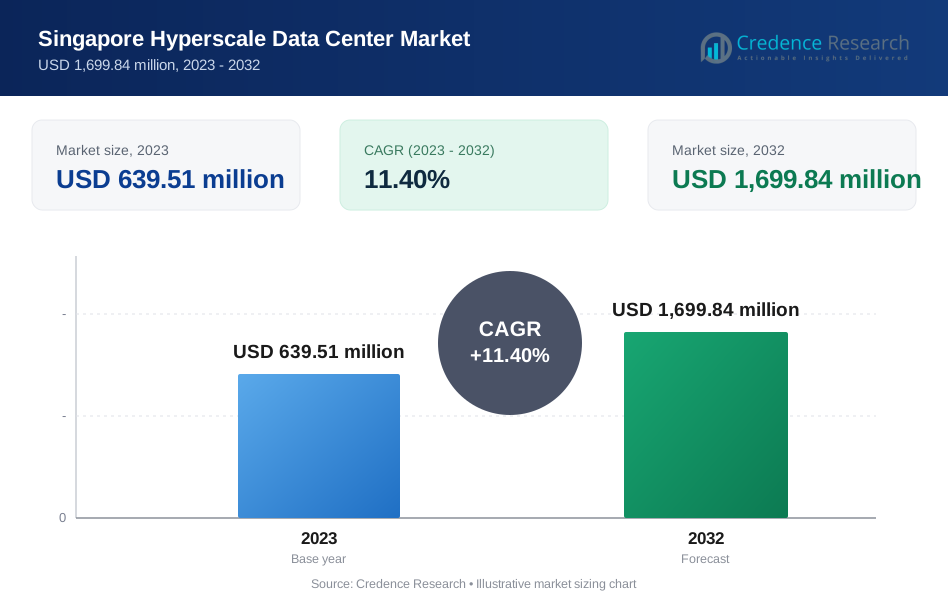
The Singapore Hyperscale Data Center Market is projected to grow from USD 639.51 million in 2023 to an estimated USD 1,699.84 million by 2032, registering a compound annual growth rate (CAGR) of 11.40%.from 2024 to 2032. This growth is driven by increasing demand for cloud services, big data analytics, and the rise in digital transformation initiatives across various industries.
The market is primarily driven by rapid advancements in technology, growing demand for scalable computing solutions, and the increasing need for data storage and management due to rising internet penetration and the proliferation of connected devices. Moreover, favorable government policies and investments in digital infrastructure contribute significantly to market expansion. Trends like energy efficiency and sustainable data center operations are also influencing market growth.
Geographically, Singapore's strategic location and well-established infrastructure make it a preferred destination for hyperscale data centers in the Asia-Pacific region. Major global players such as Google, Amazon Web Services (AWS), Microsoft, and Alibaba Cloud have established or are expanding their presence in the country. These companies, along with local data center operators, are expected to play a pivotal role in the continued growth of the Singapore hyperscale data center market.
Market Drivers
Growing Demand for Cloud Services and Digital Transformation
One of the primary drivers of the Singapore hyperscale data center market is the rising demand for cloud services and digital transformation initiatives. As more businesses across various industries migrate to cloud-based platforms, hyperscale data centers are becoming critical to supporting the massive amounts of data generated and processed daily. Companies are increasingly moving away from traditional data storage solutions and adopting cloud infrastructure for greater flexibility, scalability, and cost-efficiency. Singapore, being a hub for multinational corporations, is witnessing a surge in demand for public, private, and hybrid cloud solutions. Hyperscale data centers provide the backbone for cloud service providers like Amazon Web Services (AWS), Google Cloud, and Microsoft Azure to host, process, and manage data on a large scale. This transition toward digital-first strategies across industries such as banking, healthcare, retail, and telecommunications is fueling the need for hyperscale data centers that can accommodate the rapid expansion of data workloads and ensure seamless operational continuity. Moreover, with the rise of the Internet of Things (IoT), big data analytics, and artificial intelligence (AI), the demand for hyperscale data centers is poised to grow significantly. For instance, PwC Singapore highlights that investments and innovations in cloud transformation are taking center stage, driven by increasing competition, customer expectations, and new sources of data and insights.
Favorable Government Policies and Investments in Digital Infrastructure
The Singaporean government’s proactive approach to fostering the growth of the digital economy is another major factor driving the hyperscale data center market. Government initiatives such as the Smart Nation program, which aims to leverage technology to improve the quality of life and drive economic growth, have encouraged the development of cutting-edge digital infrastructure. The government has invested heavily in expanding data centers, fiber optic networks, and broadband infrastructure to position Singapore as a leading digital hub in the Asia-Pacific region. Additionally, regulatory frameworks that promote data security, privacy, and sustainability have made Singapore an attractive destination for hyperscale data center operators. The government’s commitment to green data centers and energy-efficient technologies is particularly relevant, as the industry is facing growing pressure to reduce its carbon footprint. In response, data center operators are increasingly adopting renewable energy sources, liquid cooling technologies, and energy-efficient designs to comply with sustainability goals while reducing operational costs. Furthermore, Singapore’s political stability, strong legal system, and favorable tax policies add to the attractiveness of the country for global companies looking to establish large-scale data centers. According to the Singapore Government, an estimated $3.3 billion will be spent on info-communications technology (ICT) procurement in FY24 to modernize ICT infrastructure and develop digital services.
Increasing Data Traffic and Connectivity Demands
The exponential growth in data traffic, driven by factors such as video streaming, social media, online gaming, and e-commerce, is fueling the demand for hyperscale data centers in Singapore. The region’s highly connected ecosystem, which includes some of the world’s fastest internet speeds and extensive submarine cable networks, supports its position as a central hub for data traffic in Asia. As consumer and business applications generate increasing amounts of data, there is an escalating need for robust, scalable infrastructure that can handle massive data volumes. Hyperscale data centers are designed to support such workloads by offering high levels of processing power, storage capacity, and network bandwidth. Singapore’s strategic location also makes it an ideal gateway for data exchange between Asia, Europe, and the Americas, further increasing the need for hyperscale facilities that can manage cross-border data traffic efficiently. This growth in data consumption, along with the rising number of connected devices, smart cities, and 5G deployment, is driving the expansion of hyperscale data centers in the country. The push toward greater connectivity and the demand for low-latency services are likely to continue influencing the market’s growth trajectory in the coming years. According to DataReportal, internet users in Singapore at the start of 2024 stood at 5.6 million, representing 96.9% of the population.
Advancements in Data Center Technologies and Energy Efficiency
Technological advancements in data center design and operations are playing a crucial role in driving the growth of hyperscale data centers in Singapore. Innovations in server architecture, virtualization, and modular designs are enabling data centers to deliver higher efficiency, performance, and scalability. Additionally, software-defined data centers (SDDCs), which offer enhanced automation and flexibility, are becoming more prevalent, allowing operators to manage resources more effectively and reduce operational complexities. With the increasing focus on sustainability, energy efficiency has become a key concern for hyperscale data center operators. Singapore, like many global markets, is emphasizing the importance of reducing energy consumption and carbon emissions in data center operations. Technologies such as liquid cooling, dynamic power management, and the use of artificial intelligence for real-time monitoring and optimization of energy use are becoming standard practices in the industry. Furthermore, the integration of renewable energy sources such as solar and wind power into data center operations is gaining traction as companies seek to meet regulatory requirements and corporate sustainability goals. These advancements are not only driving the operational efficiency of hyperscale data centers but are also helping operators reduce costs, improve reliability, and meet the growing demands for greener data solutions. As data center technologies continue to evolve, Singapore’s hyperscale data center market is expected to benefit from these innovations, enabling it to maintain its competitive edge in the global data center landscape.
Market Trends
Growing Focus on Sustainability and Energy Efficiency
Sustainability and energy efficiency have emerged as dominant trends in the Singapore hyperscale data center market, as both operators and regulatory bodies emphasize reducing the environmental impact of data center operations. Singapore’s government has implemented initiatives aimed at promoting green data center practices, such as adopting renewable energy sources and improving energy efficiency standards. Hyperscale data center operators are increasingly turning to innovations like liquid cooling systems, which significantly reduce the energy required for cooling large-scale facilities, and artificial intelligence (AI)-driven energy management systems that optimize energy consumption in real-time. The growing importance of sustainability is driven by rising energy costs, stricter regulations, and increasing pressure from stakeholders to reduce carbon footprints. Many operators are also exploring alternative energy sources, including solar and wind power, to offset their carbon emissions and comply with Singapore’s sustainability goals. For instance, the Singapore Green Data Centre Roadmap (GDCR) launched by the Infocomm Media Development Authority (IMDA) aims to provide at least 300 megawatts of additional capacity for data centers through green energy deployments. The focus on green technologies is expected to continue, with operators investing heavily in solutions that not only reduce operational costs but also enhance their environmental credentials.
Expansion of Edge Computing and 5G Integration
Another significant trend shaping the Singapore hyperscale data center market is the rise of edge computing and the integration of 5G technology. With the rapid deployment of 5G networks across Singapore, there is a growing demand for low-latency data processing and storage solutions closer to end-users. Edge computing allows data to be processed at the edge of the network, reducing latency and improving the performance of applications that rely on real-time data analysis, such as autonomous vehicles, smart cities, and IoT devices. Hyperscale data centers are evolving to accommodate edge computing capabilities, with operators building smaller, decentralized data centers that work in tandem with hyperscale facilities to ensure seamless data flow. The integration of 5G is further driving this trend, enabling hyperscale data centers to handle massive amounts of data at unprecedented speeds while supporting emerging technologies like AI, augmented reality (AR), and virtual reality (VR). For instance, Singtel has launched Paragon, an all-in-one platform for 5G network, edge computing, and services orchestration, to enable enterprises to deploy mission-critical applications on Singtel MEC (multi-access edge compute). As 5G becomes more widely adopted, the demand for hyperscale data centers with edge computing capabilities is expected to accelerate, shaping the future landscape of Singapore’s data center market.
Market Restraints and Challenges
Land Scarcity and High Operational Costs
One of the most significant challenges faced by the hyperscale data center market in Singapore is land scarcity and the associated high operational costs. As a small island nation with limited land resources, Singapore struggles with space constraints for new data center developments. The demand for large-scale hyperscale facilities requires vast tracts of land, which are difficult to secure in a densely populated city-state. This issue has driven up the cost of land, making it more expensive for data center operators to expand their operations. Moreover, operational costs, including energy consumption, cooling, and maintenance, are considerably higher due to Singapore’s tropical climate, which demands extensive cooling infrastructure to maintain optimal temperatures for data centers. These factors collectively increase the cost of establishing and running hyperscale data centers in Singapore, potentially deterring new entrants or limiting expansion plans for existing players. For instance, the Singapore Data Center Market report highlights that the limited availability of land and the high cost of real estate are primary challenges.
Energy Consumption and Environmental Concerns
Another critical challenge for the Singapore hyperscale data center market is the increasing scrutiny over energy consumption and environmental sustainability. Hyperscale data centers are known for their substantial energy requirements, as they house vast amounts of servers and equipment that need to run continuously. In a country where energy resources are limited, hyperscale data centers face growing pressure from both the government and environmental groups to reduce their carbon footprint. Additionally, Singapore’s commitment to sustainability and its green energy targets further compel data center operators to adopt environmentally friendly practices, which may require significant investments in renewable energy sources, energy-efficient cooling systems, and other green technologies. Balancing the need for large-scale data processing with environmental concerns presents a challenging dynamic, as operators must manage escalating energy demands while ensuring compliance with sustainability goals, often leading to increased costs and regulatory hurdles. According to Schneider Electric, Singapore’s data centers are tackling the sustainability dilemma by emphasizing the critical importance of sustainable practices in new data center construction and operation.
Market Segmentation Analysis
By Component
The Singapore hyperscale data center market is segmented by components into solutions and services. Under solutions, the segment includes servers, storage, networking, and software. Servers are a crucial element, as hyperscale data centers require massive computational power to manage and process large-scale data. Storage solutions are essential for efficient data management, particularly with the growth of big data and cloud computing. Networking infrastructure ensures seamless data flow within the data centers, while software solutions optimize operations through automation and data management tools. The services segment includes consulting, installation and deployment, and maintenance and support. Consulting services provide critical insights during the planning phase, while installation and deployment services ensure the smooth setup of hyperscale facilities. Maintenance and support services are vital for ensuring long-term operational efficiency and minimizing downtime.
By End User
The market is further segmented by end users into cloud providers, colocation providers, and enterprises. Cloud providers represent a significant share of the market due to the rising adoption of cloud computing services in Singapore. Major global players like AWS, Google, and Microsoft are expanding their hyperscale data centers to support cloud infrastructure. Colocation providers are also key players, offering space, power, and cooling services to enterprises that do not want to invest in their own data centers. Enterprises across various industries are increasingly leveraging hyperscale data centers for their data storage and processing needs, particularly in sectors that handle vast amounts of data.
Segments
Based on Component
- Solutions
- Servers
- Storage
- Networking
- Software
- Services
- Consulting
- Installation and Deployment
- Maintenance and Support
Based on End User
- Cloud Providers
- Colocation Providers
- Enterprises
Based on Data Center Size
- Small and Medium-Sized Data Centers
- Large Data Centers
Based on Industry
- Banking, Financial Services, and Insurance (BFSI)
- IT and Telecom
- Government and Defense
- Retail and Manufacturing
- Healthcare
- Media and Entertainment
- Others
Based on Region
- Asia-Pacific
- North America
- Europe
- Southeast Asia
- Global Markets
Regional Analysis
Asia Pacific (15%):
Singapore, as a leading data center hub in the Asia-Pacific region, holds a significant position in the global hyperscale data center market. The country’s strategic location, robust infrastructure, and favorable regulatory environment make it an ideal destination for hyperscale data centers. Singapore accounts for approximately 15% of the Asia-Pacific data center market, driven by its advanced connectivity and stable political and economic climate. Its market share is expected to grow further due to ongoing investments in digital infrastructure and rising demand for cloud services across the region.
North America (40%):
When compared to other global regions, North America dominates the hyperscale data center market with a share of over 40%, primarily driven by the United States, which is home to many of the world’s largest hyperscale facilities. However, Singapore’s hyperscale data center market is growing at a faster pace compared to some mature markets due to the continuous influx of investments from global players and the increasing adoption of cloud services by local and regional businesses
Key players
- Amazon Web Services, Inc.
- Cisco Systems, Inc.
- IBM Corporation
- Oracle Corporation
- Arista Networks, Inc.
- Microsoft Corporation
- Google, Inc.
- Intel Corporation
- Huawei Technologies Co.
- Meta Platforms Inc.
- Equinix, Inc.
- Broadcom
- Schneider Electric
Competitive Analysis
The Singapore hyperscale data center market is highly competitive, with major global technology companies vying for market share. Amazon Web Services (AWS), Microsoft, and Google dominate the cloud service segment, leveraging their extensive cloud platforms and global infrastructure to meet growing demand. Equinix plays a significant role as a leading colocation provider, offering space and connectivity to enterprises and cloud providers. Companies like Cisco, Intel, and Broadcom focus on providing critical networking, storage, and processing technologies that power hyperscale data centers. Huawei Technologies and IBM are also prominent, contributing innovative solutions in both hardware and software. Schneider Electric stands out for its energy-efficient solutions, addressing the industry's increasing focus on sustainability. The competitive landscape is marked by continuous innovation, with players focusing on scaling operations, enhancing energy efficiency, and meeting growing demand for cloud-based services.
Recent Developments
- In May 2024, AWS announced a $9 billion investment to expand its cloud infrastructure in Singapore. This investment will support the construction, operation, and maintenance of data centers up to 2028.
- In April 2024, Cisco introduced Cisco Hypershield, a new security architecture designed for distributed, AI-native security in hyperscale data centers.
- In August 2024, IBM announced new data center developments, highlighting its commitment to expanding its hyperscale data center footprint.
- In July 2024, Oracle launched its second cloud region in Singapore to meet the growing demand for AI and cloud services.
- In December 2022, Arista announced the expansion of its 7050X4 and 7060X5 Series, providing higher network speeds and investment protection for hyperscale data centers.
- In February 2022, Microsoft announced a strategic agreement with HTX to develop Singapore’s first sovereign cloud, built on the Azure platform.
- In June 2024, Google completed the expansion of its data center campus and cloud region in Singapore, bringing its total investment in the country to $5 billion.
- In May 2024, Huawei, in collaboration with the ASEAN Centre for Energy, released a white paper on building next-generation data center facilities in ASEAN, focusing on sustainability.
- In March 2024, Meta announced the development of two 24,576-GPU data center scale clusters to support its AI infrastructure.
- In October 2022, Broadcom announced the availability of the industry’s first open end-to-end networking solution optimized for hyperscale data centers.
Market Concentration and Characteristics
The Singapore hyperscale data center market is characterized by moderate to high market concentration, with a few dominant global players such as Amazon Web Services (AWS), Microsoft, Google, and Equinix controlling a significant portion of the market. These companies benefit from their vast resources, advanced technological capabilities, and established global infrastructure. Additionally, leading hardware and networking companies like Cisco, Intel, and Huawei also play pivotal roles by providing essential components for data center operations. The market is marked by rapid technological advancements, with a strong focus on energy efficiency, scalability, and sustainability. Due to Singapore’s strategic location and supportive regulatory environment, the market continues to attract investments from both global and regional players, contributing to its competitive but concentrated nature.
Report Coverage
The research report offers an in-depth analysis based on Component, End User, Data Center Size, Industry and Region. It details leading market players, providing an overview of their business, product offerings, investments, revenue streams, and key applications. Additionally, the report includes insights into the competitive environment, SWOT analysis, current market trends, as well as the primary drivers and constraints. Furthermore, it discusses various factors that have driven market expansion in recent years. The report also explores market dynamics, regulatory scenarios, and technological advancements that are shaping the industry. It assesses the impact of external factors and global economic changes on market growth. Lastly, it provides strategic recommendations for new entrants and established companies to navigate the complexities of the market.
Future Outlook
- The demand for cloud services will continue to drive the expansion of hyperscale data centers in Singapore, as businesses increasingly shift to digital platforms for scalability and efficiency.
- Environmental concerns and government regulations will push data center operators to adopt green technologies, leading to more energy-efficient designs and the use of renewable energy sources.
- As hyperscale data centers grow, operators will invest in advanced cooling solutions such as liquid cooling and AI-based energy management systems to reduce operational costs and environmental impact.
- The growing demand for real-time data processing and low-latency services, driven by 5G deployment, will lead to an increase in edge computing capabilities integrated with hyperscale data centers.
- Colocation providers will see increased demand as enterprises seek flexible and cost-effective solutions for managing their growing data needs without investing in their own infrastructure.
- Singapore's government will continue to support the hyperscale data center market through favorable policies, investments in digital infrastructure, and initiatives aimed at maintaining the country’s status as a regional data hub.
- As data privacy and sovereignty concerns rise, hyperscale data centers will need to implement stringent security measures and localized data storage solutions to comply with regional regulations.
- Automation and AI technologies will be increasingly integrated into hyperscale data center operations to optimize resource allocation, improve efficiency, and reduce human intervention.
- The market will witness the entry of new players and strategic partnerships, both from local and international companies, as demand for hyperscale data centers continues to rise across various industries.
- Singapore’s strategic location and extensive submarine cable networks will strengthen its role as a key hub for data exchange between Asia-Pacific, Europe, and the Americas, further boosting the hyperscale data center market.
Request a Free Sample
Fill in your details and we'll send you a free sample report.
- Sample data tables & charts
- Research methodology
Need a Custom Version of This Report?
Tailor the scope, geography, or segments to your exact requirements.
- Custom geography or segment scope
- Direct access to our analyst team
Frequently Asked Questions
What is the market size of the Singapore hyperscale data center market in 2023 and2032?
What are the key drivers of growth in the Singapore hyperscale data center market?
How is sustainability influencing the Singapore hyperscale data center market?
Which industries are the largest users of hyperscale data centers in Singapore?
Table of Content
Chapter 1. Report Introduction
- 1.1 Report Description & Purpose
- 1.1.1 Report Title & Market Definition
- 1.1.2 Unique Selling Propositions (USP) & Key Differentiators
- 1.1.3 Value Proposition for Stakeholders
- 1.2 Research Objectives
- 1.2.1 Market Sizing Objectives (Volume & Revenue)
- 1.2.2 Segmentation Objectives
- 1.2.3 Competitive Intelligence Objectives
- 1.2.4 Forecast & Scenario Objectives
- 1.3 Report Scope
- 1.3.1 Singapore Hyperscale Data Center Scope – Types & Subtypes Covered
- 1.3.2 Geographic Scope – Regions & Countries Covered
- 1.3.3 Historical Period, Base Year & Forecast Period (2023; forecast to 2032)
- 1.3.4 Inclusions & Exclusions
- 1.4 HS Code & Classification Framework
- 1.5 Currency, Units & Pricing Basis
- 1.6 Target Stakeholders
- 1.7 Limitations & Assumptions
Chapter 2. Executive Summary
- 2.1 Global Singapore Hyperscale Data Center Market Snapshot
- 2.1.1 Market Size – Historical (2023) & Forecast (2023-2032) (2023: USD 639.51 million → 2032: USD 1,699.84 million)
- 2.1.2 Volume & Revenue – Global Totals
- 2.1.3 Key Market Highlights – Top Five Facts
- 2.2 Singapore Hyperscale Data Center Market Segmentation Snapshot
- 2.2.1 Market Split by Region – 2023 vs. 2032
- 2.3 Competitive Snapshot
- 2.3.1 Top 10 Players by Revenue Share – 2023
- 2.3.2 Top 10 Players by Volume Share – 2023
- 2.3.3 Recent Strategic Developments (18-Month Summary)
- 2.4 Key Investment Highlights & Strategic Conclusions
Chapter 3. Singapore Hyperscale Data Center Market Dynamics & Industry Analysis
- 3.1 Market Overview & Context
- 3.1.1 Singapore Hyperscale Data Center Market Position in the Broader Automotive Value Chain
- 3.1.2 OEM vs. Replacement Market Dynamics
- 3.1.3 Market Maturity & Development Stage by Region
- 3.2 Singapore Hyperscale Data Center Market Drivers
- 3.3 Singapore Hyperscale Data Center Market Restraints & Challenges
- 3.4 Singapore Hyperscale Data Center Market Opportunities
- 3.5 Porter's Five Forces Analysis
- 3.5.1 Threat of New Entrants
- 3.5.2 Bargaining Power of Suppliers
- 3.5.3 Bargaining Power of Buyers
- 3.5.4 Threat of Substitutes
- 3.5.5 Competitive Rivalry – Intensity Assessment
- 3.6 Singapore Hyperscale Data Center Value Chain Analysis
- 3.6.1 Upstream – Raw Material/Input Suppliers
- 3.6.1.1 Raw Material/Input 1
- 3.6.1.2 Raw Material/Input 2
- 3.6.1.3 Raw Material/Input 3
- 3.6.2 Midstream – Production/Manufacturing/Service Delivery
- 3.6.2.1 Production/Process Overview
- 3.6.2.2 Key Facility Locations & Capacity by Manufacturer
- 3.6.3 Downstream – Distribution & End Consumer
- 3.6.3.1 Primary Channel – B2B/OEM
- 3.6.3.2 Secondary Channels – Dealer, Retail, Online, Direct
- 3.6.4 Value Chain Profitability Analysis
- 3.6.1 Upstream – Raw Material/Input Suppliers
- 3.7 PESTEL Analysis
- 3.7.1 Political Factors
- 3.7.2 Economic Factors
- 3.7.3 Social Factors
- 3.7.4 Technological Factors
- 3.7.5 Environmental Factors
- 3.7.6 Legal Factors
- 3.8 Singapore Hyperscale Data Center Supply Chain Analysis
- 3.8.1 Raw Material/Input Supply Risk Assessment
- 3.8.2 Manufacturing Concentration Risk (Geographic Exposure)
- 3.8.3 Trade Disruption Impact Analysis
- 3.9 Regulatory & Policy Landscape
Note: The regulatory and policy landscape section covers regulations based on their applicability to the market, Singapore Hyperscale Data Center category, geography, and scope of the study. Only regulatory frameworks with a material impact on operations, compliance, trade, sustainability, or market access are analyzed in detail.
Chapter 4. Key Investment Pockets & Opportunity Analysis
- 4.1 Singapore Hyperscale Data Center Market Attractiveness Analysis
- 4.1.1 By Region – Investment Attractiveness Matrix (Volume × CAGR)
- 4.2 Absolute Revenue Growth Opportunity
- 4.2.1 By Region – Absolute USD Growth Through 2032
- 4.3 Incremental Volume Opportunity
- 4.3.1 By Region – Incremental Volume Through 2032
- 4.3.2 Segment – Incremental Volume
- 4.4 Emerging Submarket Opportunity Deep Dive (Subject to Applicability)
- 4.5 Emerging Market Opportunity Scorecards
- 4.5.1 United States
- 4.5.2 Europe
- 4.5.3 Asia
- 4.5.4 Middle East & Africa
Note: Emerging Market Opportunity Scorecards will be included based on relevance and strategic importance. Regions listed are indicative and may vary depending on data availability and market dynamics.
Chapter 5. Singapore Hyperscale Data Center Import-Export Analysis & Trade Flows
- 5.1 Global Trade Overview
- 5.1.1 Global Export Value by Country (2023)
- 5.1.2 Global Export Volume by Country (2023)
- 5.1.3 Global Import Value by Country (2023)
- 5.1.4 Global Import Volume by Country (2023)
- 5.1.5 Net Trade Balance by Country (2023)
- 5.2 Export Analysis – Segment
- 5.2.1 Type 1 (HS Code)
- 5.2.2 Type 2 (HS Code)
- 5.2.3 Type 3 (HS Code)
- 5.2.4 Type 4 (HS Code)
- 5.2.5 Type 5 (HS Code)
- 5.3 Import Analysis – Segment
- 5.3.1 Type 1 (HS Code)
- 5.3.2 Type 2 (HS Code)
- 5.3.3 Type 3 (HS Code)
- 5.3.4 Type 4 (HS Code)
- 5.3.5 Type 5 (HS Code)
- 5.4 Average Unit Trade Prices
- 5.4.1 Average Export Price – Segment & Country
- 5.4.2 Average Import Price – Segment & Source Country
- 5.4.3 Price Trends (2023)
- 5.5 Key Trade Route Analysis
- 5.5.1 Trade Route 1
- 5.5.2 Trade Route 2
- 5.5.3 Trade Route 3
- 5.5.4 Trade Route 4
- 5.5.5 Trade Route 5
- 5.6 Trade Policy Impact Assessment
- 5.6.1 US Anti-Dumping & Section 301 Tariffs
- 5.6.2 EU Customs Union Impact
- 5.6.3 Major Free Trade Agreements
- 5.6.4 USMCA Rules of Origin
Note: Trade policy analysis will be included only where relevant to the Singapore Hyperscale Data Center market.
Chapter 6. Competitive Landscape & Company Benchmarking
- 6.1 Singapore Hyperscale Data Center Market Concentration & Structure
- 6.1.1 Herfindahl-Hirschman Index (HHI) – vs. 2023
- 6.1.2 Tier 1, Tier 2 & Tier 3 Market Structure
- 6.1.3 Global, Regional & Local Player Dynamics
- 6.2 Singapore Hyperscale Data Center Market Share Analysis – 2023
- 6.2.1 Global Revenue Share by Company
- 6.2.2 Global Volume Share by Company
- 6.2.3 Regional Revenue Share
- 6.2.4 Market Share Evolution ( vs. 2023)
- 6.2.5 OEM Segment Share by Company
- 6.2.6 Replacement Segment Share by Company
- 6.3 Production/Delivery Capacity & Facility Analysis
- 6.3.1 Global Installed Capacity
- 6.3.2 Capacity Utilization Rates
- 6.3.3 Production/Output Volume
- 6.3.4 Facility Locations & Capacity Map
- 6.3.5 Planned Capacity Additions
- 6.4 Singapore Hyperscale Data Center Competitive Benchmarking Matrix
- 6.4.1 Revenue, Volume, CAGR & Profitability Comparison
- 6.4.2 Channel Revenue Mix
- 6.4.3 Geographic Revenue Exposure
- 6.4.4 R&D Intensity
- 6.4.5 Sustainability Maturity
- 6.5 Strategic Developments in Singapore Hyperscale Data Center (Last 24 Months)
- 6.5.1 Mergers, Acquisitions & Divestments
- 6.5.2 New Singapore Hyperscale Data Center Launches
- 6.5.3 Facility Expansions
- 6.5.4 Strategic Alliances, Joint Ventures & Partnerships
- 6.5.5 Distribution Expansion & Market Entry
- 6.5.6 Sustainability & ESG Initiatives
- 6.6 Competitive Strategy Mapping
- 6.6.1 Leader, Challenger, Follower & Niche Classification
- 6.6.2 Pricing Strategy Comparison
- 6.6.3 Channel Strategy Matrix
Note: Strategic developments are included based on their materiality and the availability of reliable information.
Chapter 7. Global Singapore Hyperscale Data Center Market – By Distribution Channel
- 7.1 Segment Overview
- 7.1.1 Volume & Revenue Split by Channel (2023 & 2032)
- 7.1.2 Channel Mix Evolution (2023-2032)
Chapter 8. Regional Market Analysis – Global Overview
- 8.1 Global Regional Overview
- 8.1.1 Regional Volume Share
- 8.1.2 Regional Revenue Share
- 8.1.3 Regional Volume by Region
- 8.1.4 Regional Revenue by Region
- 8.1.5 Regional Forecast Through 2032
- 8.2 Cross-Regional Segment Analysis
- 8.2.1 By Distribution Channel
- 8.2.2 By Brand/Price Tier
Chapter 9. North America Singapore Hyperscale Data Center Market
- 9.1 United States
- 9.2 Canada
- 9.3 Mexico
Chapter 10. Europe Singapore Hyperscale Data Center Market
- 10.1 Germany
- 10.2 France
- 10.3 Italy
- 10.4 United Kingdom
- 10.5 Spain
- 10.6 Poland
- 10.7 Russia
- 10.8 Netherlands
- 10.9 Belgium
- 10.10 Sweden
- 10.11 Denmark
- 10.12 Norway
- 10.13 Rest of Europe
Chapter 11. Asia Pacific Singapore Hyperscale Data Center Market
- 11.1 China
- 11.2 India
- 11.3 Japan
- 11.4 South Korea
- 11.5 Thailand
- 11.6 Indonesia
- 11.7 Vietnam
- 11.8 Malaysia
- 11.9 Australia
- 11.10 Rest of Asia Pacific
Chapter 12. Latin America Singapore Hyperscale Data Center Market
- 12.1 Brazil
- 12.2 Argentina
- 12.3 Colombia
- 12.4 Chile
- 12.5 Rest of Latin America
Chapter 13. Middle East Singapore Hyperscale Data Center Market
- 13.1 Saudi Arabia
- 13.2 United Arab Emirates
- 13.3 Turkey
- 13.4 Israel
- 13.5 Iran
- 13.6 Rest of the Middle East
Chapter 14. Africa Singapore Hyperscale Data Center Market
- 14.1 South Africa
- 14.2 Egypt
- 14.3 Nigeria
- 14.4 Morocco
- 14.5 Rest of Africa
Chapter 15. Singapore Hyperscale Data Center Company Profiles
- 15.1 [Company 01]
- 15.1.1 Company Overview
- 15.1.2 Key Management Personnel
- 15.1.3 Products & Services Portfolio
- 15.1.4 Financial Performance
- 15.1.5 Key Market Focus & Geographic Presence
- 15.1.6 Recent Developments & Strategic Initiatives
Note: The company profile list is preliminary and may change based on research findings, market developments, data availability, and client requirements.
Chapter 16. Appendices
- Appendix A – List of Abbreviations & Acronyms
- Appendix B – Industry Classification Code Reference – Full Series
- Appendix C – Production & Capacity Data Tables
- Appendix D – End-Use & Demand Base Tables
- Appendix E – Consumption & Replacement Rate Assumptions
- Appendix F – ASP Reference Tables
- Appendix G – Manufacturing & Facility Database
- Appendix H – Import-Export Data Tables
- Appendix I – Regulatory Summary Tables
- Appendix J – Primary Research Participant List (Anonymized)
- Appendix K – Primary Research Questionnaire Framework
- Appendix L – Data Sources & Bibliography
- Appendix M – Market Size Divergence & Source Comparison
Chapter 17. Research Methodology
- 17.1 Research Framework & Philosophy
- 17.2 Secondary Research – Sources, Hierarchy & Data Extraction
- 17.3 Data Modeling – Bottom-Up & Top-Down Market Sizing
- 17.4 Primary Research – Stakeholder Framework, LOI & Sample Sizes
- 17.5 Forecast Methodology – Regression, Scenario & Sensitivity Analysis
- 17.6 Quality Control – Four-Layer Validation Framework
- 17.7 Limitations & Standard Assumptions
- 17.8 Disclaimer
