Market Overview:
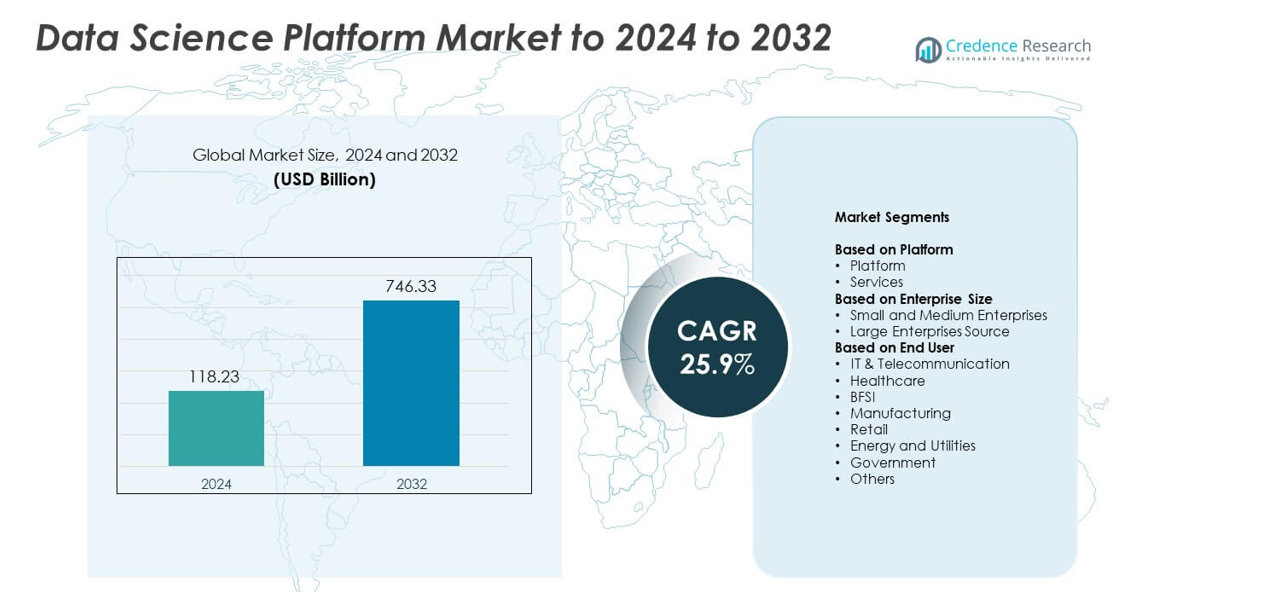
Data Science Platform Market size was valued at USD 118.23 billion in 2024 and is anticipated to reach USD 746.33 billion by 2032, at a CAGR of 25.9% during the forecast period.
| REPORT ATTRIBUTE | DETAILS |
|---|---|
| Historical Period | 2020-2023 |
| Base Year | 2024 |
| Forecast Period | 2025-2032 |
| Data Science Platform Market Size 2024 | USD 118.23 billion |
| Data Science Platform Market, CAGR | 25.9% |
| Data Science Platform Market Size 2032 | USD 746.33 billion |
The Data Science Platform Market is shaped by major players such as Oracle, SAP, Google LLC, Cloud Software Group, Inc., The MathWorks, Inc., Microsoft, Alteryx, IBM Corporation, SAS Institute Inc., and H2O.ai, each expanding advanced analytics and AI-driven solutions for global enterprises. These companies strengthen their position through cloud-native platforms, automated machine learning, and strong data governance features. North America led the market in 2024 with about 37% share, driven by high AI adoption, strong digital infrastructure, and large-scale enterprise investments. Europe and Asia Pacific followed as key growth regions supported by rising analytics deployments and expanding cloud usage.
Market Insights
- The Data Science Platform Market was valued at USD 118.23 billion in 2024 and is projected to reach USD 746.33 billion by 2032, growing at a CAGR of 25.9%.
- Strong demand for AI and machine learning adoption drives market expansion, with enterprises scaling predictive analytics, automation, and cloud-based data workflows across operations.
- Generative AI, AutoML, and low-code adoption shape major trends as companies seek faster model development and wider analytics use among non-technical teams.
- The market remains competitive with global vendors enhancing cloud-native platforms, governance tools, and industry-specific solutions; the platform segment led with about 71% share in 2024.
- North America dominated the market with nearly 37% share in 2024, followed by Europe at about 28% and Asia Pacific at roughly 25%, while IT and telecommunication remained the leading end-user segment with around 29% share.
Market Segmentation Analysis:
By Platform
The platform segment led the Data Science Platform Market in 2024 with about 71% share. This dominance came from strong adoption of unified analytics platforms that combine data preparation, model training, and deployment in one environment. Enterprises preferred integrated platforms because they reduce tool fragmentation and improve workflow speed across teams. Growth stayed strong as organizations adopted AI-driven automation, scalable cloud environments, and advanced machine learning capabilities. Service adoption also increased, but platform solutions remained ahead due to higher demand for end-to-end data lifecycle management.
- For instance, Databricks confirmed in 2024/2025 that its platform was used by more than 15,000 global organizations.
By Enterprise Size
Large enterprises dominated the enterprise size segment in 2024 with nearly 64% share. Adoption remained high due to large-scale data pipelines, complex AI workloads, and strong budgets for advanced analytics. Large organizations used enterprise-grade platforms to manage structured and unstructured data across global operations. Demand grew as companies focused on automation, operational intelligence, and cloud migration. Small and medium enterprises expanded usage as well, but their share stayed lower because many lacked in-house data teams and relied more on affordable, simplified solutions.
- For instance, Snowflake reported in its 2024 filings that it had more than 691 Forbes Global 2000 customers, reflecting heavy usage by large enterprises across global regions.
By End User
The IT and telecommunication segment held the largest share in 2024 with around 29%. This sector used data science platforms to enhance network optimization, customer analytics, fraud detection, and predictive maintenance. Telecom operators increased AI-based insights to support 5G rollout and real-time service management. BFSI, healthcare, and retail also showed strong growth, but IT and telecommunication stayed ahead due to high data volume and continuous digital transformation. Demand increased further as companies adopted cloud-native analytics and machine learning to improve service delivery and operational accuracy.
Key Growth Drivers
Rising Adoption of AI and Machine Learning
Growing use of AI and machine learning across enterprises drives strong demand for unified data science platforms. Companies rely on these platforms to speed model development, manage large datasets, and automate workflows. Cloud-native tools help teams improve productivity and reduce operational delays. Adoption increases as organizations integrate predictive analytics into customer experience, fraud detection, and process optimization. This shift positions AI-enabled platforms as a core element of digital transformation.
- For instance, OpenAI announced in November 2023 that ChatGPT reached over 100 million weekly active users
Expansion of Cloud-Based Data Infrastructure
Enterprises continue to migrate analytics workloads to cloud environments, boosting platform adoption. Cloud-based data science platforms allow flexible scaling, quick deployment, and improved collaboration across distributed teams. Organizations benefit from reduced infrastructure costs and greater access to advanced ML tools. Cloud integration supports real-time processing, enabling faster business decisions. As enterprises modernize data pipelines, demand for scalable cloud platforms grows rapidly.
- For instance, Amazon Web Services reported on Pi Day (March 14, 2025) that Amazon S3 stored more than 400 trillion objects, supporting large-scale cloud analytics pipelines across global enterprises.
Increasing Data Volume Across Industries
Rising data generation from connected devices, digital services, and enterprise applications fuels platform adoption. Companies need centralized environments to handle structured and unstructured data efficiently. Platforms support advanced modeling, automated pipelines, and strong governance, enabling enterprises to extract meaningful insights. High data velocity in sectors such as telecom, finance, and retail strengthens the need for robust analytics frameworks. This rising dependency makes data science platforms essential for strategic decision-making.
Key Trends & Opportunities
Growth of Generative AI Integration
Enterprises adopt generative AI to create predictive models, automate content, and enhance data exploration. Data science platforms integrate generative AI features that accelerate experimentation and reduce manual coding. Adoption rises as companies use these capabilities for simulation, forecasting, and synthetic data generation. This creates opportunities for platform providers to expand toolsets and attract advanced AI users. Generative AI enhances productivity and helps enterprises innovate at greater speed.
- For instance, NVIDIA stated in 2024 that the company's ecosystem spans approximately 40,000 companies and nearly 5 million developers, while more than 1,600 generative AI companies specifically were building on NVIDIA CUDA, TensorRT, and related AI frameworks, as confirmed in its official GTC announcements and annual reviews.
Rising Use of AutoML and Low-Code Tools
AutoML and low-code features transform model development by reducing the need for specialized coding skills. Teams use automated model selection, hyperparameter tuning, and deployment tools to shorten development cycles. This trend supports wider adoption among business analysts and non-technical users. Platforms offering easy interfaces gain market advantage as organizations push for democratized analytics. The shift expands market reach and encourages broader enterprise experimentation with AI-driven insights.
- For instance, Google confirmed in 2024 that its Vertex AI and AI Studio platforms processed billions of requests, with the total number of API calls reaching approximately 150 billion in a single month by late 2024/early 2025.
Industry-Specific Platform Customization
Vendors increasingly design platforms tailored to healthcare, BFSI, retail, and manufacturing needs. These sector-focused solutions include domain models, compliance support, and specialized data pipelines. Demand rises as industries require faster deployment and regulatory alignment. Customization helps enterprises address unique challenges with higher precision. Providers offering vertical solutions unlock new growth opportunities and strengthen their competitive position.
Key Challenges
Data Privacy and Regulatory Compliance Issues
Strict data protection laws create operational hurdles for organizations adopting data science platforms. Companies must manage sensitive information while meeting global regulations related to consent, retention, and cross-border data transfer. Compliance demands increase development time and require strong governance frameworks. Industries such as healthcare and finance face higher scrutiny, raising the complexity of data workflows. These constraints limit platform flexibility and slow enterprise adoption.
Shortage of Skilled Data Professionals
The market faces a limited supply of trained data scientists, ML engineers, and analytics experts. Many enterprises struggle to build teams capable of handling complex modeling, data integration, and platform optimization. This shortage slows project execution and reduces returns on platform investments. Companies depend heavily on training, automation, and low-code tools to bridge the gap. Talent constraints remain a major barrier, especially for small and medium enterprises.
Regional Analysis
North America
North America led the data science platform market in 2024 with about 37% share. The region maintained leadership due to strong cloud adoption, large AI investments, and advanced enterprise digitalization. Companies in technology, telecom, and banking accelerated use of predictive analytics and automated machine learning tools. The United States drove most of the demand as enterprises scaled big data pipelines and strengthened real-time decision systems. Ongoing 5G expansion and high deployment of enterprise AI solutions continued to support platform growth, keeping North America the most mature and influential regional market.
Europe
Europe held nearly 28% share in 2024, supported by steady adoption of advanced analytics across manufacturing, automotive, and financial services. Strict data governance laws encouraged structured data science practices, driving investments in secure and compliant platforms. Germany, the United Kingdom, and France led the regional demand as enterprises expanded AI-driven automation. Growing interest in generative AI and industry-specific solutions also supported market expansion. Increased focus on energy efficiency, supply chain intelligence, and digital transformation kept Europe an important and rapidly evolving market.
Asia Pacific
Asia Pacific accounted for around 25% share in 2024 and showed the fastest growth due to rising digital transformation across China, India, Japan, and South Korea. Cloud migration, large data creation, and expanding AI capability programs boosted platform adoption. Telecom, retail, and BFSI companies scaled machine learning use to manage growing customer bases. Government initiatives promoting AI innovation further enhanced regional growth. Expanding startup ecosystems and rapid enterprise modernization positioned Asia Pacific as a key future growth hub for data science platforms.
Latin America
Latin America captured about 6% share in 2024, with adoption driven by growing digitalization in Brazil, Mexico, and Argentina. Companies increased use of cloud analytics and machine learning to streamline operations and improve customer management. The region benefited from rising investments in fintech, telecom modernization, and retail digital platforms. Limited access to advanced talent slowed adoption, but improved cloud availability supported market expansion. Gradual growth in AI readiness and enterprise automation kept Latin America on a steady upward path.
Middle East and Africa
Middle East and Africa held nearly 4% share in 2024, supported by rising digital transformation in the UAE, Saudi Arabia, and South Africa. Governments drove adoption by investing in national AI strategies and advanced data infrastructure. Enterprises in energy, telecom, and public services used analytics platforms to enhance efficiency and automate operations. Cloud service expansion and smart city projects boosted demand, though skill shortages and lower enterprise maturity limited wider penetration. Increased focus on innovation and diversification created a stable foundation for long-term market growth.
Market Segmentations:
By Platform
- Platform
- Services
By Enterprise Size
- Small and Medium Enterprises
- Large Enterprises Source
By End User
- IT & Telecommunication
- Healthcare
- BFSI
- Manufacturing
- Retail
- Energy and Utilities
- Government
- Others
By Geography
- North America
- U.S.
- Canada
- Mexico
- Europe
- Germany
- France
- U.K.
- Italy
- Spain
- Rest of Europe
- Asia Pacific
- China
- Japan
- India
- South Korea
- South-east Asia
- Rest of Asia Pacific
- Latin America
- Brazil
- Argentina
- Rest of Latin America
- Middle East & Africa
- GCC Countries
- South Africa
- Rest of the Middle East and Africa
Competitive Landscape
The competitive landscape of the Data Science Platform Market is shaped by leading companies such as Oracle, SAP, Google LLC, Cloud Software Group, Inc., The MathWorks, Inc., Microsoft, Alteryx, IBM Corporation, SAS Institute Inc., and H2O.ai. The market continues to advance as global vendors invest in cloud-native architectures, integrated machine learning tools, and strong automation capabilities. Providers focus on expanding AI-driven workflows that improve accuracy, reduce development time, and support enterprise-scale deployments. Competition strengthens as companies enhance security, governance, and real-time analytics features to meet rising regulatory and operational demands. Vendors also differentiate through industry-specific solutions designed for healthcare, financial services, manufacturing, and telecom. Growing adoption of generative AI and AutoML pushes firms to expand model management, collaborative environments, and low-code interfaces. Strategic partnerships, product upgrades, and ecosystem expansion remain central competitive priorities as enterprises seek unified platforms that manage full data lifecycles efficiently.
Key Player Analysis
- Oracle
- SAP
- Google LLC
- Cloud Software Group, Inc.
- The MathWorks, Inc.
- Microsoft
- Alteryx
- IBM Corporation
- SAS Institute Inc.
- H2O.ai
Recent Developments
- In 2025, Google launched Gemini 2.5 models, featuring improved reasoning capabilities and real-time cost-effective performance enhancements for enterprise users.
- In 2025, H2O.ai introduced significant updates with its enterprise platform h2oGPTe featuring new agentic AI capabilities designed for secure, scalable, and customer-controlled AI deployments.
- In 2024, IBM partnered with Telefónica Tech to accelerate enterprise adoption of AI and analytic tools, addressing evolving enterprise needs in data science workflows.
Report Coverage
The research report offers an in-depth analysis based on Platform, Enterprise Size, End-User and Geography. It details leading market players, providing an overview of their business, product offerings, investments, revenue streams, and key applications. Additionally, the report includes insights into the competitive environment, SWOT analysis, current market trends, as well as the primary drivers and constraints. Furthermore, it discusses various factors that have driven market expansion in recent years. The report also explores market dynamics, regulatory scenarios, and technological advancements that are shaping the industry. It assesses the impact of external factors and global economic changes on market growth. Lastly, it provides strategic recommendations for new entrants and established companies to navigate the complexities of the market.
Future Outlook
- The market will expand as enterprises scale AI and machine learning adoption.
- Cloud-native platforms will gain stronger traction across global industries.
- Generative AI integration will enhance model development and automation.
- AutoML and low-code tools will support wider use among non-technical teams.
- Industry-specific platform customization will accelerate deployment in regulated sectors.
- Real-time analytics demand will rise with increased data flow from connected systems.
- Vendors will strengthen governance and compliance features to meet stricter regulations.
- Collaboration tools will grow as teams adopt distributed and hybrid work models.
- Edge analytics capabilities will expand for faster on-device processing.
- Global talent shortages will push providers to deliver more automated and guided workflows.

Request a Free Sample
Fill in your details and we'll send you a free sample report.
- Sample data tables & charts
- Research methodology
Market Dynamics
Rising Adoption of AI and Machine Learning
Enterprises are increasingly integrating AI and machine learning into their operations, driving demand for unified data science platforms that streamline model development, automate workflows, and manage large datasets. This trend is especially strong in sectors like IT, telecom, and finance, where predictive analytics and automation are critical for competitiveness.
Expansion of Cloud-Based Data Infrastructure
The migration of analytics workloads to cloud environments enables organizations to scale quickly, collaborate efficiently, and reduce infrastructure costs. Cloud-native data science platforms support real-time processing and flexible deployment, accelerating adoption across industries undergoing digital transformation.
Increasing Data Volume Across Industries
The exponential growth of data from connected devices, digital services, and enterprise applications necessitates robust platforms capable of handling both structured and unstructured data. Data science platforms provide centralized environments for advanced modeling, automated pipelines, and governance, making them essential for extracting actionable insights.
Growth of Generative AI and AutoML Integration
The integration of generative AI and AutoML features into data science platforms accelerates model development, reduces manual coding, and democratizes analytics for non-technical users. This enables faster experimentation, broader adoption, and innovation, particularly as enterprises seek to leverage AI for simulation, forecasting, and synthetic data generation.
Industry-Specific Platform Customization
Vendors are increasingly offering tailored solutions for sectors such as healthcare, BFSI, retail, and manufacturing, addressing unique regulatory, compliance, and operational needs. This customization drives adoption in regulated industries and opens new growth opportunities for platform providers.
Need a Custom Version of This Report?
Tailor the scope, geography, or segments to your exact requirements.
- Custom geography or segment scope
- Direct access to our analyst team
Frequently Asked Questions
What is the current market size for Data Science Platform Market, and what is its projected size in 2032?
At what Compound Annual Growth Rate is the Data Science Platform Market projected to grow between 2025 and 2032?
Which is the leading market for Data Science Platform?
What are the key drivers for the growth of the Data Science Platform market?
Which is the major segment in Data Science Platform Market by Deployment Mode?
Who are the leading companies in the Data Science Platform Market?
Table of Content
Chapter 1 Market Segmentation
- 1.1 Segmentation Framework
- 1.1.1 Product and Service Classification
- 1.1.2 Application and End-Use Classification
- 1.1.3 Technology and Solution Classification
- 1.1.4 Customer and Distribution Channel Classification
- 1.1.5 Geographic Segmentation
- 1.1.6 Market Segment Definitions and Boundaries
- 1.2 By End User
- 1.2.1 IT & Telecommunication
- 1.2.2 Healthcare
- 1.2.3 BFSI
- 1.2.4 Manufacturing
- 1.2.5 Retail
- 1.2.6 Energy and Utilities
- 1.2.7 Government
- 1.2.8 Others
- 1.3 By Platform
- 1.3.1 Platform
- 1.3.2 Services
- 1.4 By Enterprise Size
- 1.4.1 Small and Medium Enterprises
- 1.4.2 Large Enterprises
Chapter 2 Introduction
- 2.1 Report Objectives and Scope
- 2.2 Product Definition and Industry Terminology
- 2.3 Market Inclusions and Exclusions
- 2.4 Research Process
- 2.4.1 Primary Research and Expert Interviews
- 2.4.2 Secondary Research and Source Review
- 2.4.3 Top-Down and Bottom-Up Estimation
- 2.4.4 Data Triangulation and Verification
- 2.5 Market Size Measurement Basis
- 2.5.1 2024: USD 118.23 billion → 2032: USD 746.33 billion
- 2.6 Historical and Forecast Reference Periods
- 2.6.1 Base Year: 2024
- 2.6.2 Forecast Period: 2024-2032
- 2.7 Research Assumptions and Limitations
Chapter 3 Executive Summary
- 3.1 Market Snapshot and Key Findings
- 3.2 Base-Year Market Size, 2024
- 3.3 Forecast Market Size, 2032
- 3.4 Revenue and Volume Growth Outlook
- 3.5 Key Demand and Supply Indicators
- 3.6 Leading Market Segments
- 3.7 Fastest-Growing Market Opportunities
- 3.8 Regional Performance Highlights
- 3.9 Technology and Industry Transformation
- 3.10 Competitive Landscape Summary
- 3.11 Analyst View and Strategic Implications
Chapter 4 Global Data Science Platform Market Trends and Developments
- 4.1 Historical Industry Development
- 4.2 Recent Market Trends and Developments
- 4.3 Demand and Customer Behavior Trends
- 4.4 Technology and Product Innovation
- 4.5 Artificial Intelligence, Automation and Digitalization
- 4.6 Local Manufacturing and Supply Chain Realignment
- 4.7 Industry Partnerships, Mergers and Acquisitions
- 4.8 Sustainability and Circular Economy Developments
- 4.9 Government and Private Sector Investment Trends
- 4.10 Emerging Business Models and Commercialization
- 4.11 Industry Developments and Announcements
Chapter 5 Global Data Science Platform Market Production, Supply and Demand Analysis
- 5.1 Demand Trend and Consumption Analysis
- 5.2 Demand Forecast, 2024-2032
- 5.3 Production and Output Trend
- 5.4 Production and Output Forecast, 2024-2032
- 5.5 Installed Capacity and Capacity Utilization
- 5.6 Company-Wise Production Plants and Statistics
- 5.6.1 Installed Production Capacity
- 5.6.2 Actual Production
- 5.6.3 Planned Capacity and Expansion Targets
- 5.7 Supply Chain Structure and Procurement Trends
- 5.8 Supply-Demand Gap and Bottlenecks
- 5.9 Import Dependence and Sourcing Structure
- 5.10 Contract Manufacturing and Outsourcing
- 5.11 Regional Supply and Demand Concentration
Chapter 6 Global Data Science Platform Market Pricing Analysis
- 6.1 Pricing Structure and Measurement
- 6.2 Historical Pricing Trends
- 6.3 Pricing Outlook, 2024-2032
- 6.4 Average Selling Price and Unit Economics
- 6.5 Pricing by Product and Market Segment
- 6.6 Geographic Pricing Differences
- 6.7 Key Input, Energy, Labor and Logistics Costs
- 6.8 Contract Pricing and Purchasing Models
- 6.9 Pricing Sensitivity and Competitive Positioning
- 6.10 Price, Margin and Profitability Implications
Chapter 7 Global Data Science Platform Market Dynamics
- 7.1 Market Growth Drivers
- 7.1.1 Demand-Side Drivers
- 7.1.2 Technology and Innovation Drivers
- 7.1.3 Infrastructure and Investment Drivers
- 7.1.4 Regulatory and Policy Drivers
- 7.2 Market Restraints
- 7.2.1 Cost and Affordability Constraints
- 7.2.2 Technology and Adoption Barriers
- 7.2.3 Supply Chain and Operational Constraints
- 7.3 Market Challenges
- 7.3.1 Competitive Pressure and Margin Erosion
- 7.3.2 Skills, Infrastructure and Implementation Gaps
- 7.4 Emerging Market Opportunities
- 7.5 Market Dynamics Impact and Time-Horizon Assessment
Chapter 8 Global Data Science Platform Value Chain Analysis
- 8.1 Industry Value Chain Overview
- 8.2 Upstream Suppliers and Critical Inputs
- 8.3 Technology and Component Providers
- 8.4 Manufacturing or Service Delivery
- 8.5 Distribution, Channel Partners and Integrators
- 8.6 Downstream Applications and End Users
- 8.7 Value Addition and Profit Pools
- 8.8 Vertical Integration and Outsourcing
- 8.9 Supplier Concentration and Risk
- 8.10 Supply Chain Localization and Resilience
Chapter 9 Global Data Science Platform Market Regulations and Policies
- 9.1 Relevant Laws, Standards and Compliance Frameworks
- 9.2 Product, Service, Safety and Quality Requirements
- 9.3 Government Policies, Incentives and Subsidies
- 9.4 Imports, Exports and Trade Barriers
- 9.5 Public Procurement and Local Content Requirements
- 9.6 Environmental and Sustainability Compliance
- 9.7 Data Protection, AI and Cybersecurity Compliance
- 9.8 Upcoming Policy Changes and Market Implications
Chapter 10 Global Data Science Platform Market Hotspots and Opportunities
- 10.1 Market Opportunity Mapping and Growth Hotspots
- 10.2 High-Growth Applications and Customer Groups
- 10.3 Underserved Markets and White-Space Opportunities
- 10.4 Emerging Technology and Product Opportunities
- 10.5 New Capacity and Investment Hotspots
- 10.6 Market Entry and Expansion Opportunities
- 10.7 Distribution and Partnership Opportunities
- 10.8 Near-Term and Long-Term Commercial Potential
- 10.9 Opportunity Attractiveness and Execution Risks
Chapter 11 Global Data Science Platform Market Outlook, 2024-2032
- 11.1 Market Size and Analysis
- 11.1.1 Revenue (Market Measurement: 2024: USD 118.23 billion → 2032: USD 746.33 billion)
- 11.1.2 Market Volume and Quantity Sold
- 11.1.3 Historical Market Size
- 11.1.4 Base-Year Market Size, 2024
- 11.2 Market Forecast, 2024-2032
- 11.2.1 Revenue Forecast to 2032
- 11.2.2 Volume Forecast to 2032
- 11.2.3 CAGR and Year-on-Year Growth
- 11.2.4 Incremental Revenue Opportunity
- 11.3 Forecast Assumptions and Scenario Analysis
- 11.3.1 Base-Case Forecast
- 11.3.2 Optimistic and Conservative Scenarios
- 11.3.3 Technology, Pricing and Policy Sensitivities
- 11.4 Market Attractiveness and Growth Outlook
Chapter 12 Global Data Science Platform Market Segmentation and Outlook
- 12.1 Segmentation Summary and Market Shares, 2024
- 12.2 Largest and Fastest-Growing Segments
- 12.3 By End User - Market Size and Forecast, 2024-2032
- 12.3.1 Segment Definition and Scope
- 12.3.2 Historical Market Size
- 12.3.3 Revenue Forecast, 2024-2032
- 12.3.4 Volume Forecast, 2024-2032
- 12.3.5 Base-Year Market Share, 2024
- 12.3.6 Segment CAGR and Growth Drivers
- 12.3.7 Subsegment Market Size and Forecast
- 12.3.7.1 IT & Telecommunication
- 12.3.7.2 Healthcare
- 12.3.7.3 BFSI
- 12.3.7.4 Manufacturing
- 12.3.7.5 Retail
- 12.3.7.6 Energy and Utilities
- 12.3.7.7 Government
- 12.3.7.8 Others
- 12.3.8 Subsegment Pricing and Adoption Trends
- 12.3.9 Leading Suppliers and Competition
- 12.3.10 Regional Demand and Opportunities
- 12.4 By Platform - Market Size and Forecast, 2024-2032
- 12.4.1 Segment Definition and Scope
- 12.4.2 Historical Market Size
- 12.4.3 Revenue Forecast, 2024-2032
- 12.4.4 Volume Forecast, 2024-2032
- 12.4.5 Base-Year Market Share, 2024
- 12.4.6 Segment CAGR and Growth Drivers
- 12.4.7 Subsegment Market Size and Forecast
- 12.4.7.1 Platform
- 12.4.7.2 Services
- 12.4.8 Subsegment Pricing and Adoption Trends
- 12.4.9 Leading Suppliers and Competition
- 12.4.10 Regional Demand and Opportunities
- 12.5 By Enterprise Size - Market Size and Forecast, 2024-2032
- 12.5.1 Segment Definition and Scope
- 12.5.2 Historical Market Size
- 12.5.3 Revenue Forecast, 2024-2032
- 12.5.4 Volume Forecast, 2024-2032
- 12.5.5 Base-Year Market Share, 2024
- 12.5.6 Segment CAGR and Growth Drivers
- 12.5.7 Subsegment Market Size and Forecast
- 12.5.7.1 Small and Medium Enterprises
- 12.5.7.2 Large Enterprises
- 12.5.8 Subsegment Pricing and Adoption Trends
- 12.5.9 Leading Suppliers and Competition
- 12.5.10 Regional Demand and Opportunities
- 12.6 Segment Growth Comparison
- 12.7 Segment Attractiveness and Priority Matrix
Chapter 13 Global Data Science Platform End-Use and Application Market Outlook
- 13.1 End-Use Industry and Customer Demand Structure
- 13.2 Leading Applications and Customer Groups
- 13.3 End-Use Market Size, Share and Forecast
- 13.4 Major End-Use Industry Deep Dives
- 13.4.1 Customer Requirements and Use Cases
- 13.4.2 Demand and Replacement Cycles
- 13.4.3 Technical and Regulatory Considerations
- 13.4.4 Purchasing and Procurement Models
- 13.4.5 Leading Vendors and Distribution Channels
- 13.4.6 Forecast and Commercial Opportunities
- 13.5 Emerging Applications and Cross-Segment Demand
- 13.6 End-Use Industry Investment Priorities
Chapter 14 Global Data Science Platform Geographic Market Outlook, 2024-2032
- 14.1 Regional Market Size and Share, 2024
- 14.2 Regional Market Forecast, 2024-2032
- 14.3 Regional Pricing, Production and Demand Differences
- 14.4 North America
- 14.4.1 United States
- 14.4.2 Canada
- 14.4.3 Mexico
- 14.5 Europe
- 14.5.1 Germany
- 14.5.2 France
- 14.5.3 Italy
- 14.5.4 United Kingdom
- 14.5.5 Spain
- 14.5.6 Poland
- 14.5.7 Russia
- 14.5.8 Netherlands
- 14.5.9 Belgium
- 14.5.10 Sweden
- 14.5.11 Denmark
- 14.5.12 Norway
- 14.5.13 Rest of Europe
- 14.6 Asia Pacific
- 14.6.1 China
- 14.6.2 India
- 14.6.3 Japan
- 14.6.4 South Korea
- 14.6.5 Thailand
- 14.6.6 Indonesia
- 14.6.7 Vietnam
- 14.6.8 Malaysia
- 14.6.9 Australia
- 14.6.10 Rest of Asia Pacific
- 14.7 Latin America
- 14.7.1 Brazil
- 14.7.2 Argentina
- 14.7.3 Colombia
- 14.7.4 Chile
- 14.7.5 Rest of Latin America
- 14.8 Middle East
- 14.8.1 Saudi Arabia
- 14.8.2 United Arab Emirates
- 14.8.3 Turkey
- 14.8.4 Israel
- 14.8.5 Iran
- 14.8.6 Rest of the Middle East
- 14.9 Africa
- 14.9.1 South Africa
- 14.9.2 Egypt
- 14.9.3 Nigeria
- 14.9.4 Morocco
- 14.9.5 Rest of Africa
- 14.10 Regional Investment, Policy and Supply Chain Differences
- 14.11 Regional Competitive Landscape
- 14.12 Geographic Growth Hotspots
Chapter 15 Global Data Science Platform Technology, Innovation and Sustainability Outlook
- 15.1 Technology Landscape and Maturity
- 15.2 Product, Process and Service Innovation
- 15.3 AI, Automation and Digital Tools in the Industry
- 15.4 Technology Adoption and Performance Benchmarking
- 15.5 Innovation Pipeline and R&D Investment
- 15.6 Patent and Intellectual Property Trends
- 15.7 Energy Efficiency and Resource Management
- 15.8 Sustainability, Recycling and Circularity
- 15.9 Technology Roadmap, 2024-2032
- 15.10 Risks of Obsolescence and Technology Substitution
Chapter 16 Global Data Science Platform Market Key Strategic Imperatives
- 16.1 Growth and Market Entry Priorities
- 16.2 High-Return Products and Segments
- 16.3 Pricing, Profitability and Cost Optimization
- 16.4 Technology Investment and Product Differentiation
- 16.5 Supply Chain Localization and Resilience
- 16.6 Distribution and Customer Acquisition
- 16.7 Partnership, Acquisition and Capacity Strategy
- 16.8 Regional Expansion Priorities
- 16.9 Short-, Medium- and Long-Term Actions
Chapter 17 Competition Outlook
- 17.1 Industry Competition Characteristics
- 17.2 Market Structure and Concentration
- 17.3 Market Share and Competitive Positioning, 2024
- 17.4 Company-Wise Revenue and Product Benchmarking
- 17.5 Production and Service Capacity Benchmarking
- 17.6 Technology, Pricing and Differentiation
- 17.7 Regional Footprint and Distribution Strength
- 17.8 Mergers, Acquisitions and Strategic Alliances
- 17.9 New Entrants and Competitive Threats
- 17.10 Porter's Five Forces and Industry Attractiveness
- 17.11 Competitive Outlook, 2024-2032
Chapter 18 Company Profiles
- 18.1 Company Coverage and Selection Criteria
- 18.2 Oracle
- 18.2.1 Business Description
- 18.2.2 Company Ownership and Geographic Presence
- 18.2.3 Product and Service Portfolio
- 18.2.4 Manufacturing and Operating Footprint
- 18.2.5 Production Capacity and Expansion Plans
- 18.2.6 Financial Performance and Investment
- 18.2.7 Market Share and Competitive Position
- 18.2.8 Technology and Innovation Capabilities
- 18.2.9 Strategic Alliances or Partnerships
- 18.2.10 Recent Developments
- 18.2.11 Growth Strategy and Outlook
- 18.3 SAP
- 18.4 Google LLC
- 18.5 Cloud Software Group, Inc.
- 18.6 The MathWorks, Inc.
- 18.7 Microsoft
- 18.8 Alteryx
- 18.9 IBM Corporation
- 18.10 SAS Institute Inc.
- 18.11 H2O.ai
- 18.12 Other Relevant Market Participants
Note: Every listed company is profiled on the structure shown under the first company. The company list is preliminary and may change based on research findings, market developments, data availability and client requirements.
Chapter 19 Disclaimer
- 19.1 Research and Forecast Disclaimer
- 19.2 Data Source and Estimation Limitations
Note: The depth of individual sections depends on data availability for this market. Volume, capacity, trade and other unit-based metrics are included where applicable.